
COORDINATE GEOMETRY Distance between 2 points Midpoint of
COORDINATE GEOMETRY • Distance between 2 points • Mid-point of 2 points
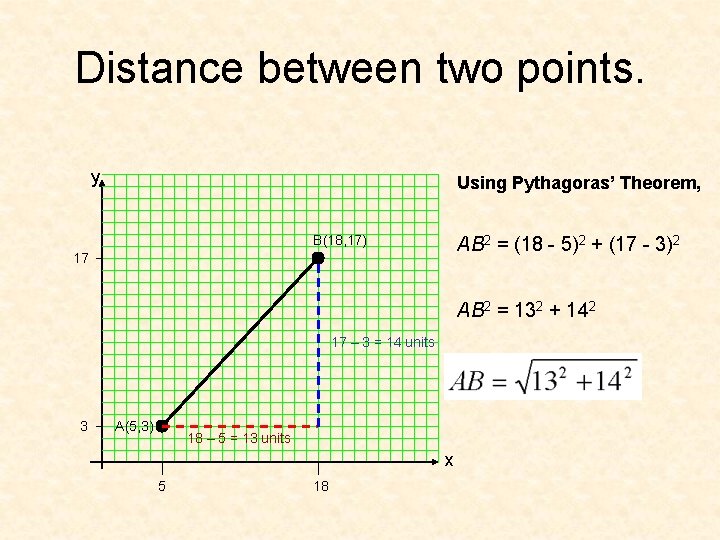
Distance between two points. y Using Pythagoras’ Theorem, B(18, 17) AB 2 = (18 - 5)2 + (17 - 3)2 17 AB 2 = 132 + 142 17 – 3 = 14 units 3 A(5, 3) 18 – 5 = 13 units x 5 18
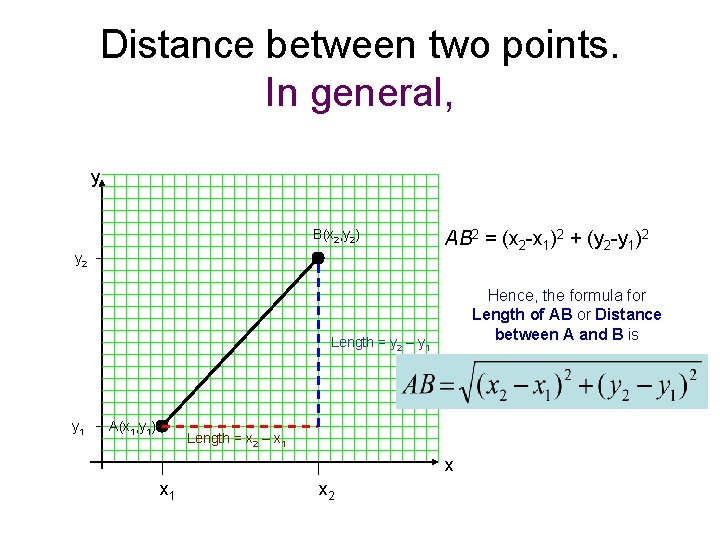
Distance between two points. In general, y B(x 2, y 2) y 2 AB 2 = (x 2 -x 1)2 + (y 2 -y 1)2 Hence, the formula for Length of AB or Distance between A and B is Length = y 2 – y 1 A(x 1, y 1) Length = x 2 – x 1 x 2
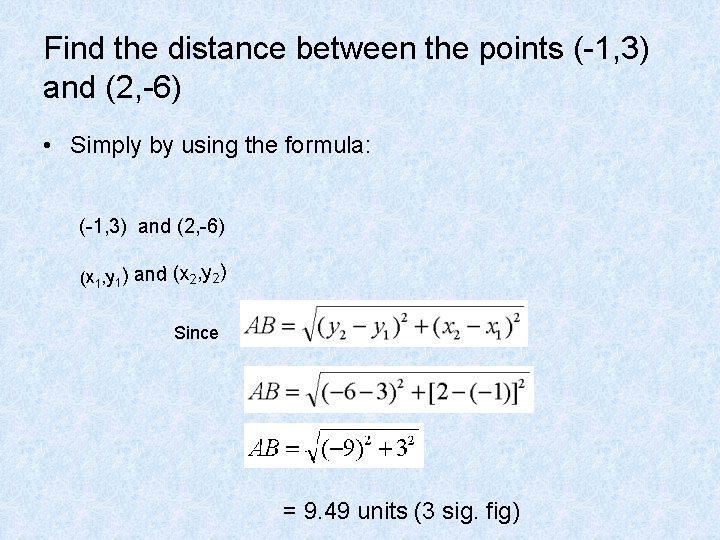
Find the distance between the points (-1, 3) and (2, -6) • Simply by using the formula: (-1, 3) and (2, -6) (x 1, y 1) and (x 2, y 2) Since = 9. 49 units (3 sig. fig)
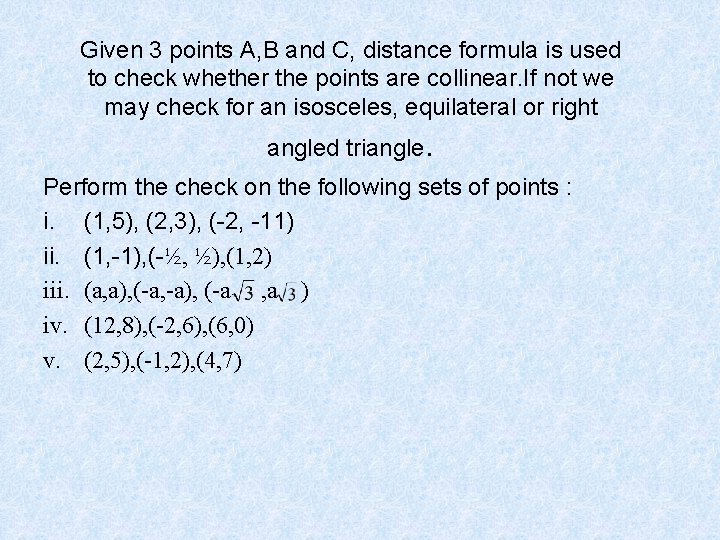
Given 3 points A, B and C, distance formula is used to check whether the points are collinear. If not we may check for an isosceles, equilateral or right angled triangle. Perform the check on the following sets of points : i. (1, 5), (2, 3), (-2, -11) ii. (1, -1), (-½, ½), (1, 2) iii. (a, a), (-a, -a), (-a , a ) iv. (12, 8), (-2, 6), (6, 0) v. (2, 5), (-1, 2), (4, 7)
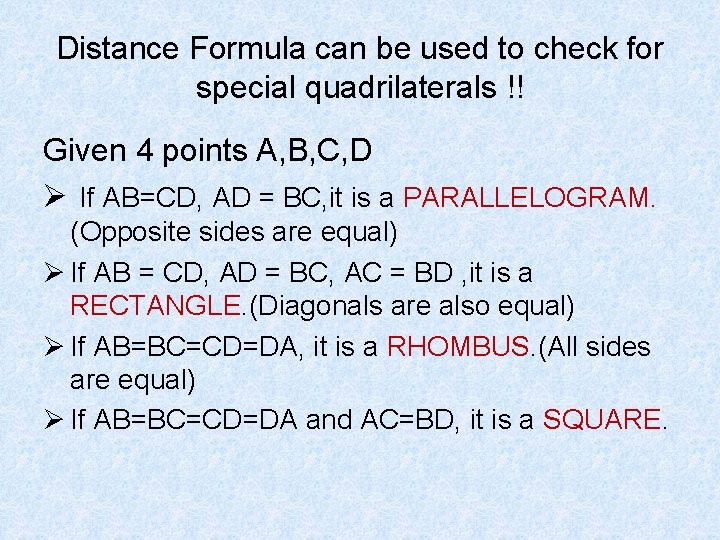
Distance Formula can be used to check for special quadrilaterals !! Given 4 points A, B, C, D Ø If AB=CD, AD = BC, it is a PARALLELOGRAM. (Opposite sides are equal) Ø If AB = CD, AD = BC, AC = BD , it is a RECTANGLE. (Diagonals are also equal) Ø If AB=BC=CD=DA, it is a RHOMBUS. (All sides are equal) Ø If AB=BC=CD=DA and AC=BD, it is a SQUARE.
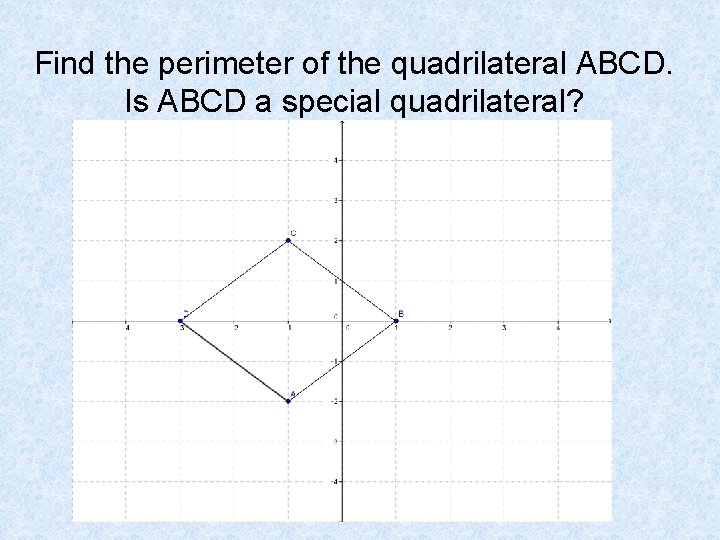
Find the perimeter of the quadrilateral ABCD. Is ABCD a special quadrilateral?
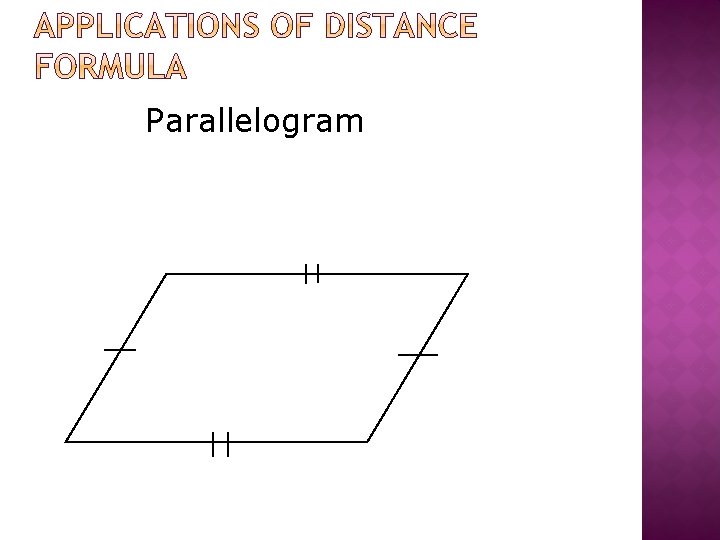
Parallelogram
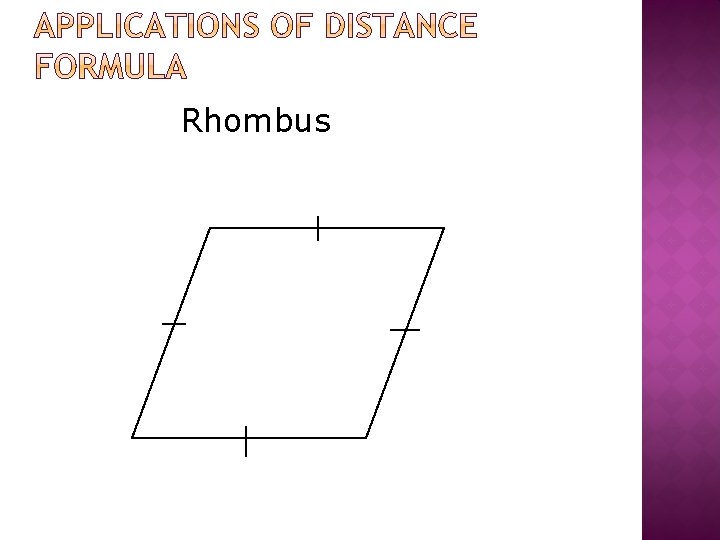
Rhombus
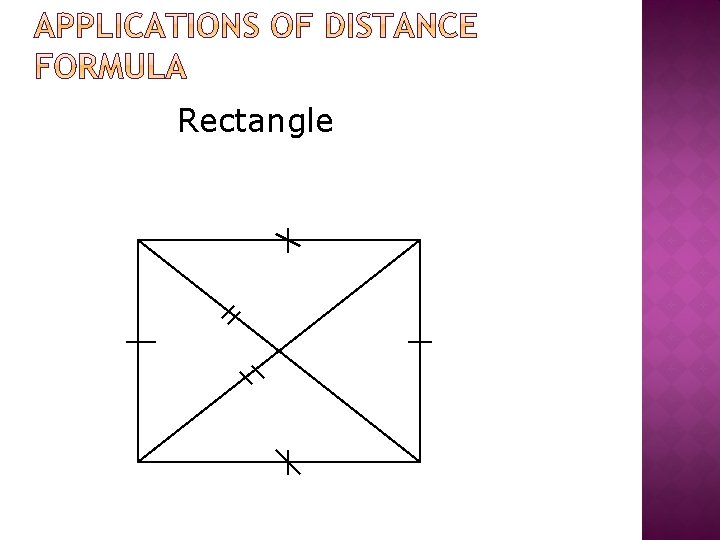
Rectangle
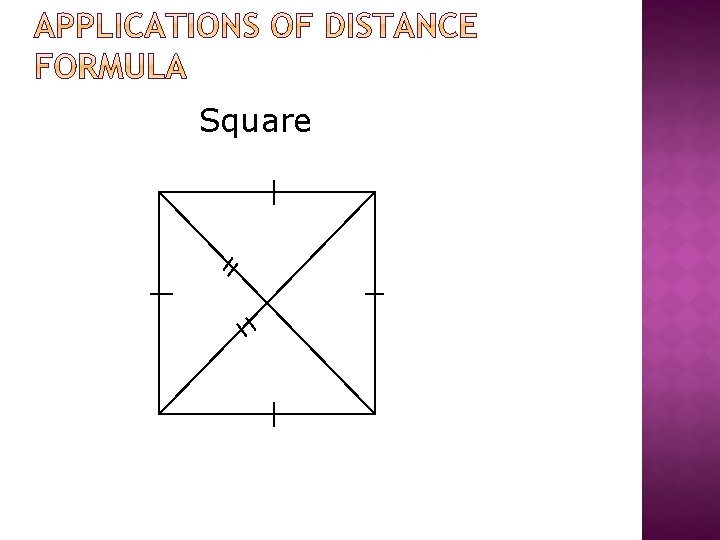
Square
SPECIAL QUADRILATERALS 1. Show that (1, 1), (4, 4), (4, 8), (1, 5) are the vertices of a parallelogram. 2. Show that A(2, -2), B(14, 10), C(11, 13) and D(1, 1) are the vertices of a rectangle. 3. Show that the points (1, 2), (5, 4), (3, 8), (-1, 6) are the vertices of a square. 4. Show that (1, -1) is the centre of the circle circumscribing the triangle whose angular points are (4, 3), (-2, 3) and (6, -1).
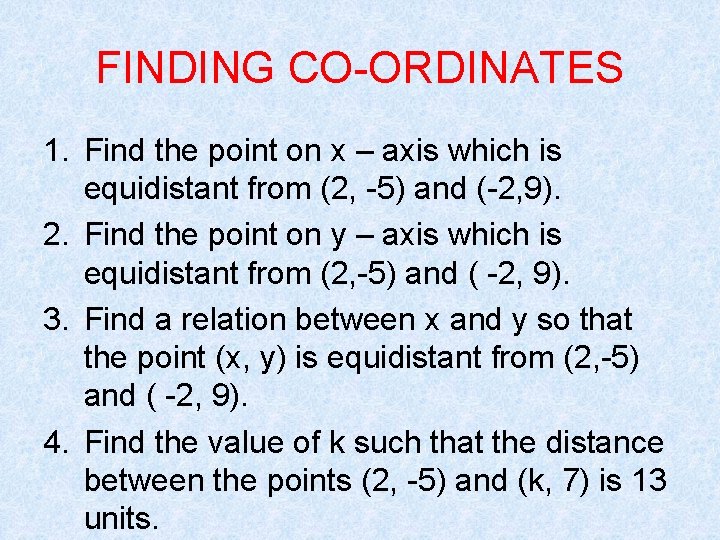
FINDING CO-ORDINATES 1. Find the point on x – axis which is equidistant from (2, -5) and (-2, 9). 2. Find the point on y – axis which is equidistant from (2, -5) and ( -2, 9). 3. Find a relation between x and y so that the point (x, y) is equidistant from (2, -5) and ( -2, 9). 4. Find the value of k such that the distance between the points (2, -5) and (k, 7) is 13 units.
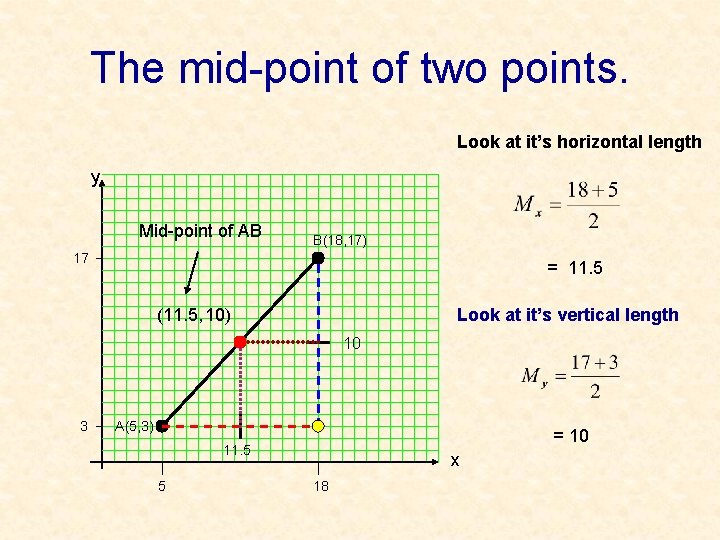
The mid-point of two points. Look at it’s horizontal length y Mid-point of AB B(18, 17) 17 = 11. 5 (11. 5, 10) Look at it’s vertical length 10 3 A(5, 3) = 10 11. 5 5 x 18
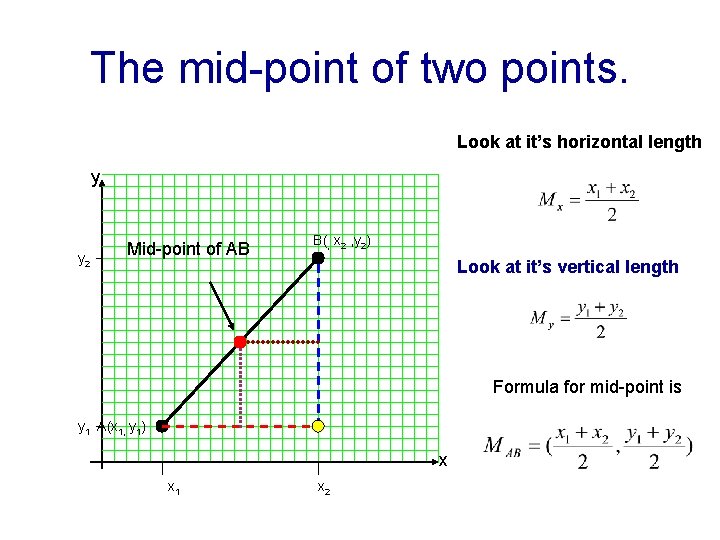
The mid-point of two points. Look at it’s horizontal length y y 2 Mid-point of AB B(, x 2 , y 2) Look at it’s vertical length Formula for mid-point is y 1 A(x 1, y 1) x x 1 x 2
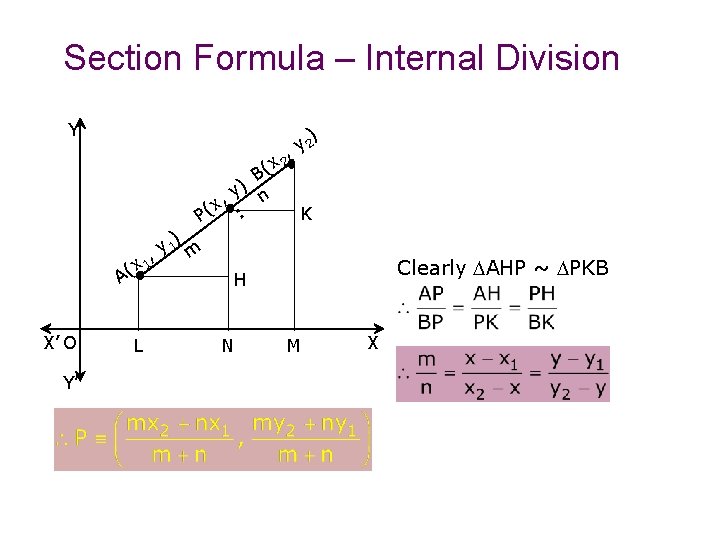
Section Formula – Internal Division Y ) 2 y , x 2 ( B ) y n , x P( : K ) 1 y m , x 1 ( A X’ O Y’ L Clearly AHP ~ PKB H N M X
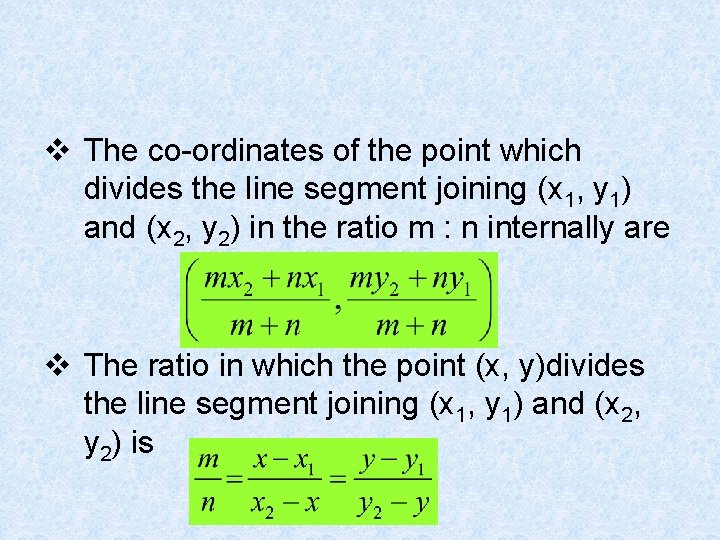
v The co-ordinates of the point which divides the line segment joining (x 1, y 1) and (x 2, y 2) in the ratio m : n internally are v The ratio in which the point (x, y)divides the line segment joining (x 1, y 1) and (x 2, y 2) is
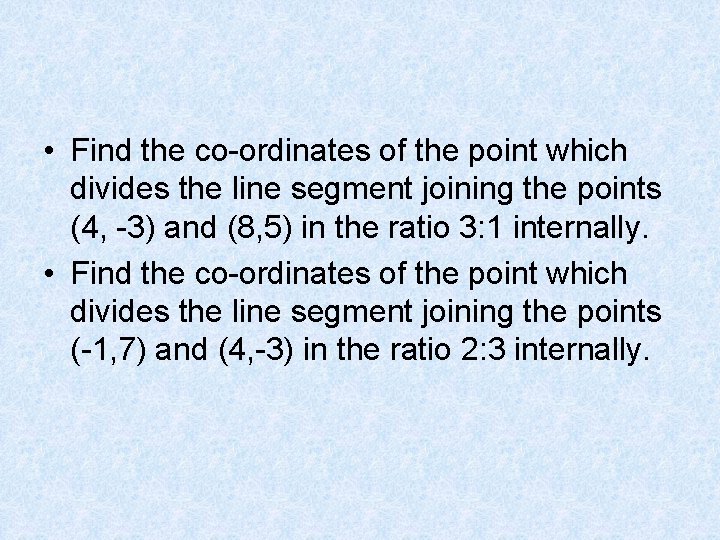
• Find the co-ordinates of the point which divides the line segment joining the points (4, -3) and (8, 5) in the ratio 3: 1 internally. • Find the co-ordinates of the point which divides the line segment joining the points (-1, 7) and (4, -3) in the ratio 2: 3 internally.
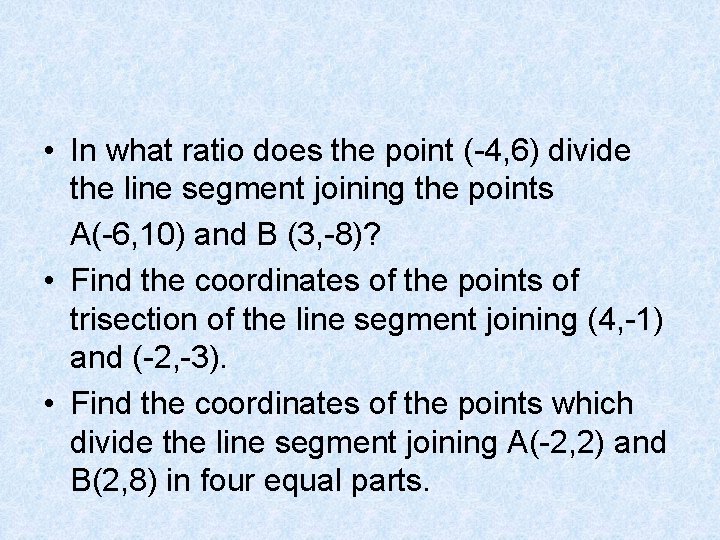
• In what ratio does the point (-4, 6) divide the line segment joining the points A(-6, 10) and B (3, -8)? • Find the coordinates of the points of trisection of the line segment joining (4, -1) and (-2, -3). • Find the coordinates of the points which divide the line segment joining A(-2, 2) and B(2, 8) in four equal parts.
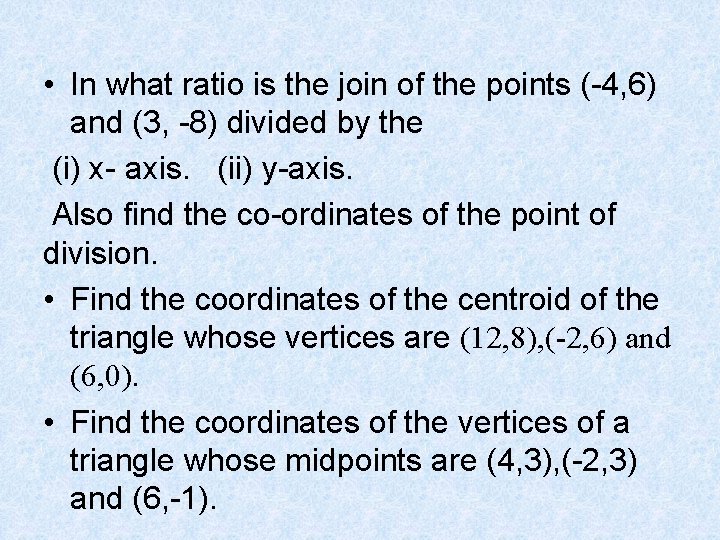
• In what ratio is the join of the points (-4, 6) and (3, -8) divided by the (i) x- axis. (ii) y-axis. Also find the co-ordinates of the point of division. • Find the coordinates of the centroid of the triangle whose vertices are (12, 8), (-2, 6) and (6, 0). • Find the coordinates of the vertices of a triangle whose midpoints are (4, 3), (-2, 3) and (6, -1).
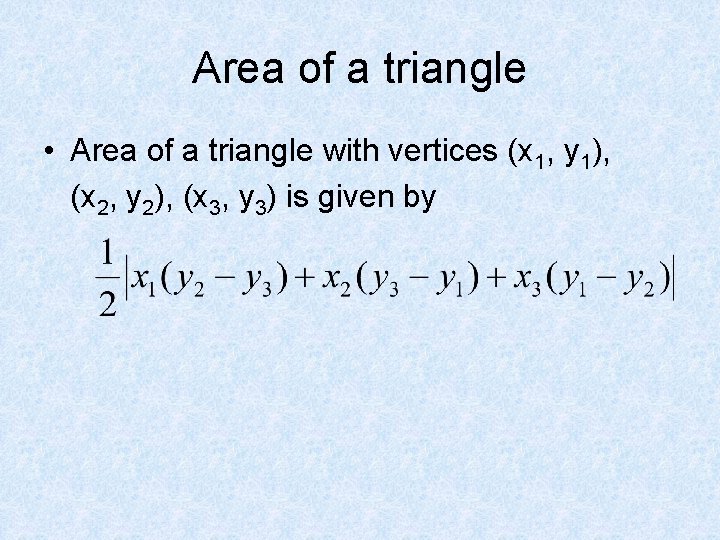
Area of a triangle • Area of a triangle with vertices (x 1, y 1), (x 2, y 2), (x 3, y 3) is given by
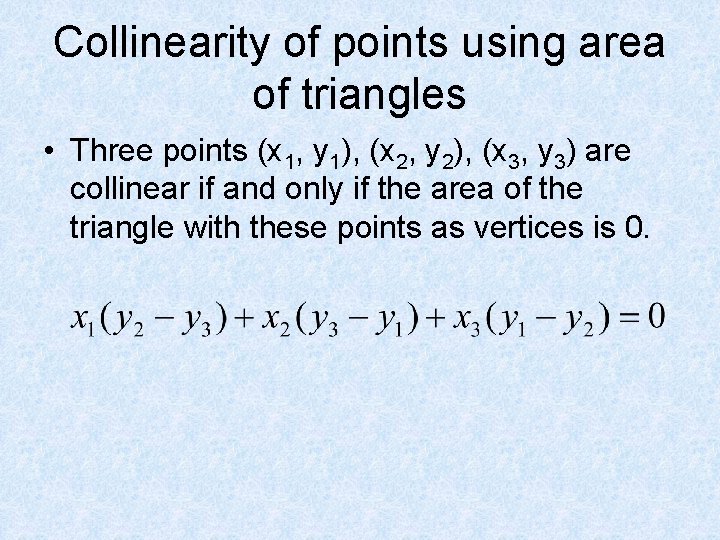
Collinearity of points using area of triangles • Three points (x 1, y 1), (x 2, y 2), (x 3, y 3) are collinear if and only if the area of the triangle with these points as vertices is 0.
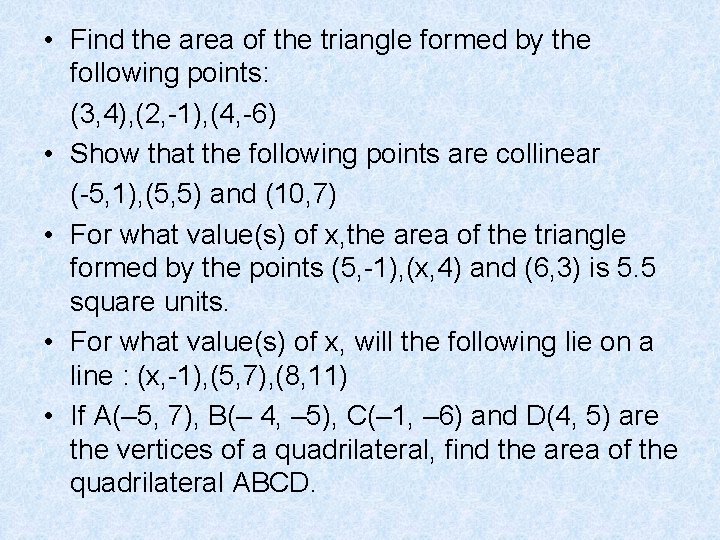
• Find the area of the triangle formed by the following points: (3, 4), (2, -1), (4, -6) • Show that the following points are collinear (-5, 1), (5, 5) and (10, 7) • For what value(s) of x, the area of the triangle formed by the points (5, -1), (x, 4) and (6, 3) is 5. 5 square units. • For what value(s) of x, will the following lie on a line : (x, -1), (5, 7), (8, 11) • If A(– 5, 7), B(– 4, – 5), C(– 1, – 6) and D(4, 5) are the vertices of a quadrilateral, find the area of the quadrilateral ABCD.
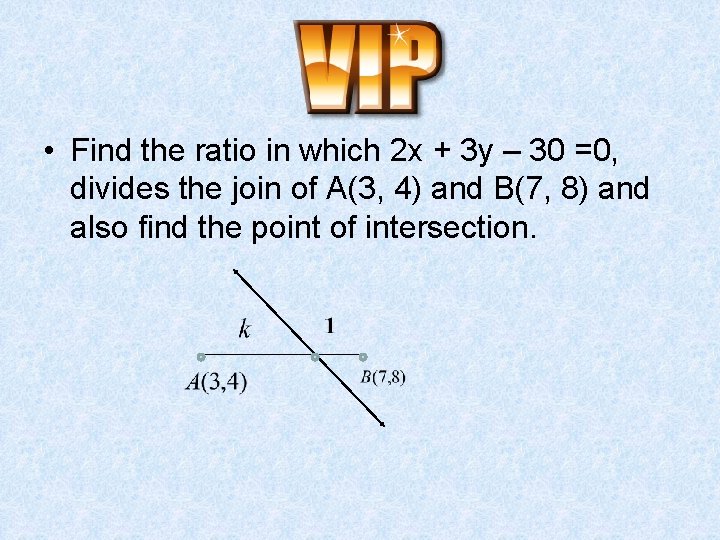
• Find the ratio in which 2 x + 3 y – 30 =0, divides the join of A(3, 4) and B(7, 8) and also find the point of intersection.
- Slides: 24