
Cooperative Learning Cooperative Base Groups Expert Pair Presentation

Cooperative Learning & Cooperative Base Groups Expert Pair Presentation Emily Armstrong & Mallory Dayton Spring 2015 Instructional Strategies
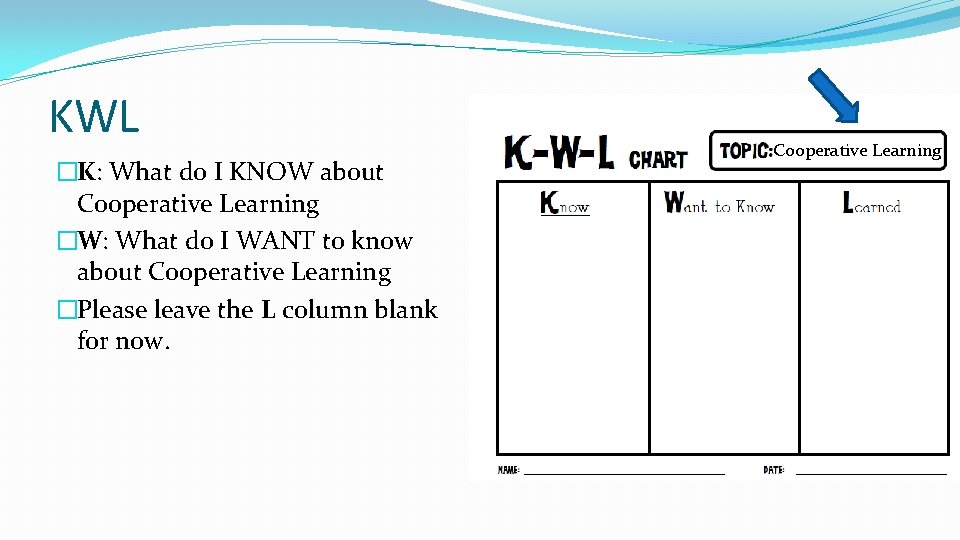
KWL �K: What do I KNOW about Cooperative Learning �W: What do I WANT to know about Cooperative Learning �Please leave the L column blank for now. Cooperative Learning
Share �In your Cooperative Base Group you will share what you KNOW and WANT to know about Cooperative Learning. �Talking Chips �Each person has four "chips" to spend. You must spend at least three, but feel free to spend all four. There is no incentive to "save" your chips. �In order to share an idea from your KWL, you must turn in a chip to the center of your group. You may not spend another chip until all members have shared as well.
Cooperative Learning �More than group work �Meaningful and engaging �Structured to benefit all students �"Using Cooperative Learning helps teachers lay the foundation for student success in a world that depends on collaboration and cooperation" (page 35)
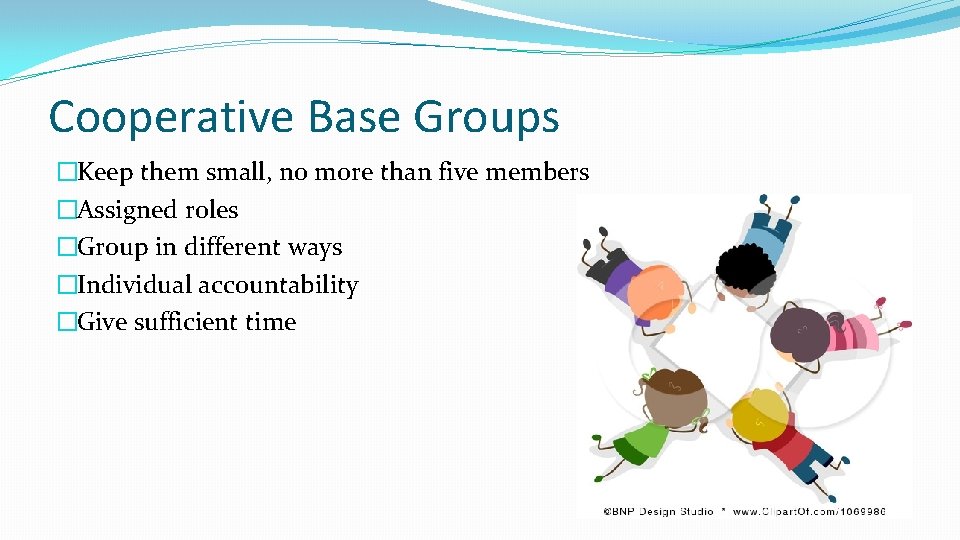
Cooperative Base Groups �Keep them small, no more than five members �Assigned roles �Group in different ways �Individual accountability �Give sufficient time
Cooperative Learning Promotes. . . �Classroom Instruction That Works says. . . �Positive Interdependence �Face-to-Face Interaction �Individual & Group Accountability �Intrapersonal & Small Group Skills �Group Processing �Dr. Spencer Kagan says. . . �Positive Interdependence �Individual Accountability �Equal Participation �Simultaneous Interaction
Tips for Successful Integration �Frequent, but not overused �Positive and fun �Structured and clear �Introduce structures with non-content specific material
Review & Reflect �Why is Cooperative Learning a powerful instructional strategy? �What are best practices for introducing and maintaining Cooperative Learning in the classroom? �What subject areas can you envision implementing cooperative based groups? Rally Table �Each group member starts with a different question and a colored pen. �Reflect on and answer your question for 1 minute. �Pass to your left. �Repeat until you have answered all questions.
Video Clip �Video of a teacher using cooperative based groups with her class �https: //youtu. be/Xcmk 2 Hq. DMJk
Visualize this strategy in your classroom. . . �Quickly sketch what a Cooperative Learning structure would look in your classroom if it was successfully implemented. �Labels are encouraged �Carousel Feedback: �Display your work on the table. �Find three sticky-notes and a pen. �You will have three 30 -second rotations to leave feedback for a peer. �Return to your work and review your feedback.
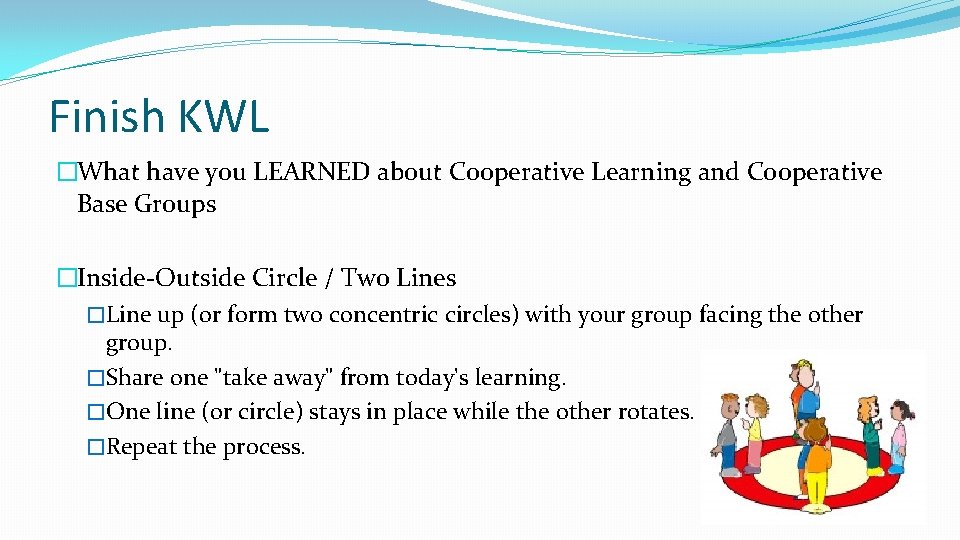
Finish KWL �What have you LEARNED about Cooperative Learning and Cooperative Base Groups �Inside-Outside Circle / Two Lines �Line up (or form two concentric circles) with your group facing the other group. �Share one "take away" from today's learning. �One line (or circle) stays in place while the other rotates. �Repeat the process.
Examples �Used today: • Strategy to use with adults: �Talking Chips �Rally Table �Inside-Outside Circle �Carousel Feedback �Other Favorites: �Quiz, Trade �Rally Coach �Jot Thoughts �Stand Up, Hand Up, Pair Up �Timed Pair Share • • One. Note Google docs One. Drive Professional Development Videos
Sources � Dean, C. , Hubbell, E. , Pitler, H. and Stone, Bj (2012). Classroom Instruction That Works, 2 nd Edition. Denver: Mc. Rel. � Kagan, Spencer & Kagan, Miguel. (2009). Kagan Cooperative Learning. San Clemente, CA: Kagan Publishing. Video � Robinson, S. (2014, September 29). Cooperative Learning with Lauber’s Class {Video file}. Retrieved from https: //www. youtube. com/watch? v=Xcmk 2 Hq. DMJk&feature=youtu. be � Zahn, C. , Krauskopf, K. , Hesse, F. W. , & Pea, R. (2012). How to Improve Collaborative Learning with Video Tools in the Classroom? Social vs. Cognitive Guidance for Student Teams. International Journal Of Computer-Supported Collaborative Learning, 7(2), 259 -284.
- Slides: 13