
Cooperative Diversity with Multiple Antenna Nodes in Fading
![References • [1] S. Alamouti, “A simple transmit diversity technique for wireless communications, ”](https://slidetodoc.com/presentation_image_h/f916141d6ec1726b9bf4acf87f35505e/image-38.jpg "References • [1] S. Alamouti, “A simple transmit diversity technique for wireless communications, ”")
- Slides: 39
Cooperative Diversity with Multiple. Antenna Nodes in Fading Relay Channels Advisor : Yinman Lee Speaker : Yen-Nan Chen (s 96325525) Communication Signal Processing Lab Graduate Institute of Communication Engineering Tin Studio Established 07. In TAITUNG CITY NCNU
Outline • • • Introduction Transmission Model Diversity Gain Analysis Simulation Results And Discussion Conclusion Communication Signal Processing Lab Graduate Institute of Communication Engineering Tin Studio Established 07. In TAITUNG CITY NCNU
Introduction • We investigate the performance of a single-relay cooperative scenario where the source, relay and destination terminals are equipped with multiple transmit/receive antennas. A. CSI-assisted Aa. F relaying B. Blind Aa. F relaying C. Da. F relaying Communication Signal Processing Lab Graduate Institute of Communication Engineering Tin Studio Established 07. In TAITUNG CITY NCNU
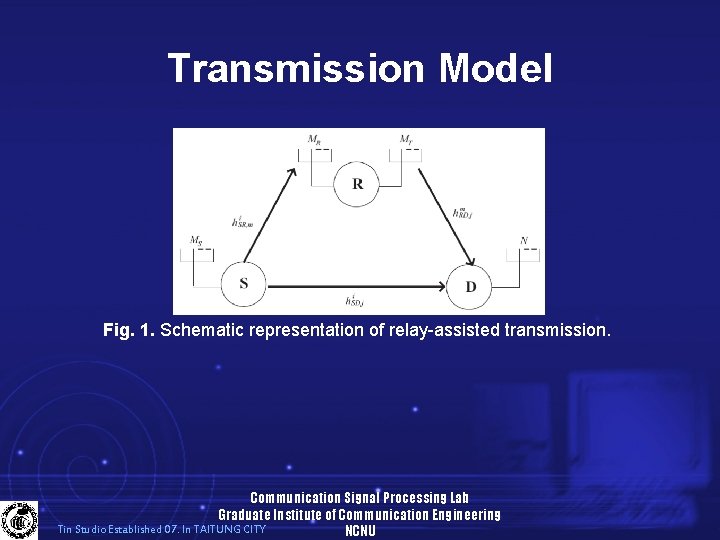
Transmission Model Fig. 1. Schematic representation of relay-assisted transmission. Communication Signal Processing Lab Graduate Institute of Communication Engineering Tin Studio Established 07. In TAITUNG CITY NCNU
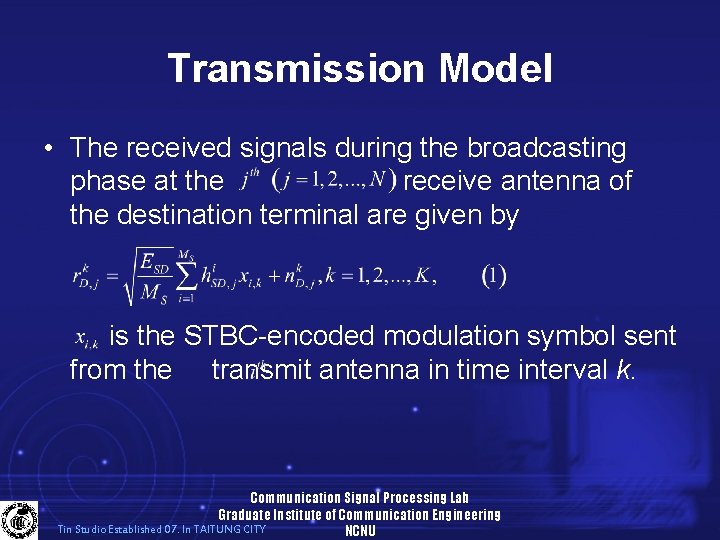
Transmission Model • The received signals during the broadcasting phase at the receive antenna of the destination terminal are given by is the STBC-encoded modulation symbol sent from the transmit antenna in time interval k. Communication Signal Processing Lab Graduate Institute of Communication Engineering Tin Studio Established 07. In TAITUNG CITY NCNU
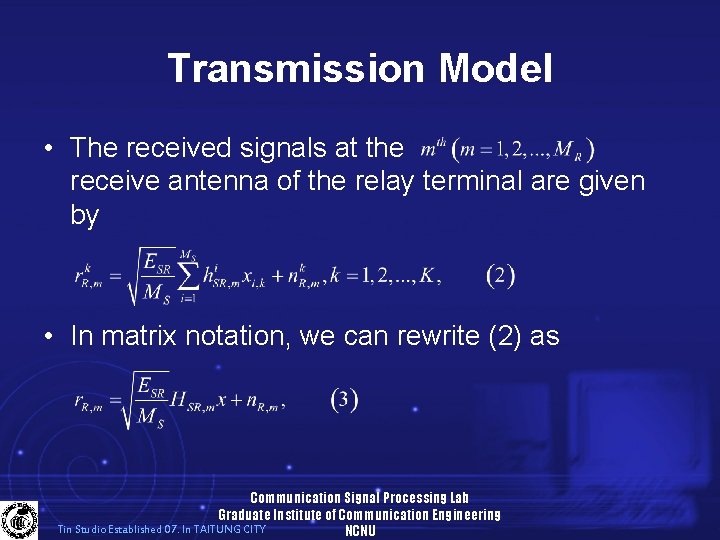
Transmission Model • The received signals at the receive antenna of the relay terminal are given by • In matrix notation, we can rewrite (2) as Communication Signal Processing Lab Graduate Institute of Communication Engineering Tin Studio Established 07. In TAITUNG CITY NCNU
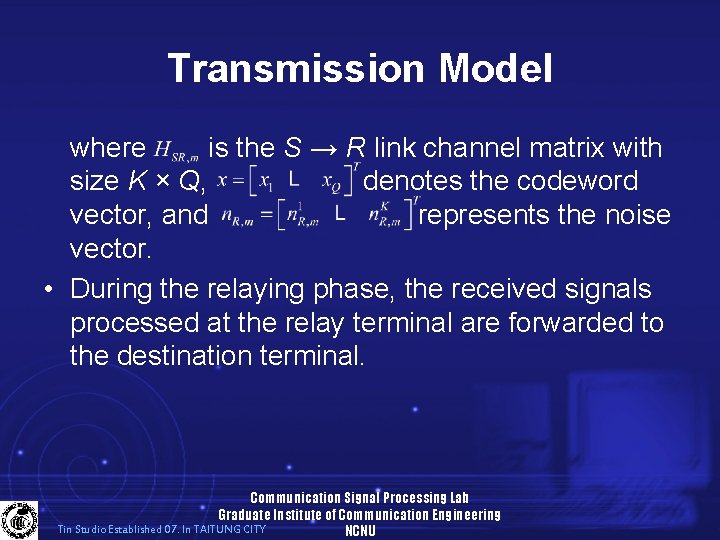
Transmission Model where is the S → R link channel matrix with size K × Q, denotes the codeword vector, and represents the noise vector. • During the relaying phase, the received signals processed at the relay terminal are forwarded to the destination terminal. Communication Signal Processing Lab Graduate Institute of Communication Engineering Tin Studio Established 07. In TAITUNG CITY NCNU
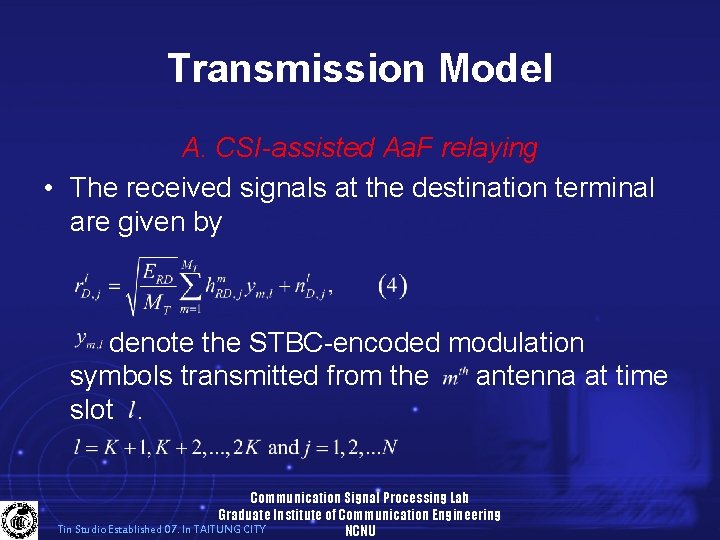
Transmission Model A. CSI-assisted Aa. F relaying • The received signals at the destination terminal are given by denote the STBC-encoded modulation symbols transmitted from the antenna at time slot. Communication Signal Processing Lab Graduate Institute of Communication Engineering Tin Studio Established 07. In TAITUNG CITY NCNU
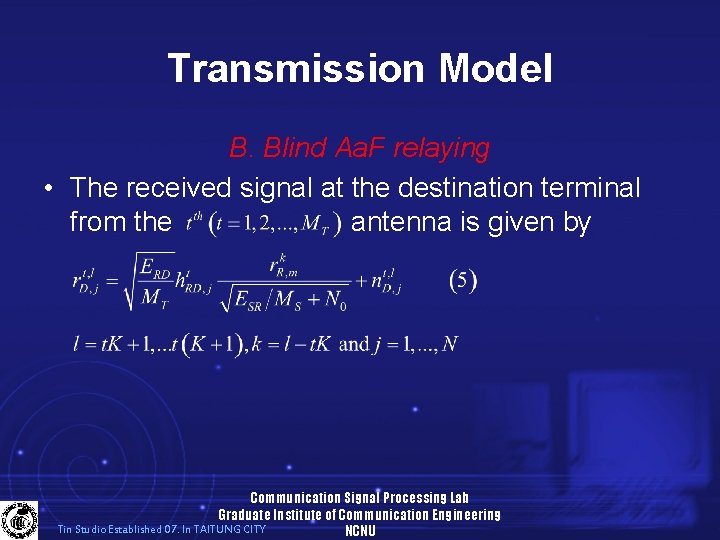
Transmission Model B. Blind Aa. F relaying • The received signal at the destination terminal from the antenna is given by Communication Signal Processing Lab Graduate Institute of Communication Engineering Tin Studio Established 07. In TAITUNG CITY NCNU
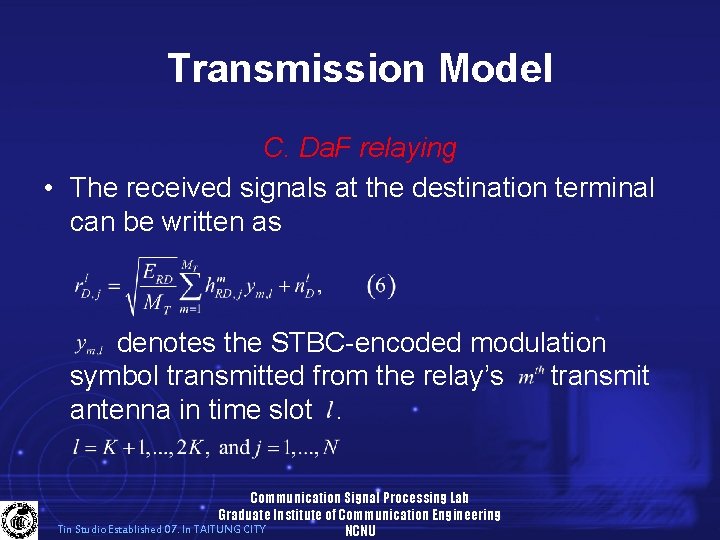
Transmission Model C. Da. F relaying • The received signals at the destination terminal can be written as denotes the STBC-encoded modulation symbol transmitted from the relay’s transmit antenna in time slot. Communication Signal Processing Lab Graduate Institute of Communication Engineering Tin Studio Established 07. In TAITUNG CITY NCNU
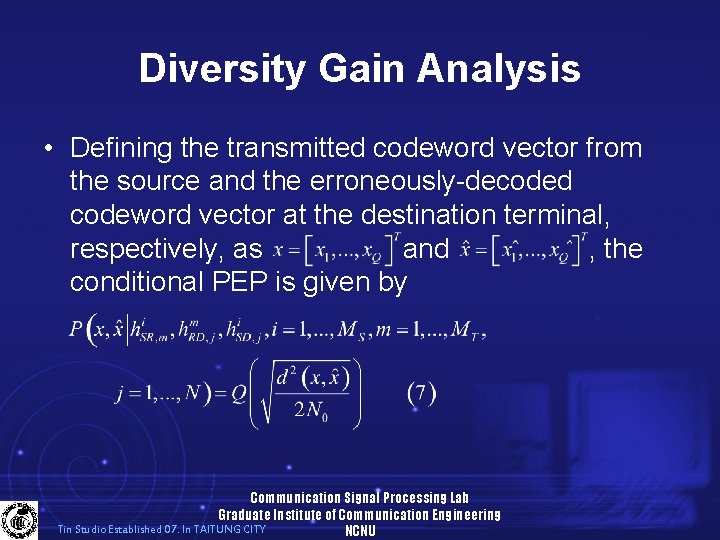
Diversity Gain Analysis • Defining the transmitted codeword vector from the source and the erroneously-decoded codeword vector at the destination terminal, respectively, as and , the conditional PEP is given by Communication Signal Processing Lab Graduate Institute of Communication Engineering Tin Studio Established 07. In TAITUNG CITY NCNU
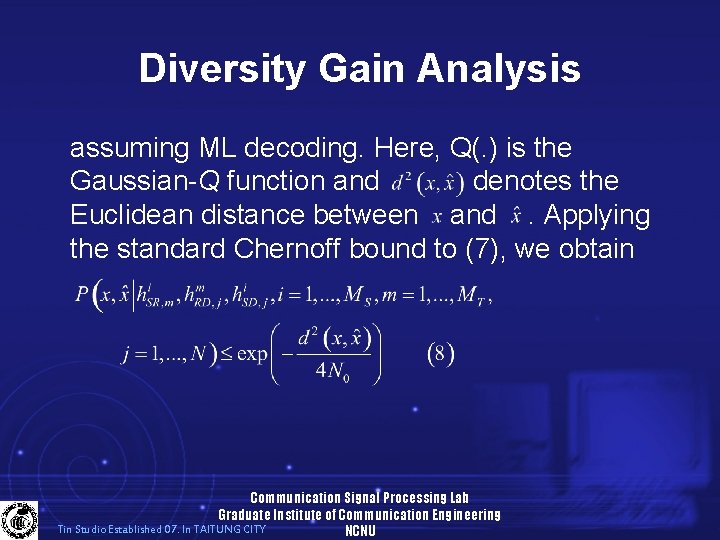
Diversity Gain Analysis assuming ML decoding. Here, Q(. ) is the Gaussian-Q function and denotes the Euclidean distance between and. Applying the standard Chernoff bound to (7), we obtain Communication Signal Processing Lab Graduate Institute of Communication Engineering Tin Studio Established 07. In TAITUNG CITY NCNU
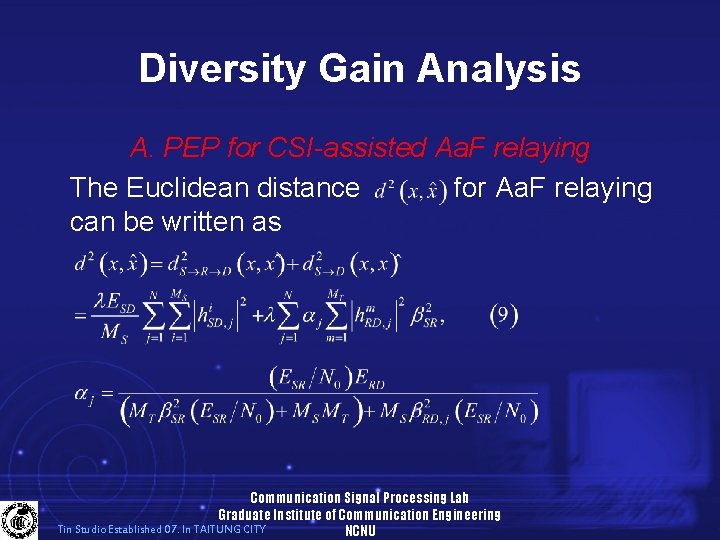
Diversity Gain Analysis A. PEP for CSI-assisted Aa. F relaying The Euclidean distance for Aa. F relaying can be written as Communication Signal Processing Lab Graduate Institute of Communication Engineering Tin Studio Established 07. In TAITUNG CITY NCNU
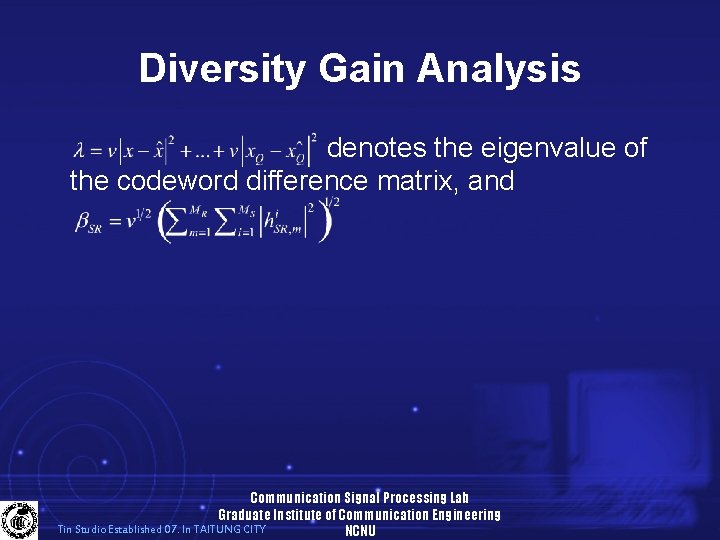
Diversity Gain Analysis denotes the eigenvalue of the codeword difference matrix, and Communication Signal Processing Lab Graduate Institute of Communication Engineering Tin Studio Established 07. In TAITUNG CITY NCNU
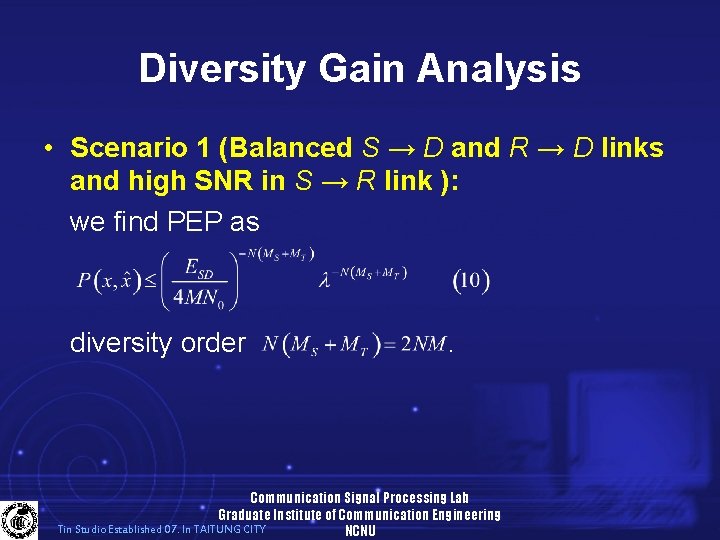
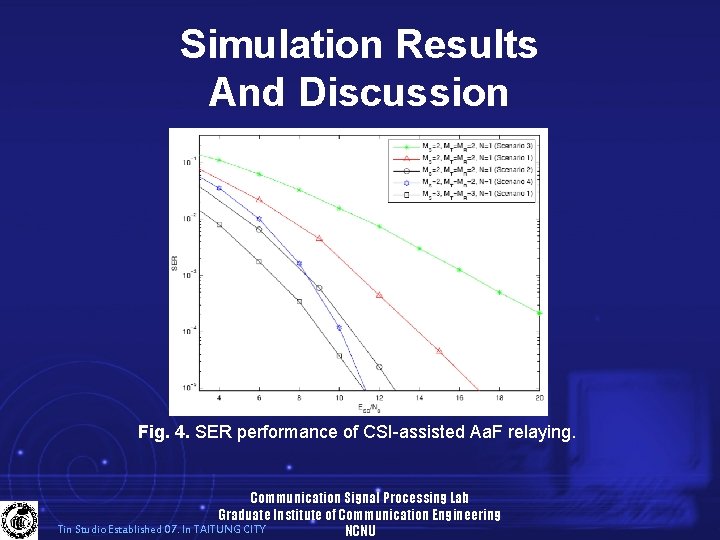
Diversity Gain Analysis • Scenario 1 (Balanced S → D and R → D links and high SNR in S → R link ): we find PEP as diversity order . Communication Signal Processing Lab Graduate Institute of Communication Engineering Tin Studio Established 07. In TAITUNG CITY NCNU
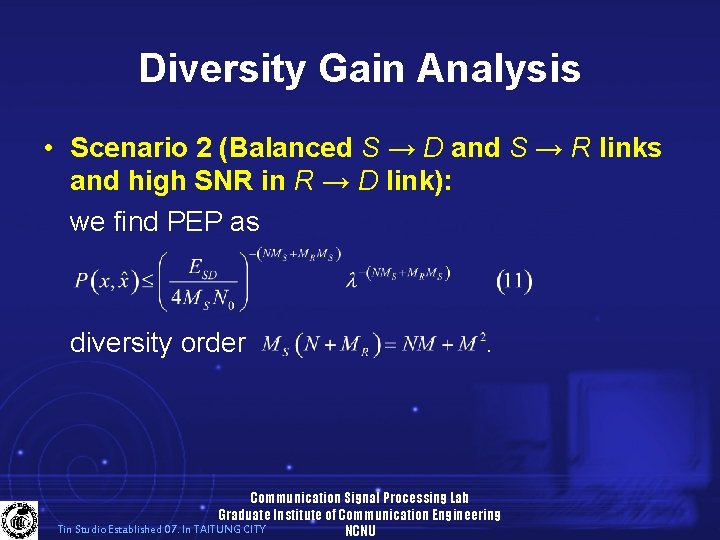
Diversity Gain Analysis • Scenario 2 (Balanced S → D and S → R links and high SNR in R → D link): we find PEP as diversity order . Communication Signal Processing Lab Graduate Institute of Communication Engineering Tin Studio Established 07. In TAITUNG CITY NCNU
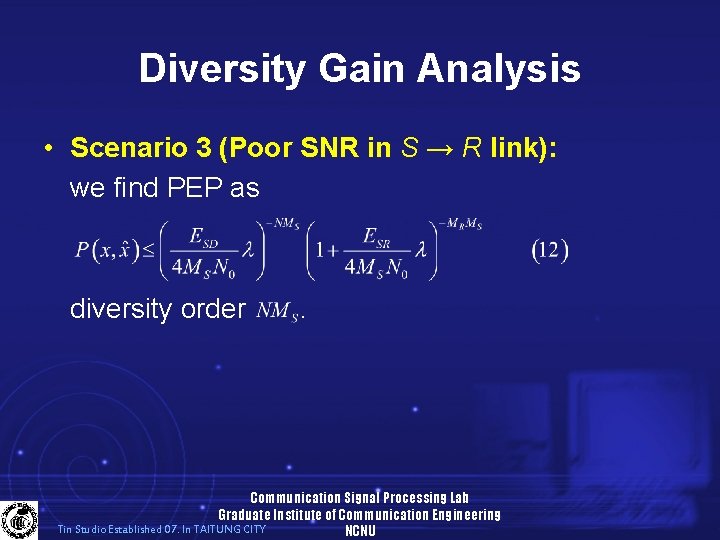
Diversity Gain Analysis • Scenario 3 (Poor SNR in S → R link): we find PEP as diversity order . Communication Signal Processing Lab Graduate Institute of Communication Engineering Tin Studio Established 07. In TAITUNG CITY NCNU
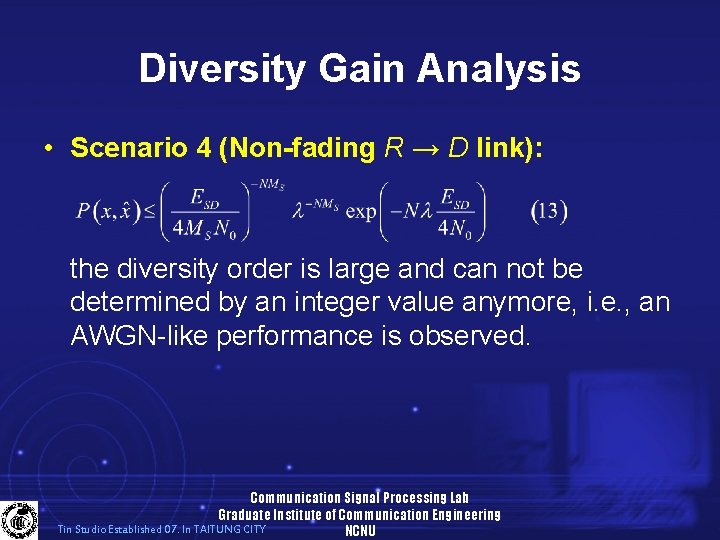
Diversity Gain Analysis • Scenario 4 (Non-fading R → D link): the diversity order is large and can not be determined by an integer value anymore, i. e. , an AWGN-like performance is observed. Communication Signal Processing Lab Graduate Institute of Communication Engineering Tin Studio Established 07. In TAITUNG CITY NCNU
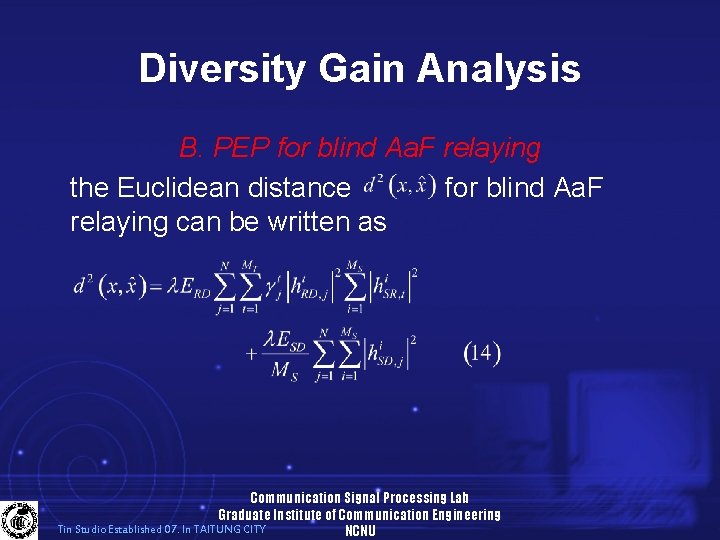
Diversity Gain Analysis B. PEP for blind Aa. F relaying the Euclidean distance for blind Aa. F relaying can be written as Communication Signal Processing Lab Graduate Institute of Communication Engineering Tin Studio Established 07. In TAITUNG CITY NCNU
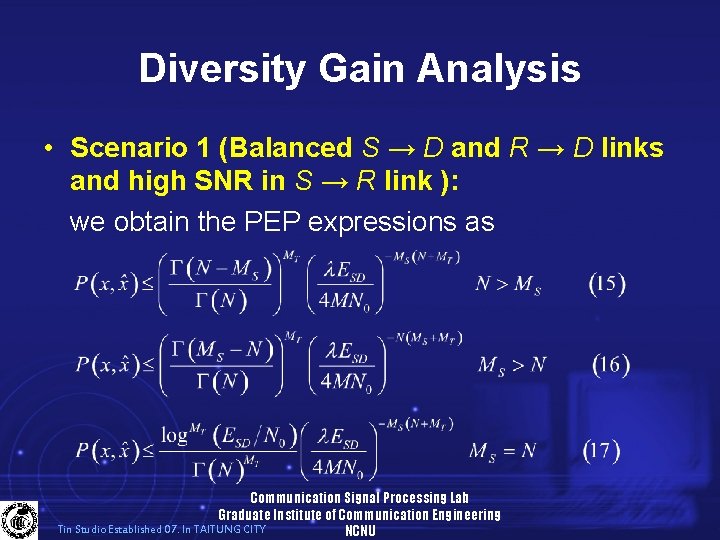
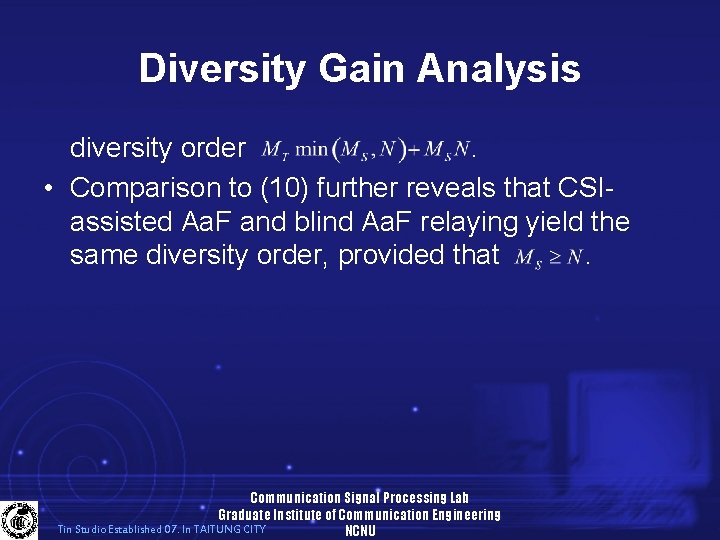
Diversity Gain Analysis • Scenario 1 (Balanced S → D and R → D links and high SNR in S → R link ): we obtain the PEP expressions as Communication Signal Processing Lab Graduate Institute of Communication Engineering Tin Studio Established 07. In TAITUNG CITY NCNU
Diversity Gain Analysis diversity order. • Comparison to (10) further reveals that CSIassisted Aa. F and blind Aa. F relaying yield the same diversity order, provided that. Communication Signal Processing Lab Graduate Institute of Communication Engineering Tin Studio Established 07. In TAITUNG CITY NCNU
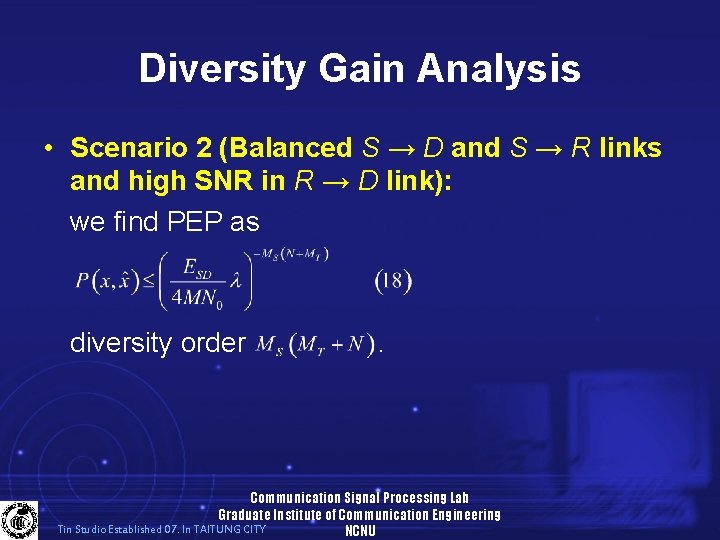
Diversity Gain Analysis • Scenario 2 (Balanced S → D and S → R links and high SNR in R → D link): we find PEP as diversity order . Communication Signal Processing Lab Graduate Institute of Communication Engineering Tin Studio Established 07. In TAITUNG CITY NCNU
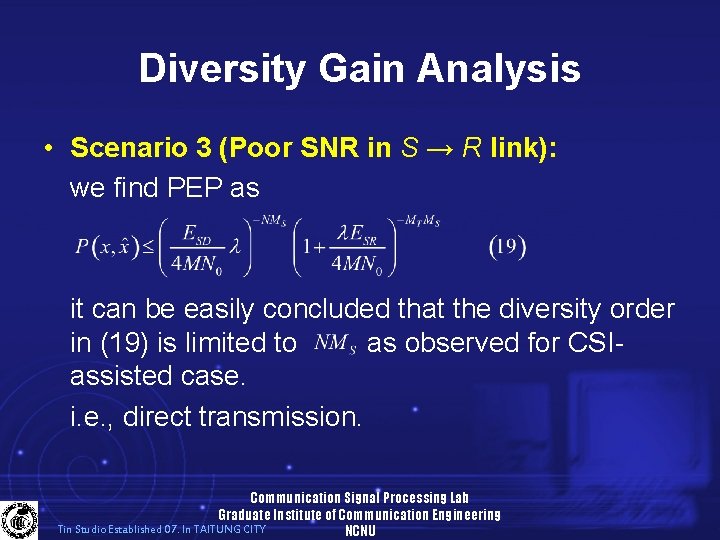
Diversity Gain Analysis • Scenario 3 (Poor SNR in S → R link): we find PEP as it can be easily concluded that the diversity order in (19) is limited to as observed for CSIassisted case. i. e. , direct transmission. Communication Signal Processing Lab Graduate Institute of Communication Engineering Tin Studio Established 07. In TAITUNG CITY NCNU
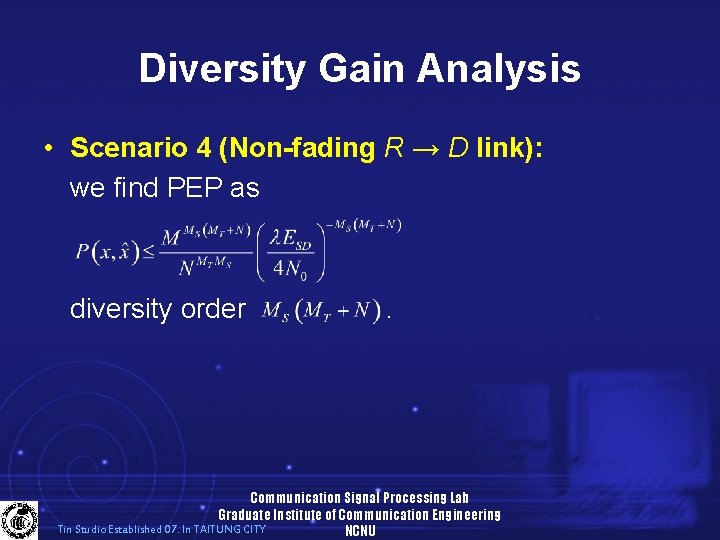
Diversity Gain Analysis • Scenario 4 (Non-fading R → D link): we find PEP as diversity order . Communication Signal Processing Lab Graduate Institute of Communication Engineering Tin Studio Established 07. In TAITUNG CITY NCNU
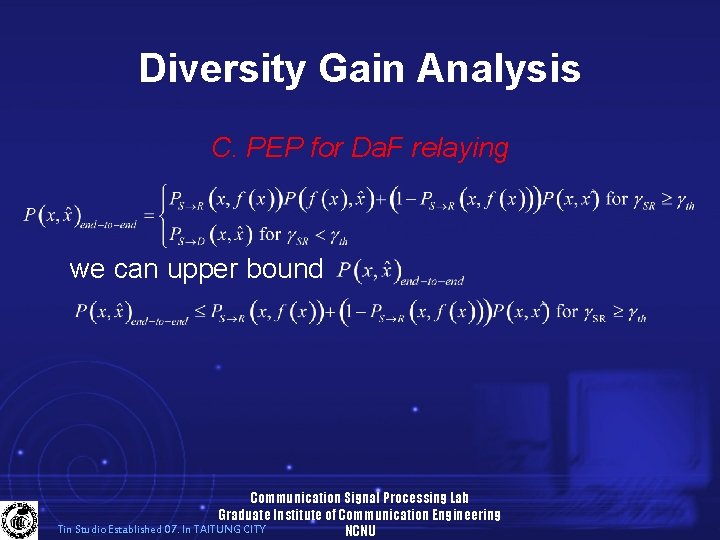
Diversity Gain Analysis C. PEP for Da. F relaying we can upper bound Communication Signal Processing Lab Graduate Institute of Communication Engineering Tin Studio Established 07. In TAITUNG CITY NCNU
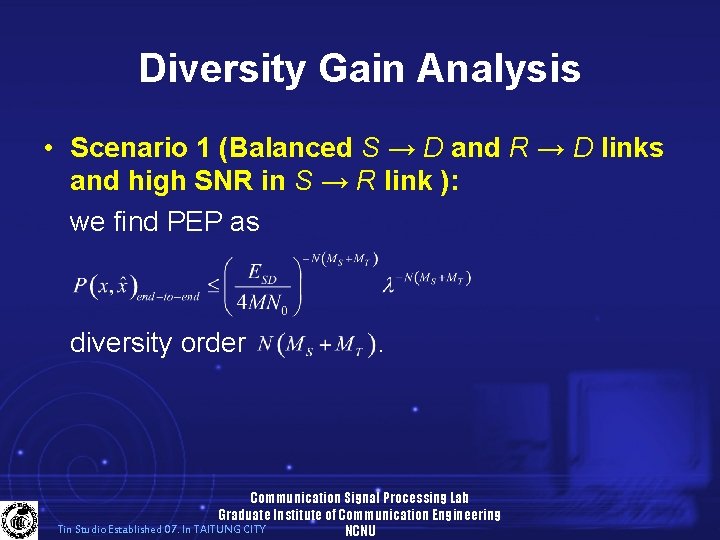
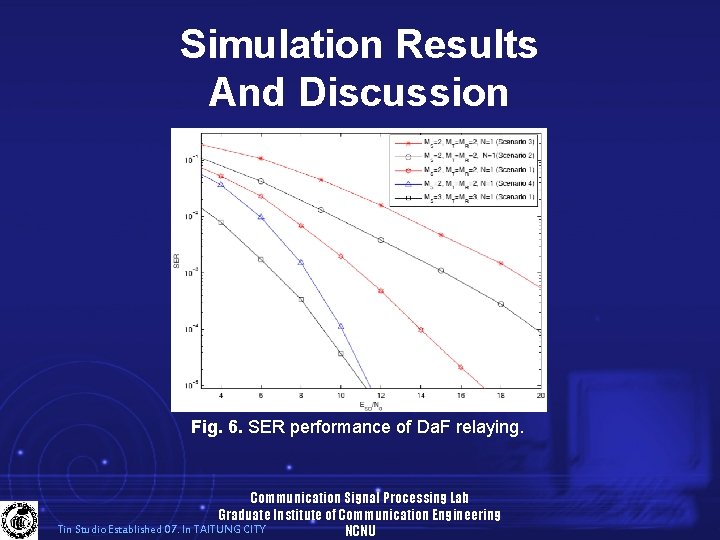
Diversity Gain Analysis • Scenario 1 (Balanced S → D and R → D links and high SNR in S → R link ): we find PEP as diversity order . Communication Signal Processing Lab Graduate Institute of Communication Engineering Tin Studio Established 07. In TAITUNG CITY NCNU
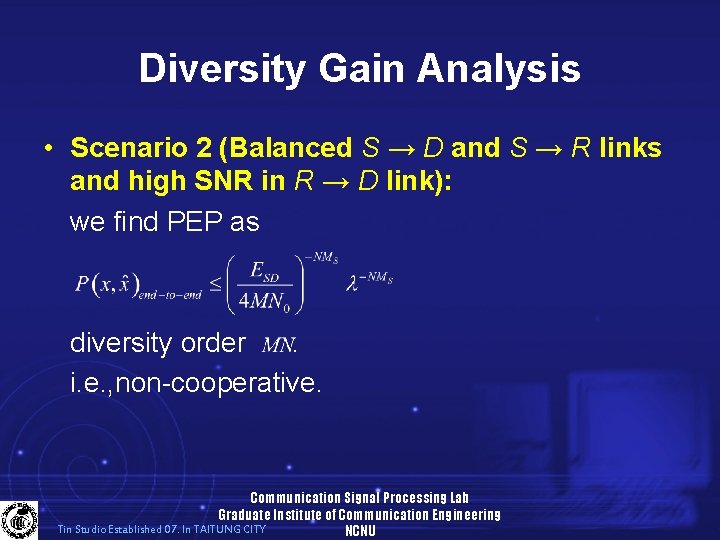
Diversity Gain Analysis • Scenario 2 (Balanced S → D and S → R links and high SNR in R → D link): we find PEP as diversity order. i. e. , non-cooperative. Communication Signal Processing Lab Graduate Institute of Communication Engineering Tin Studio Established 07. In TAITUNG CITY NCNU
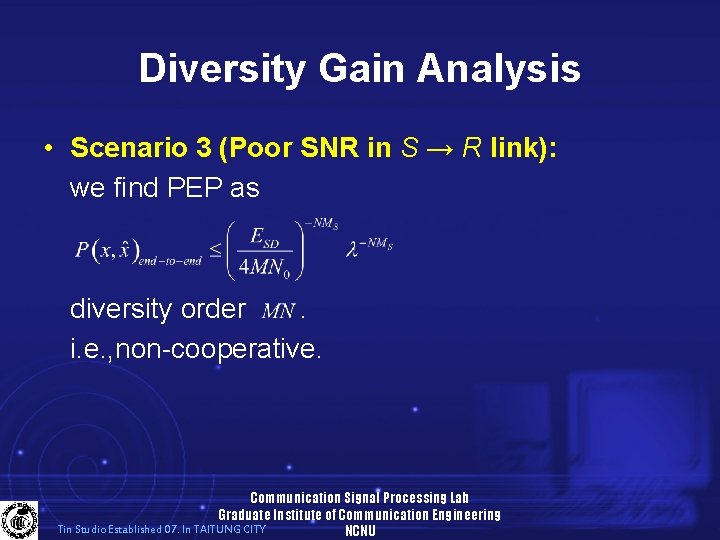
Diversity Gain Analysis • Scenario 3 (Poor SNR in S → R link): we find PEP as diversity order. i. e. , non-cooperative. Communication Signal Processing Lab Graduate Institute of Communication Engineering Tin Studio Established 07. In TAITUNG CITY NCNU
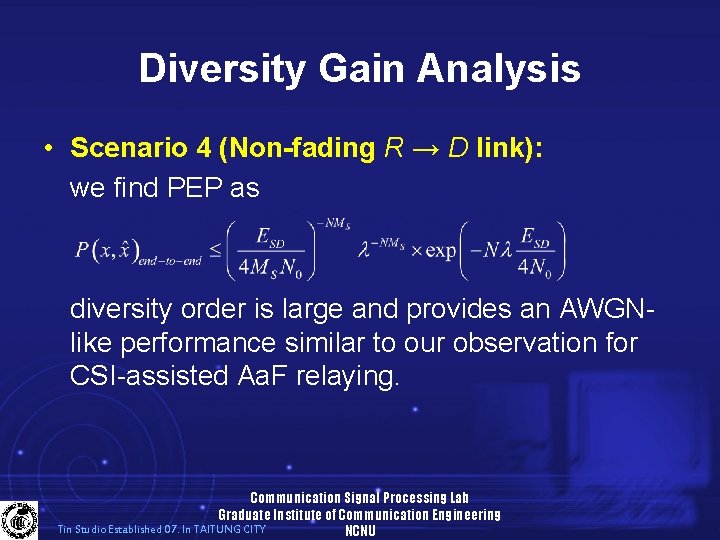
Diversity Gain Analysis • Scenario 4 (Non-fading R → D link): we find PEP as diversity order is large and provides an AWGNlike performance similar to our observation for CSI-assisted Aa. F relaying. Communication Signal Processing Lab Graduate Institute of Communication Engineering Tin Studio Established 07. In TAITUNG CITY NCNU
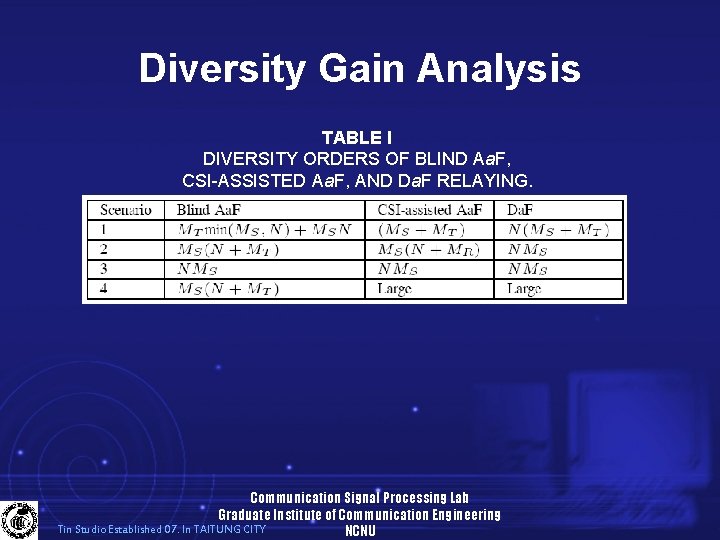
Diversity Gain Analysis TABLE I DIVERSITY ORDERS OF BLIND Aa. F, CSI-ASSISTED Aa. F, AND Da. F RELAYING. Communication Signal Processing Lab Graduate Institute of Communication Engineering Tin Studio Established 07. In TAITUNG CITY NCNU
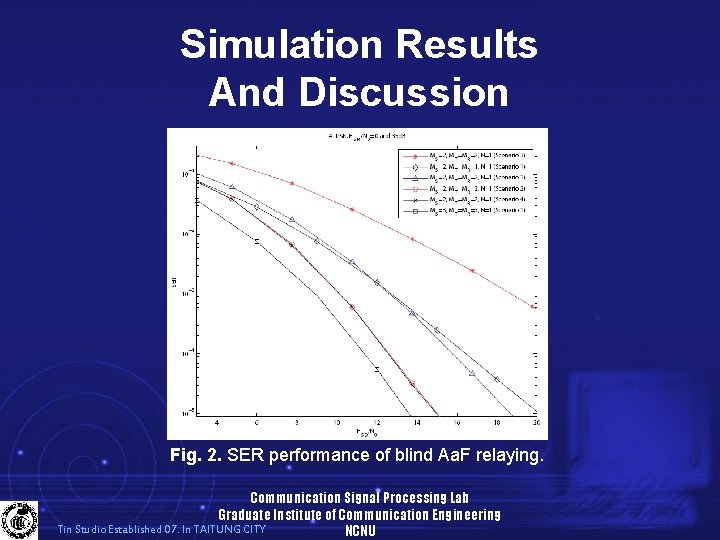
Simulation Results And Discussion Fig. 2. SER performance of blind Aa. F relaying. Communication Signal Processing Lab Graduate Institute of Communication Engineering Tin Studio Established 07. In TAITUNG CITY NCNU
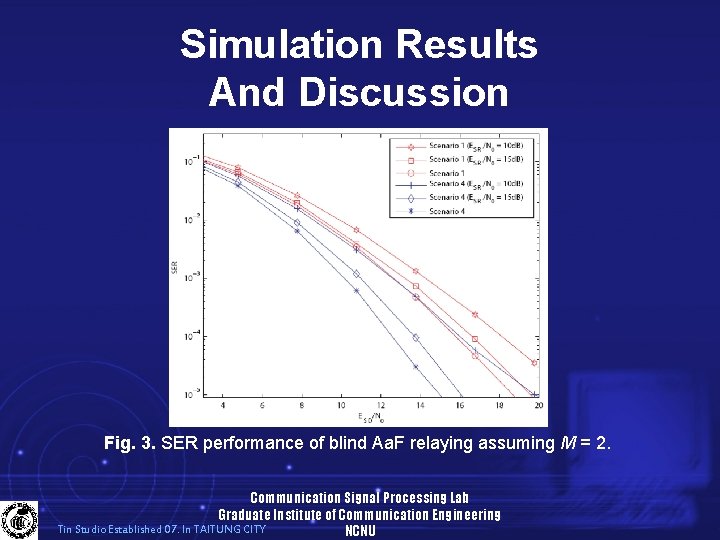
Simulation Results And Discussion Fig. 3. SER performance of blind Aa. F relaying assuming M = 2. Communication Signal Processing Lab Graduate Institute of Communication Engineering Tin Studio Established 07. In TAITUNG CITY NCNU
Simulation Results And Discussion Fig. 4. SER performance of CSI-assisted Aa. F relaying. Communication Signal Processing Lab Graduate Institute of Communication Engineering Tin Studio Established 07. In TAITUNG CITY NCNU
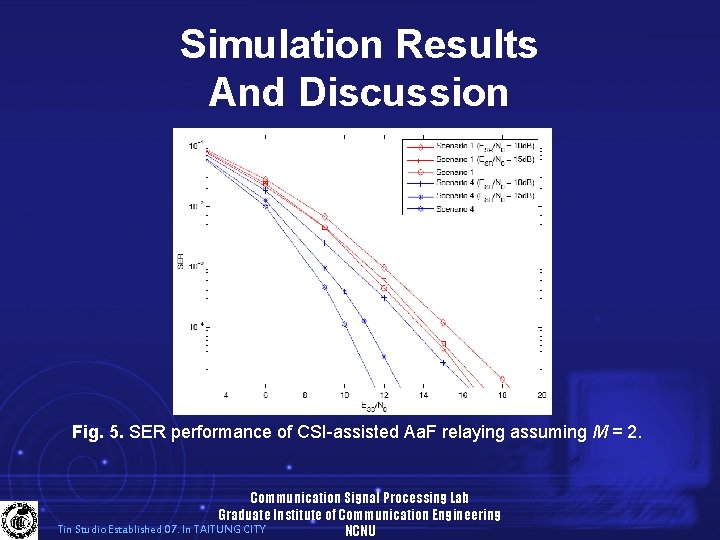
Simulation Results And Discussion Fig. 5. SER performance of CSI-assisted Aa. F relaying assuming M = 2. Communication Signal Processing Lab Graduate Institute of Communication Engineering Tin Studio Established 07. In TAITUNG CITY NCNU
Simulation Results And Discussion Fig. 6. SER performance of Da. F relaying. Communication Signal Processing Lab Graduate Institute of Communication Engineering Tin Studio Established 07. In TAITUNG CITY NCNU
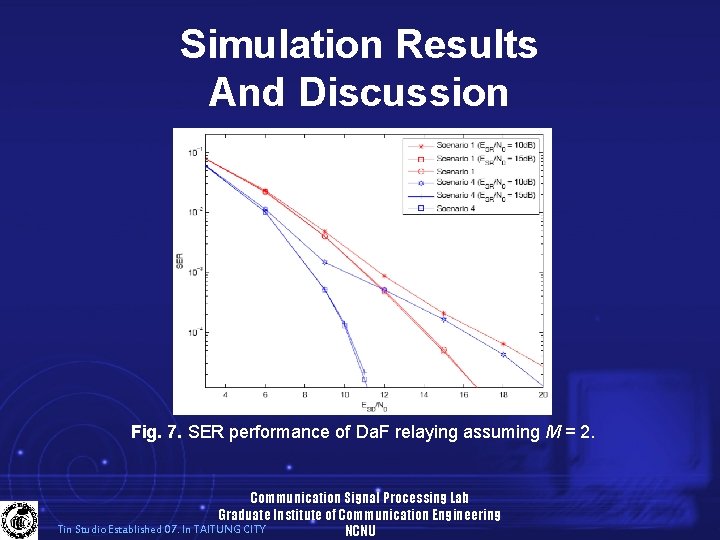
Simulation Results And Discussion Fig. 7. SER performance of Da. F relaying assuming M = 2. Communication Signal Processing Lab Graduate Institute of Communication Engineering Tin Studio Established 07. In TAITUNG CITY NCNU
Conclusion • In this paper, we have investigated performance of three relaying schemes in a cooperative scenario in which the cooperating nodes are equipped with multiple antennas and operating over frequency-flat Rayleigh fading channels. • We have analyzed the diversity gains of blind Aa. F, CSI-assisted Aa. F, and Da. F schemes Communication Signal Processing Lab Graduate Institute of Communication Engineering Tin Studio Established 07. In TAITUNG CITY NCNU
References • [1] S. Alamouti, “A simple transmit diversity technique for wireless communications, ” IEEE J. Select. Areas Commun. , vol. 16, no. 8, pp. 1451– 1458, 1998. • [2] A. Sendonaris, E. Erkip, and B. Aazhang, “User cooperation diversity-Part I: System description, ” IEEE Trans. Commun. , vol. 51, pp. 1927 -1938, Nov. 2003. • [3] A. Sendonaris, E. Erkip, and B. Aazhang, “User cooperation diversity-Part II: Implemen taion aspects and performance analysis, ” IEEE Trans. Commun. , vol. 51, pp. 1939 -1948, Nov. 2003. • [4] M. K. Simon and M. S. Alouini, Digital Communication Over Fading Channels: A Unified Approach to Performance Analysis. New. York: Wiley-Interscience, 2000. Communication Signal Processing Lab Graduate Institute of Communication Engineering Tin Studio Established 07. In TAITUNG CITY NCNU
Thanks for your attention Communication Signal Processing Lab Graduate Institute of Communication Engineering Tin Studio Established 07. In TAITUNG CITY NCNU