
Cooperative Councils Beyond Asset Transfer Caroline Collinson Adam
Co-operative Councils Beyond Asset Transfer Caroline Collinson & Adam Taeger Communities Team Communications and Engagement Newcastle City Council May 2018
Contents Section One Page 3 Background information & Methodoloy Section Two Page 11 Evidence Section Three Page 15 Conclusion & Recommendations Section Four Page 20 Resources & Further Information Section Five Page 22 Acknowledgements & Appendices 2
Brief description of the Project Council Community Asset Transfer (Policy Lab*) One of the biggest challenges councils and communities face is how to sustain valued local community assets in the face of ongoing austerity. A solution that can work for communities is asset transfer. But this is not just about budgetary pressures on councils. The concept of transferring community buildings to local ownership fits well with the values and principles of the cooperative movement. Yet whilst asset transfer seems intuitively right, we know that significant, practical barriers to transfer persist and that substantial support is required at a time of limited capacity to do this at pace. We therefore want to find out what has worked best and what has not worked as well and why? * Policy Labs are collaborative pieces of work that CCIN members work on together. 3
Aims of the Project Some organisations have seized upon asset transfer as a new and exiting opportunity. Whilst others have considered the option but have decided not to pursue asset transfer. To continue to develop the concept of co-operative asset transfer, we aimed gather information about factors that have contributed to success during and post asset transfer but also to identify some of the obstacles and barriers that have led to rejection of asset transfer as an option or to less successful outcomes. We hope that this will enable Network members to strengthen their support and practice around this important agenda. It will also help to define asset transfer policy in a cooperative context. This work might also inspire more local organisations to go for asset transfer by highlighting successes and showing what is possible through co-operative approaches. 4

What is a Community Asset Transfer ? Community Asset Transfer is the transfer of land or buildings from the council to a third sector organisation. Forms of Asset Transfer include: v A management agreement v A licence to occupy v A short lease v A long lease v Freehold Benefits: v To form long term partnerships with third sector organisations v Provide assets for wider voluntary and community sector use v Maximising community benefit v Minimising financial liability for the Council in the future v Supporting the building of social capital Bidding voluntary organisations would be asked to provide a business case demonstrating that they have the capacity to run the facility and show they contribute to the Council’s priorities. 5
Research Methodology Methods: • A call for evidence was made to all CCIN members across the network to include local authority, partner organisation and community organisation perspective and generate case studies and examples of good practice • Newcastle City Council provided asset transfer case studies both successful and unsuccessful Evidence collected included: • what went well • what was most important in successful transfer • What did not go well / barriers Learning to be shared by: • Final Report with case studies (appendices) – the report to engage a number of different audiences including community groups. Case studies will also contain useful information so that people can follow up on the examples highlighted. • Workshop session for all members – a Webinar organised for all members in October 2017 6
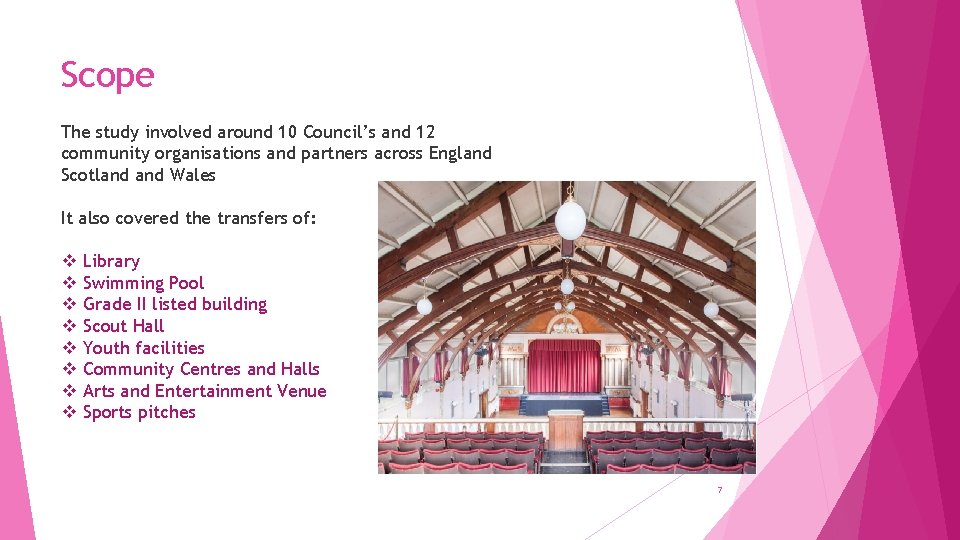
Scope The study involved around 10 Council’s and 12 community organisations and partners across England Scotland Wales It also covered the transfers of: v v v v Library Swimming Pool Grade II listed building Scout Hall Youth facilities Community Centres and Halls Arts and Entertainment Venue Sports pitches 7
Legislation Scotland is ahead of the game and new legislation came in to force on 23 January 2017 introducing the ‘right’ to make requests rather than the present voluntary approach. Asset Transfer Part 5 of the Community Empowerment Act introduces a right for community bodies to make requests to all local authorities, Scottish Ministers and a wide-ranging list of public bodies, for any land or buildings they feel they could make better use of. They can request ownership, lease or other rights, as they wish. The Act required those public authorities to transparently assess requests against a specified list of criteria, and to agree the request unless there are reasonable grounds for refusal. The Act sets out the key rights and duties and provides a framework for the asset transfer process. Regulations and orders set out more detailed arrangements for implementing the scheme. Guidance has been developed for both relevant authorities and community bodies. More information available at www. gov. scot/topics/people/engage/Asset. Transfer 8
Newcastle’s approach • Transfers mainly long leases (25 years+) with peppercorn rent but tenants responsible for R&M • Most transfers to existing tenants (but some vacant buildings have been offered up for bids from interested parties) • Full disclosure about costs and building condition made available at the start of the process • Independent expert support, including legal advice, made available • Organisations asked to provide business cases so sustainability and viability can be assessed. • Capital pot available for major repairs and or improvements to facilitate and incentivise transfer • Support for process from Communities Team, supported by property and legal services
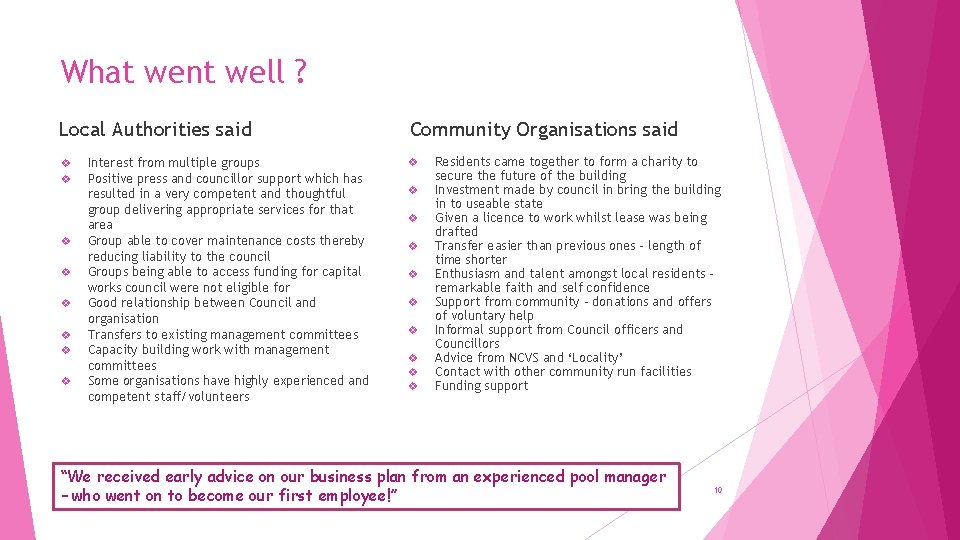
What went well ? Local Authorities said v v v v Interest from multiple groups Positive press and councillor support which has resulted in a very competent and thoughtful group delivering appropriate services for that area Group able to cover maintenance costs thereby reducing liability to the council Groups being able to access funding for capital works council were not eligible for Good relationship between Council and organisation Transfers to existing management committees Capacity building work with management committees Some organisations have highly experienced and competent staff/volunteers Community Organisations said v v v v v Residents came together to form a charity to secure the future of the building Investment made by council in bring the building in to useable state Given a licence to work whilst lease was being drafted Transfer easier than previous ones – length of time shorter Enthusiasm and talent amongst local residents – remarkable faith and self confidence Support from community – donations and offers of voluntary help Informal support from Council officers and Councillors Advice from NCVS and ‘Locality’ Contact with other community run facilities Funding support “We received early advice on our business plan from an experienced pool manager – who went on to become our first employee!” 10
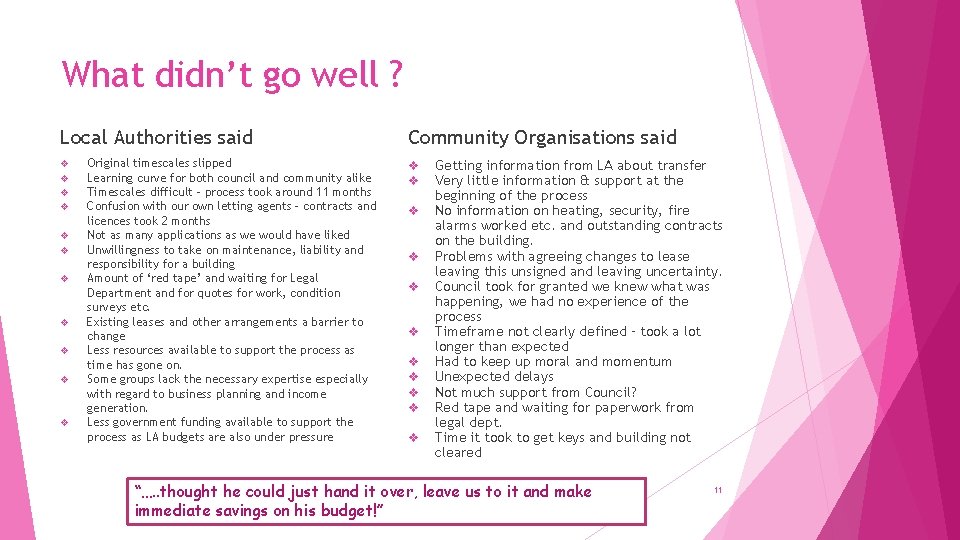
What didn’t go well ? Local Authorities said v v v Original timescales slipped Learning curve for both council and community alike Timescales difficult – process took around 11 months Confusion with our own letting agents – contracts and licences took 2 months Not as many applications as we would have liked Unwillingness to take on maintenance, liability and responsibility for a building Amount of ‘red tape’ and waiting for Legal Department and for quotes for work, condition surveys etc. Existing leases and other arrangements a barrier to change Less resources available to support the process as time has gone on. Some groups lack the necessary expertise especially with regard to business planning and income generation. Less government funding available to support the process as LA budgets are also under pressure Community Organisations said v v v Getting information from LA about transfer Very little information & support at the beginning of the process No information on heating, security, fire alarms worked etc. and outstanding contracts on the building. Problems with agreeing changes to lease leaving this unsigned and leaving uncertainty. Council took for granted we knew what was happening, we had no experience of the process Timeframe not clearly defined – took a lot longer than expected Had to keep up moral and momentum Unexpected delays Not much support from Council? Red tape and waiting for paperwork from legal dept. Time it took to get keys and building not cleared “…. . thought he could just hand it over, leave us to it and make immediate savings on his budget!” 11
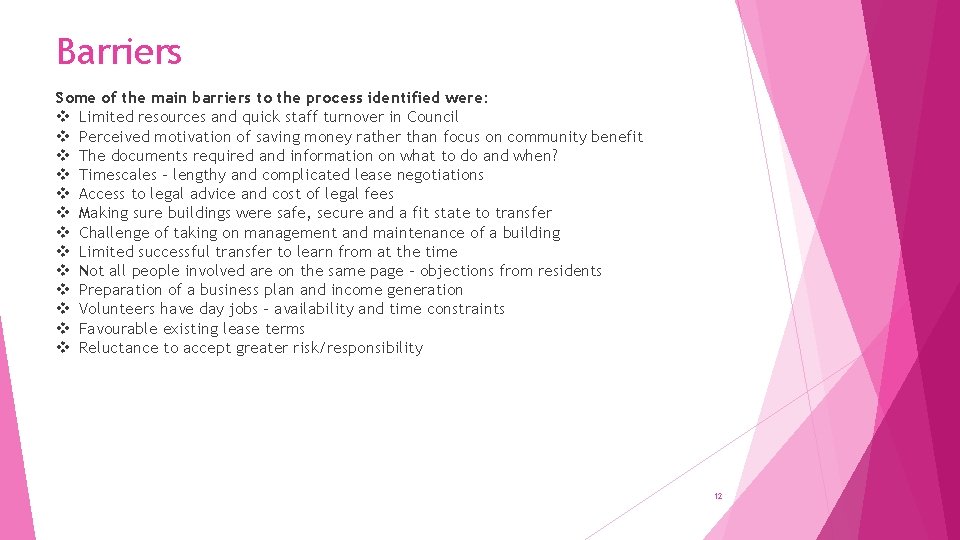
Barriers Some of the main barriers to the process identified were: v Limited resources and quick staff turnover in Council v Perceived motivation of saving money rather than focus on community benefit v The documents required and information on what to do and when? v Timescales – lengthy and complicated lease negotiations v Access to legal advice and cost of legal fees v Making sure buildings were safe, secure and a fit state to transfer v Challenge of taking on management and maintenance of a building v Limited successful transfer to learn from at the time v Not all people involved are on the same page – objections from residents v Preparation of a business plan and income generation v Volunteers have day jobs – availability and time constraints v Favourable existing lease terms v Reluctance to accept greater risk/responsibility 12
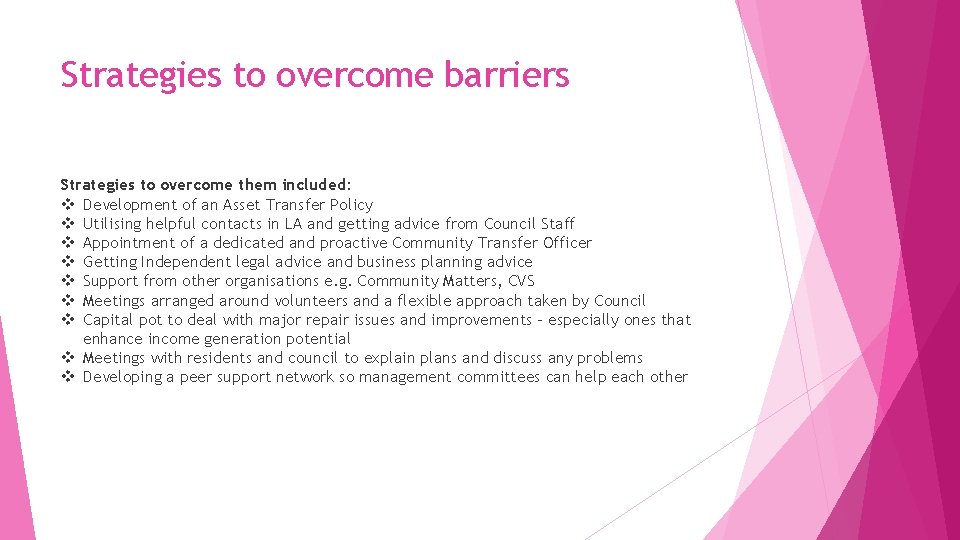
Strategies to overcome barriers Strategies to overcome them included: v Development of an Asset Transfer Policy v Utilising helpful contacts in LA and getting advice from Council Staff v Appointment of a dedicated and proactive Community Transfer Officer v Getting Independent legal advice and business planning advice v Support from other organisations e. g. Community Matters, CVS v Meetings arranged around volunteers and a flexible approach taken by Council v Capital pot to deal with major repair issues and improvements – especially ones that enhance income generation potential v Meetings with residents and council to explain plans and discuss any problems v Developing a peer support network so management committees can help each other
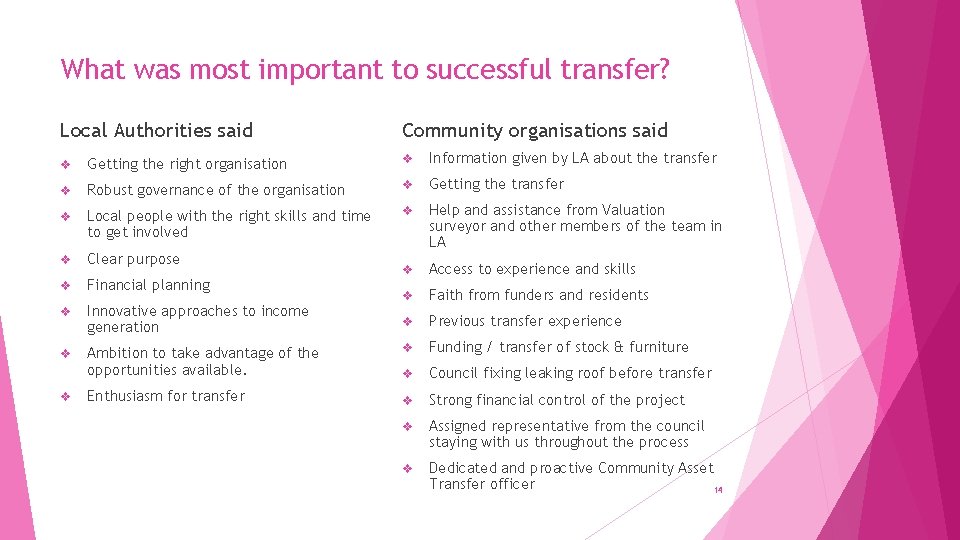
What was most important to successful transfer? Local Authorities said Community organisations said v Getting the right organisation v Information given by LA about the transfer v Robust governance of the organisation v Getting the transfer v Local people with the right skills and time to get involved v v Clear purpose Help and assistance from Valuation surveyor and other members of the team in LA Access to experience and skills v Financial planning v Faith from funders and residents v Innovative approaches to income generation v v Previous transfer experience v Ambition to take advantage of the opportunities available. v Funding / transfer of stock & furniture v Council fixing leaking roof before transfer v Strong financial control of the project v Assigned representative from the council staying with us throughout the process v Dedicated and proactive Community Asset Transfer officer 14 v Enthusiasm for transfer
Conclusion Although the evidence showed us that every transfer is unique and different themes and commonality have emerged. As more transfers are completed both local authorities and the voluntary sector are learning from their experiences. The process is getting more streamlined and efficient and therefore easier and quicker for all. The study has also provided evidence of how barriers are successfully being overcome and has helped identify ways to make the process easier which we can all learn from. We have set out these recommendations which may be considered to support members with future transfers (as well as the further learning via additional resources and useful information which follows). 15
Recommendations v Clear information and agreed timescales to ensure all are aware of the process v Community Asset transfer policy may help v A shared and agreed timescale which is realistic v Consistency and continuity is key – dedicated officers with knowledge and experience of the process can make a huge difference including within Legal departments to speed up lease negotiations v Where buildings are being transferred they need to be in a good state of repair v Organisations need appropriate support so consideration should be given at an early stage on who will support them, Council officers ? Or signposting to independent advice, including funding support and Business Planning e. g. CVS v Ongoing communication and a good relationship between officers and organisations 16
Beyond Asset Transfer. . . Success factors Within the study there were examples of successful community asset transfers which have been ongoing for several years. The evidence showed that these successful transfers had the following factors in common: ü Excellent community support ü Local people with skills and expertise with time to get involved ü Good business model with sustainable source of income and opportunity to access charitable funding ü Enthusiasm for the process and a willingness to embrace the opportunities 17
Resources / Further Information A number of Councils who responded to the call for evidence already have an Asset transfer policy in place including Norwich City Council and Glasgow City Council who kindly shared them with us. They can be found on their websites at: https: //www. norwich. gov. uk/downloads/file/2632/community_asset_transfer_policy http: //www. glasgow. gov. uk/councillorsandcommittees/view. Selected. Document. asp? c=P 62 AFQ 8 1 DX 2 U 2 UDX Get Involved We will be hosting a Live ‘You Tube’ discussion for all members on Monday 25 June 2018 at 1 pm This will officially present the draft report and offer an opportunity for discussion of ideas and to share further good practice. Please contact us to gain access or if you require any further information Email: Asset. transfer. study@newcastle. gov. uk 18
Case Studies Blakelaw Community Partnership Information at: https: //www. newcastle. gov. uk/sites/default/files/wwwfileroot/communities-andneighbourhoods/community-buildings-and-facilities/blakelaw_case_study. pdf More studies to be added Additional Resources : The Building Powerful Communities Through Community Asset Transfer: A guide for councillors, was launched by Locality, the national network supporting community organisations, and Power to Change, the independent trust supporting community businesses in England. It includes essential steps that councillors can take to make Community Asset Transfer (CAT) a success for their communities. It can be accessed at: https: //locality. org. uk/about/key-publications/building-powerful-communities-through-communityasset-transfer/ Locality is an affiliate member of the Co-Operative Council’s Innovation network 19
Acknowledgements Thank you to all the Councils and Community organisations who took the time to provide data for the study. Your input is very much appreciated and we hope that the recommendations and learning will be useful. Contacts: Caroline Collinson Communities Officer Newcastle City Council Tel 0191 277 3625 email: caroline. collinson@Newcastle. gov. uk Adam Taeger Communities Officer (Asset Transfer) Newcastle City Council Tel 0191 277 7523 email: adam. taeger@Newcastle. gov. uk 20
- Slides: 20