
Cooperative Agreements Process Improvement Team Final Report Introduction

- Slides: 38
Cooperative Agreements Process Improvement Team Final Report
Introduction n Project startup n n n Complaints from cooperators in Fall 2004 VS started to review process, then became APHIS project Cooperative Agreement Process Improvement Team (CAPIT)= n n n Dr. Lane + Core team + Steering Committee
Objectives n Improve Process n n Identify Issues n n 1. Review process 2. Identify improvement opportunities 3. Look at areas that relate to performance measures 4. Look at legal, regulatory & policy requirements Discover Best Practices n 5. Find best practices to adopt
Methodology n Collected stakeholder perspectives n n Conducted benchmarking n n Interviews, Focus Group Interviews Cooperator surveys, APHIS employee surveys, Stakeholder Workshop, AMT questionnaire APQC & Preliminary Reviewed documentation n Samples & Database
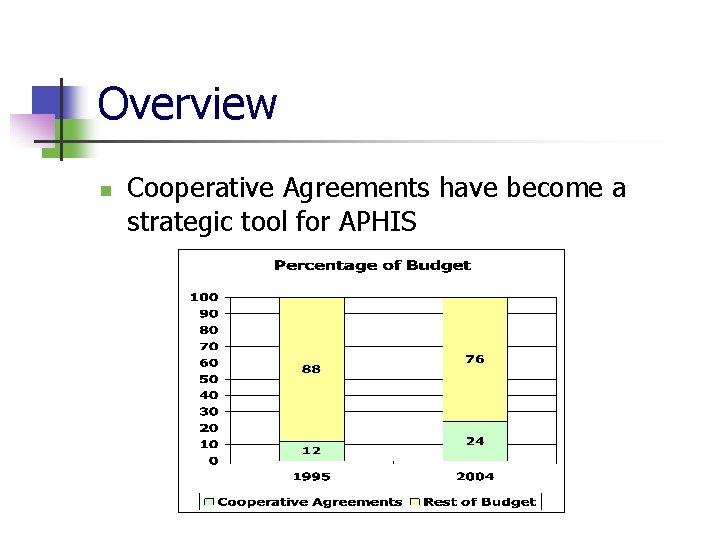
Overview n Cooperative Agreements have become a strategic tool for APHIS
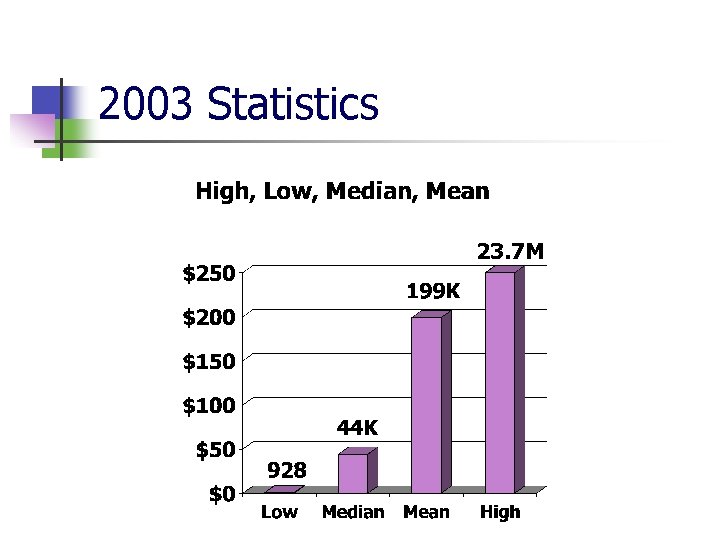
2003 Statistics 23. 7 M
2003 Statistics
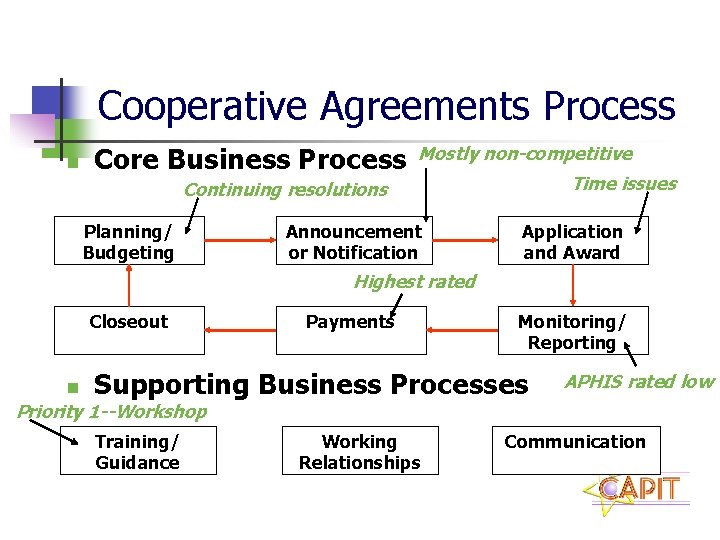
Cooperative Agreements Process n Core Business Process Mostly non-competitive Time issues Continuing resolutions Planning/ Budgeting Announcement or Notification Application and Award Highest rated Closeout n Payments Monitoring/ Reporting Supporting Business Processes APHIS rated low Priority 1 --Workshop Training/ Guidance Working Relationships Communication
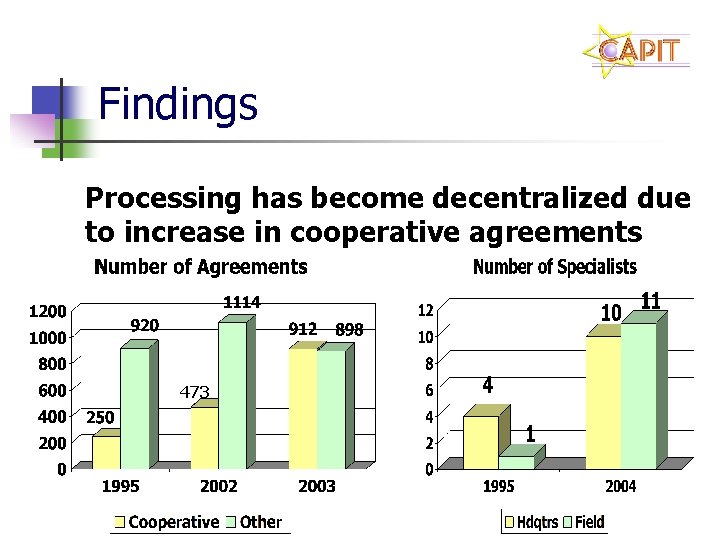
Findings Processing has become decentralized due to increase in cooperative agreements 473
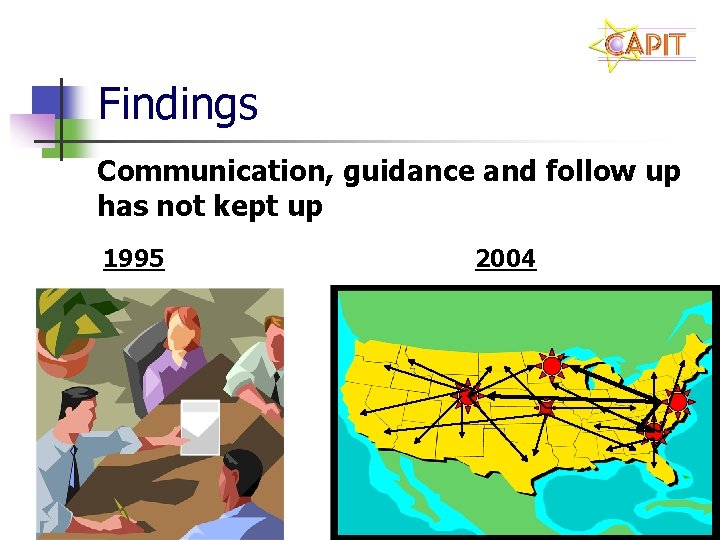
Findings Communication, guidance and follow up has not kept up 1995 2004
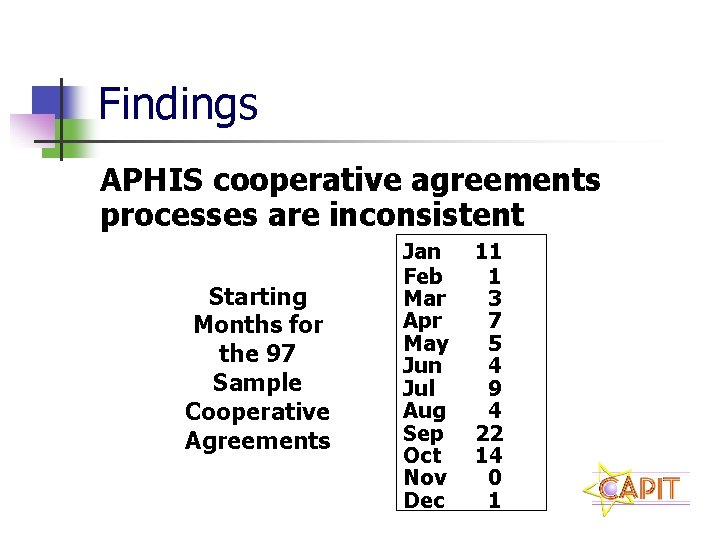
Findings APHIS cooperative agreements processes are inconsistent Starting Months for the 97 Sample Cooperative Agreements Jan Feb Mar Apr May Jun Jul Aug Sep Oct Nov Dec 11 1 3 7 5 4 9 4 22 14 0 1
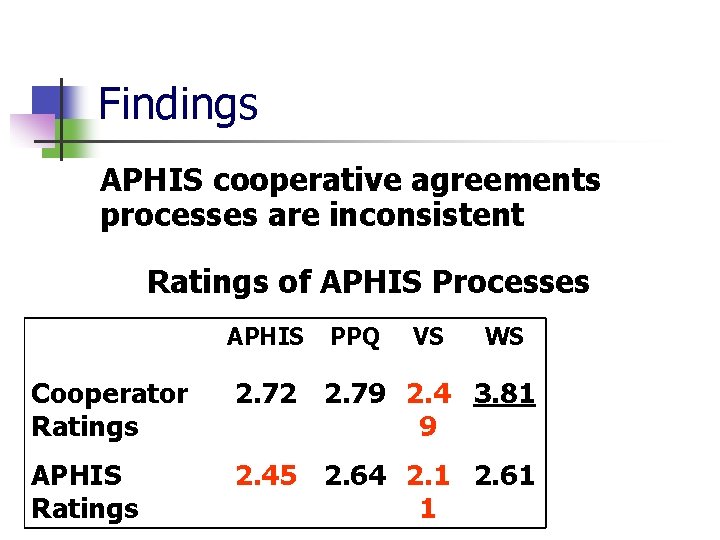
Findings APHIS cooperative agreements processes are inconsistent Ratings of APHIS Processes APHIS PPQ VS WS Cooperator Ratings 2. 72 2. 79 2. 4 3. 81 9 APHIS Ratings 2. 45 2. 64 2. 1 2. 61 1
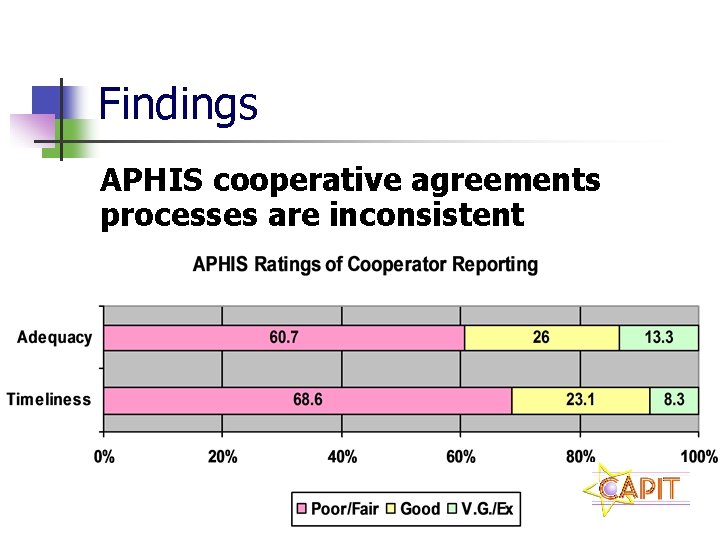
Findings APHIS cooperative agreements processes are inconsistent
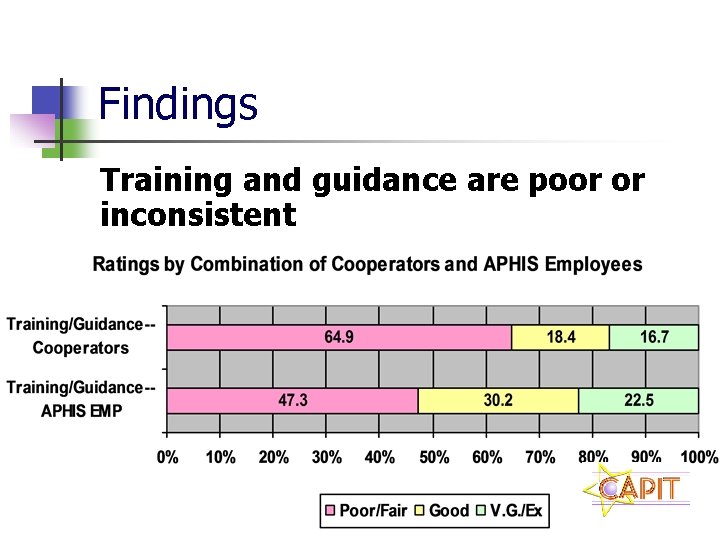
Findings Training and guidance are poor or inconsistent
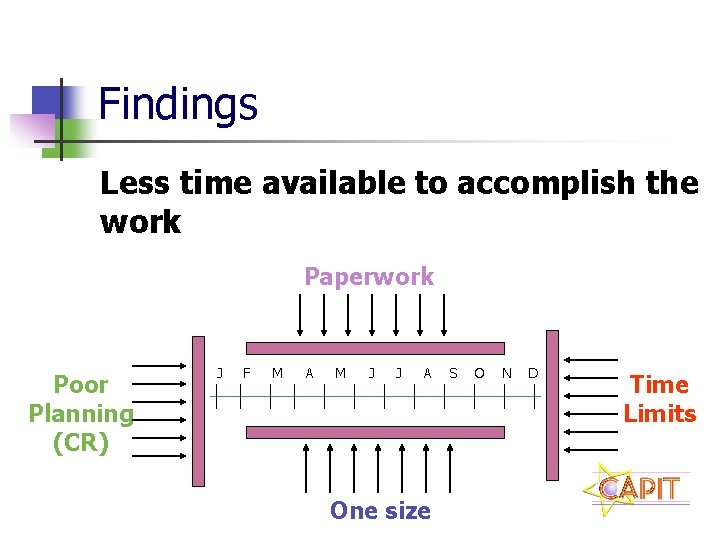
Findings Less time available to accomplish the work Paperwork Poor Planning (CR) J F M A M J J A One size S O N D Time Limits
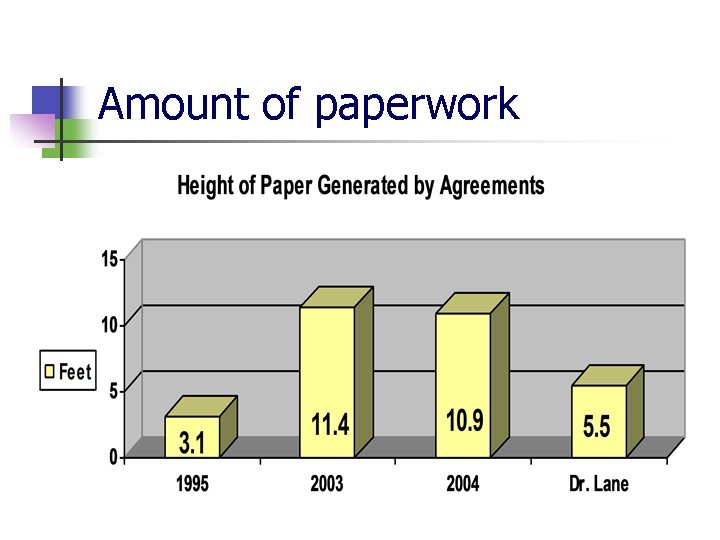
Amount of paperwork
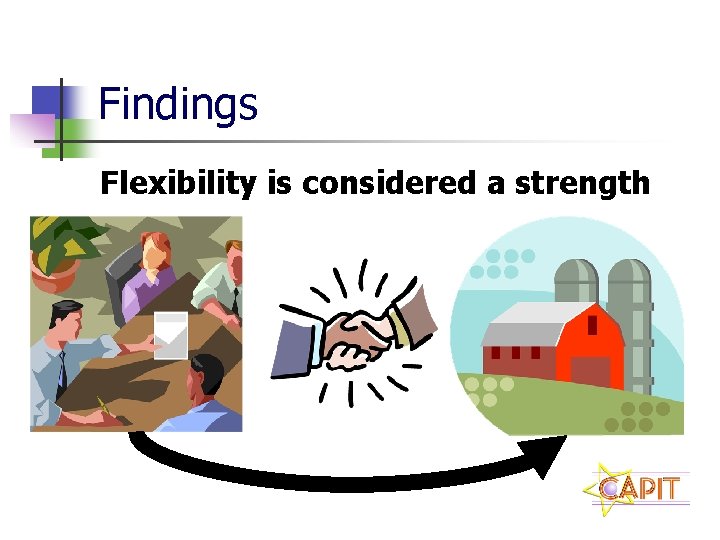
Findings Flexibility is considered a strength
Commitments 1. Hire additional person (training & communication) 2. Hold annual meeting 3. Allow maximum time 4. Don’t exceed OMB requirements
Recommendations 1. Improve consistency across the Agency especially in training and guidance 2. Streamline the process 3. Explore other opportunities
Recommendation #1 1. Improve consistency across the Agency A. Standardize APHIS practices B. Get a consistent message out about expectations and practices C. Improve follow-up
Recommendation #1 (cont) A. Standardize APHIS practices 1) Follow calendar-year based cycle of planning and operating (for ongoing agreements) 2) Standardize formats 3) Standardize process for resolving issues promptly 4) Revise Agency guidance 5) Standardize cooperator reporting
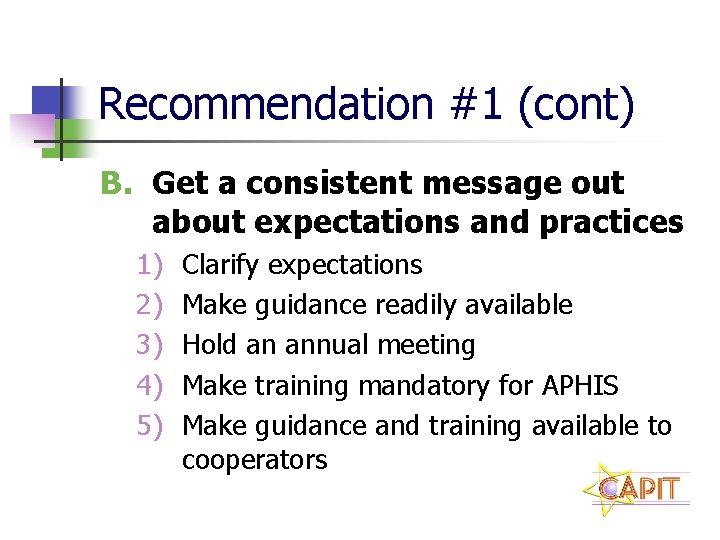
Recommendation #1 (cont) B. Get a consistent message out about expectations and practices 1) 2) 3) 4) 5) Clarify expectations Make guidance readily available Hold an annual meeting Make training mandatory for APHIS Make guidance and training available to cooperators
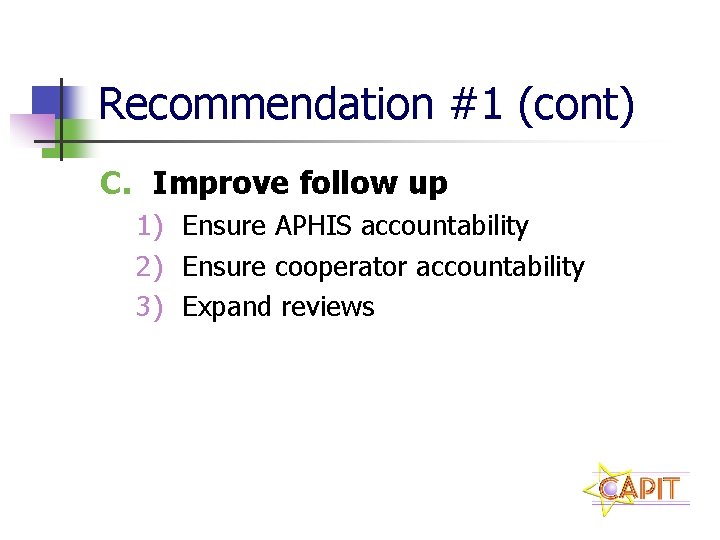
Recommendation #1 (cont) C. Improve follow up 1) Ensure APHIS accountability 2) Ensure cooperator accountability 3) Expand reviews
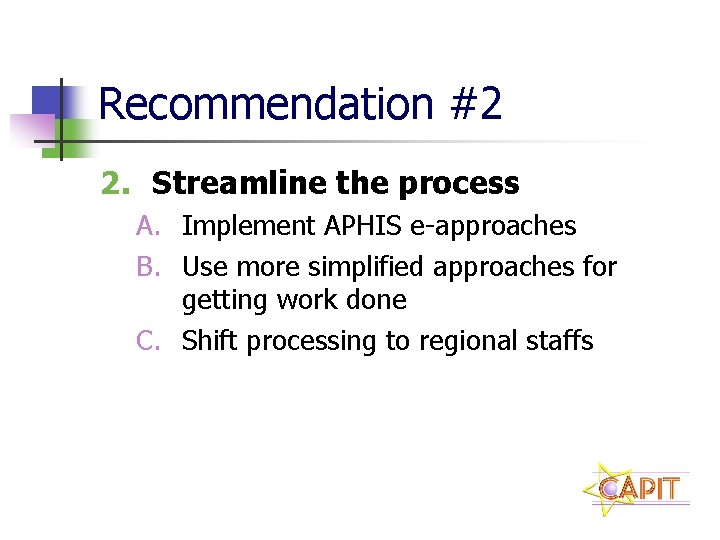
Recommendation #2 2. Streamline the process A. Implement APHIS e-approaches B. Use more simplified approaches for getting work done C. Shift processing to regional staffs
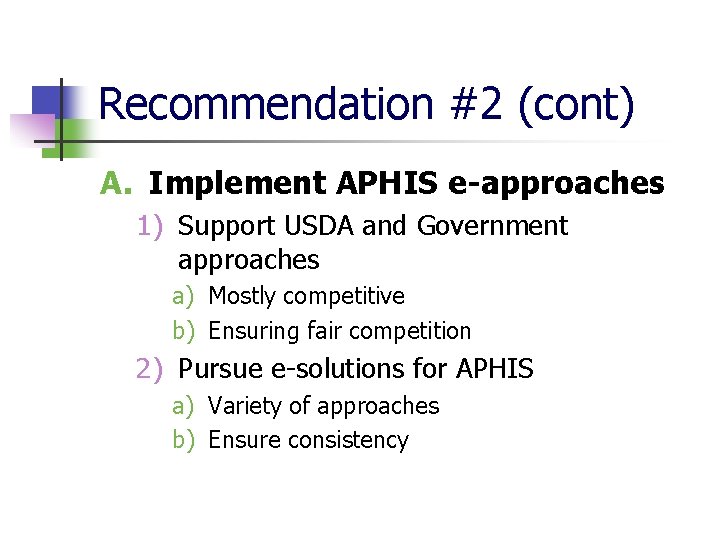
Recommendation #2 (cont) A. Implement APHIS e-approaches 1) Support USDA and Government approaches a) Mostly competitive b) Ensuring fair competition 2) Pursue e-solutions for APHIS a) Variety of approaches b) Ensure consistency
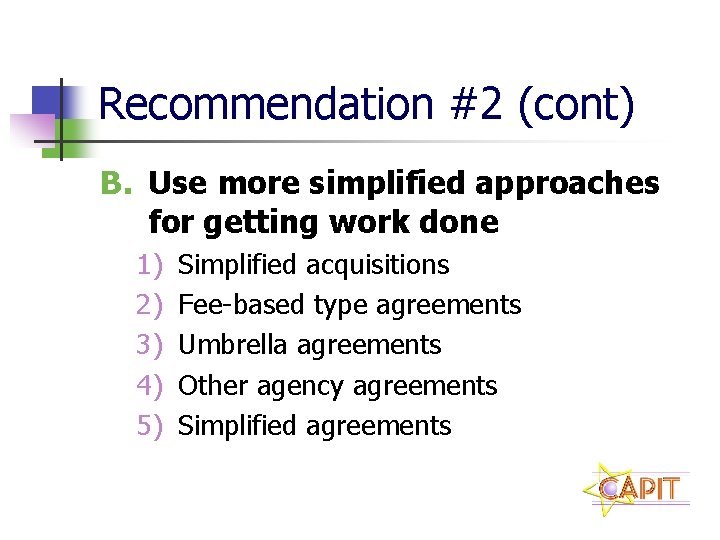
Recommendation #2 (cont) B. Use more simplified approaches for getting work done 1) 2) 3) 4) 5) Simplified acquisitions Fee-based type agreements Umbrella agreements Other agency agreements Simplified agreements
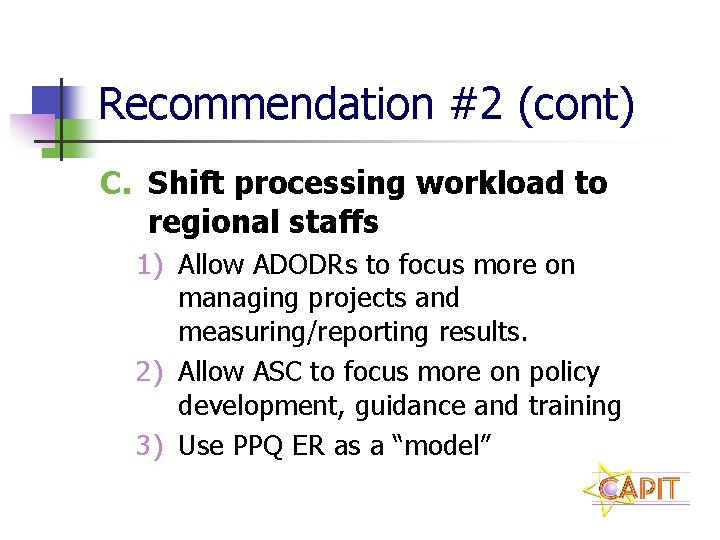
Recommendation #2 (cont) C. Shift processing workload to regional staffs 1) Allow ADODRs to focus more on managing projects and measuring/reporting results. 2) Allow ASC to focus more on policy development, guidance and training 3) Use PPQ ER as a “model”
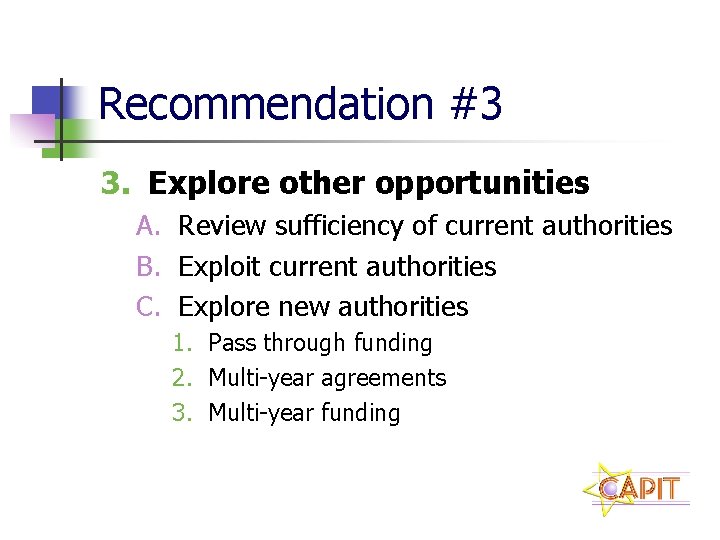
Recommendation #3 3. Explore other opportunities A. Review sufficiency of current authorities B. Exploit current authorities C. Explore new authorities 1. Pass through funding 2. Multi-year agreements 3. Multi-year funding
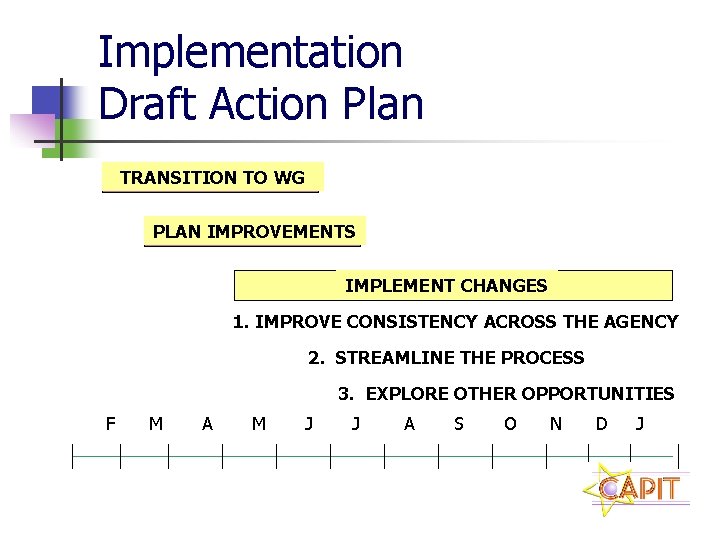
Implementation Draft Action Plan TRANSITION TO WG PLAN IMPROVEMENTS IMPLEMENT CHANGES 1. IMPROVE CONSISTENCY ACROSS THE AGENCY 2. STREAMLINE THE PROCESS 3. EXPLORE OTHER OPPORTUNITIES F M A M J J A S O N D J
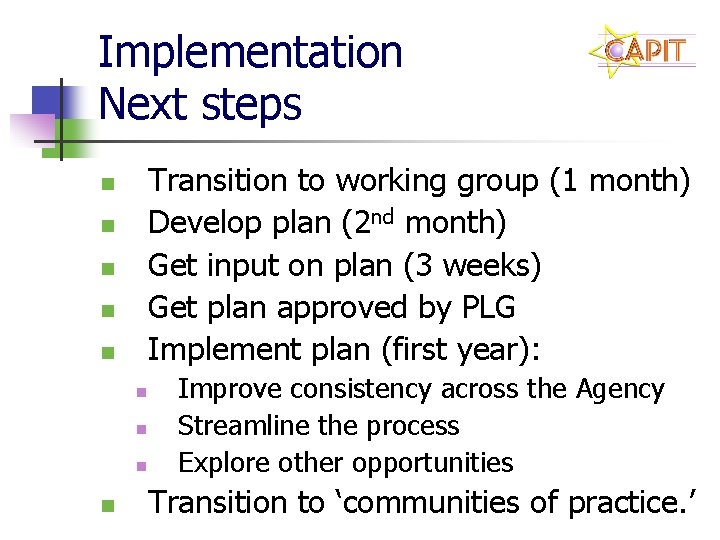
Implementation Next steps Transition to working group (1 month) Develop plan (2 nd month) Get input on plan (3 weeks) Get plan approved by PLG Implement plan (first year): n n n n n Improve consistency across the Agency Streamline the process Explore other opportunities Transition to ‘communities of practice. ’
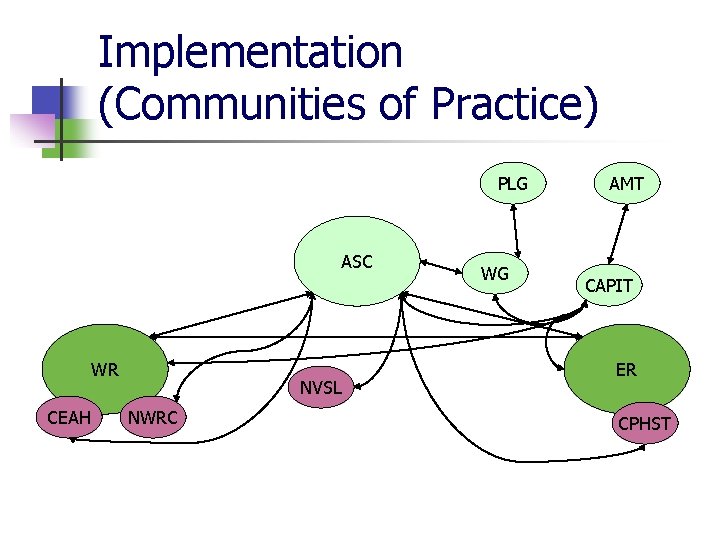
Implementation (Communities of Practice) PLG ASC WR CEAH NVSL NWRC WG AMT CAPIT ER CPHST
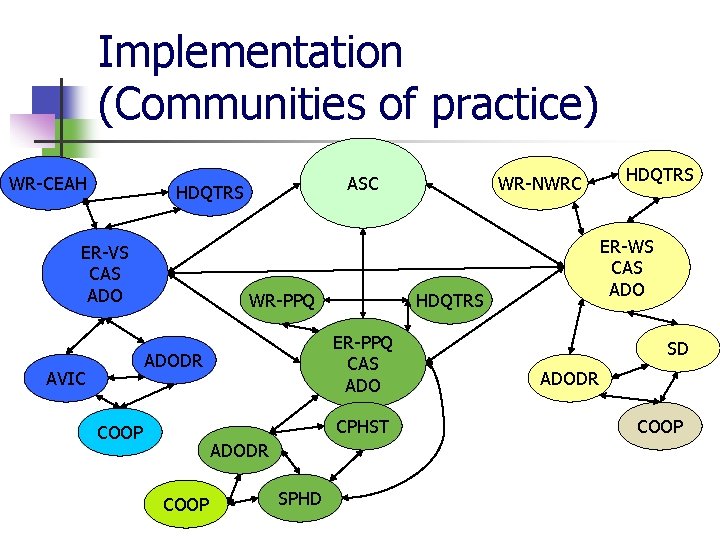
Implementation (Communities of practice) WR-CEAH ASC HDQTRS ER-VS CAS ADO WR-PPQ AVIC CPHST COOP ADODR COOP SPHD HDQTRS ER-WS CAS ADO HDQTRS ER-PPQ CAS ADODR WR-NWRC SD ADODR COOP
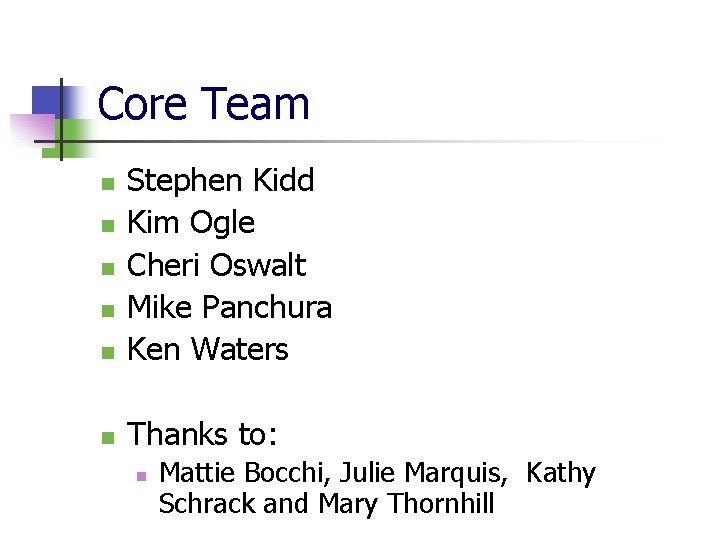
Core Team n Stephen Kidd Kim Ogle Cheri Oswalt Mike Panchura Ken Waters n Thanks to: n n n Mattie Bocchi, Julie Marquis, Kathy Schrack and Mary Thornhill
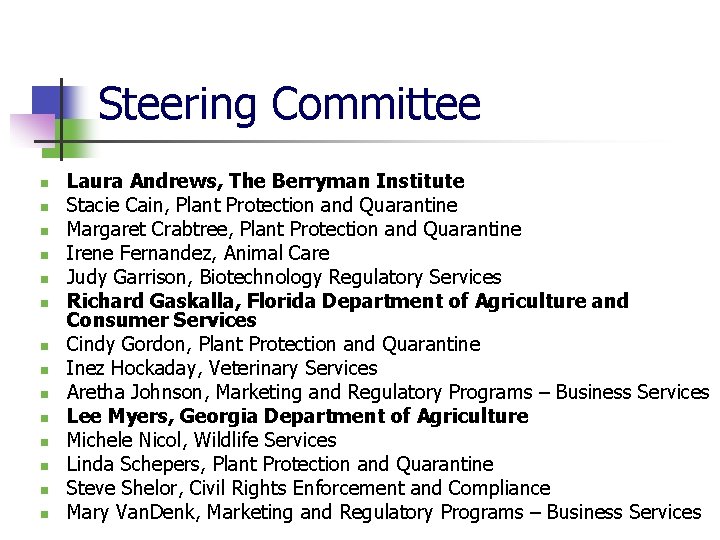
Steering Committee n n n n Laura Andrews, The Berryman Institute Stacie Cain, Plant Protection and Quarantine Margaret Crabtree, Plant Protection and Quarantine Irene Fernandez, Animal Care Judy Garrison, Biotechnology Regulatory Services Richard Gaskalla, Florida Department of Agriculture and Consumer Services Cindy Gordon, Plant Protection and Quarantine Inez Hockaday, Veterinary Services Aretha Johnson, Marketing and Regulatory Programs – Business Services Lee Myers, Georgia Department of Agriculture Michele Nicol, Wildlife Services Linda Schepers, Plant Protection and Quarantine Steve Shelor, Civil Rights Enforcement and Compliance Mary Van. Denk, Marketing and Regulatory Programs – Business Services
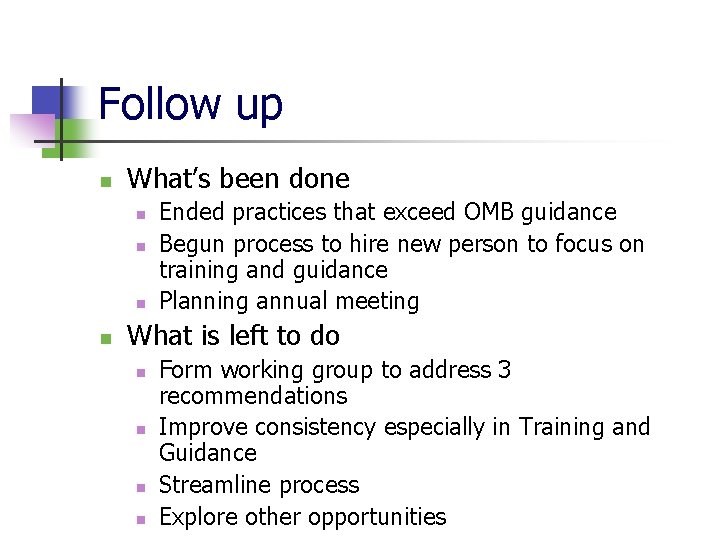
Follow up n What’s been done n n Ended practices that exceed OMB guidance Begun process to hire new person to focus on training and guidance Planning annual meeting What is left to do n n Form working group to address 3 recommendations Improve consistency especially in Training and Guidance Streamline process Explore other opportunities
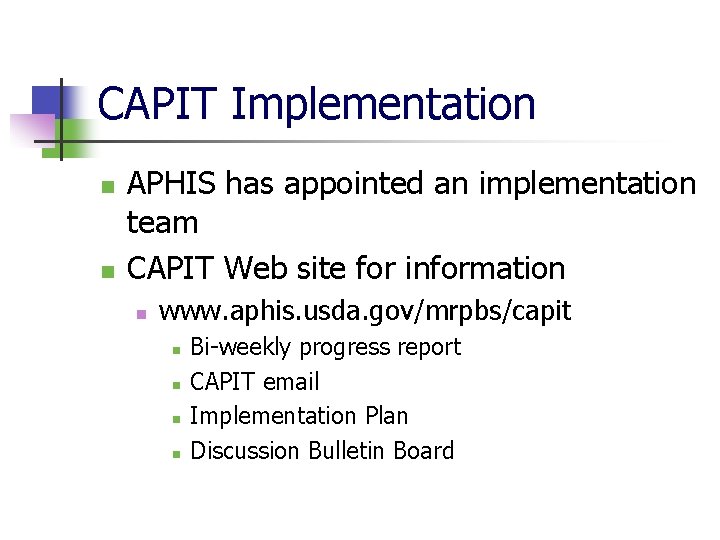
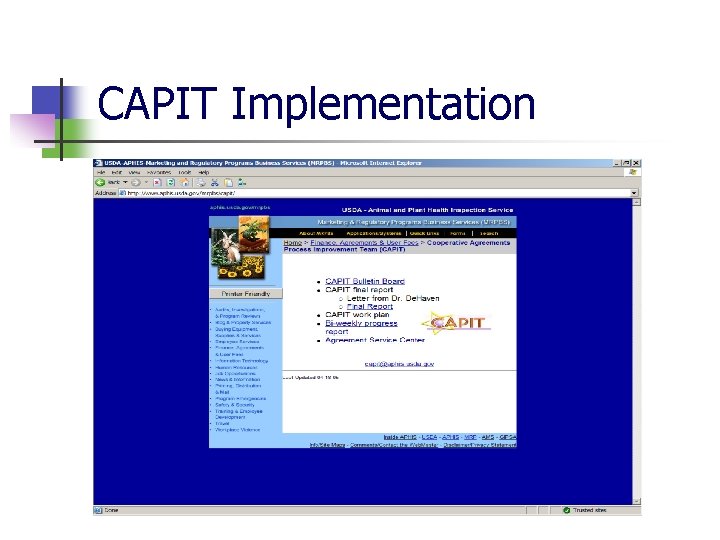
CAPIT Implementation n n APHIS has appointed an implementation team CAPIT Web site for information n www. aphis. usda. gov/mrpbs/capit n n Bi-weekly progress report CAPIT email Implementation Plan Discussion Bulletin Board
CAPIT Implementation
Cooperative Agreements Process Improvement Team Final Report