
Cooperation between DMH Myanmar and MET Norway on

Cooperation between DMH Myanmar and MET Norway on Capacity Building In collaboration with Asian Disaster Preparedness Center (ADPC) Tor Ivar Mathisen Workshop, 6. -9. September 2016, Nay Pyi Taw Norwegian Meteorological Institute

Key figures… Funded by the Norwegian Ministry of Foreign Affairs (MFA) Project inception 2012/2013 Budget: 180. 000 USD per year Cooperation with Asian Disaster Preparedness Center (ADPC) in Bangkok A part of the Mo. U between DMH and ADPC Coordinated with the activity carried out by Norwegian Water Resources and Energy Directorate (NVE) Norwegian Meteorological Institute

Key figures… Focus on building human and institutional capacity § «Disaster Risk Reduction» (DRR) through handling «Early Warning System» (EWS) and (GFCS) § Preparing for climate services (GFCS) Basically no investment in equipment Norwegian Meteorological Institute
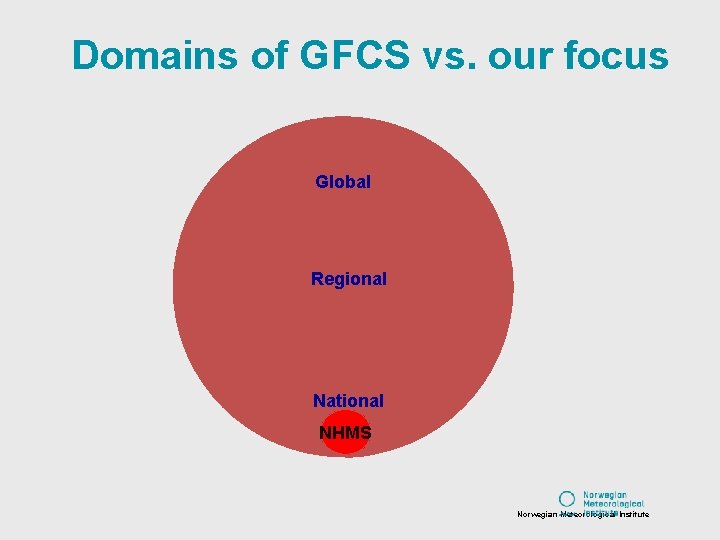
Domains of GFCS vs. our focus Global Regional National NHMS Norwegian Meteorological Institute

“Building the institution by building the people” Build relationships, cooperation with colleagues - trust and mutual respect Establishment of a common project team Listen, understand - then propose Based on DMH’s available capacity and resources DMH ownership Overall Goal: Make DMH (not Met Norway) visible for the users and independent of us Norwegian Meteorological Institute

What are we doing? Strengthen EWS (decision making): Integrated forecasting tools developed at Met Norway (free, open source software) – hands-on-training NWP model outputs: WRF (ADPC), ECMWF (Met Norway), GFS, GSM Observations, satellite images, (radar) NWP model/forecast verification Climate services: Digitizing and QC of historical observation data (ADPC/Met Norway) Climate data base and Climate Data Portal (ADPC) Analysis and products National Climate Report – understanding current and future climate Identify synergies between countries in the region (Vietnam and Bangladesh) Learn from each other Enhance the relationship between the institutions Norwegian Meteorological Institute

Further plans "We need to listen, understand then propose” Focus areas: Strengthening the EWS (forecasting decision making), and with a special focus on extreme weather incidents Medium range weather forecasting (ensembles, probability) Marine forecasting Aviation weather forecasting Improving the experience on model verification Improving DMH understanding of current and future climate, to prepare for the future and able to adapt the national infrastructure Independence: Still focus at support and hand-on-training, to help DMH become more robust and independent Norwegian Meteorological Institute

Coordination and collaboration between donors to ensure sustainability Build block by block (no “black boxes”) § Use open standards/formats § Try to use free, open software systems Balance between: § The new technology and the human/institutional technical skill and capacity at DMH Avoid: § Duplication of activities § Overload of the human resources (key experts) at DMH "The work needs to be meaningful both for DMH and Met Norway” Norwegian Meteorological Institute
- Slides: 8