
Cooling Off Hot Conversations Tips for Conflict Prevention
- Slides: 43
+ Cooling Off Hot Conversations: Tips for Conflict Prevention & Diffusion GFBAI Webinar Series Presented by: Lisë Stewart, GFBAI Board Chair Melissa Kelly-Mc. Cabe, Clear Intent Strategy, Inc. Doug Baumoel, Continuity Family Business Consulting Natalie Mc. Veigh, Wells Fargo Private Bank
+ Natalie Mc. Veigh
+ Why is C-IQ important in Conflict? Conversational Intelligence (C-IQ) is one of most powerful and human and hardwired skill of connecting with others through conversations. How can we trigger trust, growth and innovation, even during times of conflict? Everything happens through conversation! • Conversations are dynamic and multifaceted interactions • ‘Neuroception’ is the physiological perception of support safety and healthy connection and conversation with others • C-IQ is how we engage with each other • C-IQ is how we influence each other
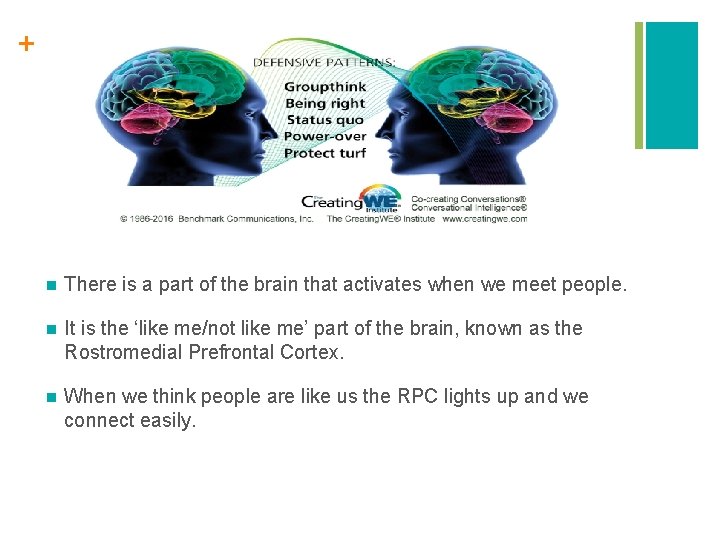
+ n There is a part of the brain that activates when we meet people. n It is the ‘like me/not like me’ part of the brain, known as the Rostromedial Prefrontal Cortex. n When we think people are like us the RPC lights up and we connect easily.
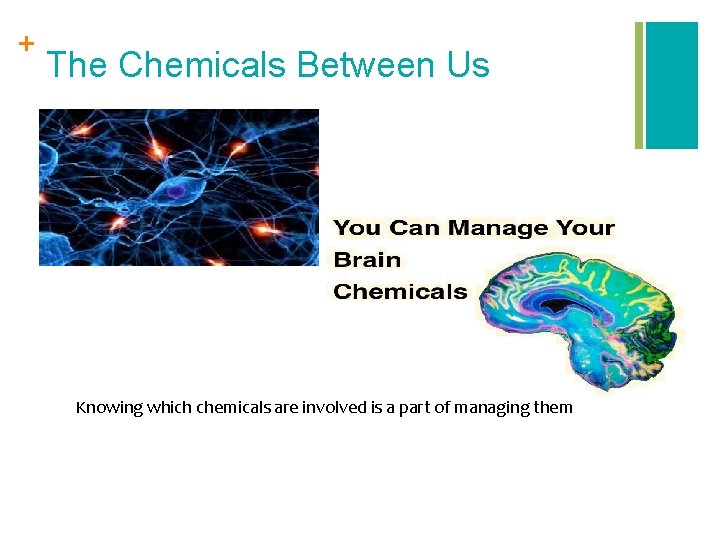
+ The Chemicals Between Us Knowing which chemicals are involved is a part of managing them
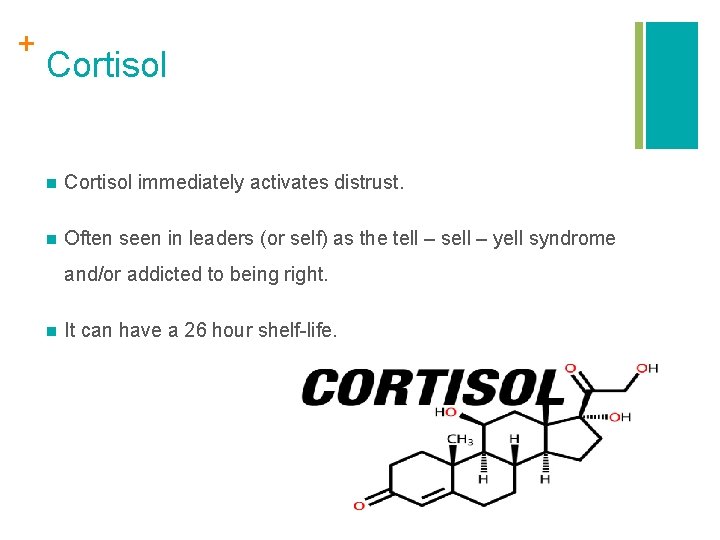
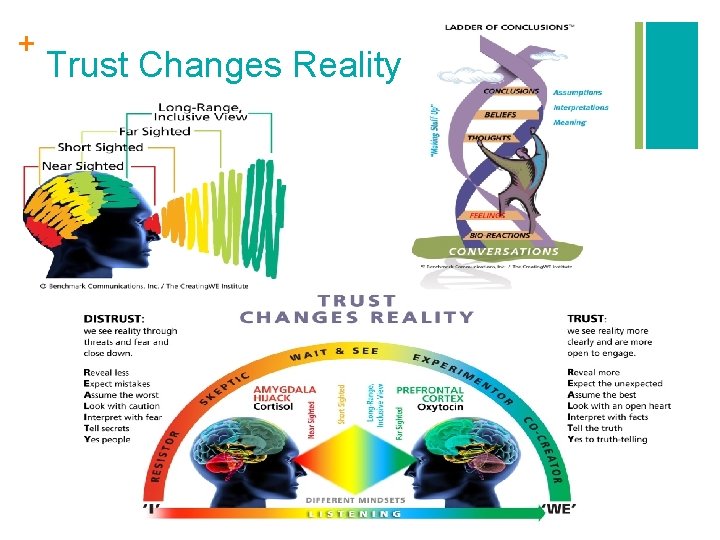
+ Cortisol n Cortisol immediately activates distrust. n Often seen in leaders (or self) as the tell – sell – yell syndrome and/or addicted to being right. n It can have a 26 hour shelf-life.
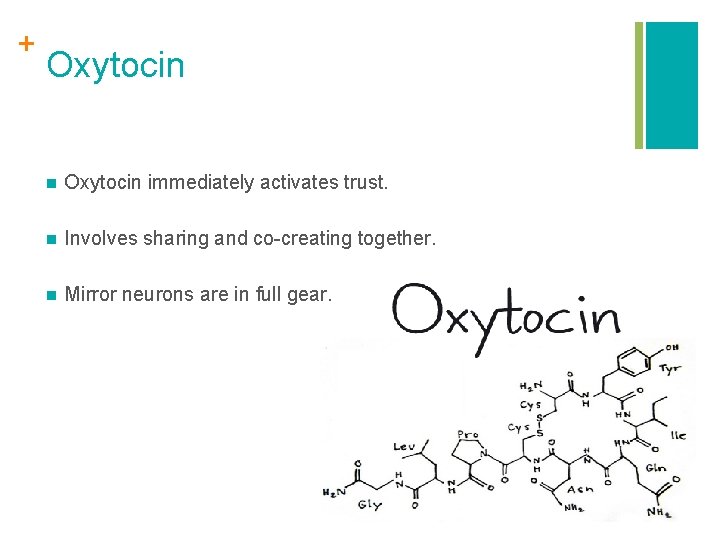
+ Oxytocin n Oxytocin immediately activates trust. n Involves sharing and co-creating together. n Mirror neurons are in full gear.
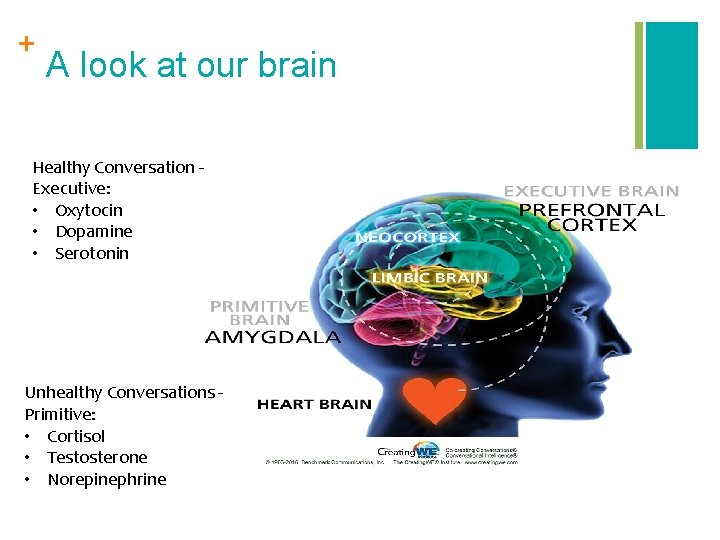
+ A look at our brain Healthy Conversation Executive: • Oxytocin • Dopamine • Serotonin Unhealthy Conversations Primitive: • Cortisol • Testosterone • Norepinephrine
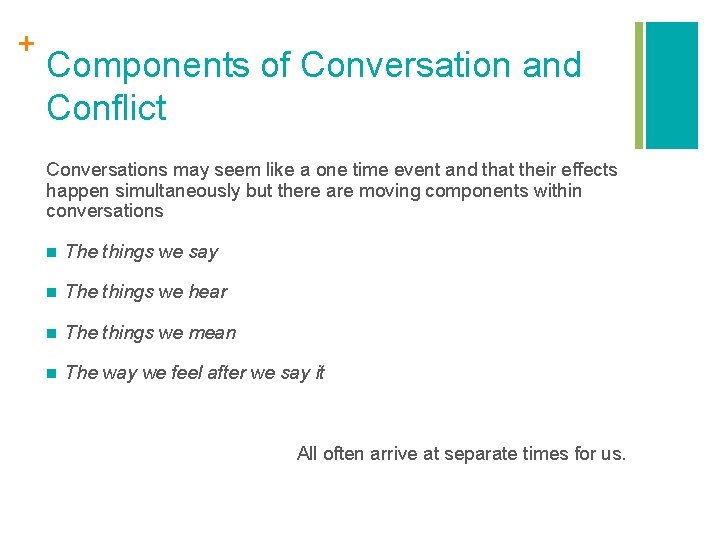
+ Components of Conversation and Conflict Conversations may seem like a one time event and that their effects happen simultaneously but there are moving components within conversations n The things we say n The things we hear n The things we mean n The way we feel after we say it All often arrive at separate times for us.
+ Trust Changes Reality
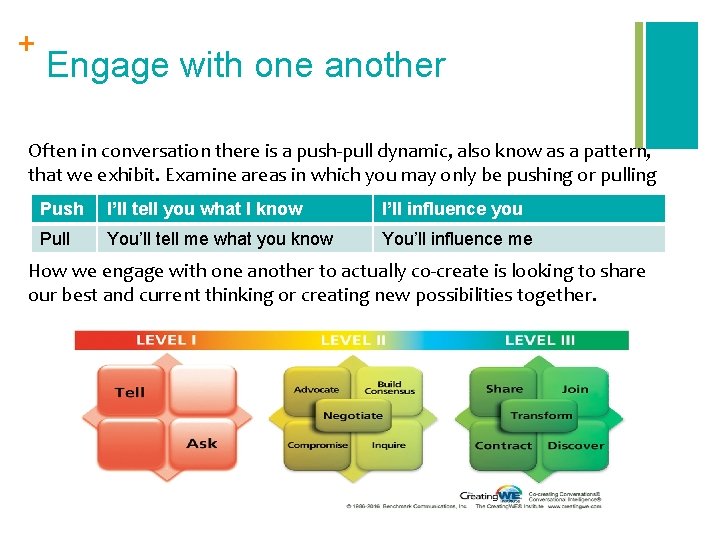
+ Engage with one another Often in conversation there is a push-pull dynamic, also know as a pattern, that we exhibit. Examine areas in which you may only be pushing or pulling Push I’ll tell you what I know I’ll influence you Pull You’ll tell me what you know You’ll influence me How we engage with one another to actually co-create is looking to share our best and current thinking or creating new possibilities together.
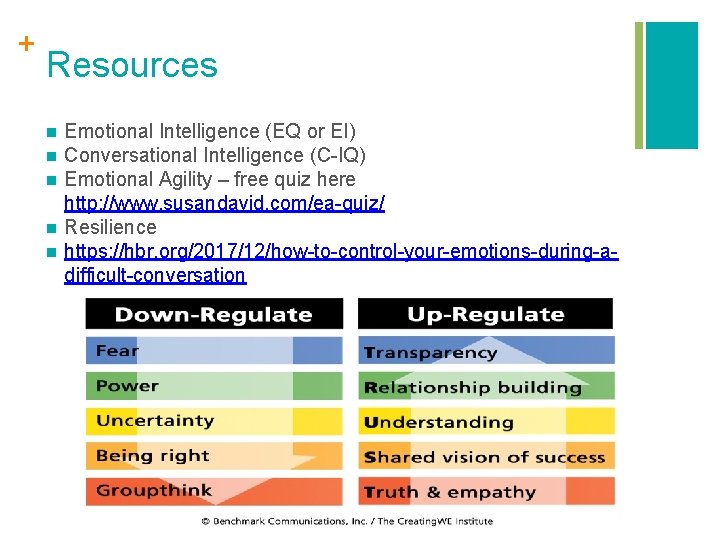
+ Resources n n n Emotional Intelligence (EQ or EI) Conversational Intelligence (C-IQ) Emotional Agility – free quiz here http: //www. susandavid. com/ea-quiz/ Resilience https: //hbr. org/2017/12/how-to-control-your-emotions-during-adifficult-conversation
+ Melissa Kelly-Mc. Cabe
+ Conflict What words come to mind when you hear the word “conflict”?
+ Conflict What words come to mind when you hear the word “conflict”? What emotions are evoked in you?
+ Conflict What words come to mind when you hear the word “conflict”? What emotions are evoked in you? A Neutral Definition: Conflict is when two or more ideas want to occupy the same space.
+ Conflict What words come to mind when you hear the word “conflict”? What emotions are evoked in you? A Neutral Definition: Conflict is when two or more ideas want to occupy the same space. What emotions are evoked in you with this definition?
Thomas-Kilmann Conflict Modes Focused on my needs, desired outcomes, agenda High Assertiveness + Low www. kilmanndiagnostics. com
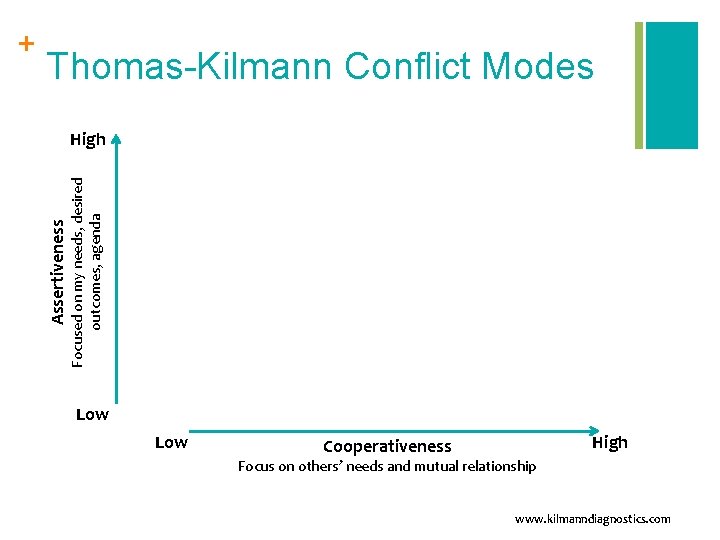
Thomas-Kilmann Conflict Modes Focused on my needs, desired outcomes, agenda High Assertiveness + Low Cooperativeness High Focus on others’ needs and mutual relationship www. kilmanndiagnostics. com
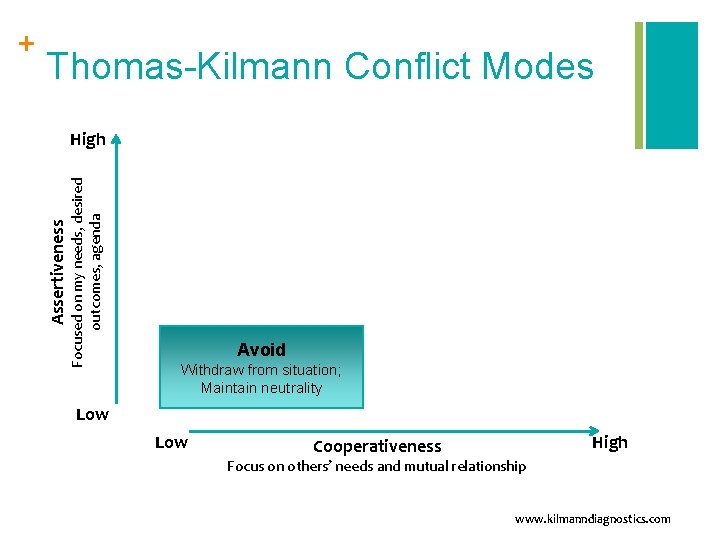
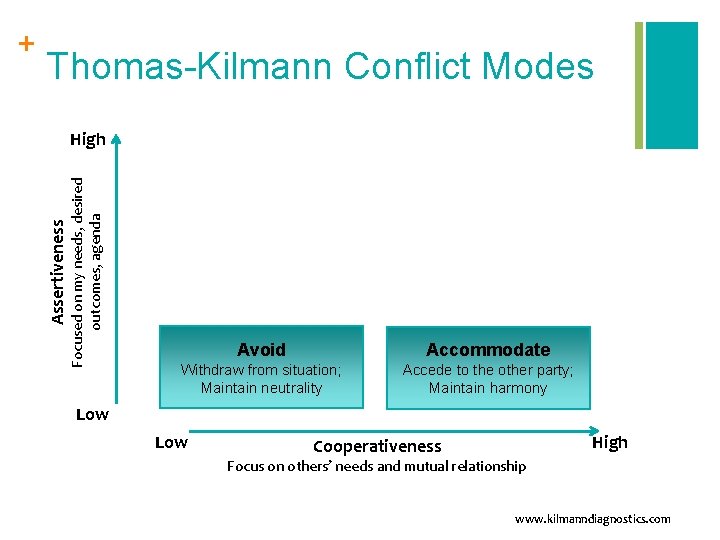
Thomas-Kilmann Conflict Modes Focused on my needs, desired outcomes, agenda High Assertiveness + Avoid Withdraw from situation; Maintain neutrality Low Cooperativeness High Focus on others’ needs and mutual relationship www. kilmanndiagnostics. com
Thomas-Kilmann Conflict Modes Focused on my needs, desired outcomes, agenda High Assertiveness + Avoid Accommodate Withdraw from situation; Maintain neutrality Accede to the other party; Maintain harmony Low Cooperativeness High Focus on others’ needs and mutual relationship www. kilmanndiagnostics. com
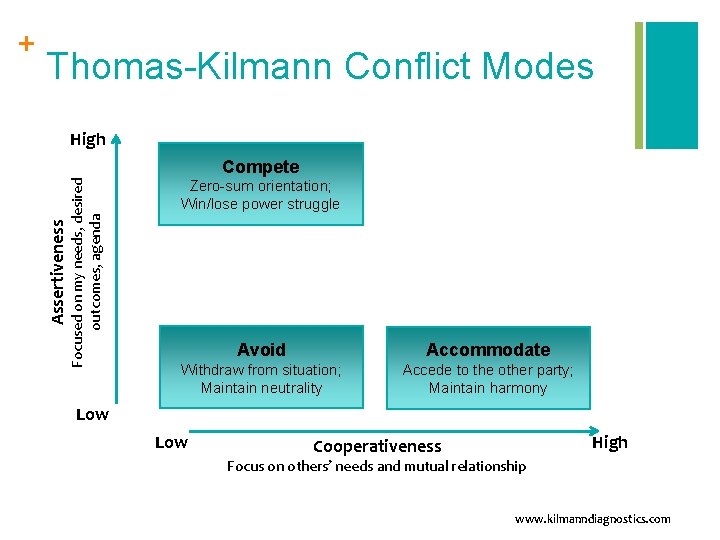
Thomas-Kilmann Conflict Modes High Focused on my needs, desired outcomes, agenda Compete Zero-sum orientation; Win/lose power struggle Assertiveness + Avoid Accommodate Withdraw from situation; Maintain neutrality Accede to the other party; Maintain harmony Low Cooperativeness High Focus on others’ needs and mutual relationship www. kilmanndiagnostics. com
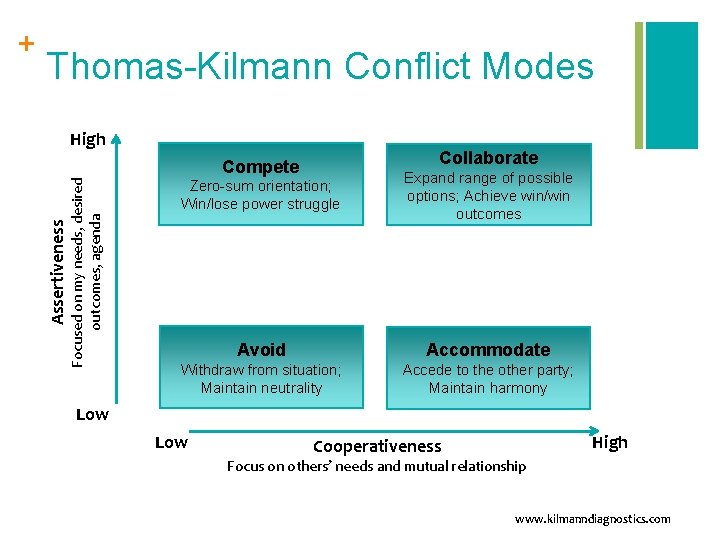
Thomas-Kilmann Conflict Modes High Collaborate Focused on my needs, desired outcomes, agenda Compete Zero-sum orientation; Win/lose power struggle Expand range of possible options; Achieve win/win outcomes Avoid Accommodate Withdraw from situation; Maintain neutrality Accede to the other party; Maintain harmony Assertiveness + Low Cooperativeness High Focus on others’ needs and mutual relationship www. kilmanndiagnostics. com
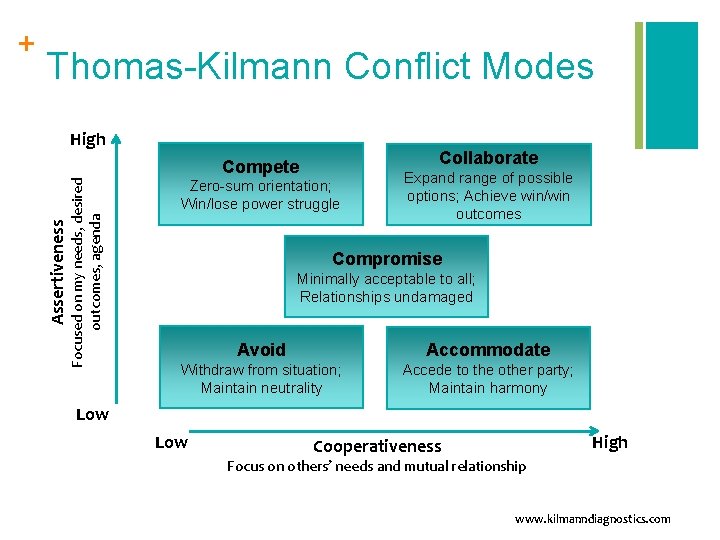
Thomas-Kilmann Conflict Modes High Collaborate Focused on my needs, desired outcomes, agenda Compete Zero-sum orientation; Win/lose power struggle Assertiveness + Expand range of possible options; Achieve win/win outcomes Compromise Minimally acceptable to all; Relationships undamaged Avoid Accommodate Withdraw from situation; Maintain neutrality Accede to the other party; Maintain harmony Low Cooperativeness High Focus on others’ needs and mutual relationship www. kilmanndiagnostics. com
+ You and Your Client n What is your “go to” mode in high conflict situations? n What are the strengths of that mode? n What might get in the way when your mode is over done? n What is the dance when you are with another who has the same conflict “go to” mode ~ and the dance with someone who has a different “go to” mode?
+ Thank you. Melissa S. Kelly-Mc. Cabe, MCC Board Certified Coach mkmccabe@Clear. Intent. Strategy. com www. Clear. Intent. Strategy. com
+ Doug Baumoel
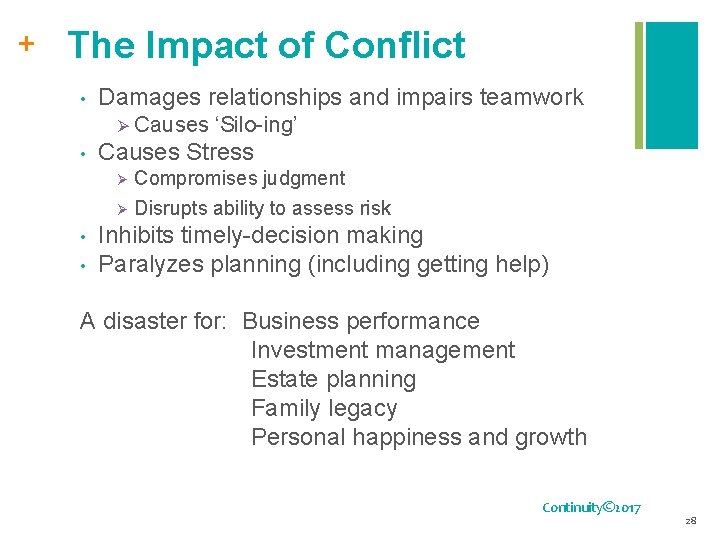
+ The Impact of Conflict • Damages relationships and impairs teamwork Ø Causes • ‘Silo-ing’ Causes Stress Compromises judgment Ø Disrupts ability to assess risk Ø • • Inhibits timely-decision making Paralyzes planning (including getting help) A disaster for: Business performance Investment management Estate planning Family legacy Personal happiness and growth Continuity© 2017 28
+ Managing Family Business Conflict: • First: Understand What’s Going On Ø Systemically/Structurally Ø Operationally Ø Emotionally • Second: Evaluate Approaches for Managing Conflict Ø Force Ø Bargaining Ø Development • Third: Match Approach to Symptom Ø Engage appropriate advisory team Continuity© 2017 29
+ Why is Conflict Built-in to the Family Enterprise System? • Family businesses are the business entitytype with the most interdependence among stakeholders. Ø • Emotional, Financial, Professional, Reputational, Social, Legal, Cultural, Generational High levels of interdependence mean higher potential for conflict. Continuity© 2017 30
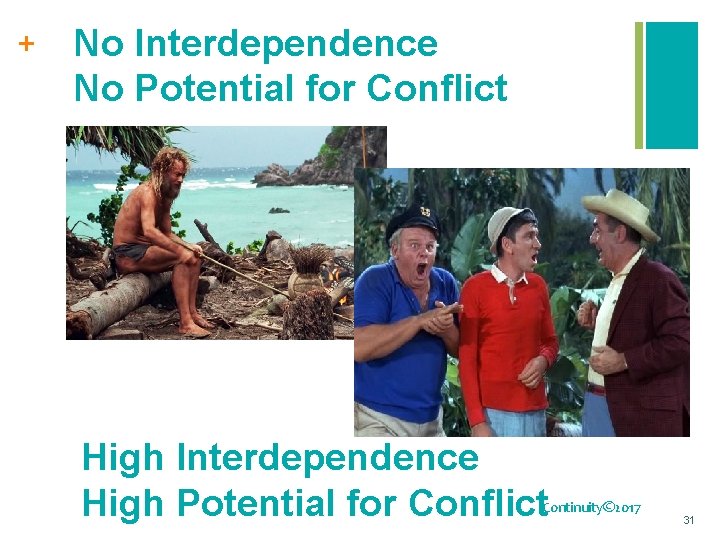
+ No Interdependence No Potential for Conflict High Interdependence High Potential for Conflict Continuity© 2017 31
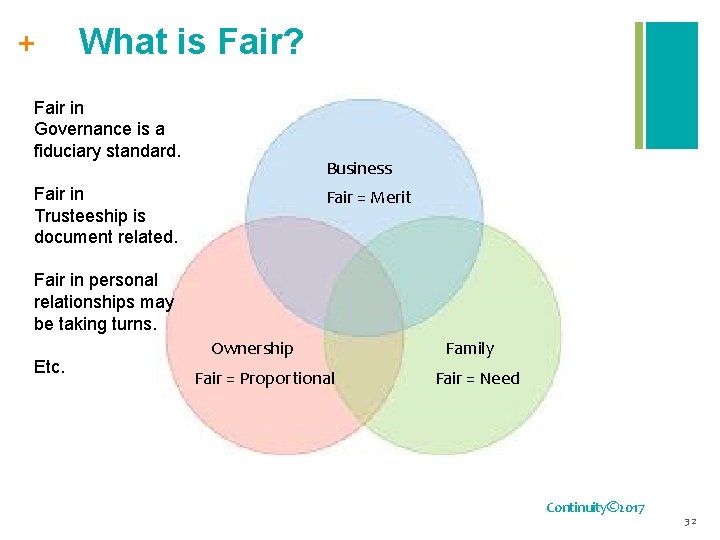
+ What is Fair? Fair in Governance is a fiduciary standard. Business Fair in Trusteeship is document related. Fair = Merit Fair in personal relationships may be taking turns. Etc. Ownership Fair = Proportional Family Fair = Need Continuity© 2017 32
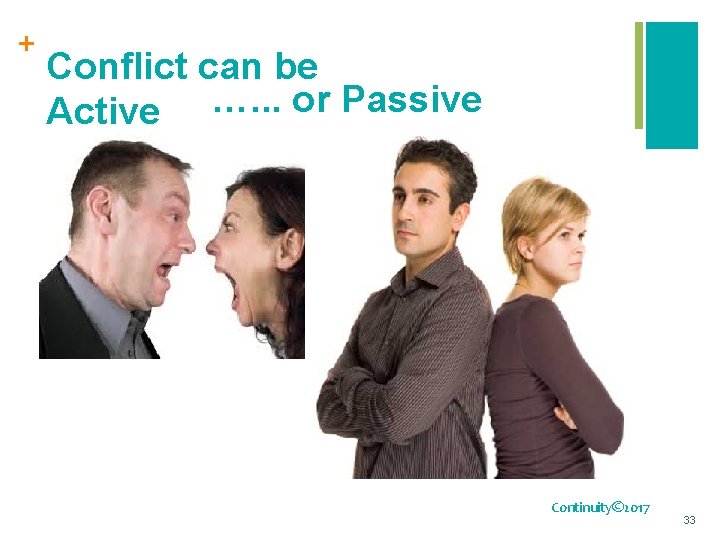
+ Conflict can be …. . . or Passive Active Continuity© 2017 33
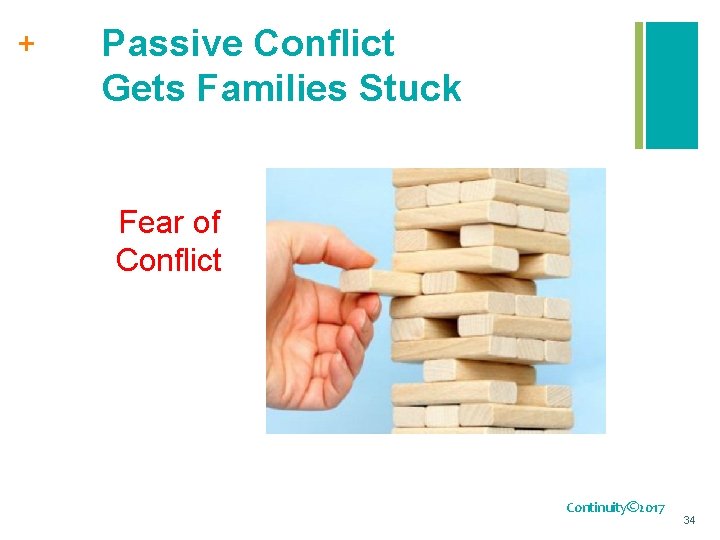
+ Passive Conflict Gets Families Stuck Fear of Conflict Continuity© 2017 34
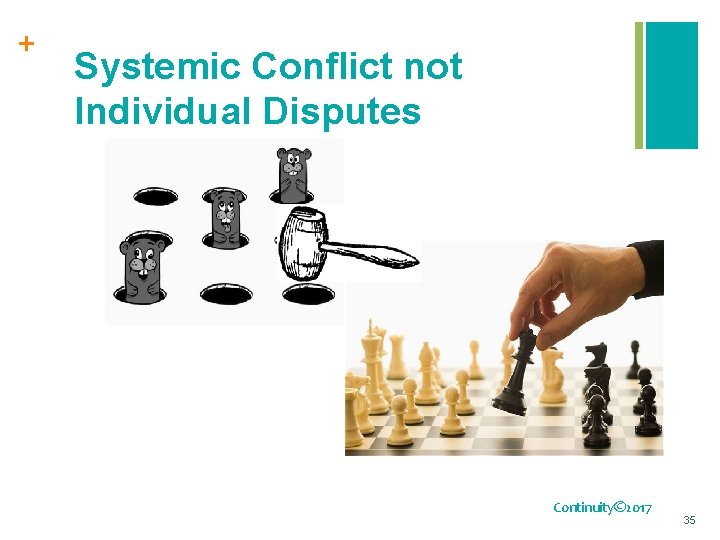
+ Systemic Conflict not Individual Disputes Continuity© 2017 35
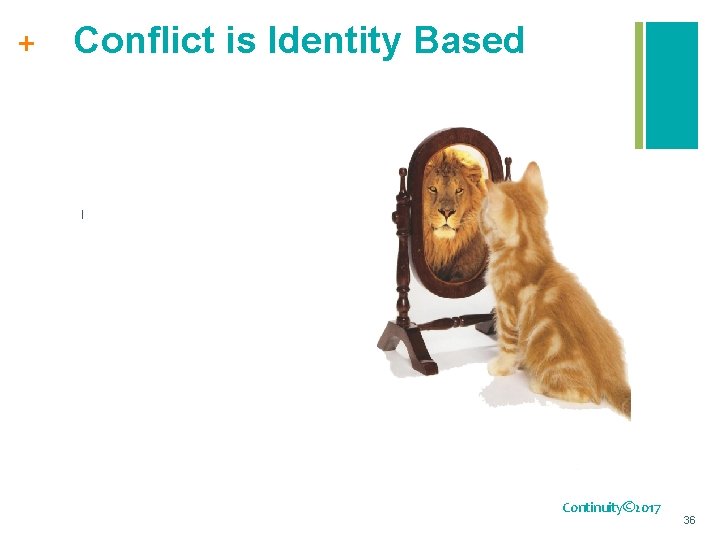
+ Conflict is Identity Based Continuity© 2017 36
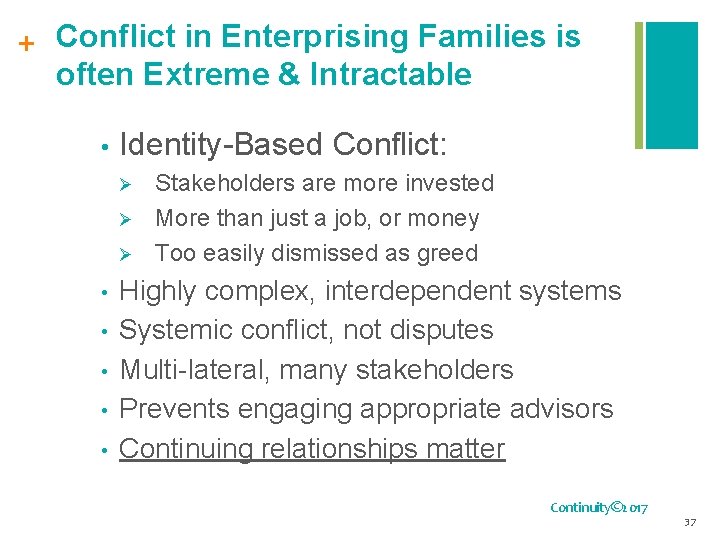
+ Conflict in Enterprising Families is often Extreme & Intractable • Identity-Based Conflict: Ø Ø Ø • • • Stakeholders are more invested More than just a job, or money Too easily dismissed as greed Highly complex, interdependent systems Systemic conflict, not disputes Multi-lateral, many stakeholders Prevents engaging appropriate advisors Continuing relationships matter Continuity© 2017 37
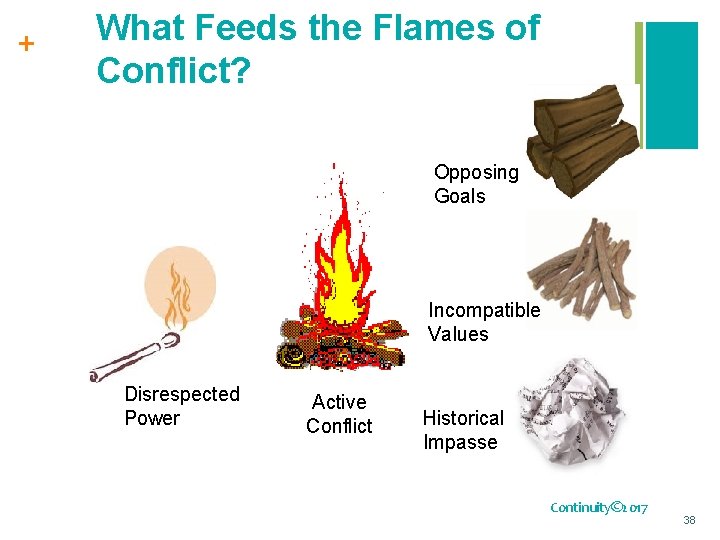
+ What Feeds the Flames of Conflict? Opposing Goals Incompatible Values Disrespected Power Active Fear of Conflict Historical Impasse Continuity© 2017 38
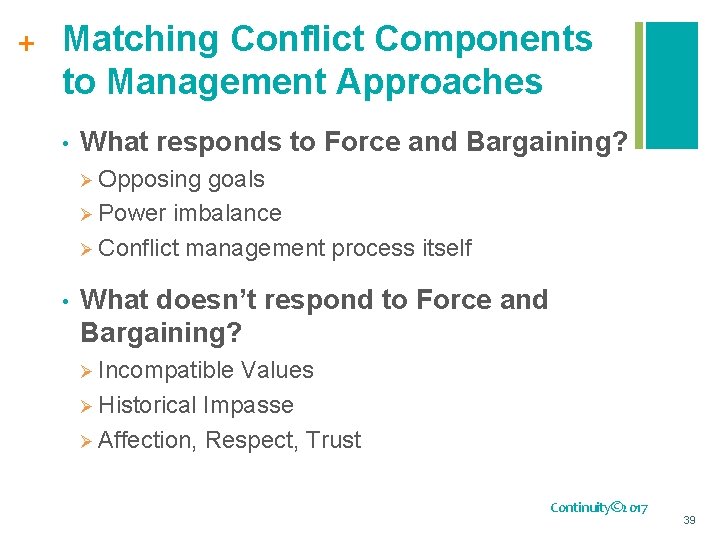
+ Matching Conflict Components to Management Approaches • What responds to Force and Bargaining? Ø Opposing goals Ø Power imbalance Ø Conflict management process itself • What doesn’t respond to Force and Bargaining? Ø Incompatible Values Ø Historical Impasse Ø Affection, Respect, Trust 39 Continuity© 2017 39
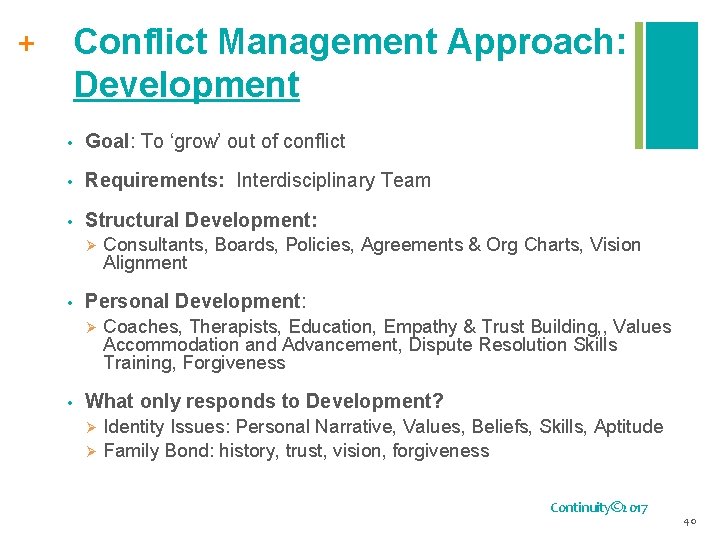
+ Conflict Management Approach: Development • Goal: To ‘grow’ out of conflict • Requirements: Interdisciplinary Team • Structural Development: Ø • Personal Development: Ø • Consultants, Boards, Policies, Agreements & Org Charts, Vision Alignment Coaches, Therapists, Education, Empathy & Trust Building, , Values Accommodation and Advancement, Dispute Resolution Skills Training, Forgiveness What only responds to Development? Ø Ø Identity Issues: Personal Narrative, Values, Beliefs, Skills, Aptitude Family Bond: history, trust, vision, forgiveness Continuity© 2017 40
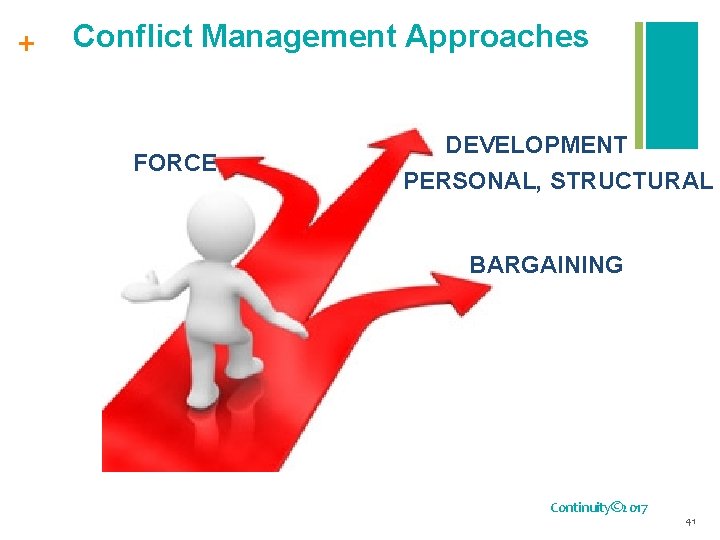
+ Conflict Management Approaches FORCE DEVELOPMENT PERSONAL, STRUCTURAL BARGAINING Continuity© 2017 41
+ Summary § § Conflict in Family Business is Identity-Based Identity includes Non-Negotiable characteristics: Ø • • beliefs, values, affection, skills, experience, perspective, etc. Common mistakes to managing family business conflict: Ø Mediating the Non-negotiable Ø Using force (legal, financial, threats, voting) Ø Over-reliance on communication Personal development: be the best stakeholder you can be Structural development: Create policy, agreements, process, Build trust through shared experience Forge strategic alignment, or provide exit ramp Communicate clearly, purposefully Prepare for, and expect, conflict – it is normal, it’s what tells you that your organization is evolving Continuity© 2017 42
+ Find us online at: Galliard. Institute. org @galliardgroup Galliard Family Business Advisor Institute @Galliard. FBAI Remember, we are here to help you to help YOUR clients! Thank you!