
Cooling of Transformer Unit 3 Electrical Machine Design
- Slides: 13
Cooling of Transformer Unit 3 Electrical Machine Design
Cooling of transformers Losses in transformer-Converted in heat energy. Heat developed is transmitted by, Conduction Convection Radiation The paths of heat flow are, From internal hot spot to the outer surface(in contact with oil) From outer surface to the oil From the oil to the tank From tank to the cooling medium-Air or water.
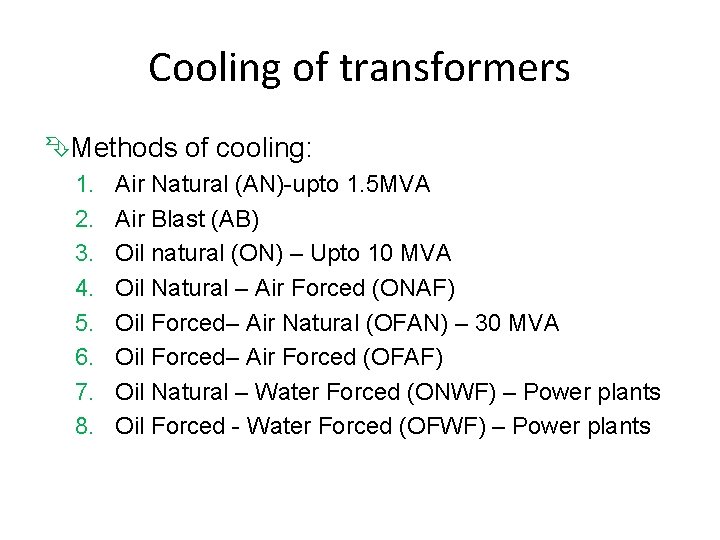
Cooling of transformers Methods of cooling: 1. 2. 3. 4. 5. 6. 7. 8. Air Natural (AN)-upto 1. 5 MVA Air Blast (AB) Oil natural (ON) – Upto 10 MVA Oil Natural – Air Forced (ONAF) Oil Forced– Air Natural (OFAN) – 30 MVA Oil Forced– Air Forced (OFAF) Oil Natural – Water Forced (ONWF) – Power plants Oil Forced - Water Forced (OFWF) – Power plants
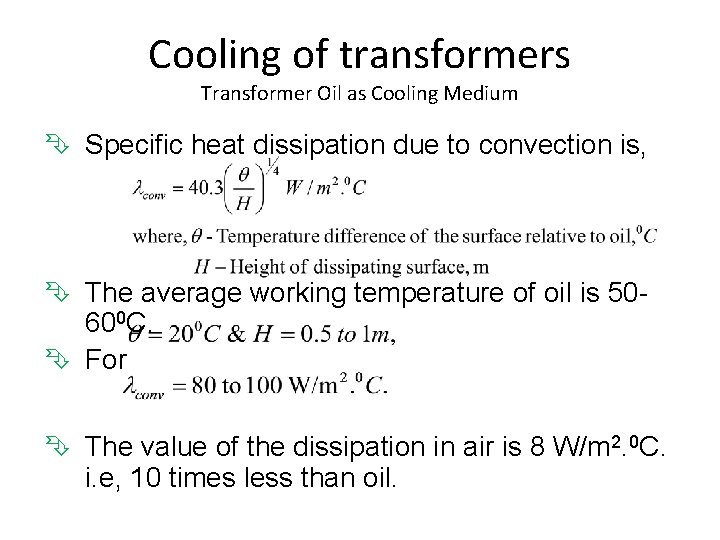
Cooling of transformers Transformer Oil as Cooling Medium Specific heat dissipation due to convection is, The average working temperature of oil is 50600 C. For The value of the dissipation in air is 8 W/m 2. 0 C. i. e, 10 times less than oil.
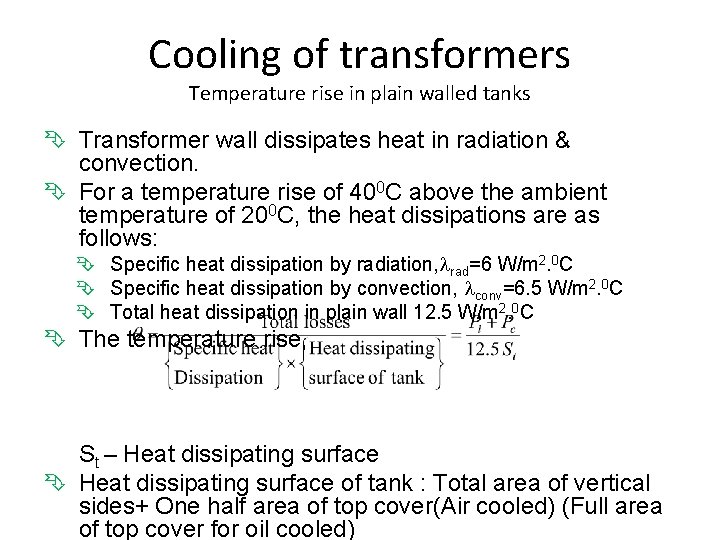
Cooling of transformers Temperature rise in plain walled tanks Transformer wall dissipates heat in radiation & convection. For a temperature rise of 400 C above the ambient temperature of 200 C, the heat dissipations are as follows: Specific heat dissipation by radiation, rad=6 W/m 2. 0 C Specific heat dissipation by convection, conv=6. 5 W/m 2. 0 C Total heat dissipation in plain wall 12. 5 W/m 2. 0 C The temperature rise, St – Heat dissipating surface of tank : Total area of vertical sides+ One half area of top cover(Air cooled) (Full area of top cover for oil cooled)
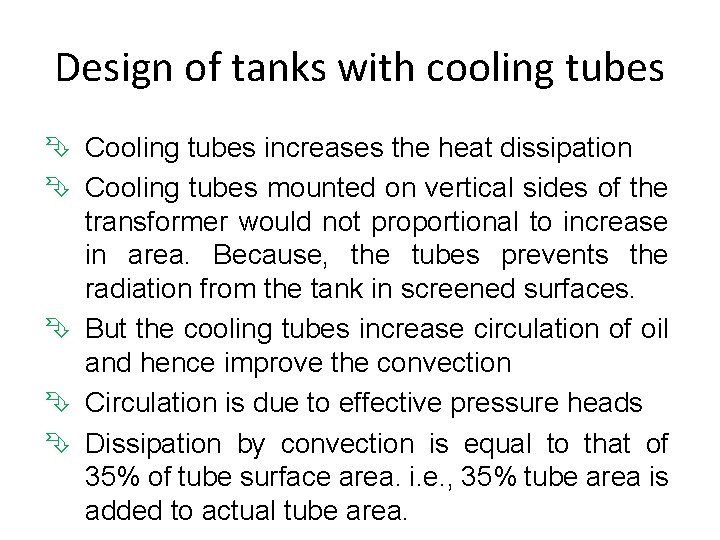
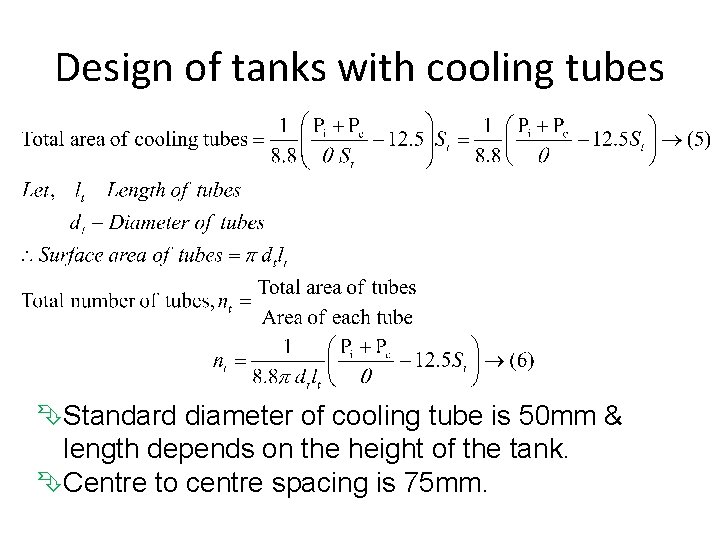
Design of tanks with cooling tubes Cooling tubes increases the heat dissipation Cooling tubes mounted on vertical sides of the transformer would not proportional to increase in area. Because, the tubes prevents the radiation from the tank in screened surfaces. But the cooling tubes increase circulation of oil and hence improve the convection Circulation is due to effective pressure heads Dissipation by convection is equal to that of 35% of tube surface area. i. e. , 35% tube area is added to actual tube area.
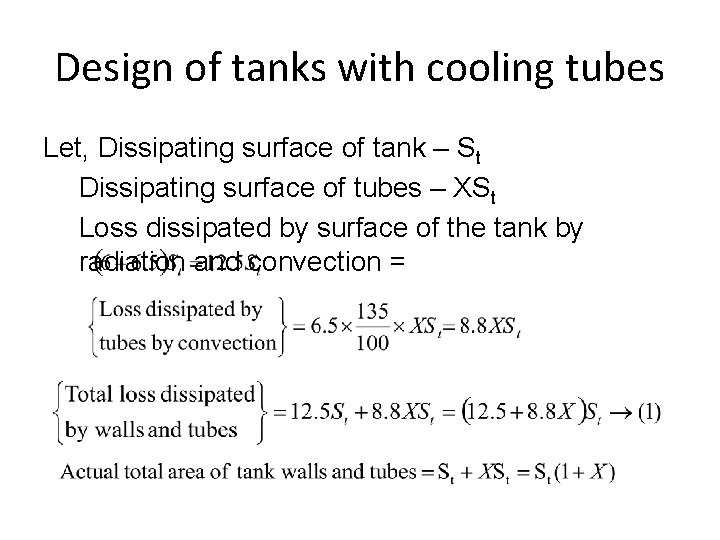
Design of tanks with cooling tubes Let, Dissipating surface of tank – St Dissipating surface of tubes – XSt Loss dissipated by surface of the tank by radiation and convection =
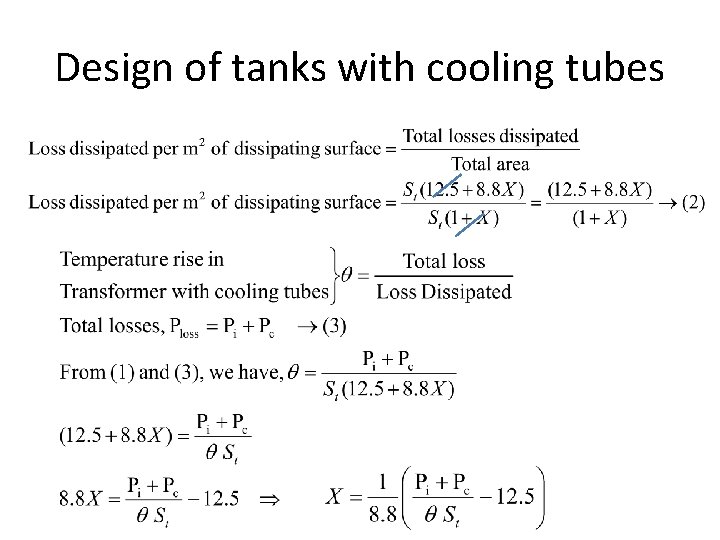
Design of tanks with cooling tubes
Design of tanks with cooling tubes Standard diameter of cooling tube is 50 mm & length depends on the height of the tank. Centre to centre spacing is 75 mm.
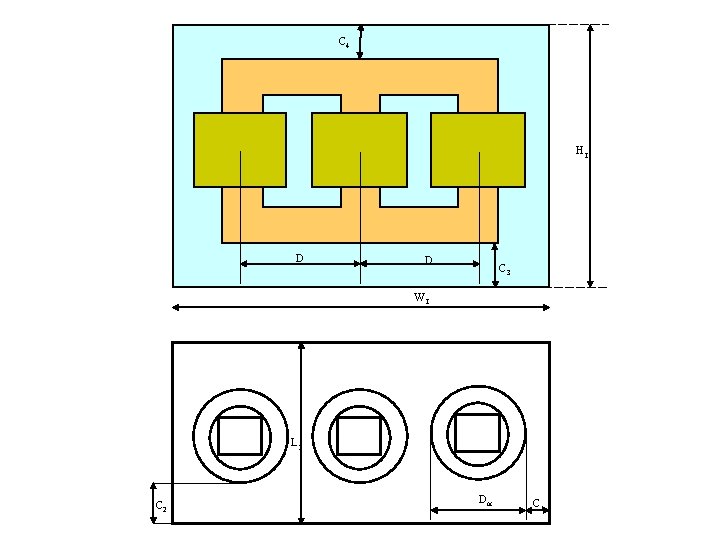
C 4 HT D D C 3 WT LT C 2 Doc C 1
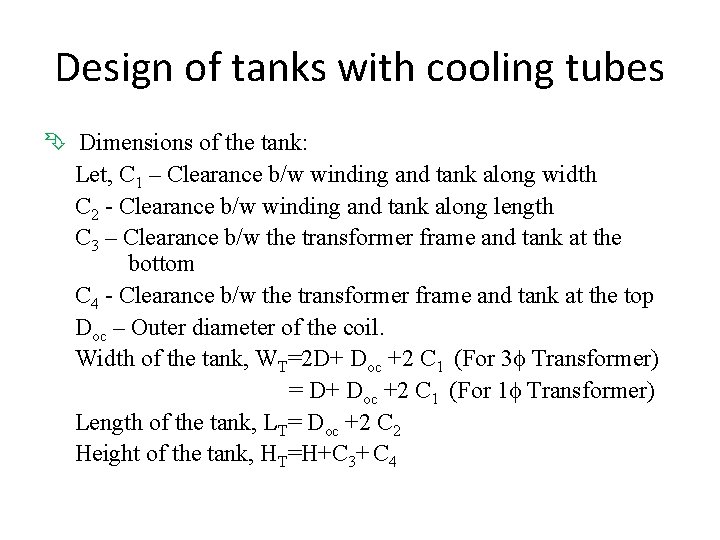
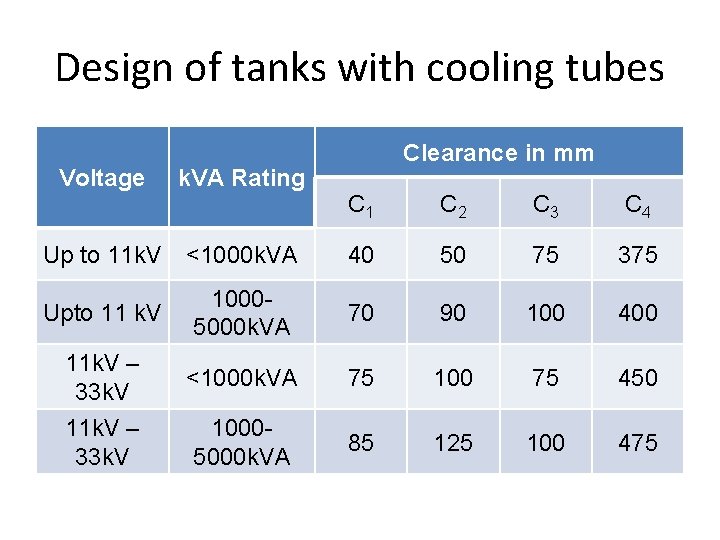
Design of tanks with cooling tubes Dimensions of the tank: Let, C 1 – Clearance b/w winding and tank along width C 2 - Clearance b/w winding and tank along length C 3 – Clearance b/w the transformer frame and tank at the bottom C 4 - Clearance b/w the transformer frame and tank at the top Doc – Outer diameter of the coil. Width of the tank, WT=2 D+ Doc +2 C 1 (For 3 Transformer) = D+ Doc +2 C 1 (For 1 Transformer) Length of the tank, LT= Doc +2 C 2 Height of the tank, HT=H+C 3+ C 4
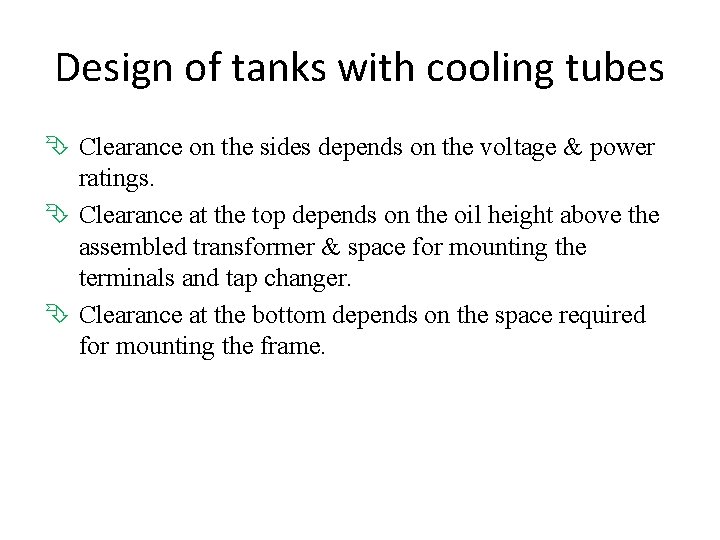
Design of tanks with cooling tubes Clearance on the sides depends on the voltage & power ratings. Clearance at the top depends on the oil height above the assembled transformer & space for mounting the terminals and tap changer. Clearance at the bottom depends on the space required for mounting the frame.
Design of tanks with cooling tubes Voltage k. VA Rating Up to 11 k. V Clearance in mm C 1 C 2 C 3 C 4 <1000 k. VA 40 50 75 375 Upto 11 k. V 10005000 k. VA 70 90 100 400 11 k. V – 33 k. V <1000 k. VA 75 100 75 450 11 k. V – 33 k. V 10005000 k. VA 85 125 100 475