
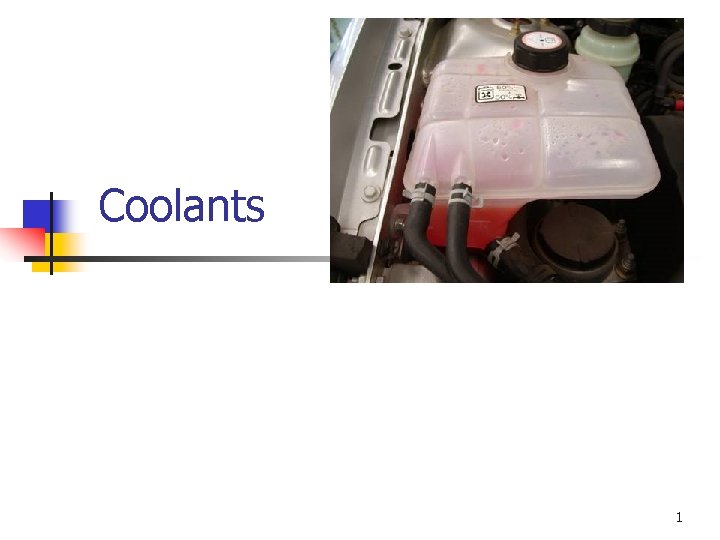
Coolants 1 What is Coolant Coolant is a
- Slides: 89
Coolants 1
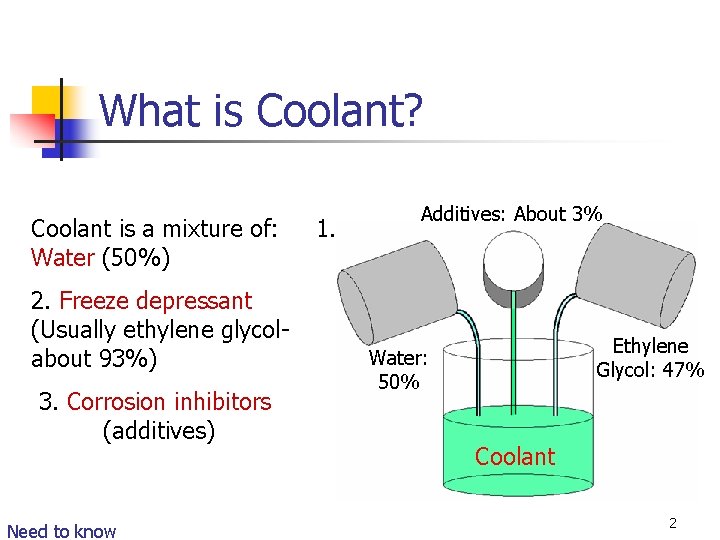
What is Coolant? Coolant is a mixture of: Water (50%) 2. Freeze depressant (Usually ethylene glycolabout 93%) 3. Corrosion inhibitors (additives) Need to know 1. Additives: About 3% Ethylene Glycol: 47% Water: 50% Coolant 2
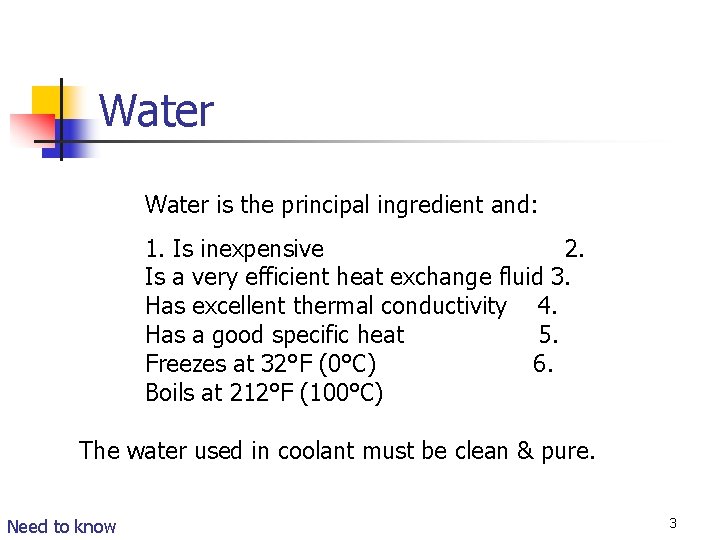
Water is the principal ingredient and: 1. Is inexpensive 2. Is a very efficient heat exchange fluid 3. Has excellent thermal conductivity 4. Has a good specific heat 5. Freezes at 32°F (0°C) 6. Boils at 212°F (100°C) The water used in coolant must be clean & pure. Need to know 3
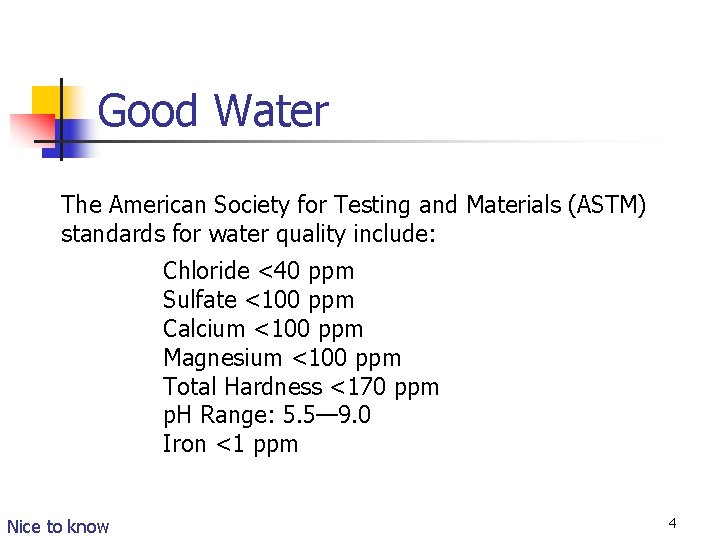
Good Water The American Society for Testing and Materials (ASTM) standards for water quality include: Chloride <40 ppm Sulfate <100 ppm Calcium <100 ppm Magnesium <100 ppm Total Hardness <170 ppm p. H Range: 5. 5— 9. 0 Iron <1 ppm Nice to know 4
Good Quality Water Good quality water types include: • Deionized • Distilled • Demineralized • Purified Need to know 5
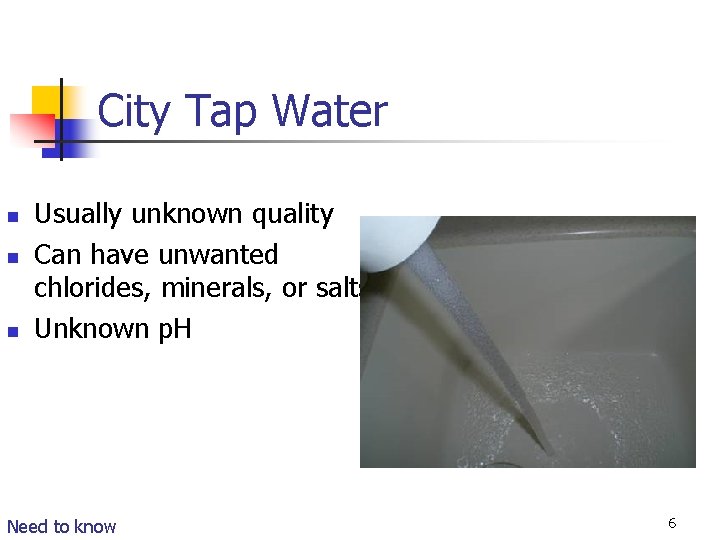
City Tap Water n n n Usually unknown quality Can have unwanted chlorides, minerals, or salts Unknown p. H Need to know 6
What to do? Test the water at the shop and if it has high mineral content, consider: 1. Purchasing distilled or demineralized water 2. Installing a micro filtration system 3. Installing a reverse osmosis system Need to know 7
Burst Pressure Water expands when it freezes, and this creates the burst pressure that can break cooling system components. Antifreezes (freeze depressants) lower the freeze temperature. Nice to know 8
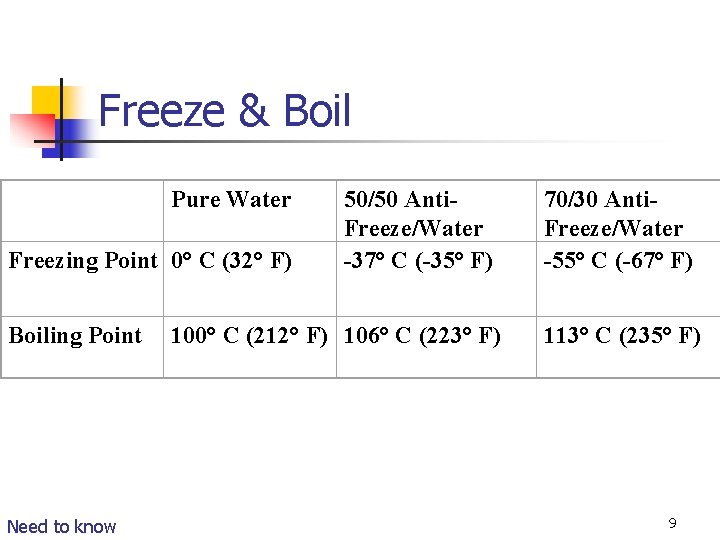
Freeze & Boil Pure Water Freezing Point 0° C (32° F) Boiling Point Need to know 50/50 Anti. Freeze/Water -37° C (-35° F) 100° C (212° F) 106° C (223° F) 70/30 Anti. Freeze/Water -55° C (-67° F) 113° C (235° F) 9
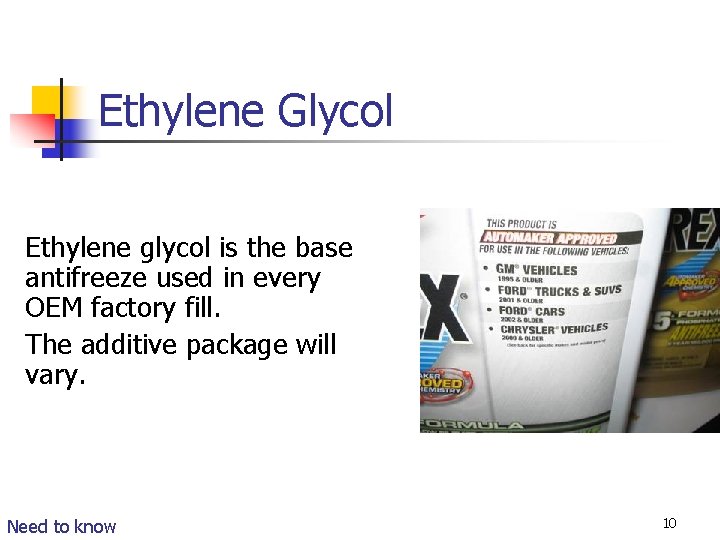
Ethylene Glycol Ethylene glycol is the base antifreeze used in every OEM factory fill. The additive package will vary. Need to know 10
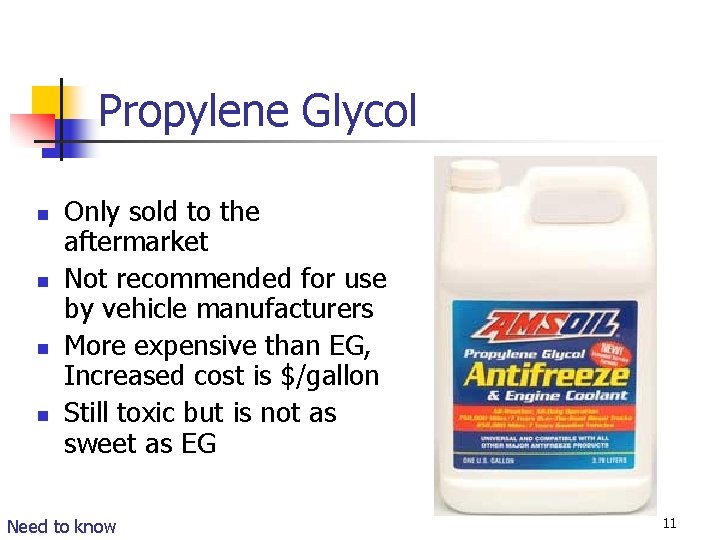
Propylene Glycol n n Only sold to the aftermarket Not recommended for use by vehicle manufacturers More expensive than EG, Increased cost is $/gallon Still toxic but is not as sweet as EG Need to know 11
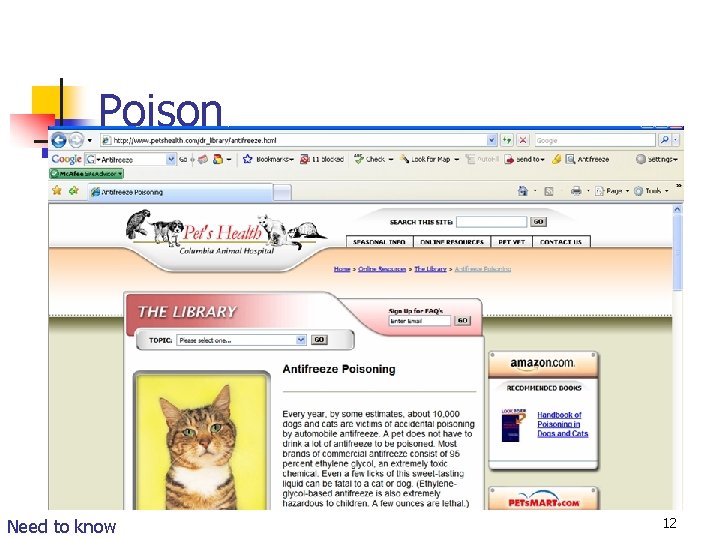
Poison Need to know 12
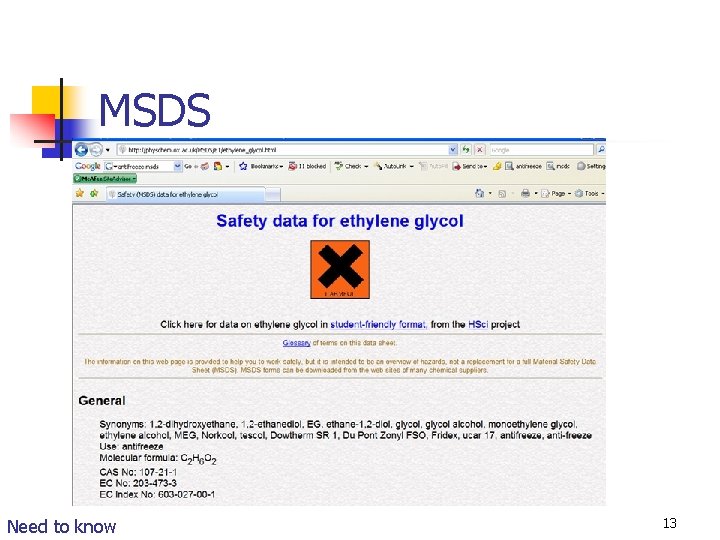
MSDS Need to know 13
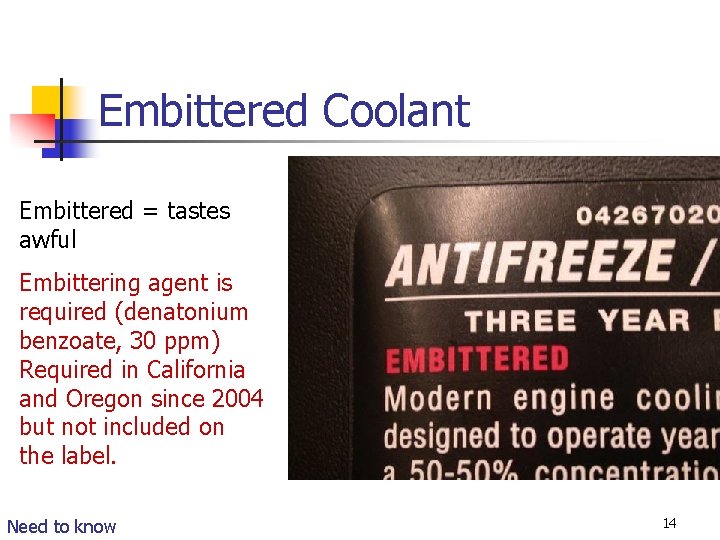
Embittered Coolant Embittered = tastes awful Embittering agent is required (denatonium benzoate, 30 ppm) Required in California and Oregon since 2004 but not included on the label. Need to know 14
Additives The major additives: 1. reduce corrosion 2. buffer p. H 3. add color (dye) Need to know 15
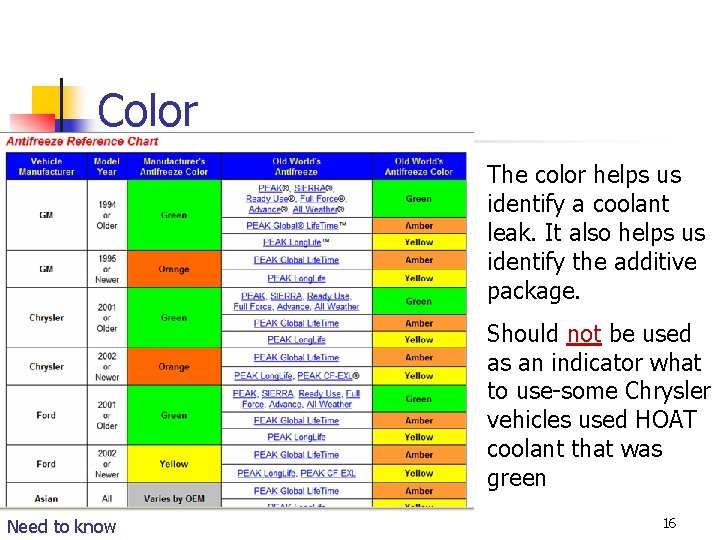
Color The color helps us identify a coolant leak. It also helps us identify the additive package. Should not be used as an indicator what to use-some Chrysler vehicles used HOAT coolant that was green Need to know 16
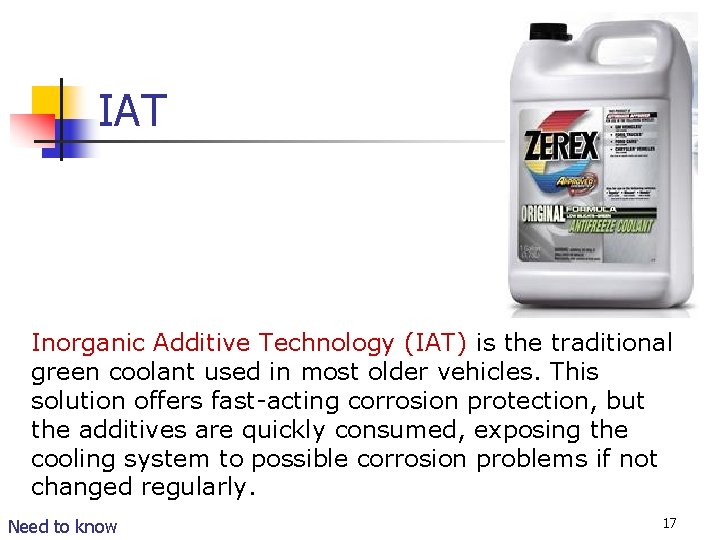
IAT Inorganic Additive Technology (IAT) is the traditional green coolant used in most older vehicles. This solution offers fast-acting corrosion protection, but the additives are quickly consumed, exposing the cooling system to possible corrosion problems if not changed regularly. Need to know 17
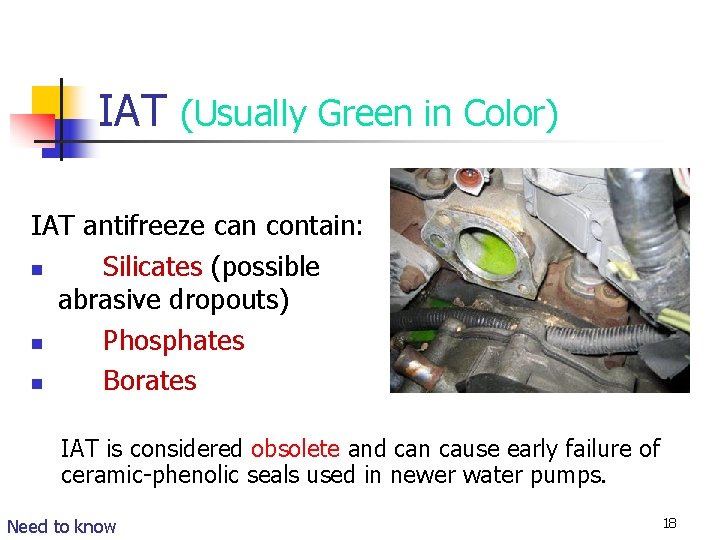
IAT (Usually Green in Color) IAT antifreeze can contain: n Silicates (possible abrasive dropouts) n Phosphates n Borates IAT is considered obsolete and can cause early failure of ceramic-phenolic seals used in newer water pumps. Need to know 18
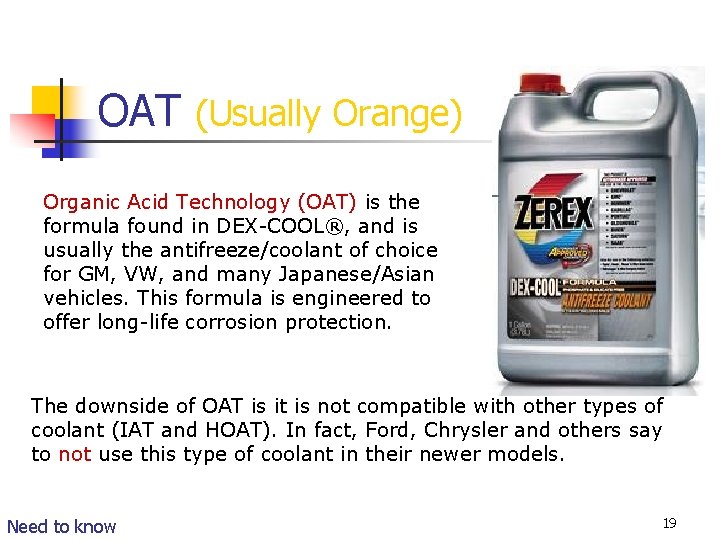
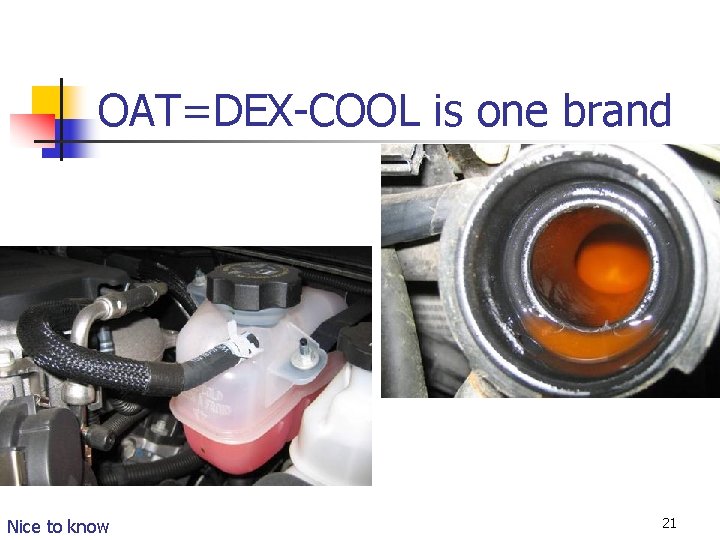
OAT (Usually Orange) Organic Acid Technology (OAT) is the formula found in DEX-COOL®, and is usually the antifreeze/coolant of choice for GM, VW, and many Japanese/Asian vehicles. This formula is engineered to offer long-life corrosion protection. The downside of OAT is it is not compatible with other types of coolant (IAT and HOAT). In fact, Ford, Chrysler and others say to not use this type of coolant in their newer models. Need to know 19
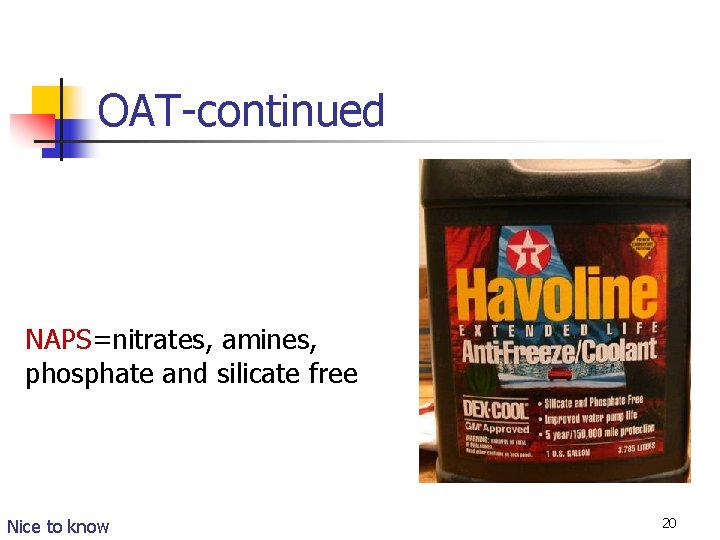
OAT-continued NAPS=nitrates, amines, phosphate and silicate free Nice to know 20
OAT=DEX-COOL is one brand Nice to know 21
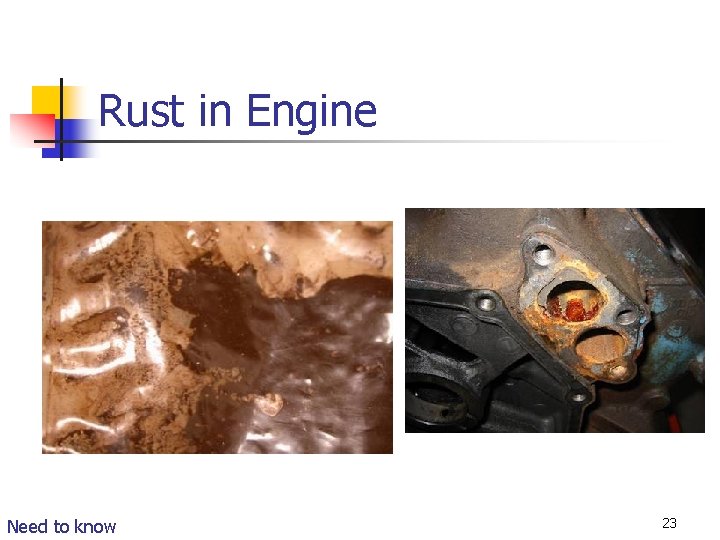
DEX-COOL Concerns n n Root cause seems to be air entering system past the cap and leaking intake manifolds Replace cap and check cap seats if radiator contains air Air causes rust of cast iron and formation of ‘Brown Gunk’ Rust then causes blockages Need to know 22
Rust in Engine Need to know 23
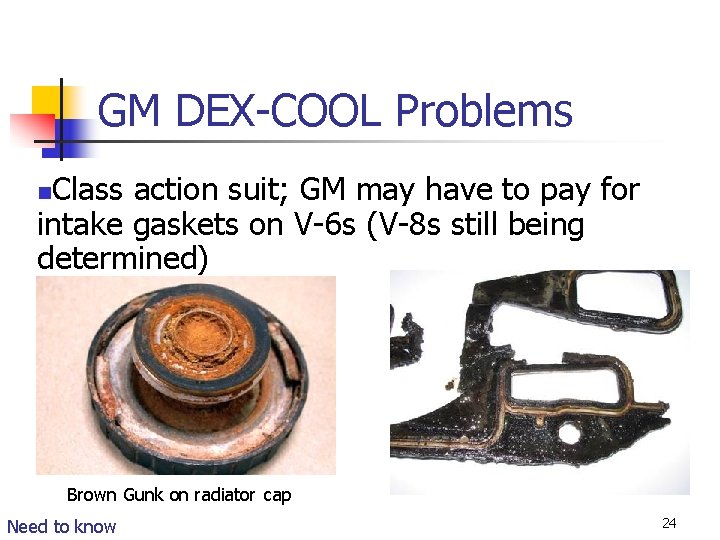
GM DEX-COOL Problems Class action suit; GM may have to pay for intake gaskets on V-6 s (V-8 s still being determined) n Brown Gunk on radiator cap Need to know 24
DEX-COOL’s Unique Formulation n DEX-COOL uses Ethylhexanoic Acid (2 EH) as a corrosive inhibitor 2 -EH is prone to damage plastics like Nylon 6. 6 used in intake manifold gaskets and radiators G 30 OAT and Peak Global OAT do NOT use 2 -EH Nice to know 25
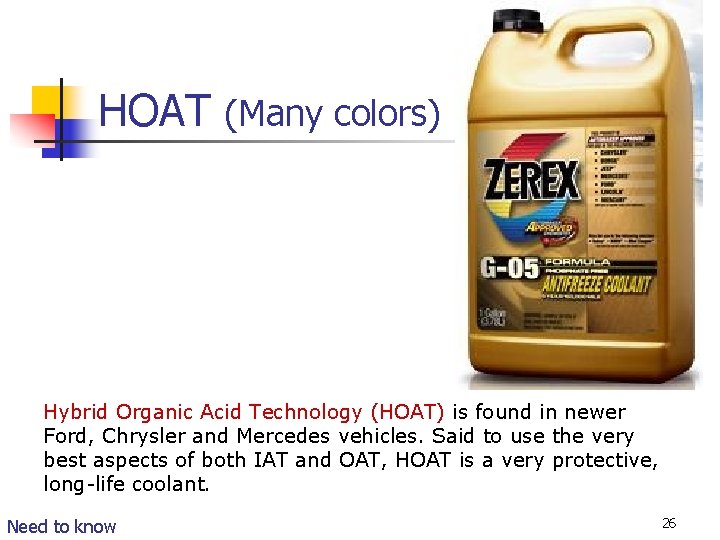
HOAT (Many colors) Hybrid Organic Acid Technology (HOAT) is found in newer Ford, Chrysler and Mercedes vehicles. Said to use the very best aspects of both IAT and OAT, HOAT is a very protective, long-life coolant. Need to know 26
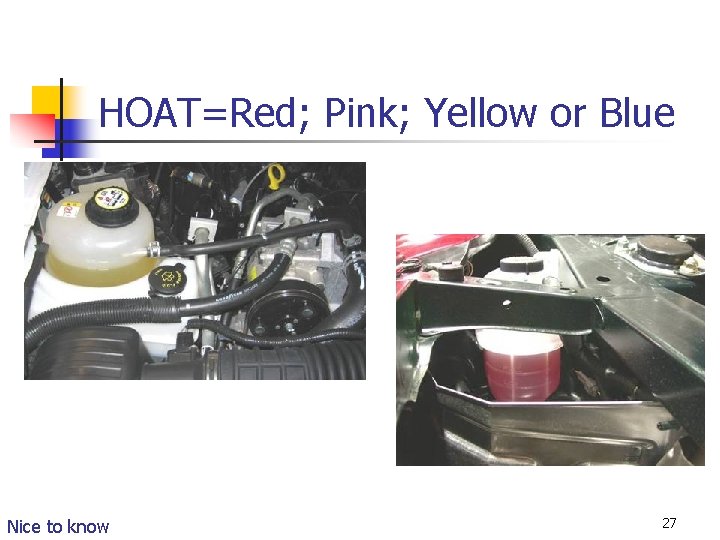
HOAT=Red; Pink; Yellow or Blue Nice to know 27
“G” Designations n n n G= Glysantin –trade name of BASF. Valvoline (Zerex) in the US. G 30 and G 34= non-silicate and phosphate free G 05 = different from Texaco’s DEX-COOL, G 05 product contains from 252 to 308 PPM Silicon which Valvoline believes provides a better aluminum protection Nice to know 28
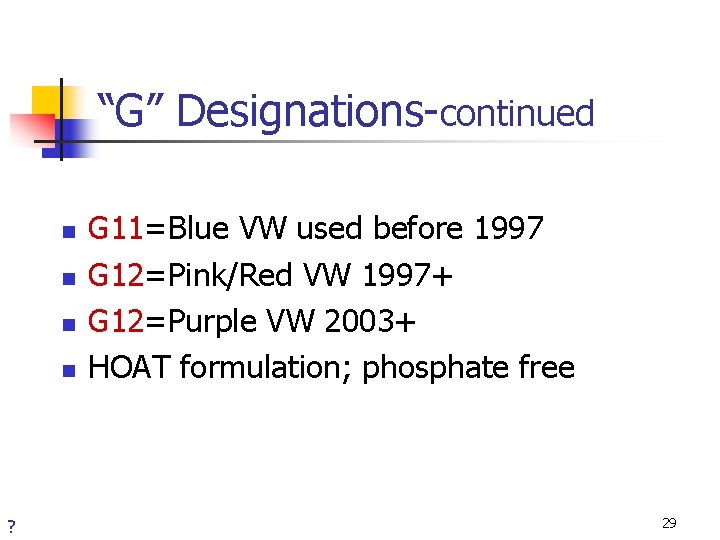
“G” Designations-continued n n ? G 11=Blue VW used before 1997 G 12=Pink/Red VW 1997+ G 12=Purple VW 2003+ HOAT formulation; phosphate free 29
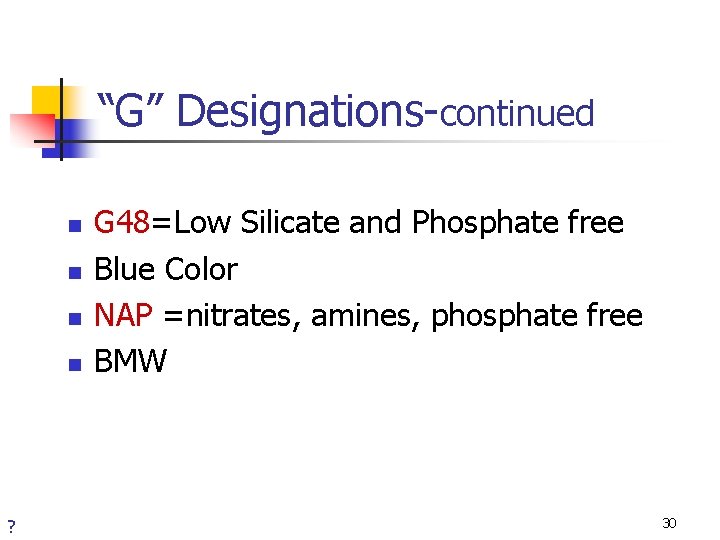
“G” Designations-continued n n ? G 48=Low Silicate and Phosphate free Blue Color NAP =nitrates, amines, phosphate free BMW 30
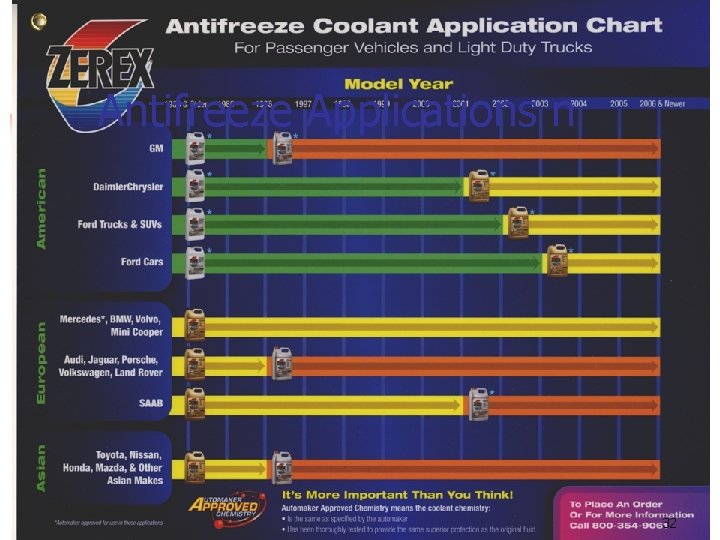
Replacement Antifreeze The best choice is to follow the vehicle manufacturer’s recommendations. OR, you can follow the recommendations of reliable antifreeze manufacturers (next slide). Need to know 31
Antifreeze Applications n 32
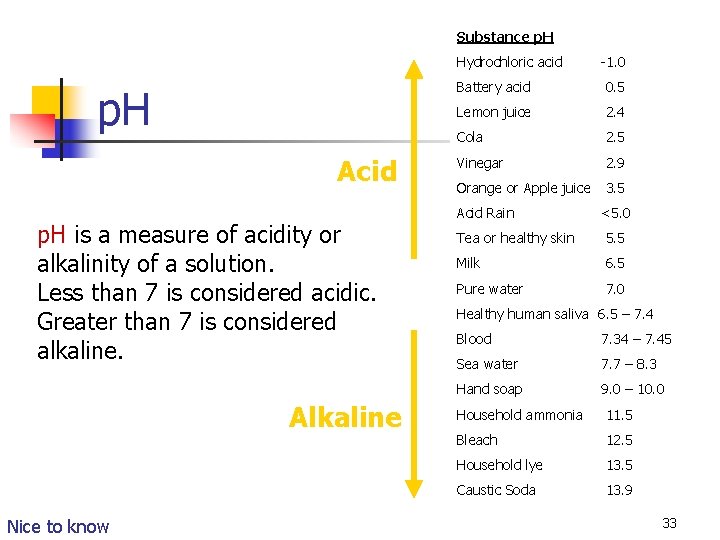
Substance p. H Hydrochloric acid p. H Acid p. H is a measure of acidity or alkalinity of a solution. Less than 7 is considered acidic. Greater than 7 is considered alkaline. Alkaline Nice to know -1. 0 Battery acid 0. 5 Lemon juice 2. 4 Cola 2. 5 Vinegar 2. 9 Orange or Apple juice 3. 5 Acid Rain <5. 0 Tea or healthy skin 5. 5 Milk 6. 5 Pure water 7. 0 Healthy human saliva 6. 5 – 7. 4 Blood 7. 34 – 7. 45 Sea water 7. 7 – 8. 3 Hand soap 9. 0 – 10. 0 Household ammonia 11. 5 Bleach 12. 5 Household lye 13. 5 Caustic Soda 13. 9 33
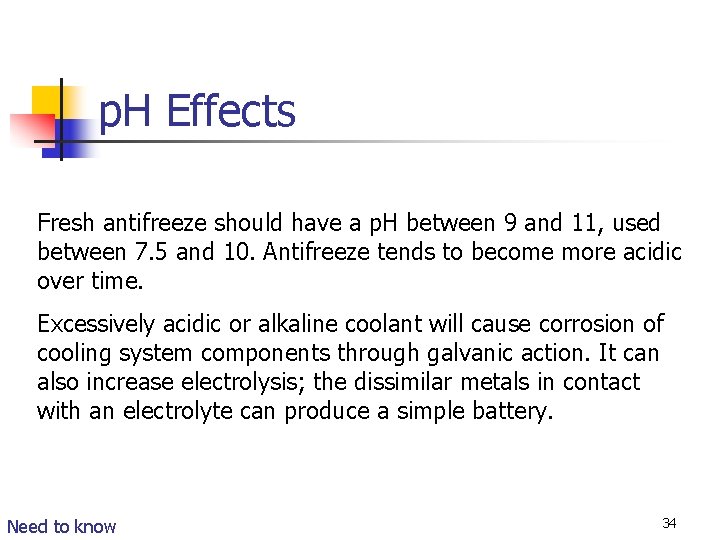
p. H Effects Fresh antifreeze should have a p. H between 9 and 11, used between 7. 5 and 10. Antifreeze tends to become more acidic over time. Excessively acidic or alkaline coolant will cause corrosion of cooling system components through galvanic action. It can also increase electrolysis; the dissimilar metals in contact with an electrolyte can produce a simple battery. Need to know 34
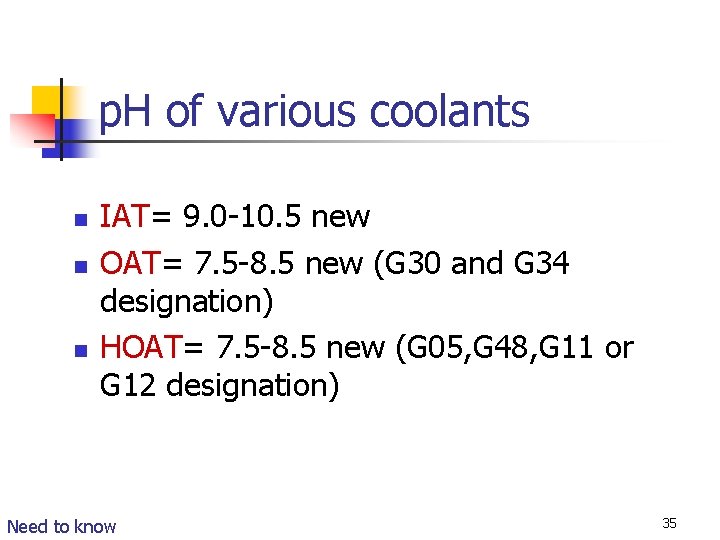
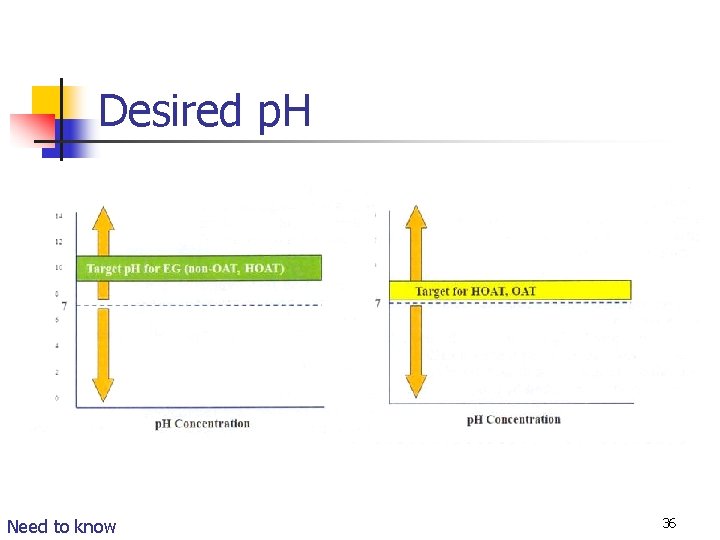
p. H of various coolants n n n IAT= 9. 0 -10. 5 new OAT= 7. 5 -8. 5 new (G 30 and G 34 designation) HOAT= 7. 5 -8. 5 new (G 05, G 48, G 11 or G 12 designation) Need to know 35
Desired p. H Need to know 36
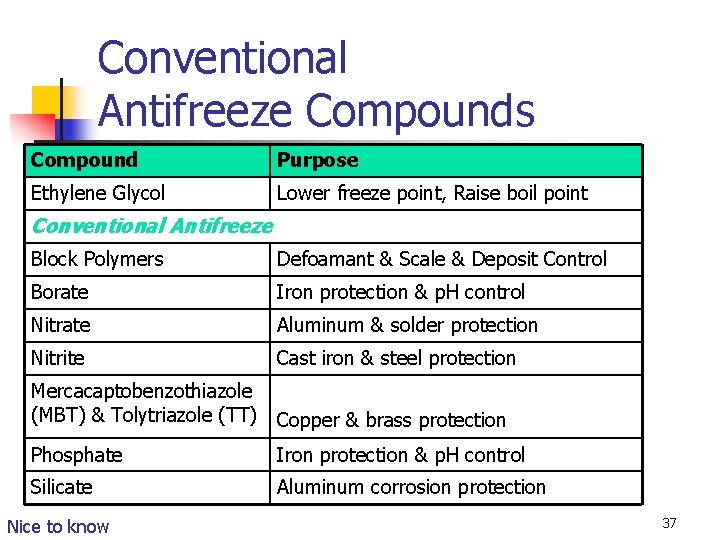
Conventional Antifreeze Compounds Compound Purpose Ethylene Glycol Lower freeze point, Raise boil point Conventional Antifreeze Block Polymers Defoamant & Scale & Deposit Control Borate Iron protection & p. H control Nitrate Aluminum & solder protection Nitrite Cast iron & steel protection Mercacaptobenzothiazole (MBT) & Tolytriazole (TT) Copper & brass protection Phosphate Iron protection & p. H control Silicate Aluminum corrosion protection Nice to know 37
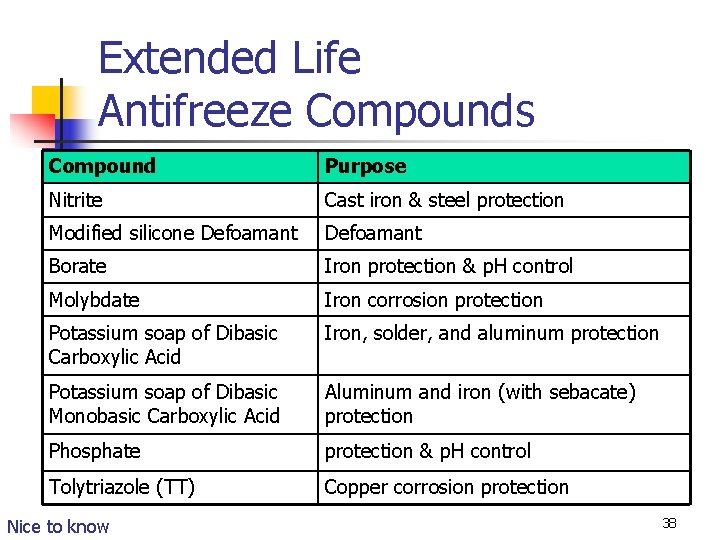
Extended Life Antifreeze Compounds Compound Purpose Nitrite Cast iron & steel protection Modified silicone Defoamant Borate Iron protection & p. H control Molybdate Iron corrosion protection Potassium soap of Dibasic Carboxylic Acid Iron, solder, and aluminum protection Potassium soap of Dibasic Monobasic Carboxylic Acid Aluminum and iron (with sebacate) protection Phosphate protection & p. H control Tolytriazole (TT) Copper corrosion protection Nice to know 38
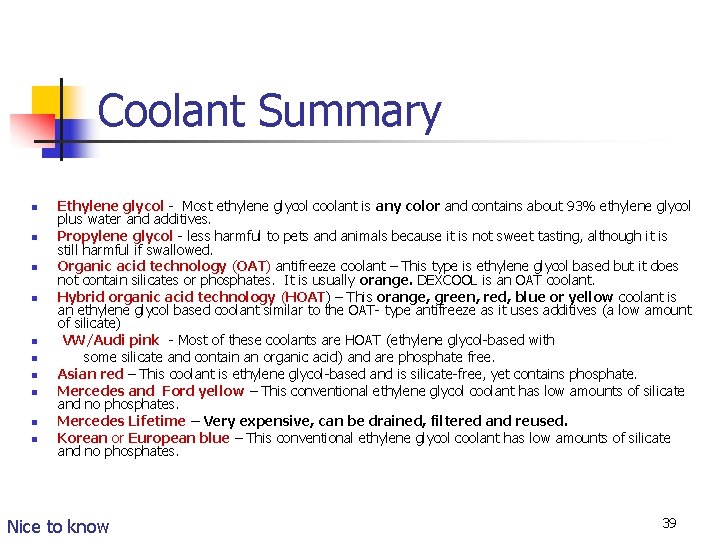
Coolant Summary n n n n n Ethylene glycol - Most ethylene glycol coolant is any color and contains about 93% ethylene glycol plus water and additives. Propylene glycol - less harmful to pets and animals because it is not sweet tasting, although it is still harmful if swallowed. Organic acid technology (OAT) antifreeze coolant – This type is ethylene glycol based but it does not contain silicates or phosphates. It is usually orange. DEXCOOL is an OAT coolant. Hybrid organic acid technology (HOAT) – This orange, green, red, blue or yellow coolant is an ethylene glycol based coolant similar to the OAT- type antifreeze as it uses additives (a low amount of silicate) VW/Audi pink - Most of these coolants are HOAT (ethylene glycol-based with some silicate and contain an organic acid) and are phosphate free. Asian red – This coolant is ethylene glycol-based and is silicate-free, yet contains phosphate. Mercedes and Ford yellow – This conventional ethylene glycol coolant has low amounts of silicate and no phosphates. Mercedes Lifetime – Very expensive, can be drained, filtered and reused. Korean or European blue – This conventional ethylene glycol coolant has low amounts of silicate and no phosphates. Nice to know 39
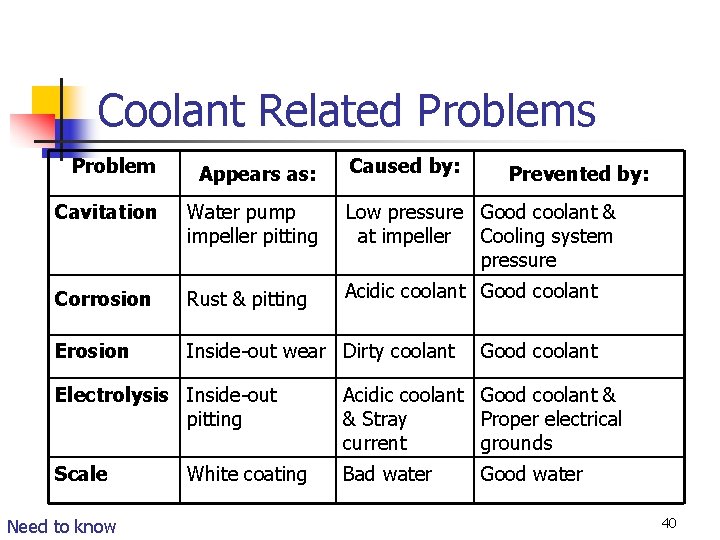
Coolant Related Problems Problem Appears as: Caused by: Cavitation Water pump impeller pitting Low pressure Good coolant & at impeller Cooling system pressure Corrosion Rust & pitting Acidic coolant Good coolant Erosion Inside-out wear Dirty coolant Prevented by: Good coolant Electrolysis Inside-out pitting Acidic coolant Good coolant & & Stray Proper electrical current grounds Scale Bad water Need to know White coating Good water 40
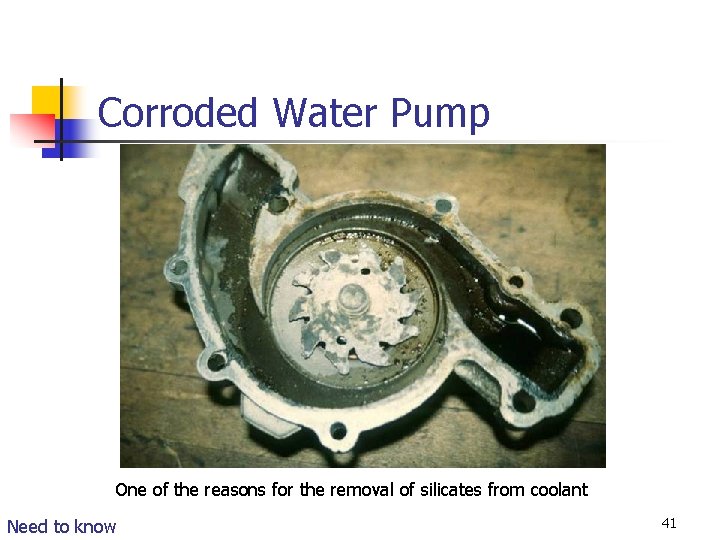
Corroded Water Pump One of the reasons for the removal of silicates from coolant Need to know 41
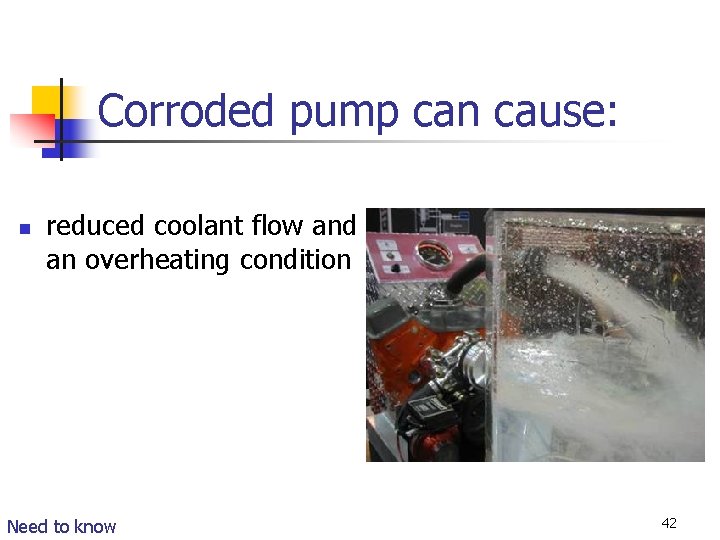
Corroded pump can cause: n reduced coolant flow and an overheating condition Need to know 42
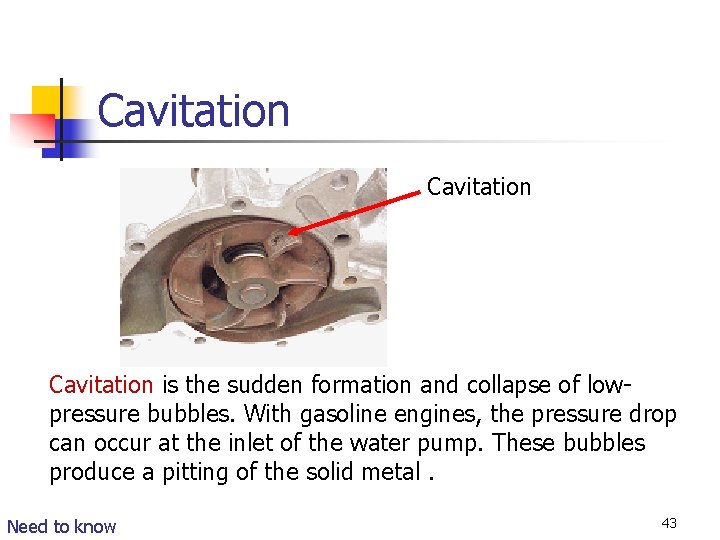
Cavitation is the sudden formation and collapse of lowpressure bubbles. With gasoline engines, the pressure drop can occur at the inlet of the water pump. These bubbles produce a pitting of the solid metal. Need to know 43
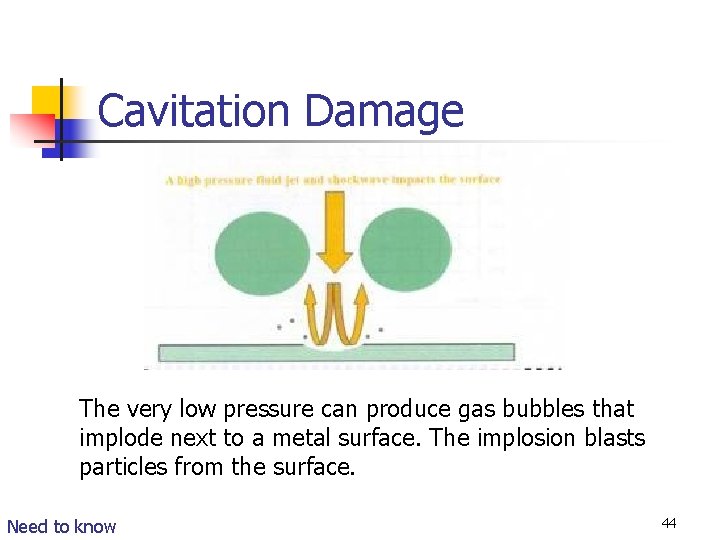
Cavitation Damage The very low pressure can produce gas bubbles that implode next to a metal surface. The implosion blasts particles from the surface. Need to know 44
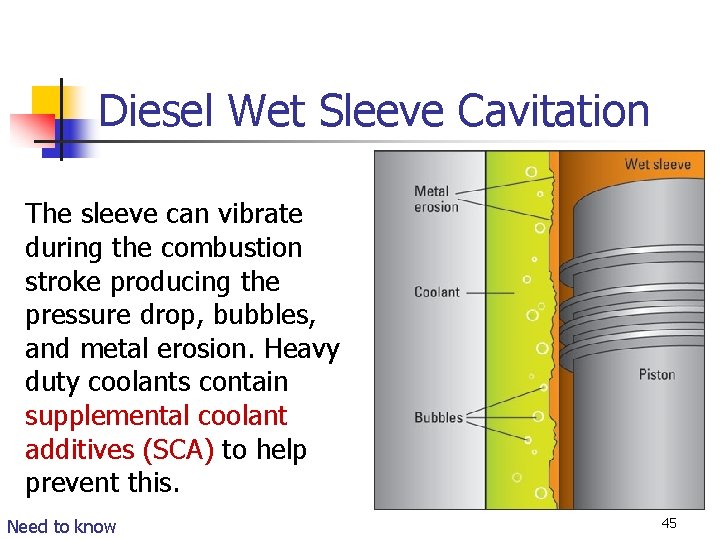
Diesel Wet Sleeve Cavitation The sleeve can vibrate during the combustion stroke producing the pressure drop, bubbles, and metal erosion. Heavy duty coolants contain supplemental coolant additives (SCA) to help prevent this. Need to know 45
Corrosion Common corrosion is the “decomposition of metal” and is commonly called rust, an iron oxide that forms on iron components. Corrosion is also aluminum oxide, the whitish material that forms on aluminum components Oxide formation eats away at the parent material from the outside, and it also forms an insulating barrier for heat transfer. Need to know 46
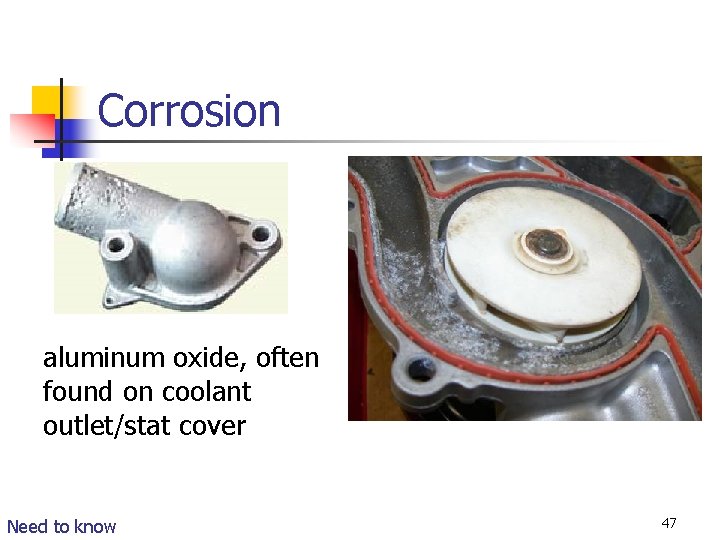
Corrosion aluminum oxide, often found on coolant outlet/stat cover Need to know 47
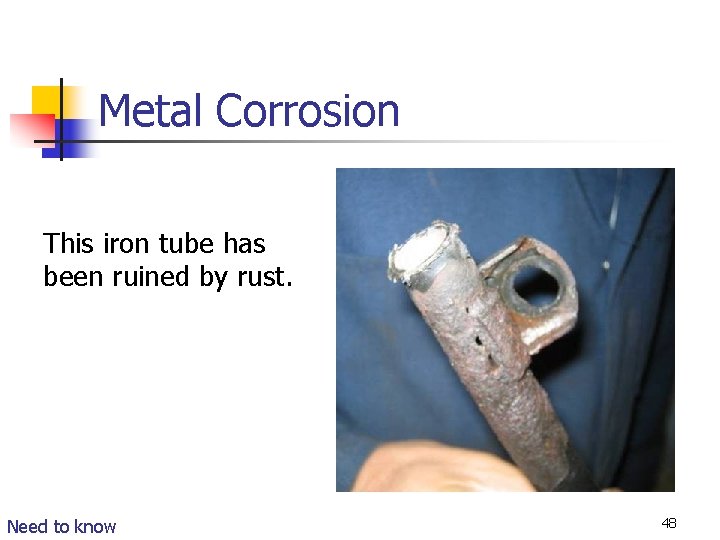
Metal Corrosion This iron tube has been ruined by rust. Need to know 48
Galvanic action n n Galvanic activity does not require an outside source of voltage The higher the conductivity of the coolant, the greater the amount of corrosion Need to know 49
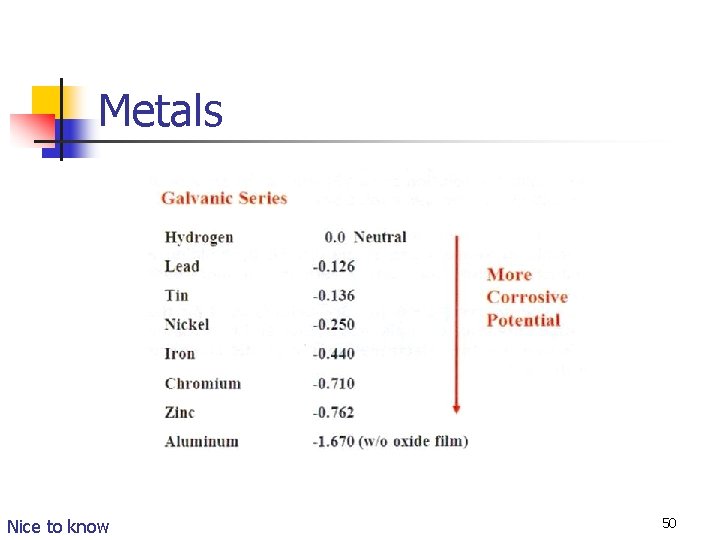
Metals Nice to know 50
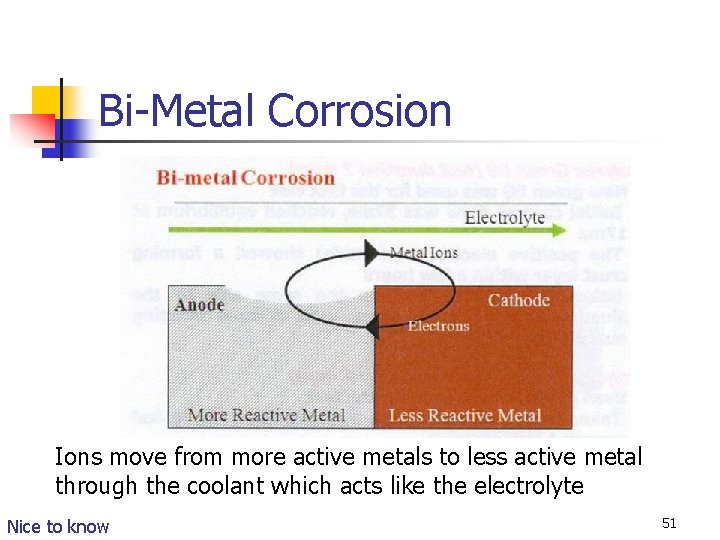
Bi-Metal Corrosion Ions move from more active metals to less active metal through the coolant which acts like the electrolyte Nice to know 51
Electrolysis requires the use of an outside voltage source. When electrical ions move from metal to the coolant, they can take metal atoms with them. This metal transfer can eat holes in a heater core or radiator. Electrolysis holes will usually start from the inside and have a dark coloration. Need to know 52
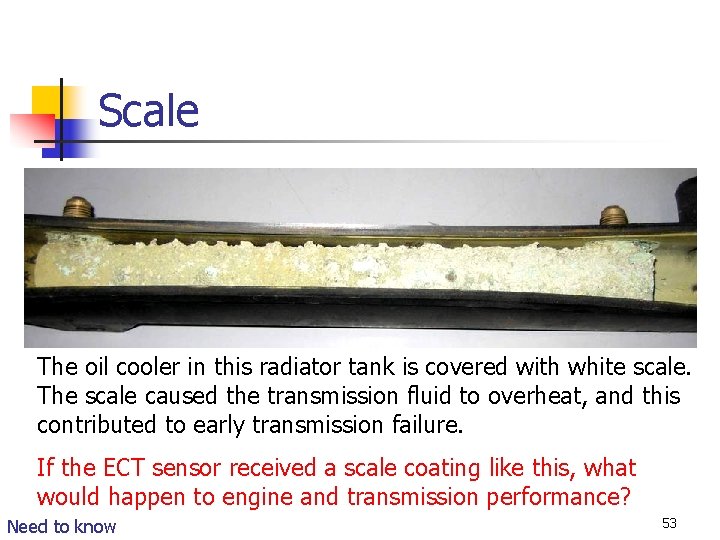
Scale The oil cooler in this radiator tank is covered with white scale. The scale caused the transmission fluid to overheat, and this contributed to early transmission failure. If the ECT sensor received a scale coating like this, what would happen to engine and transmission performance? Need to know 53
Coolant Tests Normal coolant tests include: n Visual Inspection: should be clean and bright n Freeze Point: high boiling point indicates dilution n p. H: wrong p. H indicates buffer loss n Coolant Voltage: high voltage indicates wrong p. H or stray current flow n Miscellaneous or Fleet Concerns Need to know 54
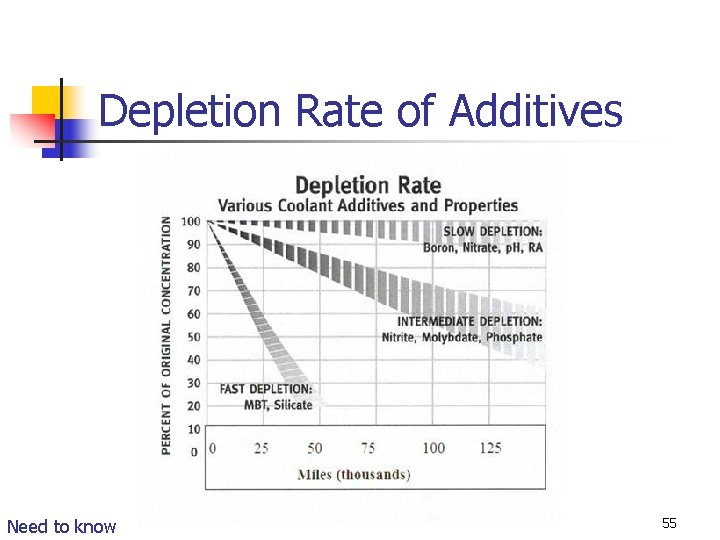
Depletion Rate of Additives Need to know 55
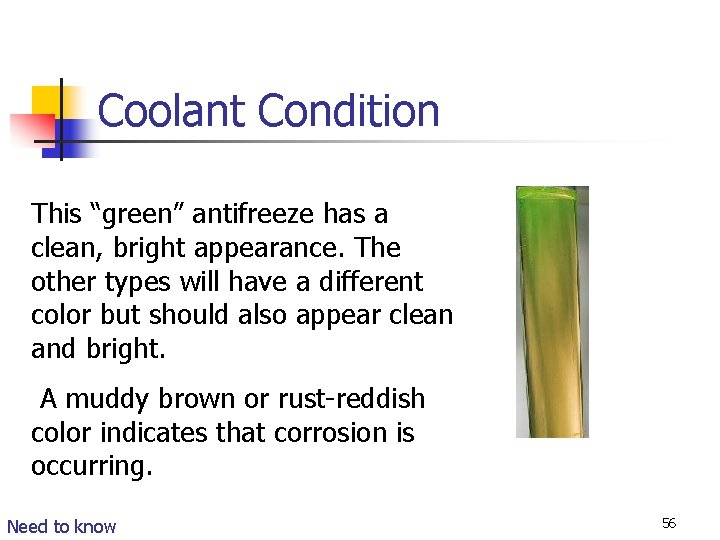
Coolant Condition This “green” antifreeze has a clean, bright appearance. The other types will have a different color but should also appear clean and bright. A muddy brown or rust-reddish color indicates that corrosion is occurring. Need to know 56
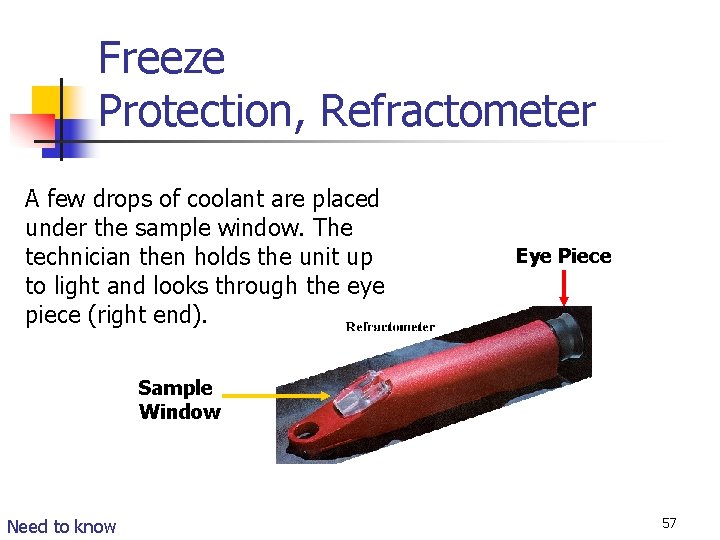
Freeze Protection, Refractometer A few drops of coolant are placed under the sample window. The technician then holds the unit up to light and looks through the eye piece (right end). Eye Piece Sample Window Need to know 57
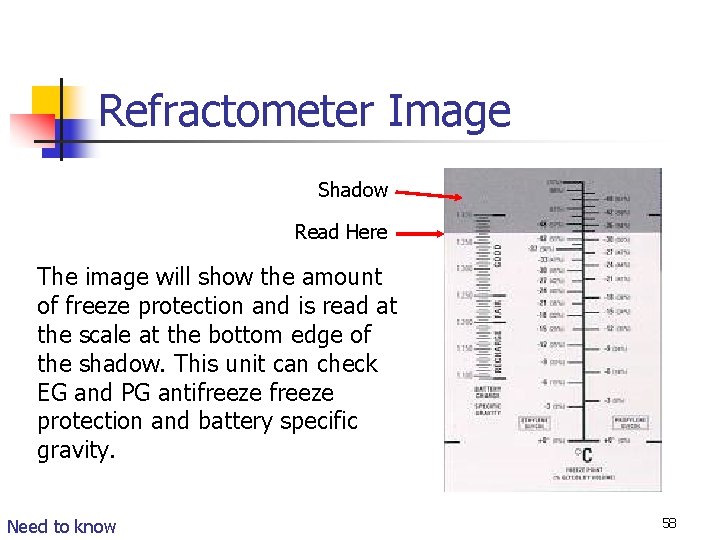
Refractometer Image Shadow Read Here The image will show the amount of freeze protection and is read at the scale at the bottom edge of the shadow. This unit can check EG and PG antifreeze protection and battery specific gravity. Need to know 58
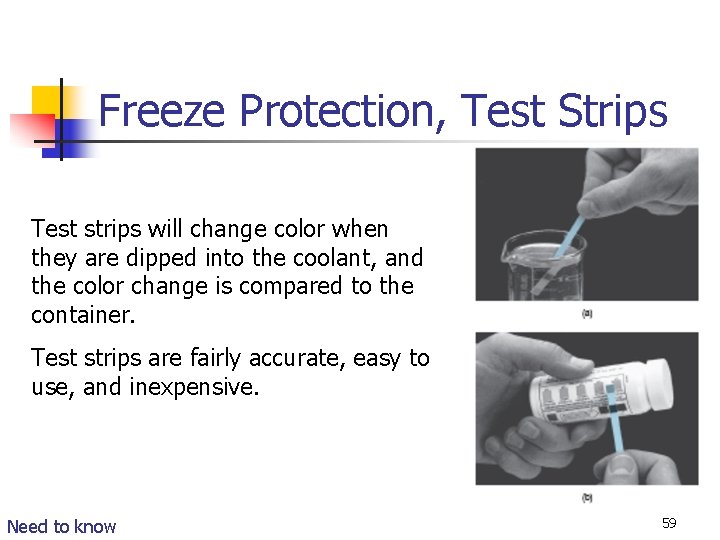
Freeze Protection, Test Strips Test strips will change color when they are dipped into the coolant, and the color change is compared to the container. Test strips are fairly accurate, easy to use, and inexpensive. Need to know 59
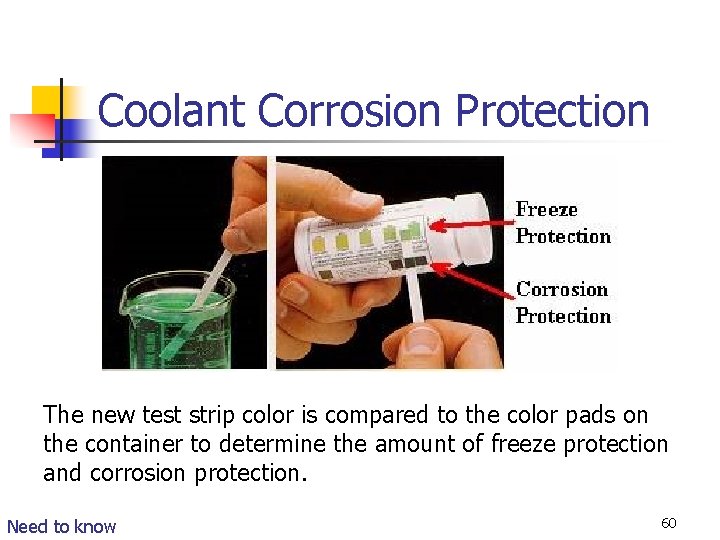
Coolant Corrosion Protection The new test strip color is compared to the color pads on the container to determine the amount of freeze protection and corrosion protection. Need to know 60
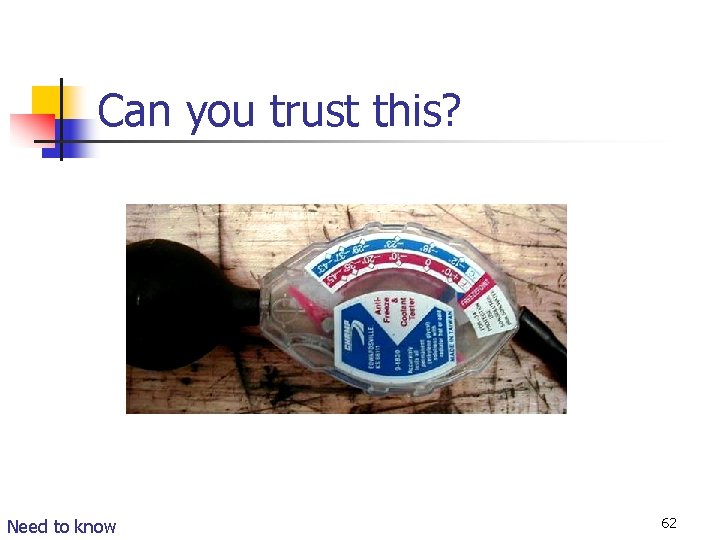
Freeze Protection, Hydrometer ? Accuracy Need to know 61
Can you trust this? Need to know 62
Testing Coolant with a Voltmeter n n n This test gives variable and questionable results depending on many factors Galvanic=less than 200 m. V Electrolysis= (engine running and accessories switched on and off)=less than 300 m. V. This check can locate faulty ground connections Need to know 63
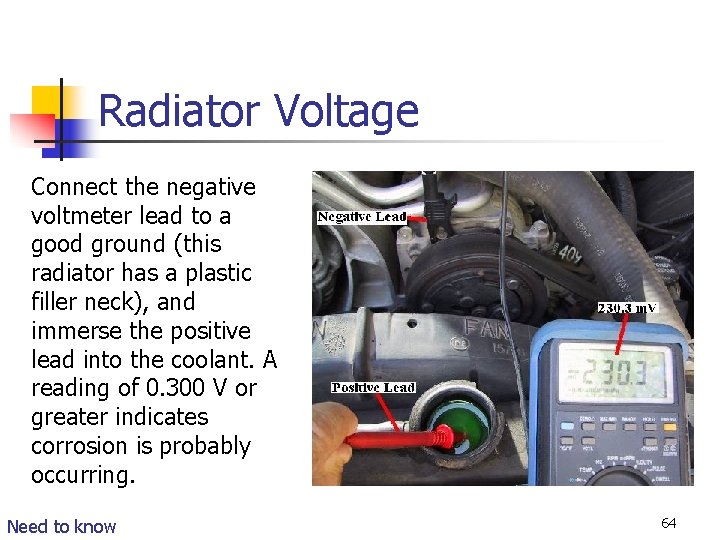
Radiator Voltage Connect the negative voltmeter lead to a good ground (this radiator has a plastic filler neck), and immerse the positive lead into the coolant. A reading of 0. 300 V or greater indicates corrosion is probably occurring. Need to know 64
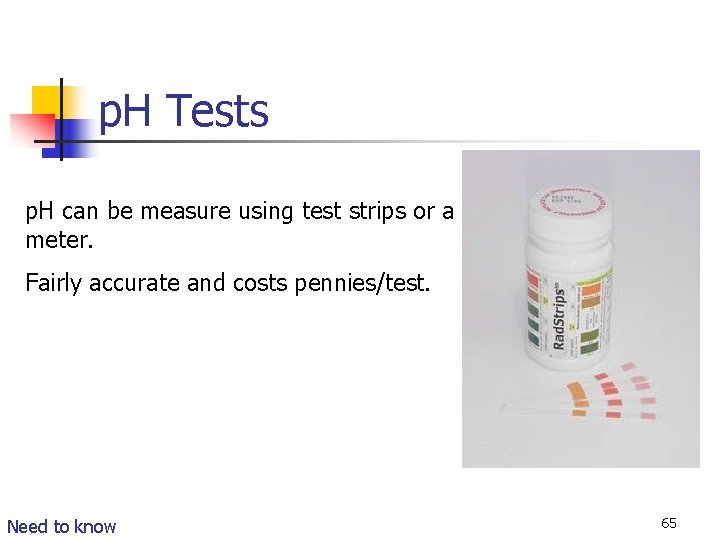
p. H Tests p. H can be measure using test strips or a meter. Fairly accurate and costs pennies/test. Need to know 65
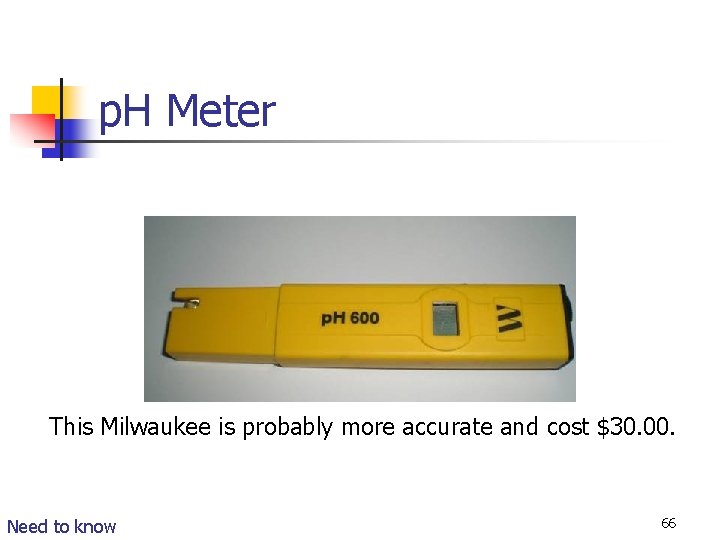
p. H Meter This Milwaukee is probably more accurate and cost $30. 00. Need to know 66
Coolant Replacement n n n About 15 to 20% remains in the system after it has been drained Fill system with antifreeze first and top off with water Or use premixed coolant for good results, and adjust to 50 -50 mix Be sure to use the specified coolant GM warns not to reuse coolant drained from the system Need to know 67
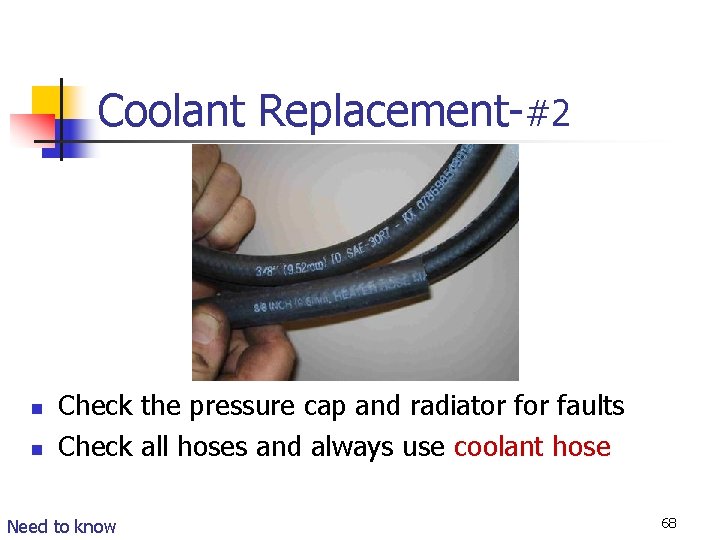
Coolant Replacement-#2 n n Check the pressure cap and radiator faults Check all hoses and always use coolant hose Need to know 68
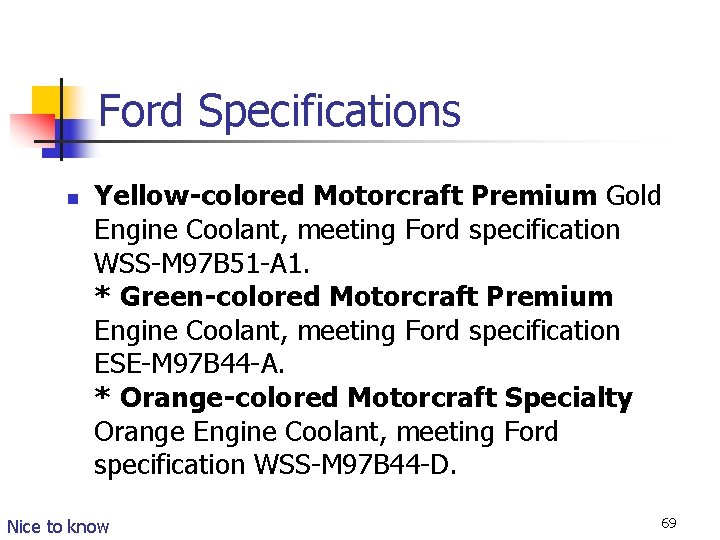
Ford Specifications n Yellow-colored Motorcraft Premium Gold Engine Coolant, meeting Ford specification WSS-M 97 B 51 -A 1. * Green-colored Motorcraft Premium Engine Coolant, meeting Ford specification ESE-M 97 B 44 -A. * Orange-colored Motorcraft Specialty Orange Engine Coolant, meeting Ford specification WSS-M 97 B 44 -D. Nice to know 69
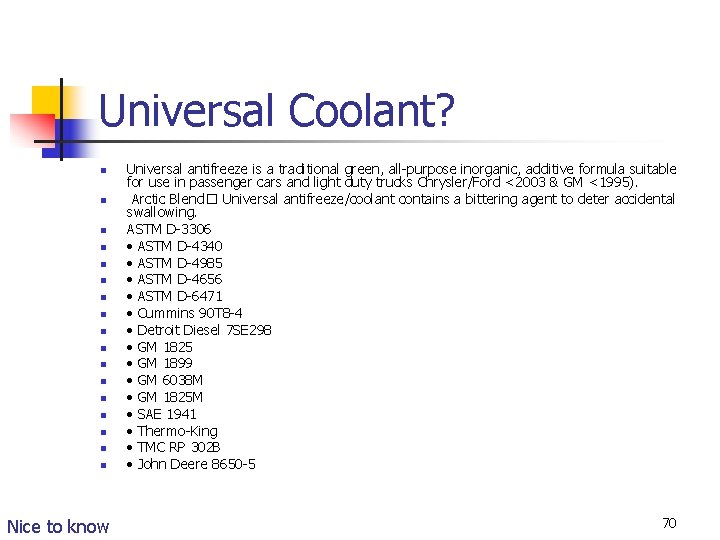
Universal Coolant? n n n n n Nice to know Universal antifreeze is a traditional green, all-purpose inorganic, additive formula suitable for use in passenger cars and light duty trucks Chrysler/Ford <2003 & GM <1995). Arctic Blend� Universal antifreeze/coolant contains a bittering agent to deter accidental swallowing. ASTM D-3306 • ASTM D-4340 • ASTM D-4985 • ASTM D-4656 • ASTM D-6471 • Cummins 90 T 8 -4 • Detroit Diesel 7 SE 298 • GM 1825 • GM 1899 • GM 6038 M • GM 1825 M • SAE 1941 • Thermo-King • TMC RP 302 B • John Deere 8650 -5 70
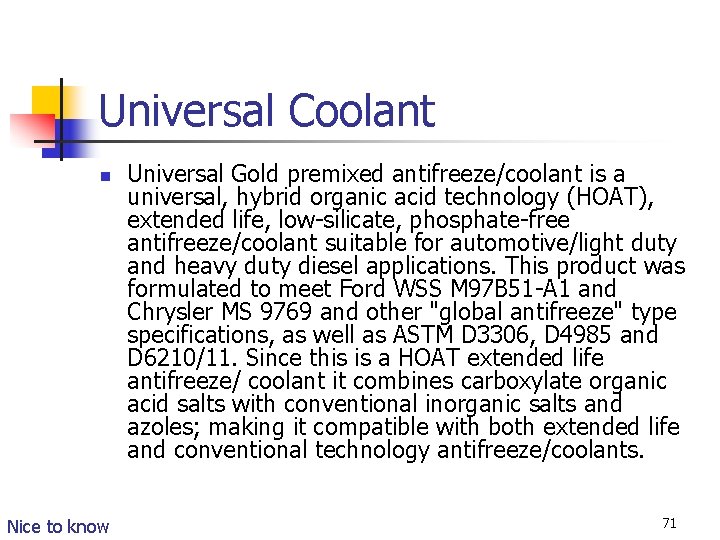
Universal Coolant n Nice to know Universal Gold premixed antifreeze/coolant is a universal, hybrid organic acid technology (HOAT), extended life, low-silicate, phosphate-free antifreeze/coolant suitable for automotive/light duty and heavy duty diesel applications. This product was formulated to meet Ford WSS M 97 B 51 -A 1 and Chrysler MS 9769 and other "global antifreeze" type specifications, as well as ASTM D 3306, D 4985 and D 6210/11. Since this is a HOAT extended life antifreeze/ coolant it combines carboxylate organic acid salts with conventional inorganic salts and azoles; making it compatible with both extended life and conventional technology antifreeze/coolants. 71
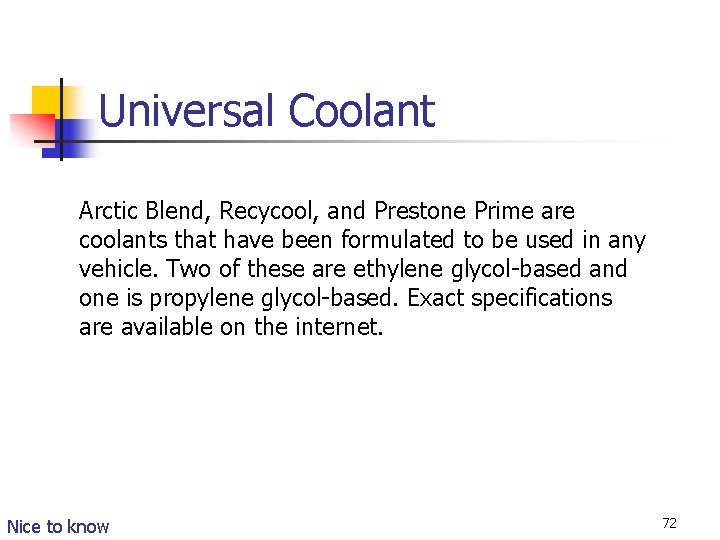
Universal Coolant Arctic Blend, Recycool, and Prestone Prime are coolants that have been formulated to be used in any vehicle. Two of these are ethylene glycol-based and one is propylene glycol-based. Exact specifications are available on the internet. Nice to know 72
Passivation n n Passivate is a chemical reaction the takes place between coolant additives and the metal that it protects. It is fairly fast, a few days, with some combinations and slow, weeks, with others. It creates the barrier between the metal and corrosion, and each chemical creates it's own barrier. Each chemical package (IAT, OAT, or HOAT) does its own passivation, and if you change chemical packages, passivation has to start over, possibly impeded by the earlier package. It boils down to: DO NOT CHANGE PACKAGES. Nice to know 73
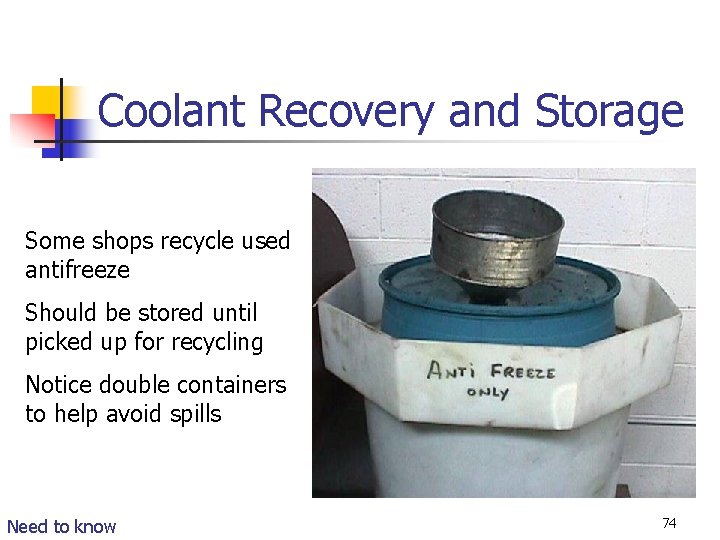
Coolant Recovery and Storage Some shops recycle used antifreeze Should be stored until picked up for recycling Notice double containers to help avoid spills Need to know 74
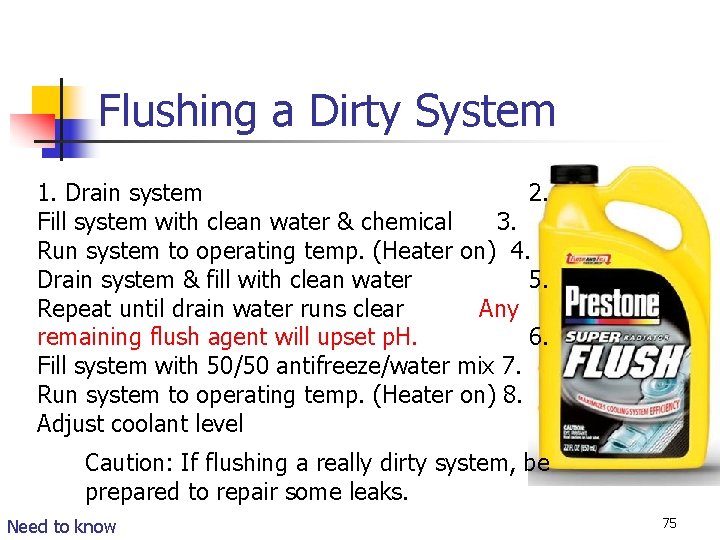
Flushing a Dirty System 1. Drain system 2. Fill system with clean water & chemical 3. Run system to operating temp. (Heater on) 4. Drain system & fill with clean water 5. Repeat until drain water runs clear Any remaining flush agent will upset p. H. 6. Fill system with 50/50 antifreeze/water mix 7. Run system to operating temp. (Heater on) 8. Adjust coolant level Caution: If flushing a really dirty system, be prepared to repair some leaks. Need to know 75
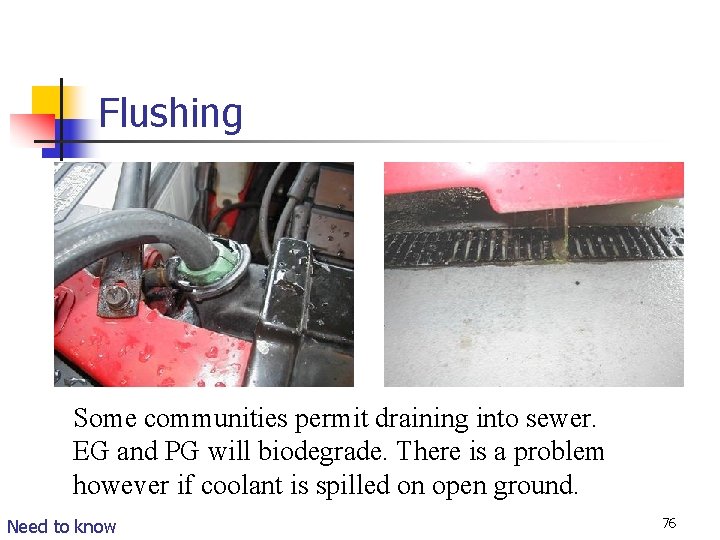
Flushing Some communities permit draining into sewer. EG and PG will biodegrade. There is a problem however if coolant is spilled on open ground. Need to know 76
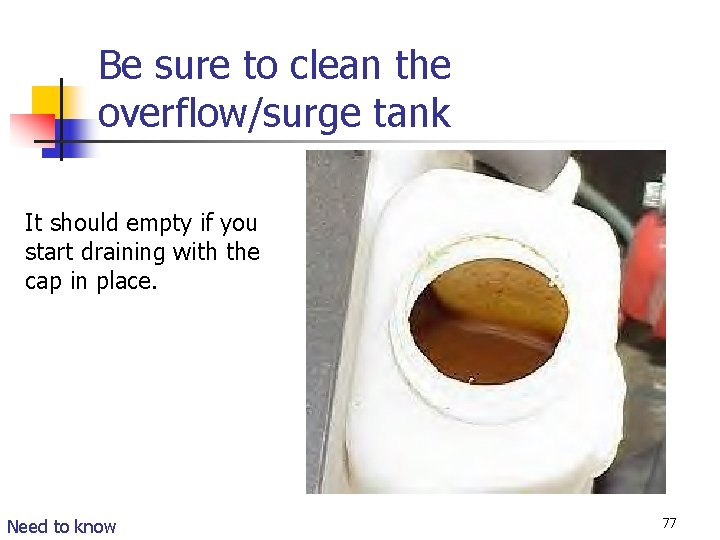
Be sure to clean the overflow/surge tank It should empty if you start draining with the cap in place. Need to know 77
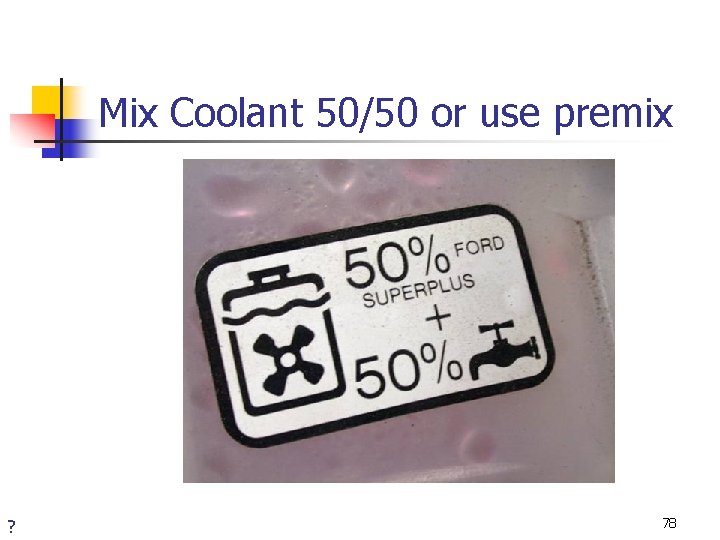
Mix Coolant 50/50 or use premix ? 78
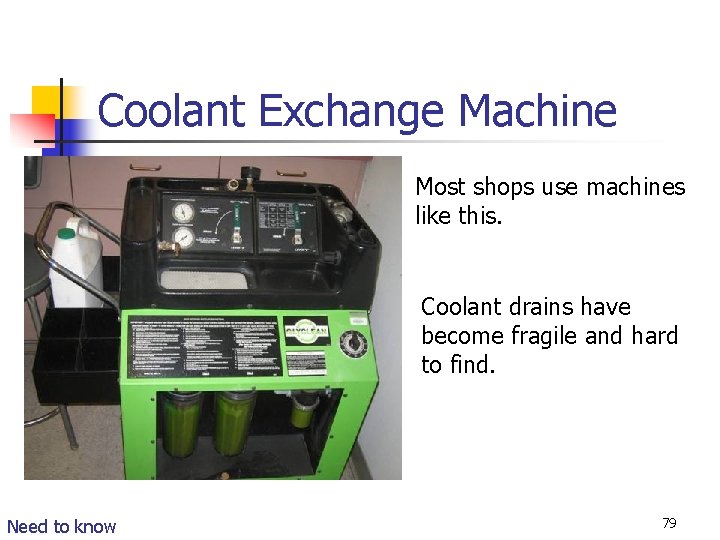
Coolant Exchange Machine Most shops use machines like this. Coolant drains have become fragile and hard to find. Need to know 79
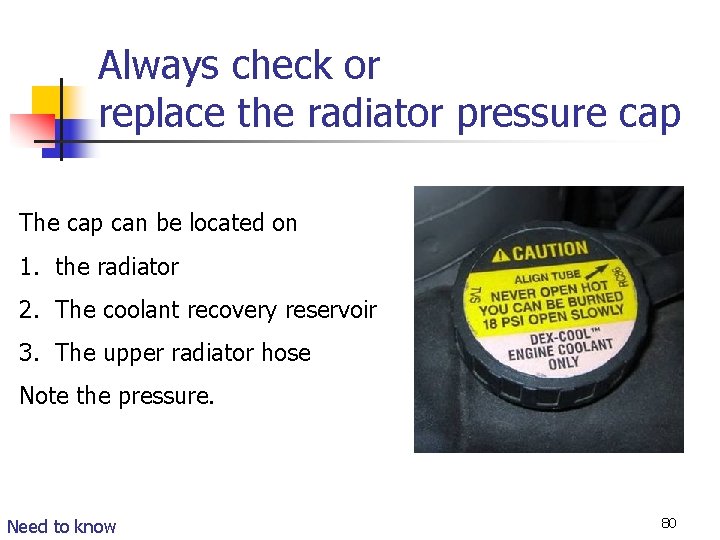
Always check or replace the radiator pressure cap The cap can be located on 1. the radiator 2. The coolant recovery reservoir 3. The upper radiator hose Note the pressure. Need to know 80
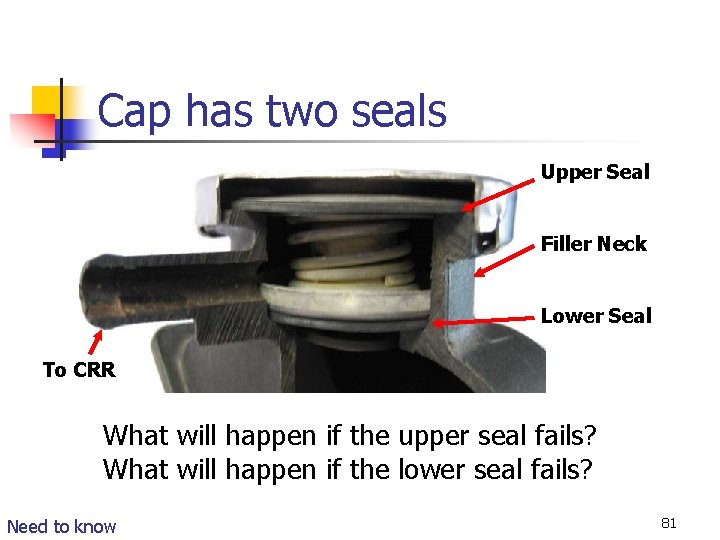
Cap has two seals Upper Seal Filler Neck Lower Seal To CRR What will happen if the upper seal fails? What will happen if the lower seal fails? Need to know 81
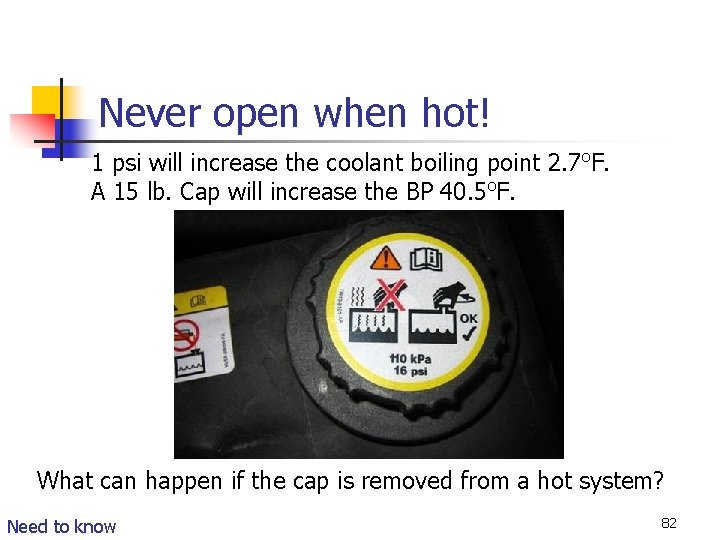
Never open when hot! 1 psi will increase the coolant boiling point 2. 7 o. F. A 15 lb. Cap will increase the BP 40. 5 o. F. What can happen if the cap is removed from a hot system? Need to know 82
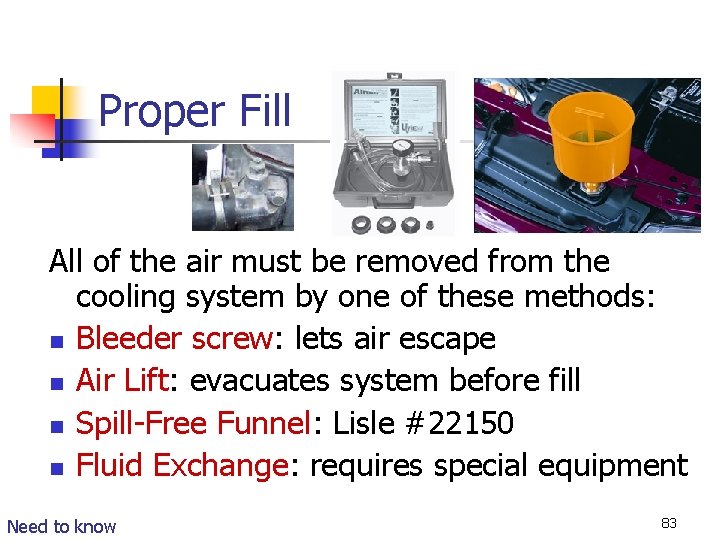
Proper Fill All of the air must be removed from the cooling system by one of these methods: n Bleeder screw: lets air escape n Air Lift: evacuates system before fill n Spill-Free Funnel: Lisle #22150 n Fluid Exchange: requires special equipment Need to know 83
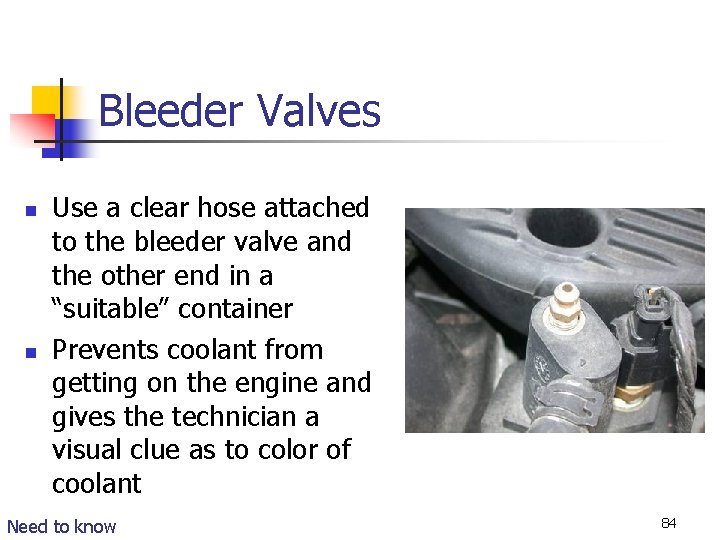
Bleeder Valves n n Use a clear hose attached to the bleeder valve and the other end in a “suitable” container Prevents coolant from getting on the engine and gives the technician a visual clue as to color of coolant Need to know 84
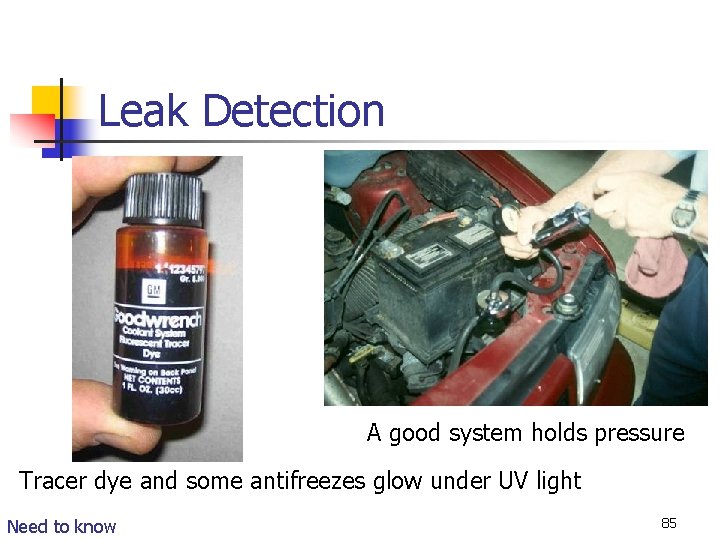
Leak Detection A good system holds pressure Tracer dye and some antifreezes glow under UV light Need to know 85
What should Technician's do? n n n Check service information for the designated coolant and replacement interval Check the coolant appearance and level at every service Check the pressure cap appearance at every service Check the appearance and p. H for signs that the coolant should be replaced before the regular service interval Check Freeze Point, p. H, and Galvanic/Electrolysis Need to know 86
Typical Questions/Answers 1. Are all green antifreezes the same? A. No-Chrysler used HOAT coolant that was green like IAT coolant 2. Can DEX-COOL be replaced with conventional green coolant? A. Yes, but then the coolant has be replaced every 24 months or 24, 000 miles 87
Questions/Answers 3. Can coolants be mixed? A. No 4. Is DEX-COOL propylene glycol ? A. No. DEX-COOL and all other coolants are ethylene glycol except one labeled propylene glycol and is never used from the factory 88
Summary n n n Not all coolants are the same Not all tap water is OK to use Premixed coolant usually produces good results Check the coolant freezing/boiling point Check the coolant p. H Always check or replace the pressure cap, especially on DEX-COOL vehicles 89