
Cooccurring disorders mental health and substance misuse in
Co-occurring disorders (mental health and substance misuse) in people experiencing homelessness – also called ‘Dual Diagnosis’ Brief Learning Resource – updated 2020
What does ‘dual diagnosis’ mean? • Generally defined as ‘the co-existence of mental health and substance misuse problems’. However there is no specific common understanding. • In practice, people are usually only given a formal diagnosis of dual diagnosis if they have severe mental health problems (generally psychotic disorders) and severe substance misuse problems that both meet the criteria for specialist services. • ‘Dual diagnosis’ can suggest that there are only two problems. In reality, people with dual diagnosis are also likely to have physical health problems, and a range of social issues, and will often be identified as having ‘complex needs’
How common is dual diagnosis? • It is very common for people to experience problems with their mental health and have a substance misuse disorder at the same time (Weaver et al, 2003). • Research shows that mental health problems are experienced by the majority of drug (70%) and alcohol (86%) users in community substance misuse treatment (Delgadillo et al, 2012).
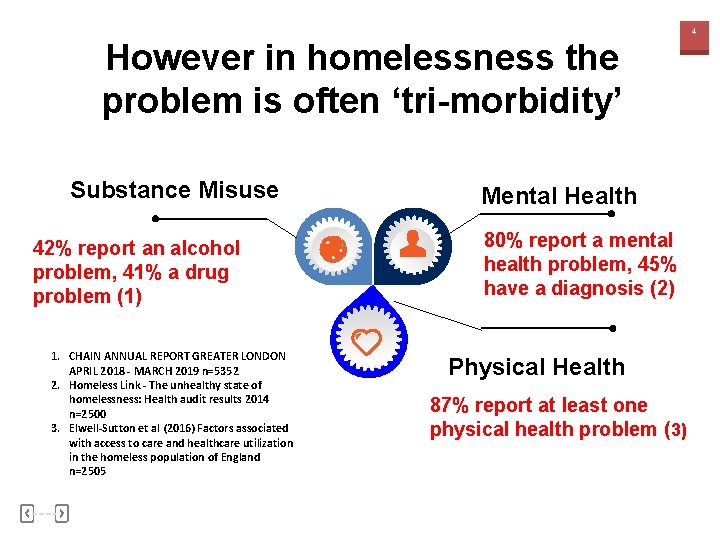
4 However in homelessness the problem is often ‘tri-morbidity’ Substance Misuse 42% report an alcohol problem, 41% a drug problem (1) 1. CHAIN ANNUAL REPORT GREATER LONDON APRIL 2018 - MARCH 2019 n=5352 2. Homeless Link - The unhealthy state of homelessness: Health audit results 2014 n=2500 3. Elwell-Sutton et al (2016) Factors associated with access to care and healthcare utilization in the homeless population of England n=2505 Mental Health 80% report a mental health problem, 45% have a diagnosis (2) Physical Health 87% report at least one physical health problem (3)
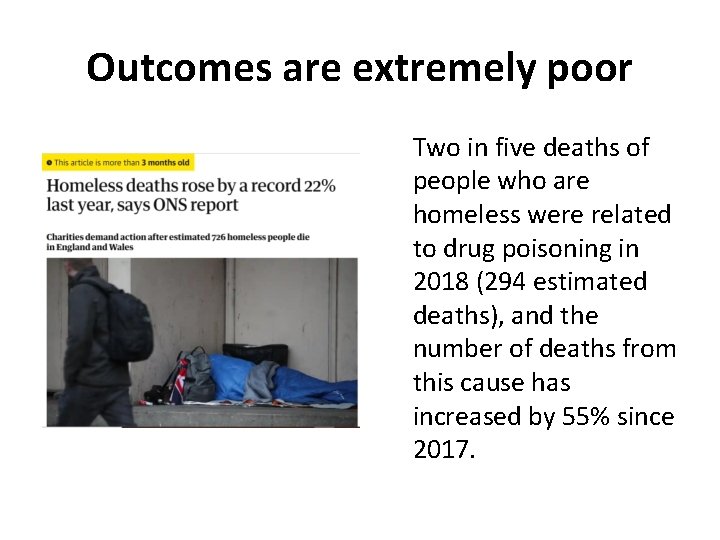
Outcomes are extremely poor Two in five deaths of people who are homeless were related to drug poisoning in 2018 (294 estimated deaths), and the number of deaths from this cause has increased by 55% since 2017.
And suicide risk is high Death by suicide is common, with a history of alcohol or drug use being recorded in 54% of all suicides in people experiencing mental health problems (National Confidential Enquiry, 2013)
Service users experience difficulties accessing treatment due to: 1. Different service cultures within mental health and substance misuse regarding the requirements of engagement / DNAs etc 2. Conflicting attribution of primary problem (i. e. which came ‘first’ – the mental health problem or the addiction) 3. Substance misuse being seen as exclusion for mental health support, although policy dictates this is not an exclusion criteria 4. Lack of belief that mental health support will work for those engaged in substance misuse
Difficulty accessing treatment cont… 5. Inadequate skill mix or training within workforce to deal with both elements 6. Different funding and commissioning streams meaning services are siloed in some areas (although in other areas funding streams are joined up) 7. Practical lack of coordinated approach / joined up care e. g. – Different referrals and paperwork – No joint assessment process – No shared data systems – service user has to repeat story

Most common mental health issue is personality disorder or ‘complex trauma’ • Complex trauma is a psychological disorder rather than a mental health problem – it is a pattern of maladaptive behaviours resulting from past psychological trauma • Up to 70% of people experiencing homelessness meet the criteria for personality disorder (Maguire et al, 2009) • People with complex trauma also experience mental health problems e. g. anxiety, depression and psychotic symptoms
This creates additional issues accessing treatment because: • Services for people with personality disorder in the mainstream population are lacking • Services for people for personality disorder and substance misuse are severely lacking
Brain Injury can also add complexity • In one study 45% of people who are homeless had a traumatic brain injury. 87% occurred before the onset of homelessness. (Topolovec. Vranic et al, 2014) • Alcoholic brain injury is also very common • Brain injury can result in memory loss, confusion, impaired attention, difficulty processing information, reduction in initiative, depression, irritability – may have a significant impact on engagement • Cognitive deficits need documenting, this is often not done if patients are frequently always under the influence
The experience of the client Issues: What is needed: • • Personalised approach what does the client want / need? Can it be achieved? • Non-judgemental attitudes • Joined up services • Client involvement in service design, delivery and decision making. • Recovery / peer mentors • Willingness to work with Client set goals • Understanding of set backs • • • Clients are discharged if they miss one appointment without notifying or cancelling Lack of understanding from health services regarding personal challenges related to poverty, homelessness etc Multiple assessments and appointments Power dynamics - clients are put off and feel alienated by complex language, or routine assessments Stigma Lack of time and relationship building – ‘no one really listens ’ Film of a client’s experience
Situation is exacerbated by reduced Local Authority budgets • Local authority budgets have been cut 21% in 10 years (Partington, 2019) • 58% of councils report cutting budgets for drug and alcohol treatment services (Eichler, 2019) • This had also had an effect on floating support, supported accommodation provision etc
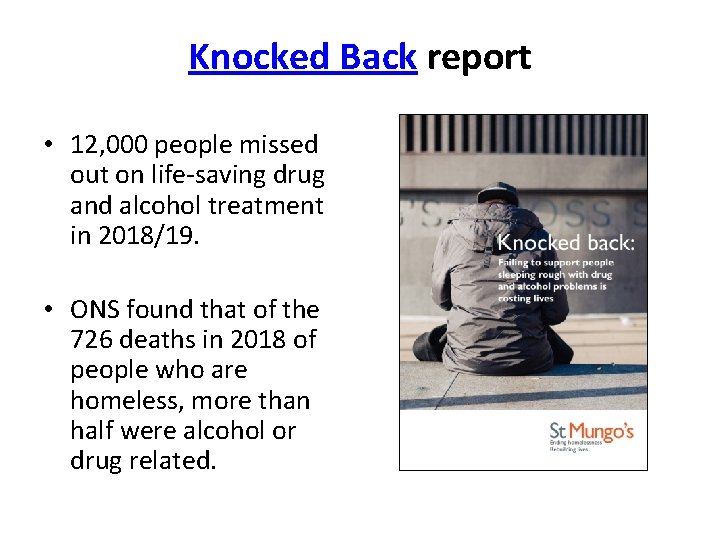
Knocked Back report • 12, 000 people missed out on life-saving drug and alcohol treatment in 2018/19. • ONS found that of the 726 deaths in 2018 of people who are homeless, more than half were alcohol or drug related.
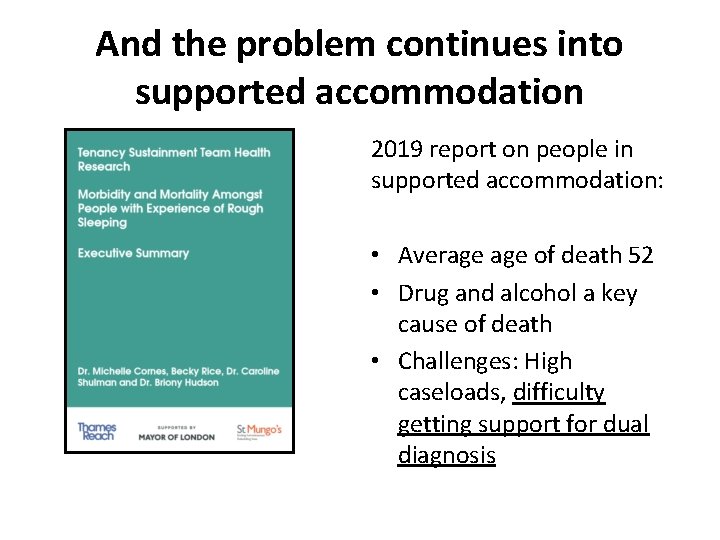
And the problem continues into supported accommodation 2019 report on people in supported accommodation: • Average of death 52 • Drug and alcohol a key cause of death • Challenges: High caseloads, difficulty getting support for dual diagnosis
Clinical guidance - Essential reading • Public Health England (2017) Better care for people with co-occurring mental health and alcohol/drug use conditions: A guide for commissioners and service providers • NICE guidance (2016) NG 58: Coexisting severe mental illness and substance misuse: community health and social care services
Better care for people with co-occurring mental health and alcohol/drug use conditions Promotes two key principles: 1. Everyone’s job. Commissioners and providers of mental health and alcohol and drug use services have a joint responsibility to meet the needs of individuals with cooccurring conditions by working together to reach shared solutions. 2. No wrong door. Providers in alcohol and drug, mental health and other services have an open door policy for individuals with cooccurring conditions, and make every contact count. Treatment for any of the co-occurring conditions is available through every contact point.
NICE guidance NG 58: Coexisting severe mental illness and substance misuse: community health and social care services • Published November 2016. • Covers how to improve services for people aged 14 and above who have been diagnosed as having a coexisting severe mental illness and substance misuse.
The NICE guideline includes recommendations on: – first contact with services – referral to secondary care mental health services – the care plan: multi-agency approach to address physical health, social care, housing and other support needs – partnership working between specialist services, health, social care and other support services and commissioners – improving service delivery – maintaining contact between services and people with coexisting severe mental illness and substance misuse who use them
It includes further links to recommendations on: – Referral to mental health services – Care plans: to address physical health, social care, housing and other support needs – Partnerships between specialist services – Maintaining contact between services and how to support people with complex needs to attend appointments and maintain engagement “Mental health services have a responsibility to work with substance misuse services to provide integrated care, and substance misuse services have a responsibility to work with mental health services to provide care. ” NICE Guidance CG 120
Additional useful historical papers • Centre for Mental Health, Drug. Scope and UK Drug Policy Commission (2012) Dual diagnosis: a challenge for the reformed NHS and for Public Health England A discussion paper • Coexisting severe mental illness (psychosis) and substance misuse: assessment and management in healthcare settings (2011) • Hughes L (2006) Closing the Gap – A CAPABILITY FRAMEWORK FOR WORKING EFFECTIVELY WITH PEOPLE WITH COMBINED MENTAL HEALTH AND SUBSTANCE USE PROBLEMS (DUAL DIAGNOSIS) • Turning Point and Rethink (2004) Dual diagnosis toolkit. Mental health and substance misuse - A practical guide for professionals and practitioners • Department of Health (2002) Mental Health Policy Implementation Guide Dual Diagnosis Good Practice Guide
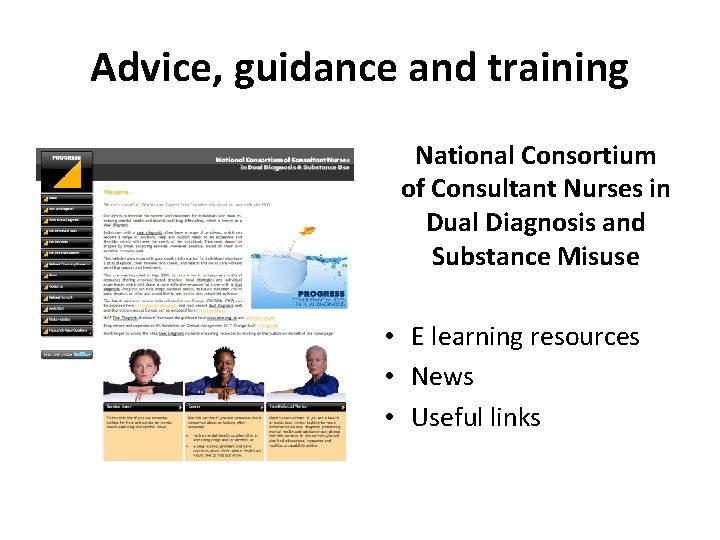
Advice, guidance and training National Consortium of Consultant Nurses in Dual Diagnosis and Substance Misuse • E learning resources • News • Useful links
What can I do to help individuals? • Document objective measures if patient is not in contact with services e. g. cognitive deficits, PHQ 9, GAD 7, AUDIT, DAST, SADQ • Try to tackle local barriers to services where possible • Undertake CPD in drug and alcohol, motivational interviewing and complex trauma • Help individuals to access peer support if possible • Ensure individuals have crisis numbers • Raise alerts when you are concerned • Discuss patients at existing MDT meetings, consider a case conference
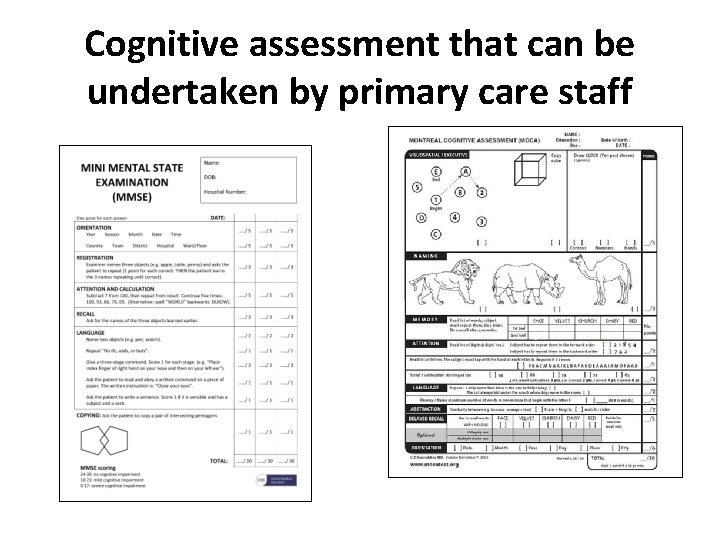
Cognitive assessment that can be undertaken by primary care staff
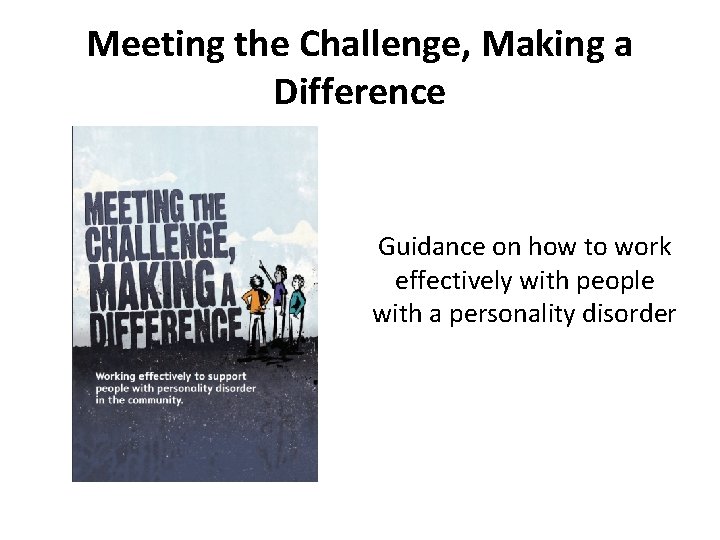
Meeting the Challenge, Making a Difference Guidance on how to work effectively with people with a personality disorder
Assess mental capacity carefully when concerns arise Capacity fluctuates in people with mental health, cognition and addictions challenges and it is situation specific Don’t let people say ‘he’s got capacity’ Ask ‘For what? ’ ‘About what? ’ ‘When? ’
Further Guidance ‘Mental Health Service Assessments for Rough Sleepers’ - https: //bit. ly/2 molta. C Includes tools for: – Risk assessment – MCA guidance & screening tool – MHA guidance & screening tool – Hospital admission plan – Guidance on making safeguarding adults alerts
Ensure you are safeguarding patients There is a Legal Duty to safeguard when a person has needs for care and support and • is experiencing, or at risk of, abuse or neglect • as a result is unable to protect themselves from the risk of, or experience of abuse or neglect 1. Physical Abuse 2. Emotional/ Psychological Abuse 3. Financial Abuse 4. Sexual Abuse 5. Organisational Abuse 6. Neglect 7. Discriminatory Abuse 8. Domestic Violence 9. Modern Slavery 10. Self Neglect
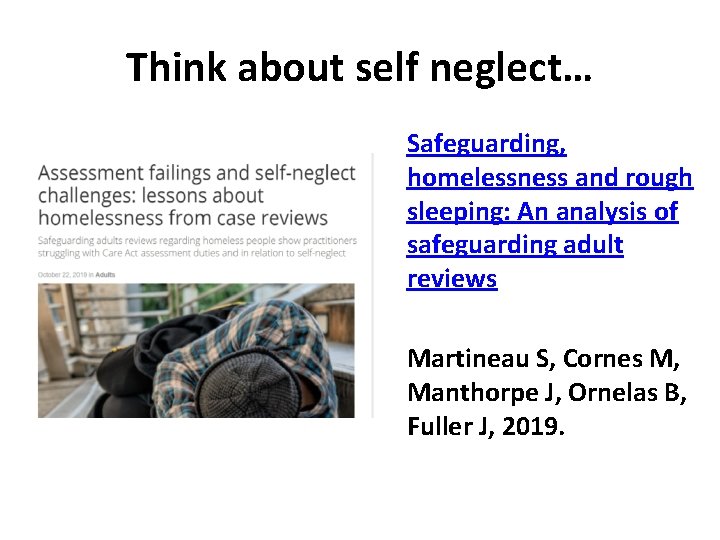
Think about self neglect… Safeguarding, homelessness and rough sleeping: An analysis of safeguarding adult reviews Martineau S, Cornes M, Manthorpe J, Ornelas B, Fuller J, 2019.
What can I do at a system level? • Initiate MDT meetings if none exist • Encourage and support in-reach services • Document and count barriers to accessing services • Highlight problems to commissioners • Encourage all services to be trauma informed • Encourage patient representation at CCG’s and health and wellbeing boards • Feedback to All Party Parliamentary Group on Dual Diagnosis
Further learning and resources • Progress e-learning and resources • Advances in Dual Diagnosis Journal • Queens Nursing Initiative Homeless Health Network - hosts resources, and runs newsletter and events: https: //www. qni. org. uk/exploreqni/homeless-health-programme/ • Faculty of Homeless and Inclusion Health – regular newsletter, meetings and annual conference: http: //www. pathway. org. uk/faculty/join/ • London Network of Nurses and Midwives Homelessness Group - hosts resources and annual conference: http: //homelesshealthnetwork. net
References • • Weaver et al (2003) Comorbidity of substance misuse and mental illness in community mental health and substance misuse services. The British Journal of Psychiatry Sep 2003, 183 (4) 304 -313 Delgadillo J, Godfrey C, Gilbody S and Payne S (2012) Depression, anxiety and comorbid substance use: association patterns in outpatient addictions treatment. Mental Health and Substance Use Vol. 6, Iss 1, (2013). The National Confidential Inquiry into Suicide and Homicide by People with Mental Illness Annual Report 2016: England, Northern Ireland, Scotland Wales October 2016. University of Manchester. Tim Elwell-Sutton, Jonathan Fok, Francesca Albanese, Helen Mathie, Richard Holland (2016) Factors associated with access to care and healthcare utilization in the homeless population of England Journal of Public Health, Volume 39, Issue 1, March 2017, Pages 26– 33, Maguire, N. J. , Johnson, R. , Vostanis, P. , Keats, H. and Remington, R. E. (2009)Homelessness and complex trauma: a review of the literature. Southampton, UK. University of Southampton Topolovec-Vranic J, Ennis N, Howatt M, Ouchterlony D, Michalak A, Masanic C, Colantonio A, Hwang SW, Kontos P, Stergiopoulos V, Cusimano MD. (2014) Traumatic brain injury among men in an urban homeless shelter: observational study of rates and mechanisms of injury CMAJ Open. 2014 Apr 25; 2(2): E 69 -76. doi: 10. 9778/cmajo. 20130046. e. Collection 2014 Apr. Eichler W (2019) Treatment cut despite ‘soaring’ alcohol-related A&E admissions https: //www. localgov. co. uk/Treatment-cut-despite-soaring-alcohol-related-AE-admissions/46858 Partington R (2019) Council spending on local services down 21% over past decade https: //www. theguardian. com/society/2019/may/29/council-spending-on-local-services-down
Produced by: QNI Homeless Health Network Progress Dual Diagnosis Network Kindly reviewed by Lois Dugmore, Nurse Consultant, Dual Diagnosis, Leicestershire Partnership NHS Trust
- Slides: 33