
Converting Units To convert from one unit to
- Slides: 13
Converting Units • To convert from one unit to another, use a conversion factor. • A conversion factor is a fraction whose value is one. • To make the right conversion factor, put the unit you are converting FROM in the denominator and the unit you are converting TO in the numerator. • Multiply. Note that units cancel like variables. • Ex: Convert 2 feet to inches 2 feet (12 inches) = 24 inches (1 foot) X
Converting SI Units • This works the same way. Try 1 or 2 practice conversions on the notes outline. Complete practice for homework • Ex: Convert 15 seconds to milliseconds • 15 s X 1 ms 10 -3 s = 15, 000 ms Note: Dividing by a negative exponent is the same as multiplying by the positive one
Measurement • Scientific measurement is designed so that all observers will achieve the same result. (i. e. it is objective) • It is based on two concepts: • Accuracy: the “correctness” of a measurement. • Precision: the degree of detail of a measurement.
Accuracy = Correctness • Assume that the rectangle shown has a true length of 11. 256 cm • The following are all accurate measurements: 11 cm 11. 3 cm 11. 26 cm 11. 256 cm An accurate measurement is one where every number place has the correct value.
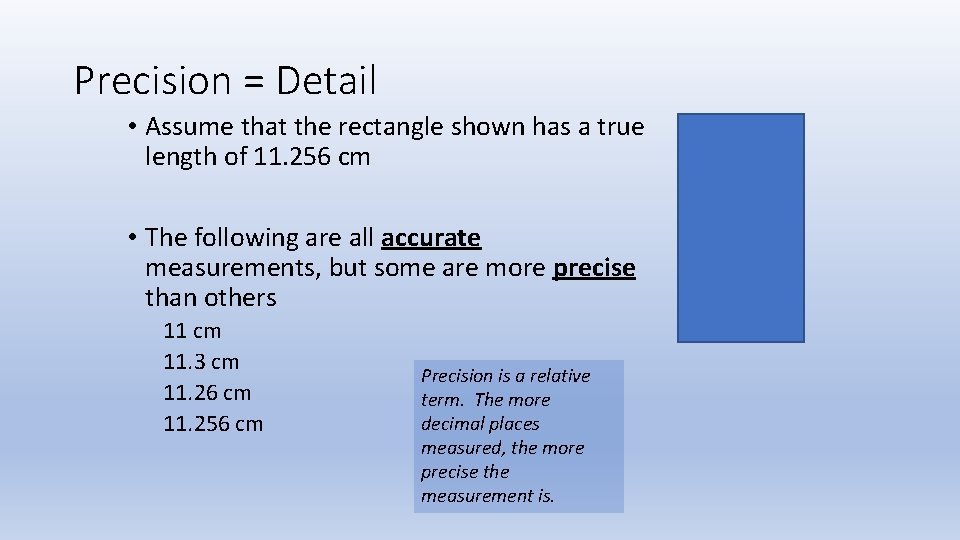
Precision = Detail • Assume that the rectangle shown has a true length of 11. 256 cm • The following are all accurate measurements, but some are more precise than others 11 cm 11. 3 cm 11. 26 cm 11. 256 cm Precision is a relative term. The more decimal places measured, the more precise the measurement is.
Uncertainty: Knowing the Limits of Data • Uncertainty is an important part of science. It too, can be measured. • For example: An index card is 12. 7 cm wide. • ANY length between 12. 65 cm and 12. 74 cm would be accurately measured as 12. 7 cm, if the precision of the measurement is 0. 1 cm.
What it all means. • From my house, my ride to Poly is 3 miles long. • Although I am unsure of the EXACT distance, I am 100% certain that the true value is between 2. 5 mi and 3. 4 mi. • Therefore, to the greatest possible precision available to me, it is a 3 mile ride.
3 mi ≠ 3. 0 mi • When dealing with measurements (not pure numbers), the number of decimal places represented matters. • A measurement of 3 mi means 2. 5 < X <3. 4 • A measurement of 3. 0 mi means 2. 95 < X < 3. 04 • Which is more precise?
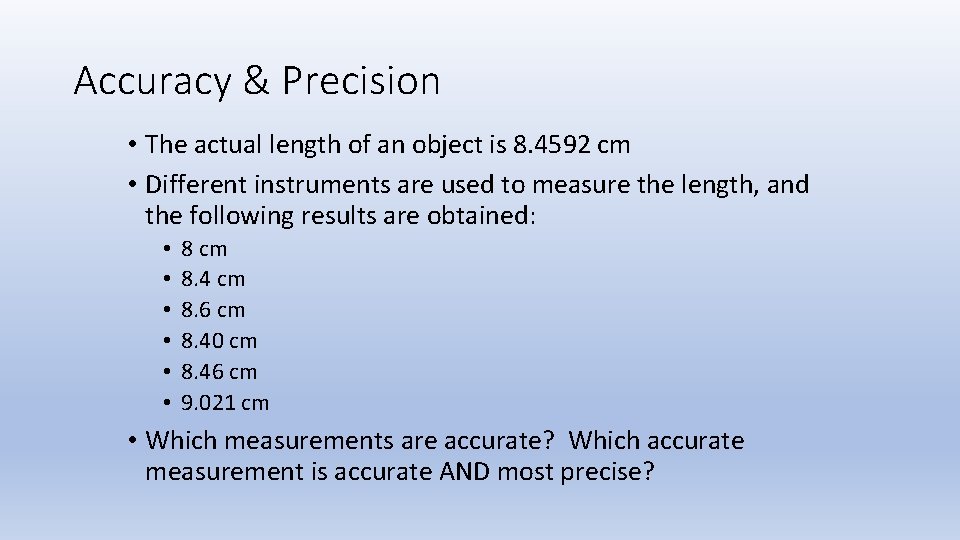
Accuracy & Precision • The actual length of an object is 8. 4592 cm • Different instruments are used to measure the length, and the following results are obtained: • • • 8 cm 8. 4 cm 8. 6 cm 8. 40 cm 8. 46 cm 9. 021 cm • Which measurements are accurate? Which accurate measurement is accurate AND most precise?
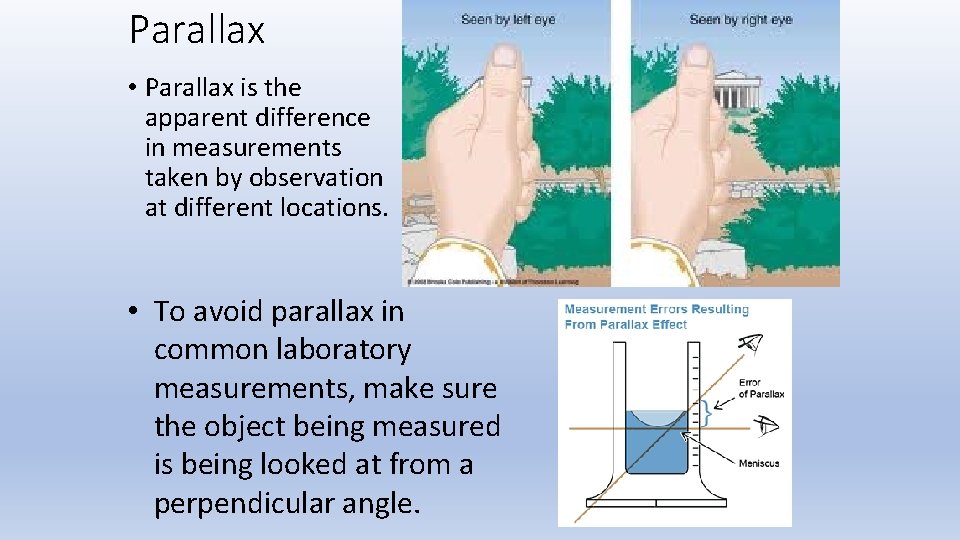
Parallax • Parallax is the apparent difference in measurements taken by observation at different locations. • To avoid parallax in common laboratory measurements, make sure the object being measured is being looked at from a perpendicular angle.
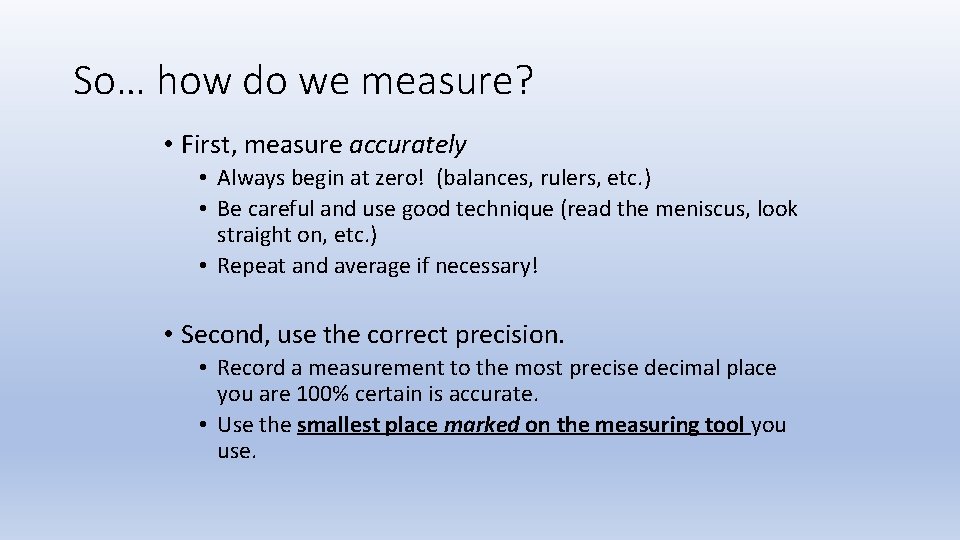
So… how do we measure? • First, measure accurately • Always begin at zero! (balances, rulers, etc. ) • Be careful and use good technique (read the meniscus, look straight on, etc. ) • Repeat and average if necessary! • Second, use the correct precision. • Record a measurement to the most precise decimal place you are 100% certain is accurate. • Use the smallest place marked on the measuring tool you use.
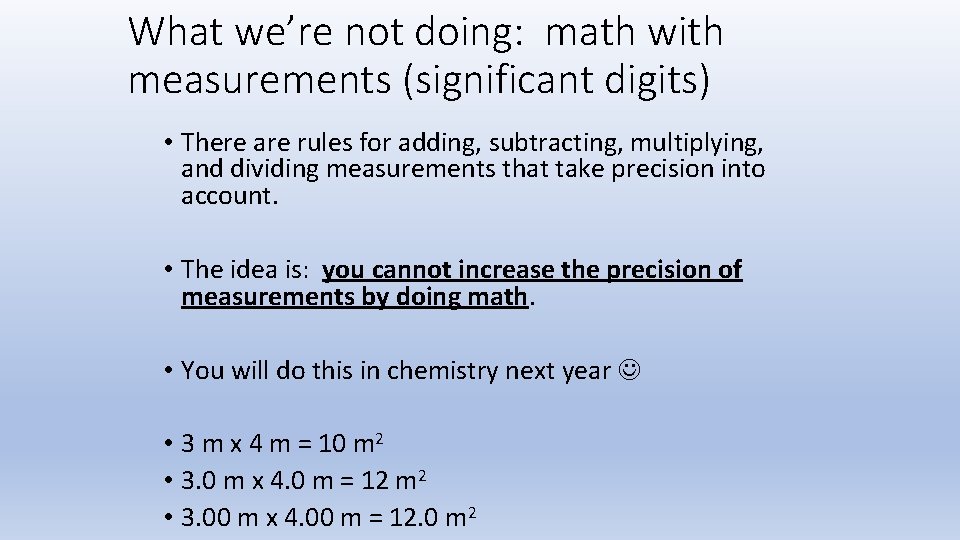
What we’re not doing: math with measurements (significant digits) • There are rules for adding, subtracting, multiplying, and dividing measurements that take precision into account. • The idea is: you cannot increase the precision of measurements by doing math. • You will do this in chemistry next year • 3 m x 4 m = 10 m 2 • 3. 0 m x 4. 0 m = 12 m 2 • 3. 00 m x 4. 00 m = 12. 0 m 2
Wrap • Accuracy is a description of how correct a measurement is. • Precision is the degree of detail of a measurement • Memorize and be able to use the metric prefixes identified yesterday (be on notice: quiz possible on prefixes at any time!)