
CONVERTING MOTION We know that there are four
- Slides: 5
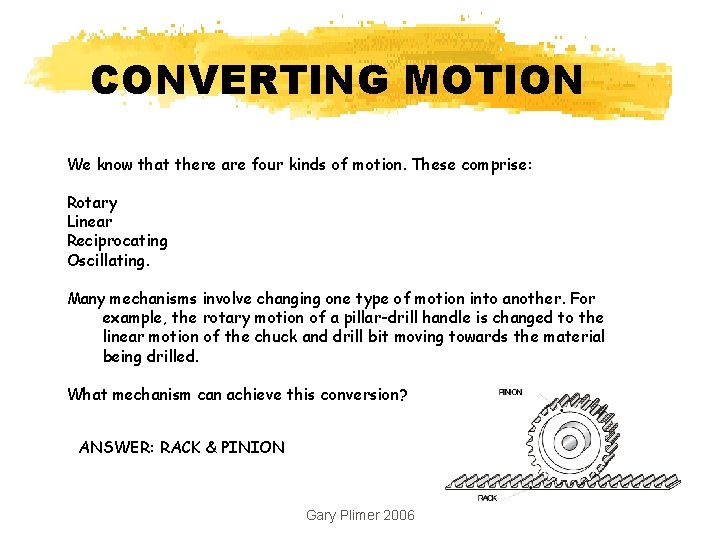
CONVERTING MOTION We know that there are four kinds of motion. These comprise: Rotary Linear Reciprocating Oscillating. Many mechanisms involve changing one type of motion into another. For example, the rotary motion of a pillar-drill handle is changed to the linear motion of the chuck and drill bit moving towards the material being drilled. What mechanism can achieve this conversion? ANSWER: RACK & PINION Gary Plimer 2006
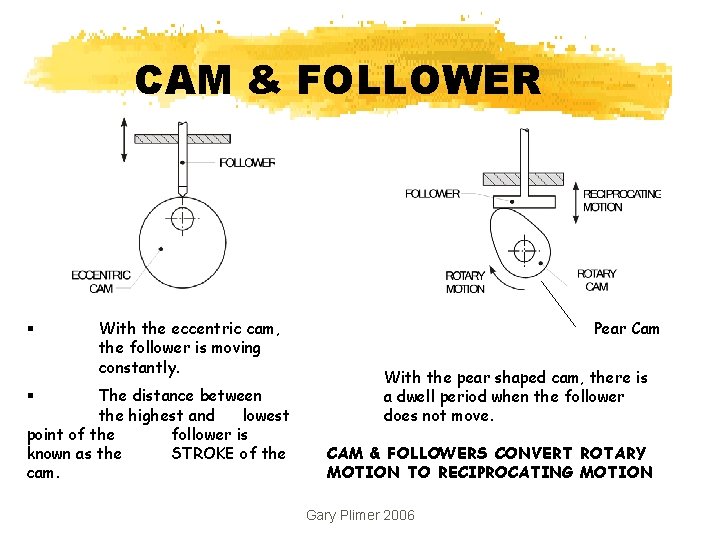
CAM & FOLLOWER § With the eccentric cam, the follower is moving constantly. The distance between the highest and lowest point of the follower is known as the STROKE of the cam. § Pear Cam With the pear shaped cam, there is a dwell period when the follower does not move. CAM & FOLLOWERS CONVERT ROTARY MOTION TO RECIPROCATING MOTION Gary Plimer 2006
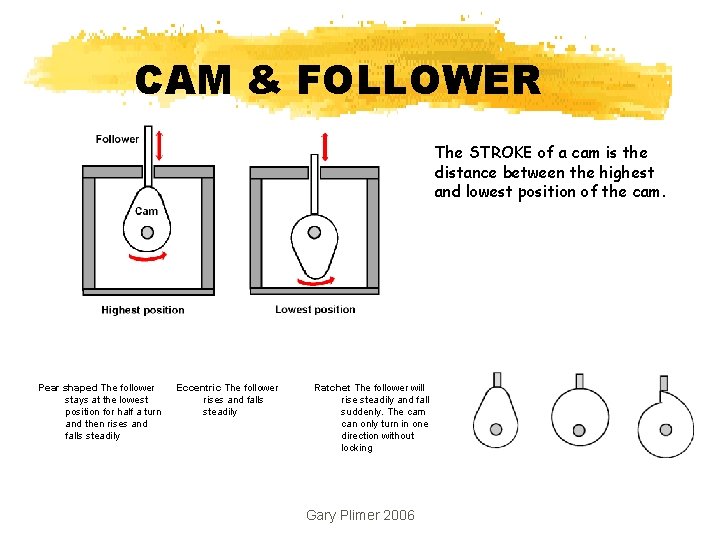
CAM & FOLLOWER The STROKE of a cam is the distance between the highest and lowest position of the cam. Pear shaped The follower stays at the lowest position for half a turn and then rises and falls steadily Eccentric The follower rises and falls steadily Ratchet The follower will rise steadily and fall suddenly. The cam can only turn in one direction without locking Gary Plimer 2006
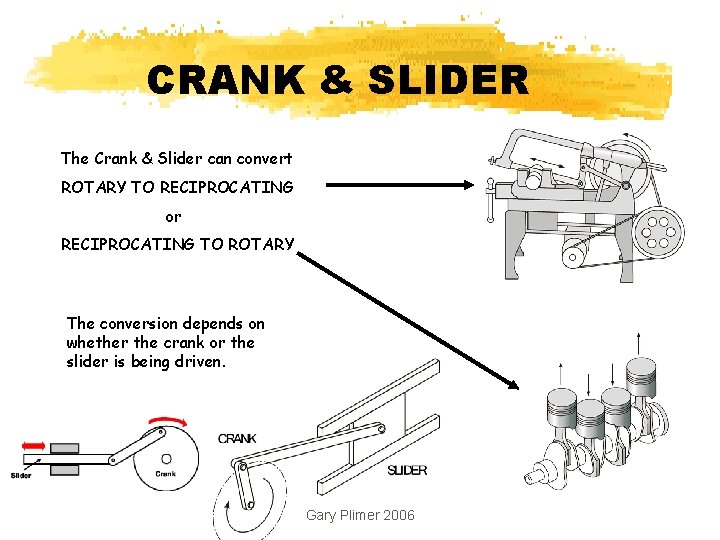
CRANK & SLIDER The Crank & Slider can convert ROTARY TO RECIPROCATING or RECIPROCATING TO ROTARY The conversion depends on whether the crank or the slider is being driven. Gary Plimer 2006
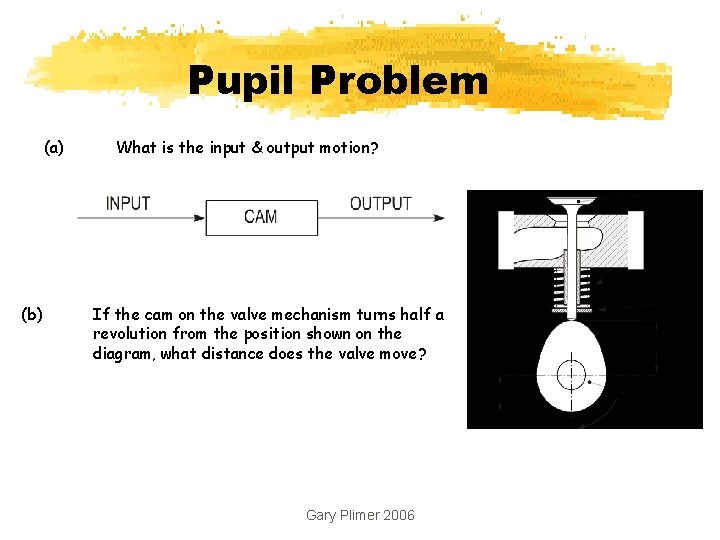
Pupil Problem (a) (b) What is the input & output motion? If the cam on the valve mechanism turns half a revolution from the position shown on the diagram, what distance does the valve move? Gary Plimer 2006