
Converter specification internal or external design for smooth

- Slides: 31
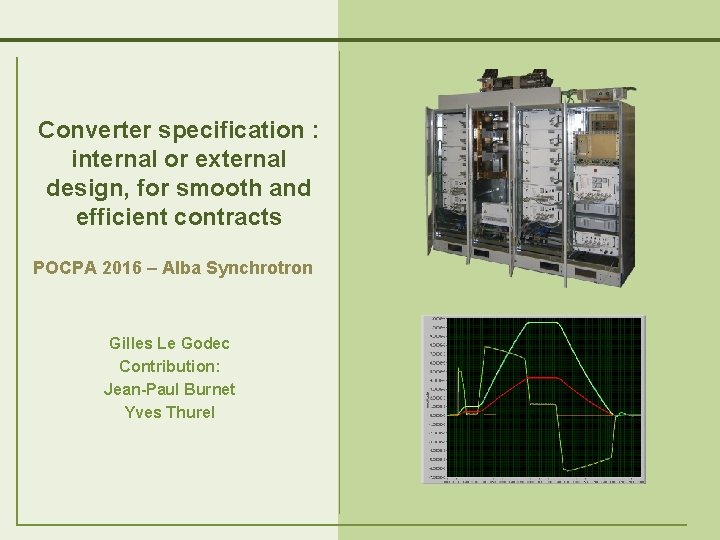
Converter specification : internal or external design, for smooth and efficient contracts POCPA 2016 – Alba Synchrotron Gilles Le Godec Contribution: Jean-Paul Burnet Yves Thurel
Contents 3 CONTENTS 1. Introduction and strategy for procurement 2. Off-the-shelf Voltage Source Converter 3. Voltage Source specified Converter 4. CERN designed Converter 5. Conclusions 48
Contents 4 CONTENTS 1. Introduction and strategy for procurement 2. Off-the-shelf Voltage Source Converter 3. Voltage Source specified Converter 4. CERN designed Converter 5. Conclusions 48
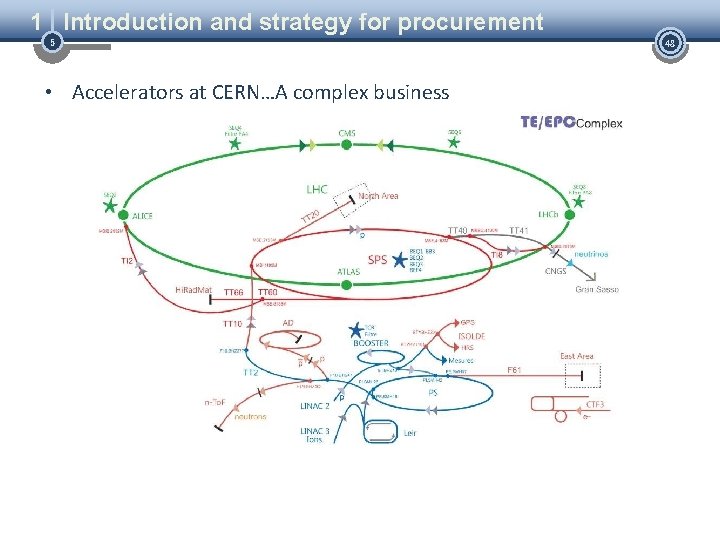
1 Introduction and strategy for procurement 5 • Accelerators at CERN…A complex business 48
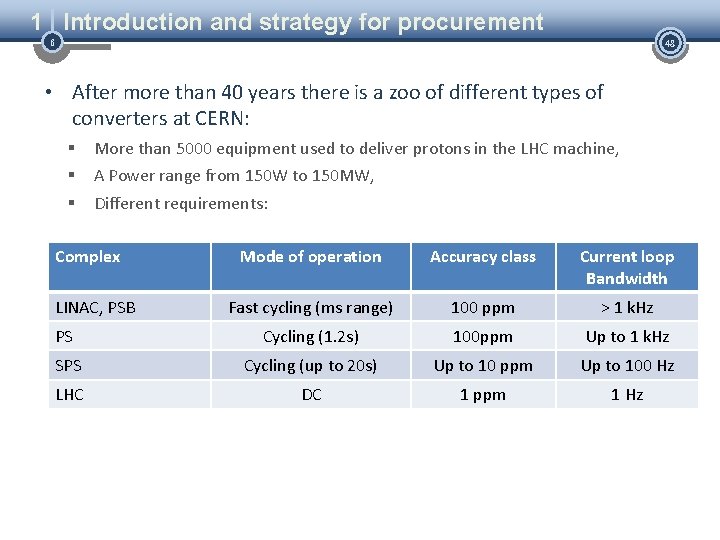
1 Introduction and strategy for procurement 6 48 • After more than 40 years there is a zoo of different types of converters at CERN: § § § More than 5000 equipment used to deliver protons in the LHC machine, A Power range from 150 W to 150 MW, Different requirements: Complex Mode of operation Accuracy class Current loop Bandwidth Fast cycling (ms range) 100 ppm > 1 k. Hz PS Cycling (1. 2 s) 100 ppm Up to 1 k. Hz SPS Cycling (up to 20 s) Up to 10 ppm Up to 100 Hz LHC DC 1 ppm 1 Hz LINAC, PSB
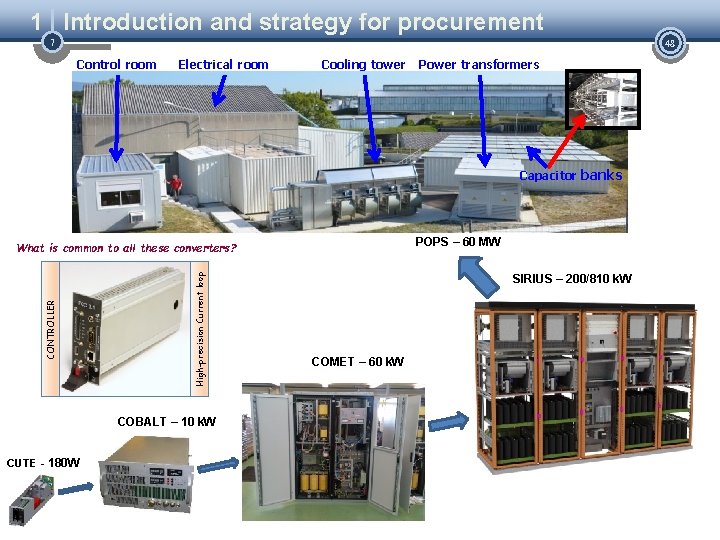
1 Introduction and strategy for procurement 7 48 Control room Electrical room Cooling tower Power transformers Capacitor banks POPS – 60 MW High-precision Current loop CONTROLLER What is common to all these converters? COBALT – 10 k. W CUTE - 180 W SIRIUS – 200/810 k. W COMET – 60 k. W
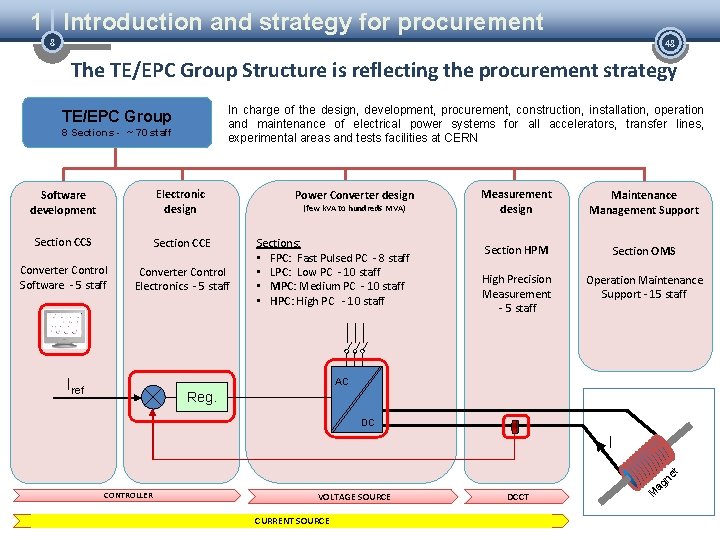
1 Introduction and strategy for procurement 8 48 The TE/EPC Group Structure is reflecting the procurement strategy In charge of the design, development, procurement, construction, installation, operation and maintenance of electrical power systems for all accelerators, transfer lines, experimental areas and tests facilities at CERN TE/EPC Group 8 Sections - ~ 70 staff Software development Electronic design Control systems Analog and Section CCE digital electronics Converter Control Section CCS Converter Control Software - 5 staff Electronics - 5 staff Power Converter design (few k. VA to hundreds MVA) Power Sections: electronics • FPC: Fast Pulsed PC - 8 staff • LPC: Low PC - 10 staff • MPC: Medium PC - 10 staff • HPC: High PC - 10 staff Measurement design Maintenance Management Support High-precision Section HPM current and voltage High Precision measurements Measurement Maintenance Section OMS management - 5 staff Operation Maintenance Support - 15 staff AC Iref Reg. DC I et CONTROLLER VOLTAGE SOURCE CURRENT SOURCE DCCT M n ag
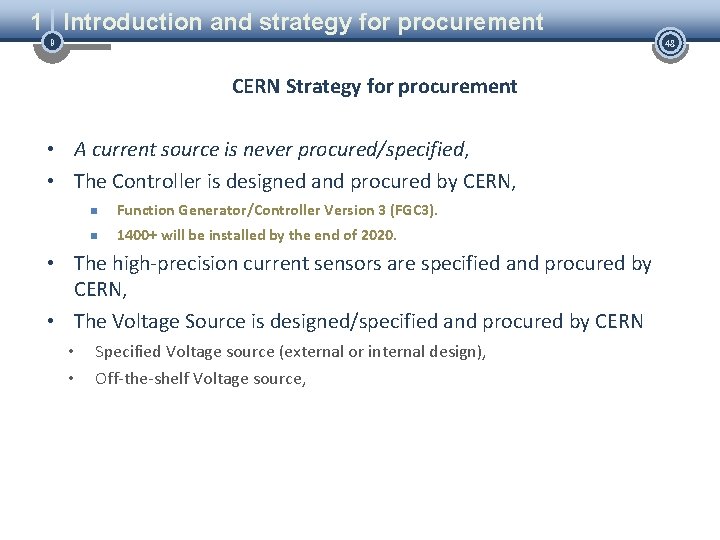
1 Introduction and strategy for procurement 9 48 CERN Strategy for procurement • A current source is never procured/specified, • The Controller is designed and procured by CERN, n Function Generator/Controller Version 3 (FGC 3). n 1400+ will be installed by the end of 2020. • The high-precision current sensors are specified and procured by CERN, • The Voltage Source is designed/specified and procured by CERN • • Specified Voltage source (external or internal design), Off-the-shelf Voltage source,
Contents 10 CONTENTS 1. Introduction and strategy for procurement 2. Off-the-shelf Voltage Source Converters 3. Voltage Source specified Converter 4. CERN designed Converter 5. Conclusions 48
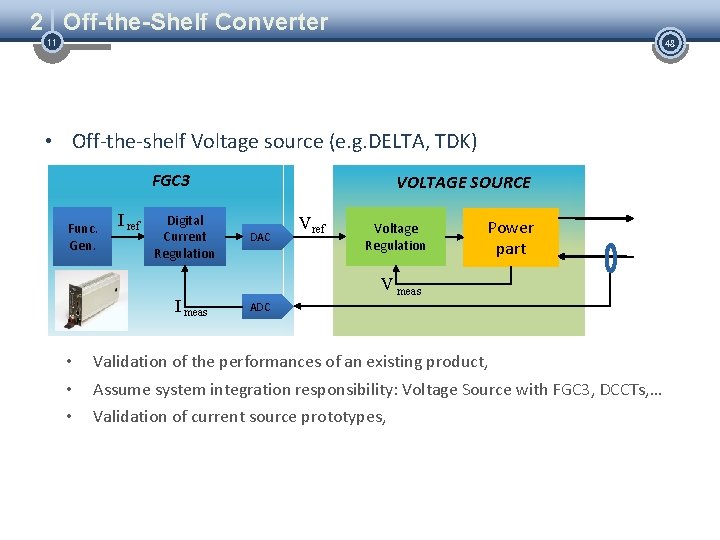
2 Off-the-Shelf Converter 11 48 • Off-the-shelf Voltage source (e. g. DELTA, TDK) FGC 3 Func. Gen. I ref Digital Current Regulation I meas • • • VOLTAGE SOURCE DAC Vref Voltage Regulation Power part V meas ADC Validation of the performances of an existing product, Assume system integration responsibility: Voltage Source with FGC 3, DCCTs, … Validation of current source prototypes,
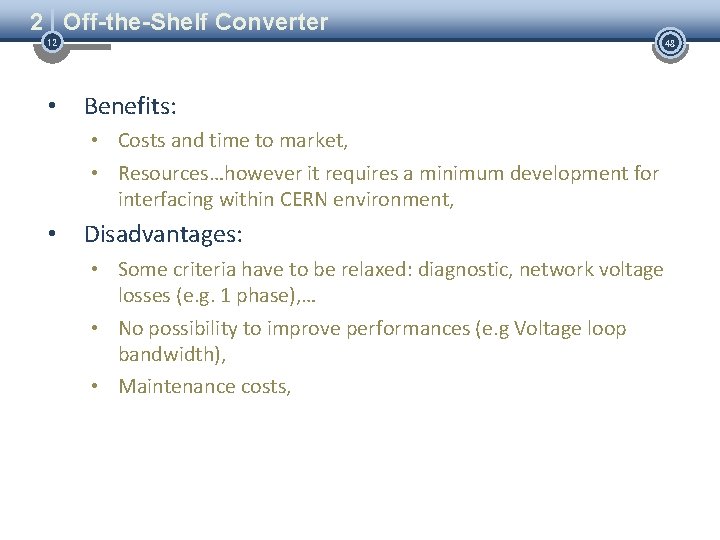
2 Off-the-Shelf Converter 12 • 48 Benefits: • Costs and time to market, • Resources…however it requires a minimum development for interfacing within CERN environment, • Disadvantages: • Some criteria have to be relaxed: diagnostic, network voltage losses (e. g. 1 phase), … • No possibility to improve performances (e. g Voltage loop bandwidth), • Maintenance costs,
Contents 13 CONTENTS 1. Introduction and strategy for procurement 2. Off-the-shelf Voltage Source Converter 3. Voltage Source specified Converter 4. CERN designed Converter 5. Conclusions 48
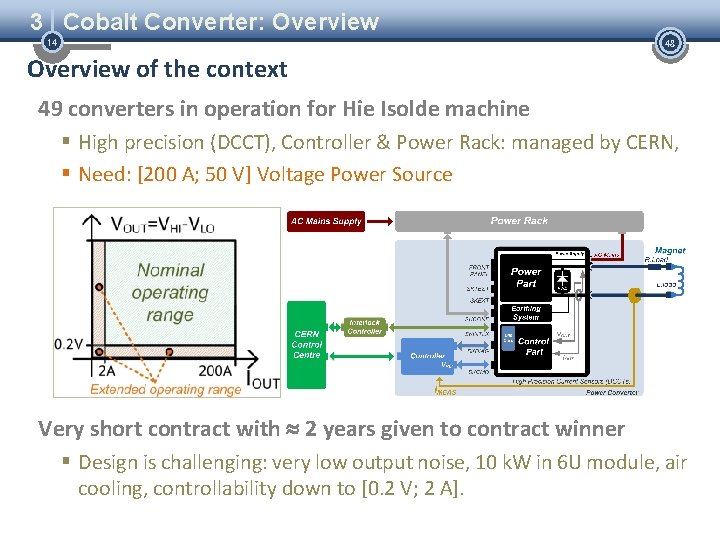
3 Cobalt Converter: Overview 14 48 Overview of the context 49 converters in operation for Hie Isolde machine § High precision (DCCT), Controller & Power Rack: managed by CERN, § Need: [200 A; 50 V] Voltage Power Source Very short contract with 2 years given to contract winner § Design is challenging: very low output noise, 10 k. W in 6 U module, air cooling, controllability down to [0. 2 V; 2 A].
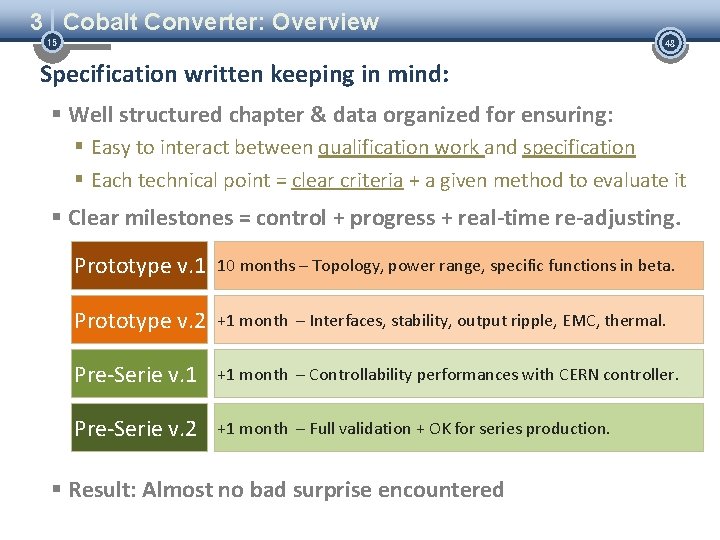
3 Cobalt Converter: Overview 15 48 Specification written keeping in mind: § Well structured chapter & data organized for ensuring: § Easy to interact between qualification work and specification § Each technical point = clear criteria + a given method to evaluate it § Clear milestones = control + progress + real-time re-adjusting. Prototype v. 1 10 months – Topology, power range, specific functions in beta. Prototype v. 2 +1 month – Interfaces, stability, output ripple, EMC, thermal. Pre-Serie v. 1 +1 month – Controllability performances with CERN controller. Pre-Serie v. 2 +1 month – Full validation + OK for series production. § Result: Almost no bad surprise encountered
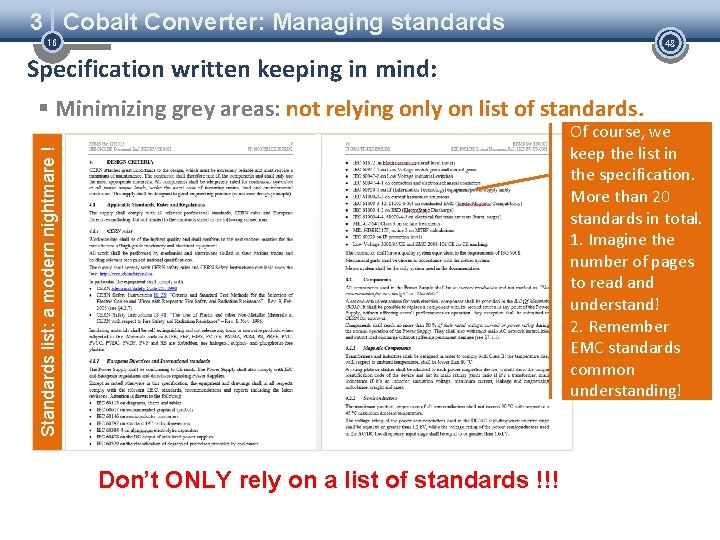
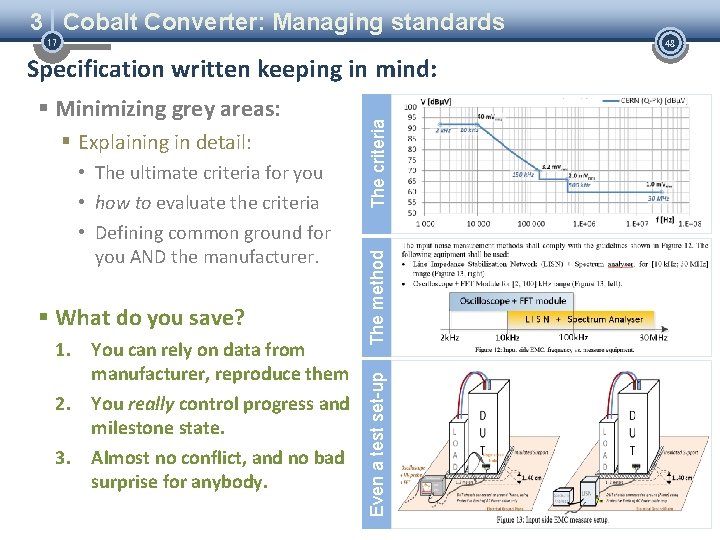
3 Cobalt Converter: Managing standards 16 48 Specification written keeping in mind: § Minimizing grey areas: not relying only on list of standards. Standards list: a modern nightmare ! Of course, we keep the list in the specification. More than 20 standards in total. 1. Imagine the number of pages to read and understand! 2. Remember EMC standards common understanding! Don’t ONLY rely on a list of standards !!!
3 Cobalt Converter: Managing standards 17 48 • The ultimate criteria for you • how to evaluate the criteria • Defining common ground for you AND the manufacturer. § What do you save? 1. You can rely on data from manufacturer, reproduce them 2. You really control progress and milestone state. 3. Almost no conflict, and no bad surprise for anybody. The method § Explaining in detail: Even a test set-up § Minimizing grey areas: The criteria Specification written keeping in mind:
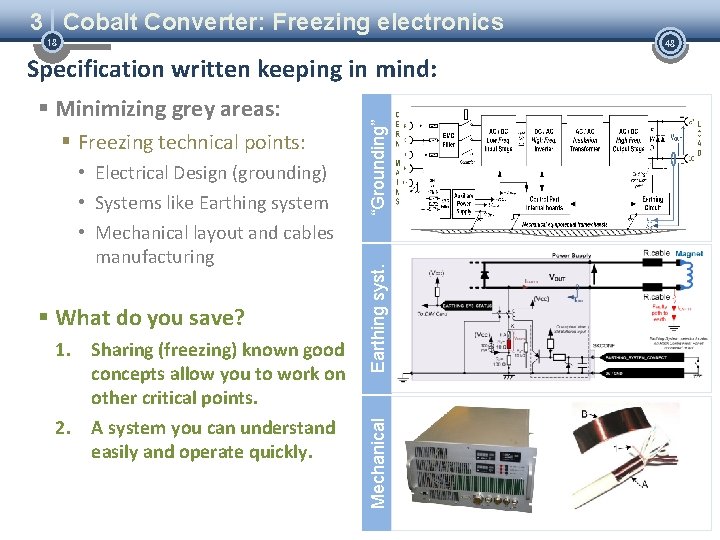
3 Cobalt Converter: Freezing electronics 18 48 • Electrical Design (grounding) • Systems like Earthing system • Mechanical layout and cables manufacturing § What do you save? 1. Sharing (freezing) known good concepts allow you to work on other critical points. 2. A system you can understand easily and operate quickly. Earthing syst. § Freezing technical points: Mechanical § Minimizing grey areas: “Grounding” Specification written keeping in mind:
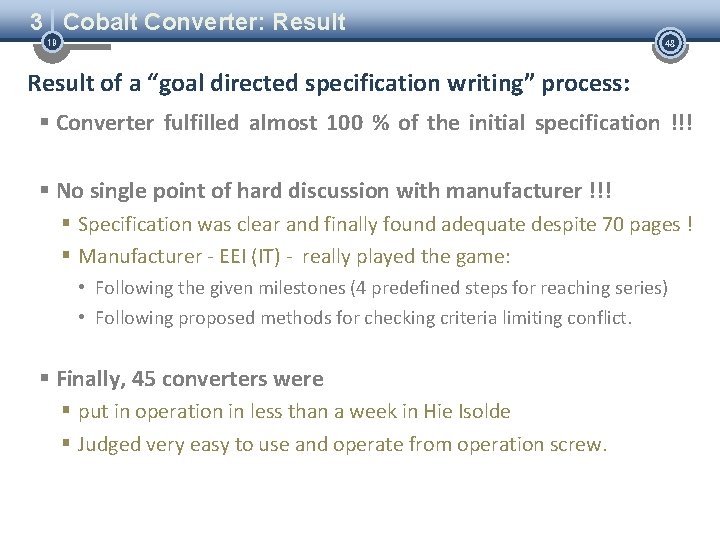
3 Cobalt Converter: Result 19 48 Result of a “goal directed specification writing” process: § Converter fulfilled almost 100 % of the initial specification !!! § No single point of hard discussion with manufacturer !!! § Specification was clear and finally found adequate despite 70 pages ! § Manufacturer - EEI (IT) - really played the game: • Following the given milestones (4 predefined steps for reaching series) • Following proposed methods for checking criteria limiting conflict. § Finally, 45 converters were § put in operation in less than a week in Hie Isolde § Judged very easy to use and operate from operation screw.
Contents 20 CONTENTS 1. Introduction and strategy for procurement 2. Off-the-shelf Voltage Source Converter 3. Voltage Source specified Converter 4. CERN designed Converter 5. Conclusions 48
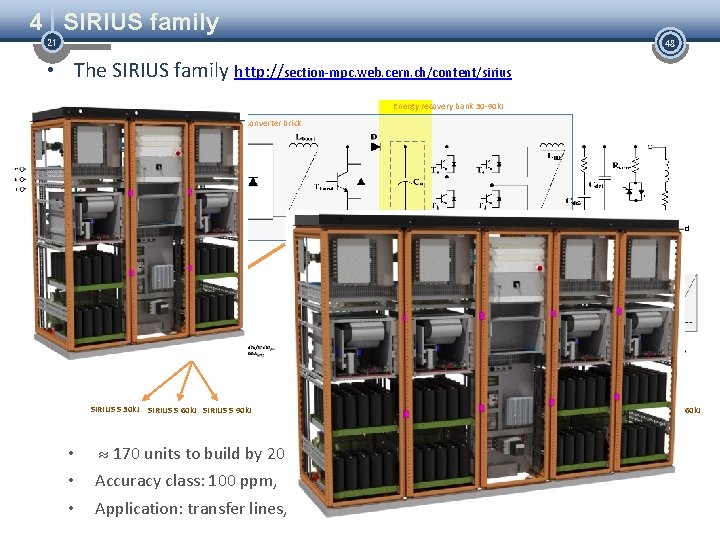
4 SIRIUS family 21 48 • The SIRIUS family http: //section-mpc. web. cern. ch/content/sirius Energy recovery bank 30 -90 k. J Standardised converter brick SIRIUS S 30 k. J SIRIUS S 60 k. J SIRIUS S 90 k. J SIRIUS 2 P 2 S SIRIUS 2 P 60 k. J SIRIUS 2 P 120 k. J • 170 units to build by 2020, • • Accuracy class: 100 ppm, SIRIUS 4 P Or 2 P_2 S SIRIUS 2 P 180 k. J SIRIUS 4 P 120 k. J SIRIUS 4 P 240 k. J SIRIUS 4 P 360 k. J Extra cabinet for energy storage: SIRIUS 4 P 600 k. J Application: transfer lines, correctors for PSB or PS, experimental areas…
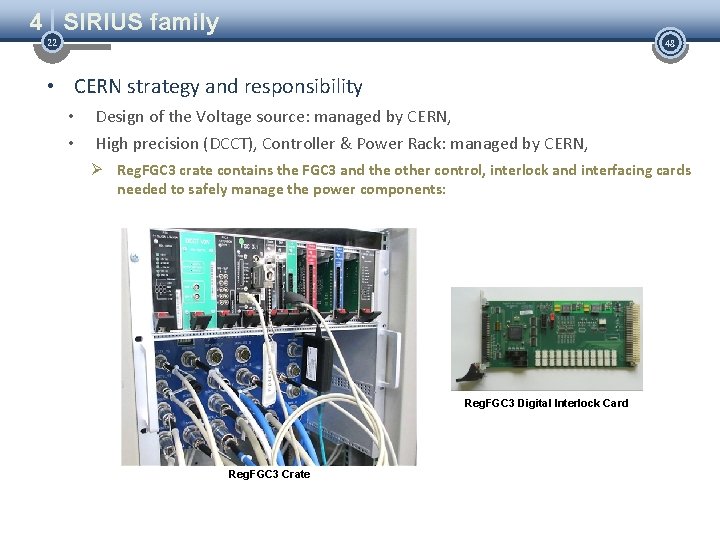
4 SIRIUS family 22 48 • CERN strategy and responsibility • • Design of the Voltage source: managed by CERN, High precision (DCCT), Controller & Power Rack: managed by CERN, Ø Reg. FGC 3 crate contains the FGC 3 and the other control, interlock and interfacing cards needed to safely manage the power components: Reg. FGC 3 Digital Interlock Card Reg. FGC 3 Crate
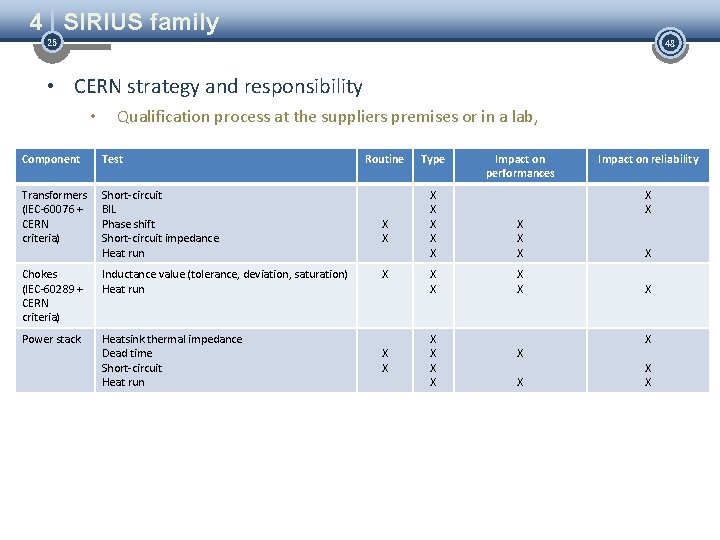
4 SIRIUS family 23 48 • CERN strategy and responsibility • Call for tenders for specific components: magnetics, power stacks, power resistors, • • Strong commitment from CERN on technical choices with suppliers, Qualification process at the suppliers premises or in a lab,
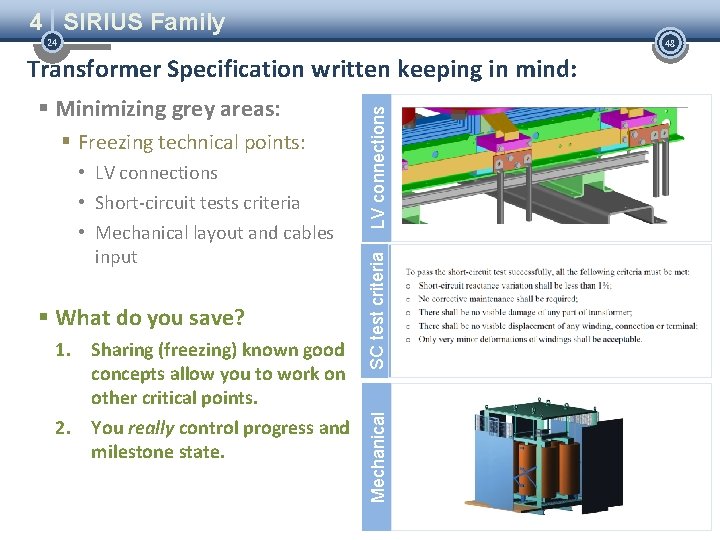
4 SIRIUS Family 24 48 • LV connections • Short-circuit tests criteria • Mechanical layout and cables input § What do you save? 1. Sharing (freezing) known good concepts allow you to work on other critical points. 2. You really control progress and milestone state. SC test criteria § Freezing technical points: Mechanical § Minimizing grey areas: LV connections Transformer Specification written keeping in mind:
4 SIRIUS family 25 48 • CERN strategy and responsibility • Qualification process at the suppliers premises or in a lab, Component Test Transformers (IEC-60076 + CERN criteria) Short-circuit BIL Phase shift Short-circuit impedance Heat run Chokes (IEC-60289 + CERN criteria) Inductance value (tolerance, deviation, saturation) Heat run Power stack Heatsink thermal impedance Dead time Short-circuit Heat run Routine X X X Type Impact on performances X X X X X Impact on reliability X X X X
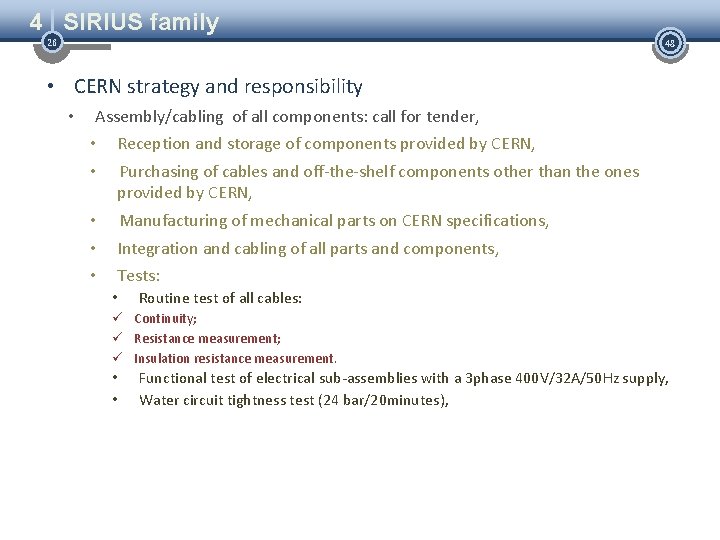
4 SIRIUS family 26 48 • CERN strategy and responsibility • Assembly/cabling of all components: call for tender, • • Reception and storage of components provided by CERN, • • • Manufacturing of mechanical parts on CERN specifications, Purchasing of cables and off-the-shelf components other than the ones provided by CERN, Integration and cabling of all parts and components, Tests: • Routine test of all cables: ü Continuity; ü Resistance measurement; ü Insulation resistance measurement. • • Functional test of electrical sub-assemblies with a 3 phase 400 V/32 A/50 Hz supply, Water circuit tightness test (24 bar/20 minutes),
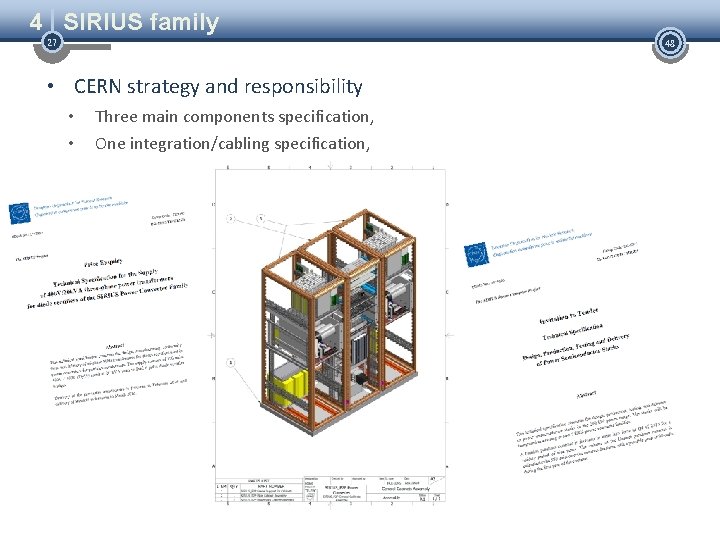
4 SIRIUS family 27 48 • CERN strategy and responsibility • • Three main components specification, One integration/cabling specification,
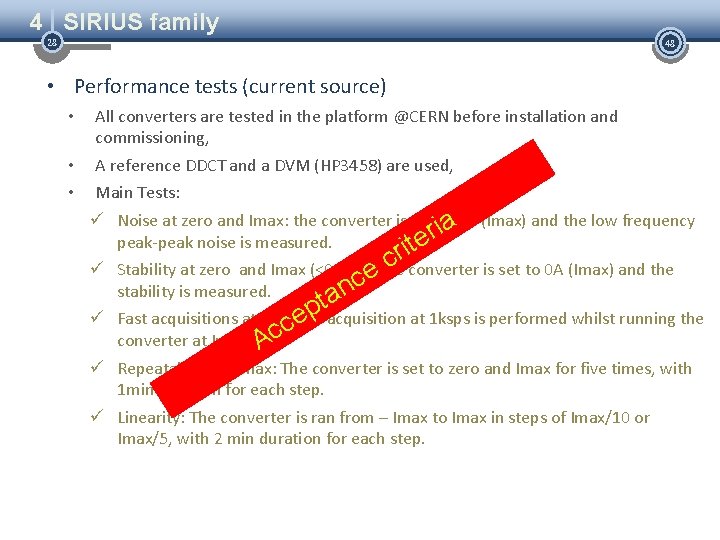
4 SIRIUS family 28 48 • Performance tests (current source) • All converters are tested in the platform @CERN before installation and commissioning, • • A reference DDCT and a DVM (HP 3458) are used, Main Tests: ü Noise at zero and Imax: the converter is set toa 0 A (Imax) and the low frequency i r peak-peak noise is measured. te i r c converter is set to 0 A (Imax) and the ü Stability at zero and Imax (<0. 1 Hz): ethe c stability is measured. n ta p ü Fast acquisitions at Imax: ean acquisition at 1 ksps is performed whilst running the c converter at Imax, Ac ü Repeatability at Imax: The converter is set to zero and Imax for five times, with 1 min duration for each step. ü Linearity: The converter is ran from – Imax to Imax in steps of Imax/10 or Imax/5, with 2 min duration for each step.
Contents 29 CONTENTS 1. Introduction and strategy for procurement 2. Off-the-shelf Voltage Source Converter 3. Voltage Source specified Converter 4. CERN designed Converter 5. Conclusions 48
5 Conclusions 30 48 • The in-house design of the high-precision Controller is a key element for standardisation, build families and reach the performances, • Several strategies possible for the procurement of the Voltage Source, • Whatever the strategy used for the procurement of the voltage source, a strong commitment/implication is required: • • To follow-up closely the project/milestones, To make sure that what is delivered is what you expect,