
CONVERSIONS DIMENSIONAL ANALYSIS SWBAT UTILIZE APPROPRIATE CONVERSION FACTORS
CONVERSIONS & DIMENSIONAL ANALYSIS SWBAT UTILIZE APPROPRIATE CONVERSION FACTORS AND DIMENSIONAL ANALYSIS AS STRATEGIES FOR SOLVING PROBLEMS THAT REQUIRE DIFFERENT UNITS

CONVERSION FACTORS
DIMENSIONAL ANALYSIS Dimensional analysis is the way to analyze and solve problems using the units of a measurement. Dimensional Analysis Steps: Start with the given value and its units Use a conversion factor that expresses the given units in the denominator (bottom) and wanted units in the numerator (top) this allows the given unit to be canceled out Use additional conversion factors as needed to reach your final units Multiply through the top and divide by the bottom numbers
SCIENTIFIC NOTATION In scientific notation a number is written as a product of two numbers: a coefficient and 10 raised to a power. Example 602, 000, 000, 000 is 6. 02 x 1023 where the coefficient is 6. 02 and the power of 10 is raised to the exponent 23. In scientific notation the coefficient is always greater than 1 and less than 10.
PRACTICE PROBLEM How many seconds are in an 8 hour workday? Known Time Worked: 8 hours 1 hour = 60 minute 1 minute = 60 seconds Unknown Seconds worked?
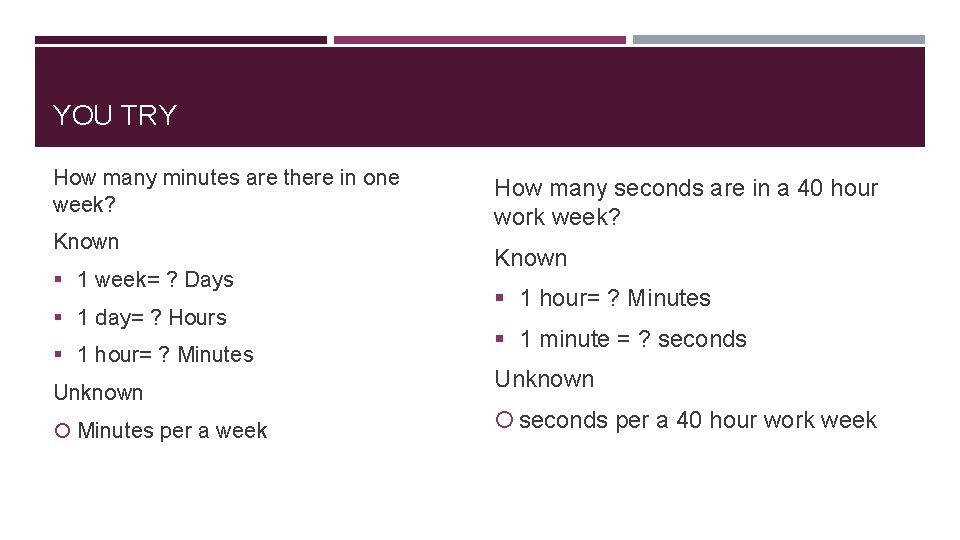
YOU TRY How many minutes are there in one week? Known § 1 week= ? Days § 1 day= ? Hours § 1 hour= ? Minutes Unknown Minutes per a week How many seconds are in a 40 hour work week? Known § 1 hour= ? Minutes § 1 minute = ? seconds Unknown seconds per a 40 hour work week

PRACTICE PROBLEM The directions for an experiment ask each student to measure 1. 84 g of copper (Cu) wire. The only copper wire available is a spool with a mass of 50 grams. How many students can do the experiment? Known Mass of Cu Available = 50 g Each student needs= 1. 84 g/student Unknown Number of students?
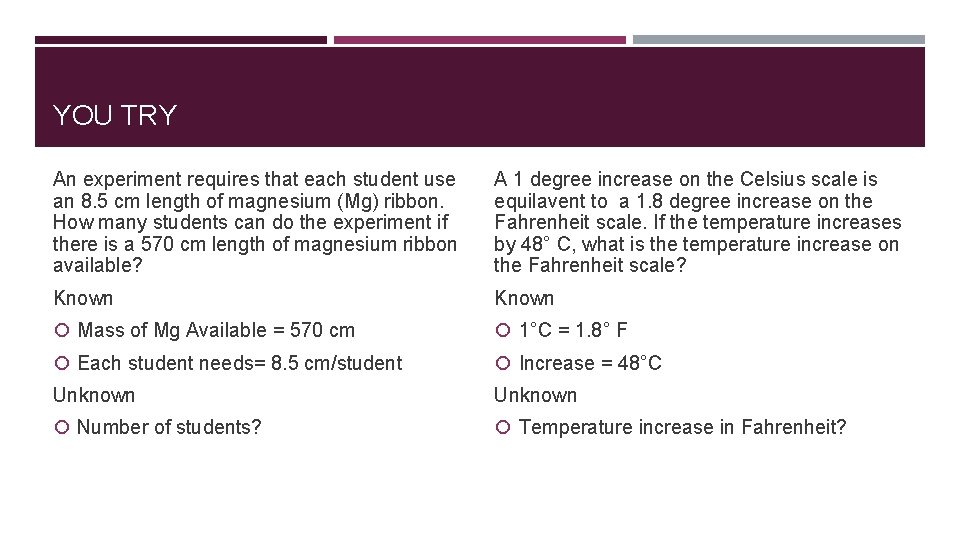
YOU TRY An experiment requires that each student use an 8. 5 cm length of magnesium (Mg) ribbon. How many students can do the experiment if there is a 570 cm length of magnesium ribbon available? A 1 degree increase on the Celsius scale is equilavent to a 1. 8 degree increase on the Fahrenheit scale. If the temperature increases by 48° C, what is the temperature increase on the Fahrenheit scale? Known Mass of Mg Available = 570 cm 1°C = 1. 8° F Each student needs= 8. 5 cm/student Increase = 48°C Unknown Number of students? Temperature increase in Fahrenheit?
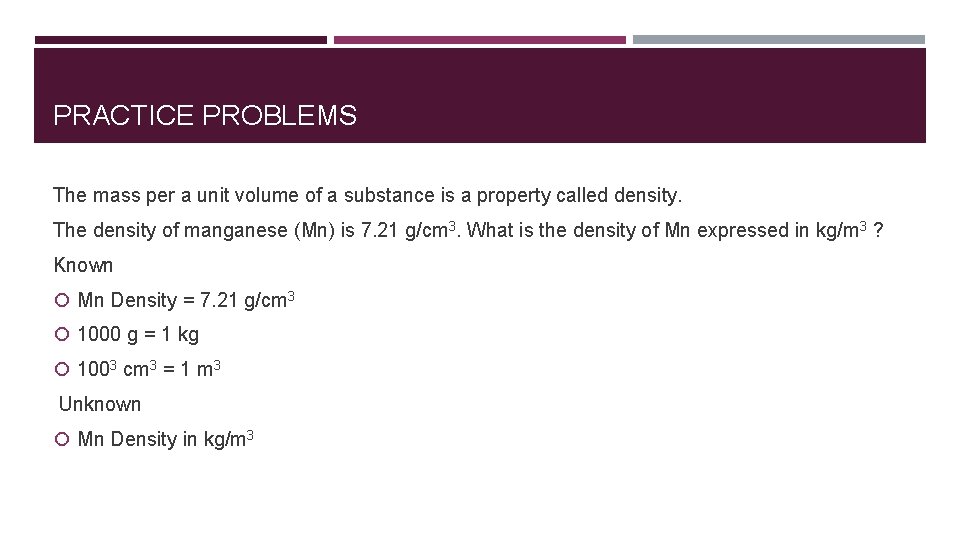
PRACTICE PROBLEMS The mass per a unit volume of a substance is a property called density. The density of manganese (Mn) is 7. 21 g/cm 3. What is the density of Mn expressed in kg/m 3 ? Known Mn Density = 7. 21 g/cm 3 1000 g = 1 kg 1003 cm 3 = 1 m 3 Unknown Mn Density in kg/m 3

YOU TRY Gold (Au) has a density of 19. 3 g/cm 3. What is the density in kilograms per cubic meter? Known Au Density = 19. 3 g/cm 3 1000 g = 1 kg 1003 cm 3 = 1 m 3 Unknown Au Density in kg/m 3 There are 7. 0 x 106 red blood cells (RBC) in 1. 0 mm 3 of blood how many RBCs are in 1. 0 L of Blood? Density of Blood = 7. 0 x 106 RBC/ 1. 0 mm 3 1 cm 3 = 103 mm 3 1 cm 3 = 1 m. L 1000 m. L = 1 L Unknown Blood’s Density in RBC/L
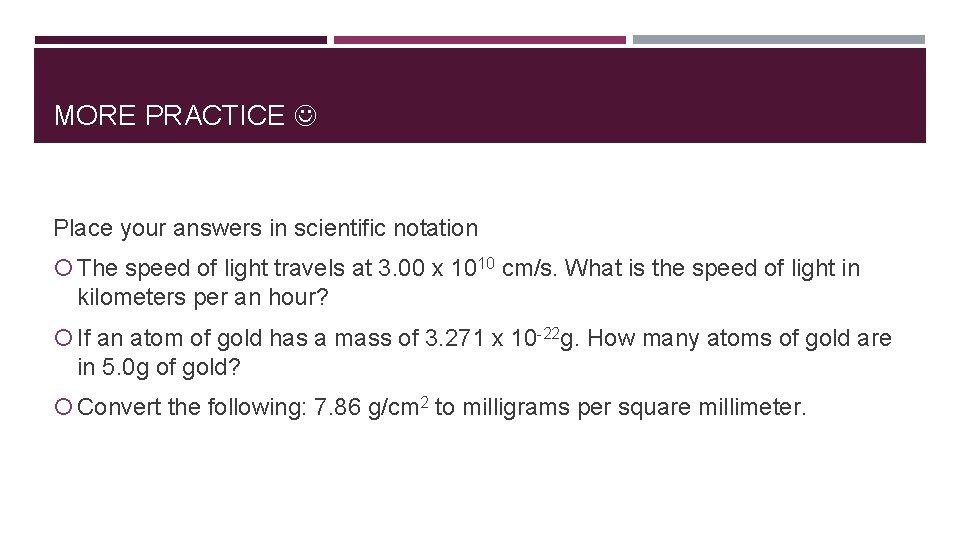
MORE PRACTICE Place your answers in scientific notation The speed of light travels at 3. 00 x 1010 cm/s. What is the speed of light in kilometers per an hour? If an atom of gold has a mass of 3. 271 x 10 -22 g. How many atoms of gold are in 5. 0 g of gold? Convert the following: 7. 86 g/cm 2 to milligrams per square millimeter.
- Slides: 11