
Conversion of Sugarcane Bagasse to Butanol and Ethanol
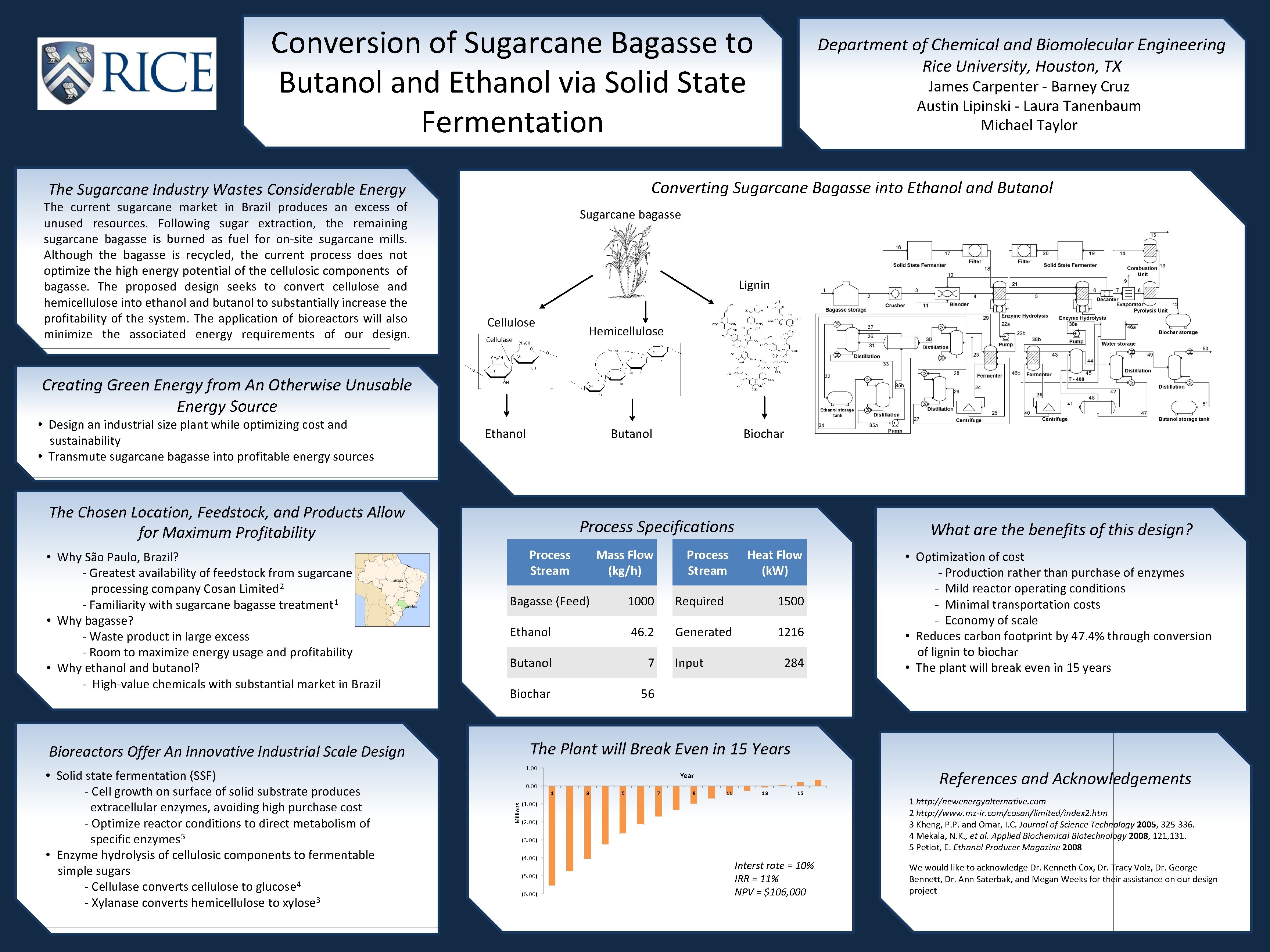
Conversion of Sugarcane Bagasse to Butanol and Ethanol via Solid State Fermentation James Carpenter - Barney Cruz Austin Lipinski - Laura Tanenbaum Michael Taylor Converting Sugarcane Bagasse into Ethanol and Butanol The Sugarcane Industry Wastes Considerable Energy The current sugarcane market in Brazil produces an excess of unused resources. Following sugar extraction, the remaining sugarcane bagasse is burned as fuel for on-site sugarcane mills. Although the bagasse is recycled, the current process does not optimize the high energy potential of the cellulosic components of bagasse. The proposed design seeks to convert cellulose and hemicellulose into ethanol and butanol to substantially increase the profitability of the system. The application of bioreactors will also minimize the associated energy requirements of our design. Department of Chemical and Biomolecular Engineering Rice University, Houston, TX Sugarcane bagasse Lignin Cellulose Hemicellulose Cellulase Xylanase Creating Green Energy from An Otherwise Unusable Energy Source • Design an industrial size plant while optimizing cost and sustainability • Transmute sugarcane bagasse into profitable energy sources Ethanol Butanol The Chosen Location, Feedstock, and Products Allow for Maximum Profitability • Why São Paulo, Brazil? - Greatest availability of feedstock from sugarcane processing company Cosan Limited 2 - Familiarity with sugarcane bagasse treatment 1 • Why bagasse? - Waste product in large excess - Room to maximize energy usage and profitability • Why ethanol and butanol? - High-value chemicals with substantial market in Brazil Process Specifications Process Stream Mass Flow (kg/h) Process Stream What are the benefits of this design? Heat Flow (k. W) Bagasse (Feed) 1000 Required 1500 Ethanol 46. 2 Generated 1216 Butanol 7 Biochar 56 Input 284 • Optimization of cost - Production rather than purchase of enzymes - Mild reactor operating conditions - Minimal transportation costs - Economy of scale • Reduces carbon footprint by 47. 4% through conversion of lignin to biochar • The plant will break even in 15 years The Plant will Break Even in 15 Years Bioreactors Offer An Innovative Industrial Scale Design 1. 00 0. 00 Millions • Solid state fermentation (SSF) - Cell growth on surface of solid substrate produces extracellular enzymes, avoiding high purchase cost - Optimize reactor conditions to direct metabolism of specific enzymes 5 • Enzyme hydrolysis of cellulosic components to fermentable simple sugars - Cellulase converts cellulose to glucose 4 - Xylanase converts hemicellulose to xylose 3 Biochar References and Acknowledgements Year 1 3 5 7 9 11 13 15 (1. 00) (2. 00) (3. 00) (4. 00) (5. 00) (6. 00) Interst rate = 10% IRR = 11% NPV = $106, 000 1 http: //newenergyalternative. com 2 http: //www. mz-ir. com/cosan/limited/index 2. htm 3 Kheng, P. P. and Omar, I. C. Journal of Science Technology 2005, 325 -336. 4 Mekala, N. K. , et al. Applied Biochemical Biotechnology 2008, 121, 131. 5 Petiot, E. Ethanol Producer Magazine 2008 We would like to acknowledge Dr. Kenneth Cox, Dr. Tracy Volz, Dr. George Bennett, Dr. Ann Saterbak, and Megan Weeks for their assistance on our design project
- Slides: 1