
CONVERSION OF SOLID FROM ONE SHAPE TO ANOTHER
- Slides: 33
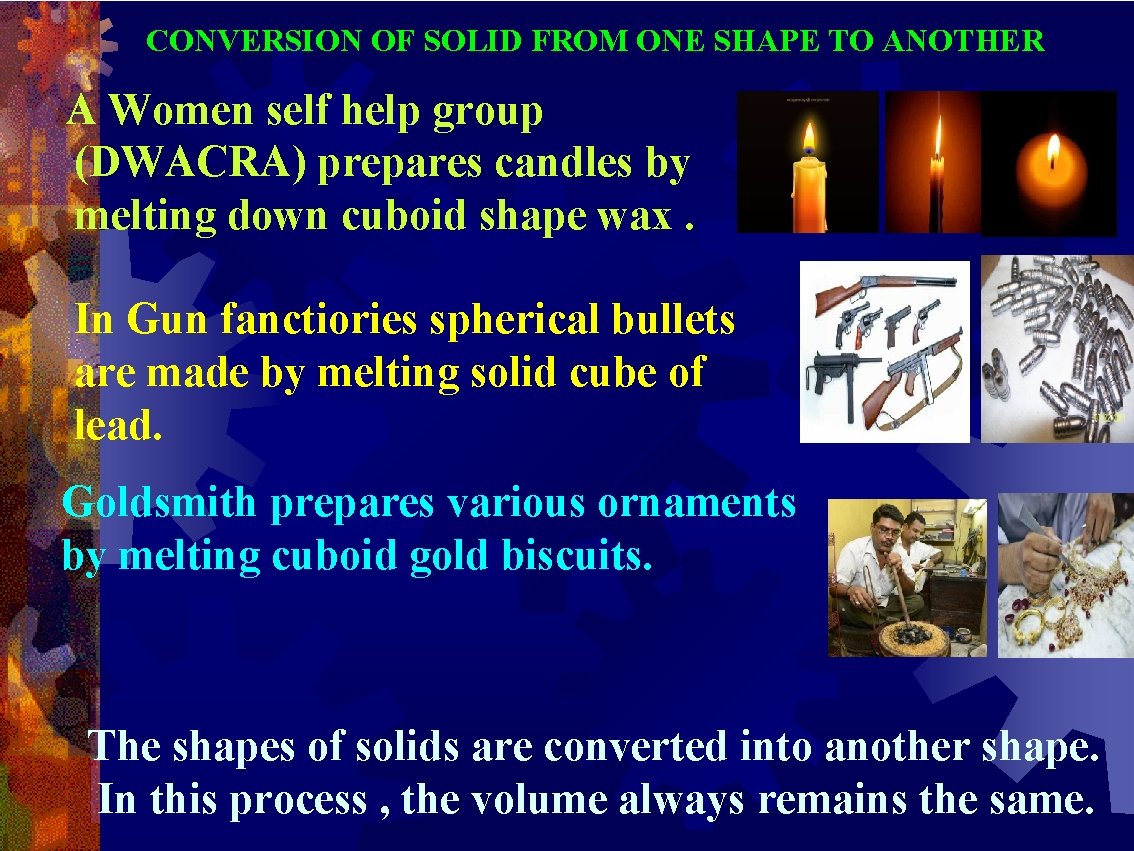
CONVERSION OF SOLID FROM ONE SHAPE TO ANOTHER A Women self help group (DWACRA) prepares candles by melting down cuboid shape wax. In Gun fanctiories spherical bullets are made by melting solid cube of lead. Goldsmith prepares various ornaments by melting cuboid gold biscuits. The shapes of solids are converted into another shape. In this process , the volume always remains the same.
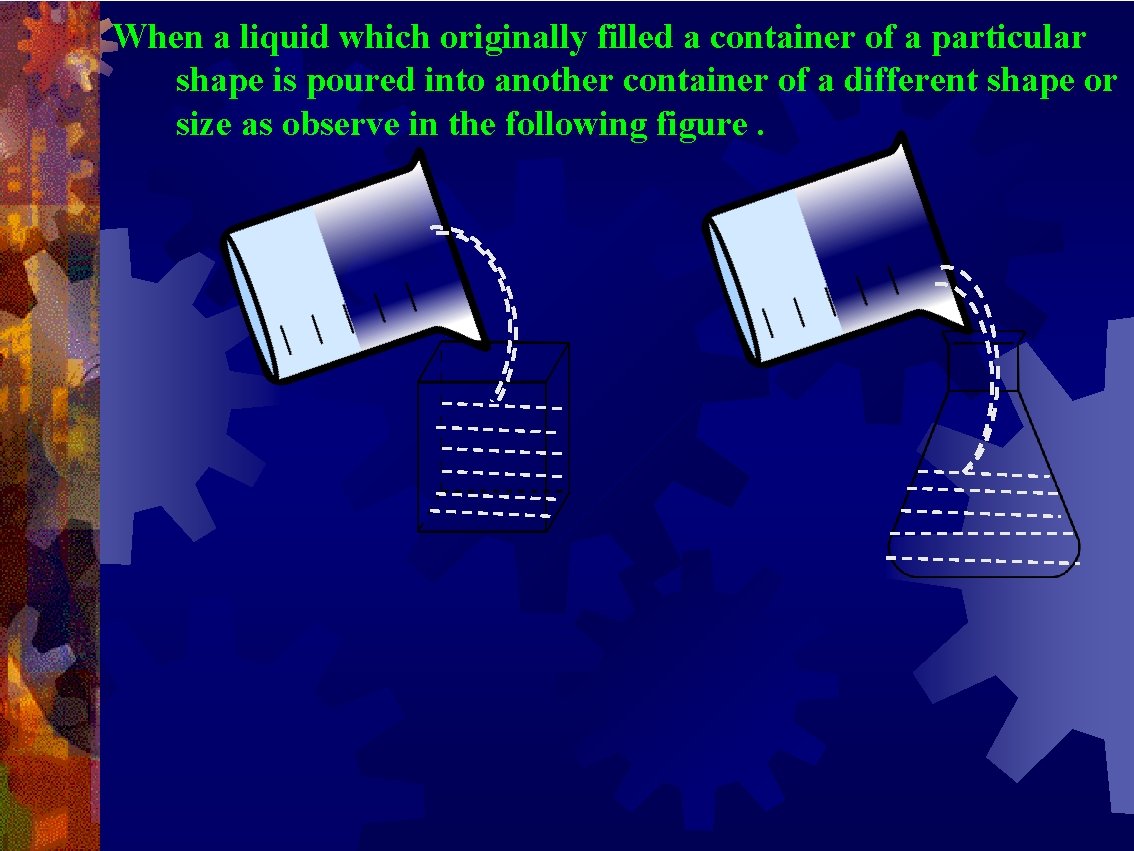
When a liquid which originally filled a container of a particular shape is poured into another container of a different shape or size as observe in the following figure.
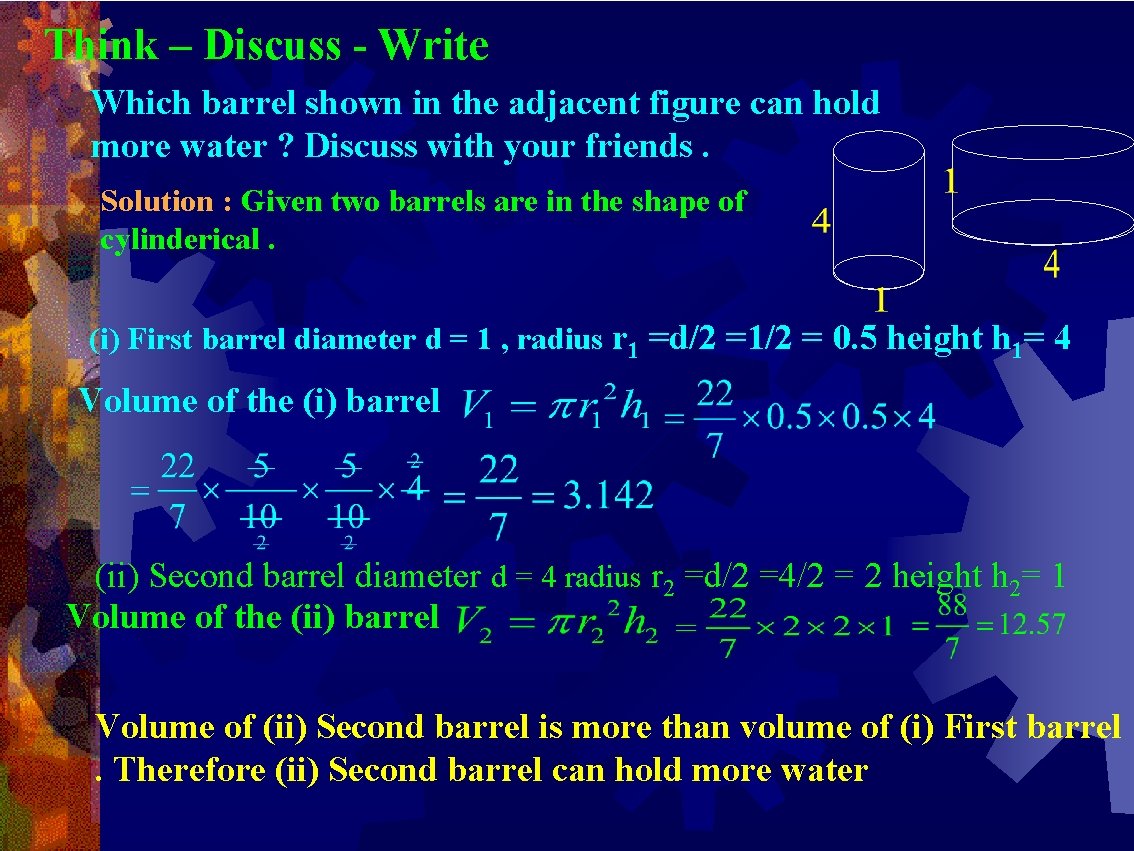
Think – Discuss - Write Which barrel shown in the adjacent figure can hold more water ? Discuss with your friends. Solution : Given two barrels are in the shape of cylinderical. (i) First barrel diameter d = 1 , radius r 1 =d/2 =1/2 = 0. 5 height h 1= 4 Volume of the (i) barrel (ii) Second barrel diameter d = 4 radius r 2 =d/2 =4/2 = 2 height h 2= 1 Volume of the (ii) barrel Volume of (ii) Second barrel is more than volume of (i) First barrel. Therefore (ii) Second barrel can hold more water
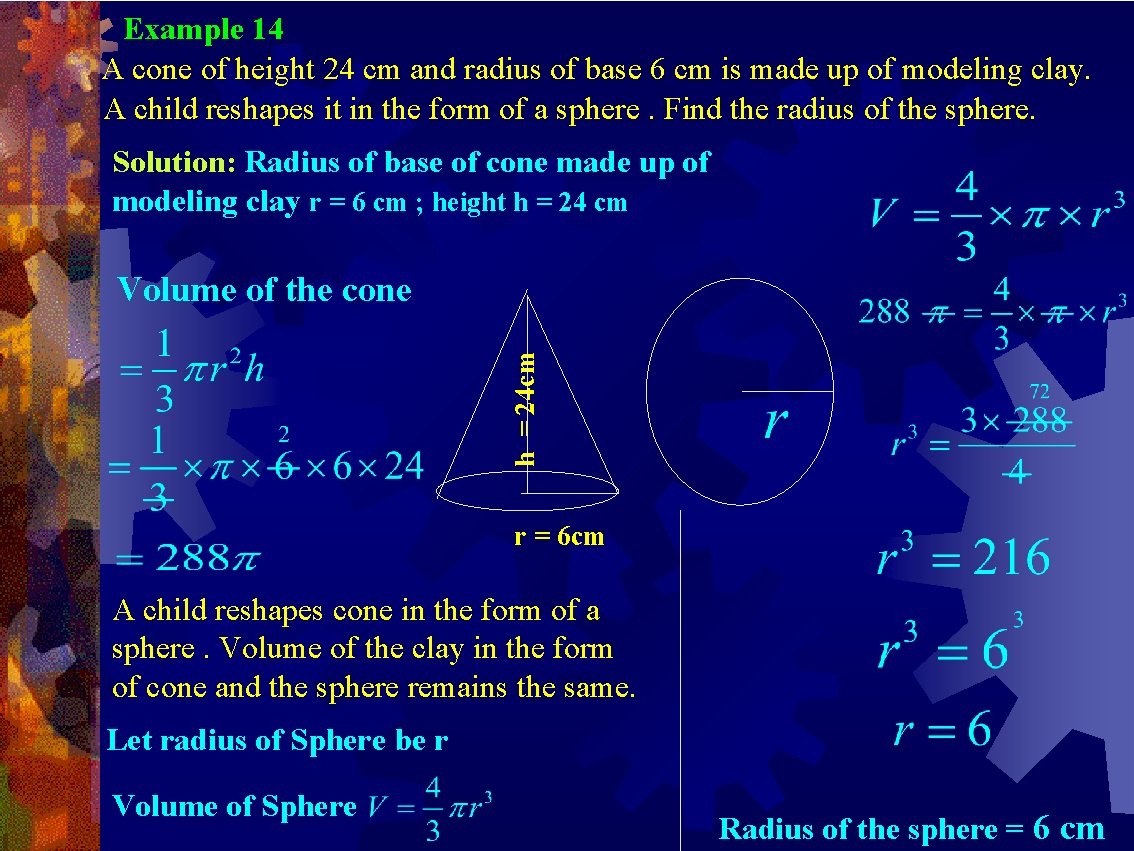
Example 14 A cone of height 24 cm and radius of base 6 cm is made up of modeling clay. A child reshapes it in the form of a sphere. Find the radius of the sphere. Solution: Radius of base of cone made up of modeling clay r = 6 cm ; height h = 24 cm h = 24 cm Volume of the cone r = 6 cm A child reshapes cone in the form of a sphere. Volume of the clay in the form of cone and the sphere remains the same. Let radius of Sphere be r Volume of Sphere Radius of the sphere = 6 cm
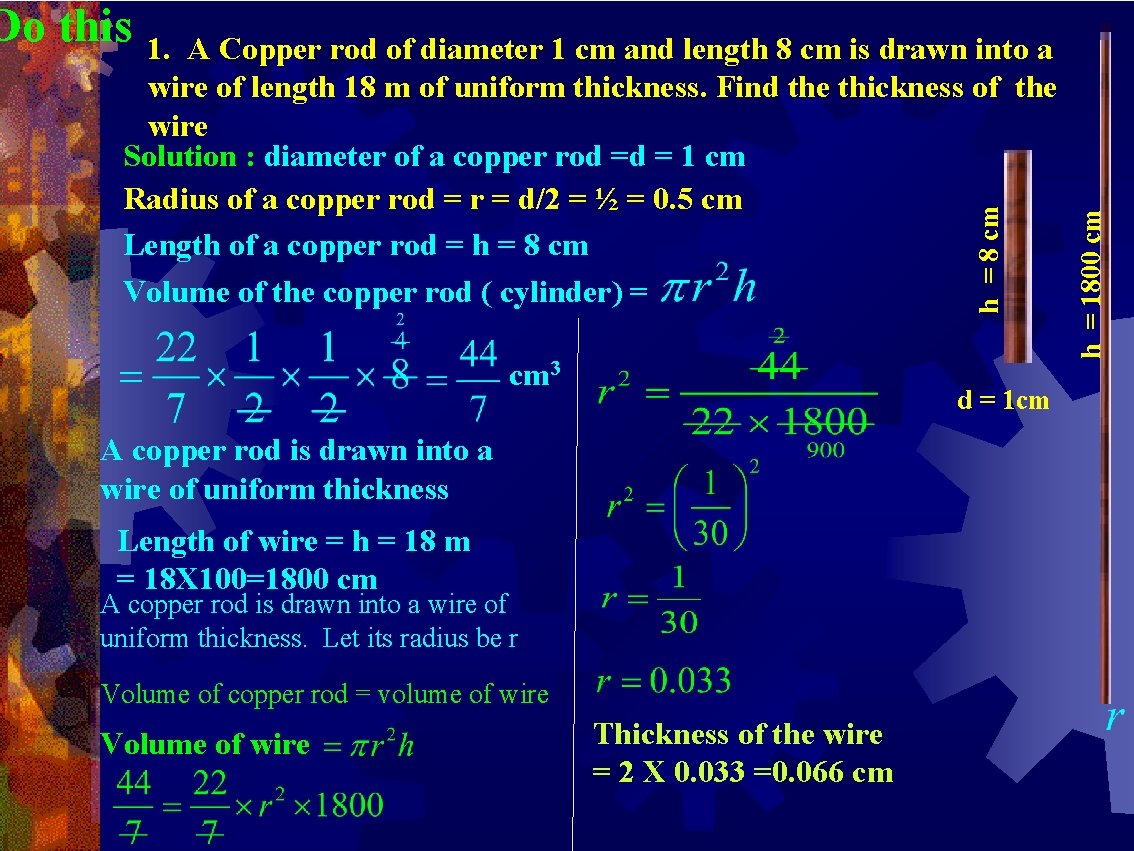
h = 8 cm 1. A Copper rod of diameter 1 cm and length 8 cm is drawn into a wire of length 18 m of uniform thickness. Find the thickness of the wire Solution : diameter of a copper rod =d = 1 cm Radius of a copper rod = r = d/2 = ½ = 0. 5 cm Length of a copper rod = h = 8 cm Volume of the copper rod ( cylinder) = cm 3 d = 1 cm A copper rod is drawn into a wire of uniform thickness Length of wire = h = 18 m = 18 X 100=1800 cm A copper rod is drawn into a wire of uniform thickness. Let its radius be r Volume of copper rod = volume of wire Volume of wire Thickness of the wire = 2 X 0. 033 =0. 066 cm h = 1800 cm Do this
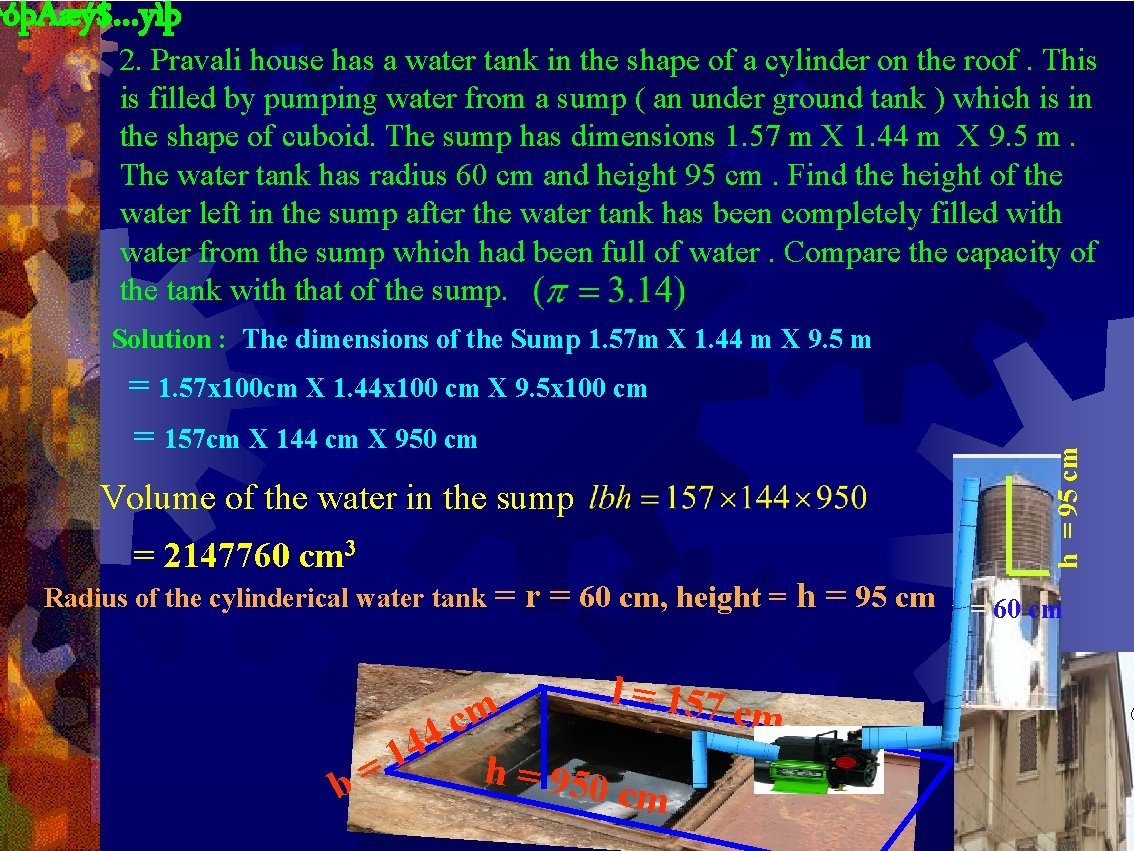
^óþÄæý$…yìþ 2. Pravali house has a water tank in the shape of a cylinder on the roof. This is filled by pumping water from a sump ( an under ground tank ) which is in the shape of cuboid. The sump has dimensions 1. 57 m X 1. 44 m X 9. 5 m. The water tank has radius 60 cm and height 95 cm. Find the height of the water left in the sump after the water tank has been completely filled with water from the sump which had been full of water. Compare the capacity of the tank with that of the sump. Solution : The dimensions of the Sump 1. 57 m X 1. 44 m X 9. 5 m h = 95 cm = 1. 57 x 100 cm X 1. 44 x 100 cm X 9. 5 x 100 cm = 157 cm X 144 cm X 950 cm Volume of the water in the sump = 2147760 cm 3 Radius of the cylinderical water tank = r = 60 cm, height = h = 95 cm m c 4 4 1 h = = 950 b l = 157 cm cm r = 60 cm
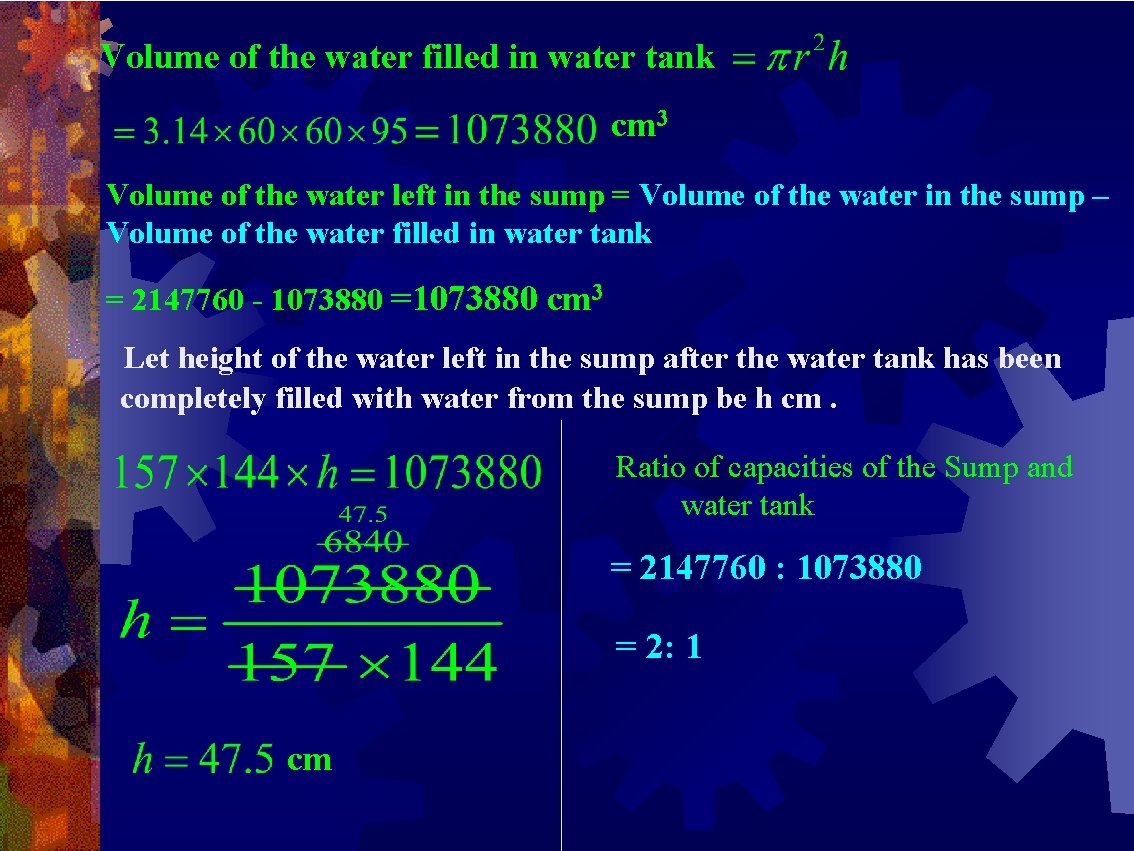
Volume of the water filled in water tank cm 3 Volume of the water left in the sump = Volume of the water in the sump – Volume of the water filled in water tank = 2147760 - 1073880 =1073880 cm 3 Let height of the water left in the sump after the water tank has been completely filled with water from the sump be h cm. Ratio of capacities of the Sump and water tank = 2147760 : 1073880 = 2: 1 cm
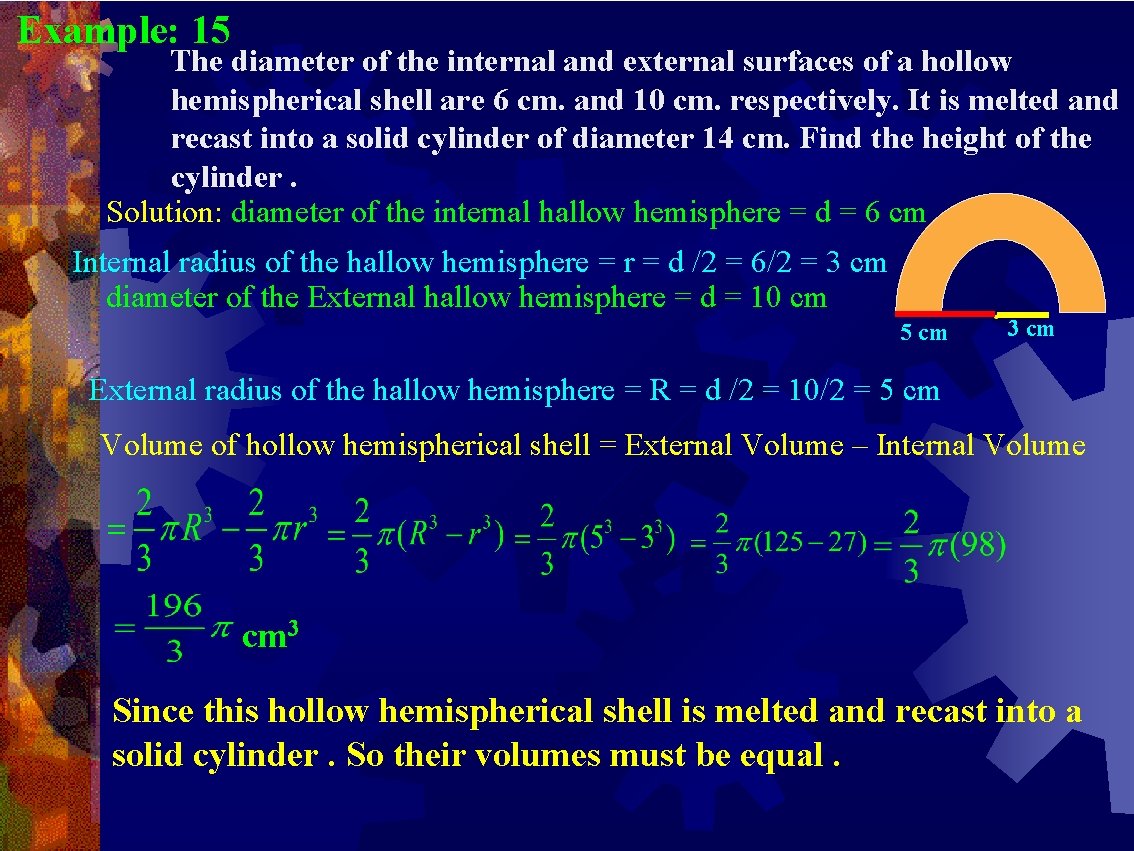
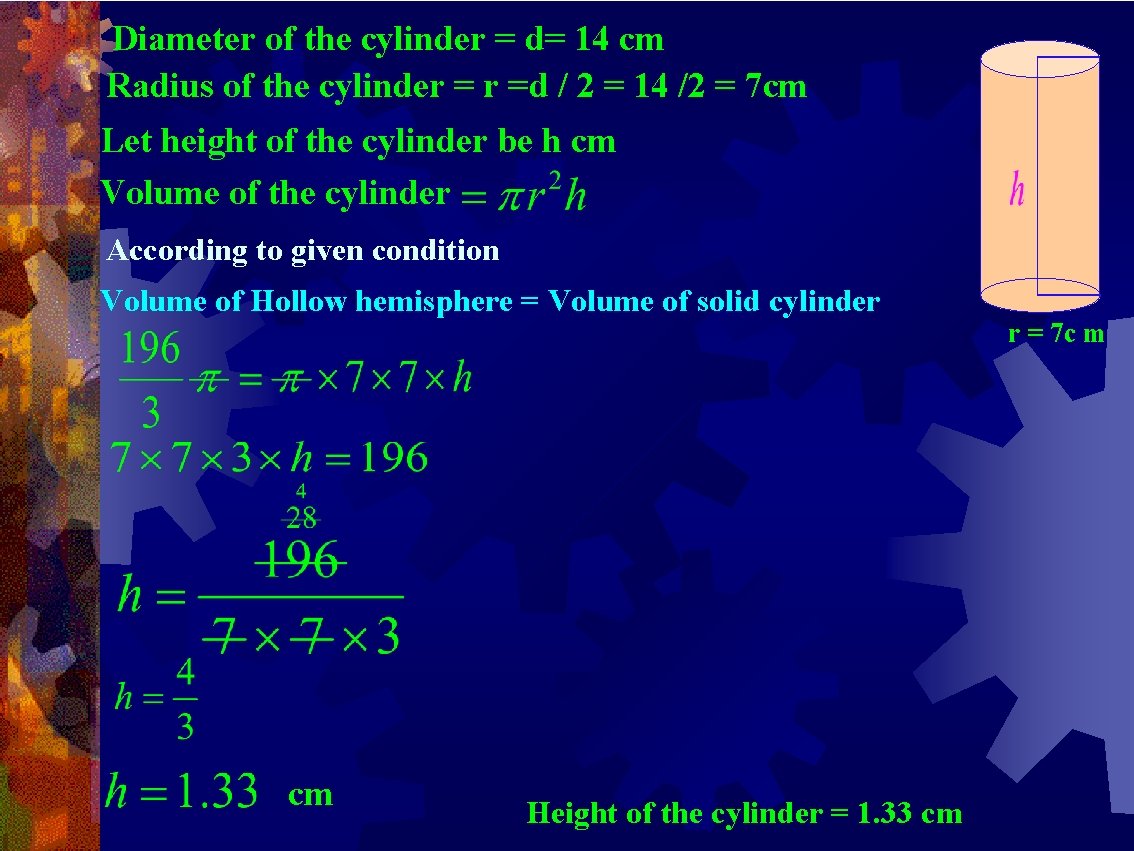
Example: 15 The diameter of the internal and external surfaces of a hollow hemispherical shell are 6 cm. and 10 cm. respectively. It is melted and recast into a solid cylinder of diameter 14 cm. Find the height of the cylinder. Solution: diameter of the internal hallow hemisphere = d = 6 cm Internal radius of the hallow hemisphere = r = d /2 = 6/2 = 3 cm diameter of the External hallow hemisphere = d = 10 cm 5 cm 3 cm External radius of the hallow hemisphere = R = d /2 = 10/2 = 5 cm Volume of hollow hemispherical shell = External Volume – Internal Volume cm 3 Since this hollow hemispherical shell is melted and recast into a solid cylinder. So their volumes must be equal.
Diameter of the cylinder = d= 14 cm Radius of the cylinder = r =d / 2 = 14 /2 = 7 cm Let height of the cylinder be h cm Volume of the cylinder According to given condition Volume of Hollow hemisphere = Volume of solid cylinder cm Height of the cylinder = 1. 33 cm r = 7 c m
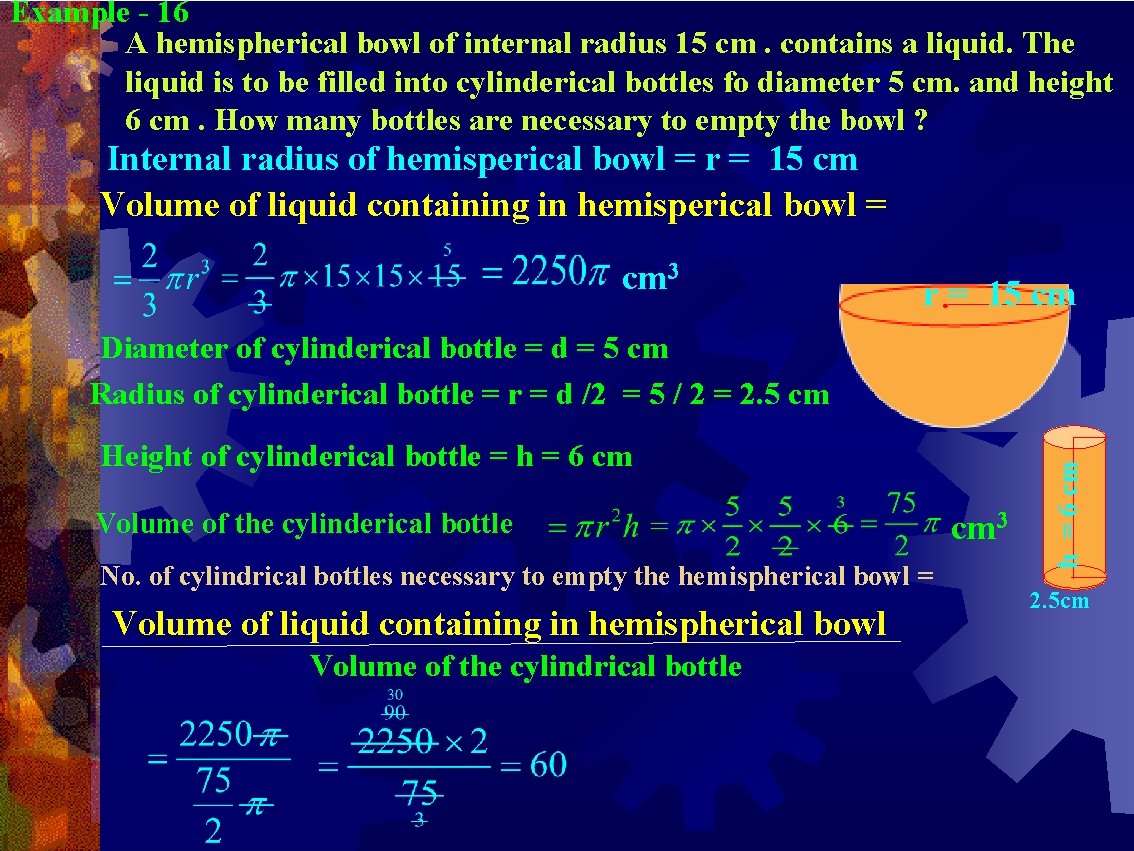
Example - 16 A hemispherical bowl of internal radius 15 cm. contains a liquid. The liquid is to be filled into cylinderical bottles fo diameter 5 cm. and height 6 cm. How many bottles are necessary to empty the bowl ? Internal radius of hemisperical bowl = r = 15 cm Volume of liquid containing in hemisperical bowl = cm 3 r = 15 cm Height of cylinderical bottle = h = 6 cm Volume of the cylinderical bottle No. of cylindrical bottles necessary to empty the hemispherical bowl = Volume of liquid containing in hemispherical bowl Volume of the cylindrical bottle cm 3 h = 6 cm Diameter of cylinderical bottle = d = 5 cm Radius of cylinderical bottle = r = d /2 = 5 / 2 = 2. 5 cm 2. 5 cm
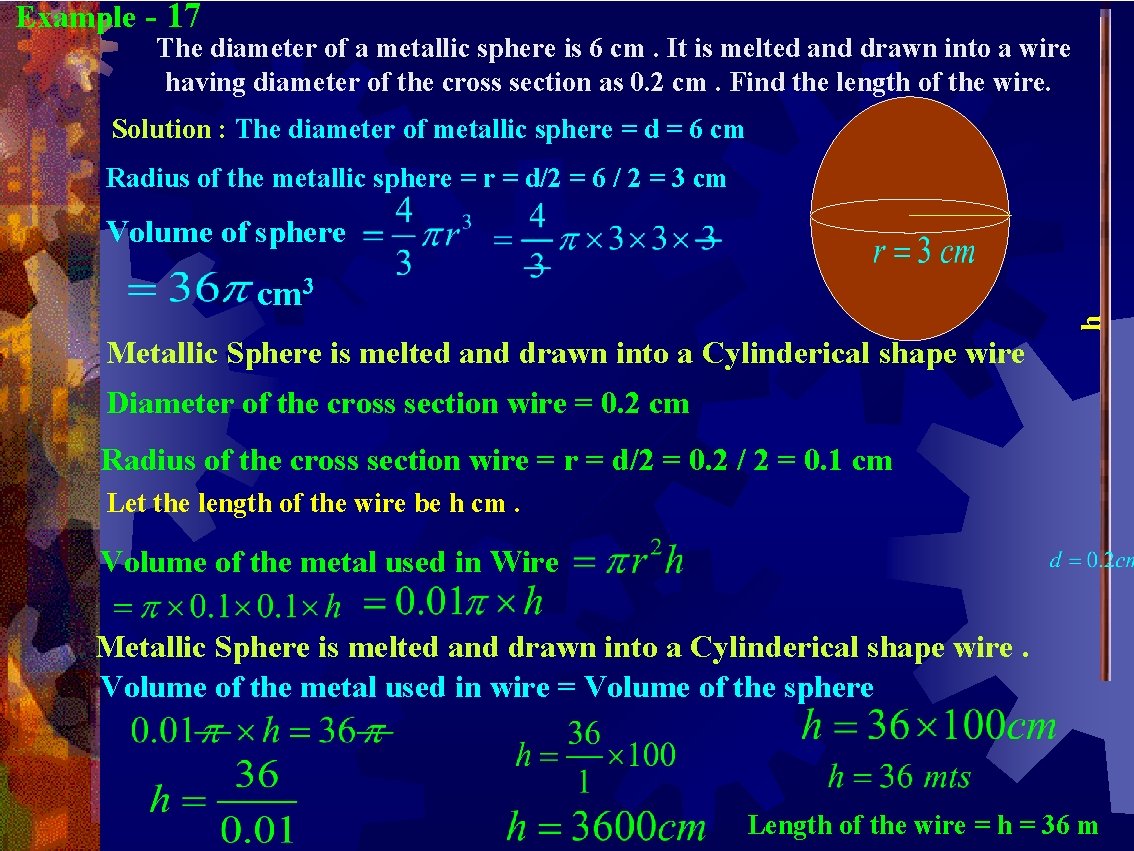
Example - 17 The diameter of a metallic sphere is 6 cm. It is melted and drawn into a wire having diameter of the cross section as 0. 2 cm. Find the length of the wire. Solution : The diameter of metallic sphere = d = 6 cm Radius of the metallic sphere = r = d/2 = 6 / 2 = 3 cm Volume of sphere h cm 3 Metallic Sphere is melted and drawn into a Cylinderical shape wire Diameter of the cross section wire = 0. 2 cm Radius of the cross section wire = r = d/2 = 0. 2 / 2 = 0. 1 cm Let the length of the wire be h cm. Volume of the metal used in Wire Metallic Sphere is melted and drawn into a Cylinderical shape wire. Volume of the metal used in wire = Volume of the sphere Length of the wire = h = 36 m
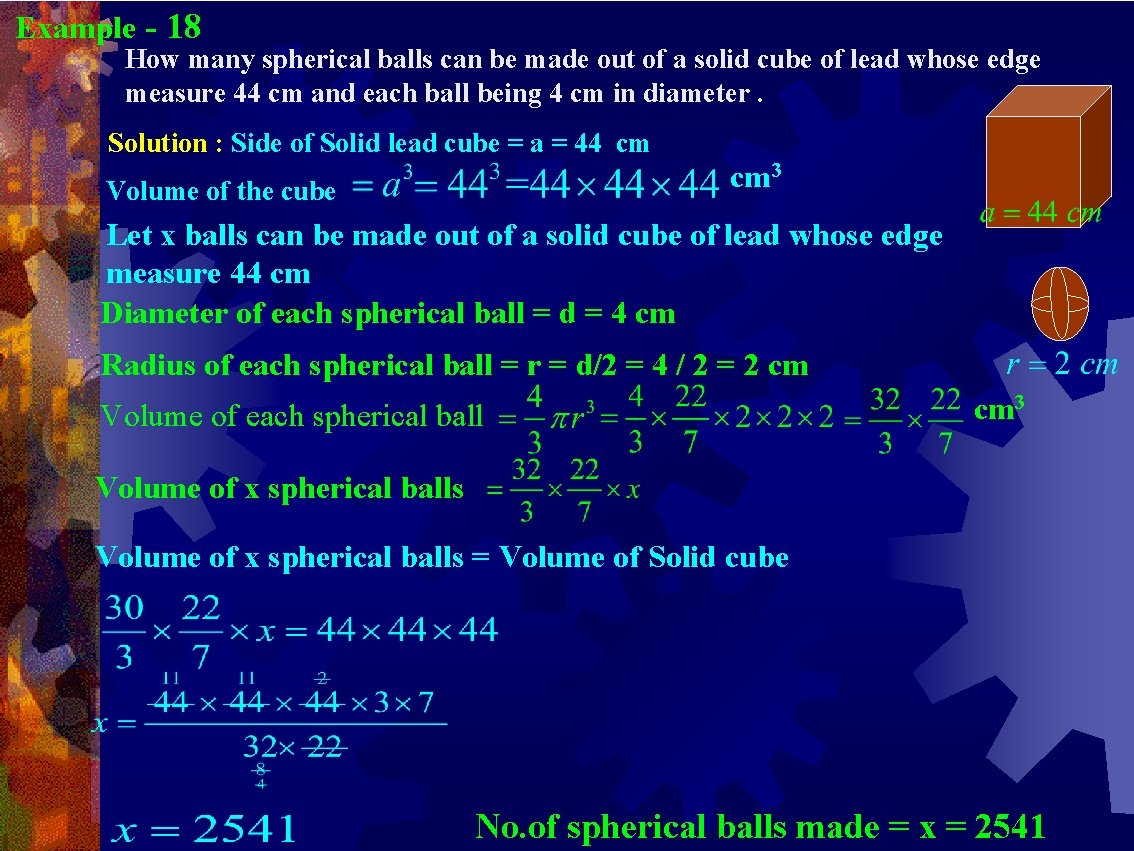
Example - 18 How many spherical balls can be made out of a solid cube of lead whose edge measure 44 cm and each ball being 4 cm in diameter. Solution : Side of Solid lead cube = a = 44 cm cm 3 Volume of the cube Let x balls can be made out of a solid cube of lead whose edge measure 44 cm Diameter of each spherical ball = d = 4 cm Radius of each spherical ball = r = d/2 = 4 / 2 = 2 cm Volume of each spherical ball cm 3 Volume of x spherical balls = Volume of Solid cube No. of spherical balls made = x = 2541
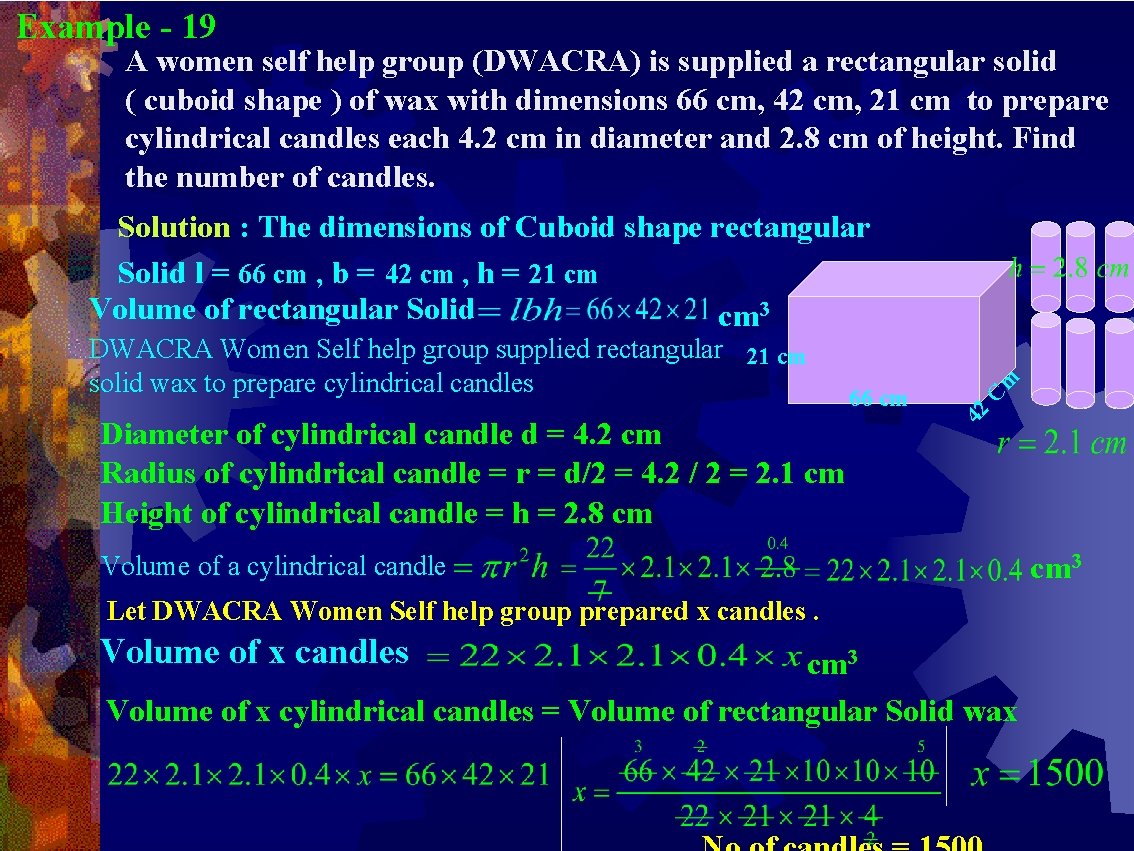
Example - 19 A women self help group (DWACRA) is supplied a rectangular solid ( cuboid shape ) of wax with dimensions 66 cm, 42 cm, 21 cm to prepare cylindrical candles each 4. 2 cm in diameter and 2. 8 cm of height. Find the number of candles. Diameter of cylindrical candle d = 4. 2 cm Radius of cylindrical candle = r = d/2 = 4. 2 / 2 = 2. 1 cm Height of cylindrical candle = h = 2. 8 cm C 66 cm 42 DWACRA Women Self help group supplied rectangular 21 cm solid wax to prepare cylindrical candles m Solution : The dimensions of Cuboid shape rectangular Solid l = 66 cm , b = 42 cm , h = 21 cm Volume of rectangular Solid cm 3 Volume of a cylindrical candle Let DWACRA Women Self help group prepared x candles. Volume of x candles cm 3 Volume of x cylindrical candles = Volume of rectangular Solid wax cm 3
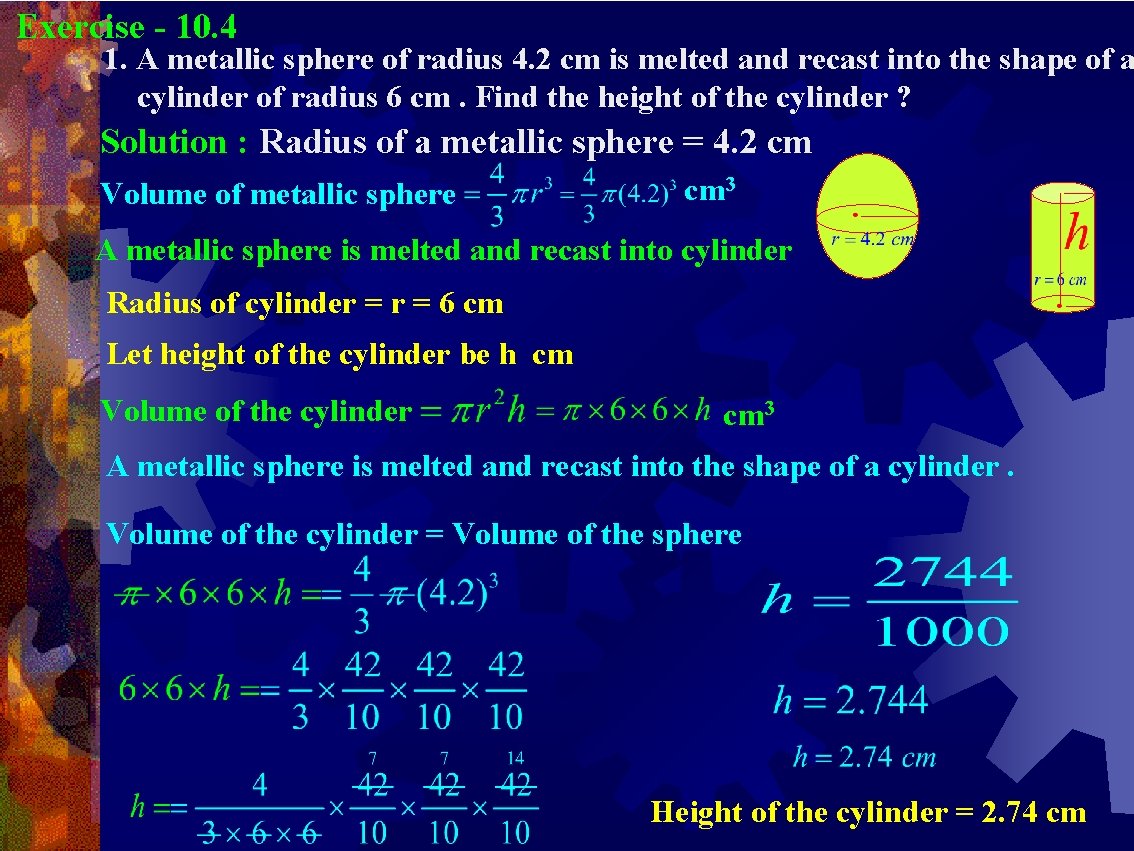
Exercise - 10. 4 1. A metallic sphere of radius 4. 2 cm is melted and recast into the shape of a cylinder of radius 6 cm. Find the height of the cylinder ? Solution : Radius of a metallic sphere = 4. 2 cm Volume of metallic sphere cm 3 A metallic sphere is melted and recast into cylinder Radius of cylinder = 6 cm Let height of the cylinder be h cm Volume of the cylinder cm 3 A metallic sphere is melted and recast into the shape of a cylinder. Volume of the cylinder = Volume of the sphere Height of the cylinder = 2. 74 cm
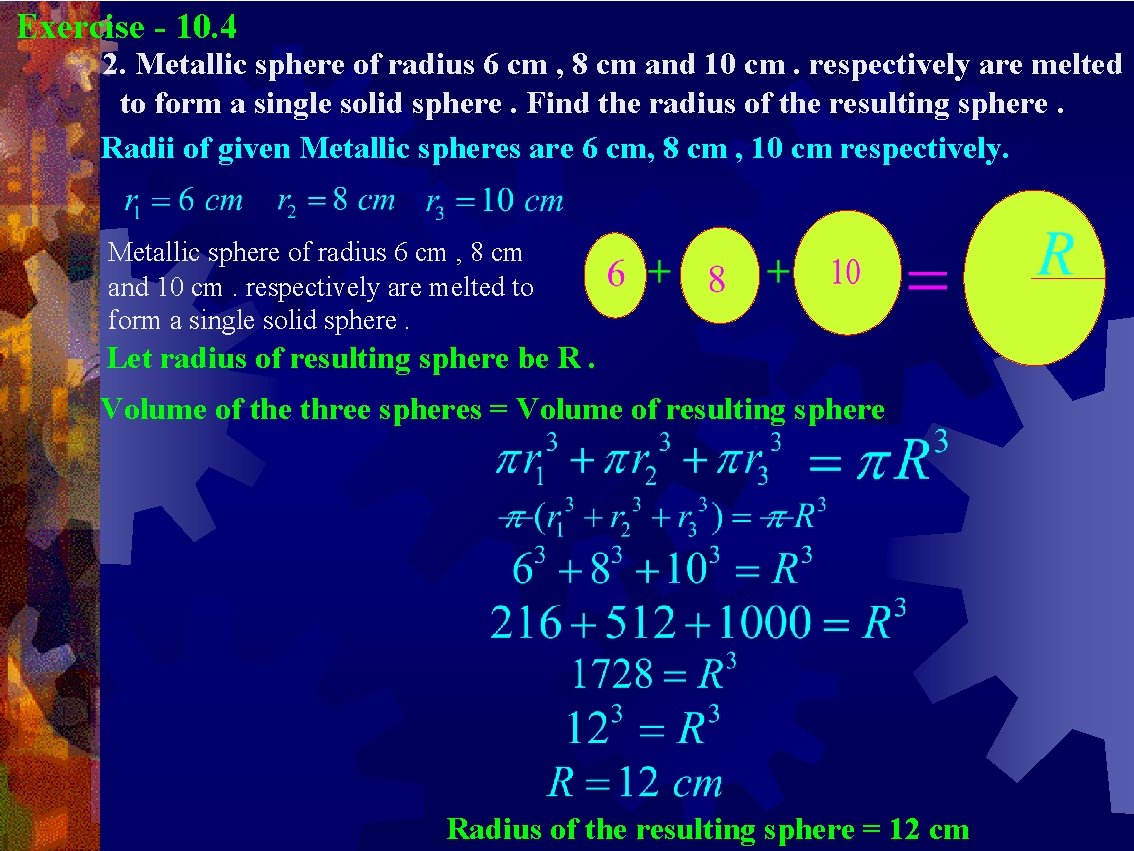
Exercise - 10. 4 2. Metallic sphere of radius 6 cm , 8 cm and 10 cm. respectively are melted to form a single solid sphere. Find the radius of the resulting sphere. Radii of given Metallic spheres are 6 cm, 8 cm , 10 cm respectively. Metallic sphere of radius 6 cm , 8 cm and 10 cm. respectively are melted to form a single solid sphere. Let radius of resulting sphere be R. Volume of the three spheres = Volume of resulting sphere Radius of the resulting sphere = 12 cm
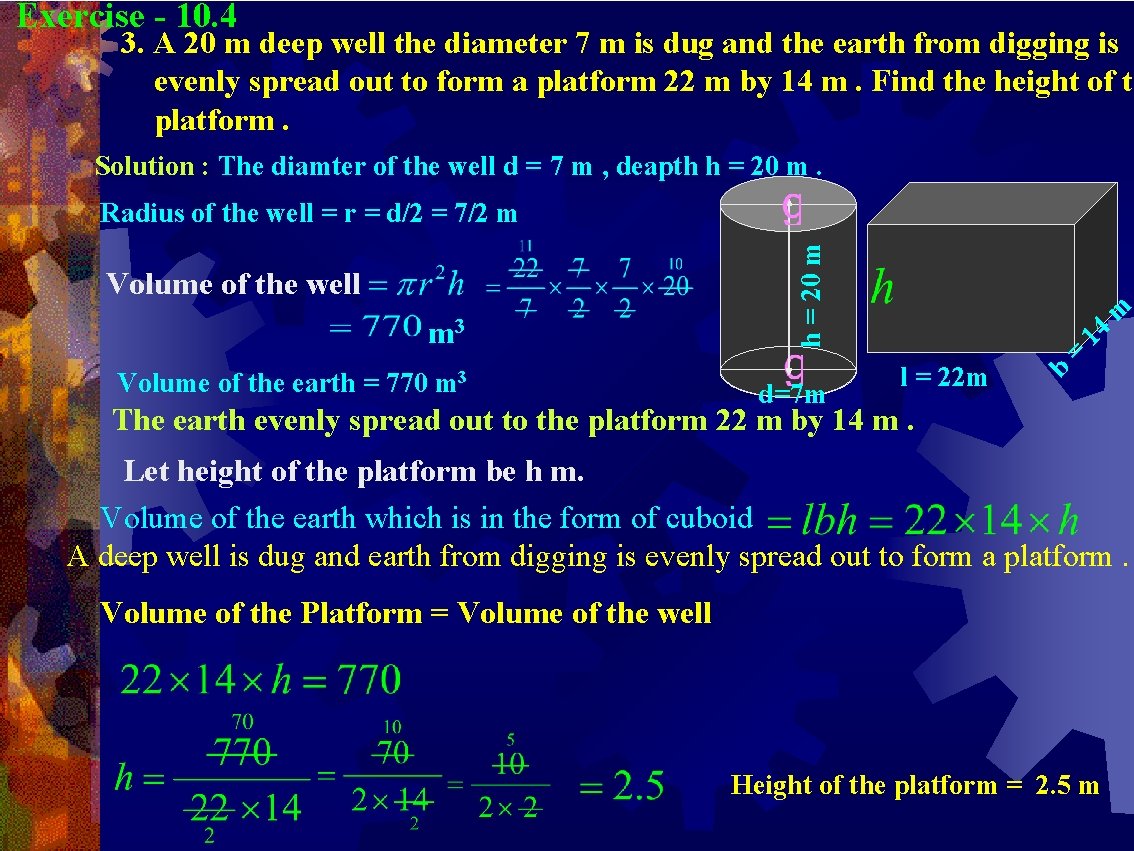
Exercise - 10. 4 3. A 20 m deep well the diameter 7 m is dug and the earth from digging is evenly spread out to form a platform 22 m by 14 m. Find the height of th platform. Solution : The diamter of the well d = 7 m , deapth h = 20 m. Volume of the earth = 770 m 3 d=7 m m 14 l = 22 m = m 3 b Volume of the well h = 20 m Radius of the well = r = d/2 = 7/2 m The earth evenly spread out to the platform 22 m by 14 m. Let height of the platform be h m. Volume of the earth which is in the form of cuboid A deep well is dug and earth from digging is evenly spread out to form a platform. Volume of the Platform = Volume of the well Height of the platform = 2. 5 m
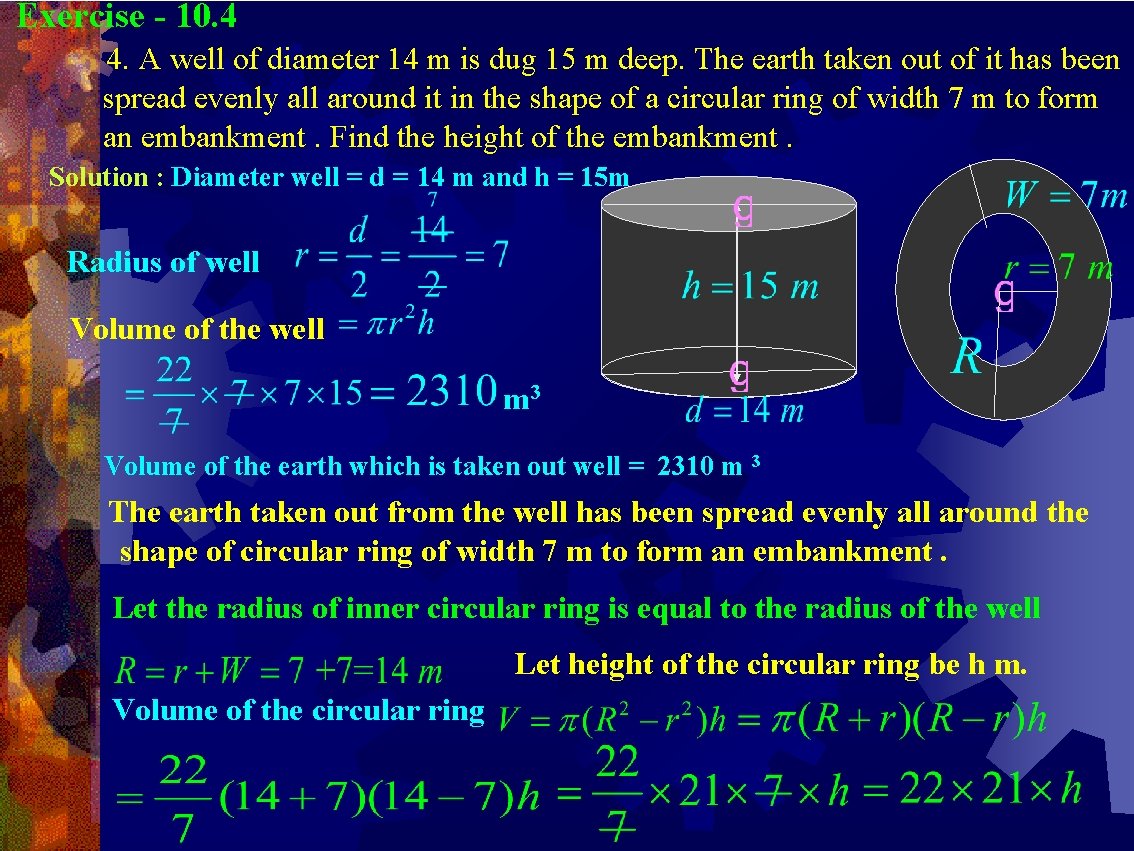
Exercise - 10. 4 4. A well of diameter 14 m is dug 15 m deep. The earth taken out of it has been spread evenly all around it in the shape of a circular ring of width 7 m to form an embankment. Find the height of the embankment. Solution : Diameter well = d = 14 m and h = 15 m Radius of well Volume of the well m 3 Volume of the earth which is taken out well = 2310 m 3 The earth taken out from the well has been spread evenly all around the shape of circular ring of width 7 m to form an embankment. Let the radius of inner circular ring is equal to the radius of the well Let height of the circular ring be h m. Volume of the circular ring
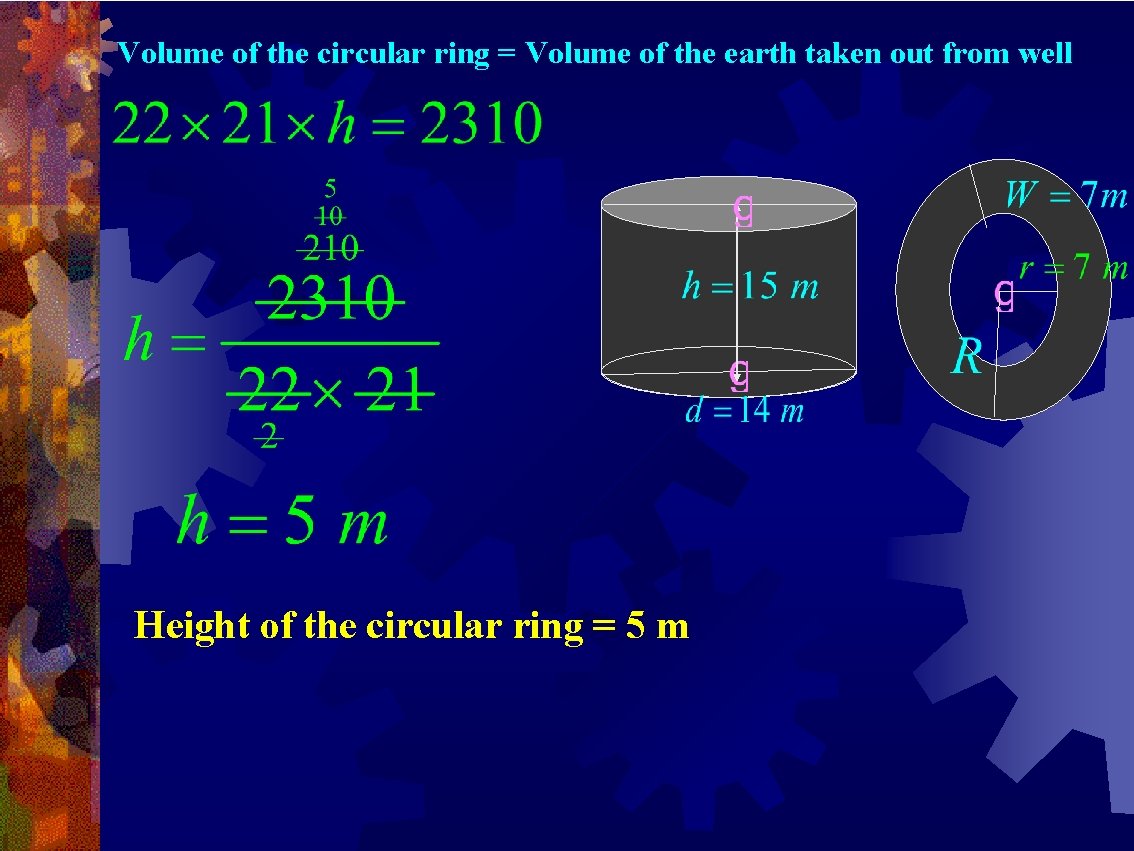
Volume of the circular ring = Volume of the earth taken out from well Height of the circular ring = 5 m
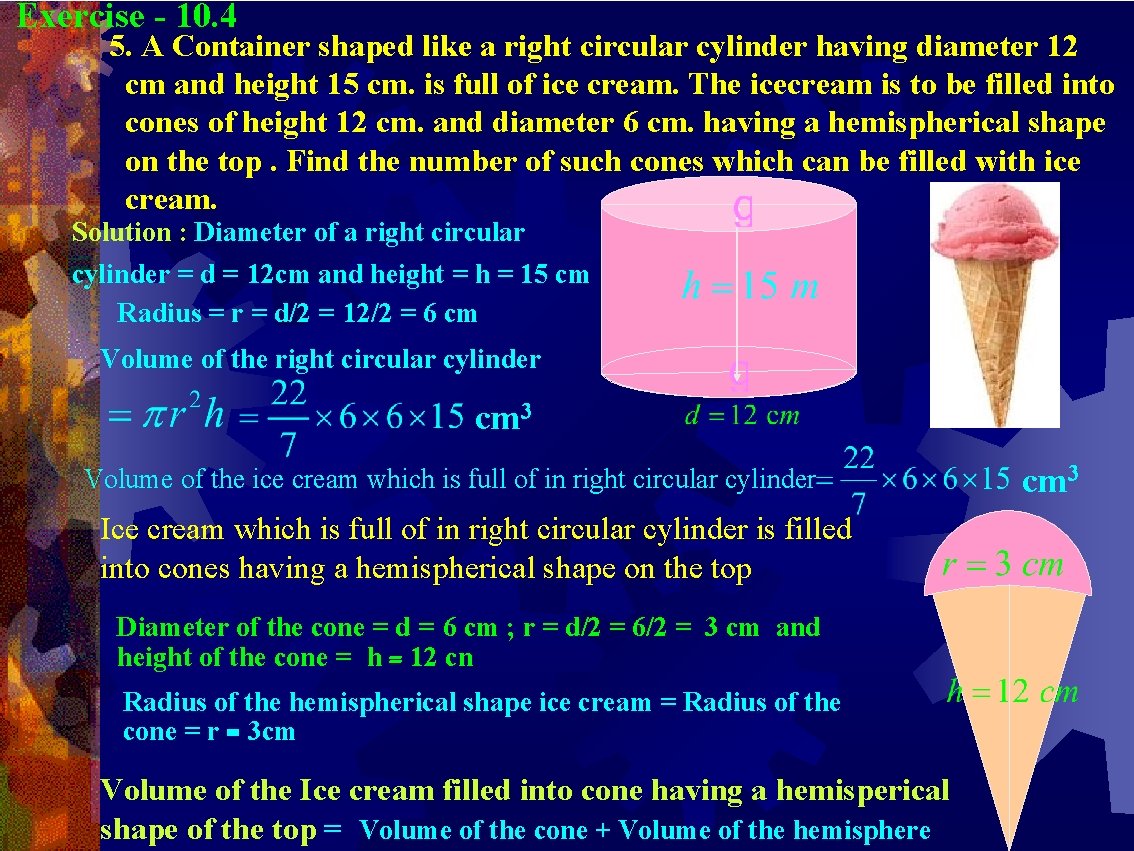
Exercise - 10. 4 5. A Container shaped like a right circular cylinder having diameter 12 cm and height 15 cm. is full of ice cream. The icecream is to be filled into cones of height 12 cm. and diameter 6 cm. having a hemispherical shape on the top. Find the number of such cones which can be filled with ice cream. Solution : Diameter of a right circular cylinder = d = 12 cm and height = h = 15 cm Radius = r = d/2 = 12/2 = 6 cm Volume of the right circular cylinder cm 3 Volume of the ice cream which is full of in right circular cylinder Ice cream which is full of in right circular cylinder is filled into cones having a hemispherical shape on the top Diameter of the cone = d = 6 cm ; r = d/2 = 6/2 = 3 cm and height of the cone = h = 12 cn Radius of the hemispherical shape ice cream = Radius of the cone = r = 3 cm Volume of the Ice cream filled into cone having a hemisperical shape of the top = Volume of the cone + Volume of the hemisphere cm 3
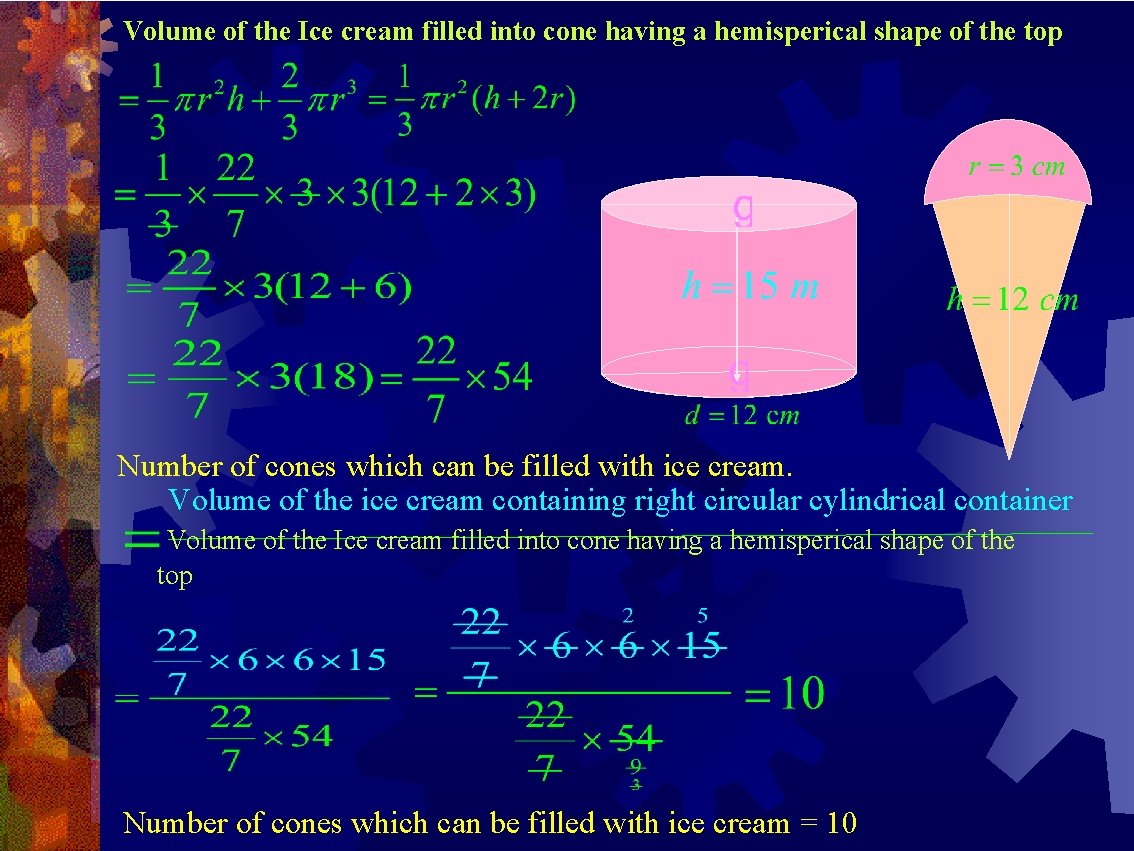
Volume of the Ice cream filled into cone having a hemisperical shape of the top Number of cones which can be filled with ice cream. Volume of the ice cream containing right circular cylindrical container Volume of the Ice cream filled into cone having a hemisperical shape of the top Number of cones which can be filled with ice cream = 10
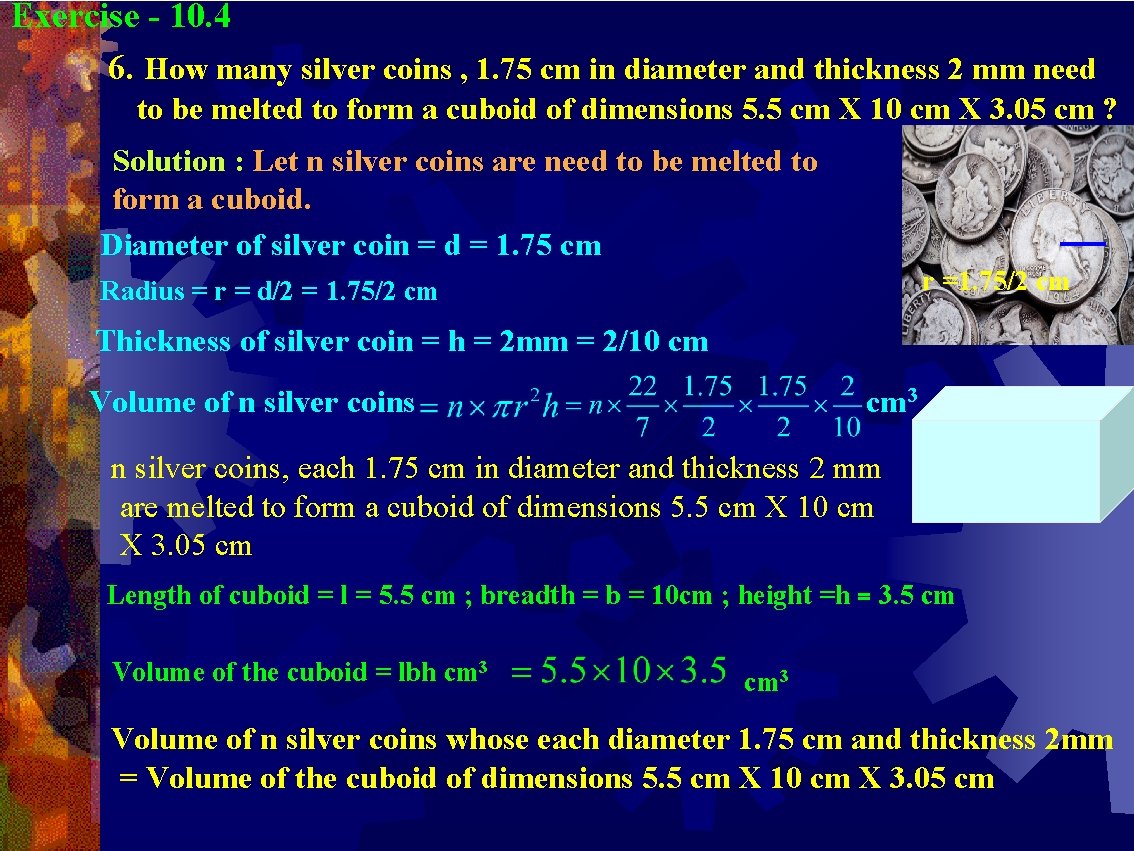
Exercise - 10. 4 6. How many silver coins , 1. 75 cm in diameter and thickness 2 mm need to be melted to form a cuboid of dimensions 5. 5 cm X 10 cm X 3. 05 cm ? Solution : Let n silver coins are need to be melted to form a cuboid. Diameter of silver coin = d = 1. 75 cm r =1. 75/2 cm Radius = r = d/2 = 1. 75/2 cm Thickness of silver coin = h = 2 mm = 2/10 cm Volume of n silver coins cm 3 n silver coins, each 1. 75 cm in diameter and thickness 2 mm are melted to form a cuboid of dimensions 5. 5 cm X 10 cm X 3. 05 cm Length of cuboid = l = 5. 5 cm ; breadth = b = 10 cm ; height =h = 3. 5 cm Volume of the cuboid = lbh cm 3 Volume of n silver coins whose each diameter 1. 75 cm and thickness 2 mm = Volume of the cuboid of dimensions 5. 5 cm X 10 cm X 3. 05 cm
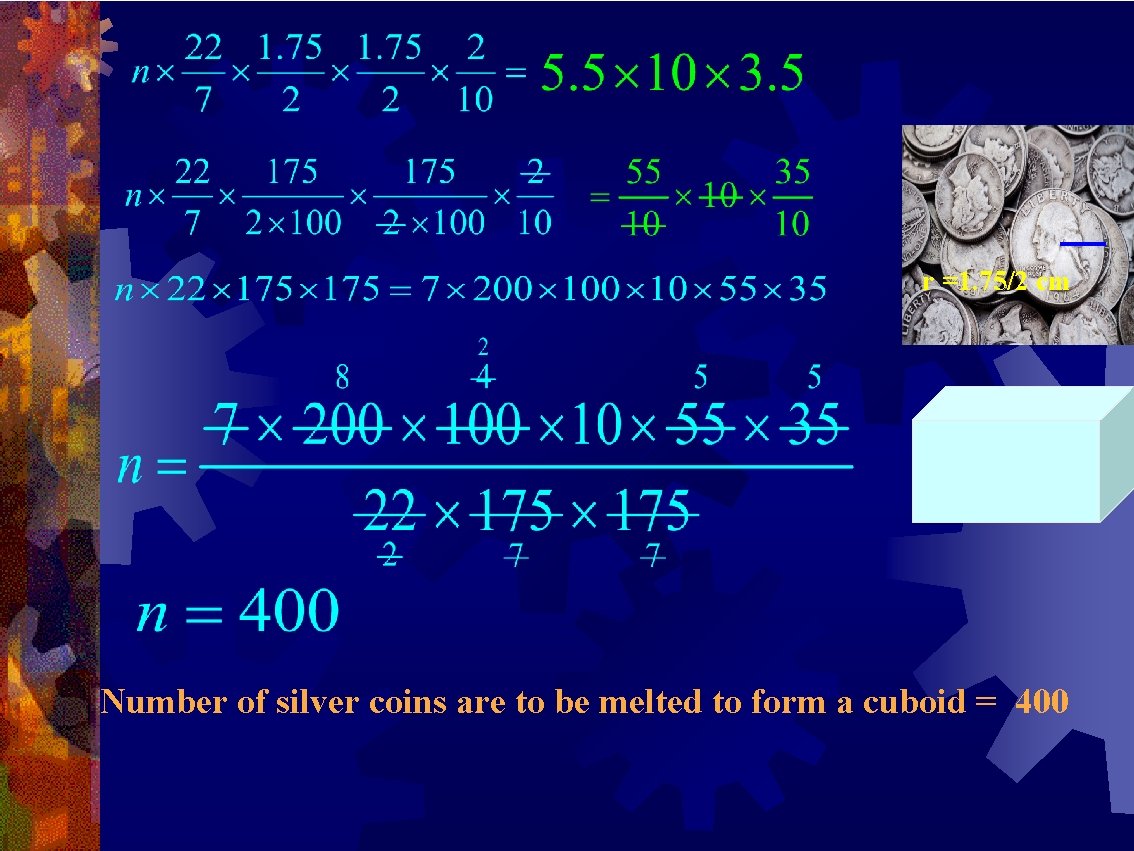
r =1. 75/2 cm Number of silver coins are to be melted to form a cuboid = 400
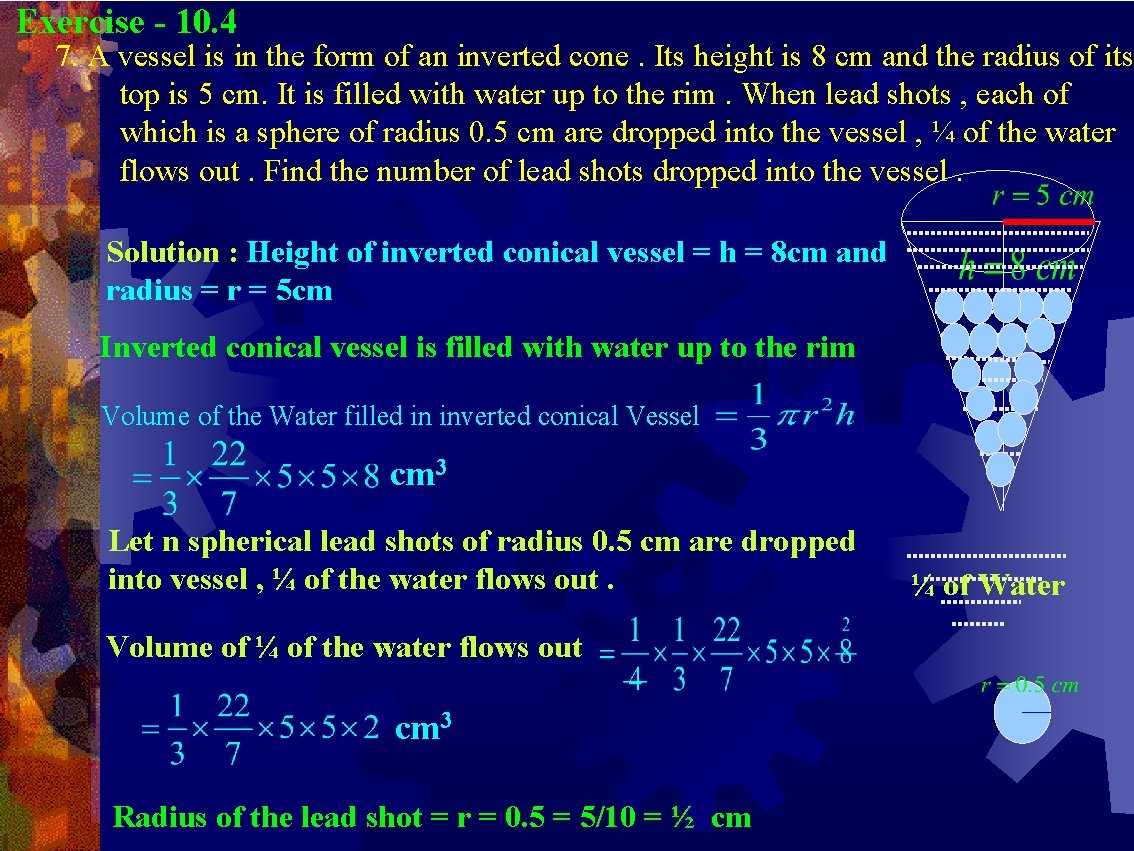
Exercise - 10. 4 7. A vessel is in the form of an inverted cone. Its height is 8 cm and the radius of its top is 5 cm. It is filled with water up to the rim. When lead shots , each of which is a sphere of radius 0. 5 cm are dropped into the vessel , ¼ of the water flows out. Find the number of lead shots dropped into the vessel. Solution : Height of inverted conical vessel = h = 8 cm and radius = r = 5 cm Inverted conical vessel is filled with water up to the rim Volume of the Water filled in inverted conical Vessel cm 3 Let n spherical lead shots of radius 0. 5 cm are dropped into vessel , ¼ of the water flows out. Volume of ¼ of the water flows out cm 3 Radius of the lead shot = r = 0. 5 = 5/10 = ½ cm ¼ of Water
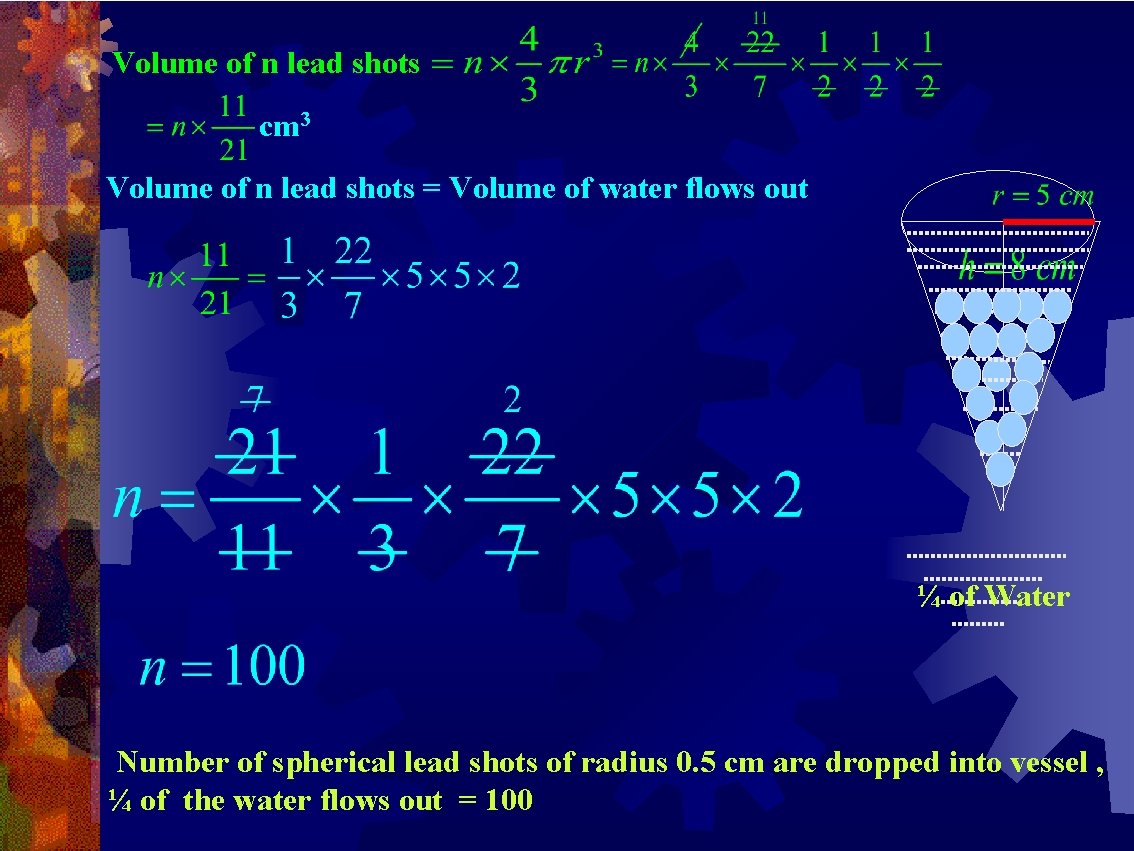
Volume of n lead shots cm 3 Volume of n lead shots = Volume of water flows out ¼ of Water Number of spherical lead shots of radius 0. 5 cm are dropped into vessel , ¼ of the water flows out = 100
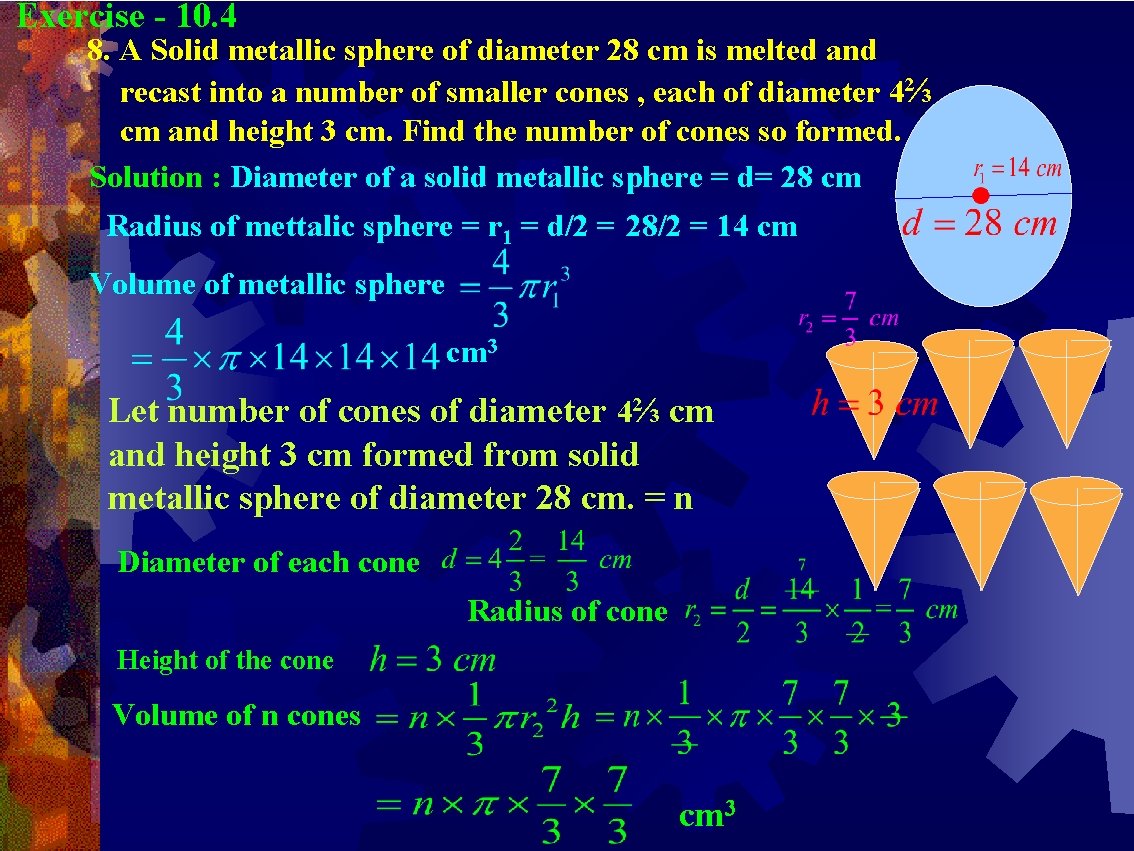
Exercise - 10. 4 8. A Solid metallic sphere of diameter 28 cm is melted and recast into a number of smaller cones , each of diameter 4⅔ cm and height 3 cm. Find the number of cones so formed. Solution : Diameter of a solid metallic sphere = d= 28 cm Radius of mettalic sphere = r 1 = d/2 = 28/2 = 14 cm Volume of metallic sphere cm 3 Let number of cones of diameter 4⅔ cm and height 3 cm formed from solid metallic sphere of diameter 28 cm. = n Diameter of each cone Radius of cone Height of the cone Volume of n cones cm 3
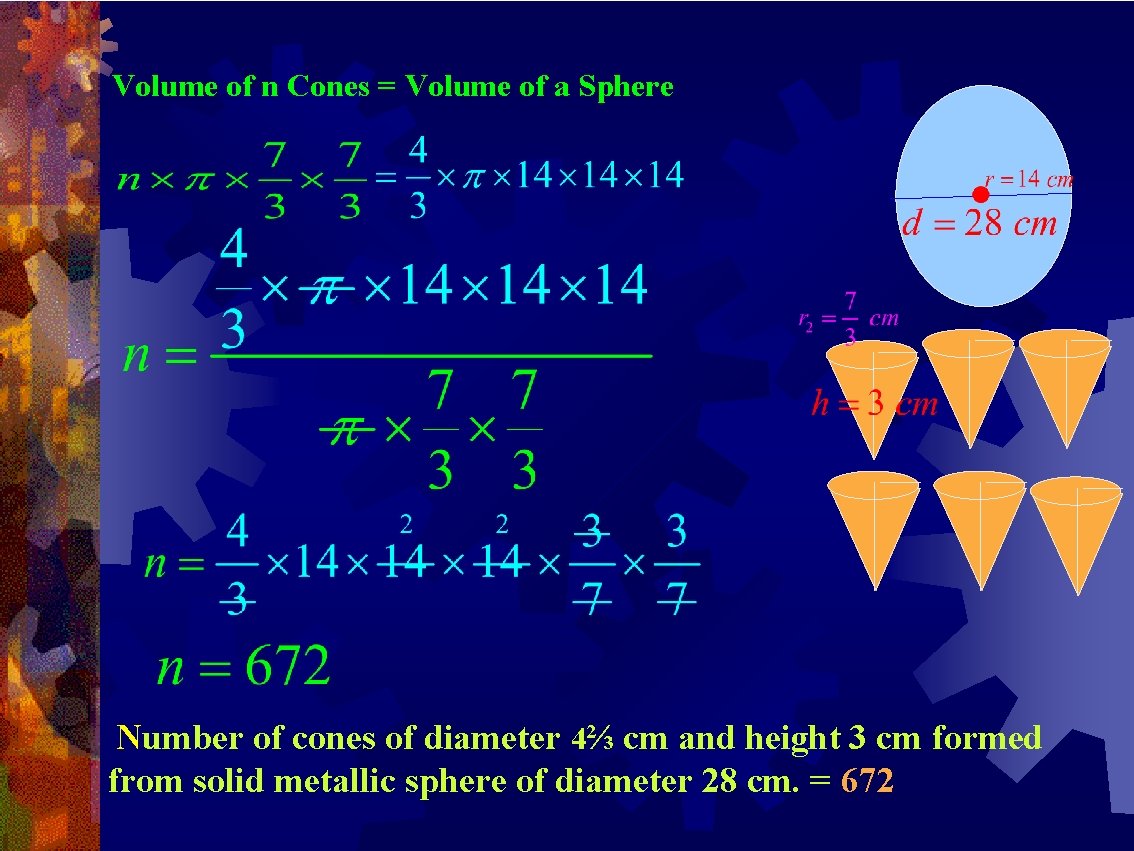
Volume of n Cones = Volume of a Sphere Number of cones of diameter 4⅔ cm and height 3 cm formed from solid metallic sphere of diameter 28 cm. = 672
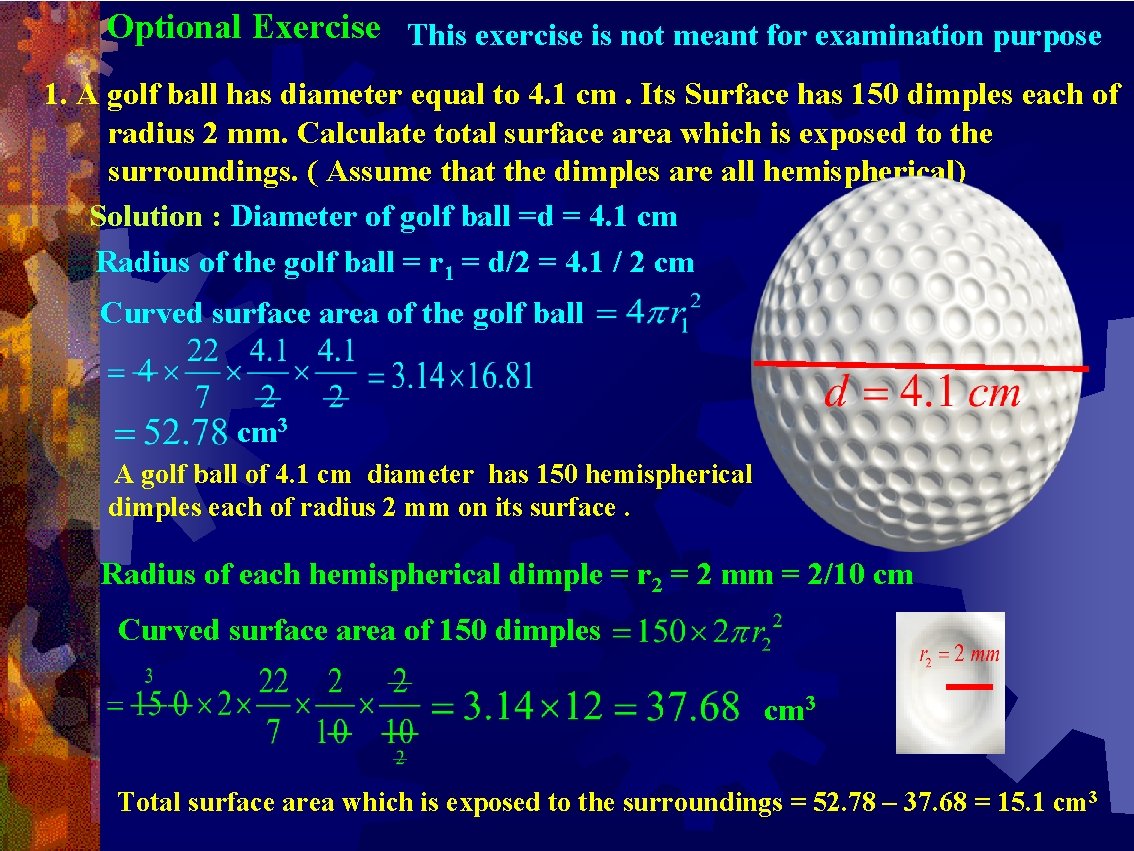
Optional Exercise This exercise is not meant for examination purpose 1. A golf ball has diameter equal to 4. 1 cm. Its Surface has 150 dimples each of radius 2 mm. Calculate total surface area which is exposed to the surroundings. ( Assume that the dimples are all hemispherical) Solution : Diameter of golf ball =d = 4. 1 cm Radius of the golf ball = r 1 = d/2 = 4. 1 / 2 cm Curved surface area of the golf ball cm 3 A golf ball of 4. 1 cm diameter has 150 hemispherical dimples each of radius 2 mm on its surface. Radius of each hemispherical dimple = r 2 = 2 mm = 2/10 cm Curved surface area of 150 dimples cm 3 Total surface area which is exposed to the surroundings = 52. 78 – 37. 68 = 15. 1 cm 3
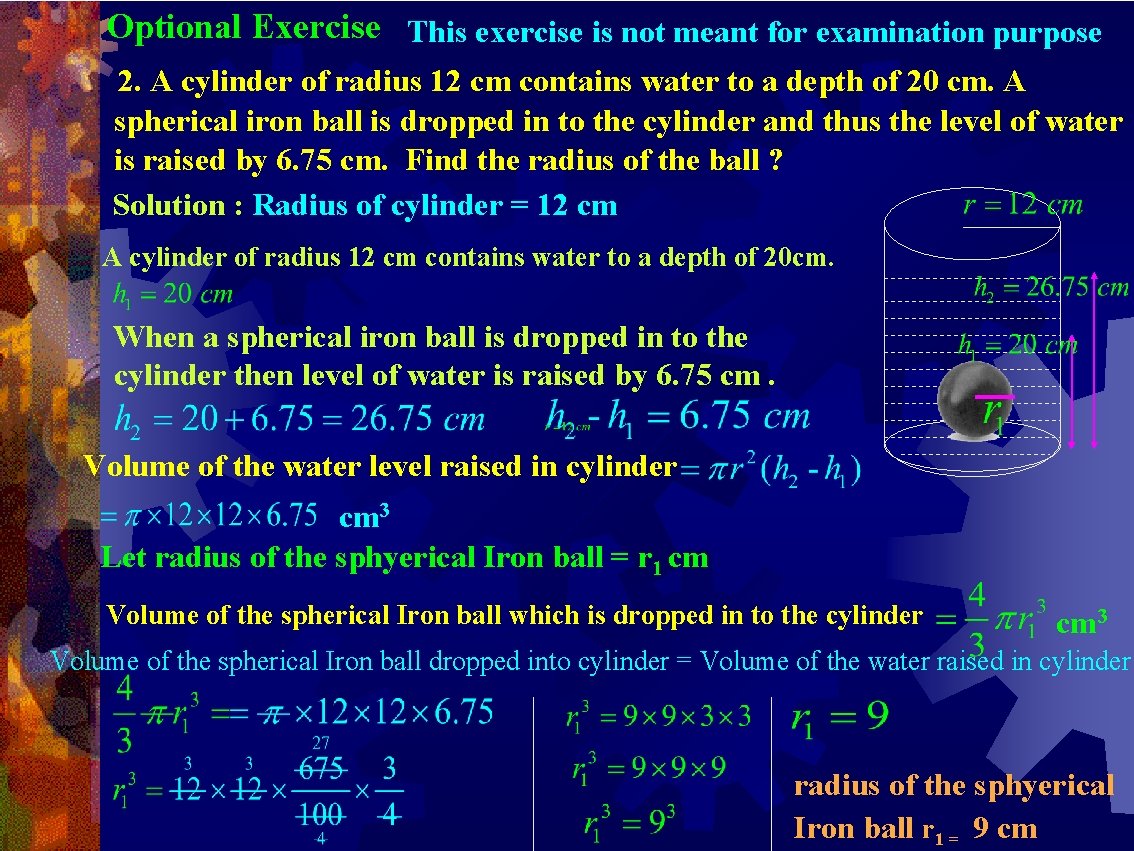
Optional Exercise This exercise is not meant for examination purpose 2. A cylinder of radius 12 cm contains water to a depth of 20 cm. A spherical iron ball is dropped in to the cylinder and thus the level of water is raised by 6. 75 cm. Find the radius of the ball ? Solution : Radius of cylinder = 12 cm A cylinder of radius 12 cm contains water to a depth of 20 cm. When a spherical iron ball is dropped in to the cylinder then level of water is raised by 6. 75 cm. Volume of the water level raised in cylinder cm 3 Let radius of the sphyerical Iron ball = r 1 cm Volume of the spherical Iron ball which is dropped in to the cylinder cm 3 Volume of the spherical Iron ball dropped into cylinder = Volume of the water raised in cylinder radius of the sphyerical Iron ball r 1 = 9 cm
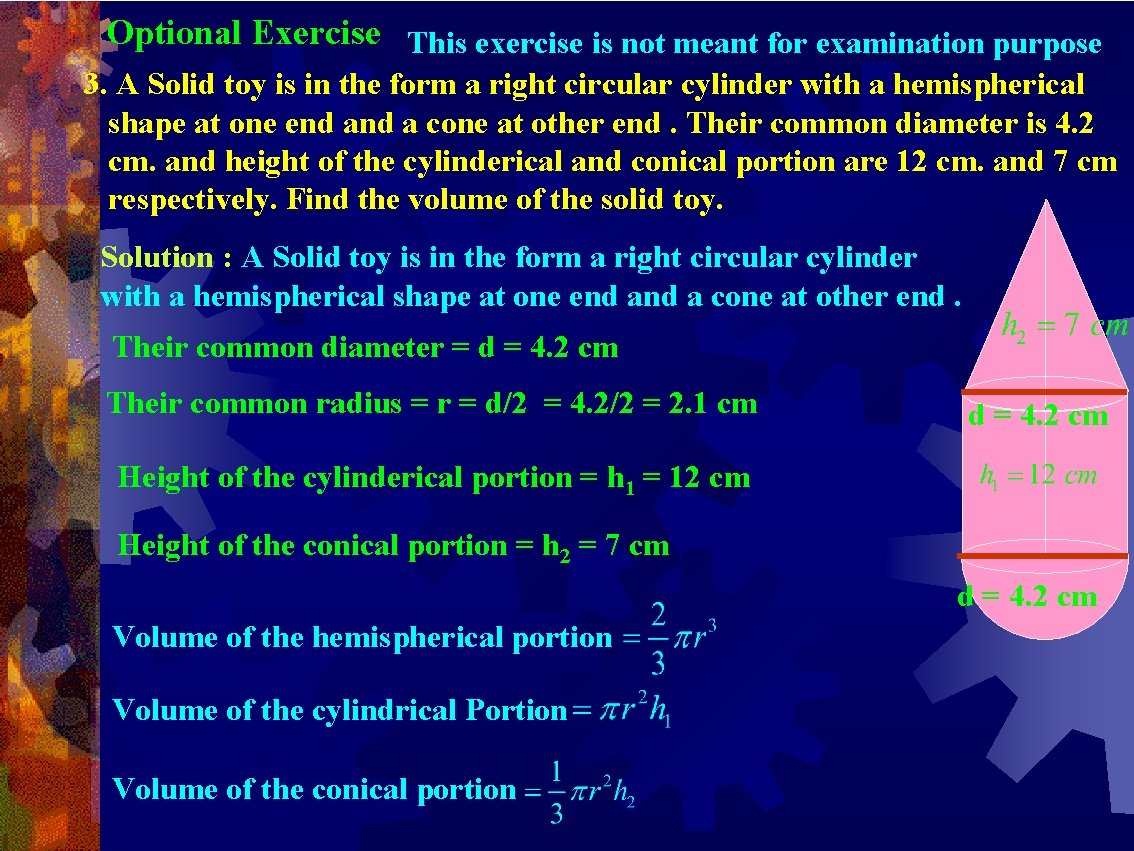
Optional Exercise This exercise is not meant for examination purpose 3. A Solid toy is in the form a right circular cylinder with a hemispherical shape at one end a cone at other end. Their common diameter is 4. 2 cm. and height of the cylinderical and conical portion are 12 cm. and 7 cm respectively. Find the volume of the solid toy. Solution : A Solid toy is in the form a right circular cylinder with a hemispherical shape at one end a cone at other end. Their common diameter = d = 4. 2 cm Their common radius = r = d/2 = 4. 2/2 = 2. 1 cm d = 4. 2 cm Height of the cylinderical portion = h 1 = 12 cm Height of the conical portion = h 2 = 7 cm d = 4. 2 cm Volume of the hemispherical portion Volume of the cylindrical Portion Volume of the conical portion
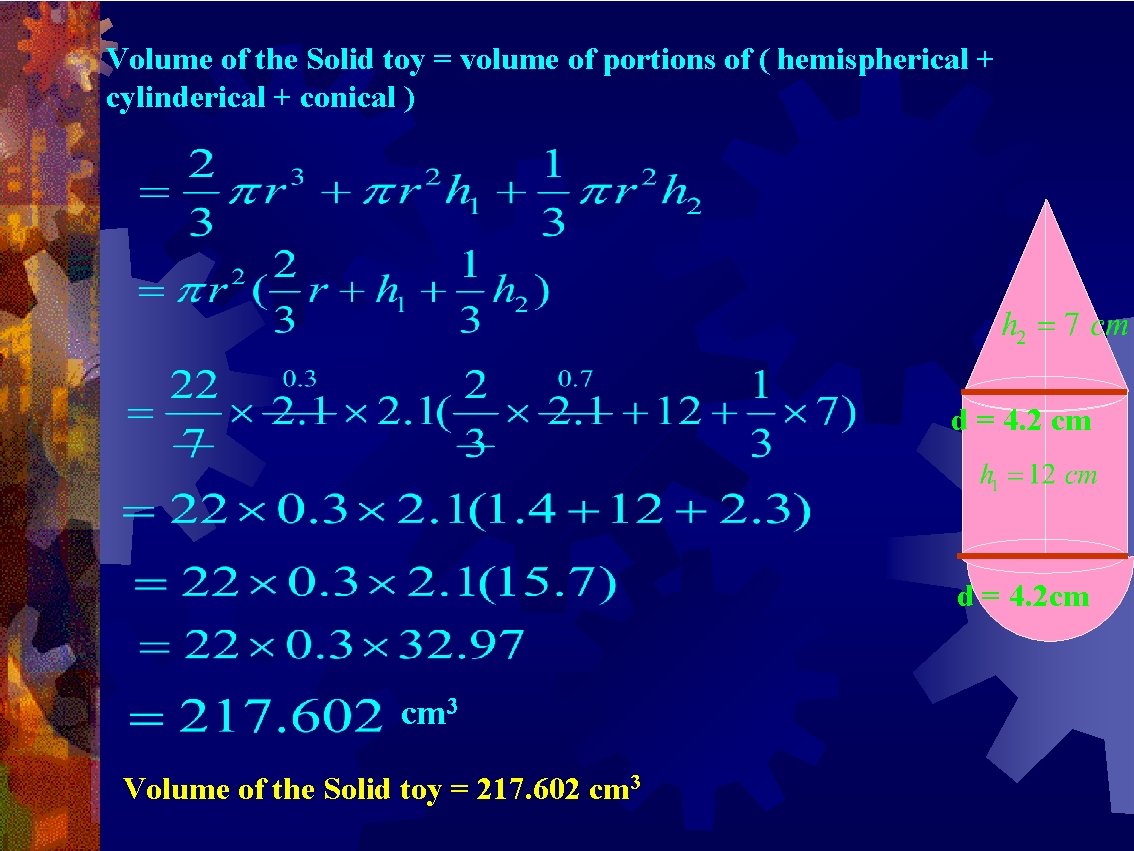
Volume of the Solid toy = volume of portions of ( hemispherical + cylinderical + conical ) d = 4. 2 cm d = 4. 2 cm cm 3 Volume of the Solid toy = 217. 602 cm 3
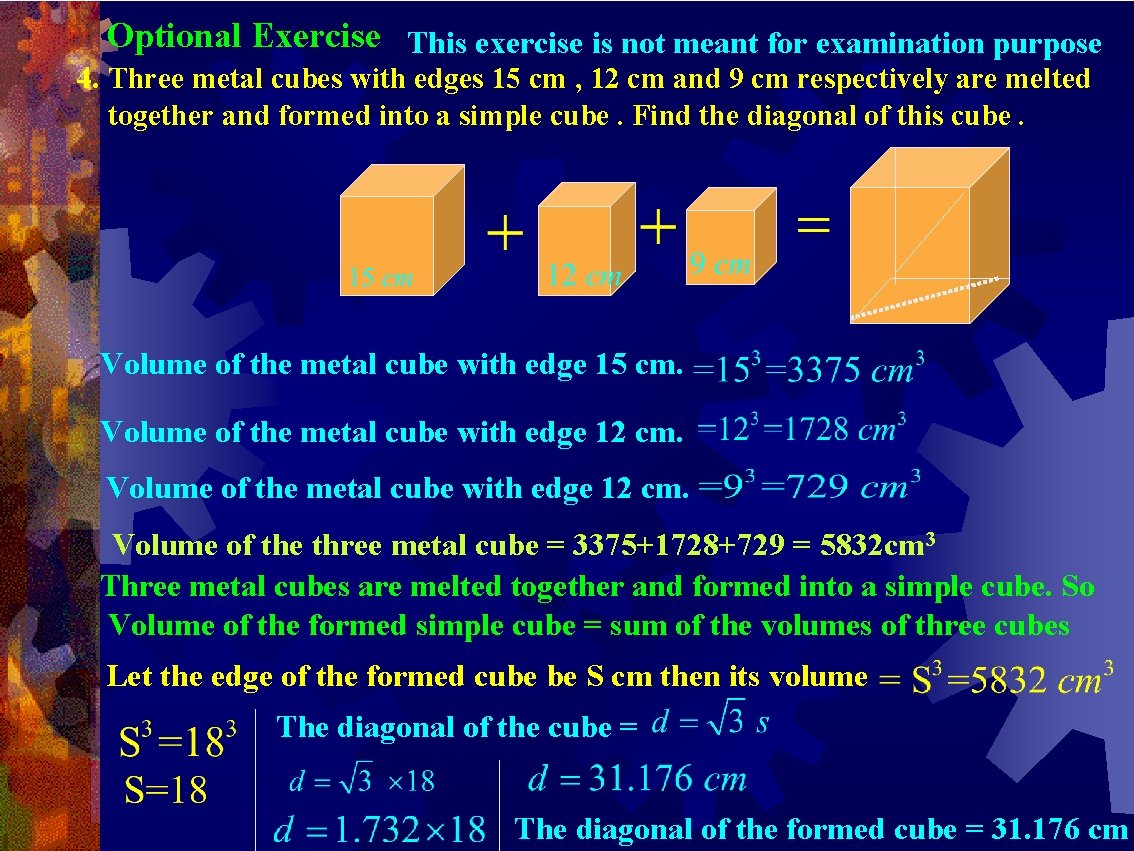
Optional Exercise This exercise is not meant for examination purpose 4. Three metal cubes with edges 15 cm , 12 cm and 9 cm respectively are melted together and formed into a simple cube. Find the diagonal of this cube. Volume of the metal cube with edge 15 cm. Volume of the metal cube with edge 12 cm. Volume of the three metal cube = 3375+1728+729 = 5832 cm 3 Three metal cubes are melted together and formed into a simple cube. So Volume of the formed simple cube = sum of the volumes of three cubes Let the edge of the formed cube be S cm then its volume The diagonal of the cube = The diagonal of the formed cube = 31. 176 cm
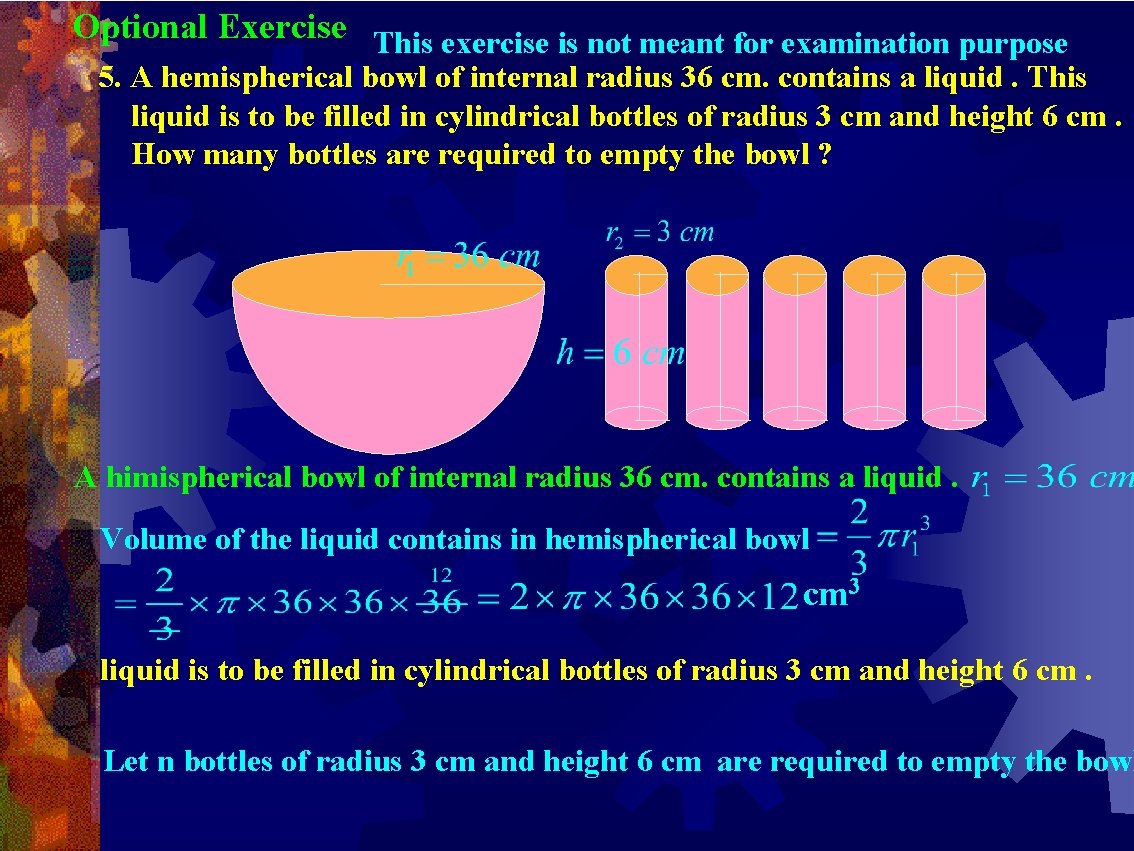
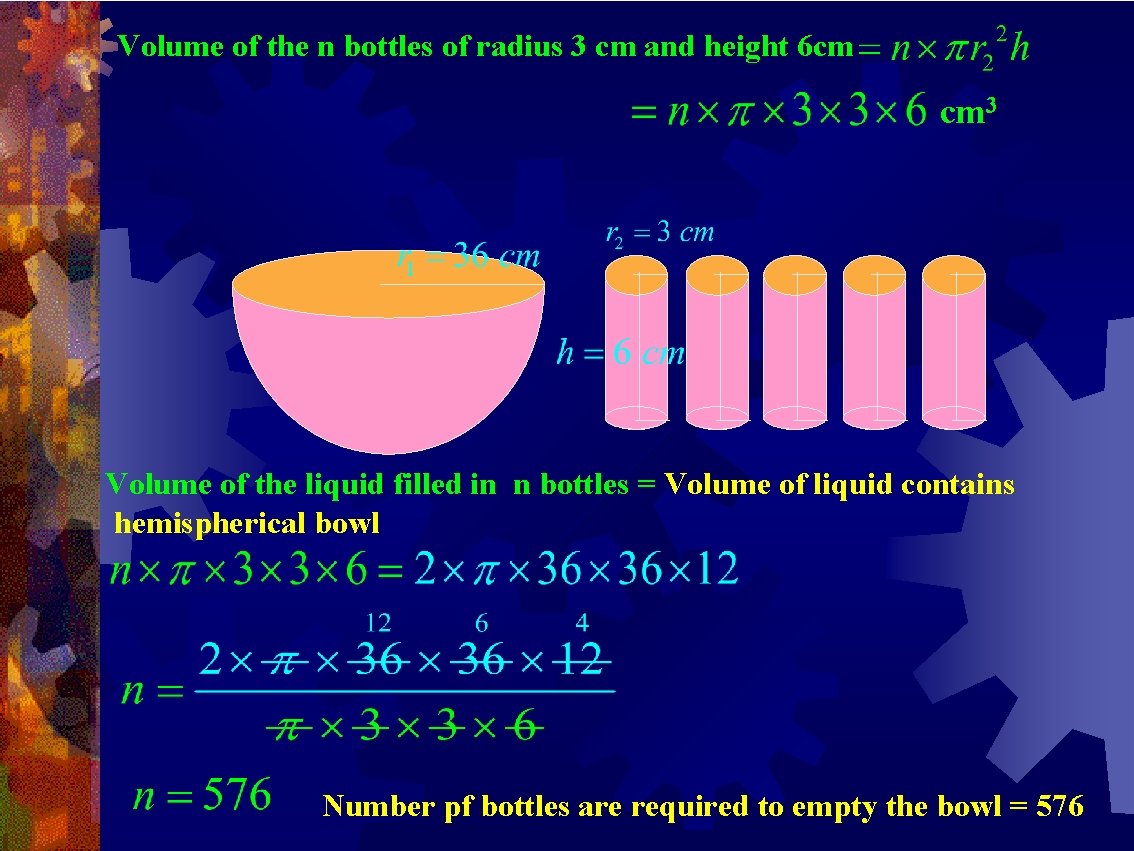
Optional Exercise This exercise is not meant for examination purpose 5. A hemispherical bowl of internal radius 36 cm. contains a liquid. This liquid is to be filled in cylindrical bottles of radius 3 cm and height 6 cm. How many bottles are required to empty the bowl ? A himispherical bowl of internal radius 36 cm. contains a liquid. Volume of the liquid contains in hemispherical bowl cm 3 liquid is to be filled in cylindrical bottles of radius 3 cm and height 6 cm. Let n bottles of radius 3 cm and height 6 cm are required to empty the bowl
Volume of the n bottles of radius 3 cm and height 6 cm cm 3 Volume of the liquid filled in n bottles = Volume of liquid contains hemispherical bowl Number pf bottles are required to empty the bowl = 576