
Conversion of Metric Units The Metric System The
- Slides: 34
Conversion of Metric Units
The Metric System • The International Metric System was developed and introduced in Europe in the times of Napoleon • It is based on the decimal numbering system • Conversion factors are always powers of 10 (i. e. larger units are 10, 1000 of the base unit and smaller units are 1/10, 1/1000 of the base unit)
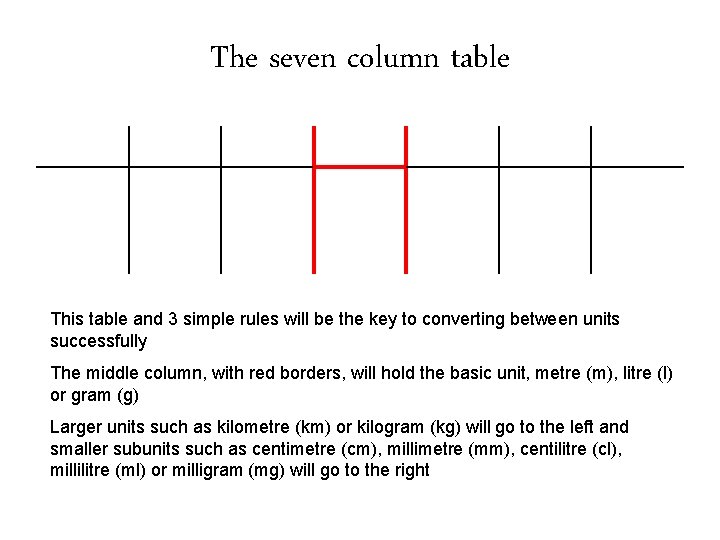
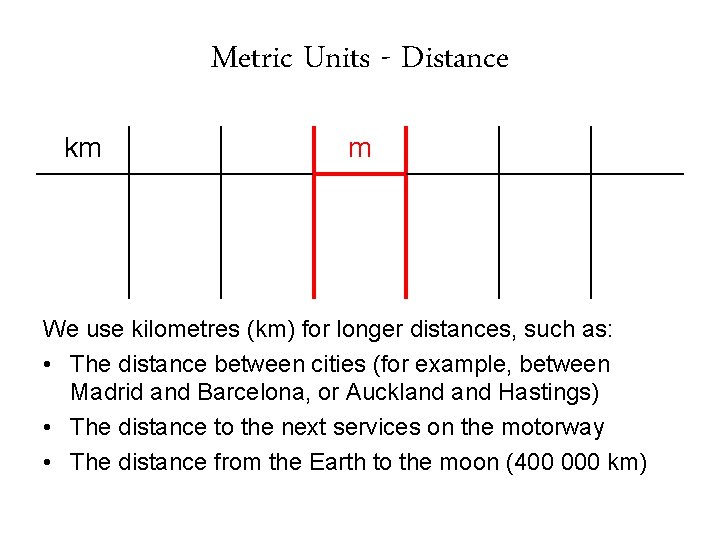
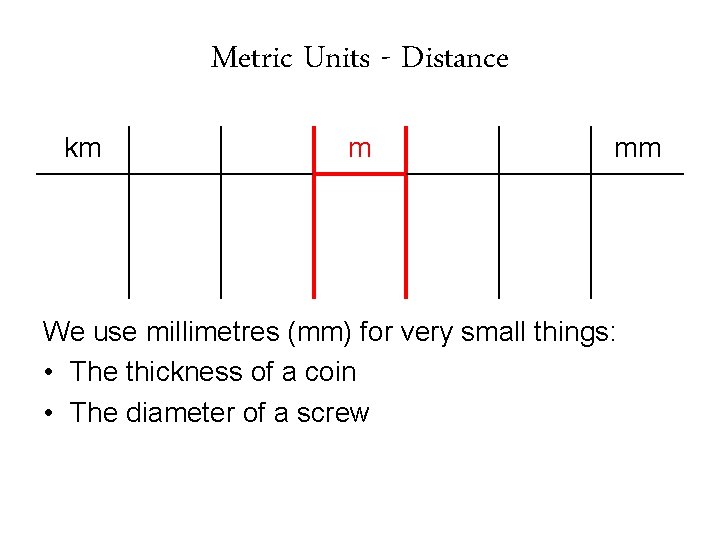
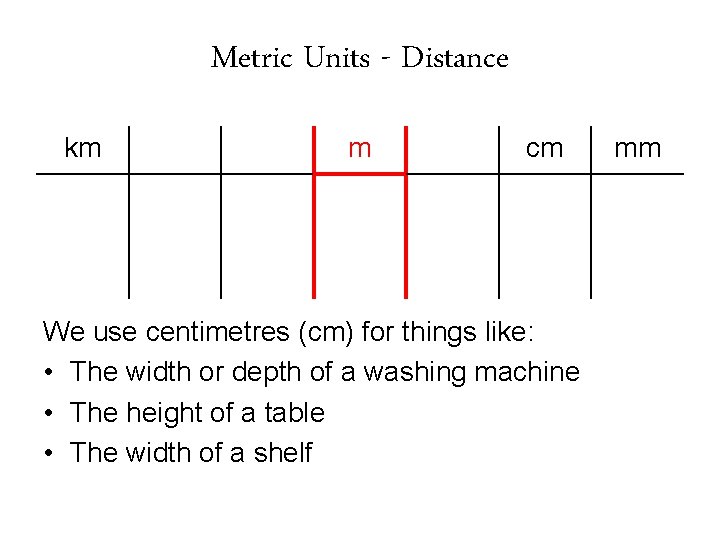
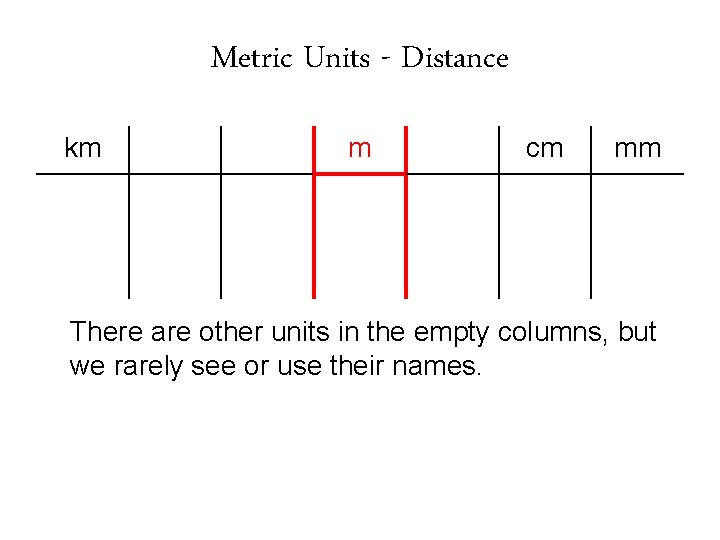
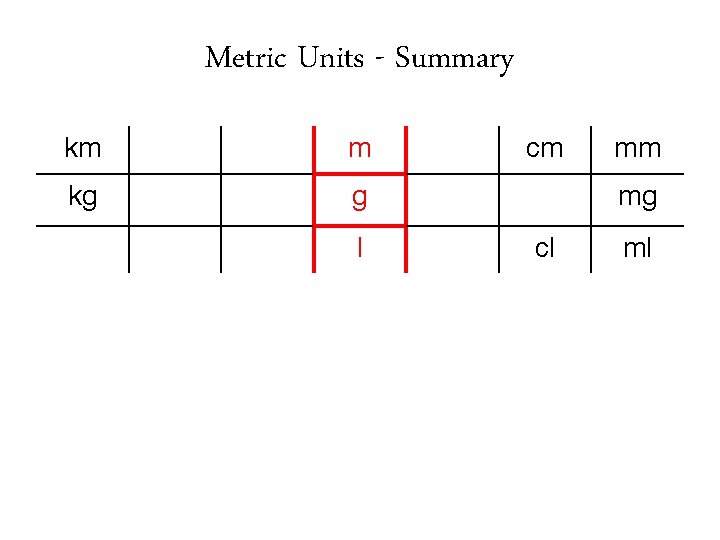
The seven column table This table and 3 simple rules will be the key to converting between units successfully The middle column, with red borders, will hold the basic unit, metre (m), litre (l) or gram (g) Larger units such as kilometre (km) or kilogram (kg) will go to the left and smaller subunits such as centimetre (cm), millimetre (mm), centilitre (cl), millilitre (ml) or milligram (mg) will go to the right
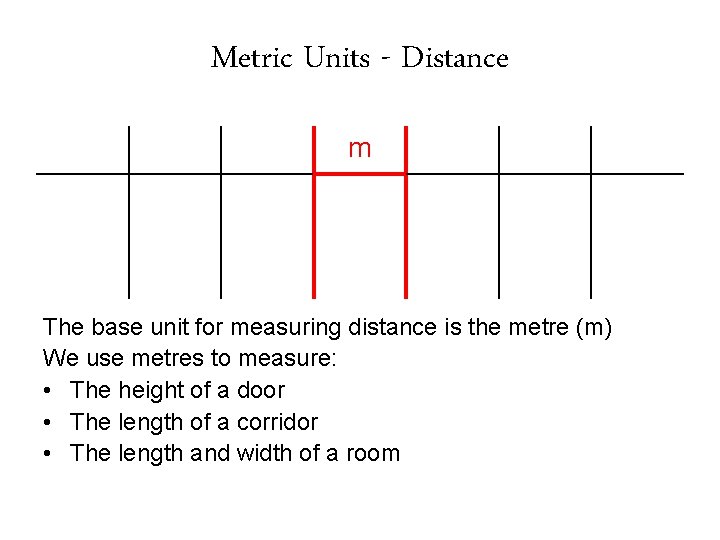
Metric Units - Distance m The base unit for measuring distance is the metre (m) We use metres to measure: • The height of a door • The length of a corridor • The length and width of a room
Metric Units - Distance km m We use kilometres (km) for longer distances, such as: • The distance between cities (for example, between Madrid and Barcelona, or Auckland Hastings) • The distance to the next services on the motorway • The distance from the Earth to the moon (400 000 km)
Metric Units - Distance km m mm We use millimetres (mm) for very small things: • The thickness of a coin • The diameter of a screw
Metric Units - Distance km m cm We use centimetres (cm) for things like: • The width or depth of a washing machine • The height of a table • The width of a shelf mm
Metric Units - Distance km m cm mm There are other units in the empty columns, but we rarely see or use their names.
Check point 1 • How many columns do you need for the Metric Unit Conversion Table? In the Metric System … • What is the basic unit for distance? • What other metric units for distance do you remember? • Can you place them in the table?
Using the 7 column table • In the next few slides we are going to see how to use this table to convert between m, km, mm and cm. • We will start by writing the original measurement on the table • Then we will see ho to convert into the desired unit
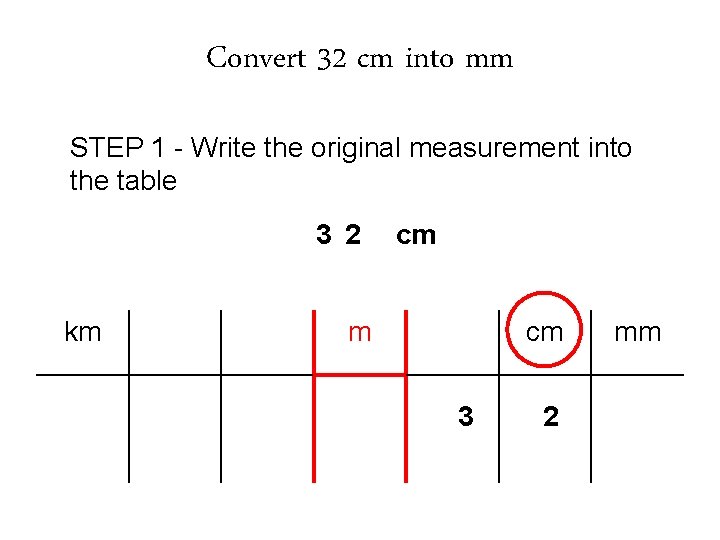
Convert 32 cm into mm STEP 1 - Write the original measurement into the table 3 2 km cm 3 2 mm
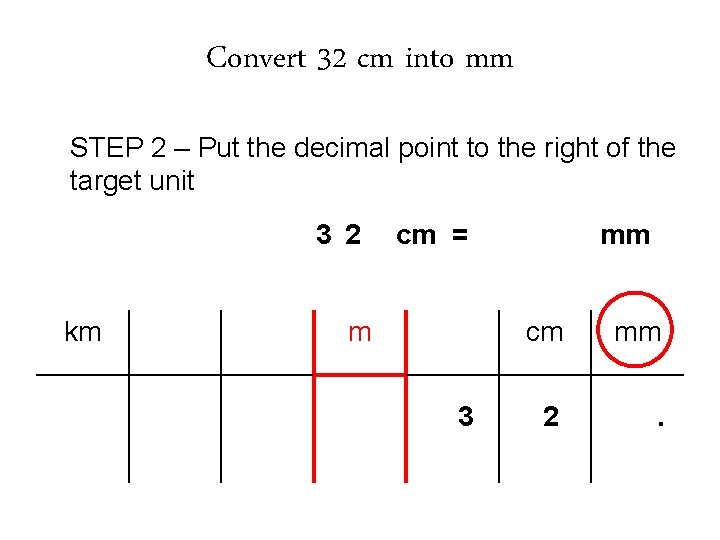
Convert 32 cm into mm STEP 2 – Put the decimal point to the right of the target unit 3 2 km cm = m 3 mm cm mm 2 .
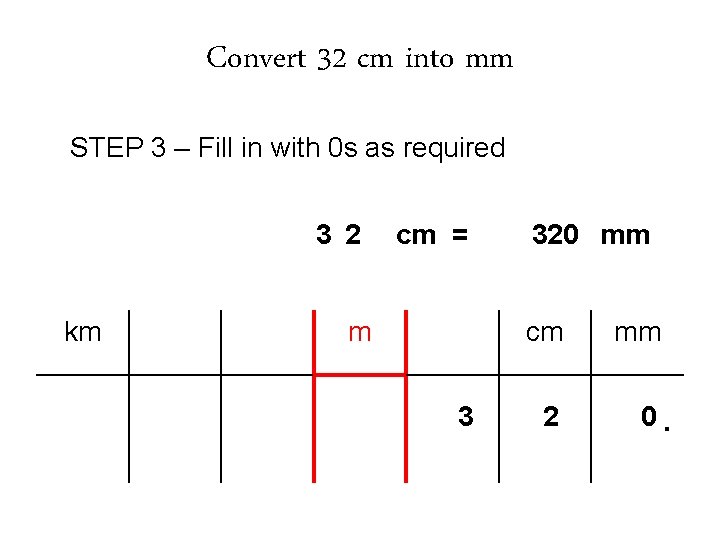
Convert 32 cm into mm STEP 3 – Fill in with 0 s as required 3 2 km cm = m 320 mm cm 3 2 mm 0.
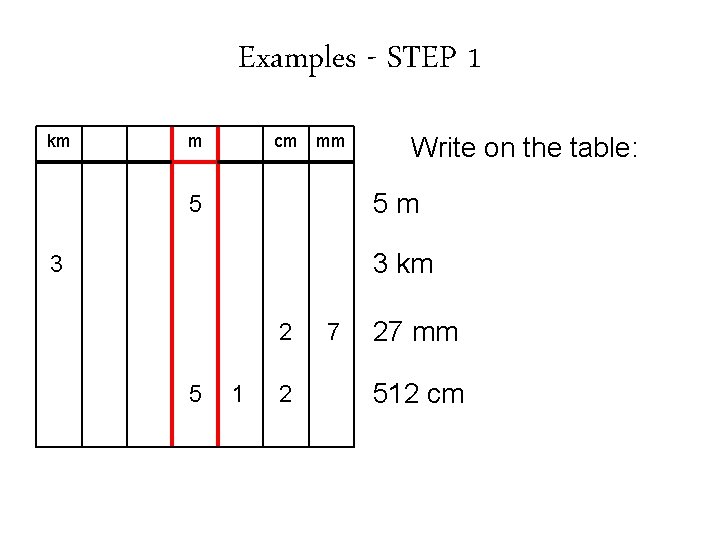
Examples - STEP 1 km m cm mm Write on the table: 5 m 5 3 km 3 2 5 1 2 7 27 mm 512 cm
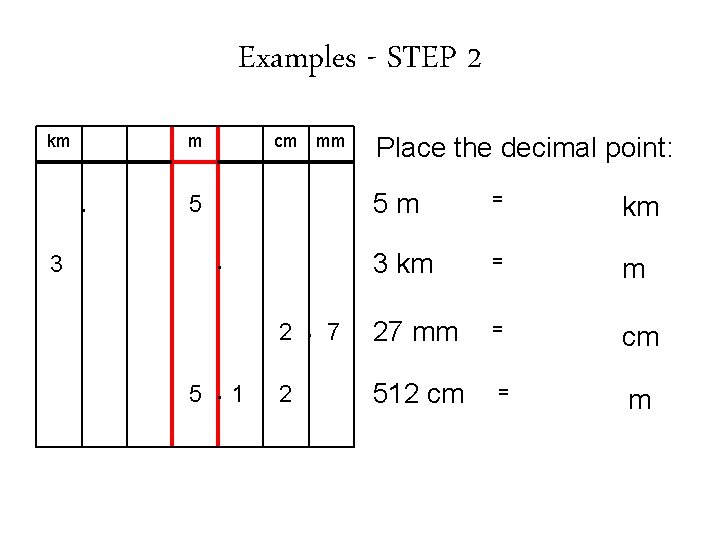
Examples - STEP 2 km m . 3 cm mm 5 m = km 3 km = m 2. 7 27 mm = cm 2 512 cm 5. 1 Place the decimal point: = m
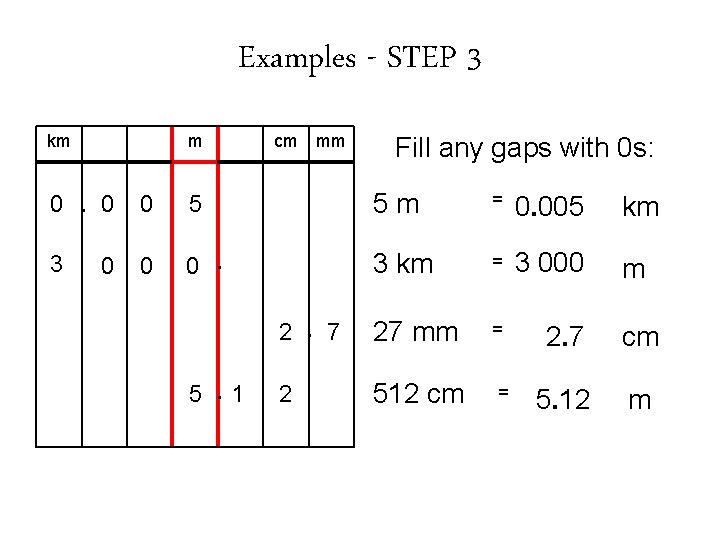
Examples - STEP 3 km m cm mm Fill any gaps with 0 s: 0. 0 0 5 5 m = 0. 005 km 3 0 0. 3 km = 3 000 m 2. 7 27 mm = 2. 7 cm 2 512 cm 5. 12 m 0 5. 1 =
Check point 2 • Draw the table and the column headings for distance • Use the table to convert the following numbers into cm: 350 m 78 mm 5 km 3 mm
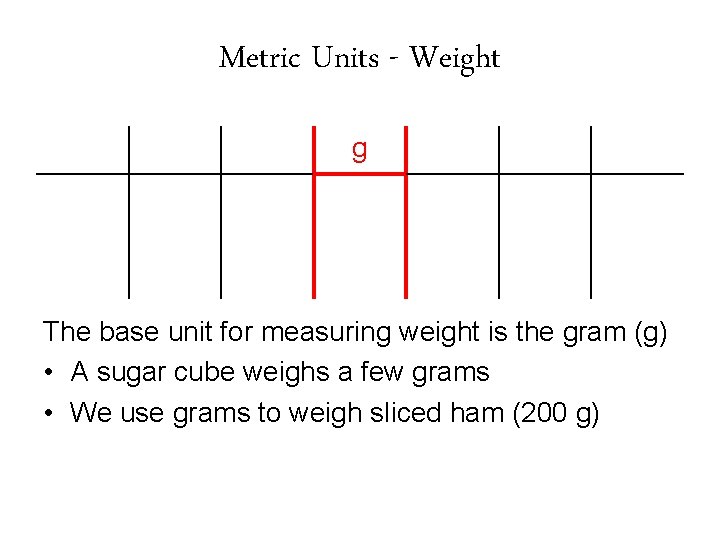
Metric Units - Weight g The base unit for measuring weight is the gram (g) • A sugar cube weighs a few grams • We use grams to weigh sliced ham (200 g)
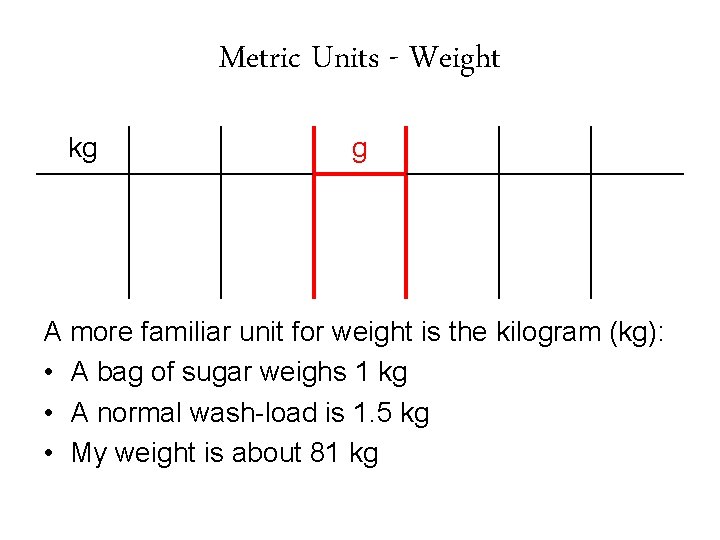
Metric Units - Weight kg g A more familiar unit for weight is the kilogram (kg): • A bag of sugar weighs 1 kg • A normal wash-load is 1. 5 kg • My weight is about 81 kg
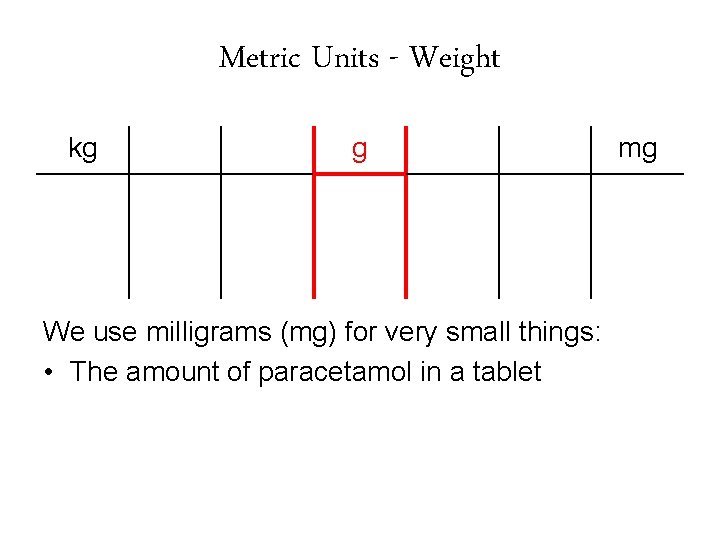
Metric Units - Weight kg g We use milligrams (mg) for very small things: • The amount of paracetamol in a tablet mg
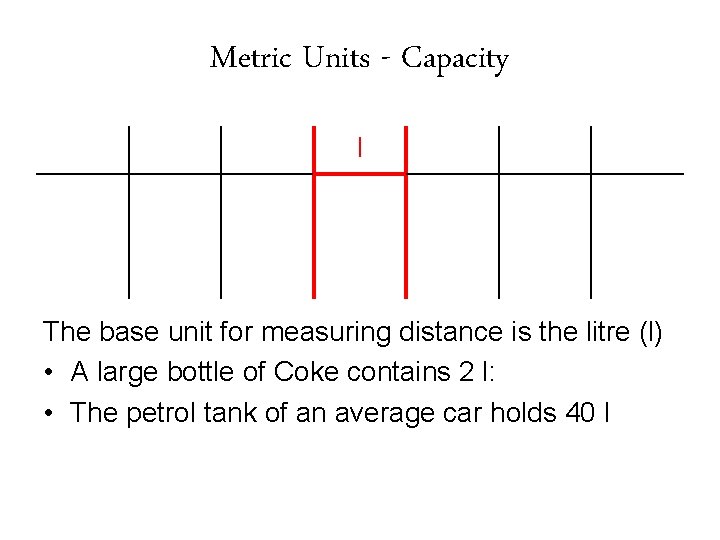
Metric Units - Capacity l The base unit for measuring distance is the litre (l) • A large bottle of Coke contains 2 l: • The petrol tank of an average car holds 40 l
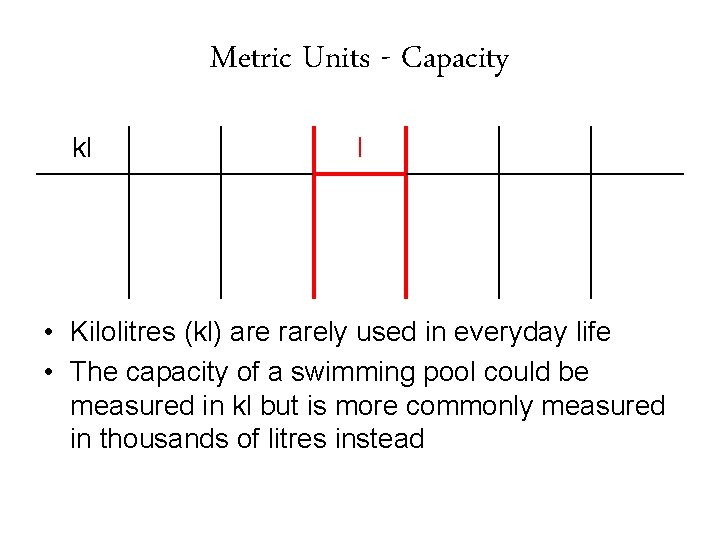
Metric Units - Capacity kl l • Kilolitres (kl) are rarely used in everyday life • The capacity of a swimming pool could be measured in kl but is more commonly measured in thousands of litres instead
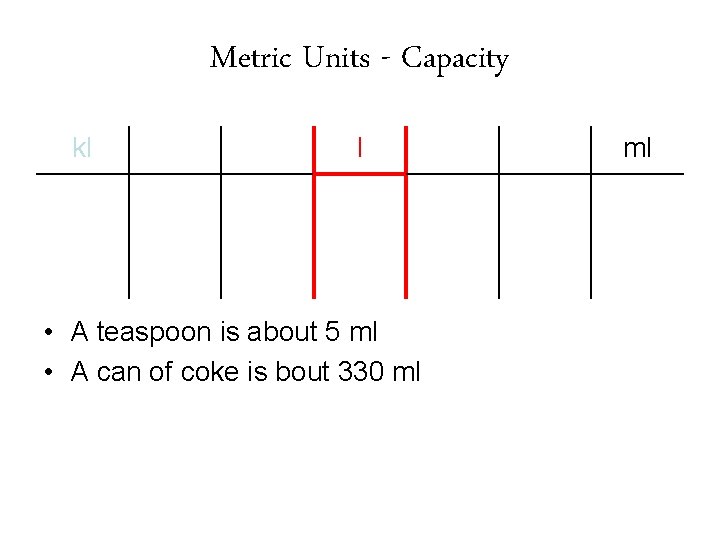
Metric Units - Capacity kl l • A teaspoon is about 5 ml • A can of coke is bout 330 ml ml
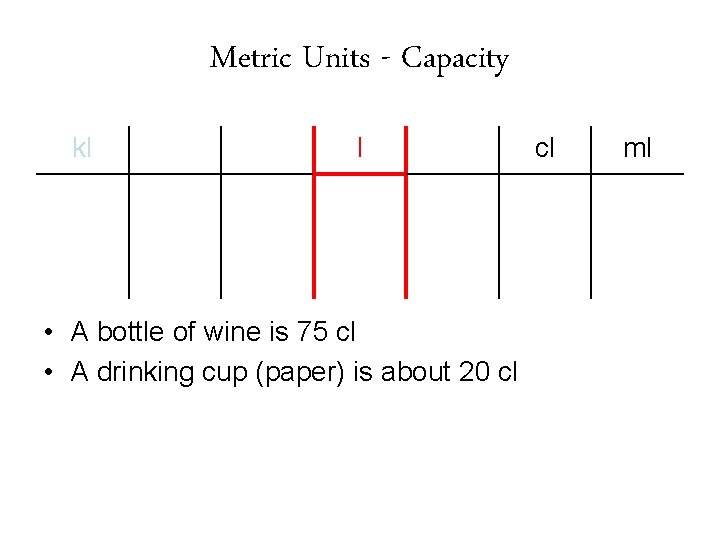
Metric Units - Capacity kl l • A bottle of wine is 75 cl • A drinking cup (paper) is about 20 cl cl ml
Metric Units - Summary km m kg g l cm mm mg cl ml
Conversion of Metric Units Harder examples
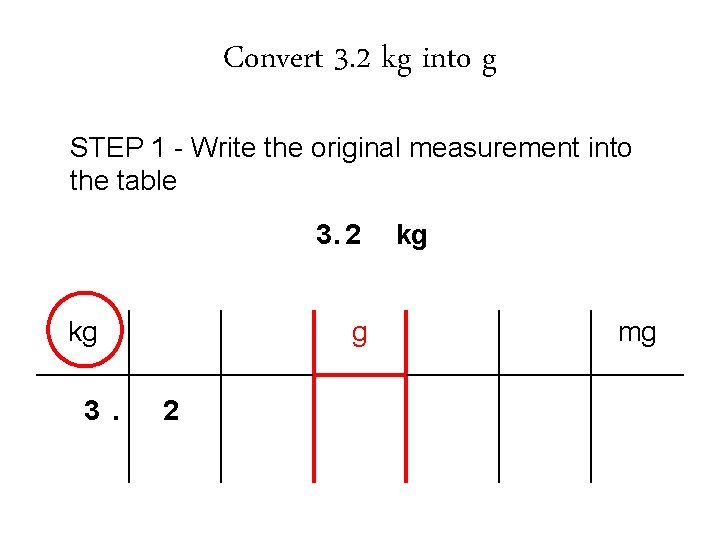
Convert 3. 2 kg into g STEP 1 - Write the original measurement into the table 3. 2 kg 3. g 2 kg mg
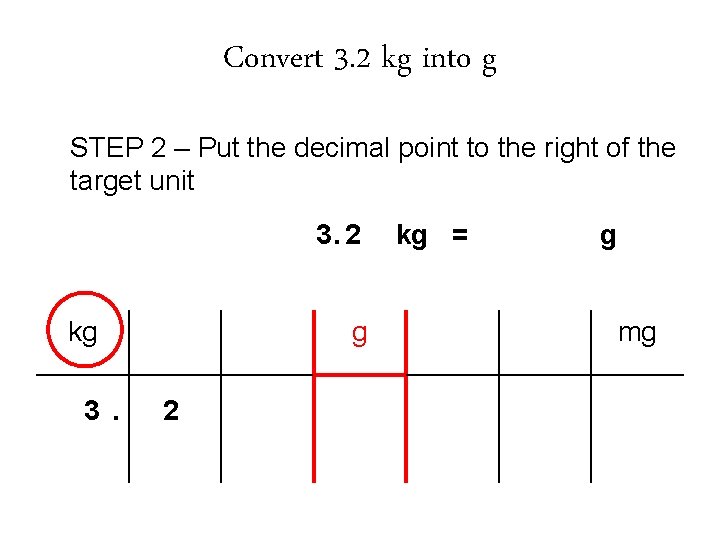
Convert 3. 2 kg into g STEP 2 – Put the decimal point to the right of the target unit 3. 2 kg 3. g 2 kg = g mg
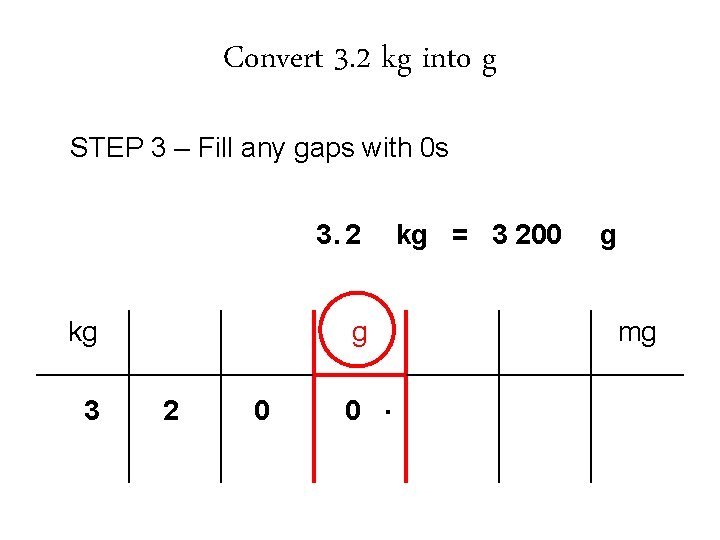
Convert 3. 2 kg into g STEP 3 – Fill any gaps with 0 s 3. 2 kg 3 g 2 0 0. kg = 3 200 g mg
Check point 3 In the Metric System… • What is the base unit for weight? • What other weight units can you remember? • What is the base unit for capacity? • What other units of capacity can you remember?
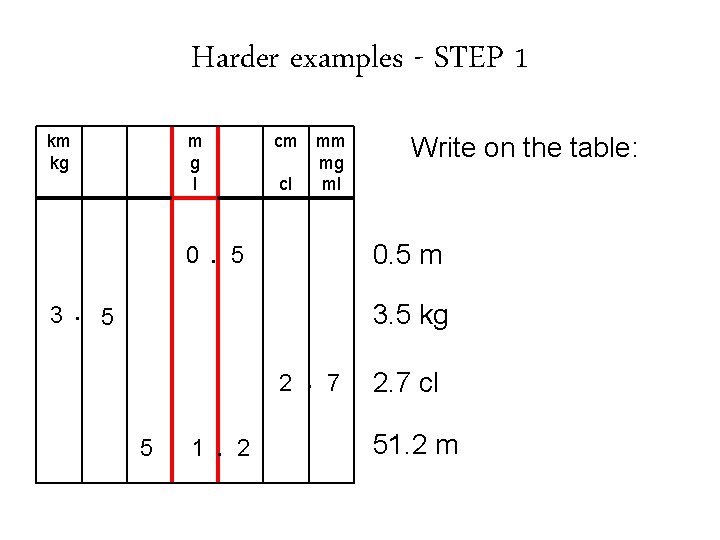
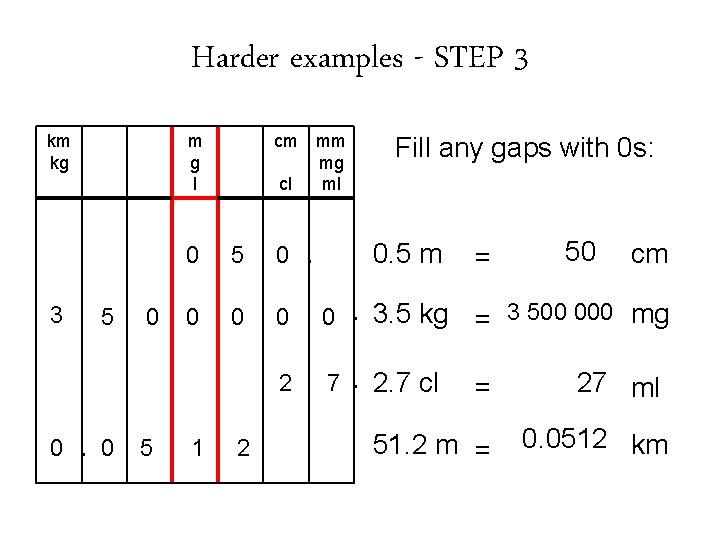
Harder examples - STEP 1 km kg m g l cm cl mm mg ml Write on the table: 0. 5 m 0. 5 3. 5 kg 2. 7 5 1. 2 2. 7 cl 51. 2 m
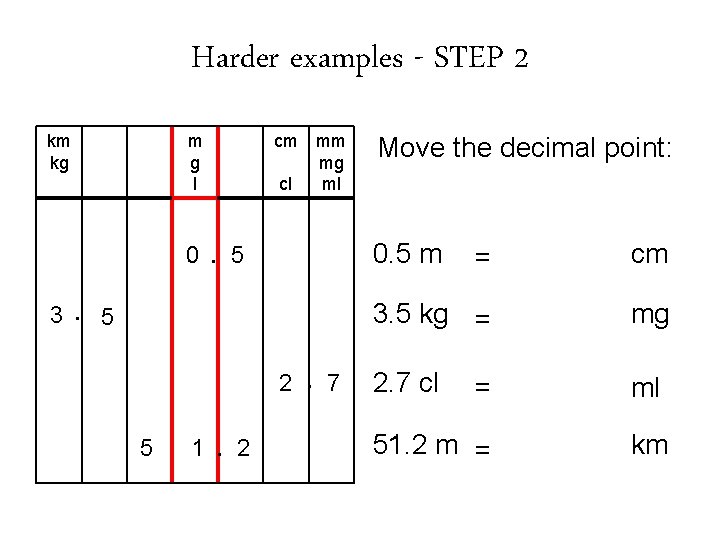
Harder examples - STEP 2 km kg m g l cm cl mm mg ml 0. 5 m 0. 5 3. 5 2. 7 5 1. 2 Move the decimal point: = cm 3. 5 kg = mg 2. 7 cl = ml 51. 2 m = km
Harder examples - STEP 3 km kg 3 m g l 5 0. 0 0 5 cm cl mm mg ml Fill any gaps with 0 s: 0. 5 m 50 cm 0 5 0. 0 0. 3. 5 kg = 3 500 000 mg 2 7. 2. 7 cl = 27 ml 51. 2 m = 0. 0512 km 1 2 =
Check point 4 Use the conversion table to answer these questions: • • • How many cm in 1 m? How many cl in 2 l? How many g in 1 kg? 1 m is the same as _____ km 1 mg is the same as _____ g