
Conversation and Communication Language Use and Conventions and
- Slides: 45
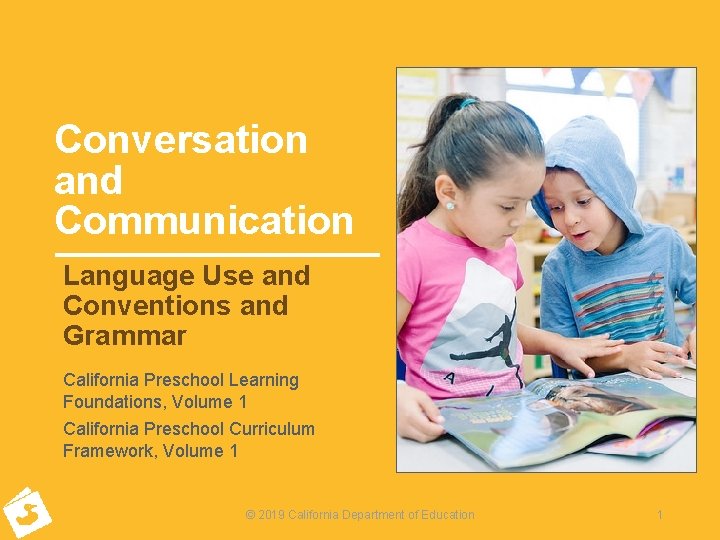
Conversation and Communication Language Use and Conventions and Grammar California Preschool Learning Foundations, Volume 1 California Preschool Curriculum Framework, Volume 1 © 2019 California Department of Education 1
Objectives • Explore key concepts from Volume 1 of both the California Preschool Learning Foundations and California Preschool Curriculum Framework—language and literacy domain, listening and speaking strand: Language Use and Conventions and Grammar substrands. • Observe, read, and discuss the developmental continuum of language use and conventions and grammar. • Develop strategies to guide instruction and learning in preschool. • Use the foundations and framework to plan developmentally appropriate, cultural, and inclusive strategies that promote the development of skills, knowledge, and behaviors related to language and literacy development. © 2019 California Department of Education 2
Communicate and Connect 1. Choose a string. 2. Find someone who has a similarly sized string. 3. Introduce yourself while discussing: – What interests you about language? – What language/s do you speak? – What is your favorite story about children learning language? © 2019 California Department of Education 3
Communicate and Connect Part 2 1. Tie your string to your partner’s string. 2. Team up with another partner pair. 3. Share what you have learned about your language partner with the new partner pair 4. Tie your team’s strings together and hang them at the front of the room. © 2019 California Department of Education 4
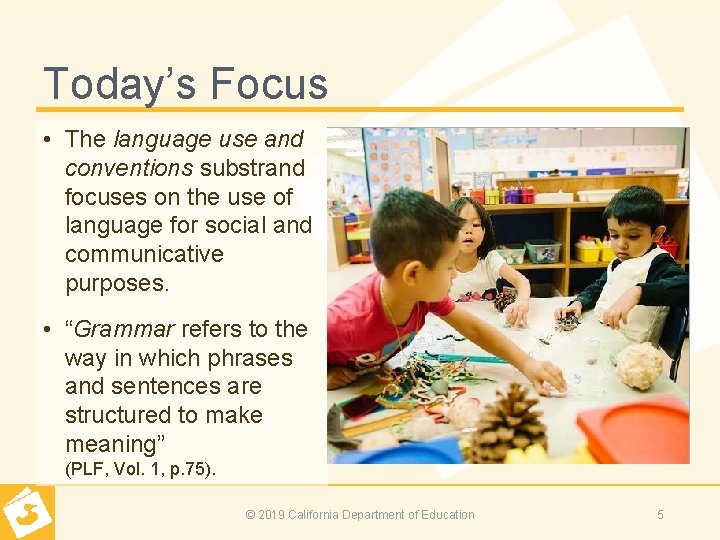
Today’s Focus • The language use and conventions substrand focuses on the use of language for social and communicative purposes. • “Grammar refers to the way in which phrases and sentences are structured to make meaning” (PLF, Vol. 1, p. 75). © 2019 California Department of Education 5
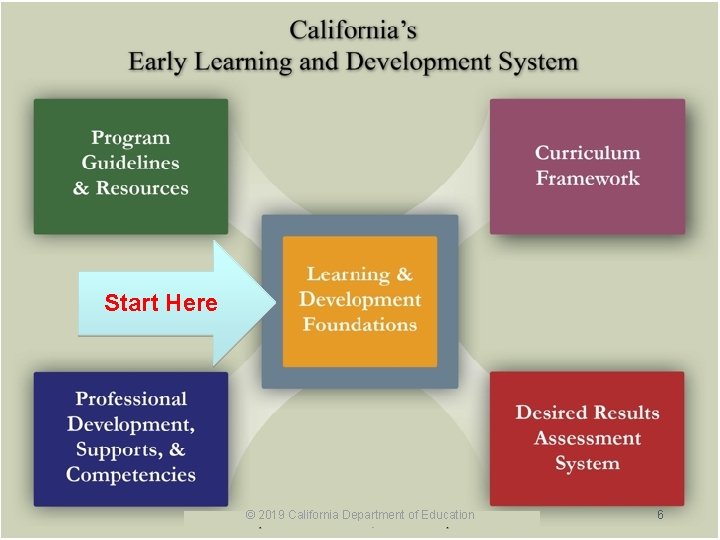
Early Learning Development System Start Here © 2019 California Department of Education 6
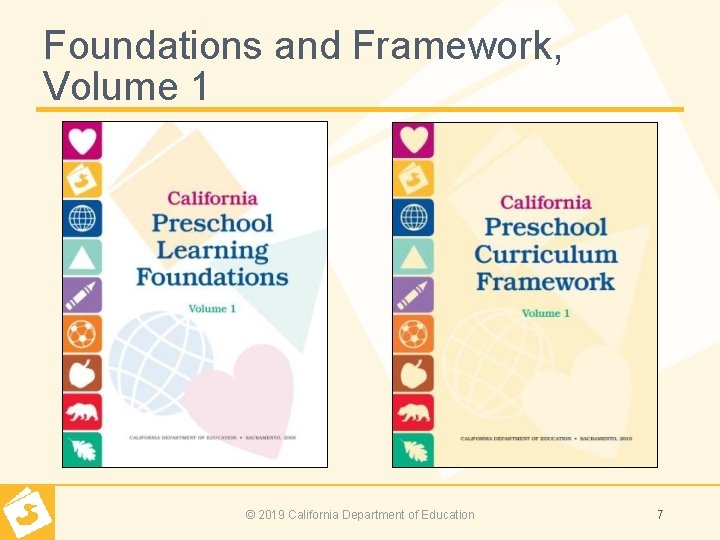
Foundations and Framework, Volume 1 © 2019 California Department of Education 7
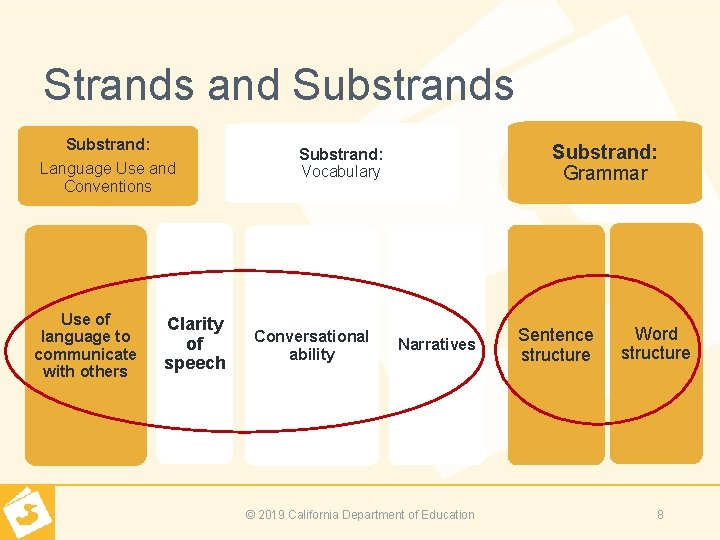
Strands and Substrands Substrand: Language Use and Conventions Use of language to communicate with others Clarity of speech Substrand: Grammar Substrand: Vocabulary Conversational ability Narratives © 2019 California Department of Education Sentence structure Word structure 8
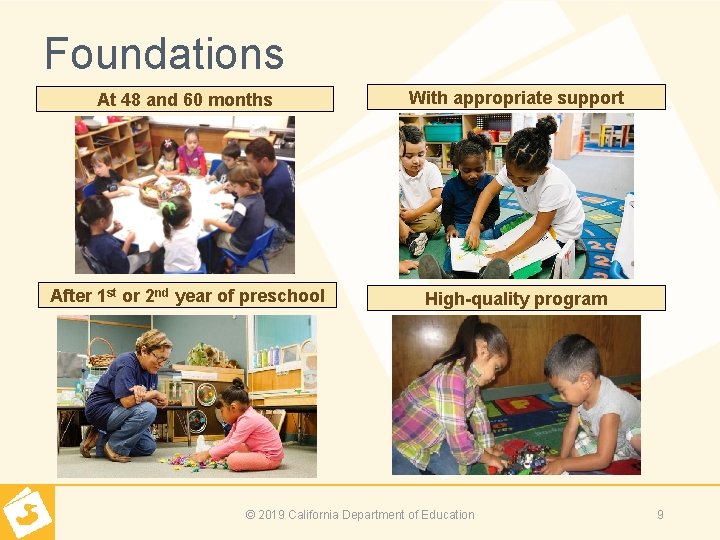
Foundations At 48 and 60 months With appropriate support After 1 st or 2 nd year of preschool High-quality program © 2019 California Department of Education 9
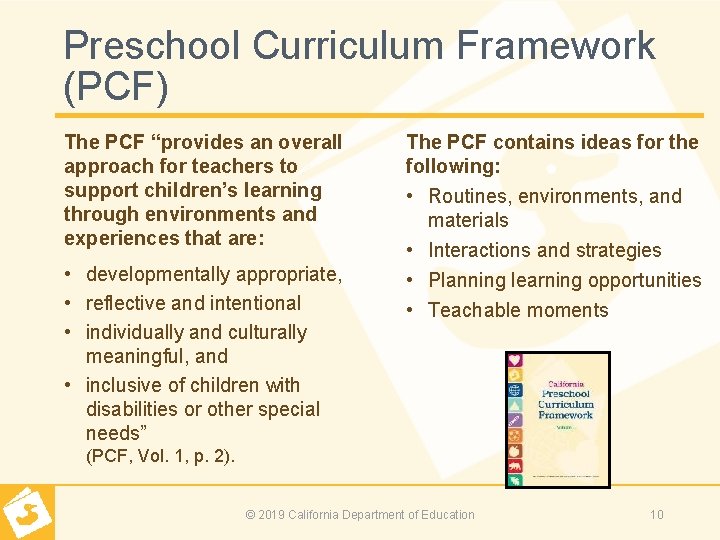
Preschool Curriculum Framework (PCF) The PCF “provides an overall approach for teachers to support children’s learning through environments and experiences that are: • developmentally appropriate, • reflective and intentional • individually and culturally meaningful, and • inclusive of children with disabilities or other special needs” The PCF contains ideas for the following: • Routines, environments, and materials • Interactions and strategies • Planning learning opportunities • Teachable moments (PCF, Vol. 1, p. 2). © 2019 California Department of Education 10
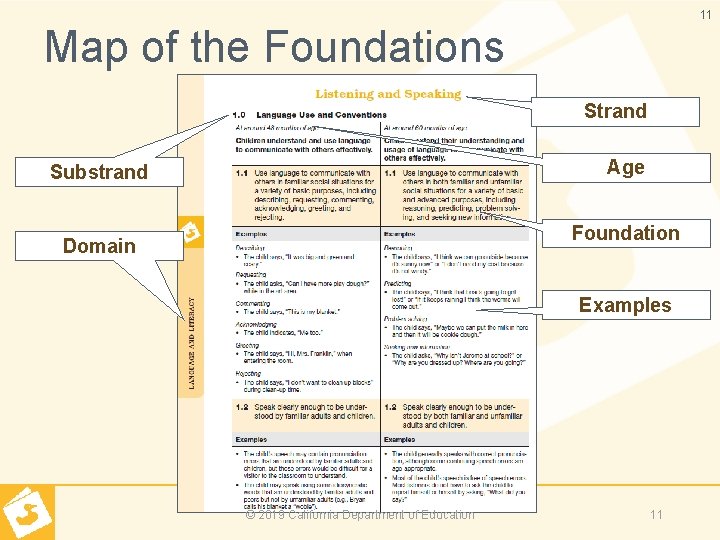
11 Map of the Foundations Strand Age Substrand Foundation Domain Examples © 2019 California Department of Education 11
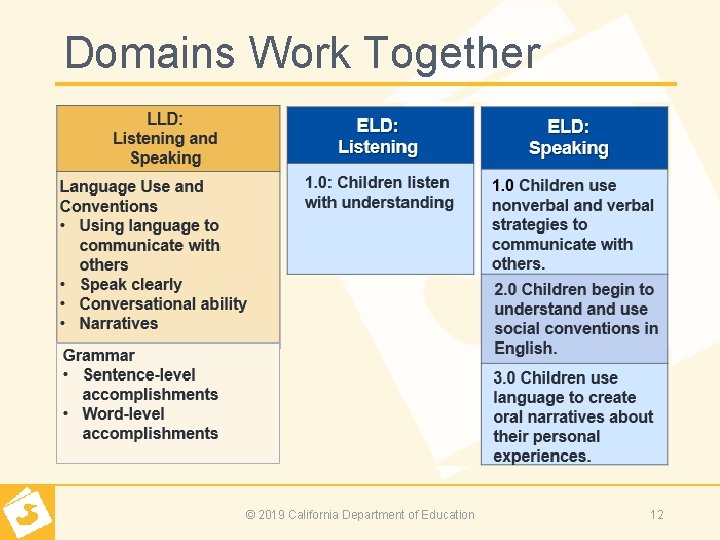
Domains Work Together © 2019 California Department of Education 12
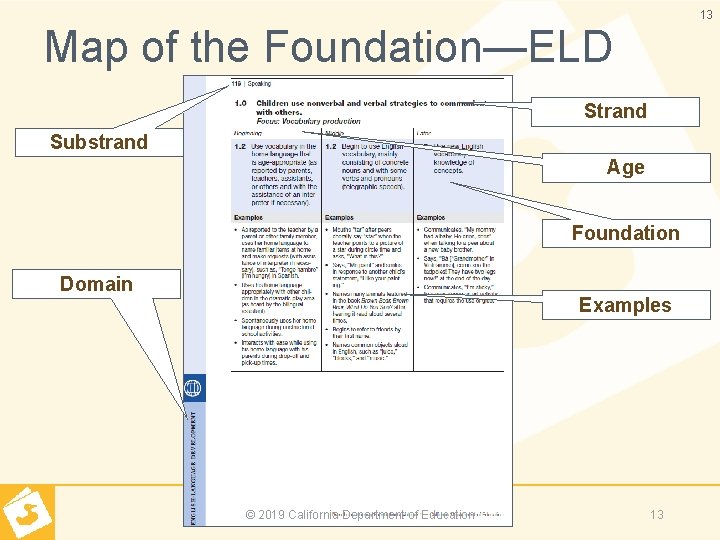
13 Map of the Foundation—ELD Strand Substrand Age Foundation Domain Examples © 2019 California Department of Education 13
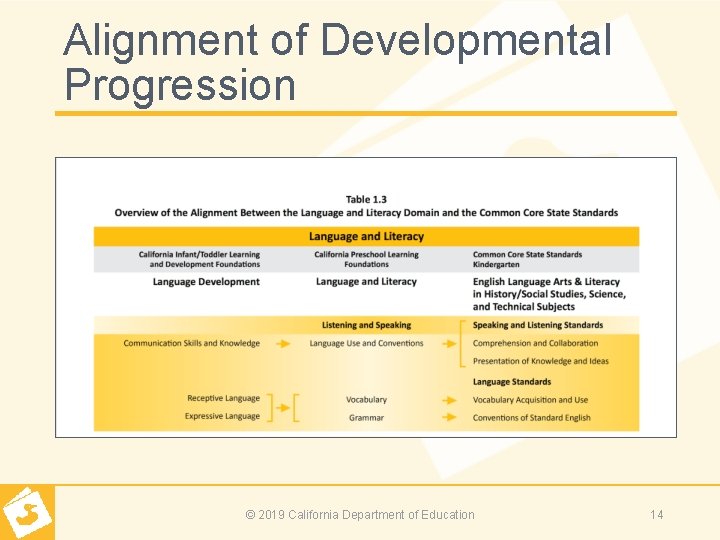
Alignment of Developmental Progression © 2019 California Department of Education 14
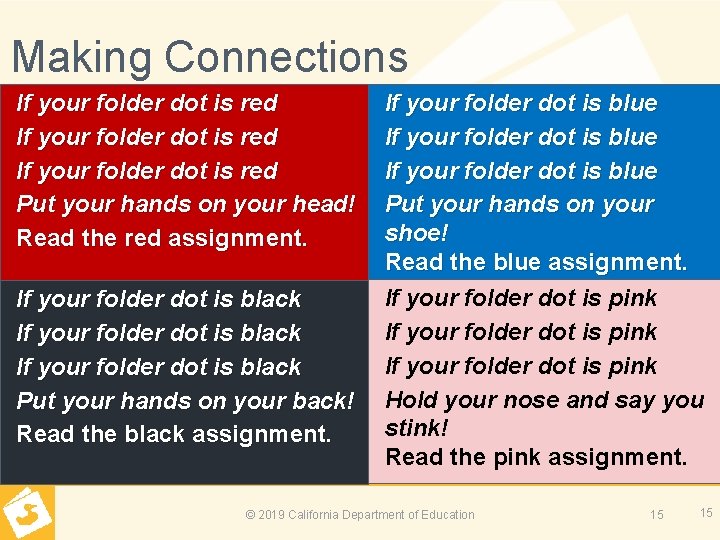
Making Connections If your folder dot is red Put your hands on your head! Read the red assignment. If your folder dot is black Put your hands on your back! Read the black assignment. If your folder dot is blue Put your hands on your shoe! Read the blue assignment. If your folder dot is pink Hold your nose and say you stink! Read the pink assignment. © 2019 California Department of Education 15 15
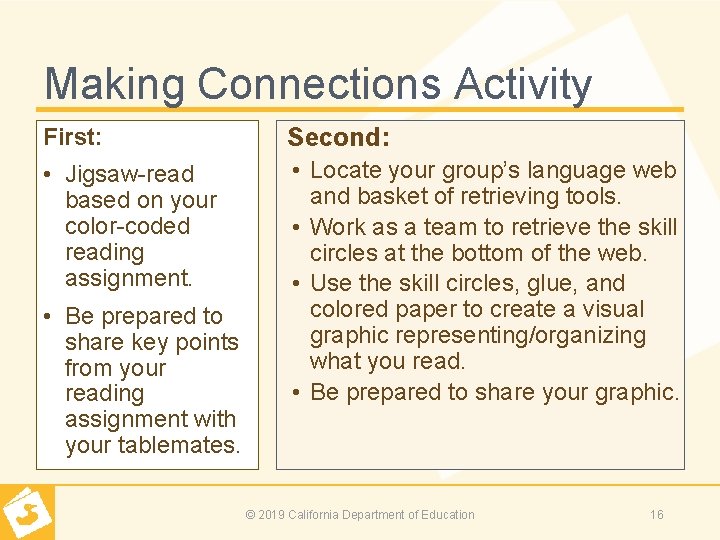
Making Connections Activity First: Second: • Jigsaw read based on your color coded reading assignment. • Locate your group’s language web and basket of retrieving tools. • Work as a team to retrieve the skill circles at the bottom of the web. • Use the skill circles, glue, and colored paper to create a visual graphic representing/organizing what you read. • Be prepared to share your graphic. • Be prepared to share key points from your reading assignment with your tablemates. © 2019 California Department of Education 16
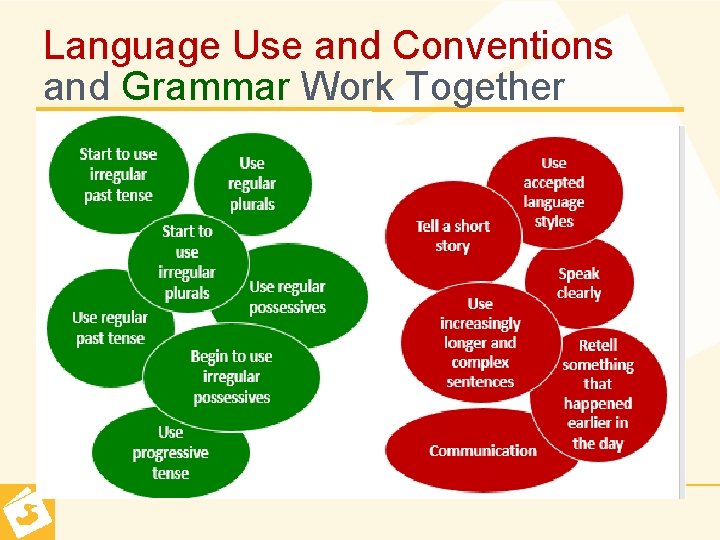
Language Use and Conventions and Grammar Work Together
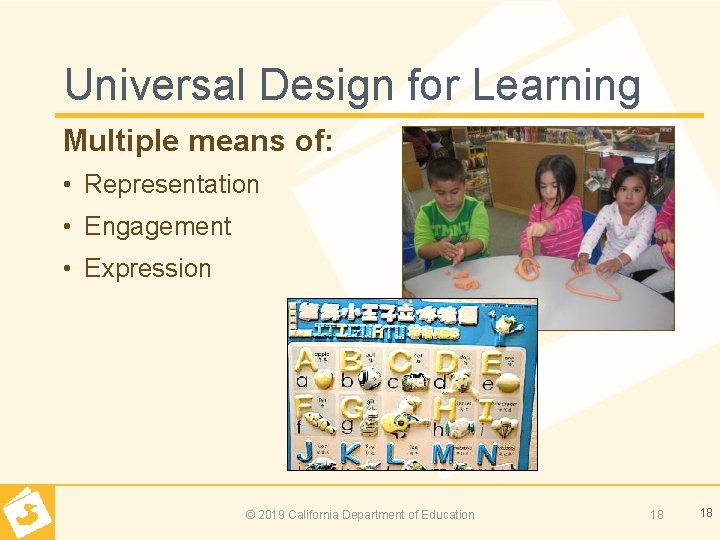
Universal Design for Learning Multiple means of: • Representation • Engagement • Expression © 2019 California Department of Education 18 18
Role of the Teacher in Supporting Oral Development What we know: “The proportion of complex sentences contained in children’s language use ranges from 5 percent to 30 percent. This variability in the rate of growth has been linked to children’s experiences in hearing complex sentences from their teachers” (Huttenlocher and oth ers as cited in PLF, Vol. 1, p. p. 75 76). What we can do: Create opportunities in the environment, daily routines, and other interactions to engage and expand conversation. © 2019 California Department of Education 19
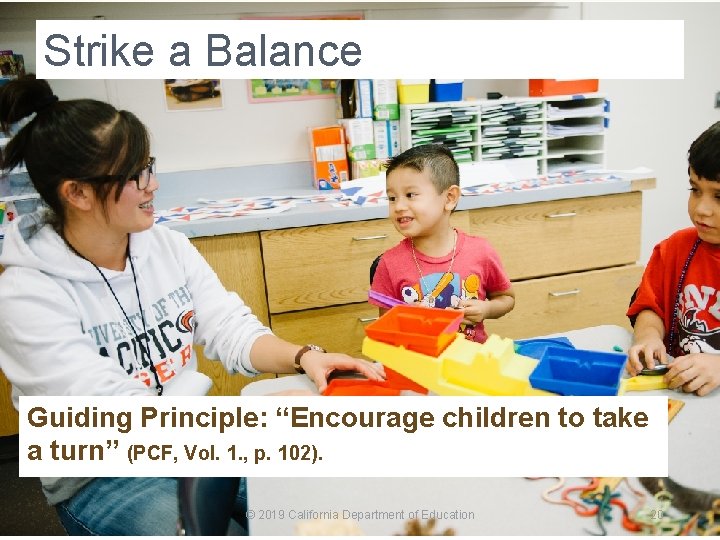
Strike a Balance Guiding Principle: “Encourage children to take a turn” (PCF, Vol. 1. , p. 102). © 2019 California Department of Education 20
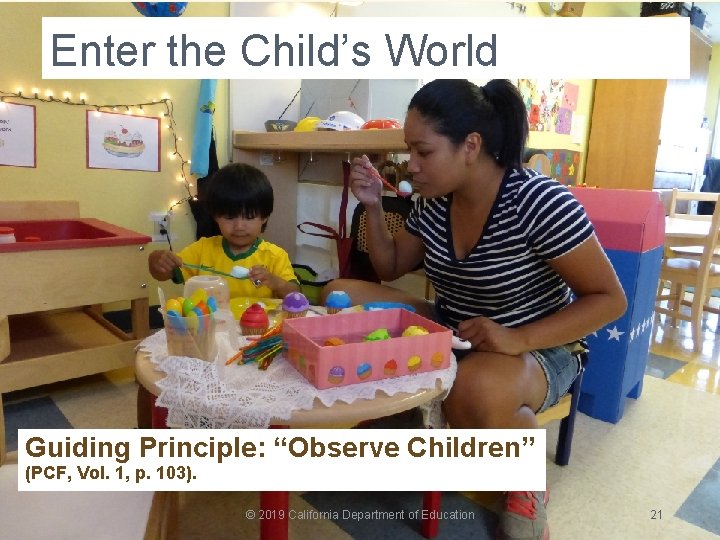
Enter the Child’s World Guiding Principle: “Observe Children” (PCF, Vol. 1, p. 103). © 2019 California Department of Education 21
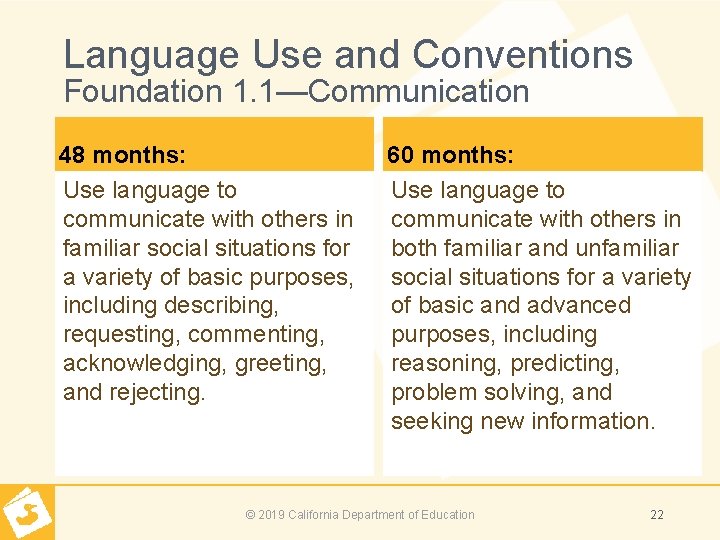
Language Use and Conventions Foundation 1. 1—Communication 48 months: Use language to communicate with others in familiar social situations for a variety of basic purposes, including describing, requesting, commenting, acknowledging, greeting, and rejecting. 60 months: Use language to communicate with others in both familiar and unfamiliar social situations for a variety of basic and advanced purposes, including reasoning, predicting, problem solving, and seeking new information. © 2019 California Department of Education 22
Video Example: Language Use and Conventions—Foundation 1. 1 As you watch, take note of one example of a basic purpose and one example of an advanced purpose. © 2019 California Department of Education 23
Cooking and Conversation— Part 1 • Take out Handout 5: Fruit Salad Recipe. • Send one groupmate to collect the cooking materials. • Self-assign the following roles within your group: – One teacher/facilitator – Two students/chefs – One or two recorders • Play your role as you follow the recipe and converse with your groupmates. © 2019 California Department of Education 24
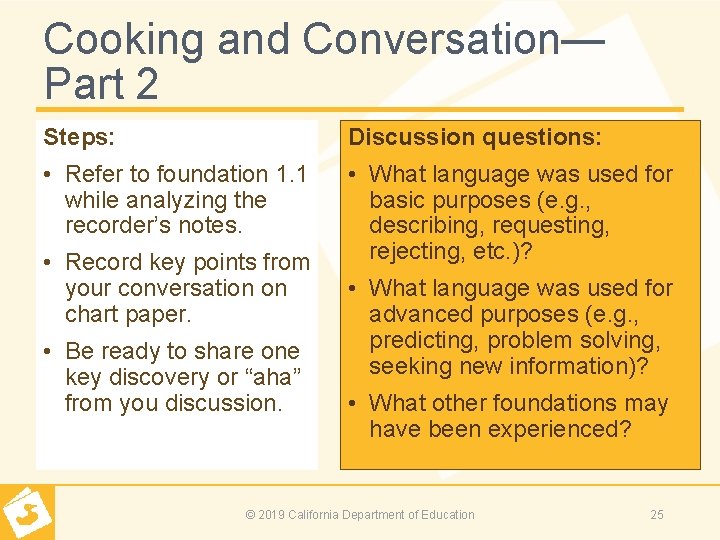
Cooking and Conversation— Part 2 Steps: Discussion questions: • Refer to foundation 1. 1 while analyzing the recorder’s notes. • What language was used for basic purposes (e. g. , describing, requesting, rejecting, etc. )? • Record key points from your conversation on chart paper. • Be ready to share one key discovery or “aha” from you discussion. • What language was used for advanced purposes (e. g. , predicting, problem solving, seeking new information)? • What other foundations may have been experienced? © 2019 California Department of Education 25
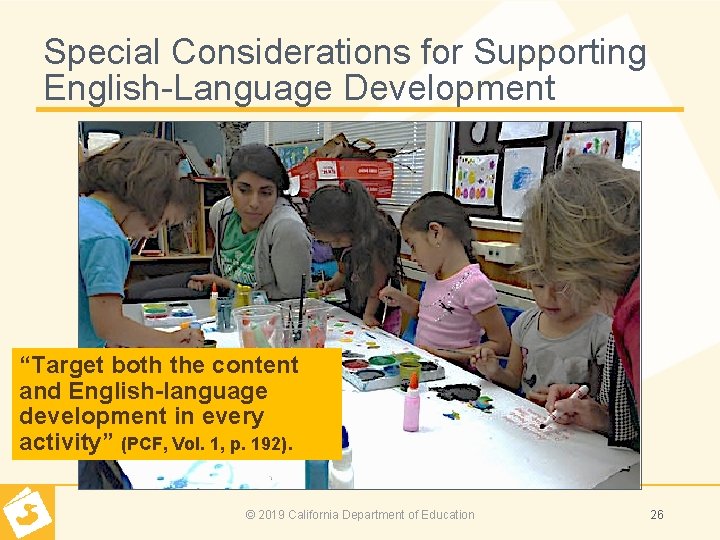
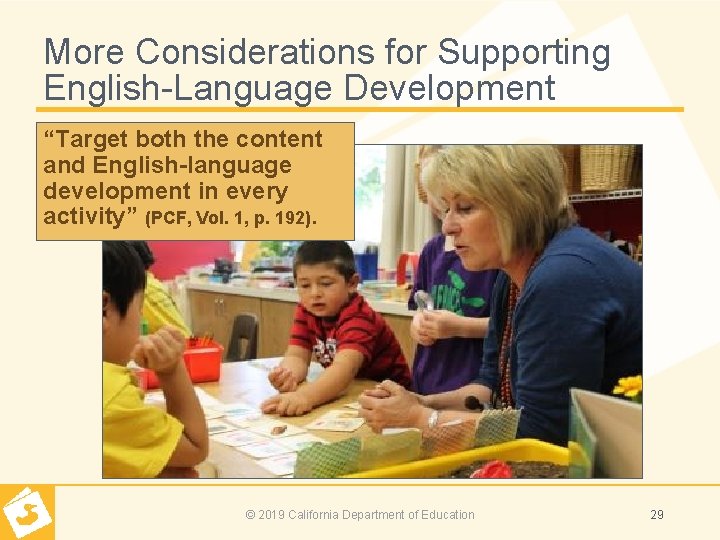
Special Considerations for Supporting English Language Development “Target both the content and English-language development in every activity” (PCF, Vol. 1, p. 192). © 2019 California Department of Education 26
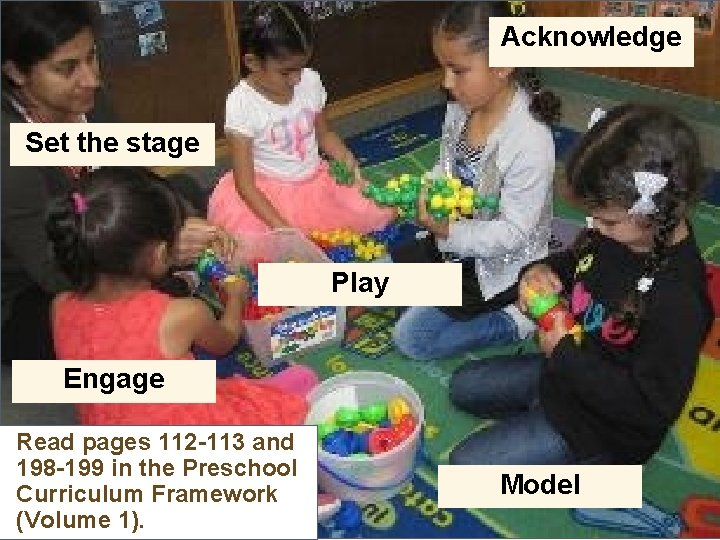
Acknowledge Interactions and Strategies to Spark Effective Communication Set the stage Play Engage Read pages 112 -113 and 198 -199 in the Preschool Curriculum Framework (Volume 1). Model 27
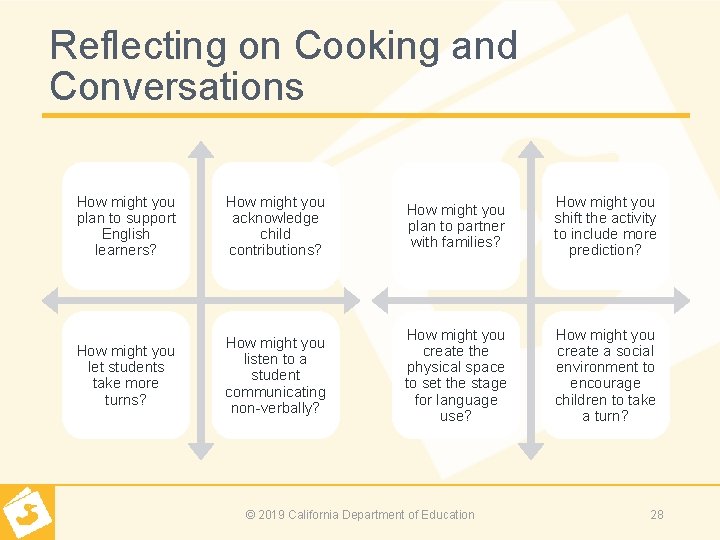
Reflecting on Cooking and Conversations How might you plan to support English learners? How might you acknowledge child contributions? How might you plan to partner with families? How might you shift the activity to include more prediction? How might you let students take more turns? How might you listen to a student communicating non verbally? How might you create the physical space to set the stage for language use? How might you create a social environment to encourage children to take a turn? © 2019 California Department of Education 28
More Considerations for Supporting English Language Development “Target both the content and English-language development in every activity” (PCF, Vol. 1, p. 192). © 2019 California Department of Education 29
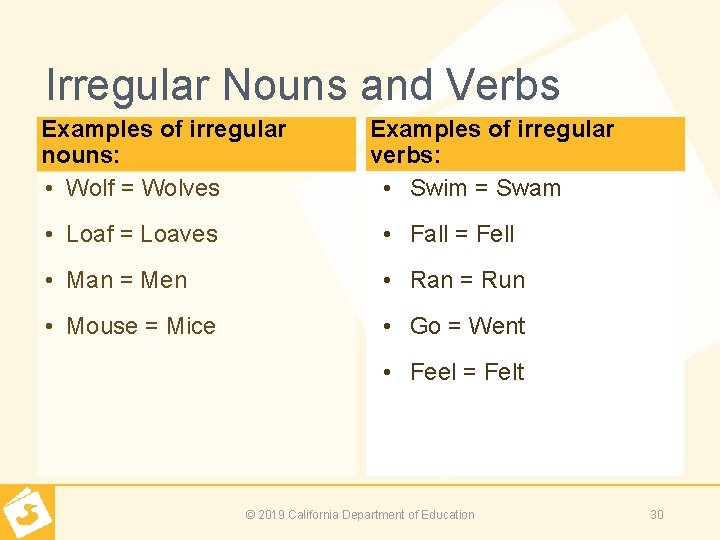
Irregular Nouns and Verbs Examples of irregular nouns: • Wolf = Wolves Examples of irregular verbs: • Swim = Swam • Loaf = Loaves • Fall = Fell • Man = Men • Ran = Run • Mouse = Mice • Go = Went • Feel = Felt © 2019 California Department of Education 30
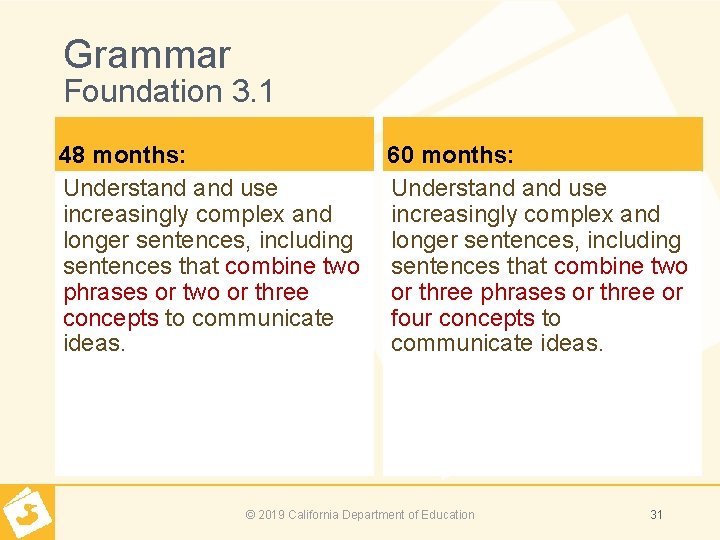
Grammar Foundation 3. 1 48 months: Understand use increasingly complex and longer sentences, including sentences that combine two phrases or two or three concepts to communicate ideas. 60 months: Understand use increasingly complex and longer sentences, including sentences that combine two or three phrases or three or four concepts to communicate ideas. © 2019 California Department of Education 31
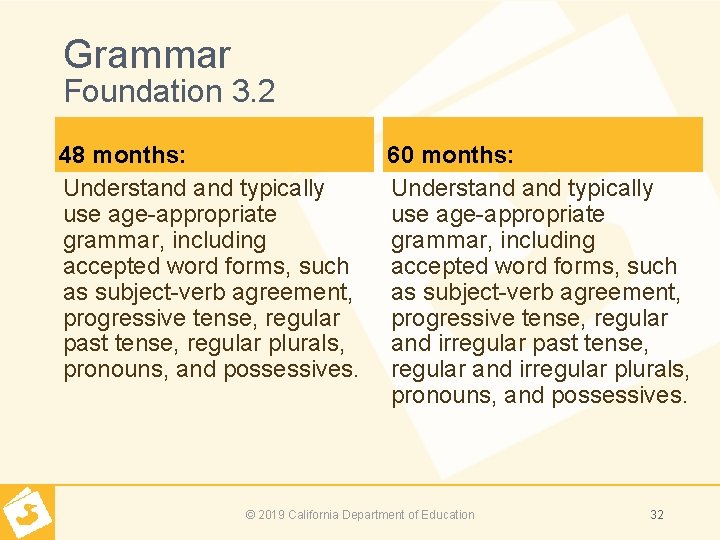
Grammar Foundation 3. 2 48 months: Understand typically use age appropriate grammar, including accepted word forms, such as subject verb agreement, progressive tense, regular past tense, regular plurals, pronouns, and possessives. 60 months: Understand typically use age appropriate grammar, including accepted word forms, such as subject verb agreement, progressive tense, regular and irregular past tense, regular and irregular plurals, pronouns, and possessives. © 2019 California Department of Education 32
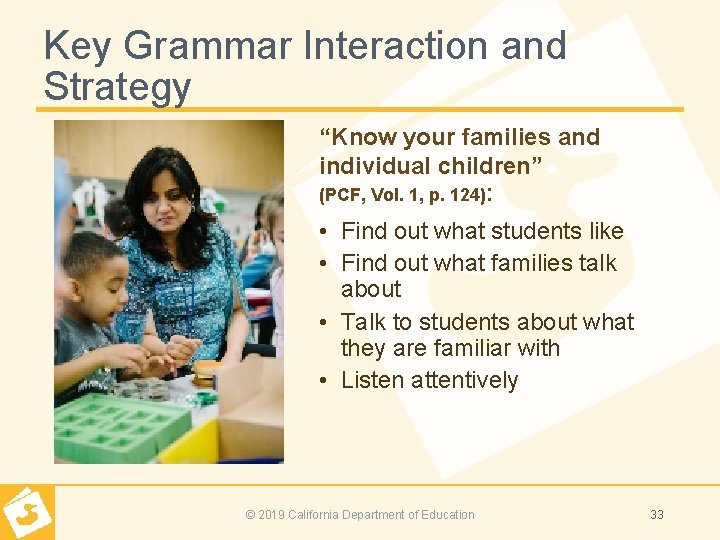
Key Grammar Interaction and Strategy “Know your families and individual children” (PCF, Vol. 1, p. 124): • Find out what students like • Find out what families talk about • Talk to students about what they are familiar with • Listen attentively © 2019 California Department of Education 33
Language Use and Conventions Foundations 1. 2 and 1. 3— Speak clearly and accepted language style 48 months: • 1. 2 Speak clearly enough to be understood by familiar adults. • 1. 3 Use accepted language and style during communication with familiar adults and children. 60 months: • 1. 2 Speak clearly enough to be understood by both familiar and unfamiliar adults and children. • 1. 3 Use accepted language and style during communication with both familiar and unfamiliar adults and children. © 2019 California Department of Education 34
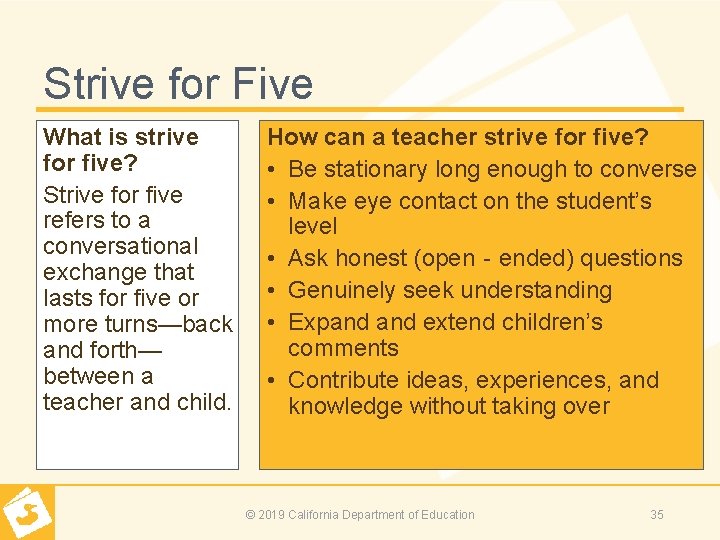
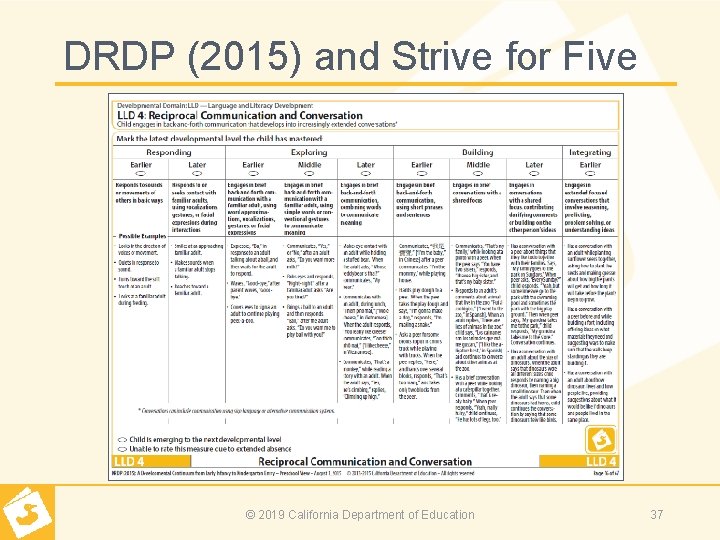
Strive for Five What is strive for five? Strive for five refers to a conversational exchange that lasts for five or more turns—back and forth— between a teacher and child. How can a teacher strive for five? • Be stationary long enough to converse • Make eye contact on the student’s level • Ask honest (open‐ended) questions • Genuinely seek understanding • Expand extend children’s comments • Contribute ideas, experiences, and knowledge without taking over © 2019 California Department of Education 35
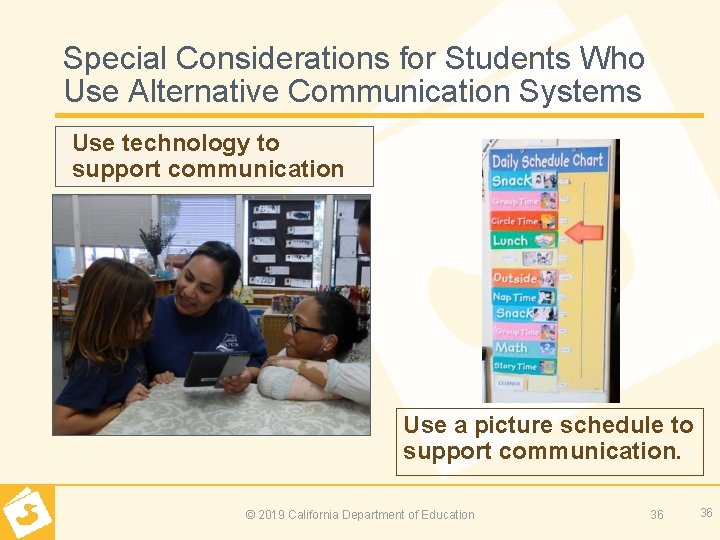
Special Considerations for Students Who Use Alternative Communication Systems Use technology to support communication Use a picture schedule to support communication. © 2019 California Department of Education 36 36
DRDP (2015) and Strive for Five © 2019 California Department of Education 37
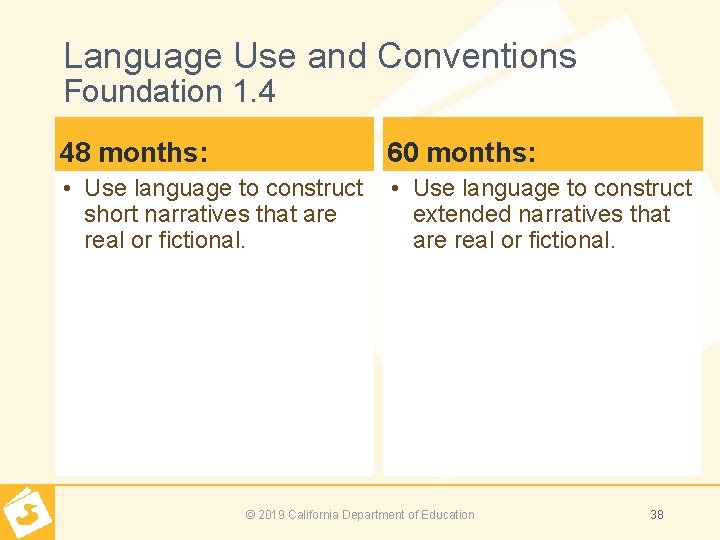
Language Use and Conventions Foundation 1. 4 48 months: 60 months: • Use language to construct short narratives that are real or fictional. • Use language to construct extended narratives that are real or fictional. © 2019 California Department of Education 38
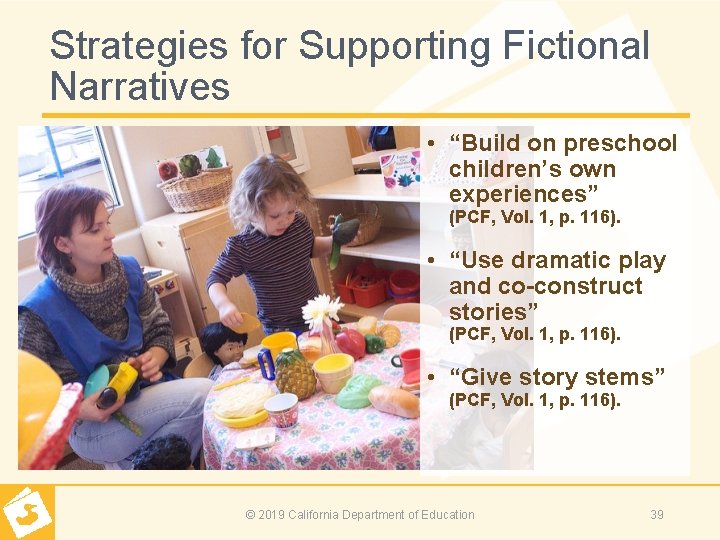
Strategies for Supporting Fictional Narratives • “Build on preschool children’s own experiences” (PCF, Vol. 1, p. 116). • “Use dramatic play and co-construct stories” (PCF, Vol. 1, p. 116). • “Give story stems” (PCF, Vol. 1, p. 116). © 2019 California Department of Education 39
Developmentally Appropriate Story Stems Always include the following aspects in a story stem: • Movement • Repetitions • Playfulness • Connections to family How would you include these ideas in your classroom? © 2019 California Department of Education 40
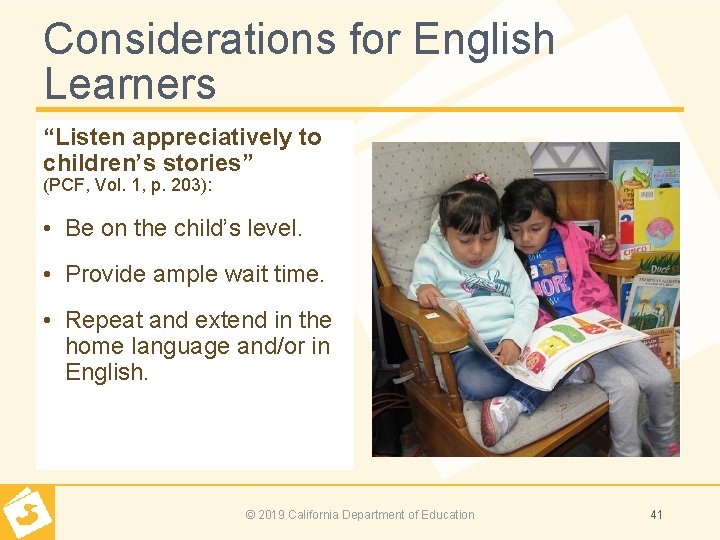
Considerations for English Learners “Listen appreciatively to children’s stories” (PCF, Vol. 1, p. 203): • Be on the child’s level. • Provide ample wait time. • Repeat and extend in the home language and/or in English. © 2019 California Department of Education 41
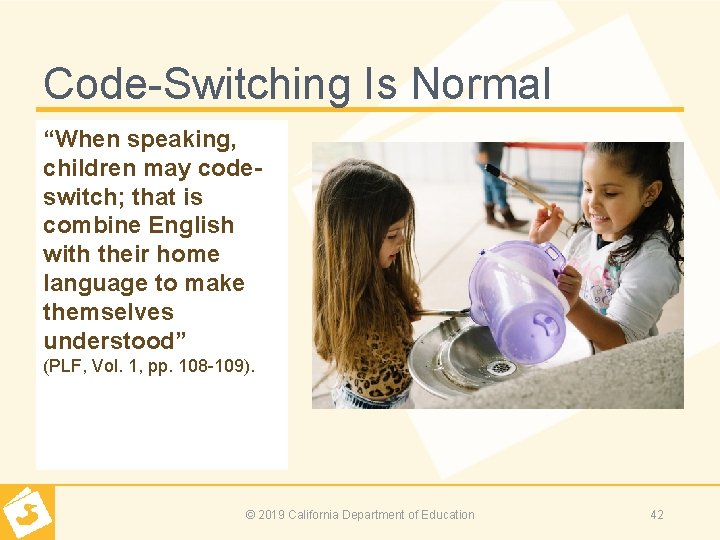
Code Switching Is Normal “When speaking, children may codeswitch; that is combine English with their home language to make themselves understood” (PLF, Vol. 1, pp. 108 109). © 2019 California Department of Education 42
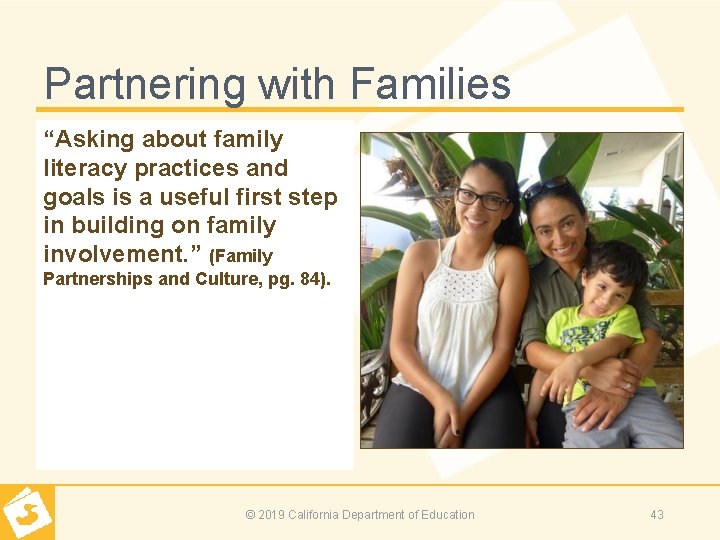
Partnering with Families “Asking about family literacy practices and goals is a useful first step in building on family involvement. ” (Family Partnerships and Culture, pg. 84). © 2019 California Department of Education 43
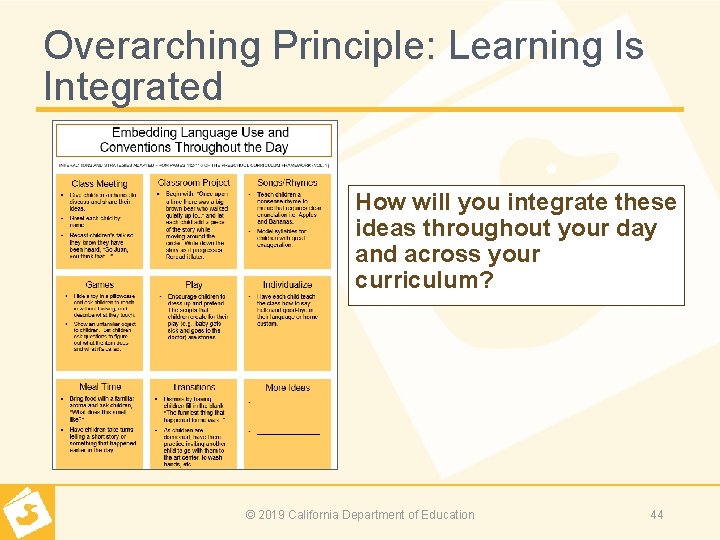
Overarching Principle: Learning Is Integrated How will you integrate these ideas throughout your day and across your curriculum? © 2019 California Department of Education 44
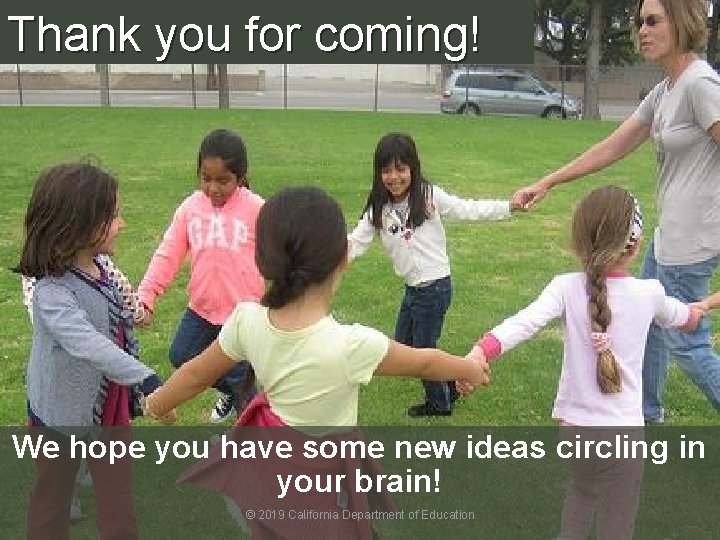
45 Thank you for coming! We hope you have some new ideas circling in your brain! © 2019 California Department of Education