
Controlling the Project Control Project Quality Control Communications

- Slides: 44
Controlling the Project § § § Control Project Quality Control Communications Control Project Risks Control Project Procurements Control Project Stakeholder Engagement Copyright © 2013 Logical Operations, Inc. All rights reserved. OV 11 - 1
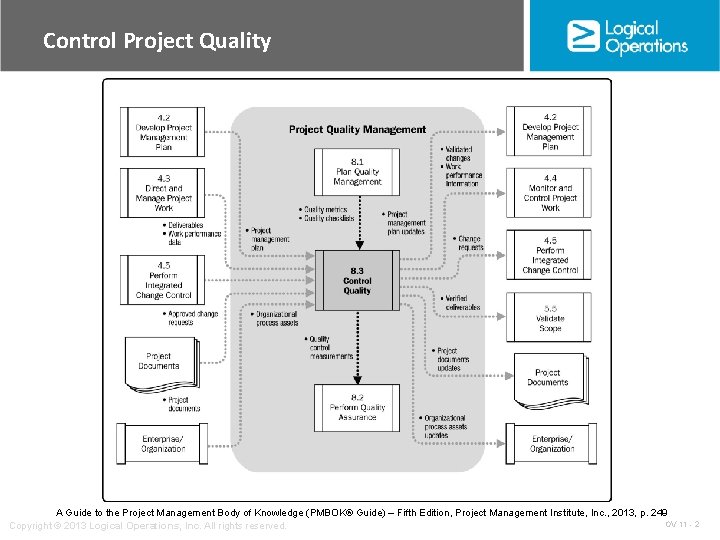
Control Project Quality A Guide to the Project Management Body of Knowledge (PMBOK® Guide) – Fifth Edition, Project Management Institute, Inc. , 2013, p. 249 OV 11 - 2 Copyright © 2013 Logical Operations, Inc. All rights reserved.
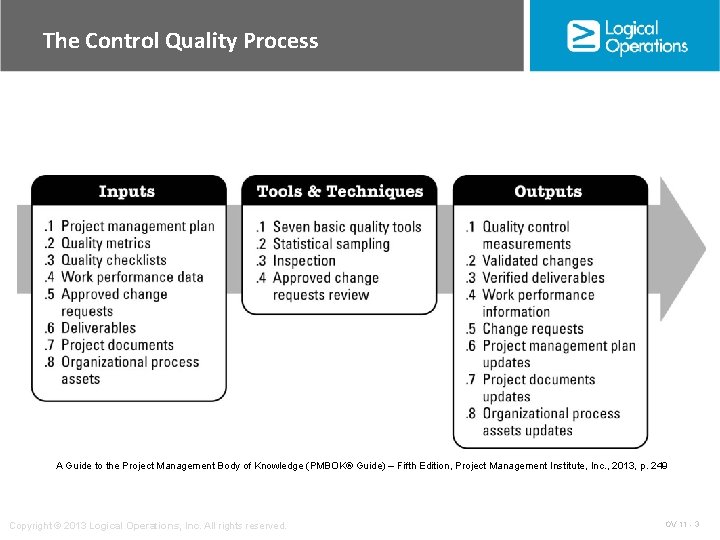
The Control Quality Process A Guide to the Project Management Body of Knowledge (PMBOK® Guide) – Fifth Edition, Project Management Institute, Inc. , 2013, p. 249 Copyright © 2013 Logical Operations, Inc. All rights reserved. OV 11 - 3
Control Quality Inputs § § § § Project management plan Quality metrics Quality checklists Work performance data Approved change requests Deliverables Project documents Organizational process assets Copyright © 2013 Logical Operations, Inc. All rights reserved. OV 11 - 4
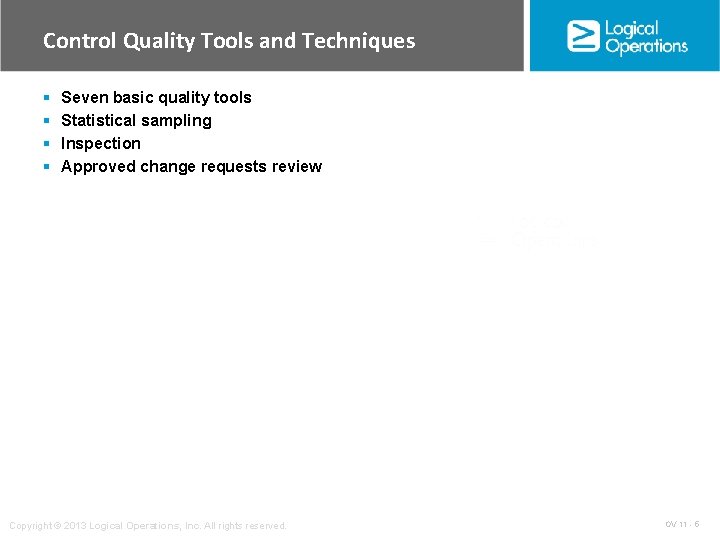
Control Quality Tools and Techniques § § Seven basic quality tools Statistical sampling Inspection Approved change requests review Copyright © 2013 Logical Operations, Inc. All rights reserved. OV 11 - 5
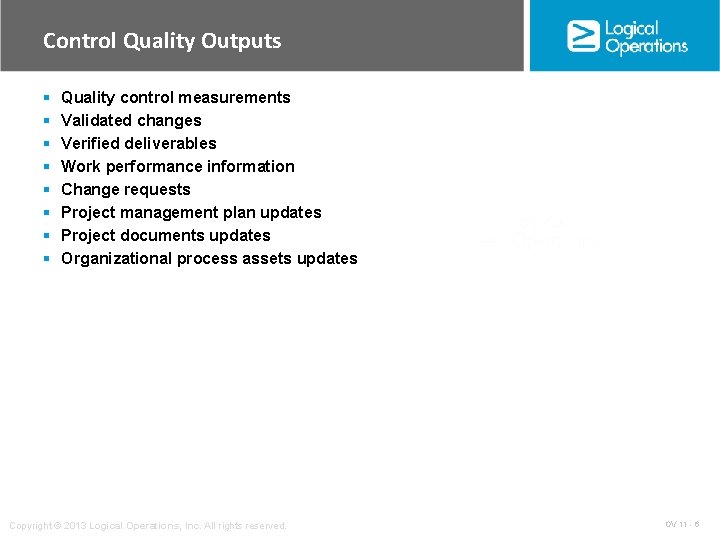
Control Quality Outputs § § § § Quality control measurements Validated changes Verified deliverables Work performance information Change requests Project management plan updates Project documents updates Organizational process assets updates Copyright © 2013 Logical Operations, Inc. All rights reserved. OV 11 - 6
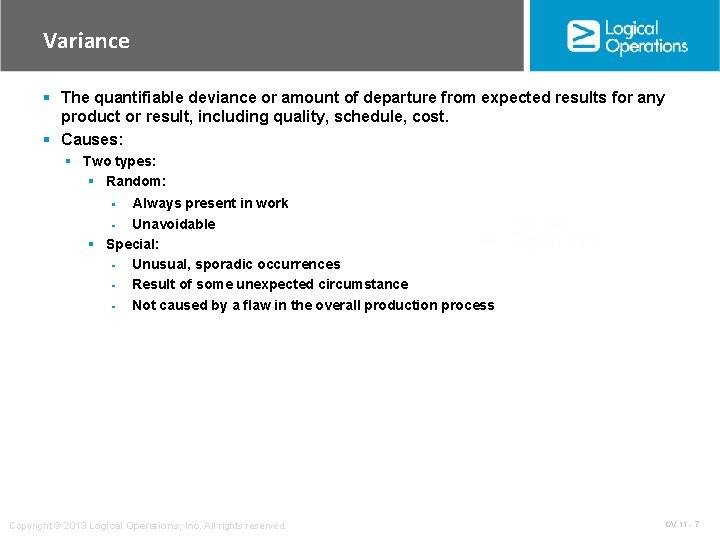
Variance § The quantifiable deviance or amount of departure from expected results for any product or result, including quality, schedule, cost. § Causes: § Two types: § Random: § Always present in work Unavoidable § Special: § Unusual, sporadic occurrences § Result of some unexpected circumstance § Not caused by a flaw in the overall production process § Copyright © 2013 Logical Operations, Inc. All rights reserved. OV 11 - 7
Tolerances § The measurement values that determine if a product or service is acceptable or unacceptable. § The standards against which data collected will be analyzed. Copyright © 2013 Logical Operations, Inc. All rights reserved. OV 11 - 8
The 6 -Sigma Limit § The standard acceptable deviation from the process mean. § Provides a generally accepted guideline for monitoring for quality. § When processes fall outside the limit, adjustments must be made. Copyright © 2013 Logical Operations, Inc. All rights reserved. OV 11 - 9
Variability Indications § Measurements that exceed the range between the upper and lower control limits are considered to be an indication of instability. § The variability expressed is atypical for the process and may be an indication of a special source of variance. Copyright © 2013 Logical Operations, Inc. All rights reserved. OV 11 - 10
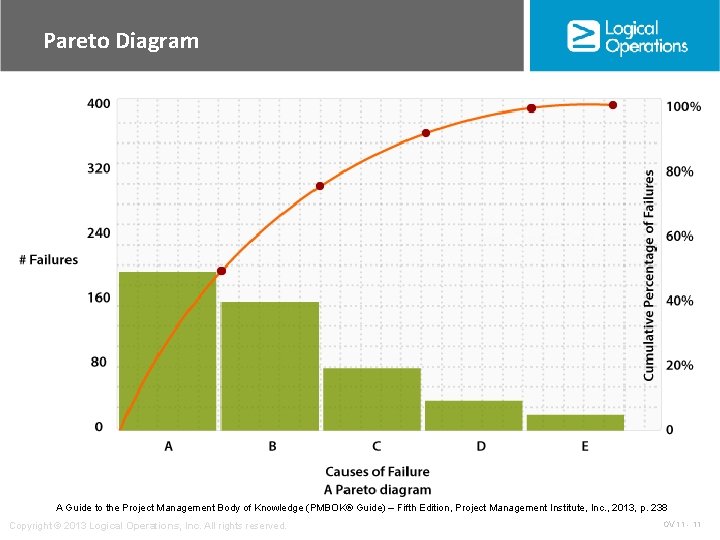
Pareto Diagram A Guide to the Project Management Body of Knowledge (PMBOK® Guide) – Fifth Edition, Project Management Institute, Inc. , 2013, p. 238 Copyright © 2013 Logical Operations, Inc. All rights reserved. OV 11 - 11
Statistical Sampling § A technique used to determine characteristics of an entire population based on actual measurement of its representative sample. § Produces a process that does not require inspection of every item. Copyright © 2013 Logical Operations, Inc. All rights reserved. OV 11 - 12
Attribute Sampling Data § Data from the sample that is counted, such as: § The number of employees participating in profit sharing. § The number of customer complaint calls. § The number of returned items. § Tells you whether or not a standard has been met. Copyright © 2013 Logical Operations, Inc. All rights reserved. OV 11 - 13
Variable Sampling Data § Data from a sample measured on a continuous scale, such as: § Time § Temperature § Weight § Provide the same level of accuracy as attribute samples with much smaller sample sizes Copyright © 2013 Logical Operations, Inc. All rights reserved. OV 11 - 14
Guidelines to Control Project Quality § Conduct inspections to detect quality errors as project work is ongoing. § Use Pareto diagrams to focus corrective actions on the problems having the greatest effect on overall quality performance. § Use control charts to analyze and communicate the variability of a process or project activity over time. § Identify ways to eliminate causes of unsatisfactory results. § Use flowcharts to identify redundancies, missed steps, or the source of quality performance problems. § Initiate process adjustments by implementing corrective or preventive actions necessary to bring the quality of work results to an acceptable level. § Continue to monitor, measure, and adjust quality throughout the project life cycle. Copyright © 2013 Logical Operations, Inc. All rights reserved. OV 11 - 15
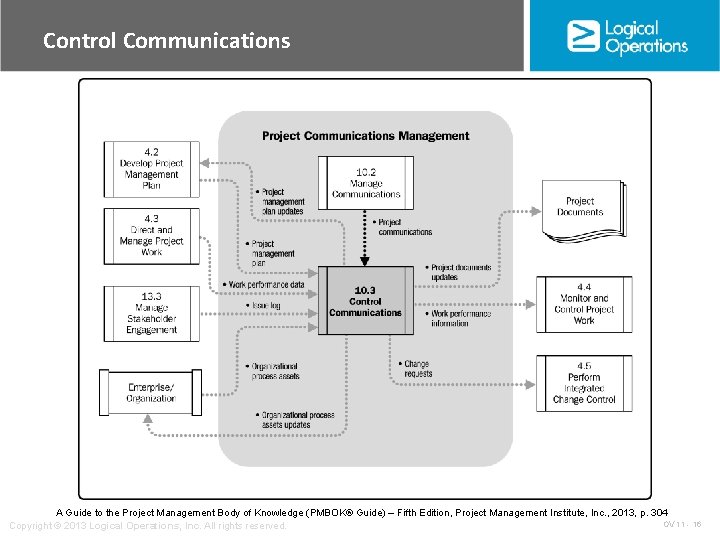
Control Communications A Guide to the Project Management Body of Knowledge (PMBOK® Guide) – Fifth Edition, Project Management Institute, Inc. , 2013, p. 304 OV 11 - 16 Copyright © 2013 Logical Operations, Inc. All rights reserved.
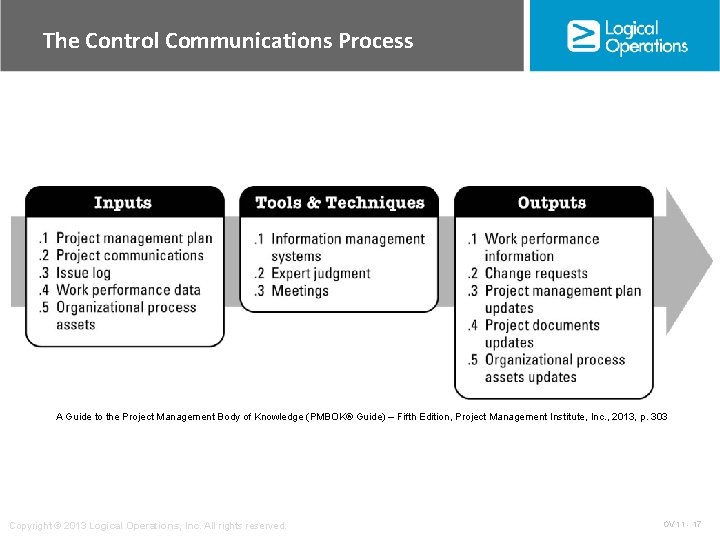
The Control Communications Process A Guide to the Project Management Body of Knowledge (PMBOK® Guide) – Fifth Edition, Project Management Institute, Inc. , 2013, p. 303 Copyright © 2013 Logical Operations, Inc. All rights reserved. OV 11 - 17
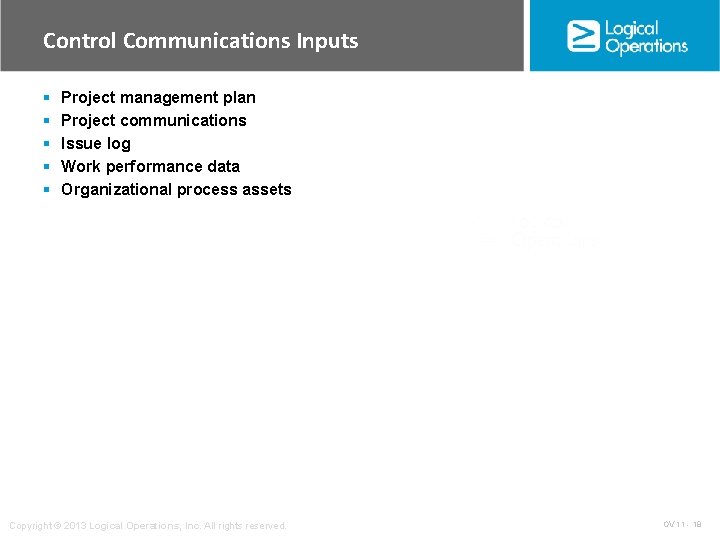
Control Communications Inputs § § § Project management plan Project communications Issue log Work performance data Organizational process assets Copyright © 2013 Logical Operations, Inc. All rights reserved. OV 11 - 18
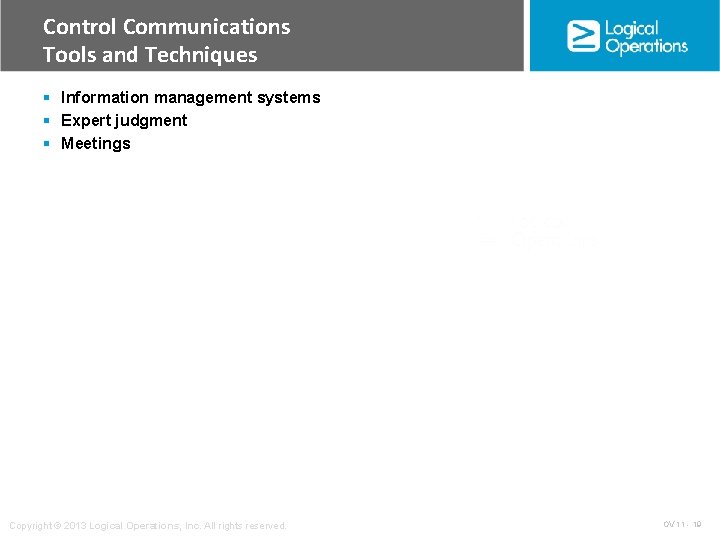
Control Communications Tools and Techniques § Information management systems § Expert judgment § Meetings Copyright © 2013 Logical Operations, Inc. All rights reserved. OV 11 - 19
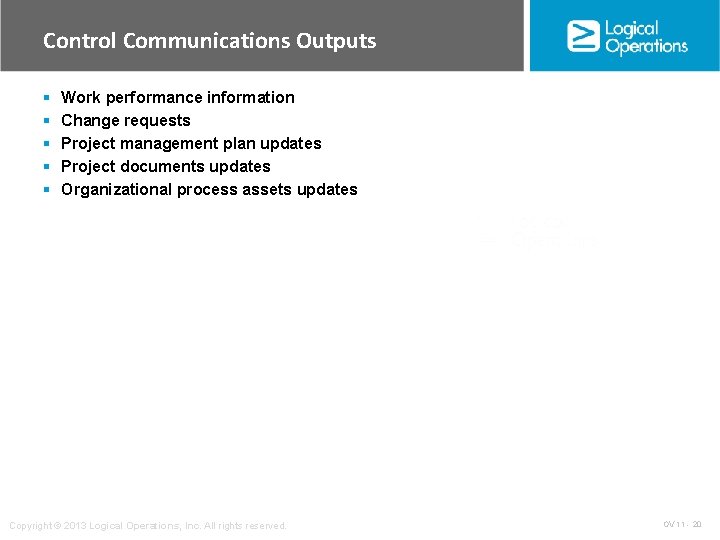
Control Communications Outputs § § § Work performance information Change requests Project management plan updates Project documents updates Organizational process assets updates Copyright © 2013 Logical Operations, Inc. All rights reserved. OV 11 - 20
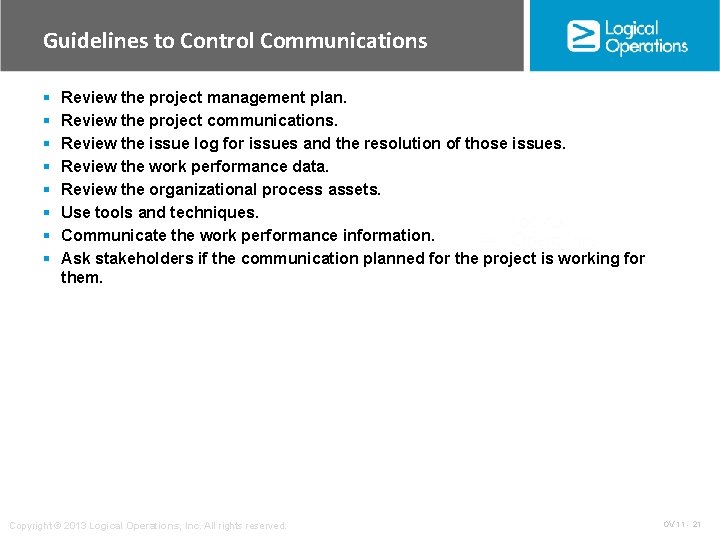
Guidelines to Control Communications § § § § Review the project management plan. Review the project communications. Review the issue log for issues and the resolution of those issues. Review the work performance data. Review the organizational process assets. Use tools and techniques. Communicate the work performance information. Ask stakeholders if the communication planned for the project is working for them. Copyright © 2013 Logical Operations, Inc. All rights reserved. OV 11 - 21
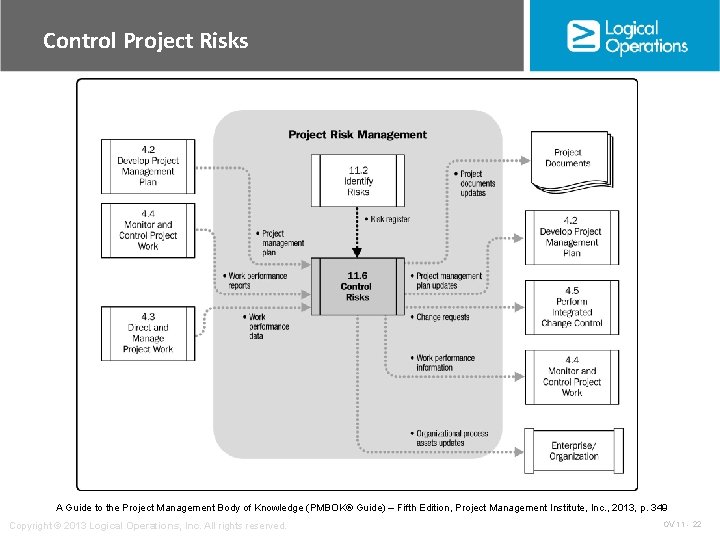
Control Project Risks A Guide to the Project Management Body of Knowledge (PMBOK® Guide) – Fifth Edition, Project Management Institute, Inc. , 2013, p. 349 Copyright © 2013 Logical Operations, Inc. All rights reserved. OV 11 - 22
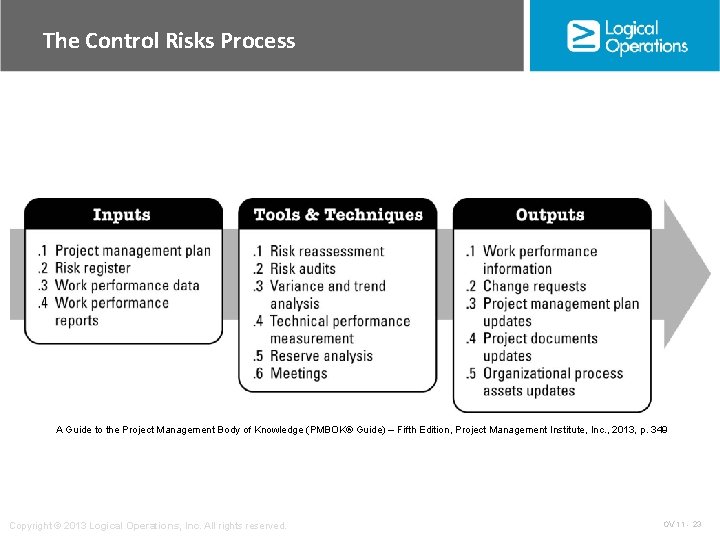
The Control Risks Process A Guide to the Project Management Body of Knowledge (PMBOK® Guide) – Fifth Edition, Project Management Institute, Inc. , 2013, p. 349 Copyright © 2013 Logical Operations, Inc. All rights reserved. OV 11 - 23
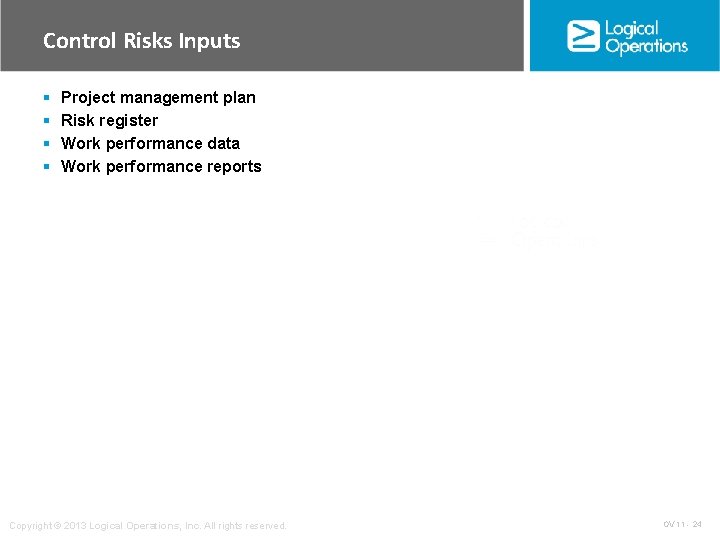
Control Risks Inputs § § Project management plan Risk register Work performance data Work performance reports Copyright © 2013 Logical Operations, Inc. All rights reserved. OV 11 - 24
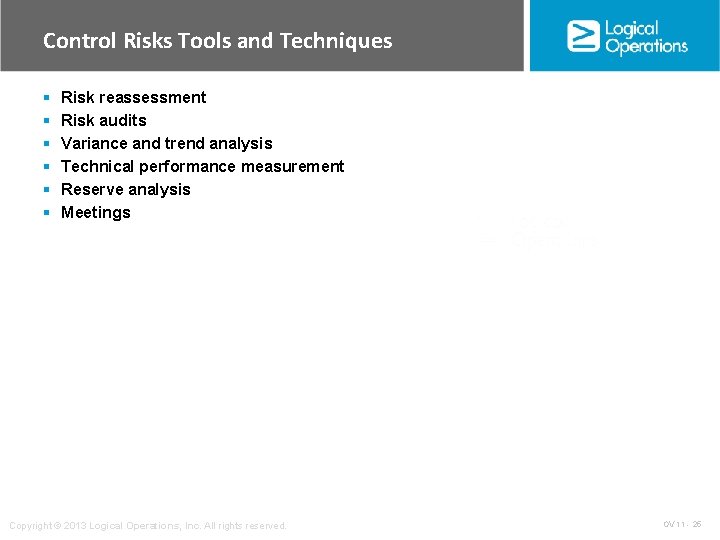
Control Risks Tools and Techniques § § § Risk reassessment Risk audits Variance and trend analysis Technical performance measurement Reserve analysis Meetings Copyright © 2013 Logical Operations, Inc. All rights reserved. OV 11 - 25
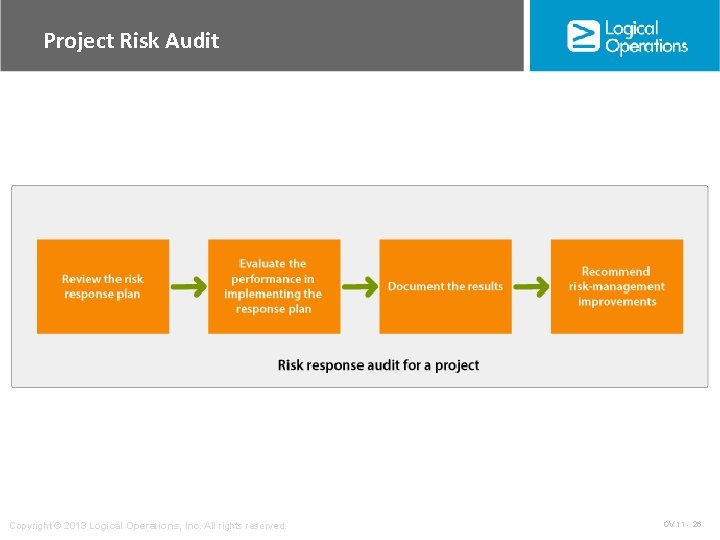
Project Risk Audit Copyright © 2013 Logical Operations, Inc. All rights reserved. OV 11 - 26
Control Risks Outputs § § § Work performance information Change requests Project management plan updates Project documents updates Organizational process assets updates Copyright © 2013 Logical Operations, Inc. All rights reserved. OV 11 - 27
Guidelines to Control Project Risk § § § Consult the risk response plan. Monitor the environment. Monitor the effectiveness of the risk response plan. Deal with unforeseen risks by systematically planning a reasoned response. Update project documentation as changes are indicated. Manage the contingency reserve so that the additional time, money, and resources are utilized as planned. Copyright © 2013 Logical Operations, Inc. All rights reserved. OV 11 - 28
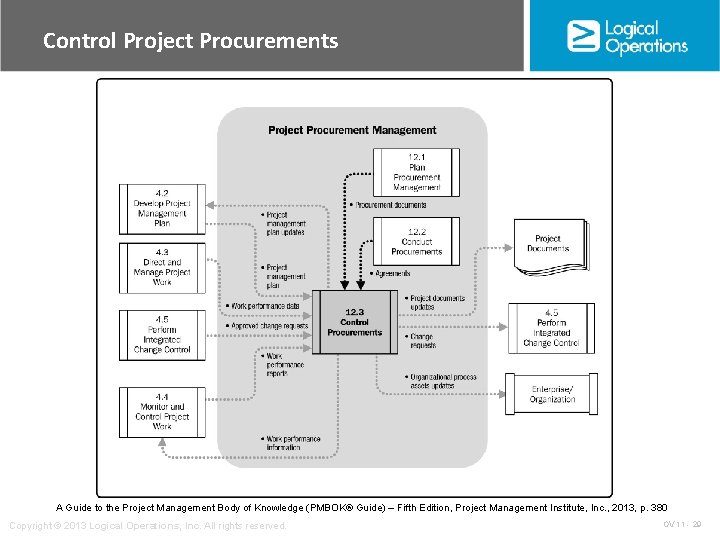
Control Project Procurements A Guide to the Project Management Body of Knowledge (PMBOK® Guide) – Fifth Edition, Project Management Institute, Inc. , 2013, p. 380 Copyright © 2013 Logical Operations, Inc. All rights reserved. OV 11 - 29
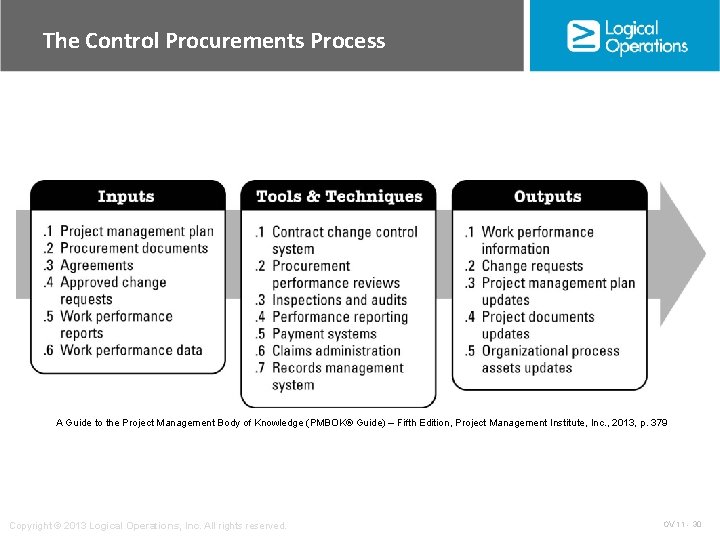
The Control Procurements Process A Guide to the Project Management Body of Knowledge (PMBOK® Guide) – Fifth Edition, Project Management Institute, Inc. , 2013, p. 379 Copyright © 2013 Logical Operations, Inc. All rights reserved. OV 11 - 30
Control Procurements Inputs § § § Project management plan Procurement documents Agreements Approved change requests Work performance reports Work performance data Copyright © 2013 Logical Operations, Inc. All rights reserved. OV 11 - 31
Control Procurements Tools and Techniques § § § § Contract change control system Procurements performance reviews Inspections and audits Performance reporting Payment systems Claims administration Records management system Copyright © 2013 Logical Operations, Inc. All rights reserved. OV 11 - 32
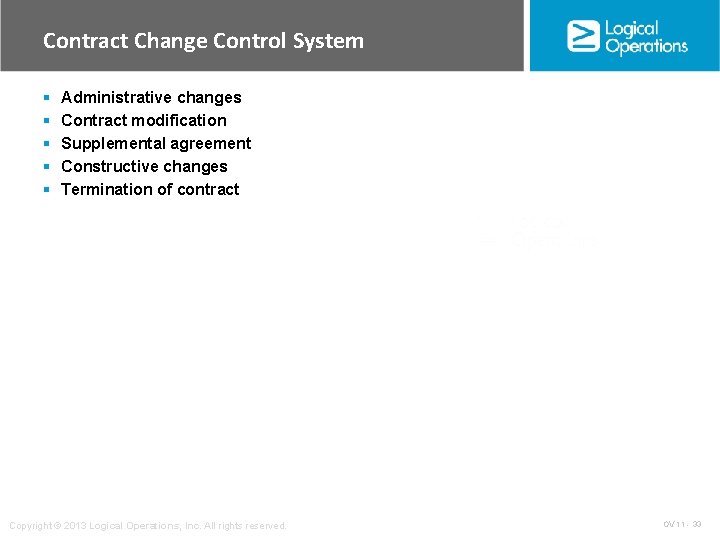
Contract Change Control System § § § Administrative changes Contract modification Supplemental agreement Constructive changes Termination of contract Copyright © 2013 Logical Operations, Inc. All rights reserved. OV 11 - 33
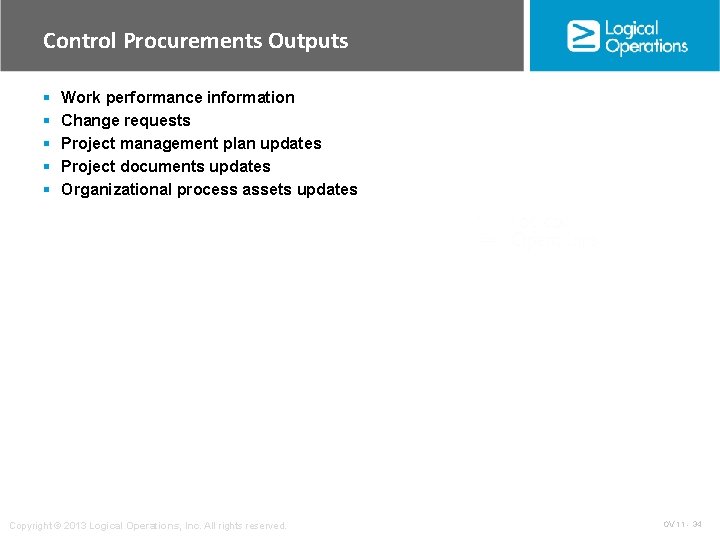
Control Procurements Outputs § § § Work performance information Change requests Project management plan updates Project documents updates Organizational process assets updates Copyright © 2013 Logical Operations, Inc. All rights reserved. OV 11 - 34
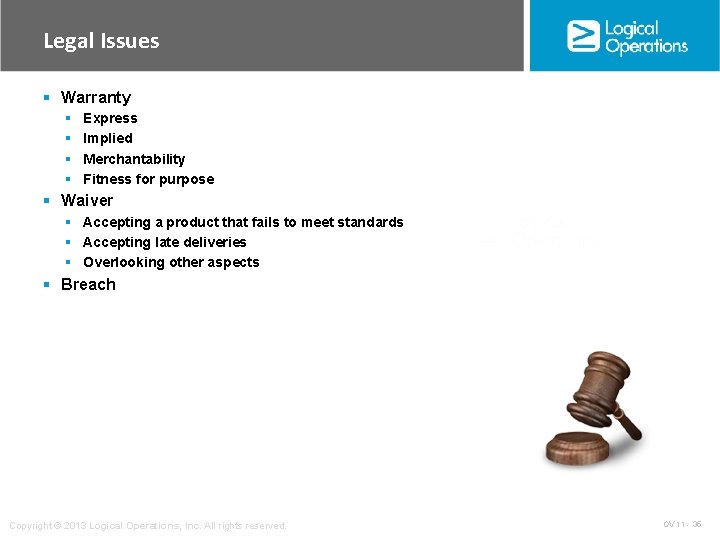
Legal Issues § Warranty § § Express Implied Merchantability Fitness for purpose § Waiver § Accepting a product that fails to meet standards § Accepting late deliveries § Overlooking other aspects § Breach Copyright © 2013 Logical Operations, Inc. All rights reserved. OV 11 - 35
Breaches of Contract § § Anticipatory breach Fundamental breach Material breach Immaterial breach Copyright © 2013 Logical Operations, Inc. All rights reserved. OV 11 - 36
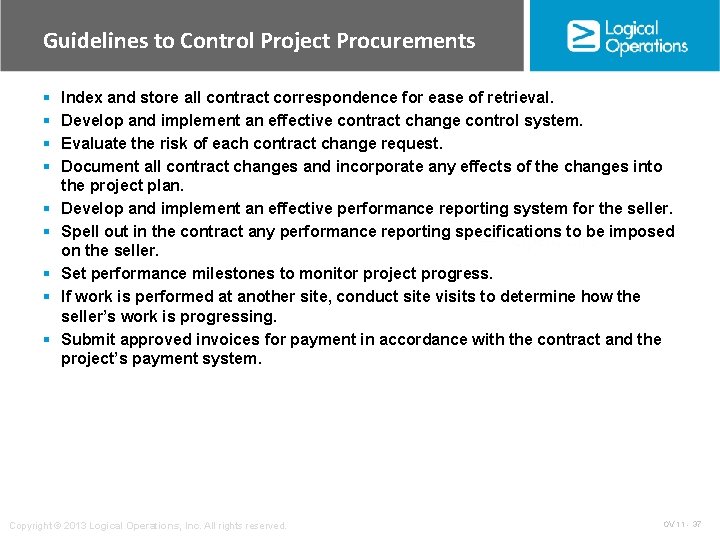
Guidelines to Control Project Procurements § § § § § Index and store all contract correspondence for ease of retrieval. Develop and implement an effective contract change control system. Evaluate the risk of each contract change request. Document all contract changes and incorporate any effects of the changes into the project plan. Develop and implement an effective performance reporting system for the seller. Spell out in the contract any performance reporting specifications to be imposed on the seller. Set performance milestones to monitor project progress. If work is performed at another site, conduct site visits to determine how the seller’s work is progressing. Submit approved invoices for payment in accordance with the contract and the project’s payment system. Copyright © 2013 Logical Operations, Inc. All rights reserved. OV 11 - 37
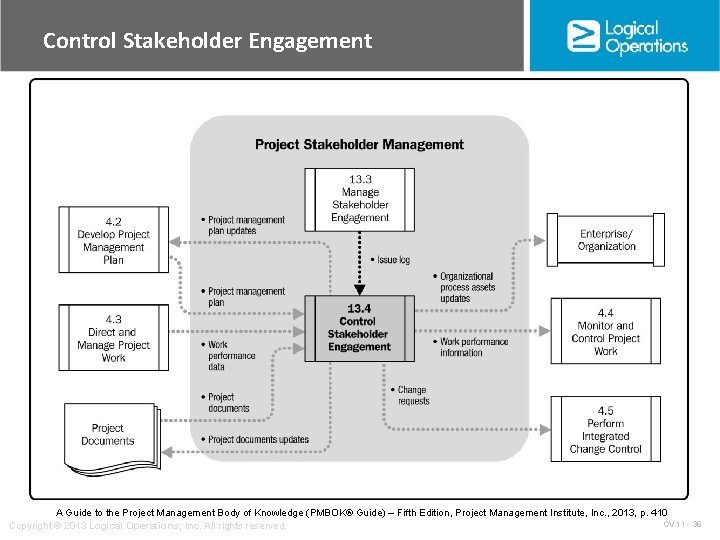
Control Stakeholder Engagement A Guide to the Project Management Body of Knowledge (PMBOK® Guide) – Fifth Edition, Project Management Institute, Inc. , 2013, p. 410 OV 11 - 38 Copyright © 2013 Logical Operations, Inc. All rights reserved.
The Control Stakeholder Engagement Process A Guide to the Project Management Body of Knowledge (PMBOK® Guide) – Fifth Edition, Project Management Institute, Inc. , 2013, p. 410 Copyright © 2013 Logical Operations, Inc. All rights reserved. OV 11 - 39
Control Stakeholder Engagement Inputs § § Project management plan Issues log Work performance data Project documents Copyright © 2013 Logical Operations, Inc. All rights reserved. OV 11 - 40
Control Stakeholder Engagement Tools and Techniques § Information management systems § Expert judgment § Meetings Copyright © 2013 Logical Operations, Inc. All rights reserved. OV 11 - 41
Control Stakeholder Engagement Outputs § § § Work performance information Change requests Project management plan updates Project documents updates Organizational process assets updates Copyright © 2013 Logical Operations, Inc. All rights reserved. OV 11 - 42
Guidelines to Control Stakeholder Engagement § Review the project management plan for information in the stakeholder management plan. § Review the issue log for a list of issues including new issues and resolved issues. § Review the work performance data for the measurements on project activities and deliverables. § Review the project documents such as the project schedule, stakeholder register, issues log, change log, and project communications. § Use tools and techniques such as information management systems, expert judgment and meetings to control the stakeholder engagement. § Communicate the work performance information and change requests to the project team and stakeholders, and update project documents. Copyright © 2013 Logical Operations, Inc. All rights reserved. OV 11 - 43
Reflective Questions 1. Why is it important to monitor and control each of the processes covered in this lesson? 2. What quality control methods have you used in the past? Were they effective? Why or why not? Copyright © 2013 Logical Operations, Inc. All rights reserved. OV 11 - 44