
Controlling Individual Agents in HighDensity Crowd Simulation Nuria

- Slides: 17
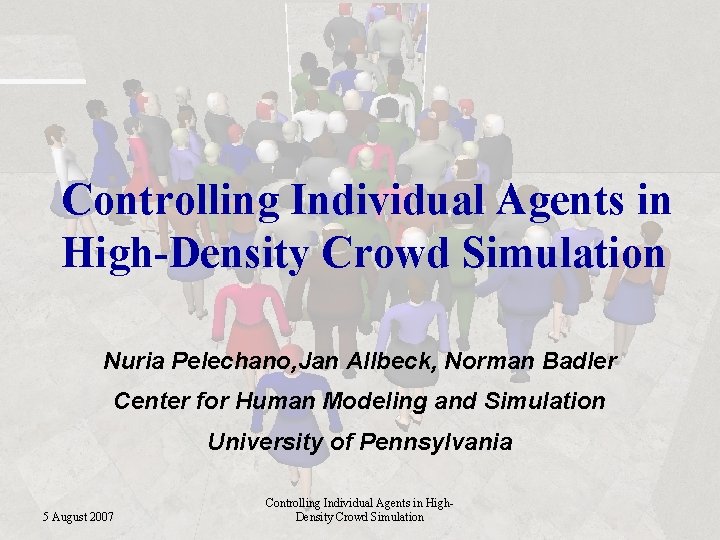
Controlling Individual Agents in High-Density Crowd Simulation Nuria Pelechano, Jan Allbeck, Norman Badler Center for Human Modeling and Simulation University of Pennsylvania 5 August 2007 Controlling Individual Agents in High. Density Crowd Simulation
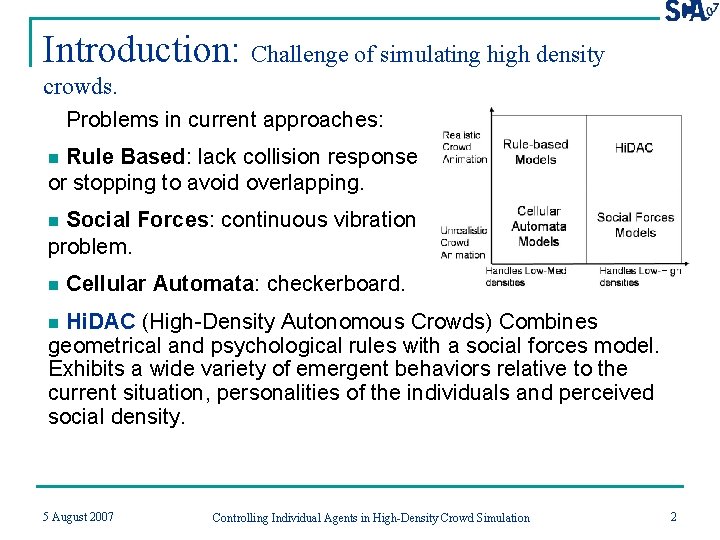
Introduction: Challenge of simulating high density crowds. Problems in current approaches: Rule Based: lack collision response or stopping to avoid overlapping. n Social Forces: continuous vibration problem. n n Cellular Automata: checkerboard. Hi. DAC (High-Density Autonomous Crowds) Combines geometrical and psychological rules with a social forces model. Exhibits a wide variety of emergent behaviors relative to the current situation, personalities of the individuals and perceived social density. n 5 August 2007 Controlling Individual Agents in High-Density Crowd Simulation 2
Related Work n Helbing: social forces models (2000). n Brogan et. al. : particle systems with dynamics (1997) n Braun et. al. : social forces+individualism (2003) n Lakoba et. al. : extended Helbing’s model. No real time (2005) n Treullie et. al. : continuum crowds (2006) n Reynolds: rule based models (1987, 1999) n Shao and Terzopoulos: cognitive models with rules (2005) n Chenney: Flow tiles (2004) n Tecchia et. al. Cellular automata model (2001) 5 August 2007 Controlling Individual Agents in High-Density Crowd Simulation 3
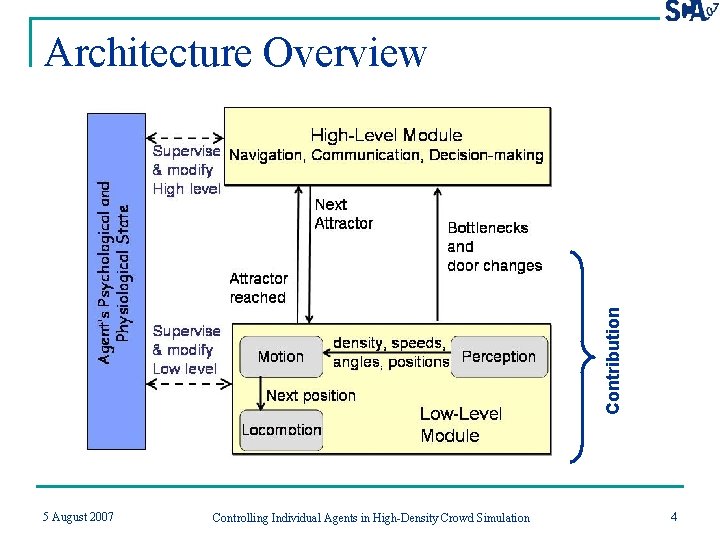
Contribution Architecture Overview 5 August 2007 Controlling Individual Agents in High-Density Crowd Simulation 4
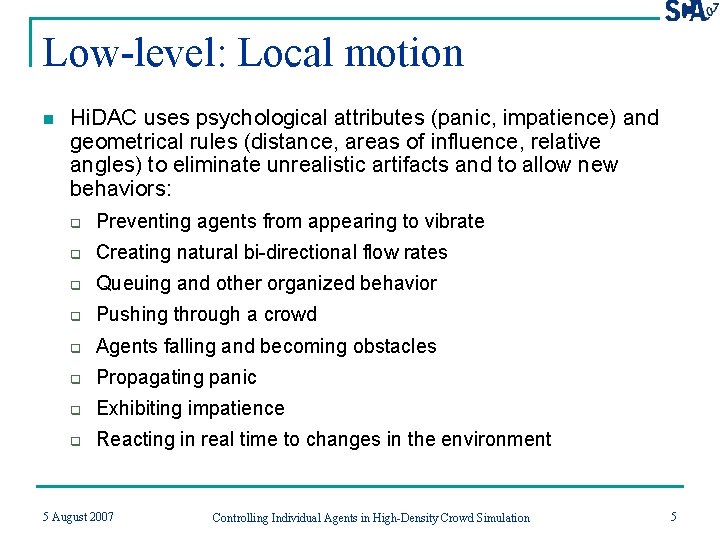
Low-level: Local motion n Hi. DAC uses psychological attributes (panic, impatience) and geometrical rules (distance, areas of influence, relative angles) to eliminate unrealistic artifacts and to allow new behaviors: q Preventing agents from appearing to vibrate q Creating natural bi-directional flow rates q Queuing and other organized behavior q Pushing through a crowd q Agents falling and becoming obstacles q Propagating panic q Exhibiting impatience q Reacting in real time to changes in the environment 5 August 2007 Controlling Individual Agents in High-Density Crowd Simulation 5
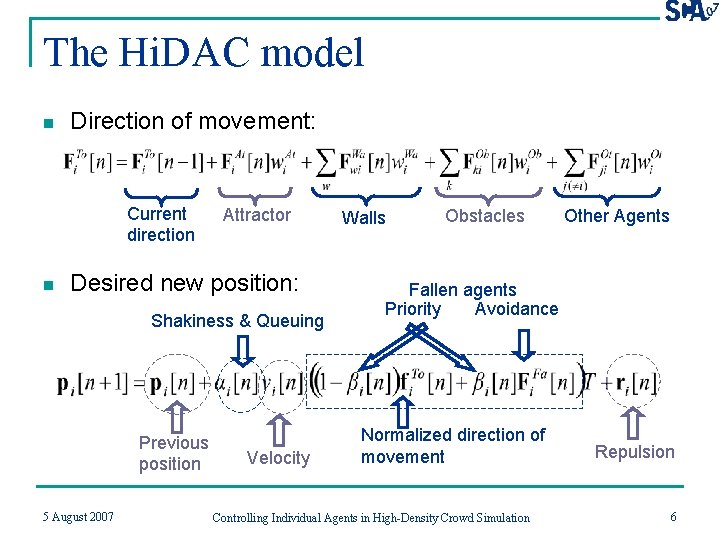
The Hi. DAC model n Direction of movement: Current direction n Attractor Desired new position: Shakiness & Queuing Previous position 5 August 2007 Velocity Walls Obstacles Other Agents Fallen agents Priority Avoidance Normalized direction of movement Controlling Individual Agents in High-Density Crowd Simulation Repulsion 6
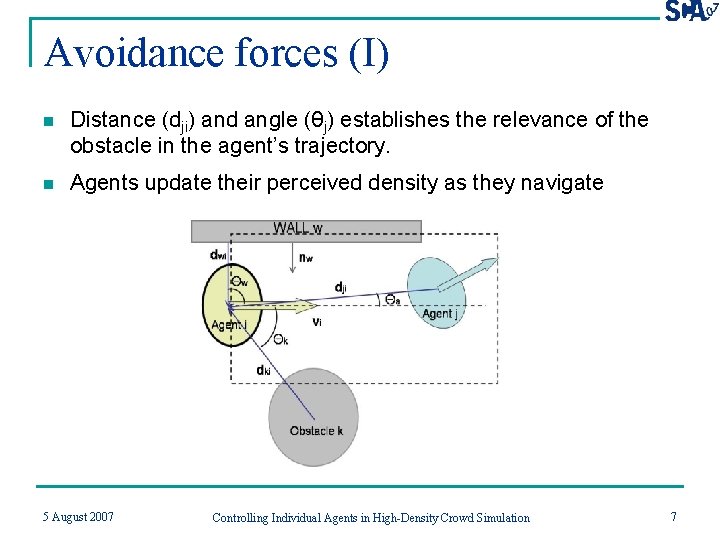
Avoidance forces (I) n Distance (dji) and angle (θj) establishes the relevance of the obstacle in the agent’s trajectory. n Agents update their perceived density as they navigate 5 August 2007 Controlling Individual Agents in High-Density Crowd Simulation 7
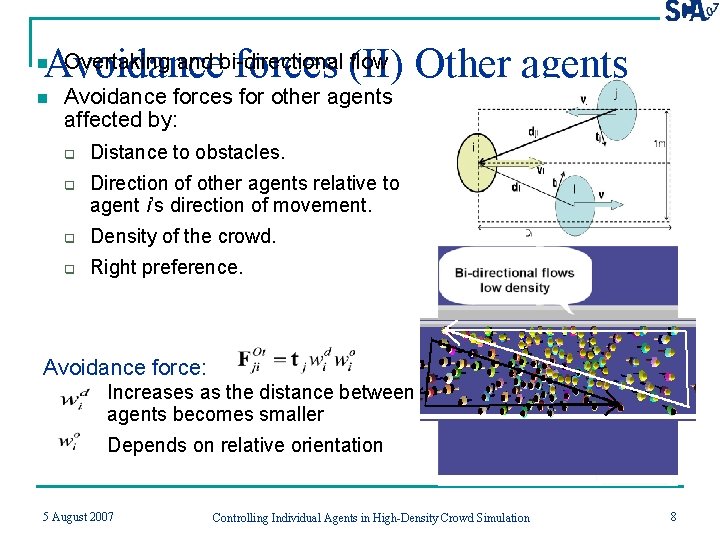
Overtaking and bi-directional flow Other agents Avoidance forces (II) n n Avoidance forces for other agents affected by: q q Distance to obstacles. Direction of other agents relative to agent i’s direction of movement. q Density of the crowd. q Right preference. Avoidance force: Increases as the distance between agents becomes smaller Depends on relative orientation 5 August 2007 Controlling Individual Agents in High-Density Crowd Simulation 8
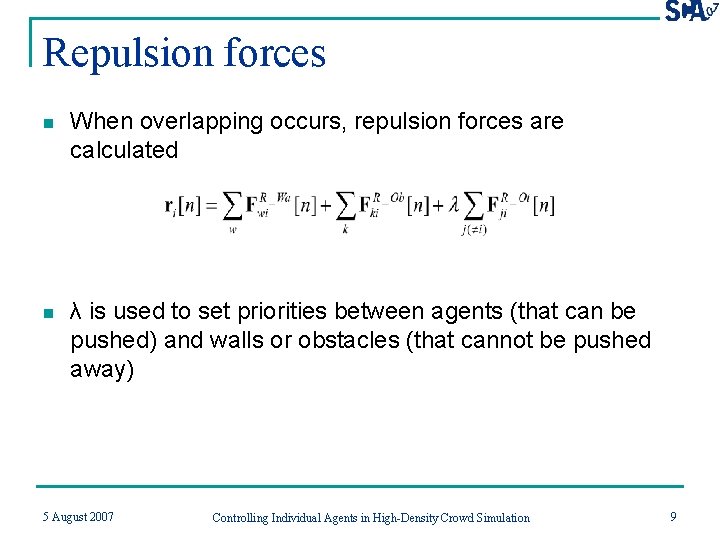
Repulsion forces n When overlapping occurs, repulsion forces are calculated n λ is used to set priorities between agents (that can be pushed) and walls or obstacles (that cannot be pushed away) 5 August 2007 Controlling Individual Agents in High-Density Crowd Simulation 9
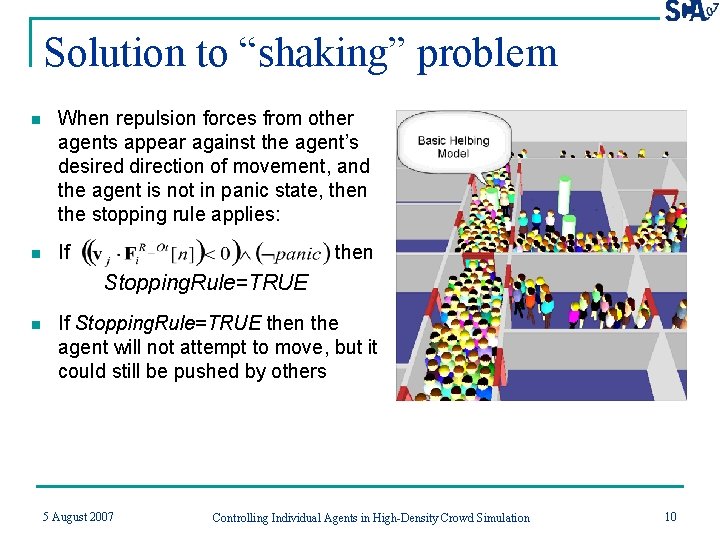
Solution to “shaking” problem n When repulsion forces from other agents appear against the agent’s desired direction of movement, and the agent is not in panic state, then the stopping rule applies: n If then Stopping. Rule=TRUE n If Stopping. Rule=TRUE then the agent will not attempt to move, but it could still be pushed by others 5 August 2007 Controlling Individual Agents in High-Density Crowd Simulation 10
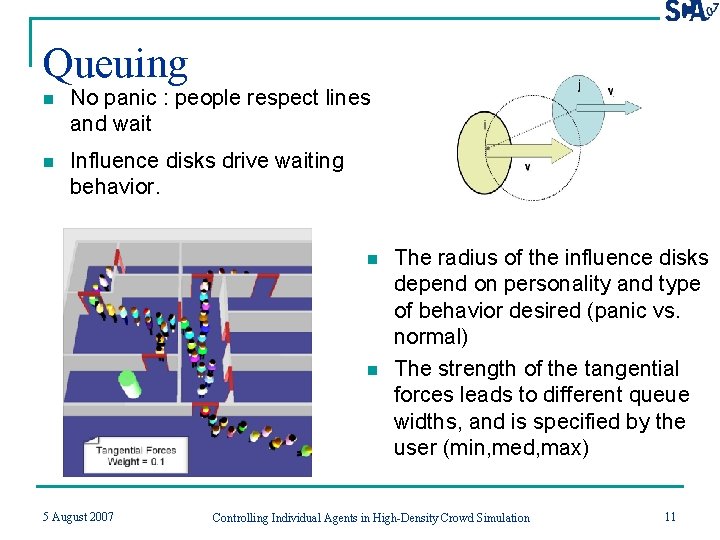
Queuing n No panic : people respect lines and wait n Influence disks drive waiting behavior. n n 5 August 2007 The radius of the influence disks depend on personality and type of behavior desired (panic vs. normal) The strength of the tangential forces leads to different queue widths, and is specified by the user (min, med, max) Controlling Individual Agents in High-Density Crowd Simulation 11
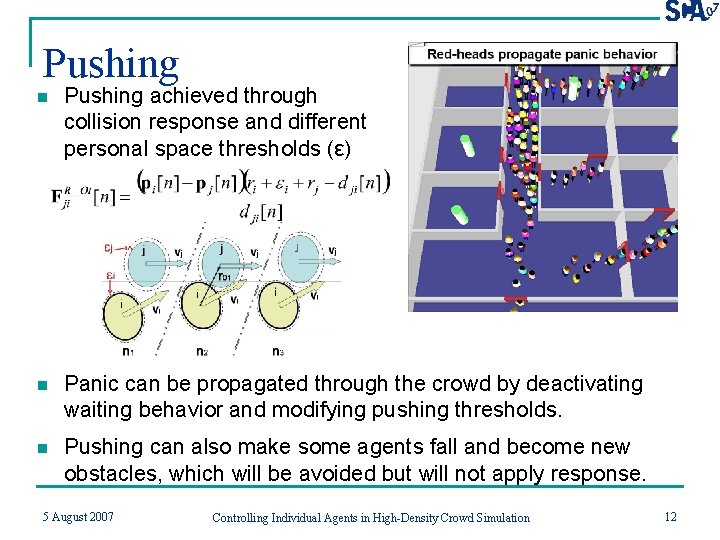
Pushing n Pushing achieved through collision response and different personal space thresholds (ε) n Panic can be propagated through the crowd by deactivating waiting behavior and modifying pushing thresholds. n Pushing can also make some agents fall and become new obstacles, which will be avoided but will not apply response. 5 August 2007 Controlling Individual Agents in High-Density Crowd Simulation 12
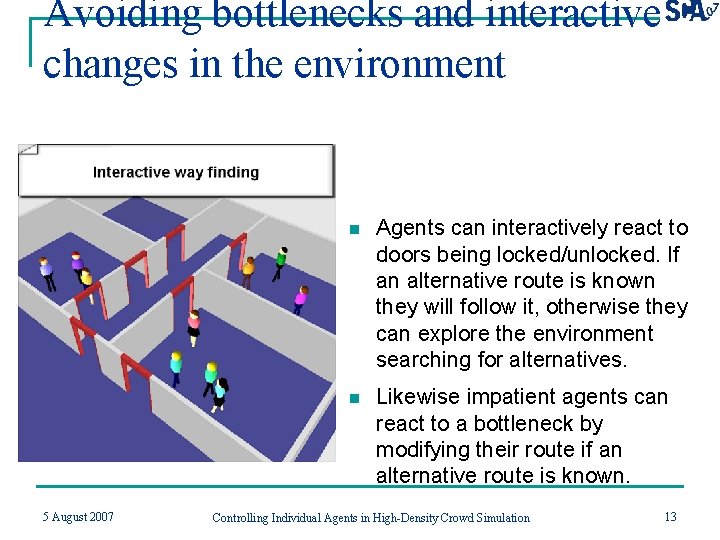
Avoiding bottlenecks and interactive changes in the environment 5 August 2007 n Agents can interactively react to doors being locked/unlocked. If an alternative route is known they will follow it, otherwise they can explore the environment searching for alternatives. n Likewise impatient agents can react to a bottleneck by modifying their route if an alternative route is known. Controlling Individual Agents in High-Density Crowd Simulation 13
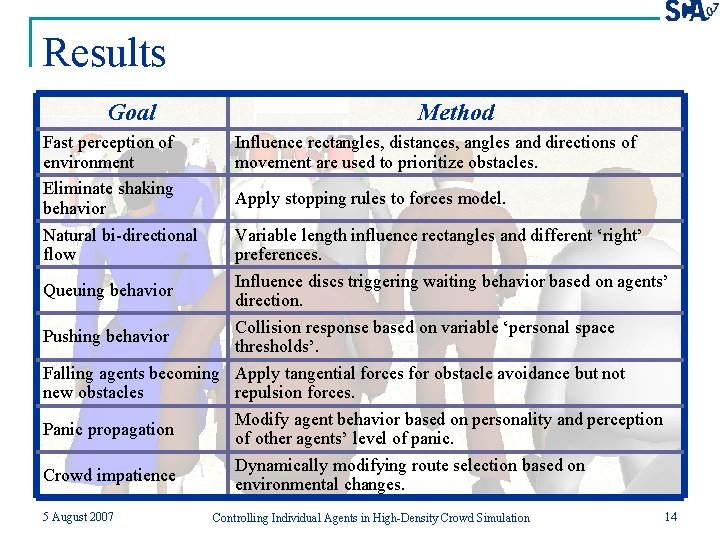
Results Goal Fast perception of environment Eliminate shaking behavior Natural bi-directional flow Method Influence rectangles, distances, angles and directions of movement are used to prioritize obstacles. Apply stopping rules to forces model. Variable length influence rectangles and different ‘right’ preferences. Influence discs triggering waiting behavior based on agents’ Queuing behavior direction. Collision response based on variable ‘personal space Pushing behavior thresholds’. Falling agents becoming Apply tangential forces for obstacle avoidance but not new obstacles repulsion forces. Modify agent behavior based on personality and perception Panic propagation of other agents’ level of panic. Dynamically modifying route selection based on Crowd impatience environmental changes. 5 August 2007 Controlling Individual Agents in High-Density Crowd Simulation 14
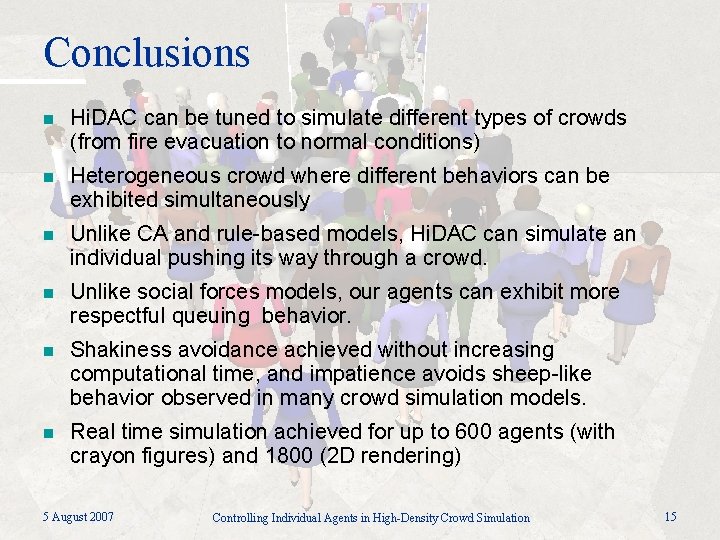
Conclusions n Hi. DAC can be tuned to simulate different types of crowds (from fire evacuation to normal conditions) n Heterogeneous crowd where different behaviors can be exhibited simultaneously n Unlike CA and rule-based models, Hi. DAC can simulate an individual pushing its way through a crowd. n Unlike social forces models, our agents can exhibit more respectful queuing behavior. n Shakiness avoidance achieved without increasing computational time, and impatience avoids sheep-like behavior observed in many crowd simulation models. n Real time simulation achieved for up to 600 agents (with crayon figures) and 1800 (2 D rendering) 5 August 2007 Controlling Individual Agents in High-Density Crowd Simulation 15
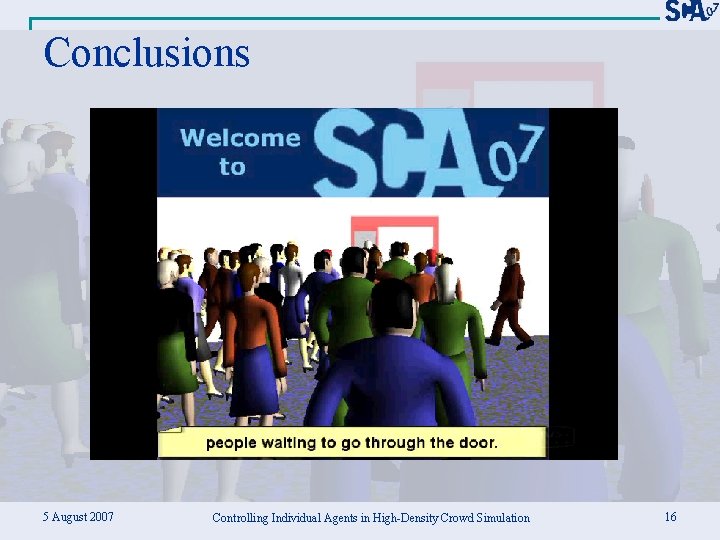
Conclusions 5 August 2007 Controlling Individual Agents in High-Density Crowd Simulation 16
Questions? n npelecha@seas. upenn. edu n allbeck@seas. upenn. edu n badler@seas. upenn. edu n URLs: q HMS Center: http: //hms. upenn. edu Hi. DAC videos: http: //hms. upenn. edu/people/pelechano 5 August 2007 Controlling Individual Agents in High-Density Crowd Simulation 17