
Controller Design for a Linearly Actuated Suspension System
![Linear Actuator/System Test • Based on the previous group’s work, k. E=0. 382 [V/rad/sec]](https://slidetodoc.com/presentation_image_h2/90563e0c0bf274c8b0eb101b9129031d/image-15.jpg "Linear Actuator/System Test • Based on the previous group’s work, k. E=0. 382 [V/rad/sec]")


- Slides: 27
Controller Design for a Linearly Actuated Suspension System (cdlass) Dan Altman, Tim Reilley & Joseph Sholl Advisors: Prof. Gutschlag & Prof. Anakwa
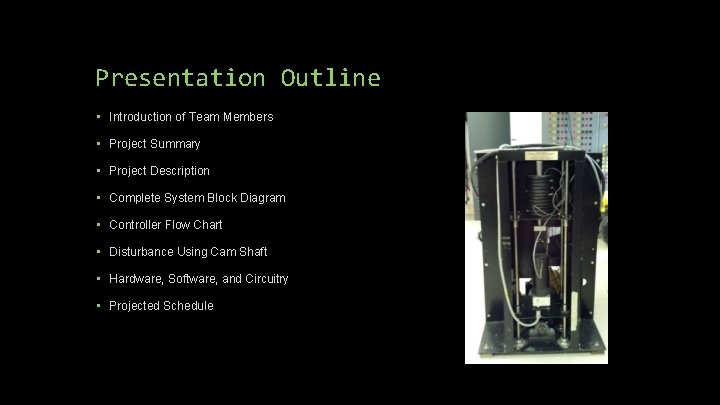
Presentation Outline • Introduction of Team Members • Project Summary • Project Description • Complete System Block Diagram • Controller Flow Chart • Disturbance Using Cam Shaft • Hardware, Software, and Circuitry • Projected Schedule
Project Summary We will design a controller for an electric linear actuator-based active suspension system. Initially, a position sensor will be used to determine the location of the “vehicle, ” relative to the “wheel” position. The controller will use this information to engage the linear actuator to keep the mass at a relatively constant position. The addition of an accelerometer to the system will eventually be investigated to control the acceleration levels experienced throughout the range of available “wheel” displacement. Lab. VIEW will be used throughout the project as the controller platform. An additional deliverable of the project will be the creation of a tutorial (or guide) on the use of Lab. VIEW in controller design and implementation.
Current Project Goals • Model the system characteristics of the linear actuator • Implement National Instrument’s hardware and software (Lab. View. TM) to provide data acquisition and power electronics control • Create a tutorial for the use of National Instrument’s hardware and software (Lab. View. TM) • Implement a feedback position controller using National Instrument’s hardware and software (Lab. View. TM) to minimize the error • Reintegrate the linear actuator and H-bridge hardware into the suspension system due to the unavailability of the H-bridge hardware used previously
Project Description This project will involve focused efforts in power electronics design, system modeling and simulation, and feedback controller design. After the system and controller are simulated successfully utilizing Simulink, National Instrument hardware and software will be used to implement the feedback controller and provide control signals to the power electronics driving the active suspension system linear actuator.
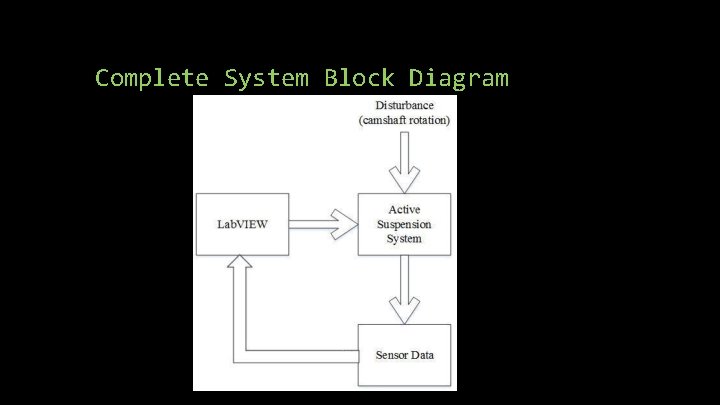
Complete System Block Diagram
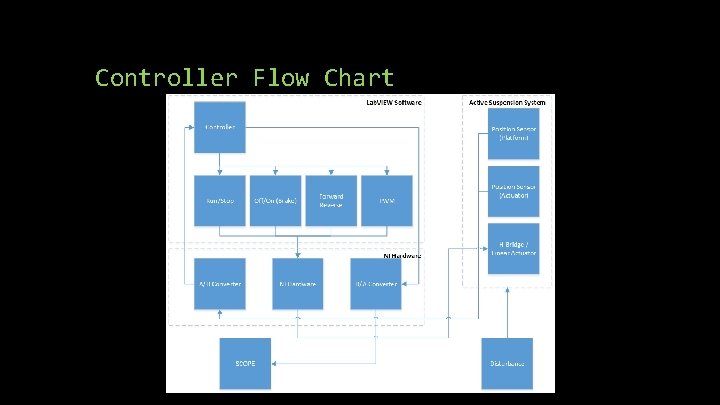
Controller Flow Chart
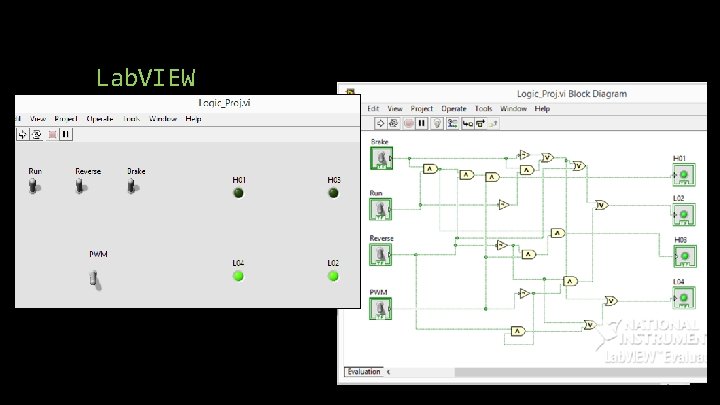
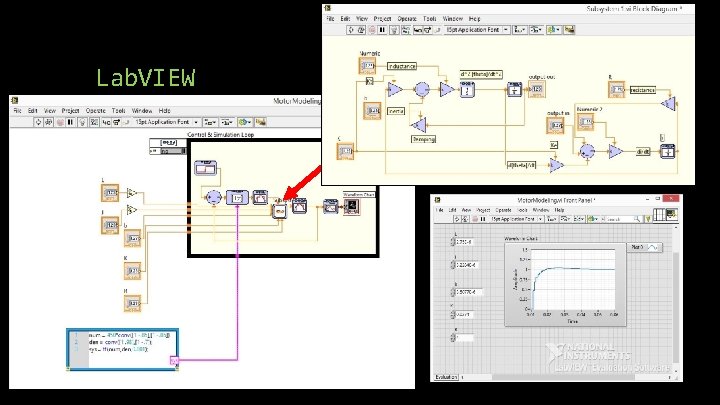
Lab. VIEW
Lab. VIEW
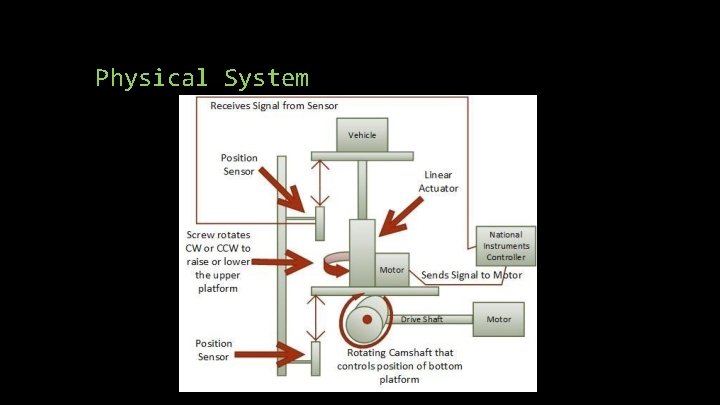
Physical System
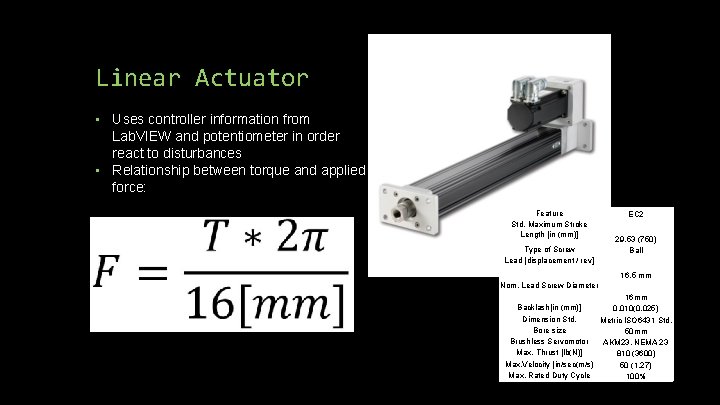
Linear Actuator • Uses controller information from Lab. VIEW and potentiometer in order react to disturbances • Relationship between torque and applied force: Feature Std. Maximum Stroke Length [in (mm)] Type of Screw Lead [displacement / rev] EC 2 29. 53 (750) Ball 16, 5 mm Nom. Lead Screw Diameter 16 mm Backlash[in (mm)] 0. 010(0. 025) Dimension Std. Metric ISO 6431 Std. Bore size 50 mm Brushless Servomotor AKM 23, NEMA 23 Max. Thrust [lb(N)] 810 (3600) Max. Velocity [in/sec(m/s) 50 (1. 27) Max. Rated Duty Cycle 100%
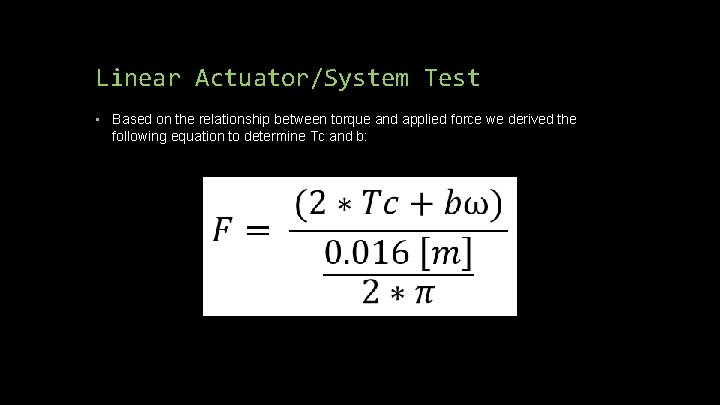
Linear Actuator/System Test • Based on the relationship between torque and applied force we derived the following equation to determine Tc and b:
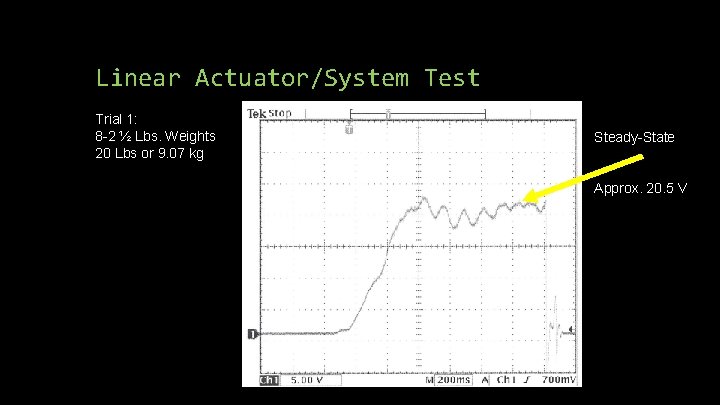
Linear Actuator/System Test Trial 1: 8 -2 ½ Lbs. Weights 20 Lbs or 9. 07 kg Steady-State Approx. 20. 5 V
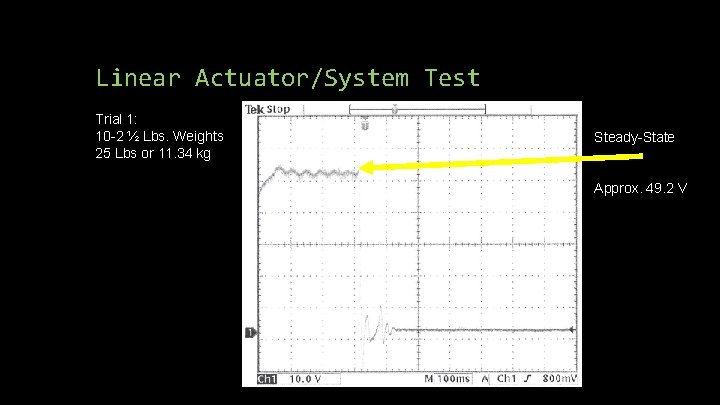
Linear Actuator/System Test Trial 1: 10 -2 ½ Lbs. Weights 25 Lbs or 11. 34 kg Steady-State Approx. 49. 2 V
Linear Actuator/System Test • Based on the previous group’s work, k. E=0. 382 [V/rad/sec] so Trial 1: ω = 20. 5 [V] /. 382 [V/rad/sec] = 53. 67 [rad/sec] Trial 2: ω = 49. 2 [V] /. 382 [V/rad/sec] = 128. 80 [rad/sec] Using simultaneous equation solver: Tc = 0. 09304 b = 7. 55 X 10 -4
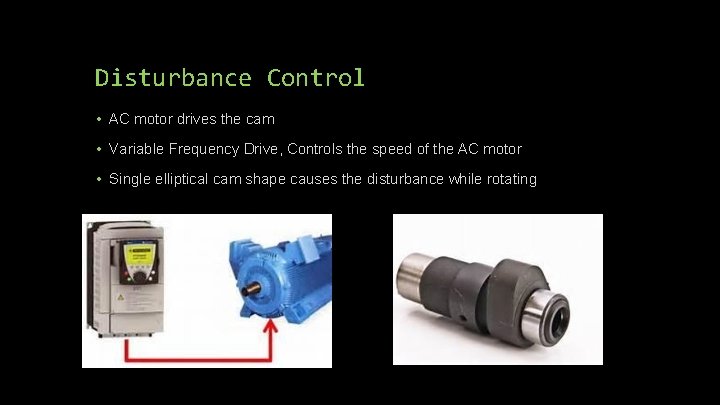
Disturbance Control • AC motor drives the cam • Variable Frequency Drive, Controls the speed of the AC motor • Single elliptical cam shape causes the disturbance while rotating
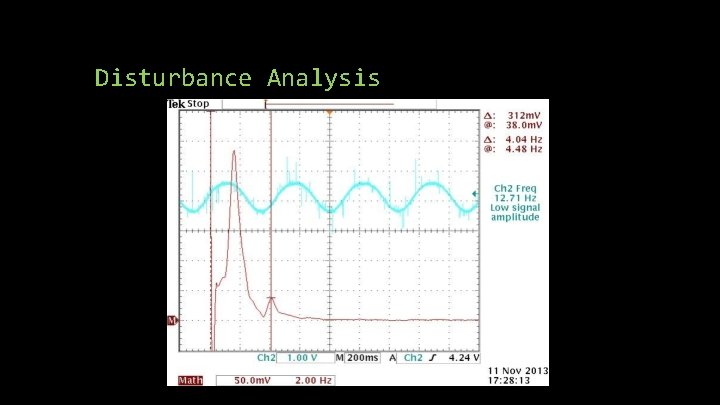
Disturbance Analysis
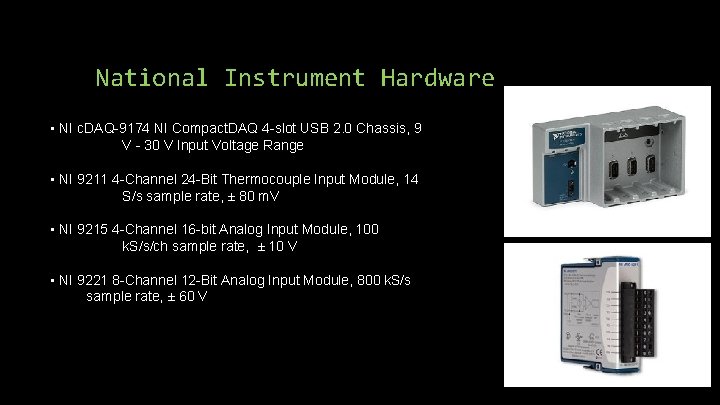
National Instrument Hardware • NI c. DAQ-9174 NI Compact. DAQ 4 -slot USB 2. 0 Chassis, 9 V - 30 V Input Voltage Range • NI 9211 4 -Channel 24 -Bit Thermocouple Input Module, 14 S/s sample rate, ± 80 m. V • NI 9215 4 -Channel 16 -bit Analog Input Module, 100 k. S/s/ch sample rate, ± 10 V • NI 9221 8 -Channel 12 -Bit Analog Input Module, 800 k. S/s sample rate, ± 60 V
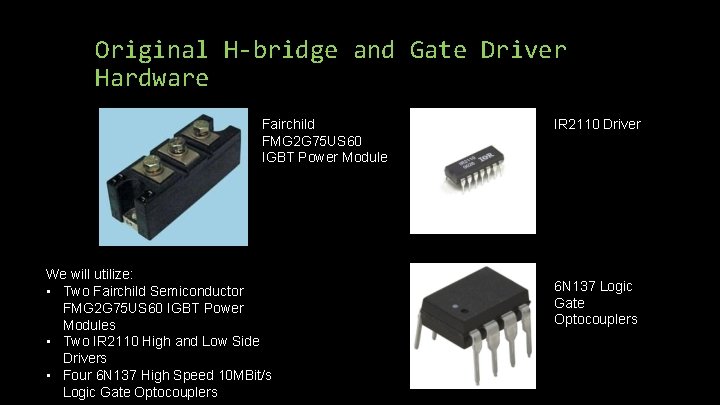
Original H-bridge and Gate Driver Hardware Fairchild FMG 2 G 75 US 60 IGBT Power Module IR 2110 Driver IR 211 0 We will utilize: • Two Fairchild Semiconductor FMG 2 G 75 US 60 IGBT Power Modules • Two IR 2110 High and Low Side Drivers • Four 6 N 137 High Speed 10 MBit/s Logic Gate Optocouplers 6 N 137 Logic Gate Optocouplers
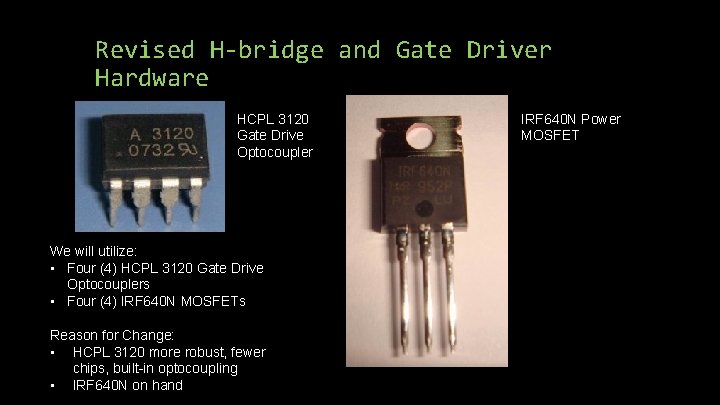
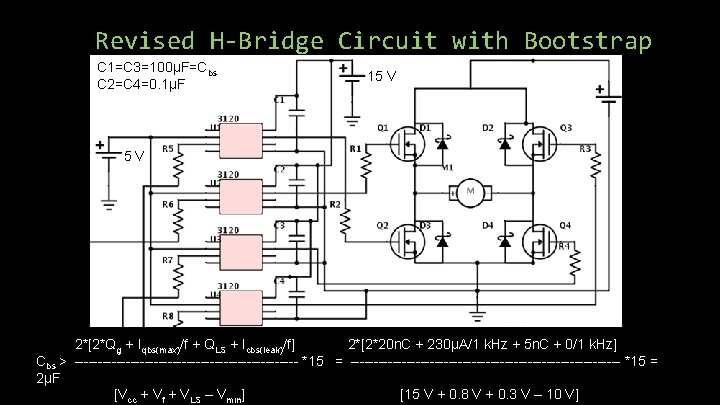
Revised H-bridge and Gate Driver Hardware HCPL 3120 Gate Drive Optocoupler We will utilize: • Four (4) HCPL 3120 Gate Drive Optocouplers • Four (4) IRF 640 N MOSFETs Reason for Change: • HCPL 3120 more robust, fewer chips, built-in optocoupling • IRF 640 N on hand IRF 640 N Power MOSFET
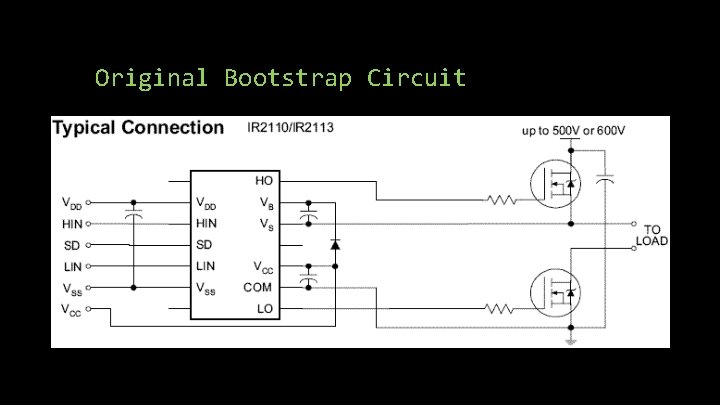
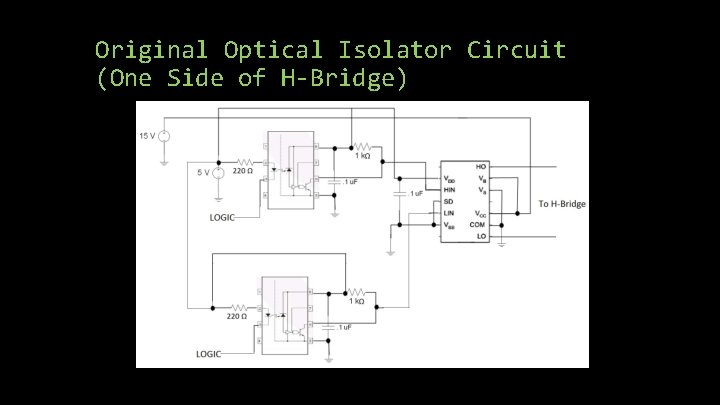
Original Bootstrap Circuit
Original Optical Isolator Circuit (One Side of H-Bridge)
Revised H-Bridge Circuit with Bootstrap C 1=C 3=100µF=Cbs C 2=C 4=0. 1µF 15 V 5 V 2*[2*Qg + Iqbs(max)/f + QLS + Icbs(leak)/f] 2*[2*20 n. C + 230µA/1 k. Hz + 5 n. C + 0/1 k. Hz] Cbs > ------------------------ *15 = ----------------------------- *15 = 2µF [Vcc + Vf + VLS – Vmin] [15 V + 0. 8 V + 0. 3 V – 10 V]
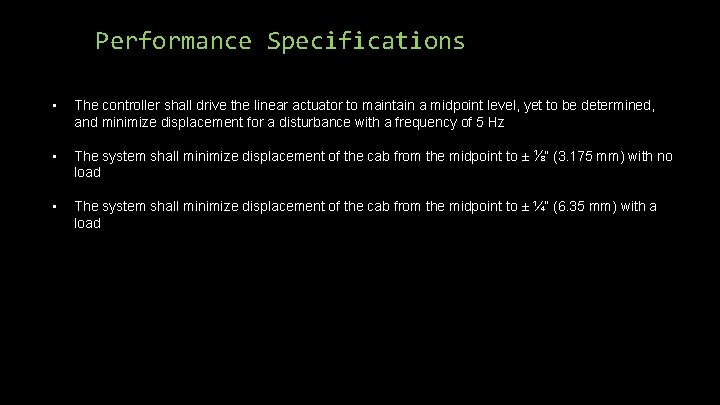
Performance Specifications • The controller shall drive the linear actuator to maintain a midpoint level, yet to be determined, and minimize displacement for a disturbance with a frequency of 5 Hz • The system shall minimize displacement of the cab from the midpoint to ± ⅛” (3. 175 mm) with no load • The system shall minimize displacement of the cab from the midpoint to ± ¼” (6. 35 mm) with a load
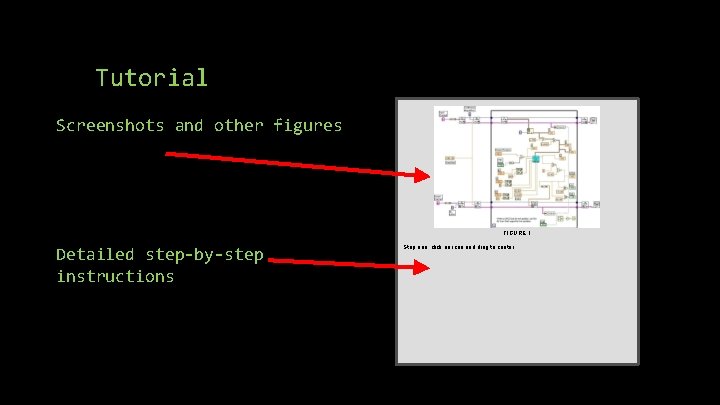
Tutorial Screenshots and other figures FIGURE 1 Detailed step-by-step instructions Step one: click on icon and drag to center.
Division of Labor • Dan Altman – Control System Design / Web Page • Tim Reilley – Power Electronics / National Instruments Hardware Integration • Joseph Sholl – Labview Software Implementation / Tutorial Developer
Project Schedule