
Controlled Vocabulary Thesaurus Design Course Introduction and Background
Controlled Vocabulary & Thesaurus Design Course Introduction and Background
Cataloging for the 21 st Century: The five CE course components 1. MARC/AACR 2 cataloging of electronic resources 2. Overview of basic concepts of 21 st century bibliographic control, including specific metadata standards and applications 3. Thesaurus design principles, building a controlled vocabulary, and examination of selected controlled vocabularies 4. Digital library design, with a project-based component 5. Philosophy and approach to asset management for the 21 st century, including evaluation skills Developed by the Association of Library Collections & Technical Services and Library of Congress’s Cataloger’s Learning Workshop
Cataloging for the 21 st Century: CE course series objectives § To equip catalogers to deal with new types of resources and to recognize their unique characteristics § To equip catalogers to evaluate competing approaches to and standards for providing access to resources § To equip catalogers to think creatively and work collaboratively with others inside and outside their home institutions § To ensure that catalogers have a broad enough understanding of the current environment to be able to make their local efforts compatible and interoperable with other efforts § To prepare catalogers to be comfortable with ambiguity and being less than perfect § To enable practicing catalogers to put themselves into the emerging digital information environment and to continue to play a significant role in shaping library services Developed by the Association of Library Collections & Technical Services and Library of Congress’s Cataloger’s Learning Workshop
Goals for this course § Understand this course as the third in a series of five courses for Cataloging in the 21 st Century and see thesauri within a larger context of vocabulary control § Understand apply fundamental concepts of controlled vocabulary and thesaurus design, and why they are important § Understand apply diverse types of term relationships to structure descriptive terms § Understand apply both basic rules and best practices from existing thesauri to the construction and maintenance of thesauri and controlled vocabularies § Develop a basis for exercising individual judgment for making thesaurus and controlled vocabulary decisions Developed by the Association of Library Collections & Technical Services and Library of Congress’s Cataloger’s Learning Workshop
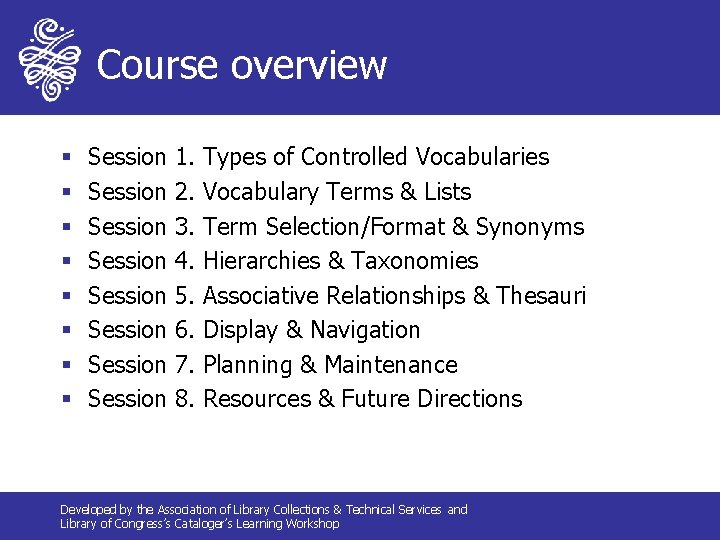
Course overview § § § § Session Session 1. 2. 3. 4. 5. 6. 7. 8. Types of Controlled Vocabularies Vocabulary Terms & Lists Term Selection/Format & Synonyms Hierarchies & Taxonomies Associative Relationships & Thesauri Display & Navigation Planning & Maintenance Resources & Future Directions Developed by the Association of Library Collections & Technical Services and Library of Congress’s Cataloger’s Learning Workshop

Why Controlled Vocabularies? § Goal of information retrieval systems: § Efficient access to information § Core problems: § Within a domain: different terms with same meaning § Between domains: same term with different meanings § Other problems: § Scalability: almost all IR research is based on small test collections or user communities § User needs vary with time and subject domain § Basic disconnect between indexer and user experience Developed by the Association of Library Collections & Technical Services and Library of Congress’s Cataloger’s Learning Workshop

Who Controls Vocabularies? § Information professionals § Computer scientists, information scientists, librarians, linguists § Designers vs. maintainers § Which are you? § What is your own interest in Controlled Vocabularies? Developed by the Association of Library Collections & Technical Services and Library of Congress’s Cataloger’s Learning Workshop
- Slides: 7