
Controlled Drugs and the Use of Drugs Beyond
Controlled Drugs and the Use of Drugs Beyond Product License Melinda Presland Consultant Pharmacist, Palliative and End of Life Care

Content • Controlled Drugs and Non-Medical Prescribing • Practicalities and governance of prescribing Controlled Drugs • Prescribing outside of product license • Non-Medical Prescribing and the use of Syringe Pumps and Syringe Pump combinations • Case Study – Controlled Drugs: PO and CSCI
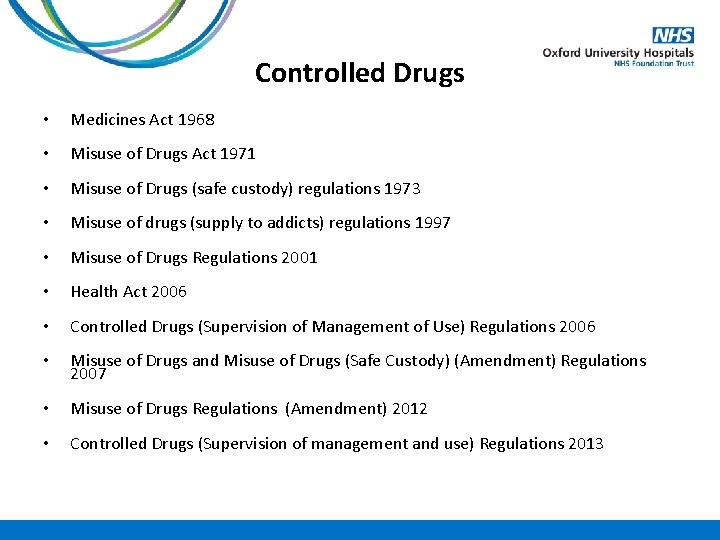
Controlled Drugs • Medicines Act 1968 • Misuse of Drugs Act 1971 • Misuse of Drugs (safe custody) regulations 1973 • Misuse of drugs (supply to addicts) regulations 1997 • Misuse of Drugs Regulations 2001 • Health Act 2006 • Controlled Drugs (Supervision of Management of Use) Regulations 2006 • Misuse of Drugs and Misuse of Drugs (Safe Custody) (Amendment) Regulations 2007 • Misuse of Drugs Regulations (Amendment) 2012 • Controlled Drugs (Supervision of management and use) Regulations 2013
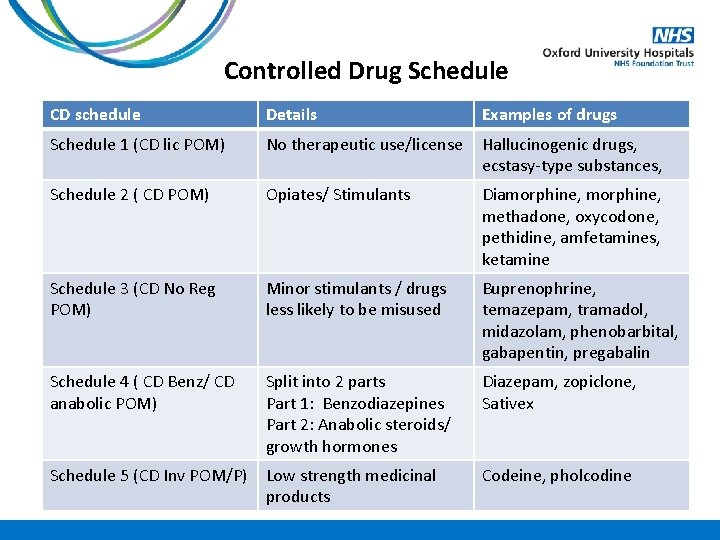
Controlled Drug Schedule CD schedule Details Examples of drugs Schedule 1 (CD lic POM) No therapeutic use/license Hallucinogenic drugs, ecstasy-type substances, Schedule 2 ( CD POM) Opiates/ Stimulants Diamorphine, methadone, oxycodone, pethidine, amfetamines, ketamine Schedule 3 (CD No Reg POM) Minor stimulants / drugs less likely to be misused Buprenophrine, temazepam, tramadol, midazolam, phenobarbital, gabapentin, pregabalin Schedule 4 ( CD Benz/ CD anabolic POM) Split into 2 parts Part 1: Benzodiazepines Part 2: Anabolic steroids/ growth hormones Diazepam, zopiclone, Sativex Schedule 5 (CD Inv POM/P) Low strength medicinal products Codeine, pholcodine
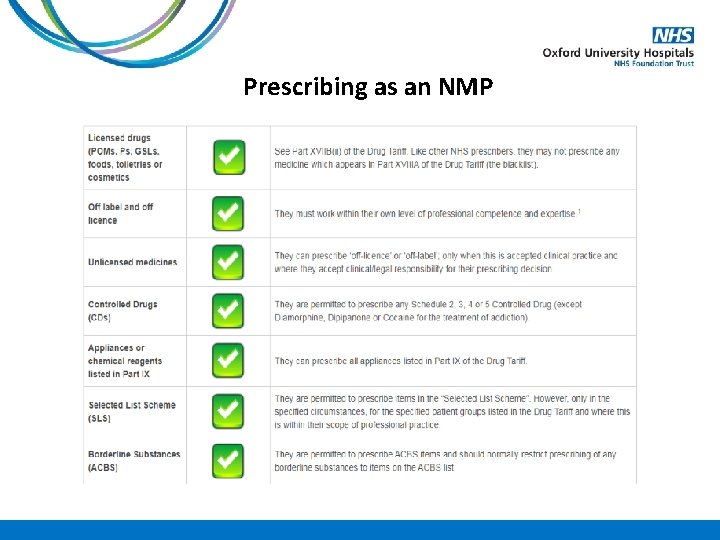
Prescribing as an NMP
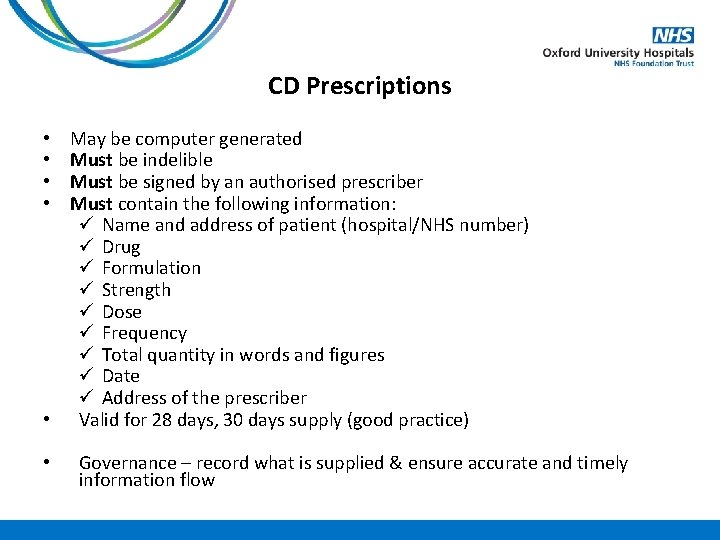
CD Prescriptions May be computer generated Must be indelible Must be signed by an authorised prescriber Must contain the following information: ü Name and address of patient (hospital/NHS number) ü Drug ü Formulation ü Strength ü Dose ü Frequency ü Total quantity in words and figures ü Date ü Address of the prescriber • Valid for 28 days, 30 days supply (good practice) • • • Governance – record what is supplied & ensure accurate and timely information flow
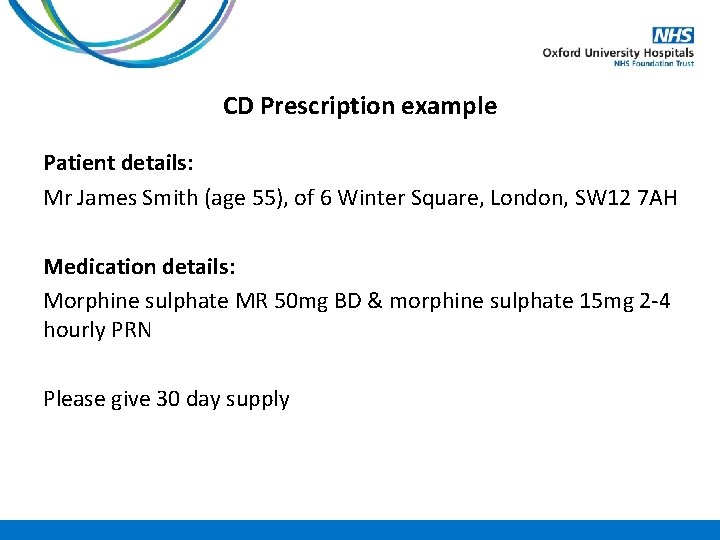
CD Prescription example Patient details: Mr James Smith (age 55), of 6 Winter Square, London, SW 12 7 AH Medication details: Morphine sulphate MR 50 mg BD & morphine sulphate 15 mg 2 -4 hourly PRN Please give 30 day supply
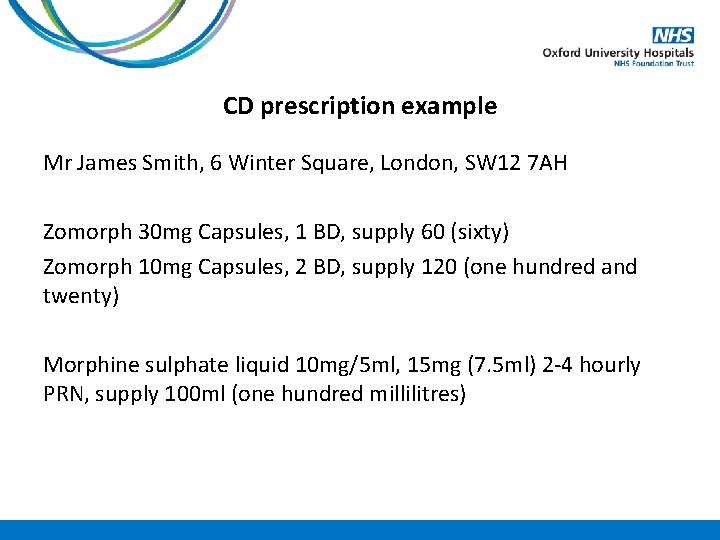
CD prescription example Mr James Smith, 6 Winter Square, London, SW 12 7 AH Zomorph 30 mg Capsules, 1 BD, supply 60 (sixty) Zomorph 10 mg Capsules, 2 BD, supply 120 (one hundred and twenty) Morphine sulphate liquid 10 mg/5 ml, 15 mg (7. 5 ml) 2 -4 hourly PRN, supply 100 ml (one hundred millilitres)
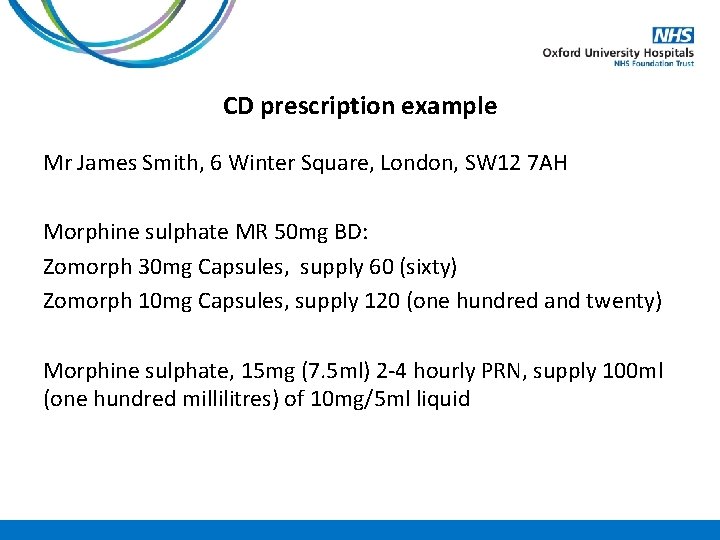
CD prescription example Mr James Smith, 6 Winter Square, London, SW 12 7 AH Morphine sulphate MR 50 mg BD: Zomorph 30 mg Capsules, supply 60 (sixty) Zomorph 10 mg Capsules, supply 120 (one hundred and twenty) Morphine sulphate, 15 mg (7. 5 ml) 2 -4 hourly PRN, supply 100 ml (one hundred millilitres) of 10 mg/5 ml liquid
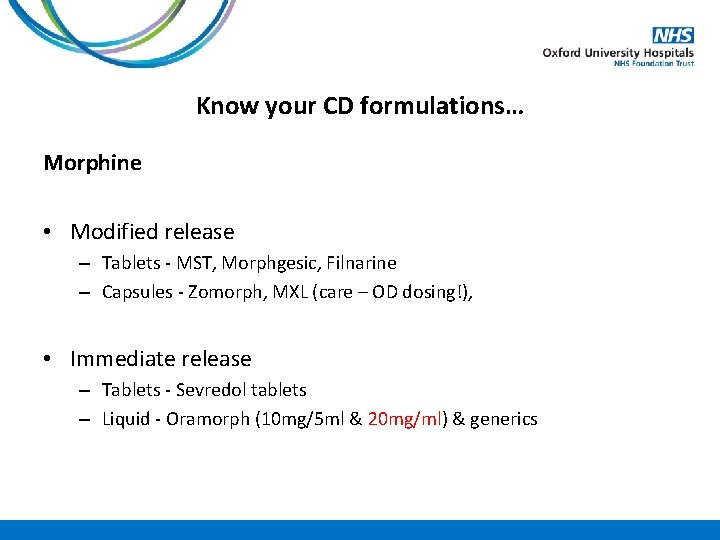
Know your CD formulations… Morphine • Modified release – Tablets - MST, Morphgesic, Filnarine – Capsules - Zomorph, MXL (care – OD dosing!), • Immediate release – Tablets - Sevredol tablets – Liquid - Oramorph (10 mg/5 ml & 20 mg/ml) & generics
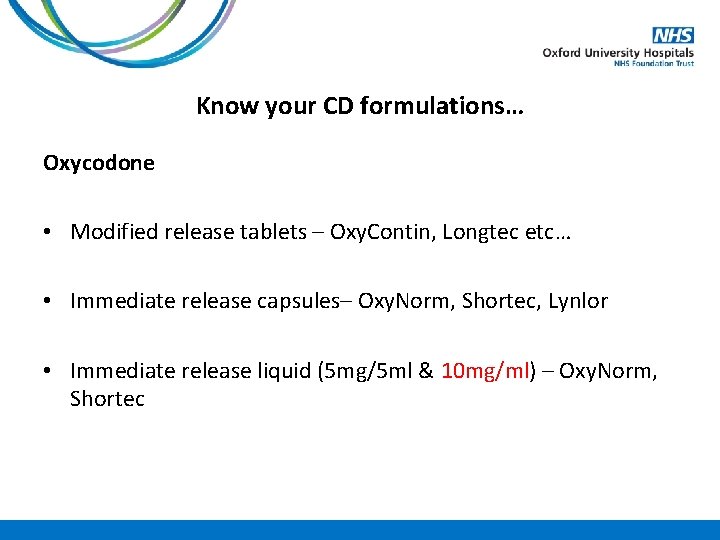
Know your CD formulations… Oxycodone • Modified release tablets – Oxy. Contin, Longtec etc… • Immediate release capsules– Oxy. Norm, Shortec, Lynlor • Immediate release liquid (5 mg/5 ml & 10 mg/ml) – Oxy. Norm, Shortec
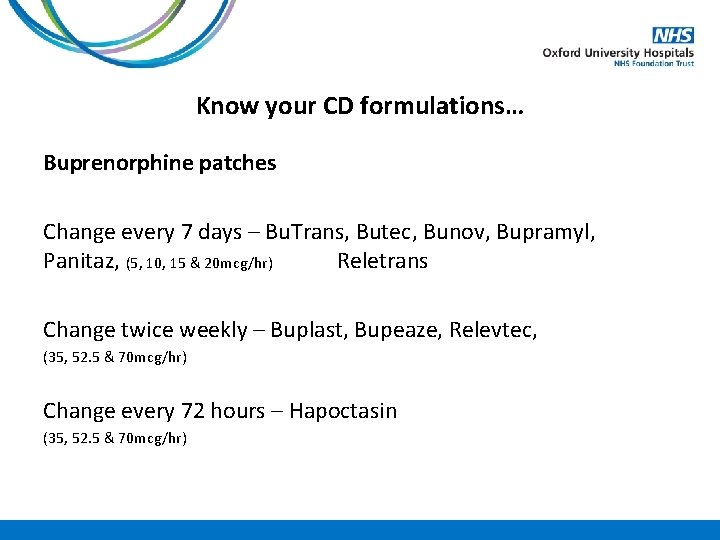
Know your CD formulations… Buprenorphine patches Change every 7 days – Bu. Trans, Butec, Bunov, Bupramyl, Panitaz, (5, 10, 15 & 20 mcg/hr) Reletrans Change twice weekly – Buplast, Bupeaze, Relevtec, (35, 52. 5 & 70 mcg/hr) Change every 72 hours – Hapoctasin (35, 52. 5 & 70 mcg/hr)
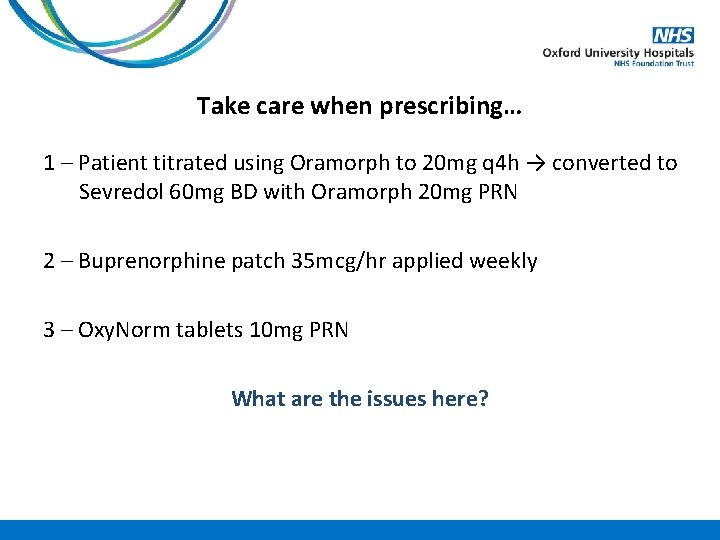
Take care when prescribing… 1 – Patient titrated using Oramorph to 20 mg q 4 h → converted to Sevredol 60 mg BD with Oramorph 20 mg PRN 2 – Buprenorphine patch 35 mcg/hr applied weekly 3 – Oxy. Norm tablets 10 mg PRN What are the issues here?
Drug licensing Before a medicine can be marketed in the UK, a number of licenses are essential • Marketing authorisation (product licence) • Manufacturer’s and wholesale dealer’s licences • Clinical trial authorisations These are granted by: • MHRA (Medicines and Healthcare products regulatory agency) • or the EMEA (European Medicines Evaluation Agency) 14
Drug licensing • For a marketing authorisation (product licence) to be granted the product must meet standards of safety, quality and efficacy. The marketing authorisation defines its terms of use. • Each product has a summary of product characteristics (SPC) which lists: – Indications – Recommended doses – Methods of administration – Contraindications – Warnings and precautions • Liability lies with the manufacturer • A licensed medicine is accompanied by appropriate product information and labelling 15
Off-label use of Medicines Have a marketing authorisation, but… • Different indication • Different dose • Different route • Responsibility lies with the prescriber 16
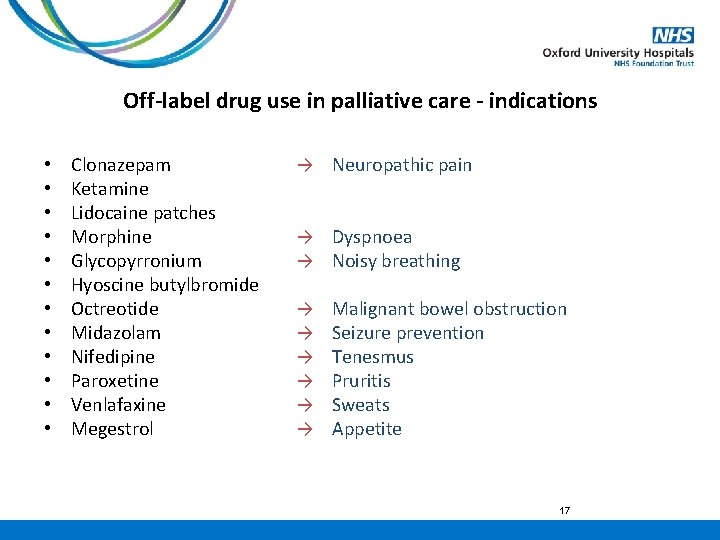
Off-label drug use in palliative care - indications • • • Clonazepam Ketamine Lidocaine patches Morphine Glycopyrronium Hyoscine butylbromide Octreotide Midazolam Nifedipine Paroxetine Venlafaxine Megestrol → Neuropathic pain → Dyspnoea → Noisy breathing → → → Malignant bowel obstruction Seizure prevention Tenesmus Pruritis Sweats Appetite 17
Off-label drug use in palliative care – routes of administration Subcutaneous • Alfentanil • Clonazepam • Cyclizine • Furosemide • Glycopyrronium • Haloperidol • Hyoscine butylbromide • Ketamine • Metoclopramide • Midazolam • Ondansetron • Phenobarbital injections Epidural/Intrathecal • Diamorphine • Fentanyl • Clonidine injections Sublingual • Lorazepam tablets • Diazepam enema Buccal • Midazolam injection Topical • Morphine injection • Diamorphine injection 18
Unlicensed Medicines No marketing authorisation Include: • Specials eg. ketamine oral liquid, tranexamic acid oral liquid • Named patient drugs eg. glycopyrronium tablets, hydomorphone injection, clonazepam injection • Syringe pump combinations eg. morphine + midazolam + glycopyrronium • Responsibility lies with the prescriber 19
Prescribing off-label or unlicensed medicines Advice for prescribers says you should: • be satisfied that an alternative, licensed medicine would not meet the patient’s needs before prescribing an unlicensed medicine • be satisfied that such use would better serve the patient’s needs than an appropriately licensed alternative before prescribing a medicine off-label • before prescribing an unlicensed medicine or using a medicine off-label you should: – be satisfied that there is a sufficient evidence base and/or experience of using the medicine to show its safety and efficacy – take responsibility for prescribing the medicine and for overseeing the patient’s care, including monitoring and follow-up – record the medicine prescribed and, where common practice is not being followed, the reasons for prescribing this medicine; you may wish to record that you have discussed the issue with the patient
Prescribing off-label or unlicensed medicines Best practice for communication includes: • you give patients, or those authorising treatment on their behalf, sufficient information about the proposed treatment, including known serious or common adverse reactions, to enable them to make an informed decision • where current practice supports the use of a medicine outside the terms of its licence, it may not be necessary to draw attention to the licence when seeking consent. However, it is good practice to give as much information as patients or carers require or which they may see as relevant • you explain the reasons for prescribing a medicine off-label or prescribing an unlicensed medicine where there is little evidence to support its use, or where the use of a medicine is innovative
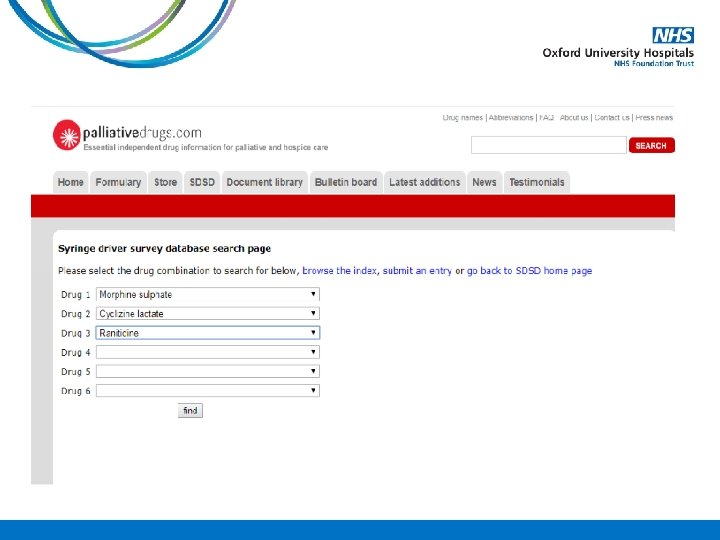
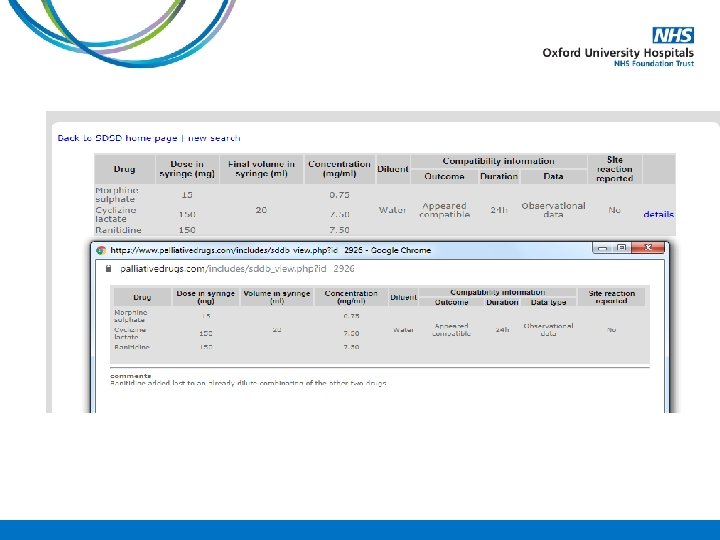
Unlicensed Medicines – Syringe Pump Combinations • Mixing two licensed medicines, where one is not a vehicle for the administration of the other, falls within the definition of manufacture and results in a new, unlicensed product being administered Medicines Act 1968 • The palliative care practice of administering a mixture of licensed medication using a syringe driver is safe and effective MHRA statement September 2008 22
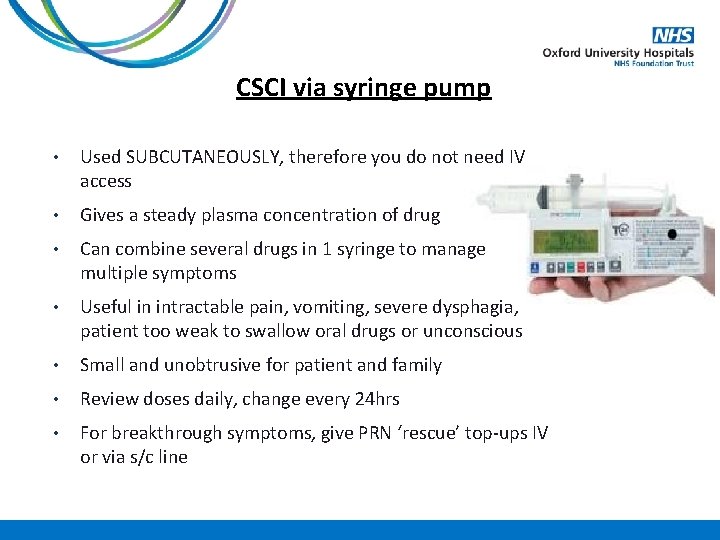
CSCI via syringe pump • Used SUBCUTANEOUSLY, therefore you do not need IV access • Gives a steady plasma concentration of drug • Can combine several drugs in 1 syringe to manage multiple symptoms • Useful in intractable pain, vomiting, severe dysphagia, patient too weak to swallow oral drugs or unconscious • Small and unobtrusive for patient and family • Review doses daily, change every 24 hrs • For breakthrough symptoms, give PRN ‘rescue’ top-ups IV or via s/c line
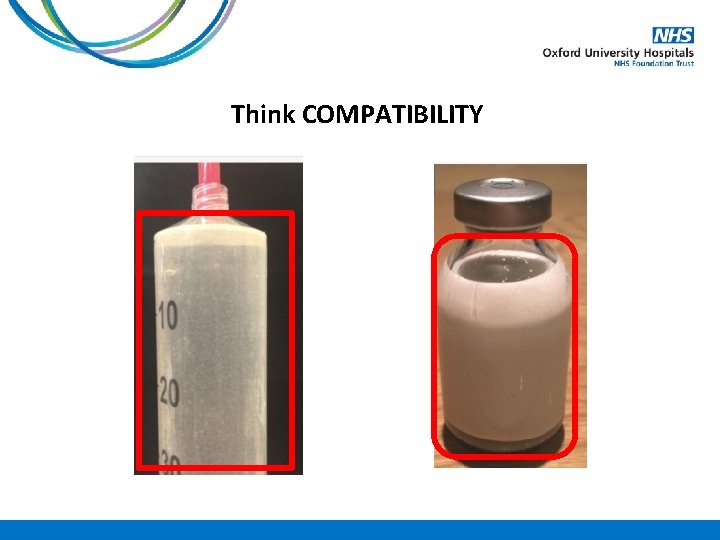
Think COMPATIBILITY
Case Study A 78 year old gentleman is admitted into the hospice on PO morphine sulphate MR 30 mg BD with deteriorating renal function. His Crcl 38 ml/min on admission. The medical team want to convert him onto an equivalent dose of oxycodone. How much PO oxycodone MR should he be started on?
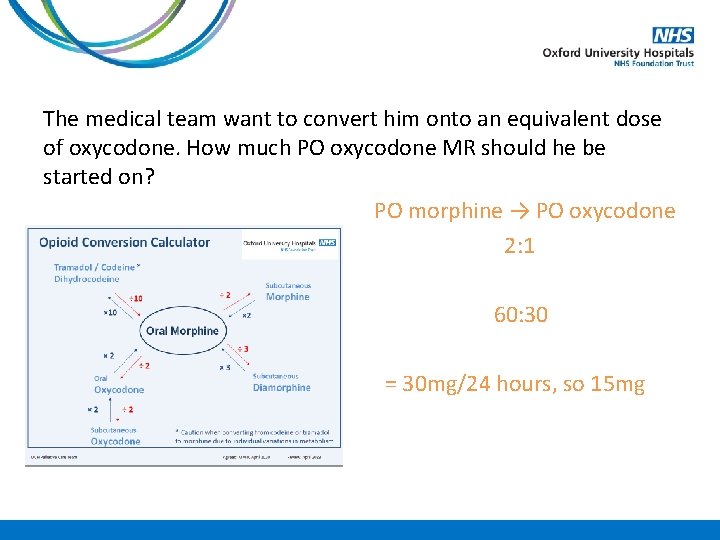
The medical team want to convert him onto an equivalent dose of oxycodone. How much PO oxycodone MR should he be started on? PO morphine → PO oxycodone 2: 1 60: 30 BD = 30 mg/24 hours, so 15 mg
His condition deteriorates and he can no longer swallow. What dose of oxycodone should be added to his syringe pump (over 24 hours)?
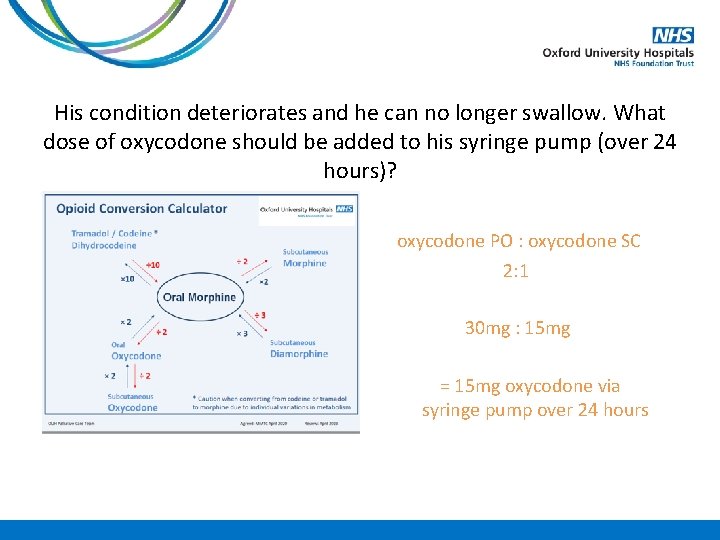
His condition deteriorates and he can no longer swallow. What dose of oxycodone should be added to his syringe pump (over 24 hours)? oxycodone PO : oxycodone SC 2: 1 30 mg : 15 mg = 15 mg oxycodone via syringe pump over 24 hours
How much oxycodone SC should be prescribed as a PRN dose? (remember convention is PRN dose is 1/6 th total daily dose, but may be upto 1/10 th)
How much oxycodone SC should be prescribed as a PRN dose? 15/6 = 2. 5 mg
He’s had 4 PRN doses of oxycodone 2. 5 mg SC in the last 24 hours. How much shall we increase the dose of oxycodone in his syringe pump to?
He’s had 4 PRN doses of oxycodone 2. 5 mg SC in the last 24 hours. How much shall we increase the dose of oxycodone in his syringe driver to? In 24 hours that’s an additional 10 mg on top of the 15 mg, however, if that was all added into the pump it would be greater than a 50% increase (convention is 30 – 50% increase). Therefore, increase oxycodone dose in the syringe driver to 20 mg over 24 hours.
What should the PRN SC oxycodone dose be now?
What should the PRN SC oxycodone dose be now? 20/6= 3. 3 mg Could either give 2. 5 mg or 5 mg (or a range if that is acceptable)
Summary • Controlled Drugs and Non-Medical Prescribing • Practicalities and governance of prescribing Controlled Drugs • Prescribing outside of product license • Non-Medical Prescribing and the use of Syringe Drivers and Syringe Driver combinations • Case Study – Controlled Drugs: PO and CSCI
References
- Slides: 38