
Controlflowbased Coverage Criteria W Eric Wong Department of
Controlflow-based Coverage Criteria W. Eric Wong Department of Computer Science The University of Texas at Dallas ewong@utdallas. edu http: //www. utdallas. edu/~ewong Dataflow-based Coverage Criteria (© 2012 Professor W. Eric Wong, The University of Texas at Dallas) 1

Speaker Biographical Sketch Professor & Director of International Outreach Department of Computer Science University of Texas at Dallas Guest Researcher Computer Security Division National Institute of Standards and Technology (NIST) Vice President, IEEE Reliability Society Secretary, ACM SIGAPP (Special Interest Group on Applied Computing) Principal Investigator, NSF TUES (Transforming Undergraduate Education in Science, Technology, Engineering and Mathematics) Project – Incorporating Software Testing into Multiple Computer Science and Software Engineering Undergraduate Courses Founder & Steering Committee co-Chair for the SERE conference (IEEE International Conference on Software Security and Reliability) (http: //paris. utdallas. edu/sere 13) Dataflow-based Coverage Criteria (© 2012 Professor W. Eric Wong, The University of Texas at Dallas) 2

Outline Block/Statement Coverage Decision Coverage Condition Coverage Multiple Condition Coverage Controlflow-based Coverage Criteria (© 2012 Professor W. Eric Wong, The University of Texas at Dallas) 3
Statement and Block Coverage 4
Declarations and Basic Blocks Any program written in a procedural language consists of a sequence of statements. Some of these statements are declarative, such as the #define and int statements in C, while others are executable, such as the assignment, if, and while statements in C and Java. Recall that a basic block is a sequence of consecutive statements that has exactly one entry point and one exit point. – For any procedural language, adequacy with respect to the statement coverage and block coverage criteria are defined next. Notation: (P, R) denotes program P subject to requirement R. Controlflow-based Coverage Criteria (© 2012 Professor W. Eric Wong, The University of Texas at Dallas) 5
Statement Coverage The statement coverage of T with respect to (P, R) is computed as Sc / (Se − Si), where Sc is the number of statements covered, Si is the number of unreachable statements, and Se is the total number of executable statements in the program, i. e. , the size of the coverage domain. T is considered adequate with respect to the statement coverage criterion if the statement coverage of T with respect to (P, R) is 1. Controlflow-based Coverage Criteria (© 2012 Professor W. Eric Wong, The University of Texas at Dallas) 6
Block Coverage The block coverage of T with respect to (P, R) is computed as Bc / (Be − Bi), where Bc is the number of blocks covered, Bi is the number of unreachable blocks, and Be is the total number of executable blocks in the program, i. e. , the size of the block coverage domain. T is considered adequate with respect to the block coverage criterion if the statement coverage of T with respect to (P, R) is 1. Controlflow-based Coverage Criteria (© 2012 Professor W. Eric Wong, The University of Texas at Dallas) 7
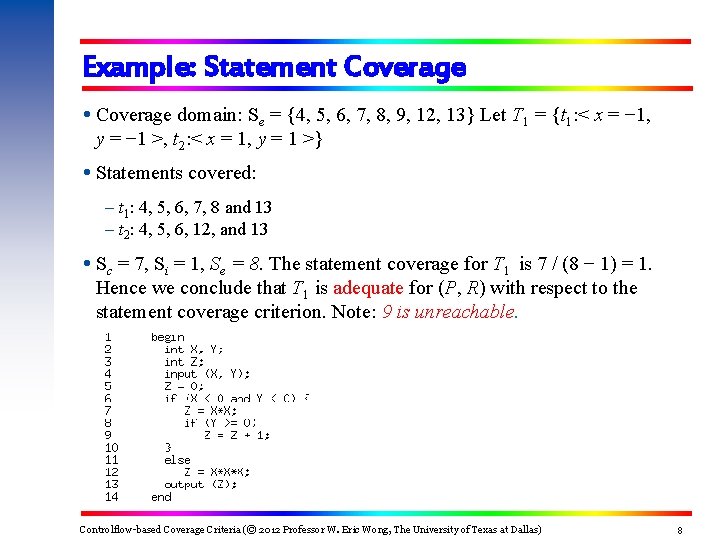
Example: Statement Coverage domain: Se = {4, 5, 6, 7, 8, 9, 12, 13} Let T 1 = {t 1: < x = − 1, y = − 1 >, t 2: < x = 1, y = 1 >} Statements covered: – t 1: 4, 5, 6, 7, 8 and 13 – t 2: 4, 5, 6, 12, and 13 Sc = 7, Si = 1, Se = 8. The statement coverage for T 1 is 7 / (8 − 1) = 1. Hence we conclude that T 1 is adequate for (P, R) with respect to the statement coverage criterion. Note: 9 is unreachable. Controlflow-based Coverage Criteria (© 2012 Professor W. Eric Wong, The University of Texas at Dallas) 8
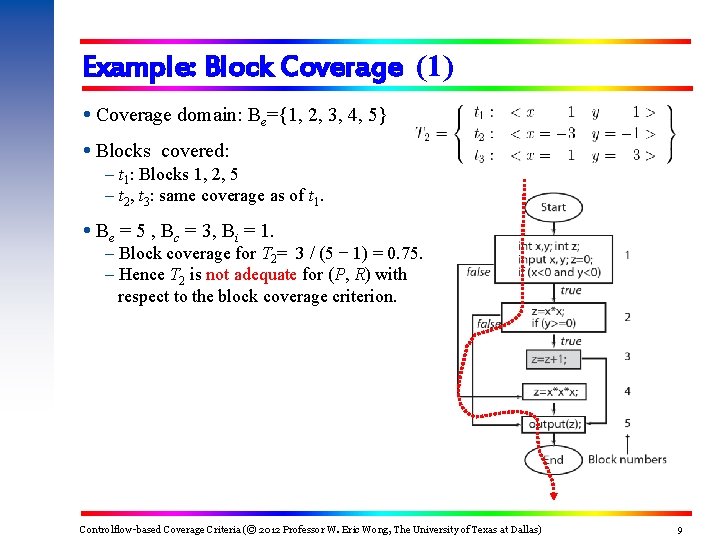
Example: Block Coverage (1) Coverage domain: Be={1, 2, 3, 4, 5} Blocks covered: – t 1: Blocks 1, 2, 5 – t 2, t 3: same coverage as of t 1. Be = 5 , Bc = 3, Bi = 1. – Block coverage for T 2= 3 / (5 − 1) = 0. 75. – Hence T 2 is not adequate for (P, R) with respect to the block coverage criterion. Controlflow-based Coverage Criteria (© 2012 Professor W. Eric Wong, The University of Texas at Dallas) 9
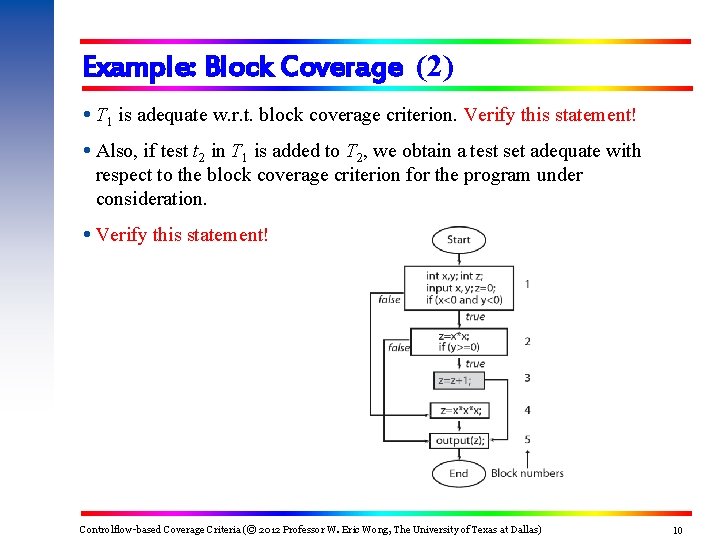
Example: Block Coverage (2) T 1 is adequate w. r. t. block coverage criterion. Verify this statement! Also, if test t 2 in T 1 is added to T 2, we obtain a test set adequate with respect to the block coverage criterion for the program under consideration. Verify this statement! Controlflow-based Coverage Criteria (© 2012 Professor W. Eric Wong, The University of Texas at Dallas) 10
Coverage Values The formulae given for computing various types of code coverage yield a coverage value between 0 and 1. However, while specifying a coverage value, one might instead use percentages. For example, a statement coverage of 0. 65 is the same as 65% statement coverage. Controlflow-based Coverage Criteria (© 2012 Professor W. Eric Wong, The University of Texas at Dallas) 11
Condition and Decision Coverage 12
Conditions Any expression that evaluates to true or false constitutes a condition. Such an expression is also known as a predicate. Given that A, B, and D are Boolean variables, and x and y are integers, A, x > y, A OR B, A AND (x < y), (A AND B) are sample conditions. Note that in programming language C, x and x + y are valid conditions, and the constants 1 and 0 correspond to, respectively, true and false. Controlflow-based Coverage Criteria (© 2012 Professor W. Eric Wong, The University of Texas at Dallas) 13
Simple and Compound Conditions A simple condition does not use any Boolean operators except for the not operator. It is made up of variables and at most one relational operator from the set {<, , >, , ==, }. Simple conditions are also referred to as atomic or elementary conditions because they cannot be parsed any further into two or more conditions. A compound condition is made up of two or more simple conditions joined by one or more Boolean operators. Controlflow-based Coverage Criteria (© 2012 Professor W. Eric Wong, The University of Texas at Dallas) 14
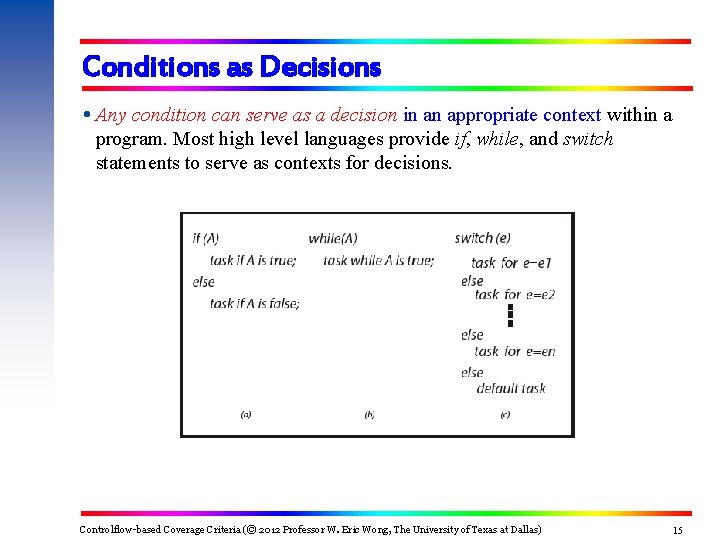
Conditions as Decisions Any condition can serve as a decision in an appropriate context within a program. Most high level languages provide if, while, and switch statements to serve as contexts for decisions. Controlflow-based Coverage Criteria (© 2012 Professor W. Eric Wong, The University of Texas at Dallas) 15
Outcomes of a Decision A decision can have three possible outcomes: true, false, and undefined. In some cases the evaluation of a condition might fail in which case the corresponding decision's outcome is undefined. Controlflow-based Coverage Criteria (© 2012 Professor W. Eric Wong, The University of Texas at Dallas) 16
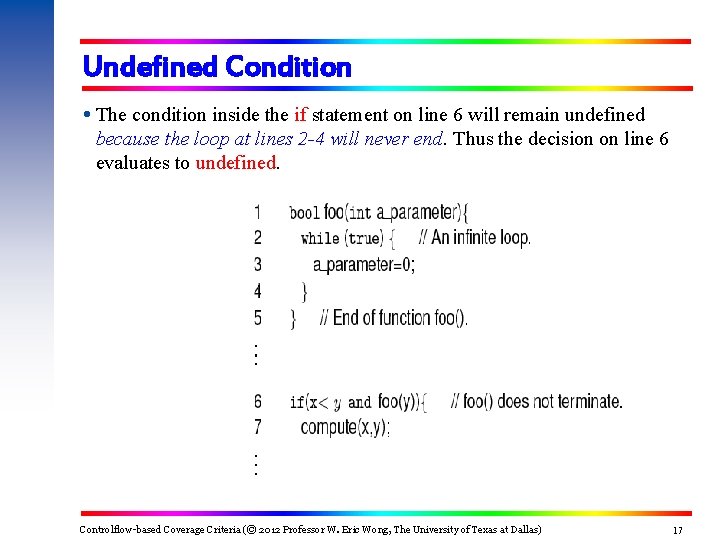
Undefined Condition The condition inside the if statement on line 6 will remain undefined because the loop at lines 2 -4 will never end. Thus the decision on line 6 evaluates to undefined. Controlflow-based Coverage Criteria (© 2012 Professor W. Eric Wong, The University of Texas at Dallas) 17
Coupled Conditions How many simple conditions are there in the compound condition: D = (A AND B) OR (C AND A)? The first occurrence of A is said to be coupled to its second occurrence. Does D contain three or four simple conditions? Both answers are correct depending on one's point of view. Indeed, there are three distinct conditions A , B, and C. The answer is four when one is interested in the number of occurrences of simple conditions in a compound condition. Controlflow-based Coverage Criteria (© 2012 Professor W. Eric Wong, The University of Texas at Dallas) 18
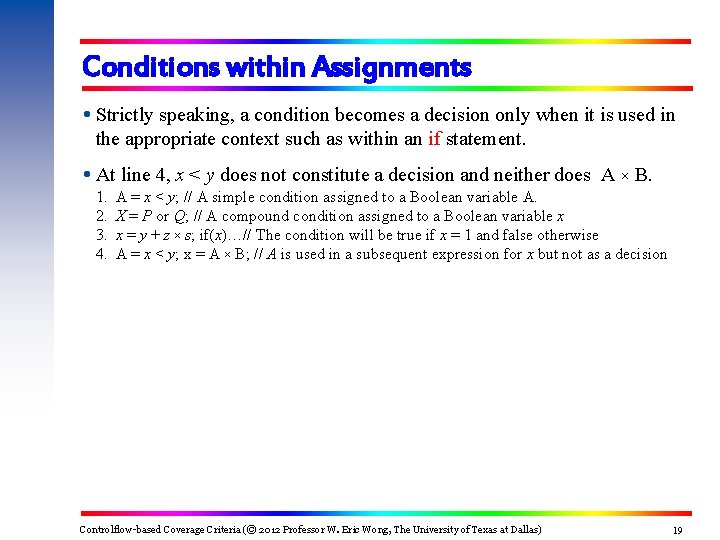
Conditions within Assignments Strictly speaking, a condition becomes a decision only when it is used in the appropriate context such as within an if statement. At line 4, x < y does not constitute a decision and neither does A × B. 1. 2. 3. 4. A = x < y; // A simple condition assigned to a Boolean variable A. X = P or Q; // A compound condition assigned to a Boolean variable x x = y + z × s; if(x)…// The condition will be true if x = 1 and false otherwise A = x < y; x = A × B; // A is used in a subsequent expression for x but not as a decision Controlflow-based Coverage Criteria (© 2012 Professor W. Eric Wong, The University of Texas at Dallas) 19
Decision Coverage A decision is considered covered if the flow of control has been diverted to all possible destinations that correspond to this decision, i. e. , all outcomes of the decision have been taken. This implies that, for example, the expression in the if or a while statement has evaluated to true in some execution of the program under test and to false in the same or another execution. Controlflow-based Coverage Criteria (© 2012 Professor W. Eric Wong, The University of Texas at Dallas) 20
Decision Coverage: Switch Statement Decision implied by the switch statement is considered covered if during one or more executions of the program under test the flow of control has been diverted to all possible destinations. Controlflow-based Coverage Criteria (© 2012 Professor W. Eric Wong, The University of Texas at Dallas) 21
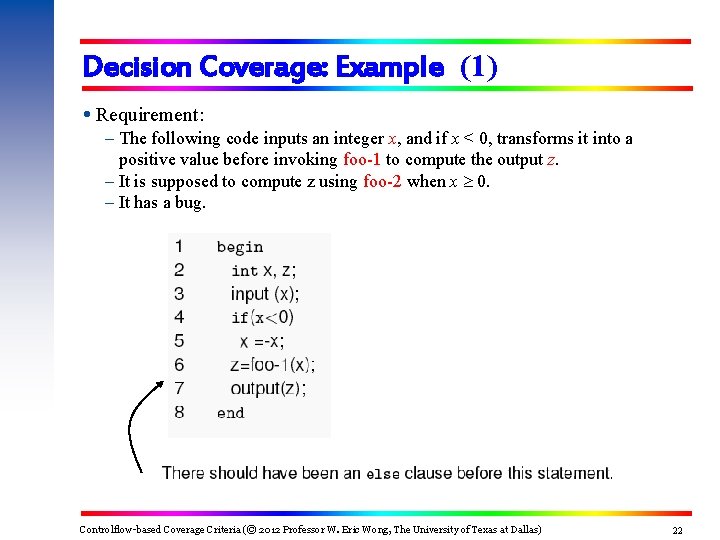
Decision Coverage: Example (1) Requirement: – The following code inputs an integer x, and if x < 0, transforms it into a positive value before invoking foo-1 to compute the output z. – It is supposed to compute z using foo-2 when x 0. – It has a bug. Controlflow-based Coverage Criteria (© 2012 Professor W. Eric Wong, The University of Texas at Dallas) 22
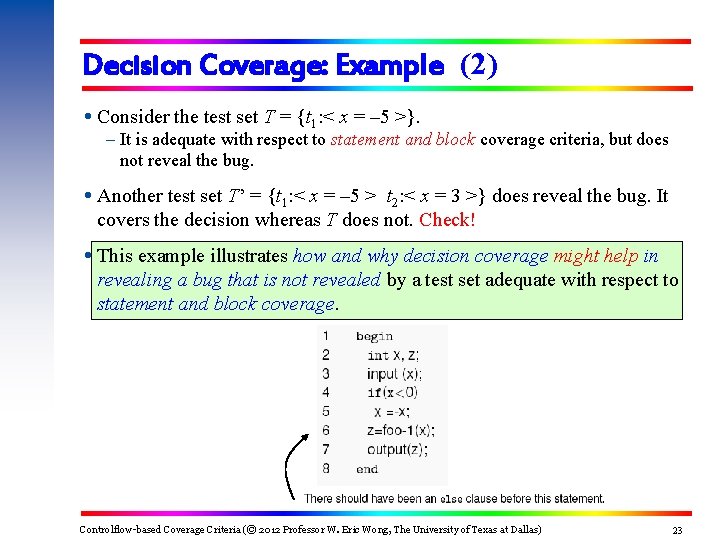
Decision Coverage: Example (2) Consider the test set T = {t 1: < x = – 5 >}. – It is adequate with respect to statement and block coverage criteria, but does not reveal the bug. Another test set T’ = {t 1: < x = – 5 > t 2: < x = 3 >} does reveal the bug. It covers the decision whereas T does not. Check! This example illustrates how and why decision coverage might help in revealing a bug that is not revealed by a test set adequate with respect to statement and block coverage. Controlflow-based Coverage Criteria (© 2012 Professor W. Eric Wong, The University of Texas at Dallas) 23
Decision Coverage: Computation The decision coverage of T with respect to (P, R) is computed as Dc / (De − Di), where Dc is the number of decisions covered. Di is the number of infeasible decisions, and De is the total number of decisions in the program, i. e. , the size of the decision coverage domain. T is considered adequate with respect to the decision coverage criterion if the decision coverage of T with respect to (P, R) is 1. Controlflow-based Coverage Criteria (© 2012 Professor W. Eric Wong, The University of Texas at Dallas) 24
Decision Coverage: Domain The domain of decision coverage consists of all decisions in the program under test. Controlflow-based Coverage Criteria (© 2012 Professor W. Eric Wong, The University of Texas at Dallas) 25
Condition Coverage A decision can be composed of a simple condition such as x < 0, or of a more complex condition, such as ((x < 0 AND y < 0) OR (p q)). AND, OR, XOR are the logical operators that connect two or more simple conditions to form a compound condition. A simple condition is considered covered if it evaluates to true and false in one or more executions of the program in which it occurs. A compound condition is considered covered if each simple condition it is comprised of is also covered. Controlflow-based Coverage Criteria (© 2012 Professor W. Eric Wong, The University of Texas at Dallas) 26
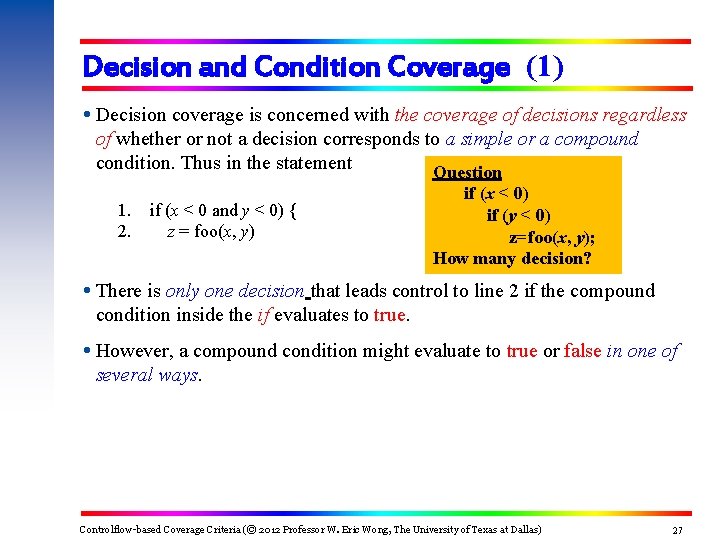
Decision and Condition Coverage (1) Decision coverage is concerned with the coverage of decisions regardless of whether or not a decision corresponds to a simple or a compound condition. Thus in the statement Question 1. 2. if (x < 0 and y < 0) { z = foo(x, y) if (x < 0) if (y < 0) z=foo(x, y); How many decision? There is only one decision that leads control to line 2 if the compound condition inside the if evaluates to true. However, a compound condition might evaluate to true or false in one of several ways. Controlflow-based Coverage Criteria (© 2012 Professor W. Eric Wong, The University of Texas at Dallas) 27
Decision and Condition Coverage (2) Referring to the following code 1. if (x < 0 and y < 0) { 2. z = foo(x, y) The condition at line 1 evaluates to false when x 0 regardless of the value of y. Another condition, such as (x < 0 OR y < 0), evaluates to true regardless of the value of y, when x < 0. With this evaluation characteristic in view, compilers often generate code that uses short circuit evaluation of compound conditions. Controlflow-based Coverage Criteria (© 2012 Professor W. Eric Wong, The University of Texas at Dallas) 28
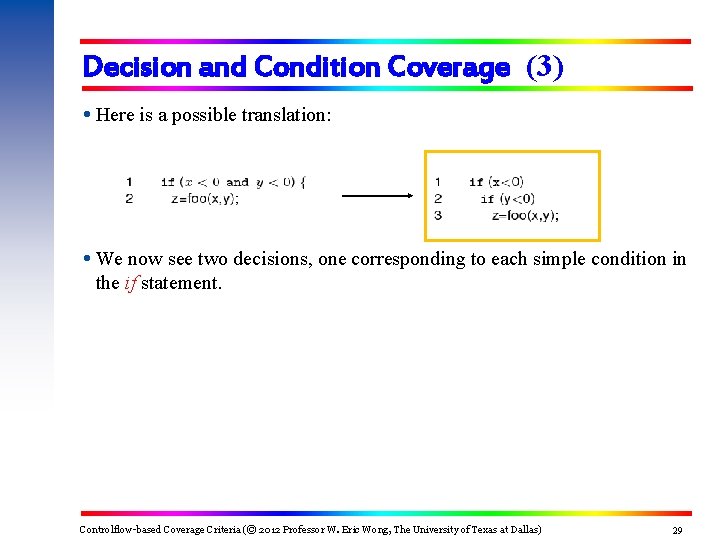
Decision and Condition Coverage (3) Here is a possible translation: We now see two decisions, one corresponding to each simple condition in the if statement. Controlflow-based Coverage Criteria (© 2012 Professor W. Eric Wong, The University of Texas at Dallas) 29
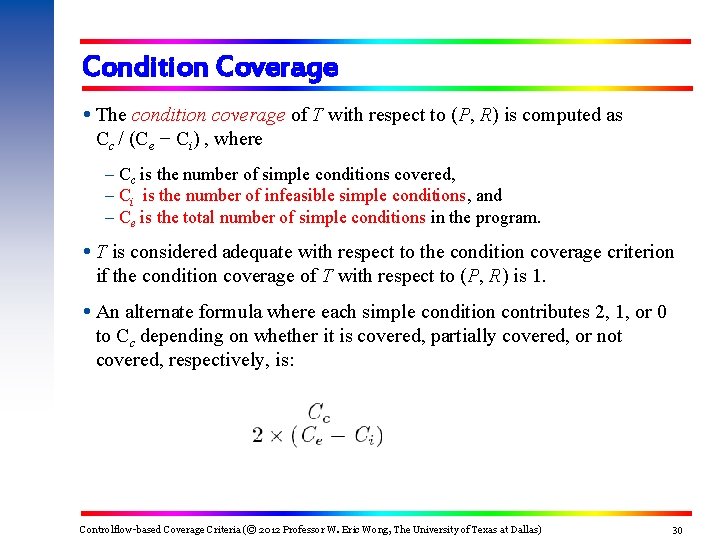
Condition Coverage The condition coverage of T with respect to (P, R) is computed as Cc / (Ce − Ci) , where – Cc is the number of simple conditions covered, – Ci is the number of infeasible simple conditions, and – Ce is the total number of simple conditions in the program. T is considered adequate with respect to the condition coverage criterion if the condition coverage of T with respect to (P, R) is 1. An alternate formula where each simple condition contributes 2, 1, or 0 to Cc depending on whether it is covered, partially covered, or not covered, respectively, is: Controlflow-based Coverage Criteria (© 2012 Professor W. Eric Wong, The University of Texas at Dallas) 30
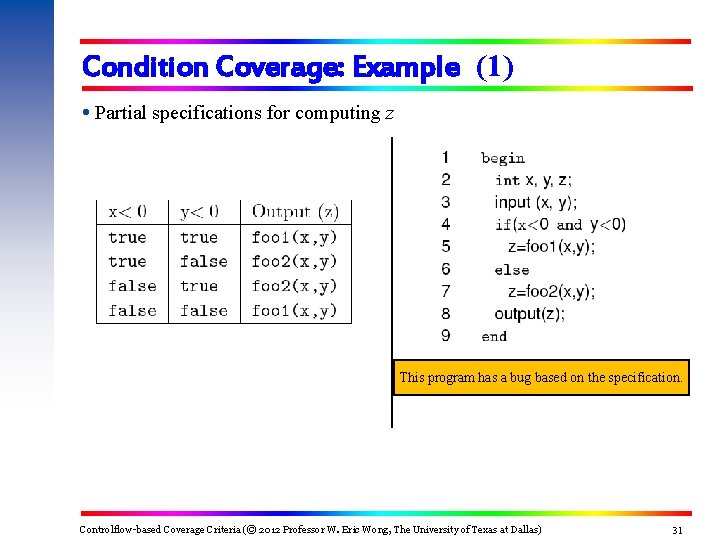
Condition Coverage: Example (1) Partial specifications for computing z This program has a bug based on the specification. Controlflow-based Coverage Criteria (© 2012 Professor W. Eric Wong, The University of Texas at Dallas) 31
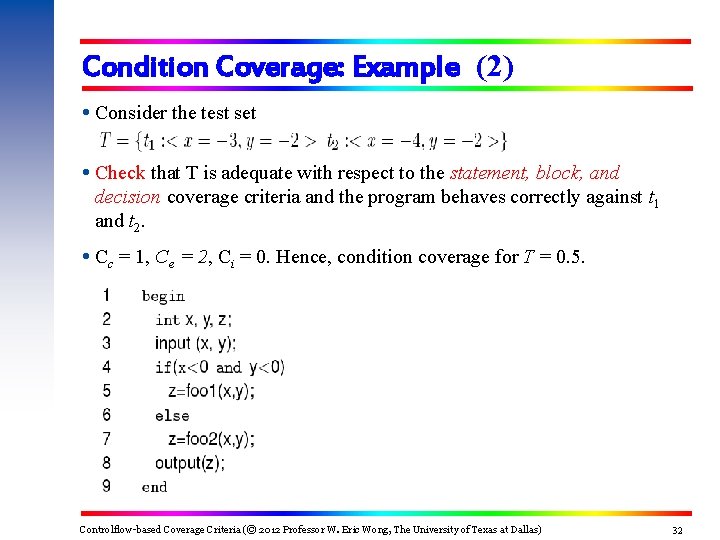
Condition Coverage: Example (2) Consider the test set Check that T is adequate with respect to the statement, block, and decision coverage criteria and the program behaves correctly against t 1 and t 2. Cc = 1, Ce = 2, Ci = 0. Hence, condition coverage for T = 0. 5. Controlflow-based Coverage Criteria (© 2012 Professor W. Eric Wong, The University of Texas at Dallas) 32
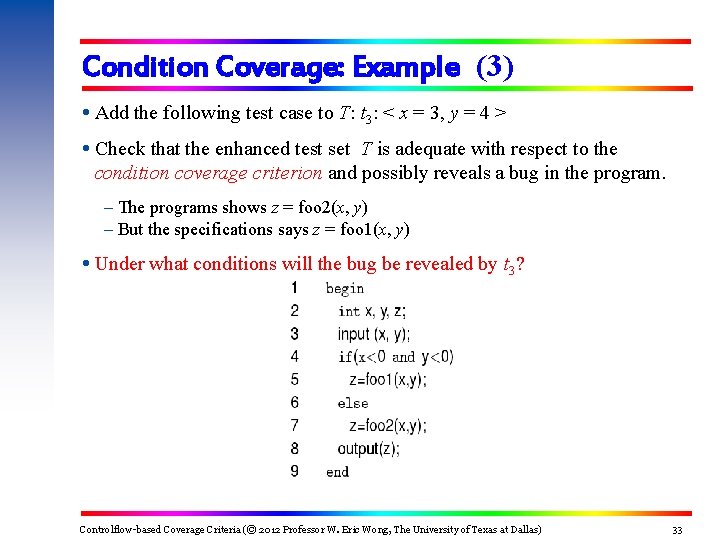
Condition Coverage: Example (3) Add the following test case to T: t 3: < x = 3, y = 4 > Check that the enhanced test set T is adequate with respect to the condition coverage criterion and possibly reveals a bug in the program. – The programs shows z = foo 2(x, y) – But the specifications says z = foo 1(x, y) Under what conditions will the bug be revealed by t 3? Controlflow-based Coverage Criteria (© 2012 Professor W. Eric Wong, The University of Texas at Dallas) 33
Condition/Decision Coverage When a decision is composed of a compound condition, decision coverage does not imply that each simple condition within a compound condition has taken both values true and false. Condition coverage ensures that each component simple condition within a condition has taken both values true and false. Question: Does the condition coverage require each decision to take all its outcomes? Controlflow-based Coverage Criteria (© 2012 Professor W. Eric Wong, The University of Texas at Dallas) 34
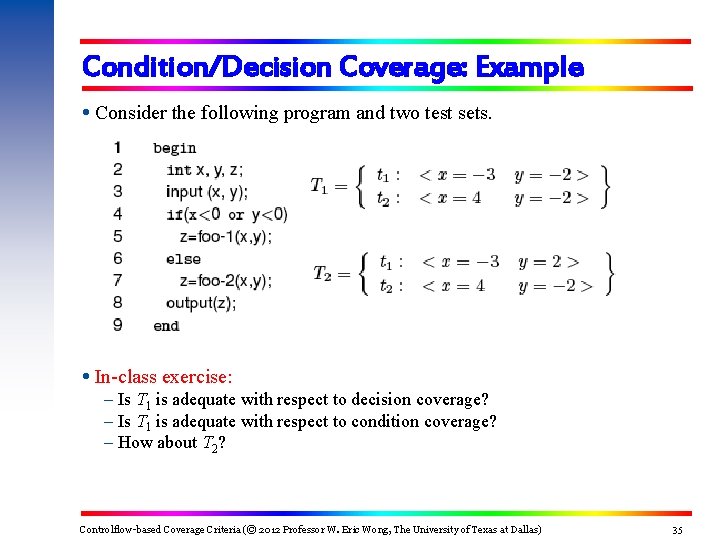
Condition/Decision Coverage: Example Consider the following program and two test sets. In-class exercise: – Is T 1 is adequate with respect to decision coverage? – Is T 1 is adequate with respect to condition coverage? – How about T 2? Controlflow-based Coverage Criteria (© 2012 Professor W. Eric Wong, The University of Texas at Dallas) 35
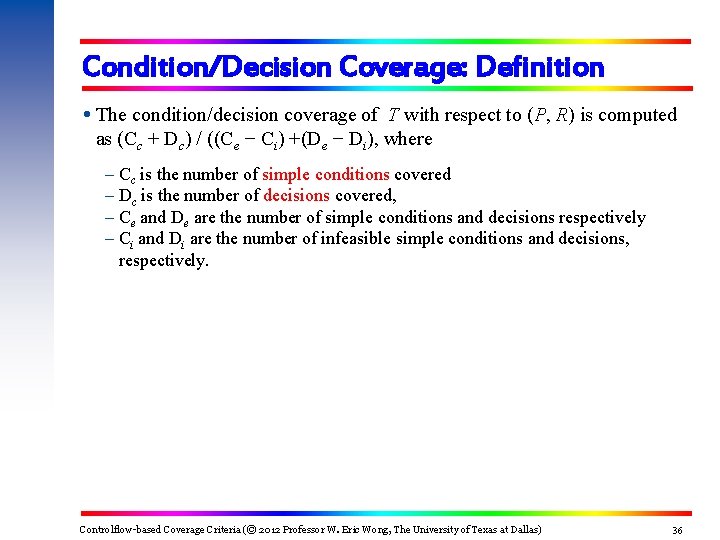
Condition/Decision Coverage: Definition The condition/decision coverage of T with respect to (P, R) is computed as (Cc + Dc) / ((Ce − Ci) +(De − Di), where – Cc is the number of simple conditions covered – Dc is the number of decisions covered, – Ce and De are the number of simple conditions and decisions respectively – Ci and Di are the number of infeasible simple conditions and decisions, respectively. Controlflow-based Coverage Criteria (© 2012 Professor W. Eric Wong, The University of Texas at Dallas) 36
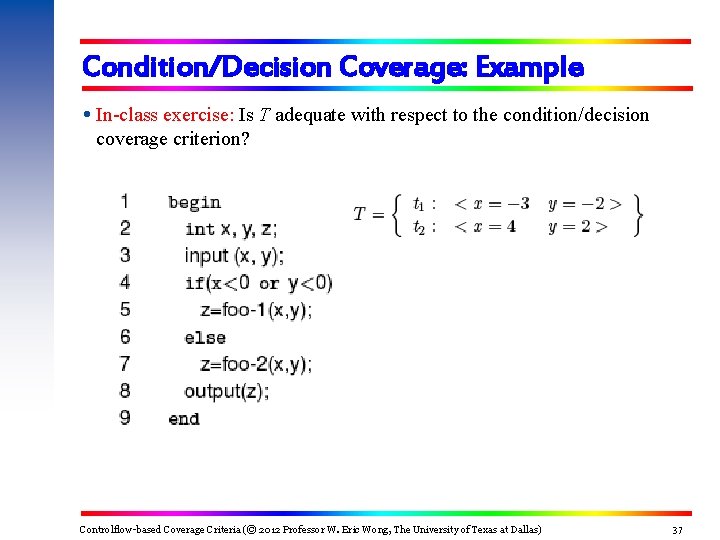
Condition/Decision Coverage: Example In-class exercise: Is T adequate with respect to the condition/decision coverage criterion? Controlflow-based Coverage Criteria (© 2012 Professor W. Eric Wong, The University of Texas at Dallas) 37
Multiple Condition Coverage 38
Multiple Condition Coverage Consider a compound condition with two or more simple conditions. Using condition coverage on some compound condition C implies that each simple condition within C needs to be evaluated to true and false. However, does it imply that all combinations of the values of the individual simple conditions in C have been exercised? Controlflow-based Coverage Criteria (© 2012 Professor W. Eric Wong, The University of Texas at Dallas) 39
Multiple Condition Coverage/Simple Condition Coverage Multiple condition coverage versus simple condition coverage is similar to uni-dimensional equivalence class partitioning versus multi-dimensional equivalence partitioning. considered separately versus considered simultaneously Controlflow-based Coverage Criteria (© 2012 Professor W. Eric Wong, The University of Texas at Dallas) 40
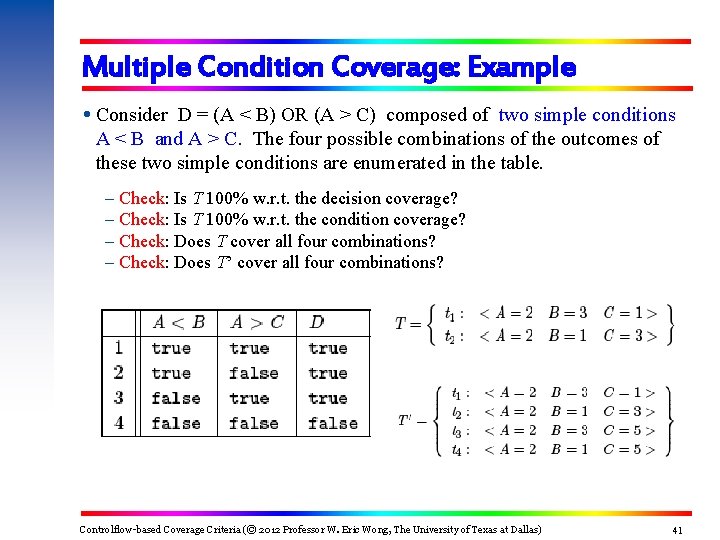
Multiple Condition Coverage: Example Consider D = (A < B) OR (A > C) composed of two simple conditions A < B and A > C. The four possible combinations of the outcomes of these two simple conditions are enumerated in the table. – Check: Is T 100% w. r. t. the decision coverage? – Check: Is T 100% w. r. t. the condition coverage? – Check: Does T cover all four combinations? – Check: Does T ’ cover all four combinations? Controlflow-based Coverage Criteria (© 2012 Professor W. Eric Wong, The University of Texas at Dallas) 41
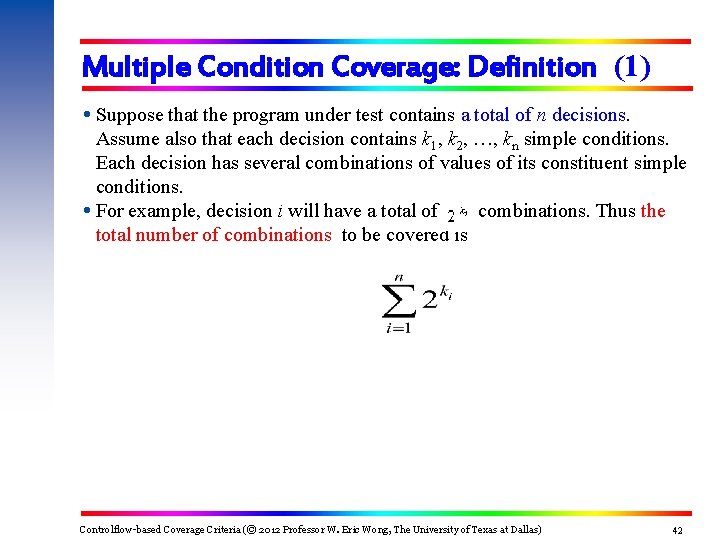
Multiple Condition Coverage: Definition (1) Suppose that the program under test contains a total of n decisions. Assume also that each decision contains k 1, k 2, …, kn simple conditions. Each decision has several combinations of values of its constituent simple conditions. For example, decision i will have a total of combinations. Thus the total number of combinations to be covered is Controlflow-based Coverage Criteria (© 2012 Professor W. Eric Wong, The University of Texas at Dallas) 42
Multiple Condition Coverage: Definition (2) The multiple condition coverage of T with respect to (P, R) is computed as Cc / (Ce − Ci), where: – Cc is the number of combinations covered, – Ci is the number of infeasible simple combinations, and – Ce is the total number of combinations in the program. T is considered adequate with respect to the multiple condition coverage criterion if the condition coverage of T with respect to (P, R) is 1. Controlflow-based Coverage Criteria (© 2012 Professor W. Eric Wong, The University of Texas at Dallas) 43
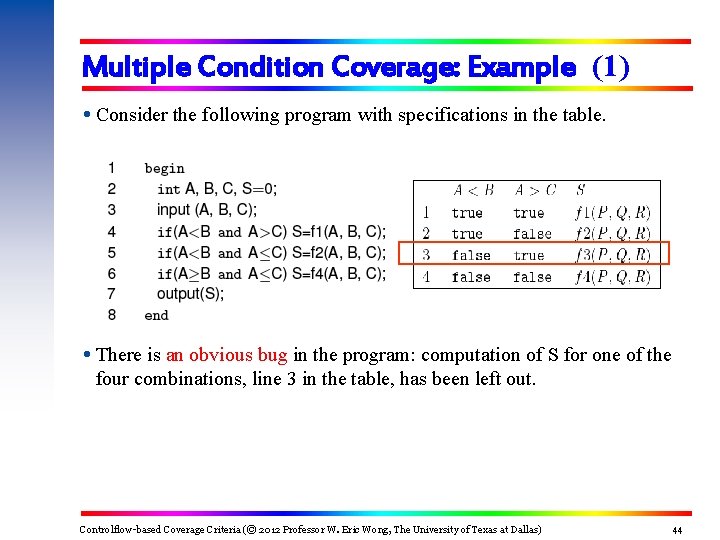
Multiple Condition Coverage: Example (1) Consider the following program with specifications in the table. There is an obvious bug in the program: computation of S for one of the four combinations, line 3 in the table, has been left out. Controlflow-based Coverage Criteria (© 2012 Professor W. Eric Wong, The University of Texas at Dallas) 44
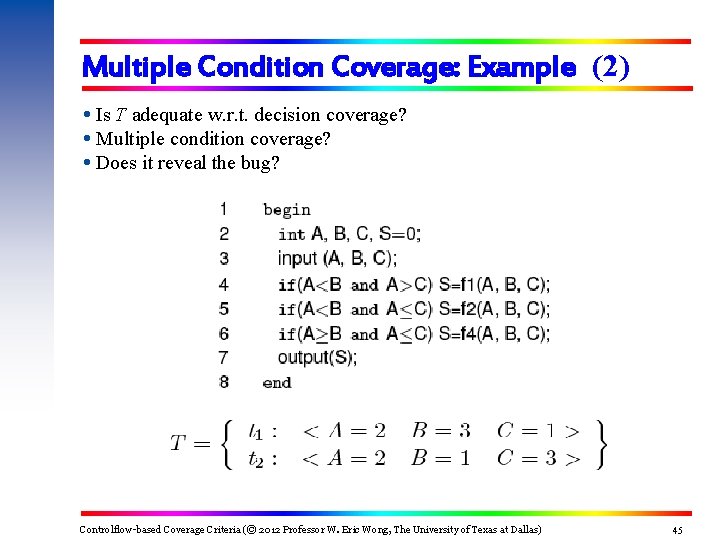
Multiple Condition Coverage: Example (2) Is T adequate w. r. t. decision coverage? Multiple condition coverage? Does it reveal the bug? Controlflow-based Coverage Criteria (© 2012 Professor W. Eric Wong, The University of Texas at Dallas) 45
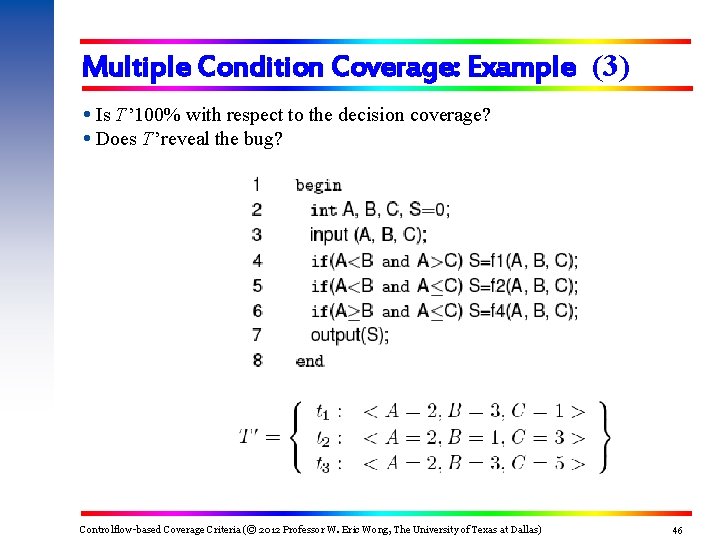
Multiple Condition Coverage: Example (3) Is T ’ 100% with respect to the decision coverage? Does T ’reveal the bug? Controlflow-based Coverage Criteria (© 2012 Professor W. Eric Wong, The University of Texas at Dallas) 46
Multiple Condition Coverage: Example (4) In-class exercise: – Is T ’ 100% w. r. t. simple condition coverage? – Is T ’ 100% w. r. t. multiple condition coverage? Now add a test to T ’ to cover the uncovered combinations. – Does your test reveal the bug? – If yes, then under what conditions? Controlflow-based Coverage Criteria (© 2012 Professor W. Eric Wong, The University of Texas at Dallas) 47
- Slides: 47