
CONTROL WHEN MANAGERS MONITOR PERFORMANCE Controlling Defined as
- Slides: 33
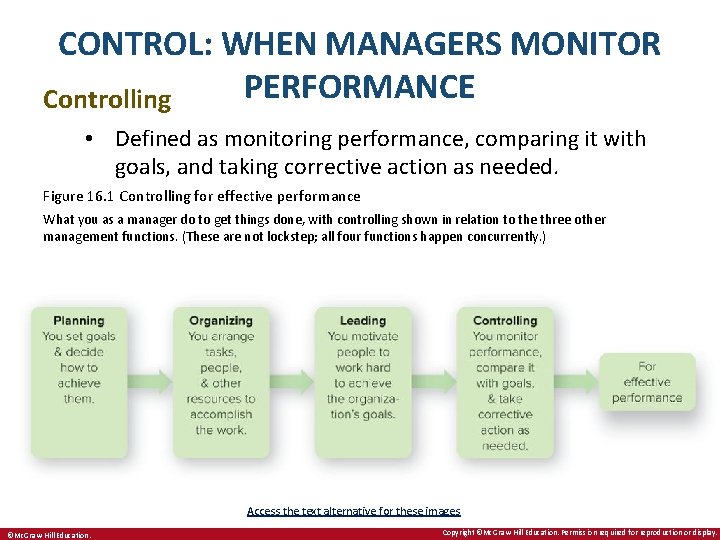
CONTROL: WHEN MANAGERS MONITOR PERFORMANCE Controlling • Defined as monitoring performance, comparing it with goals, and taking corrective action as needed. Figure 16. 1 Controlling for effective performance What you as a manager do to get things done, with controlling shown in relation to the three other management functions. (These are not lockstep; all four functions happen concurrently. ) Access the text alternative for these images ©Mc. Graw-Hill Education. Copyright ©Mc. Graw-Hill Education. Permission required for reproduction or display.
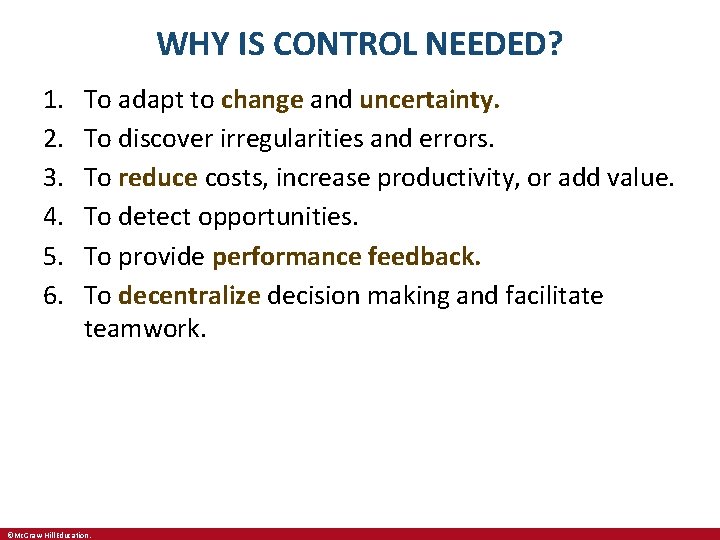
WHY IS CONTROL NEEDED? 1. 2. 3. 4. 5. 6. To adapt to change and uncertainty. To discover irregularities and errors. To reduce costs, increase productivity, or add value. To detect opportunities. To provide performance feedback. To decentralize decision making and facilitate teamwork. ©Mc. Graw-Hill Education.
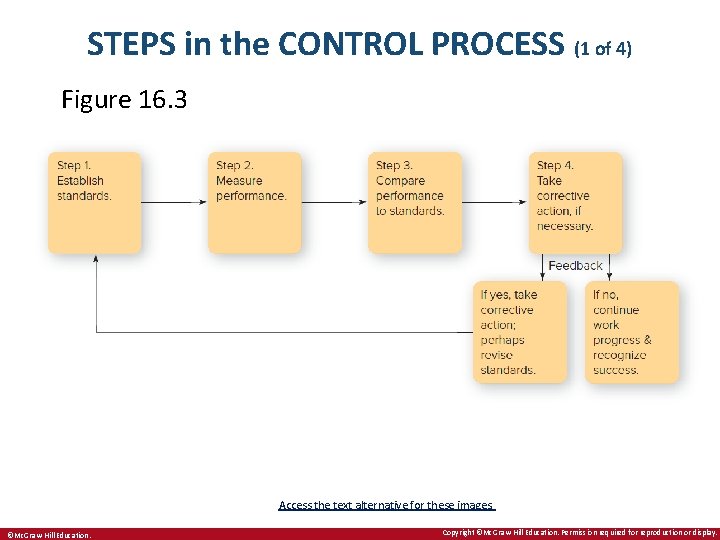
STEPS in the CONTROL PROCESS (1 of 4) Figure 16. 3 Access the text alternative for these images. ©Mc. Graw-Hill Education. Copyright ©Mc. Graw-Hill Education. Permission required for reproduction or display.
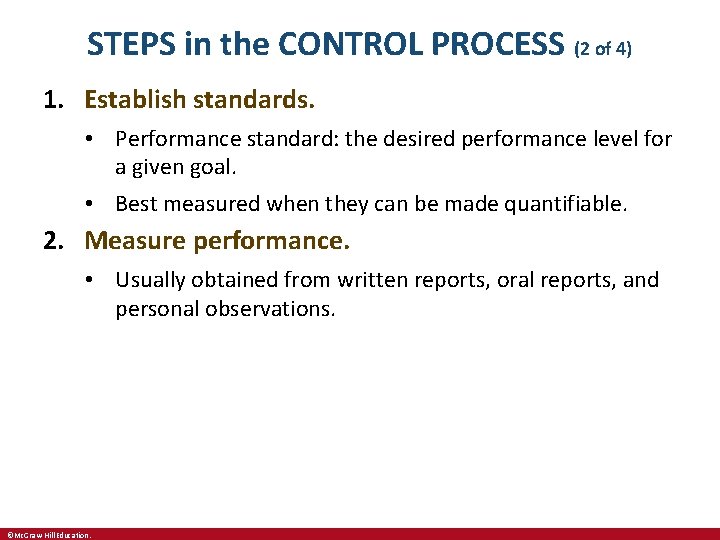
STEPS in the CONTROL PROCESS (2 of 4) 1. Establish standards. • Performance standard: the desired performance level for a given goal. • Best measured when they can be made quantifiable. 2. Measure performance. • Usually obtained from written reports, oral reports, and personal observations. ©Mc. Graw-Hill Education.
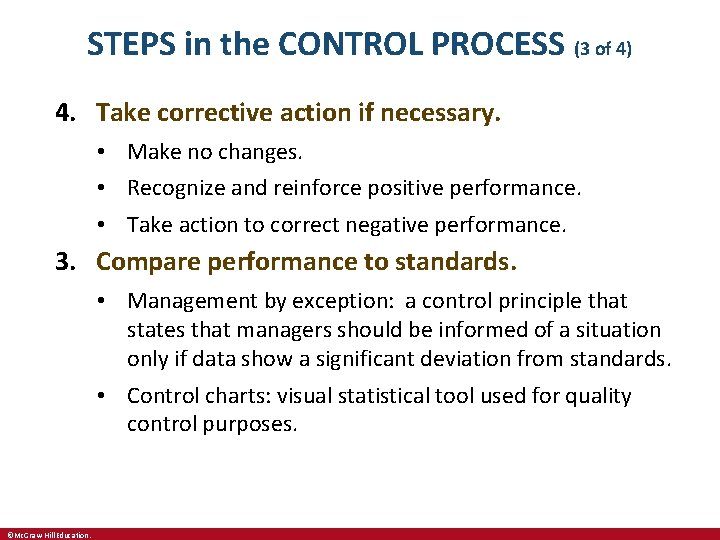
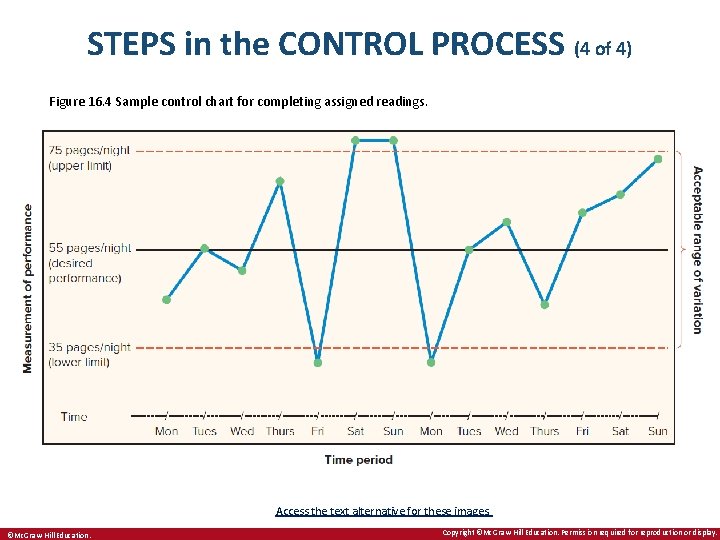
STEPS in the CONTROL PROCESS (3 of 4) 4. Take corrective action if necessary. • Make no changes. • Recognize and reinforce positive performance. • Take action to correct negative performance. 3. Compare performance to standards. • Management by exception: a control principle that states that managers should be informed of a situation only if data show a significant deviation from standards. • Control charts: visual statistical tool used for quality control purposes. ©Mc. Graw-Hill Education.
STEPS in the CONTROL PROCESS (4 of 4) Figure 16. 4 Sample control chart for completing assigned readings. Access the text alternative for these images. ©Mc. Graw-Hill Education. Copyright ©Mc. Graw-Hill Education. Permission required for reproduction or display.
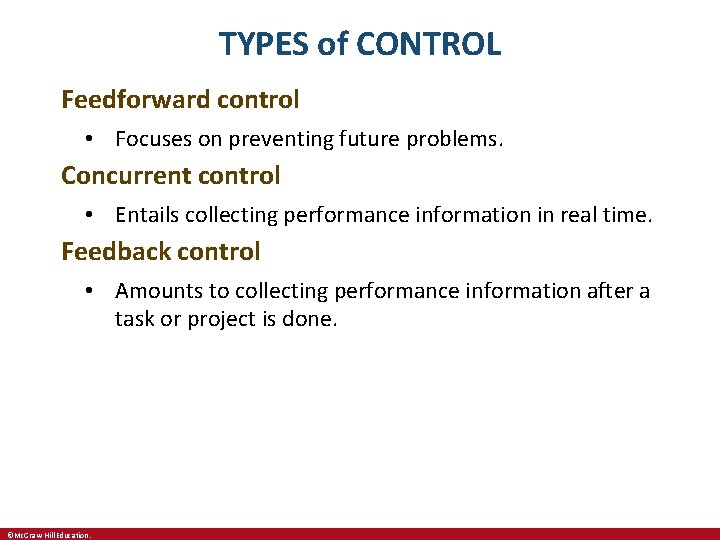
TYPES of CONTROL Feedforward control • Focuses on preventing future problems. Concurrent control • Entails collecting performance information in real time. Feedback control • Amounts to collecting performance information after a task or project is done. ©Mc. Graw-Hill Education.
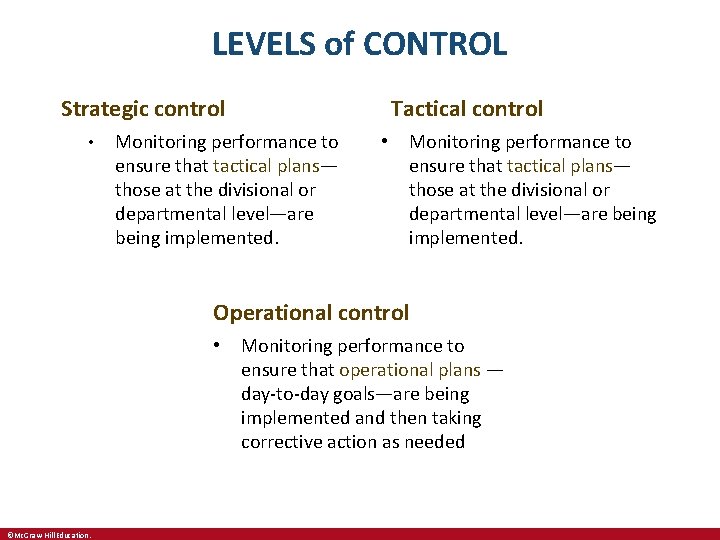
LEVELS of CONTROL Strategic control • Tactical control Monitoring performance to ensure that tactical plans— those at the divisional or departmental level—are being implemented. • Monitoring performance to ensure that tactical plans— those at the divisional or departmental level—are being implemented. Operational control • ©Mc. Graw-Hill Education. Monitoring performance to ensure that operational plans — day-to-day goals—are being implemented and then taking corrective action as needed
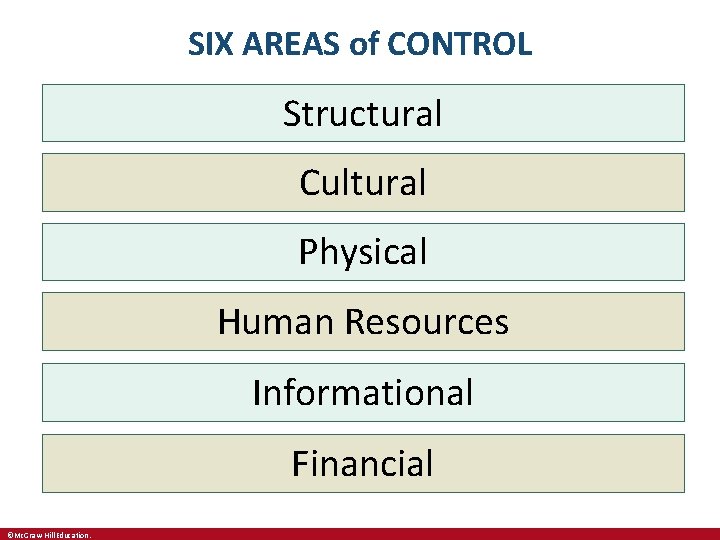
SIX AREAS of CONTROL Structural Cultural Physical Human Resources Informational Financial ©Mc. Graw-Hill Education.
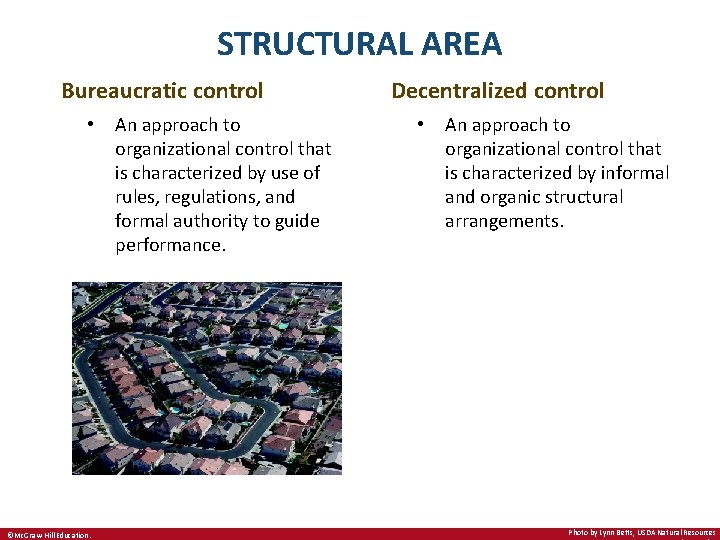
STRUCTURAL AREA Bureaucratic control • ©Mc. Graw-Hill Education. An approach to organizational control that is characterized by use of rules, regulations, and formal authority to guide performance. Decentralized control • An approach to organizational control that is characterized by informal and organic structural arrangements. Photo by Lynn Betts, USDA Natural Resources
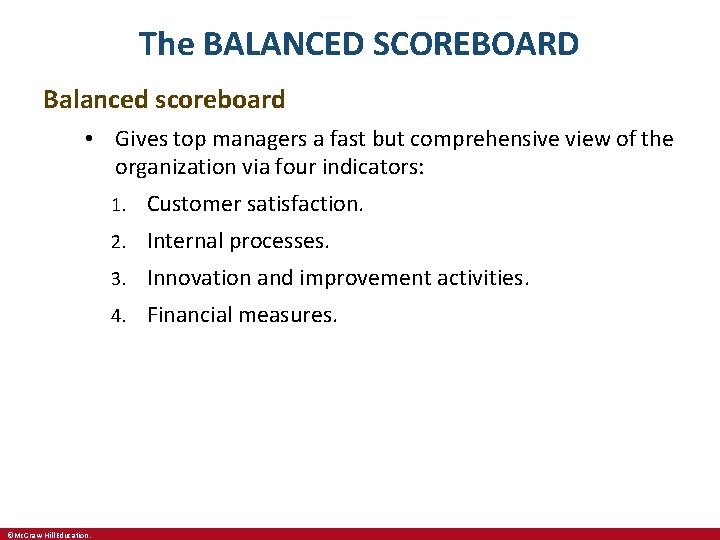
The BALANCED SCOREBOARD Balanced scoreboard • Gives top managers a fast but comprehensive view of the organization via four indicators: ©Mc. Graw-Hill Education. 1. Customer satisfaction. 2. Internal processes. 3. Innovation and improvement activities. 4. Financial measures.
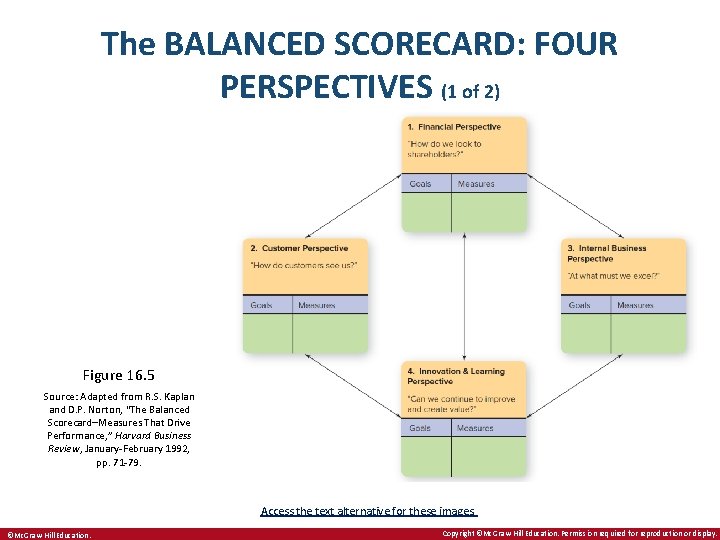
The BALANCED SCORECARD: FOUR PERSPECTIVES (1 of 2) Figure 16. 5 Source: Adapted from R. S. Kaplan and D. P. Norton, “The Balanced Scorecard Measures That Drive Performance, ” Harvard Business Review, January-February 1992, pp. 71 -79. Access the text alternative for these images. ©Mc. Graw-Hill Education. Copyright ©Mc. Graw-Hill Education. Permission required for reproduction or display.
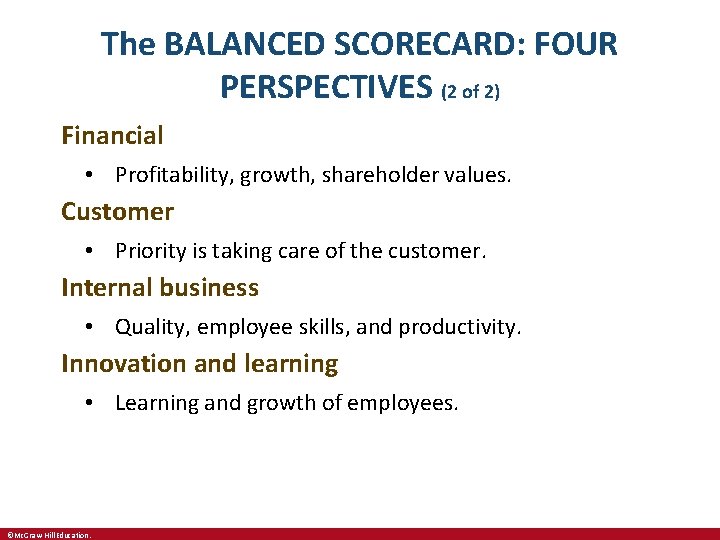
The BALANCED SCORECARD: FOUR PERSPECTIVES (2 of 2) Financial • Profitability, growth, shareholder values. Customer • Priority is taking care of the customer. Internal business • Quality, employee skills, and productivity. Innovation and learning • Learning and growth of employees. ©Mc. Graw-Hill Education.
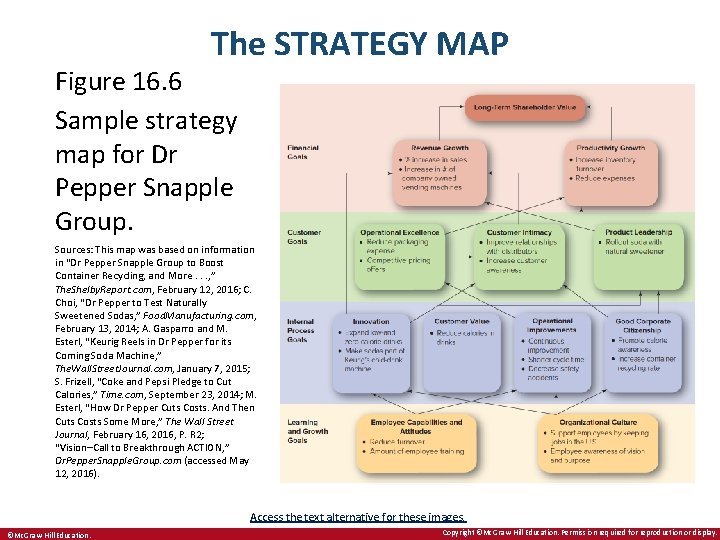
The VISUAL REPRESENTATION of a BALANCED SCORECARD Strategy map • Visual representation of the four perspectives of the balanced scorecard that enables managers to communicate their goals so that everyone in the company can understand how their jobs are linked to the overall objectives of the organization. ©Mc. Graw-Hill Education.
The STRATEGY MAP Figure 16. 6 Sample strategy map for Dr Pepper Snapple Group. Sources: This map was based on information in “Dr Pepper Snapple Group to Boost Container Recycling, and More. . . , ” The. Shelby. Report. com, February 12, 2016; C. Choi, “Dr Pepper to Test Naturally Sweetened Sodas, ” Food. Manufacturing. com, February 13, 2014; A. Gasparro and M. Esterl, “Keurig Reels in Dr Pepper for its Coming Soda Machine, ” The. Wall. Street. Journal. com, January 7, 2015; S. Frizell, “Coke and Pepsi Pledge to Cut Calories, ” Time. com, September 23, 2014; M. Esterl, “How Dr Pepper Cuts Costs. And Then Cuts Costs Some More, ” The Wall Street Journal, February 16, 2016, P. R 2; “Vision Call to Breakthrough ACTION, ” Dr. Pepper. Snapple. Group. com (accessed May 12, 2016). Access the text alternative for these images. ©Mc. Graw-Hill Education. Copyright ©Mc. Graw-Hill Education. Permission required for reproduction or display.
BUDGETS: FORMAL FINANCIAL PROJECTIONS Budget • Formal financial projection. Incremental budgeting • Allocates increased or decreased funds to a department by using the last budget period as a reference point. • Only incremental changes in the budget request are reviewed. ©Mc. Graw-Hill Education. © 3 D Vector/Shutterstock
FIXED VERSUS VARIABLE BUDGETS FIXED BUDGETS • Allocates resources on the basis of a single estimate of costs ©Mc. Graw-Hill Education. VARIABLE BUDGETS • Allows the allocation of resources to vary in proportion with various levels of activity
FINANCIAL STATEMENTS Balanced sheet • Summarizes an organization’s overall financial worth— assets and liabilities—at a specific point in time. Income statement • Summarizes an organization’s financial results—revenues and expenses—over specified period of time. ©Mc. Graw-Hill Education.
AUDITS Audit: formal verification of an organization’s financial and operational systems. • External: performed by outside experts. • Internal: performed by organization’s own professional staff. ©Mc. Graw-Hill Education.
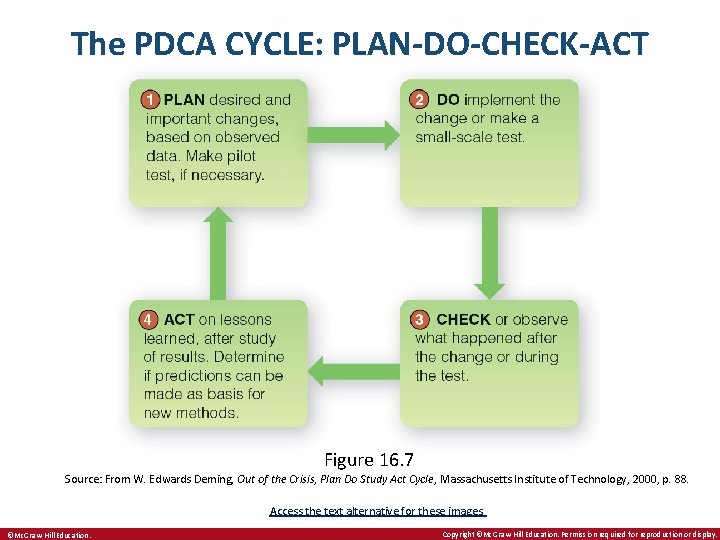
DEMING MANAGEMENT 1. Quality should be aimed at the needs of the consumer. 2. Companies should aim at improving the system, not blaming workers. 3. Improved quality leads to increased market share, increased company prospects, and increased employment. 4. Quality can be improved on the basis of hard data, using the PDCA cycle. ©Mc. Graw-Hill Education.
The PDCA CYCLE: PLAN-DO-CHECK-ACT Figure 16. 7 Source: From W. Edwards Deming, Out of the Crisis, Plan Do Study Act Cycle, Massachusetts Institute of Technology, 2000, p. 88. Access the text alternative for these images. ©Mc. Graw-Hill Education. Copyright ©Mc. Graw-Hill Education. Permission required for reproduction or display.
TOTAL QUALITY MANAGEMENT Total quality management (TQM) • A comprehensive approach—led by top management and supported throughout the organization—dedicated to continuous quality improvement, training, and customer satisfaction. ©Mc. Graw-Hill Education.
TWO CORE PRINCIPLES of TQM 1. People orientation • Everyone involved in the organization should focus on delivering value to customers. 2. Improvement orientation • Everyone should work on continuously improving work processes. ©Mc. Graw-Hill Education.
PEOPLE ORIENTATION • Delivering customer value is most important. • People will focus on quality if they feel empowered. • TQM requires training, teamwork, and crossfunctional efforts. ©Mc. Graw-Hill Education.
IMPROVEMENT ORIENTATION • It’s less expensive to do it right the first time. • It’s better to do small improvements all the time. • Accurate standards must be followed to eliminate small variations. • There must be strong commitment from top management. ©Mc. Graw-Hill Education.
APPLYING TQM to SERVICES RATER scale Enables customers to rate the quality of a service along five dimensions: ©Mc. Graw-Hill Education. 1. Reliability. 2. Assurance. 3. Tangibles. 4. Empathy. 5. Responsiveness.
SOME TQM TECHNIQUES Six Sigma & Lean Six Sigma Outsourcing Reduced cycle time ISO 9000 and 14000 Series Statistical process control ©Mc. Graw-Hill Education.
The KEYS to SUCCESSFUL CONTROL SYSTEMS 1. They are strategic and results oriented. 2. They are timely, accurate, and objective. 3. They are realistic, positive, and understandable and encourage self-control. 4. They are flexible. ©Mc. Graw-Hill Education.
BARRIERS to CONTROL SUCCESS 1. 2. 3. 4. 5. 6. Too much control. Too little control at the right time/s Too little employee participation. Overemphasis on means instead of ends. Overemphasis on paperwork. Overemphasis on one instead of multiple approaches. ©Mc. Graw-Hill Education.
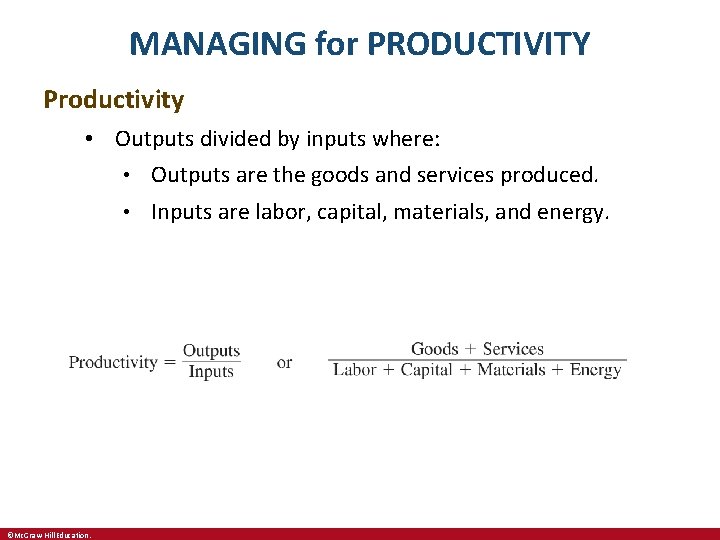
MANAGING for PRODUCTIVITY Productivity • Outputs divided by inputs where: ©Mc. Graw-Hill Education. • Outputs are the goods and services produced. • Inputs are labor, capital, materials, and energy.
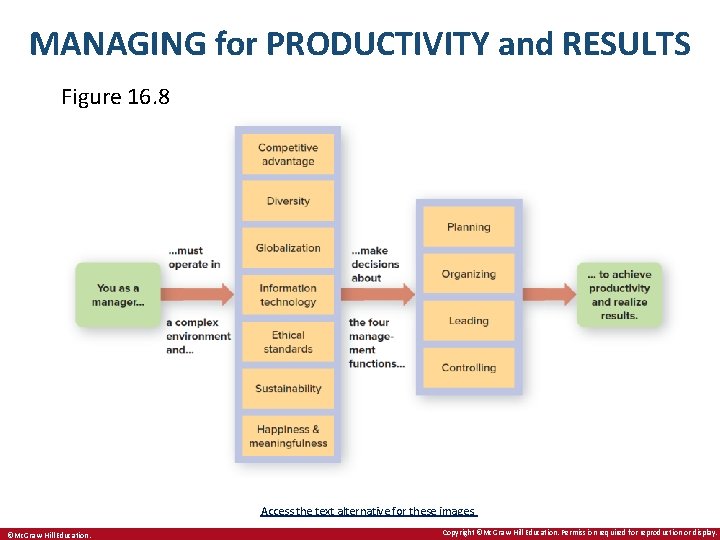
MANAGING for PRODUCTIVITY and RESULTS Figure 16. 8 Access the text alternative for these images. ©Mc. Graw-Hill Education. Copyright ©Mc. Graw-Hill Education. Permission required for reproduction or display.
The ROLE of INFORMATION TECHNOLOGY Enterprise resource planning (ERP) • Software systems and information systems for integrating virtually all aspects of a business, helping managers stay on top of the latest developments. ©Mc. Graw-Hill Education.
PROCESSES to INCREASE PRODUCTIVITY Benchmarking • A way to measure something against a standard, the benchmark. Best practices • A set of guidelines, ethics or ideas that represent the most efficient or prudent course of action. ©Mc. Graw-Hill Education.