
Control unit extension for data hazards Hazard detection
- Slides: 17
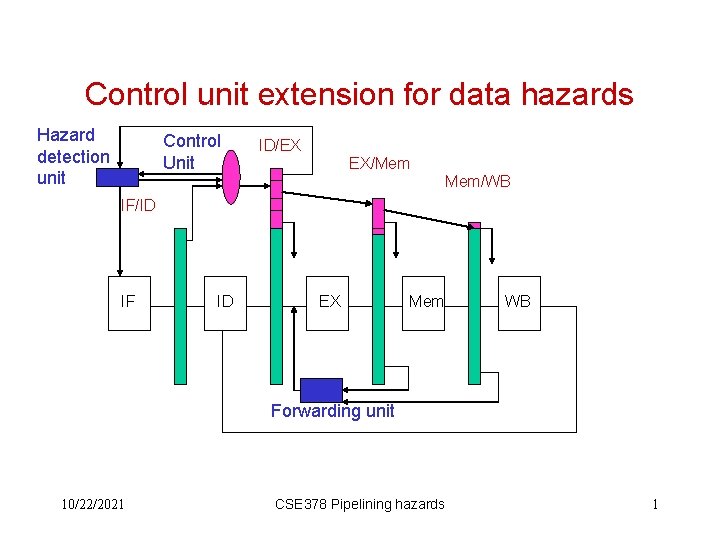
Control unit extension for data hazards Hazard detection unit Control Unit ID/EX EX/Mem Mem/WB IF/ID IF ID EX Mem WB Forwarding unit 10/22/2021 CSE 378 Pipelining hazards 1
Forwarding unit • Forwarding is done prior to ALU computation in EX stage • If we have an R-R instruction, the forwarding unit will need to check – whether EX/Mem result register = IF/ID rs – EX/Mem result register = IF/ID rt – and if so set up muxes to ALU source appropriately • and also whether – Mem/WB result register = IF/ID rs – Mem/WB result register = IF/ID rt – and if so set up muxes to ALU source appropriately 10/22/2021 CSE 378 Pipelining hazards 2
Forwarding unit (continued) • For a Load/Store or Immediate instruction – Need to check forwarding for rs only • For a branch instruction – Need to check forwarding for the registers involved in the comparison 10/22/2021 CSE 378 Pipelining hazards 3
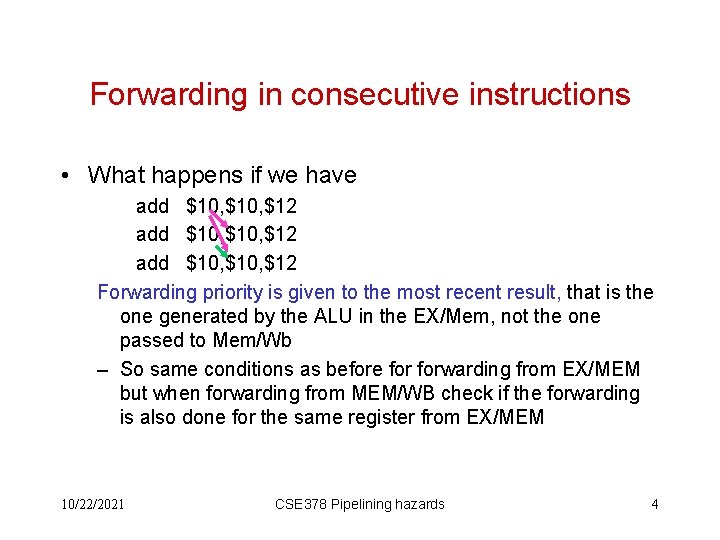
Forwarding in consecutive instructions • What happens if we have add $10, $12 add $10, $12 Forwarding priority is given to the most recent result, that is the one generated by the ALU in the EX/Mem, not the one passed to Mem/Wb – So same conditions as before forwarding from EX/MEM but when forwarding from MEM/WB check if the forwarding is also done for the same register from EX/MEM 10/22/2021 CSE 378 Pipelining hazards 4
Hazard detection unit • If a Load (instruction i-1) is followed by instruction i that needs the result of the load, we need to stall the pipeline for one cycle, that is – instruction i-1 should progress normally – instruction i should not progress – no new instruction should be fetched • The hazard detection unit should operate during the ID stage • When processing instruction i, how do we know instruction i-1 is a Load ? – Mem. Read signal is asserted in ID/EX 10/22/2021 CSE 378 Pipelining hazards 5
Hazard detection unit (continued) • How do we know we should stall – instruction i-1 is a Load and either • ID/EX rt = IF/ID rs, or • ID/EX rt = IF/ID rt • How do we prevent instruction i to progress – Put 0’s in all control fields of ID/EX (becomes a no-op) – Don’t change the IF/ID field (have a control line be asserted at every cycle to write it unless we have to stall) • How do we prevent fetching a new instruction – Have a control line asserted only when we want to write a new value in the PC 10/22/2021 CSE 378 Pipelining hazards 6
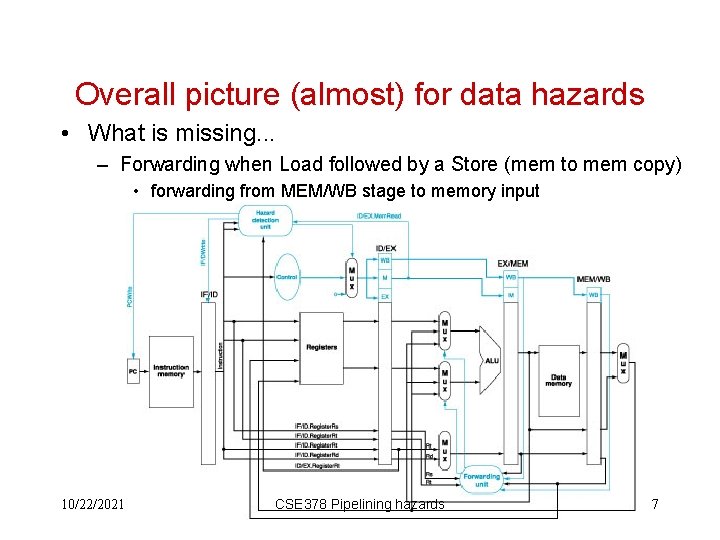
Overall picture (almost) for data hazards • What is missing. . . – Forwarding when Load followed by a Store (mem to mem copy) • forwarding from MEM/WB stage to memory input 10/22/2021 CSE 378 Pipelining hazards 7
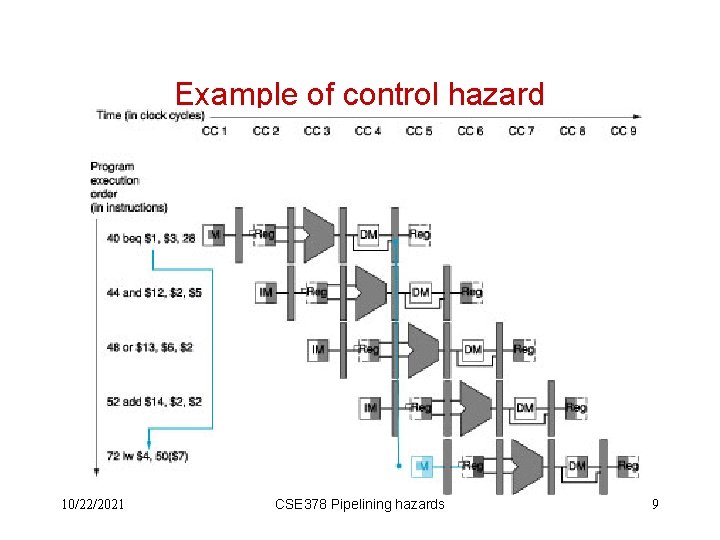
Control hazards • Pipelining and branching don’t get along • Transfer of control (jumps, procedure call/returns, successful branches) cause control hazards • When a branch is known to succeed, at the Mem stage (but could be done stage earlier), there are instructions in the pipeline in stages before Mem that – need to be converted into “no-op” – and we need to start fetching the correct instructions by using the right PC 10/22/2021 CSE 378 Pipelining hazards 8
Example of control hazard 10/22/2021 CSE 378 Pipelining hazards 9
Resolving control hazards • Detecting a potential control hazard is easy – Look at the opcode • We must insure that the state of the program is not changed until the outcome of the branch is known. Possibilities are: – Stall as soon as opcode is detected (cost 3 bubbles; same type of logic as for the load stall but for 3 cycles instead of 1) – Assume that branch won’t be taken (cost only if branch is taken; see next slides) – Use some predictive techniques 10/22/2021 CSE 378 Pipelining hazards 10
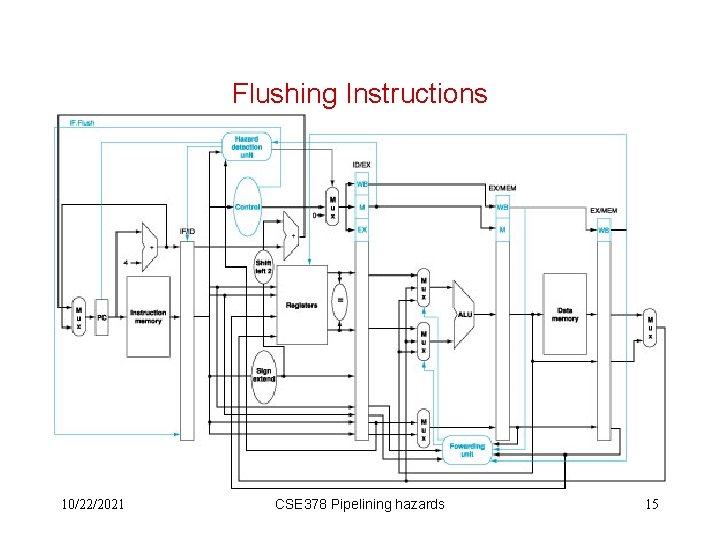
Assume branch not taken strategy • We have a problem if branch is taken! • “No-op” the “wrong” instructions – Once the new PC is known (in Mem stage) • Zero out the instruction field in the IF/ID pipeline register • For the instruction in the ID stage, use the signals that were setup for data dependencies in the Load case • For the instruction in the EX stage, zero out the result of the ALU (e. g, make the result register be register $0) 10/22/2021 CSE 378 Pipelining hazards 11
Optimizations • Move up the result of branch execution – Do target address computation in ID stage (like in multiple cycle implementation) – Comparing registers is “fast”; can be done in first phase of the clock and setting PC in the second phase. – Thus we can reduce stalling time by 1 bubble • If the forwarding is set up right, 2 bubbles can be saved 10/22/2021 CSE 378 Pipelining hazards 12
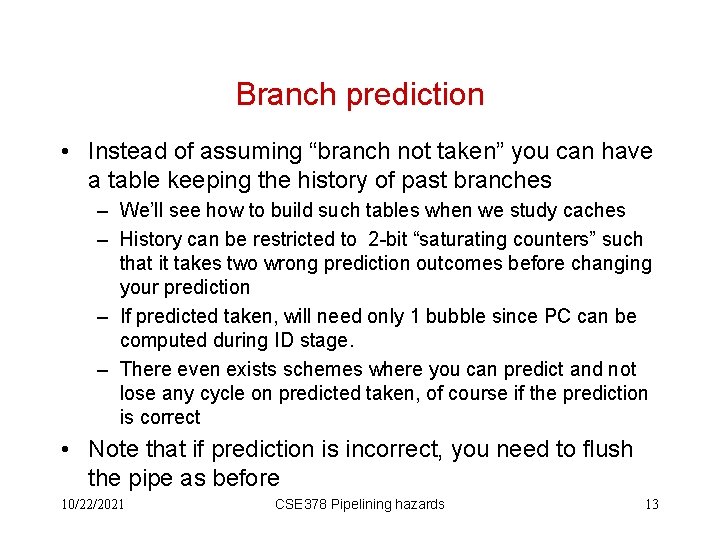
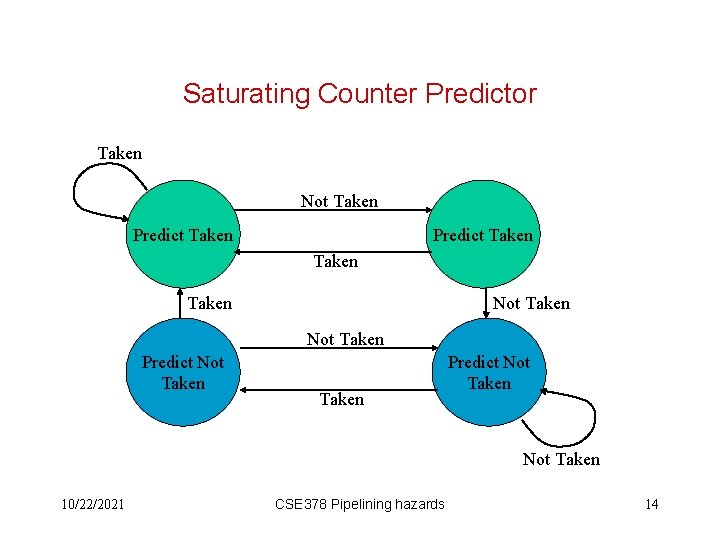
Branch prediction • Instead of assuming “branch not taken” you can have a table keeping the history of past branches – We’ll see how to build such tables when we study caches – History can be restricted to 2 -bit “saturating counters” such that it takes two wrong prediction outcomes before changing your prediction – If predicted taken, will need only 1 bubble since PC can be computed during ID stage. – There even exists schemes where you can predict and not lose any cycle on predicted taken, of course if the prediction is correct • Note that if prediction is incorrect, you need to flush the pipe as before 10/22/2021 CSE 378 Pipelining hazards 13
Saturating Counter Predictor Taken Not Taken Predict Taken Not Taken Predict Not Taken 10/22/2021 CSE 378 Pipelining hazards 14
Flushing Instructions 10/22/2021 CSE 378 Pipelining hazards 15
Current trends in microprocessor design • Superscalar processors – Several pipelines, e. g. , integer pipeline(s), floating-point, load/store unit etc – Several instructions are fetched and decoded at once. They can be executed concurrently if there are no hazards • Out-of-order execution (also called dynamically scheduled processors) – While some instructions are stalled because of dependencies or other causes (cache misses, see later), other instructions down he stream can still proceed. – However results must be stored in program order! 10/22/2021 CSE 378 Pipelining hazards 16
Current trends (continued) • Speculative execution – Predict the outcome of branches and continue processing with (of course) a recovery mechanism. – Because branches occur so often, the branch prediction mechanisms have become very sophisticated – Assume that Load/Stores don’t conflict (of course need to be able to recover) • VLIW (or EPIC) (Very Long Instruction Word) – In “pure VLIW”, each pipeline (functional unit) is assigned a task at every cycle. The compiler does it. – A little less ambitious: have compiler generate long instructions (e. g. , using 3 pipes; cf. Intel IA-64 or Itanium) 10/22/2021 CSE 378 Pipelining hazards 17