
Control Systems Lect 4 Time Response Basil Hamed
Control Systems Lect. 4 Time Response Basil Hamed
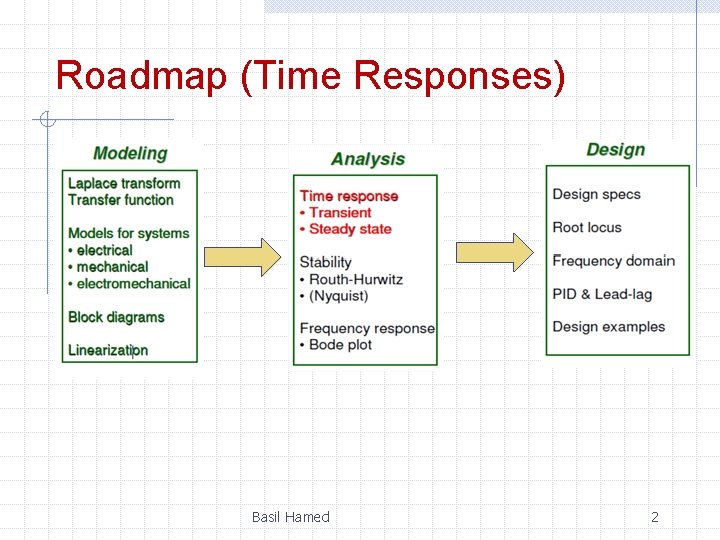
Roadmap (Time Responses) Basil Hamed 2
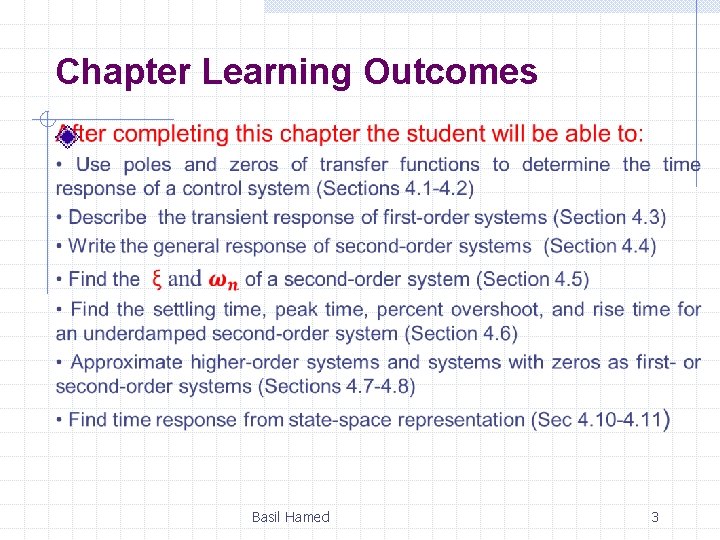
Chapter Learning Outcomes Basil Hamed 3
Why Study Time Responses • Modeling – Some parameters in the system can be estimated or identified by time responses. • Analysis – Evaluate transient and steady-state responses to see if they meets performance requirement (Satisfactory or not? ) • Design – Given design specs in terms of transient and steady state responses, design controllers satisfying all the design specs. Basil Hamed 4
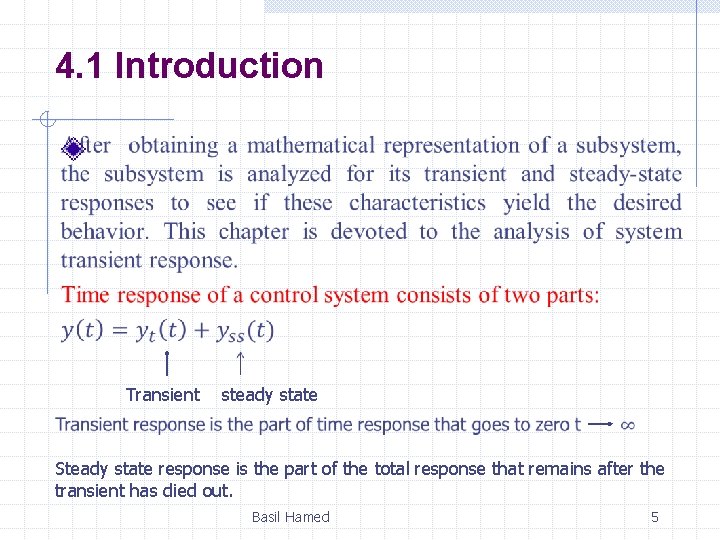
4. 1 Introduction Transient steady state Steady state response is the part of the total response that remains after the transient has died out. Basil Hamed 5
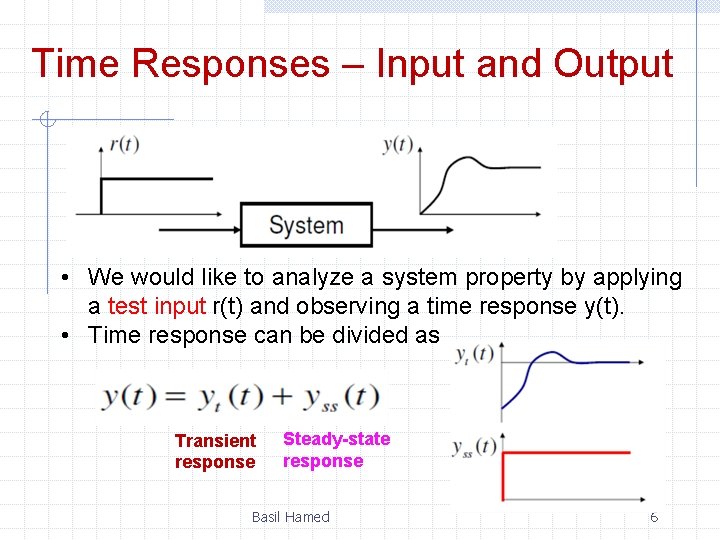
Time Responses – Input and Output • We would like to analyze a system property by applying a test input r(t) and observing a time response y(t). • Time response can be divided as Transient response Steady-state response Basil Hamed 6
4. 2 Poles, Zeros, and System Response • The output response of a system is the sum of two responses: the forced response and the natural response. • Although many techniques, such as solving a differential equation or taking the inverse Laplace transform, enable us to evaluate this output response, these techniques are laborious and time-consuming. • The use of poles and zeros and their relationship to the time response of a system is such a technique. • The concept of poles and zeros, fundamental to the analysis and design of control systems, simplifies the evaluation of a system's response. Basil Hamed 7
4. 2 Poles, Zeros, and System Response Poles of a Transfer Function the poles of a transfer function are the roots of the characteristic polynomial in the denominator. Zeros of a Transfer Function the zeros of a transfer function are the roots of the characteristic polynomial in the nominator. Basil Hamed 8
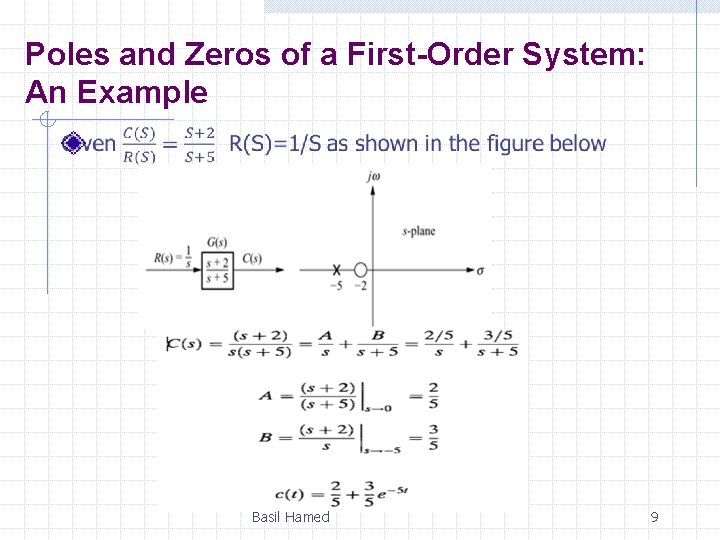
Poles and Zeros of a First-Order System: An Example Basil Hamed 9
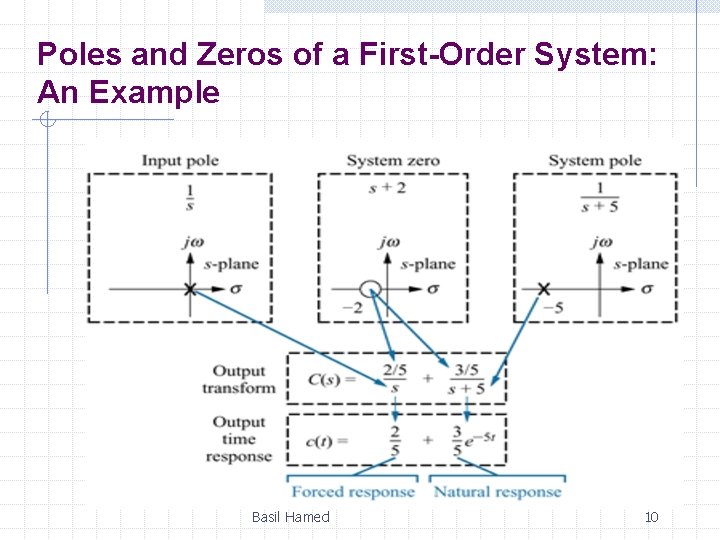
Poles and Zeros of a First-Order System: An Example Basil Hamed 10
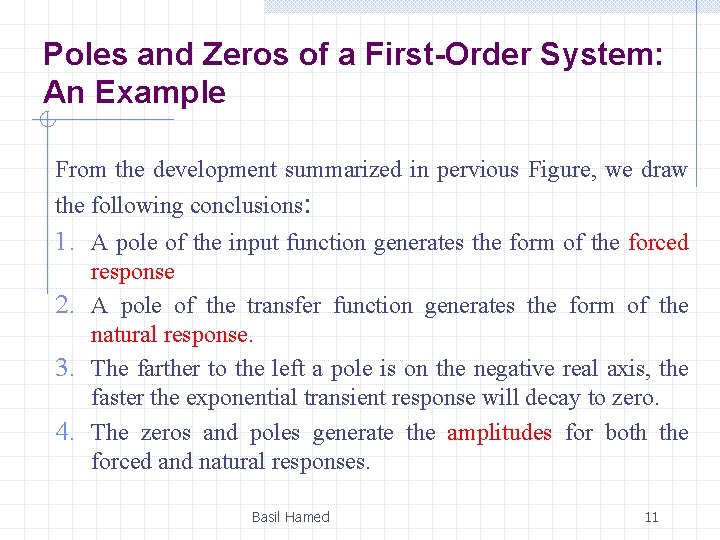
Poles and Zeros of a First-Order System: An Example From the development summarized in pervious Figure, we draw the following conclusions: 1. A pole of the input function generates the form of the forced response 2. A pole of the transfer function generates the form of the natural response. 3. The farther to the left a pole is on the negative real axis, the faster the exponential transient response will decay to zero. 4. The zeros and poles generate the amplitudes for both the forced and natural responses. Basil Hamed 11
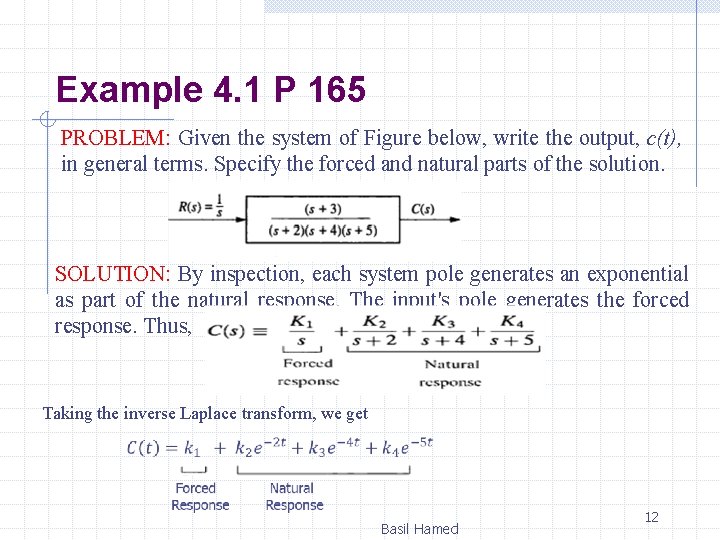
Example 4. 1 P 165 PROBLEM: Given the system of Figure below, write the output, c(t), in general terms. Specify the forced and natural parts of the solution. SOLUTION: By inspection, each system pole generates an exponential as part of the natural response. The input's pole generates the forced response. Thus, Taking the inverse Laplace transform, we get Basil Hamed 12

4. 3 First-Order Systems We now discuss first-order systems without zeros to define a performance specification for such a system. A first-order system without zeros can be described by the transfer function shown in Figure below. Basil Hamed 13
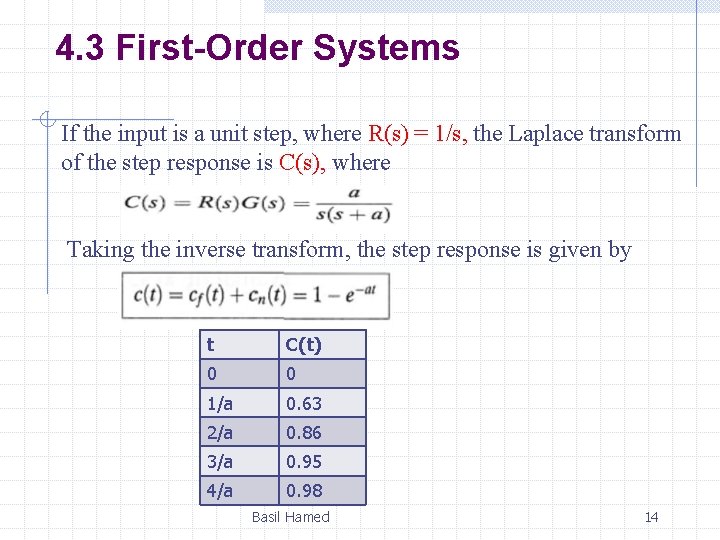
4. 3 First-Order Systems If the input is a unit step, where R(s) = 1/s, the Laplace transform of the step response is C(s), where Taking the inverse transform, the step response is given by t C(t) 0 0 1/a 0. 63 2/a 0. 86 3/a 0. 95 4/a 0. 98 Basil Hamed 14
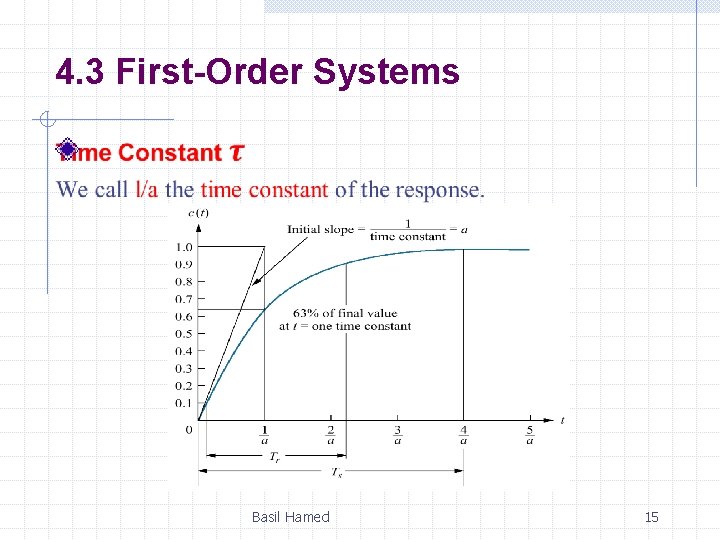
4. 3 First-Order Systems Basil Hamed 15
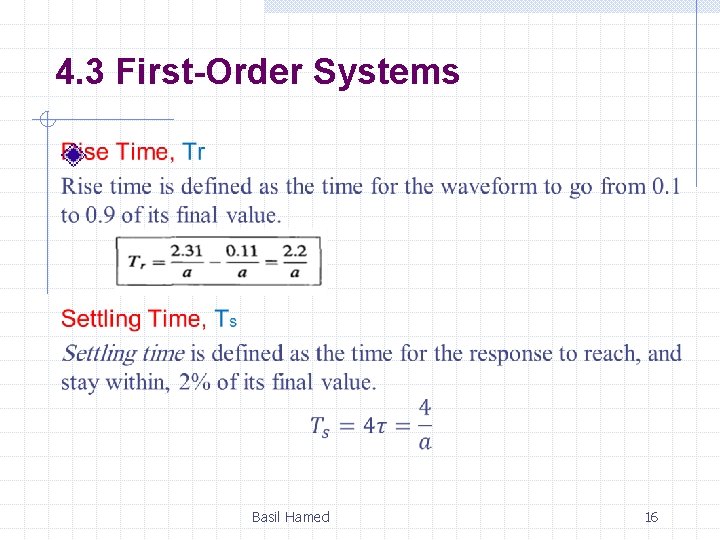
4. 3 First-Order Systems Basil Hamed 16
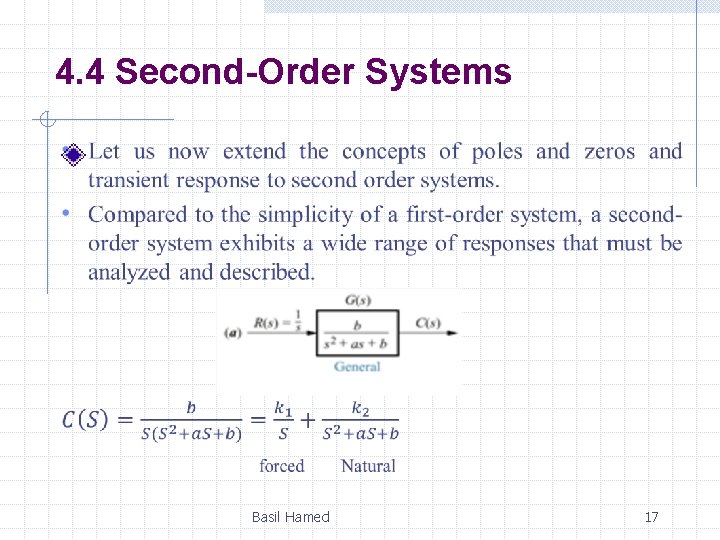
4. 4 Second-Order Systems Basil Hamed 17
4. 4 Second-Order Systems There are 4 cases for 2 nd order system; 1. Overdamped Response 2. Underdamped Response 3. Undamped Response 4. Critically Damped Response Basil Hamed 18
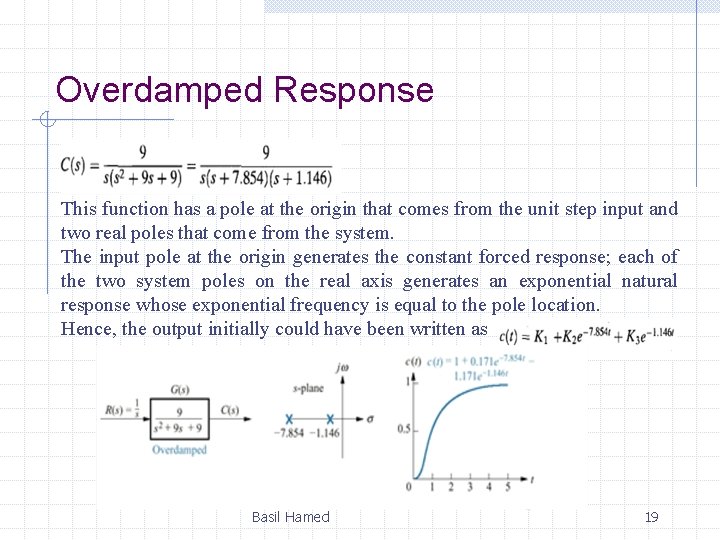
Overdamped Response This function has a pole at the origin that comes from the unit step input and two real poles that come from the system. The input pole at the origin generates the constant forced response; each of the two system poles on the real axis generates an exponential natural response whose exponential frequency is equal to the pole location. Hence, the output initially could have been written as Basil Hamed 19
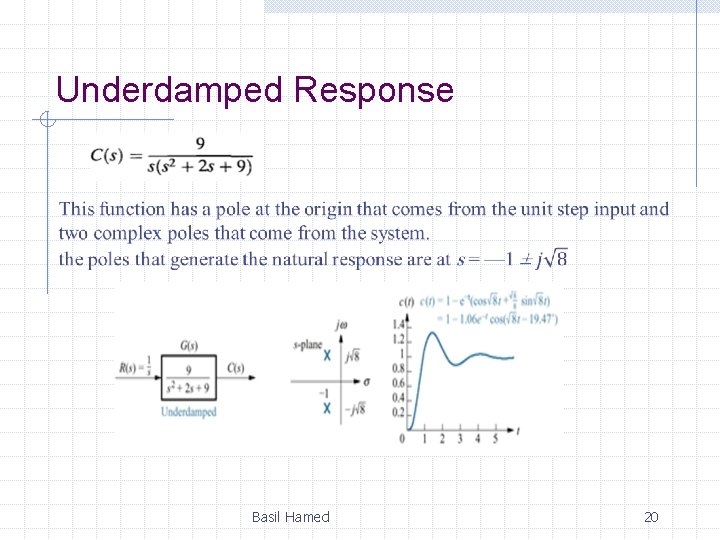
Underdamped Response Basil Hamed 20
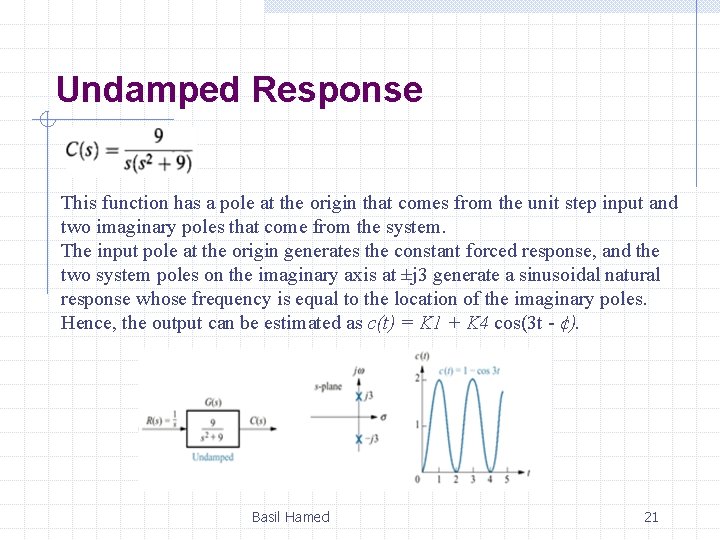
Undamped Response This function has a pole at the origin that comes from the unit step input and two imaginary poles that come from the system. The input pole at the origin generates the constant forced response, and the two system poles on the imaginary axis at ±j 3 generate a sinusoidal natural response whose frequency is equal to the location of the imaginary poles. Hence, the output can be estimated as c(t) = K 1 + K 4 cos(3 t - ¢). Basil Hamed 21
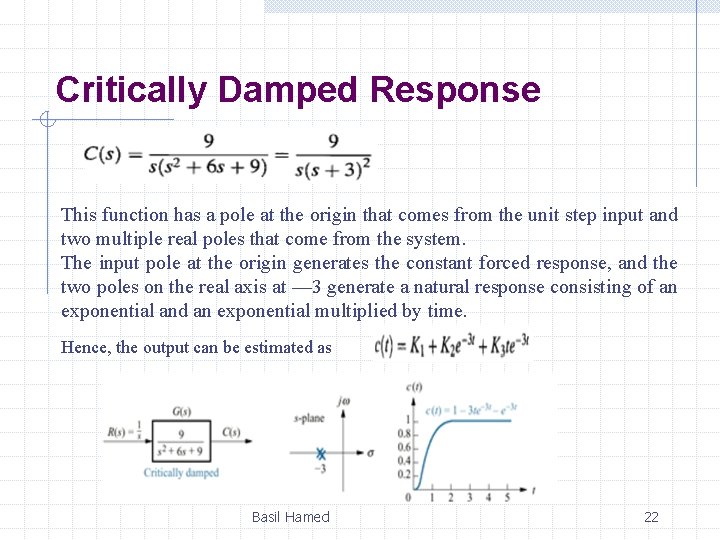
Critically Damped Response This function has a pole at the origin that comes from the unit step input and two multiple real poles that come from the system. The input pole at the origin generates the constant forced response, and the two poles on the real axis at — 3 generate a natural response consisting of an exponential and an exponential multiplied by time. Hence, the output can be estimated as Basil Hamed 22
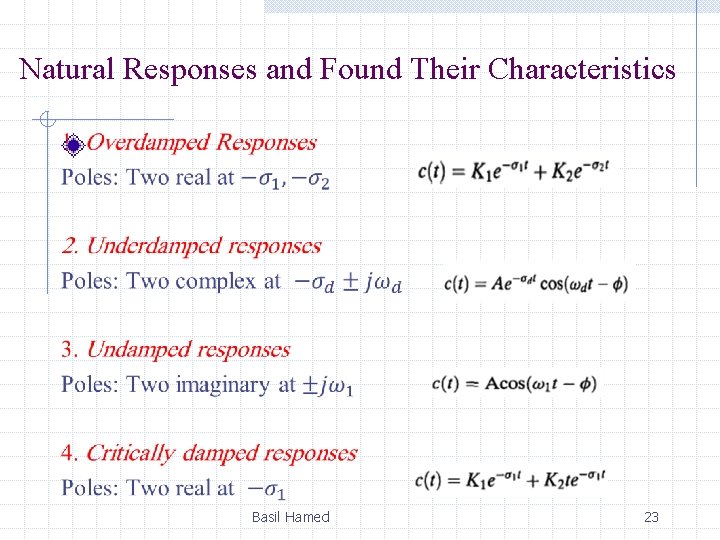
Natural Responses and Found Their Characteristics Basil Hamed 23
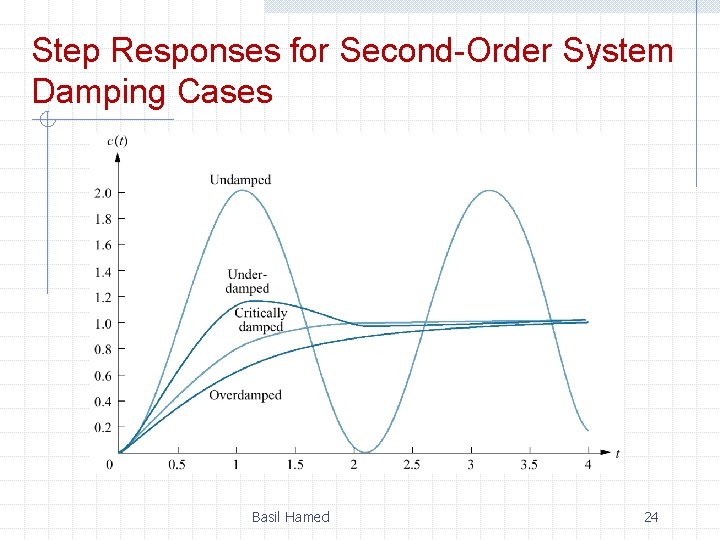
Step Responses for Second-Order System Damping Cases Basil Hamed 24
4. 5 The General Second-Order System • In this section, we define two physically meaningful specifications for second-order systems. • These quantities can be used to describe the characteristics of the second-order transient response just as time constants describe the first-order system response. • The two quantities are called natural frequency and damping ratio. Basil Hamed 25
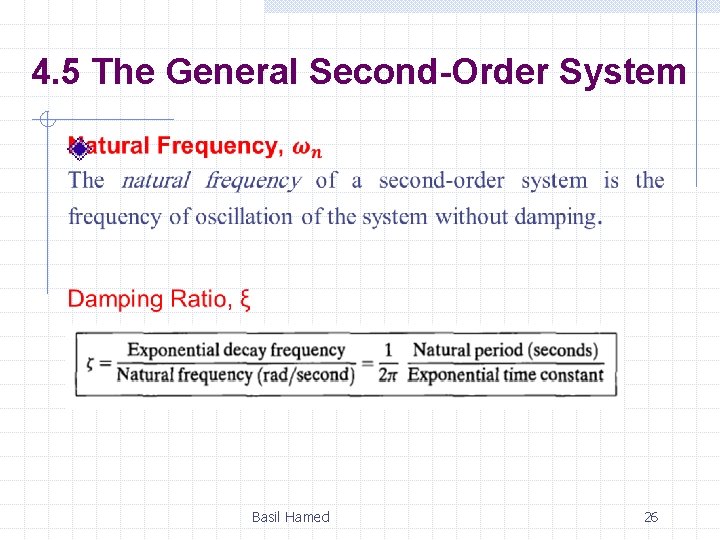
4. 5 The General Second-Order System Basil Hamed 26
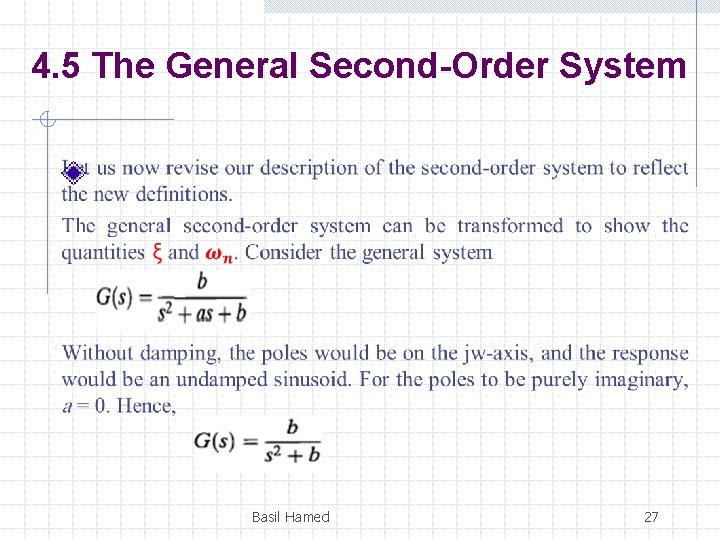
4. 5 The General Second-Order System Basil Hamed 27
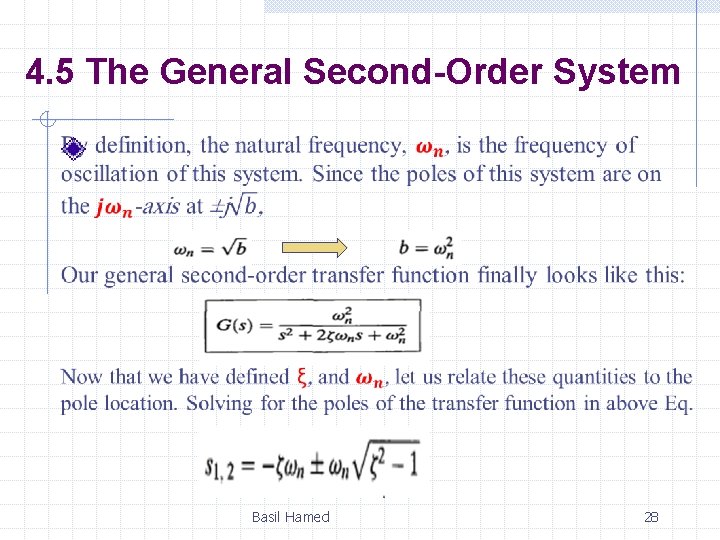
4. 5 The General Second-Order System Basil Hamed 28
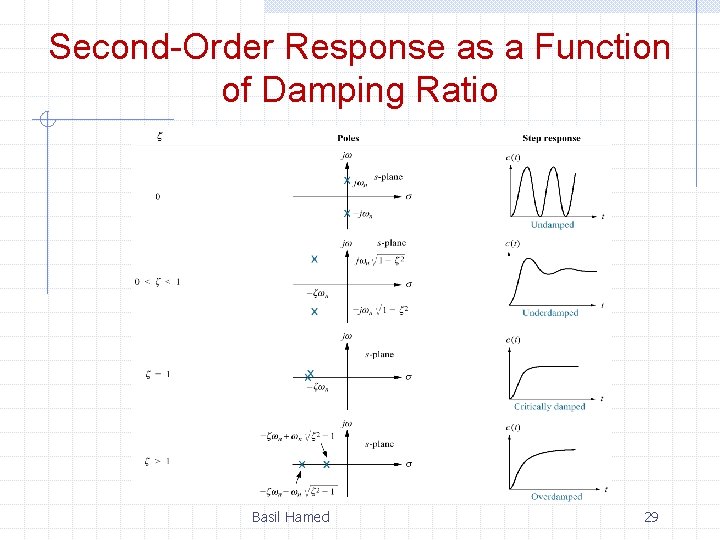
Second-Order Response as a Function of Damping Ratio Basil Hamed 29
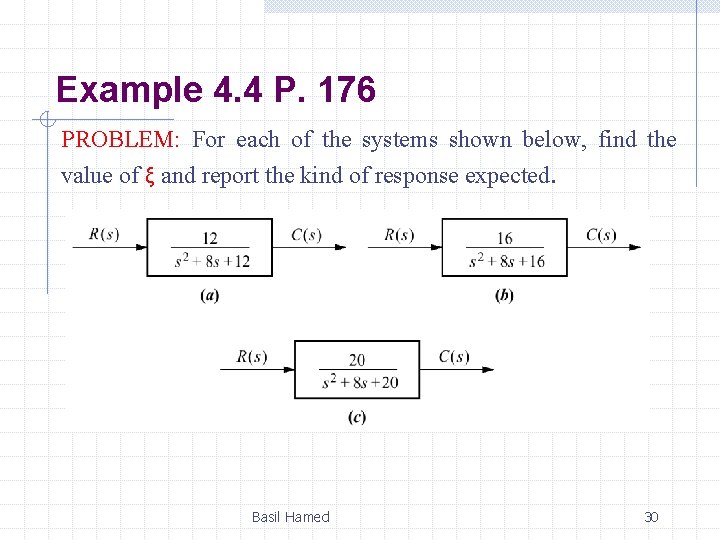
Example 4. 4 P. 176 PROBLEM: For each of the systems shown below, find the value of ξ and report the kind of response expected. Basil Hamed 30
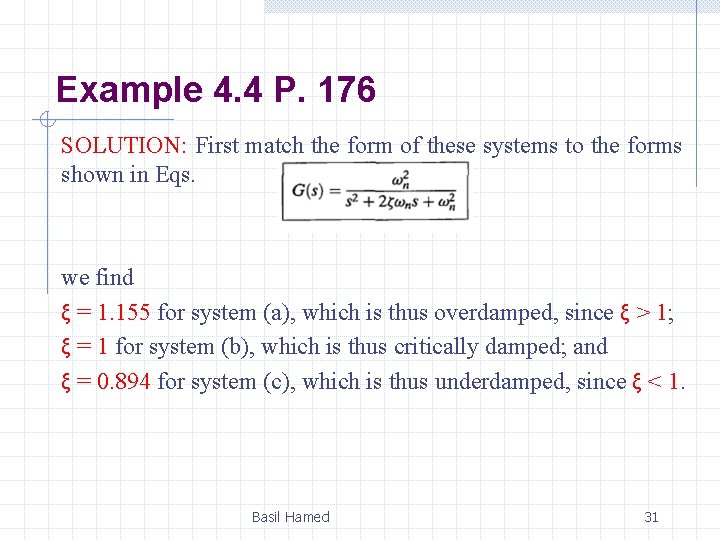
Example 4. 4 P. 176 SOLUTION: First match the form of these systems to the forms shown in Eqs. we find ξ = 1. 155 for system (a), which is thus overdamped, since ξ > 1; ξ = 1 for system (b), which is thus critically damped; and ξ = 0. 894 for system (c), which is thus underdamped, since ξ < 1. Basil Hamed 31
4. 6 Underdamped Second-Order Systems Basil Hamed 32
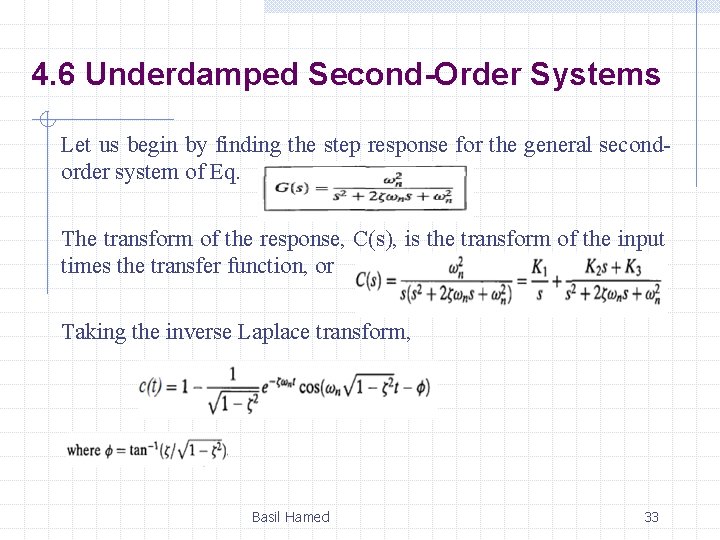
4. 6 Underdamped Second-Order Systems Let us begin by finding the step response for the general secondorder system of Eq. The transform of the response, C(s), is the transform of the input times the transfer function, or Taking the inverse Laplace transform, Basil Hamed 33
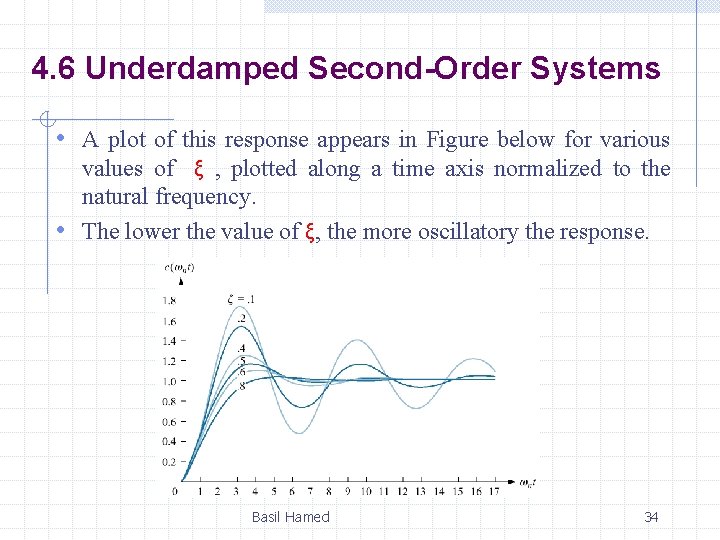
4. 6 Underdamped Second-Order Systems • A plot of this response appears in Figure below for various values of ξ , plotted along a time axis normalized to the natural frequency. • The lower the value of ξ, the more oscillatory the response. Basil Hamed 34
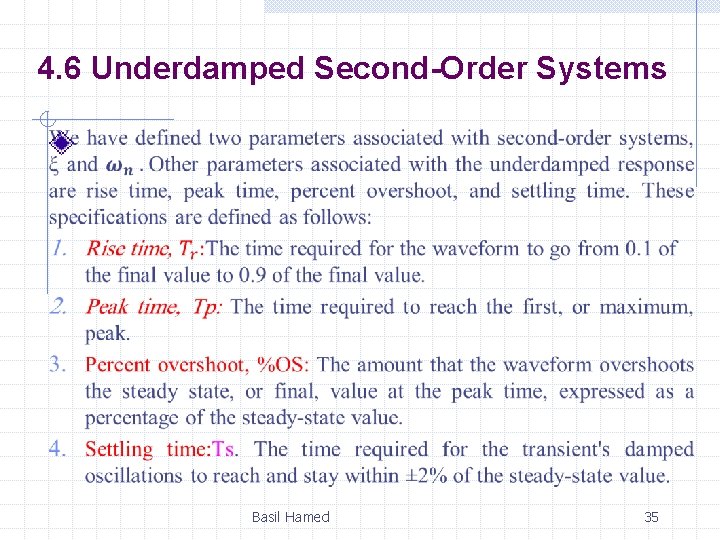
4. 6 Underdamped Second-Order Systems Basil Hamed 35
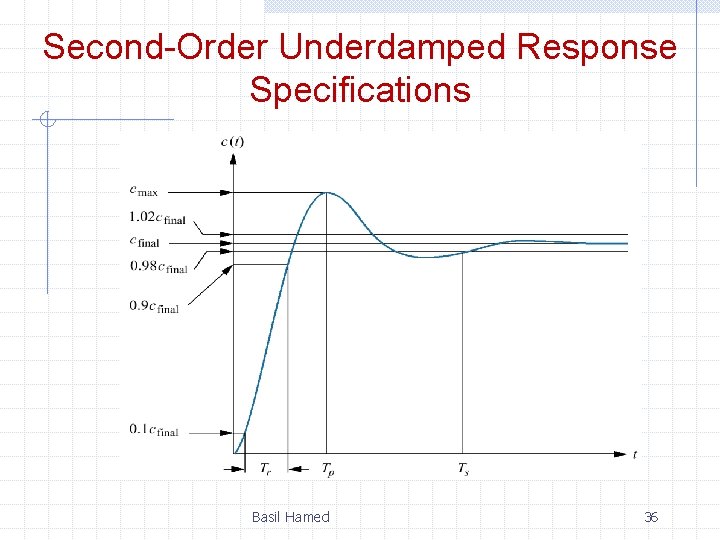
Second-Order Underdamped Response Specifications Basil Hamed 36
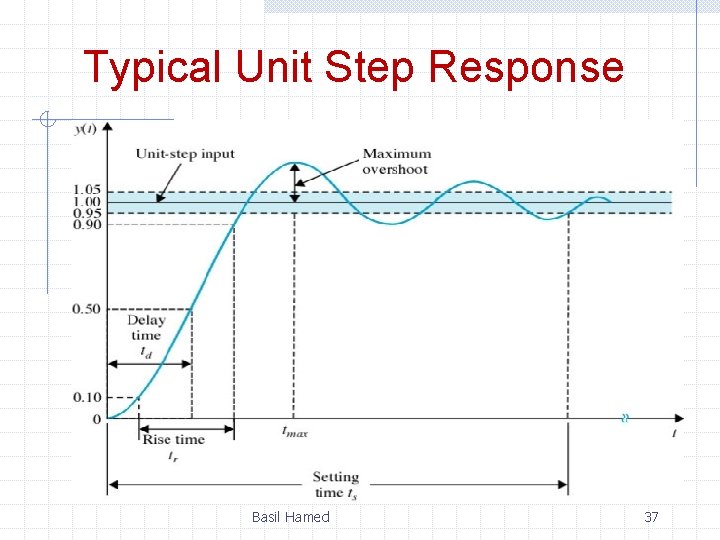
Typical Unit Step Response Basil Hamed 37
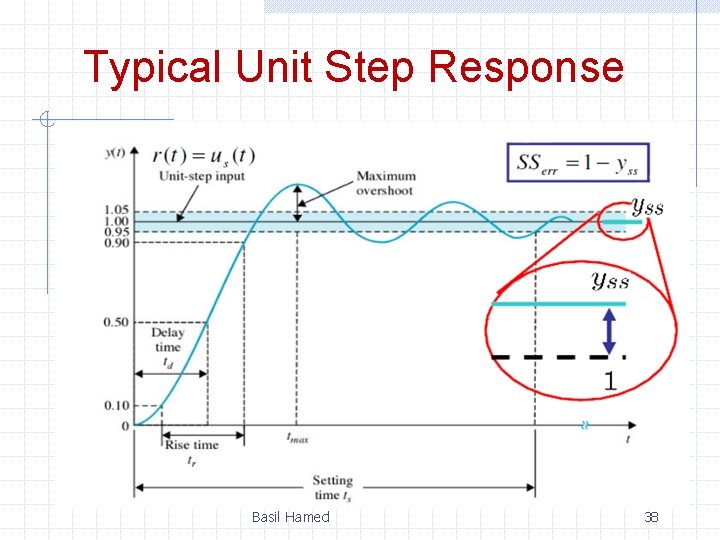
Typical Unit Step Response Basil Hamed 38
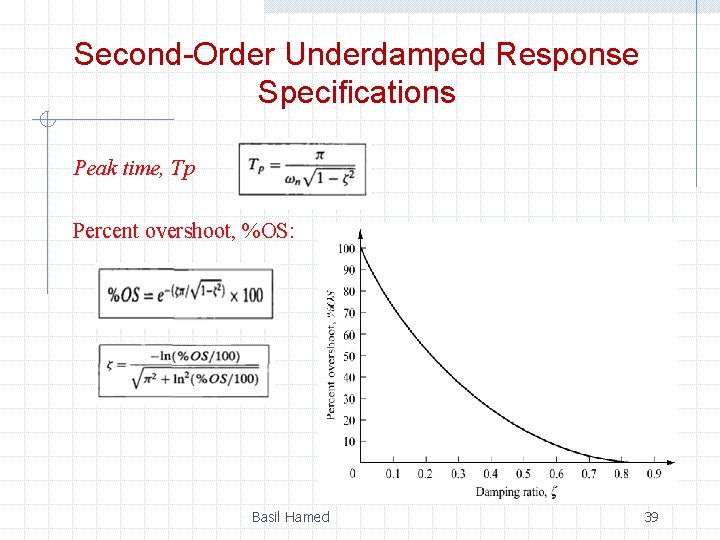
Second-Order Underdamped Response Specifications Peak time, Tp Percent overshoot, %OS: Basil Hamed 39
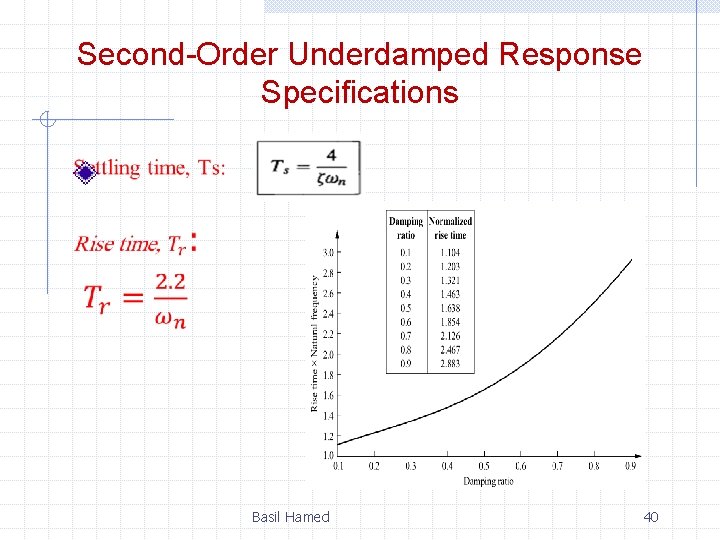
Second-Order Underdamped Response Specifications Basil Hamed 40
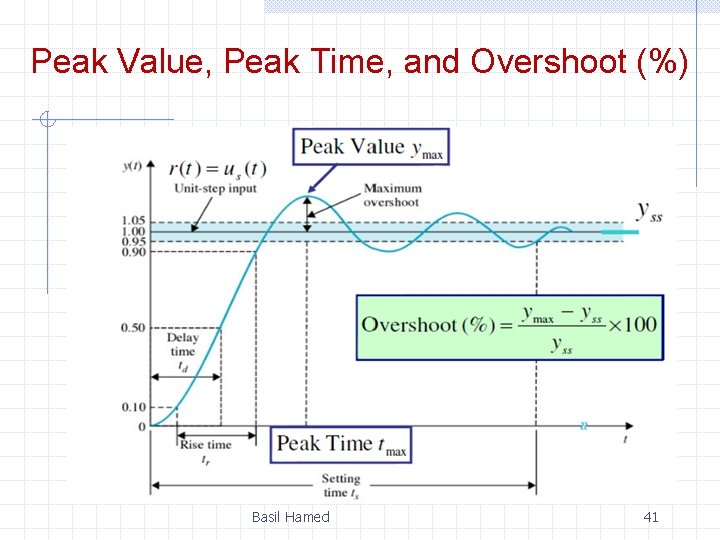
Peak Value, Peak Time, and Overshoot (%) Basil Hamed 41
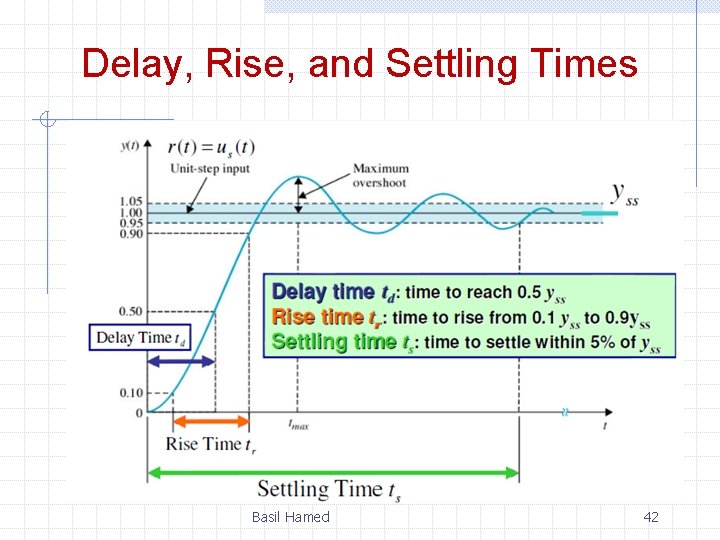
Delay, Rise, and Settling Times Basil Hamed 42
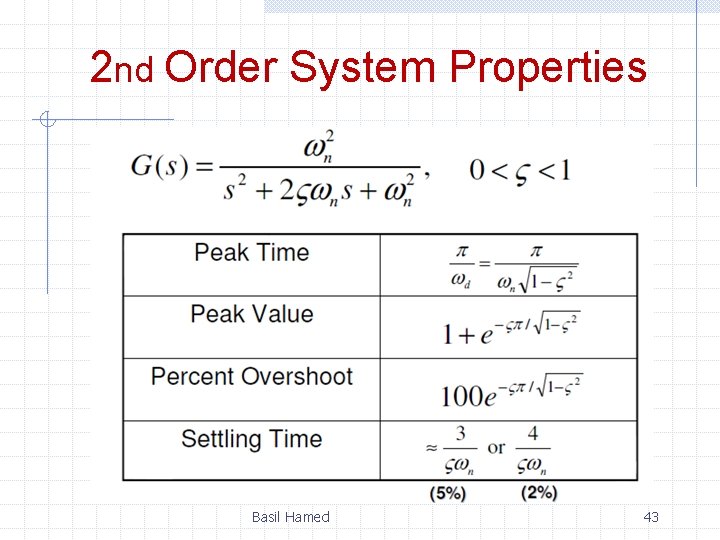
2 nd Order System Properties Basil Hamed 43
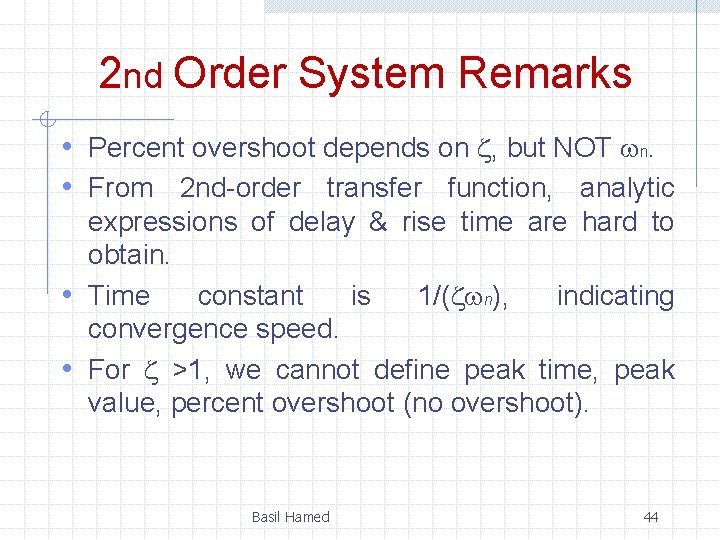
2 nd Order System Remarks • Percent overshoot depends on z, but NOT wn. • From 2 nd-order transfer function, analytic expressions of delay & rise time are hard to obtain. • Time constant is 1/(zwn), indicating convergence speed. • For z >1, we cannot define peak time, peak value, percent overshoot (no overshoot). Basil Hamed 44
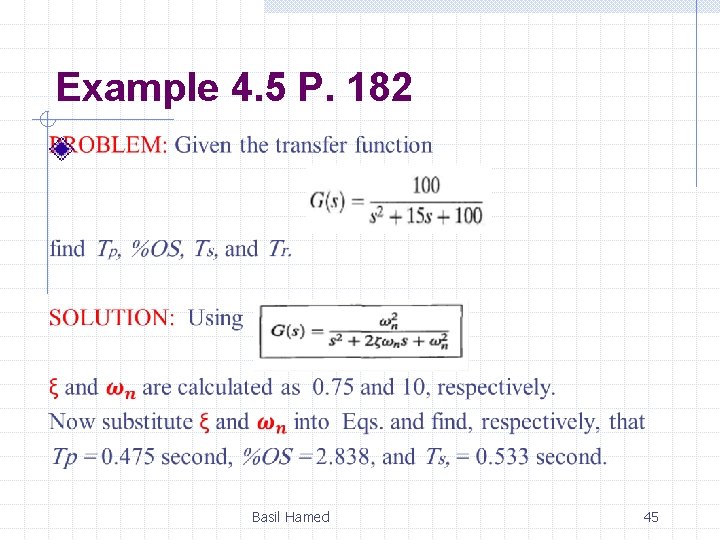
Example 4. 5 P. 182 Basil Hamed 45
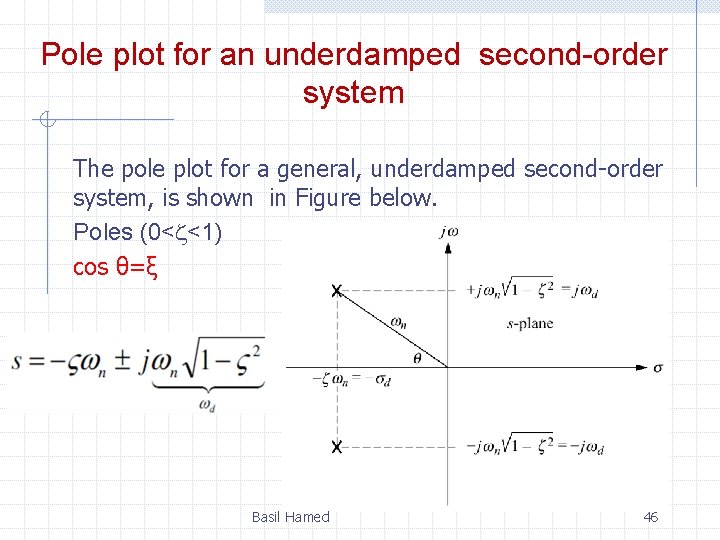
Pole plot for an underdamped second-order system The pole plot for a general, underdamped second-order system, is shown in Figure below. Poles (0<z<1) cos θ=ξ Basil Hamed 46
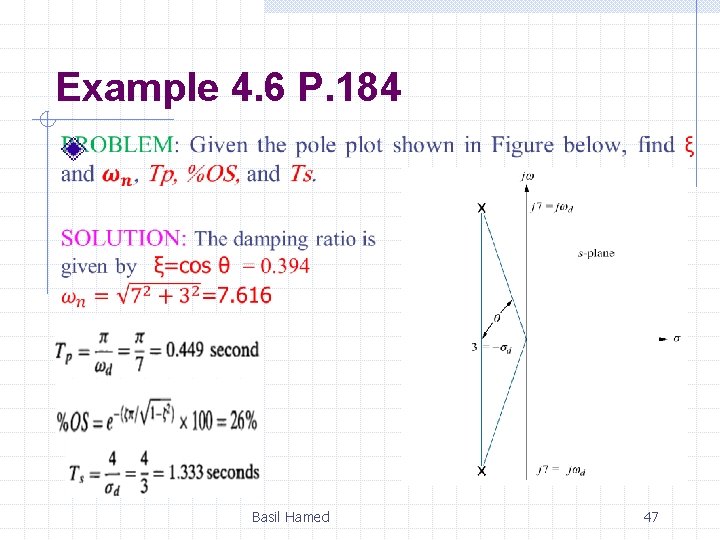
Example 4. 6 P. 184 Basil Hamed 47
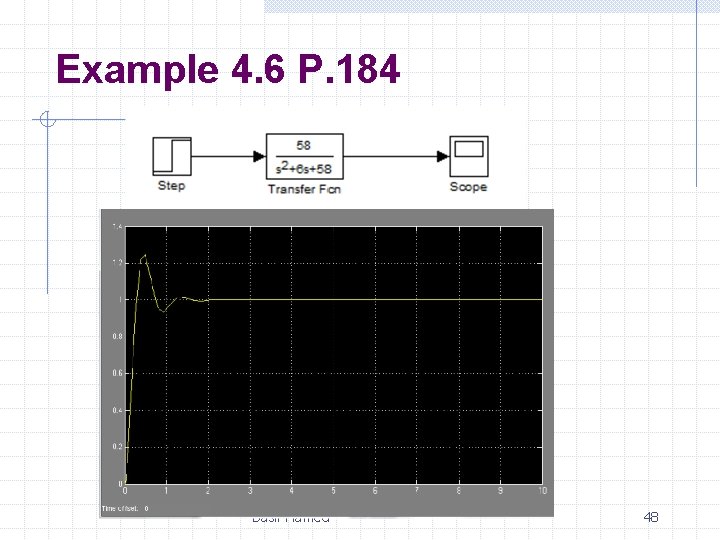
Example 4. 6 P. 184 Basil Hamed 48
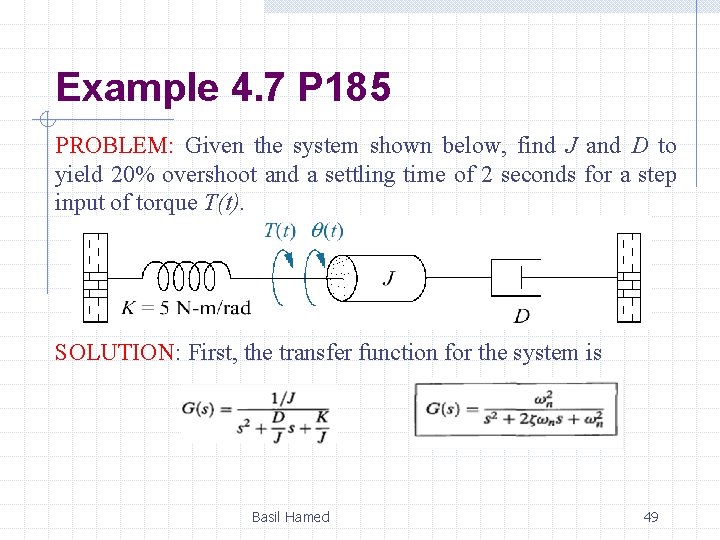
Example 4. 7 P 185 PROBLEM: Given the system shown below, find J and D to yield 20% overshoot and a settling time of 2 seconds for a step input of torque T(t). SOLUTION: First, the transfer function for the system is Basil Hamed 49
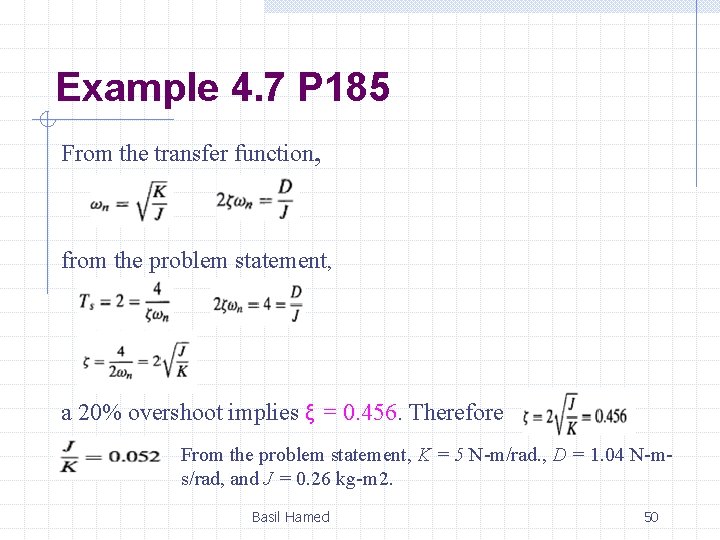
Example 4. 7 P 185 From the transfer function, from the problem statement, a 20% overshoot implies ξ = 0. 456. Therefore From the problem statement, K = 5 N-m/rad. , D = 1. 04 N-ms/rad, and J = 0. 26 kg-m 2. Basil Hamed 50
4. 7 System Response with Additional Poles • In the last section, we analyzed systems with one or two poles. It must be emphasized that the formulas describing percent overshoot, settling time, and peak time were derived only for a system with two complex poles and no zeros. • If a system that has more than two poles or has zeros, we cannot use the formulas to calculate the performance specifications that we derived. • However, under certain conditions, a system with more than two poles or with zeros can be approximated as a second-order system that has just two complex dominant poles. • Once we justify this approximation, the formulas for percent overshoot, settling time, and peak time can be applied to these higher -order systems by using the location of the dominant poles. Basil Hamed 51
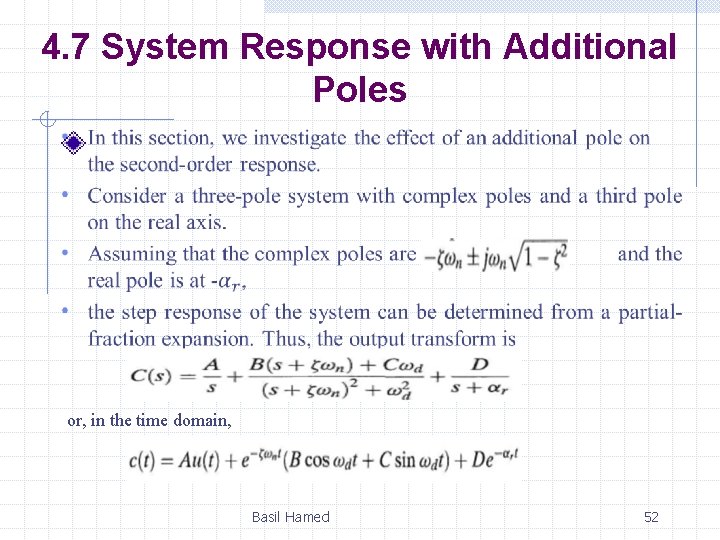
4. 7 System Response with Additional Poles or, in the time domain, Basil Hamed 52
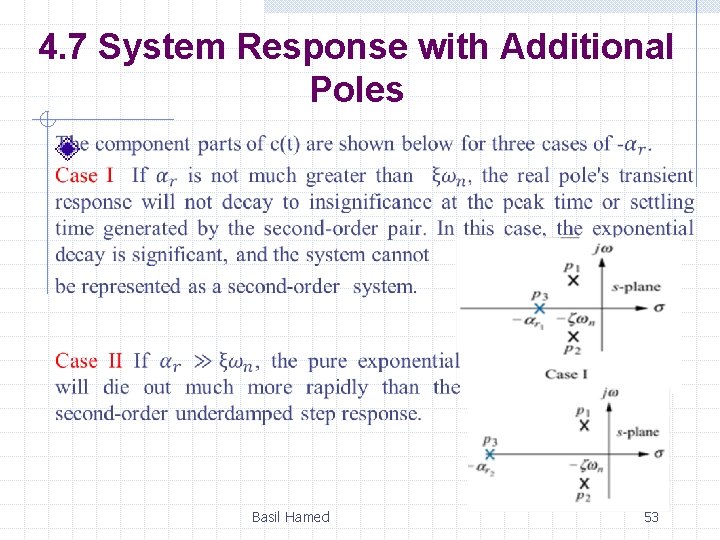
4. 7 System Response with Additional Poles Basil Hamed 53
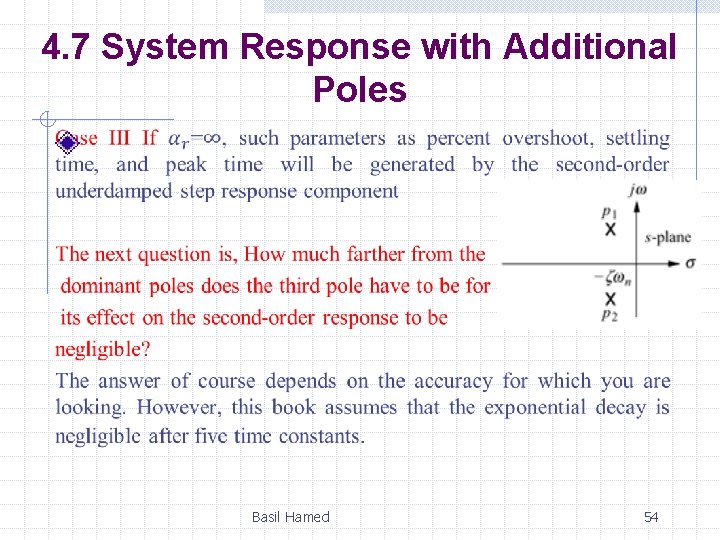
4. 7 System Response with Additional Poles Basil Hamed 54
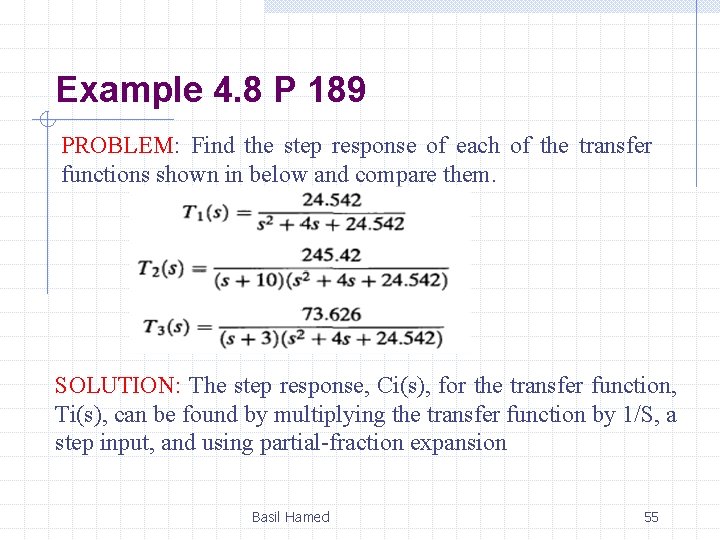
Example 4. 8 P 189 PROBLEM: Find the step response of each of the transfer functions shown in below and compare them. SOLUTION: The step response, Ci(s), for the transfer function, Ti(s), can be found by multiplying the transfer function by 1/S, a step input, and using partial-fraction expansion Basil Hamed 55
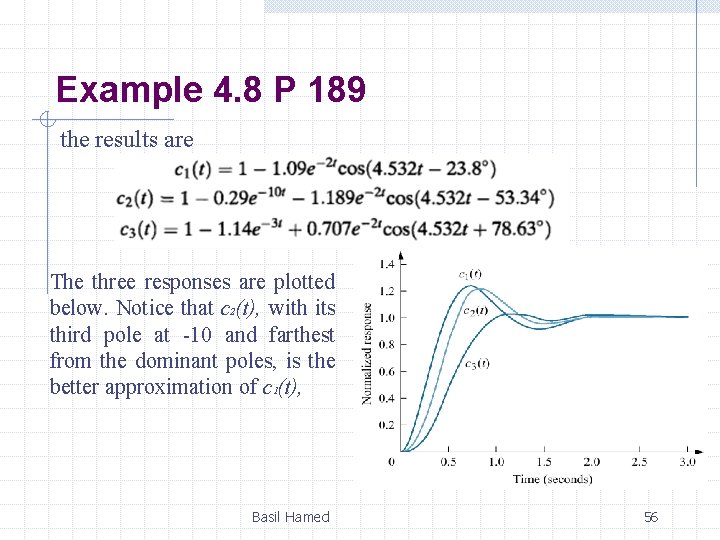
Example 4. 8 P 189 the results are The three responses are plotted below. Notice that c 2(t), with its third pole at -10 and farthest from the dominant poles, is the better approximation of c 1(t), Basil Hamed 56
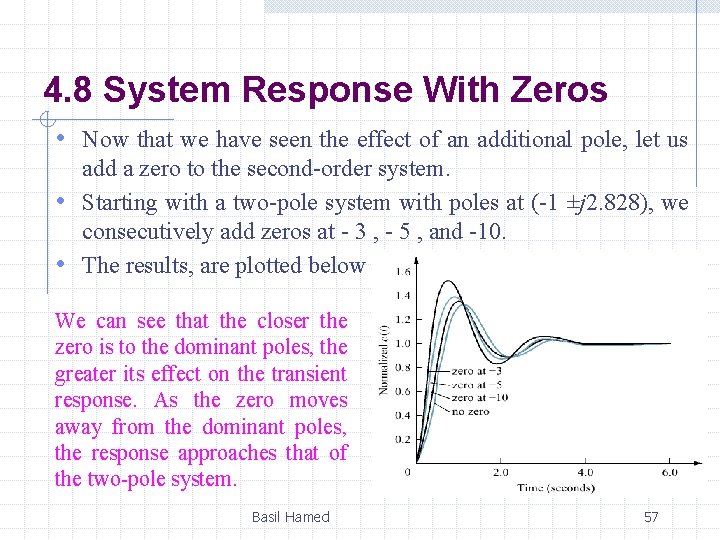
4. 8 System Response With Zeros • Now that we have seen the effect of an additional pole, let us add a zero to the second-order system. • Starting with a two-pole system with poles at (-1 ±j 2. 828), we consecutively add zeros at - 3 , - 5 , and -10. • The results, are plotted below We can see that the closer the zero is to the dominant poles, the greater its effect on the transient response. As the zero moves away from the dominant poles, the response approaches that of the two-pole system. Basil Hamed 57
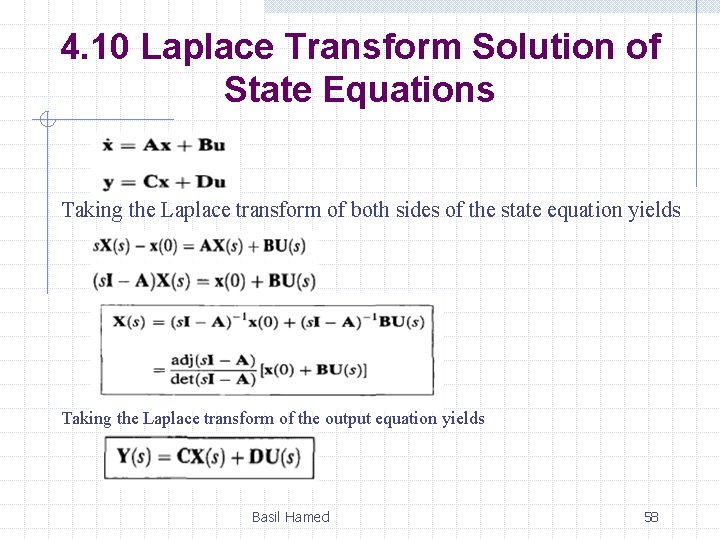
4. 10 Laplace Transform Solution of State Equations Taking the Laplace transform of both sides of the state equation yields Taking the Laplace transform of the output equation yields Basil Hamed 58
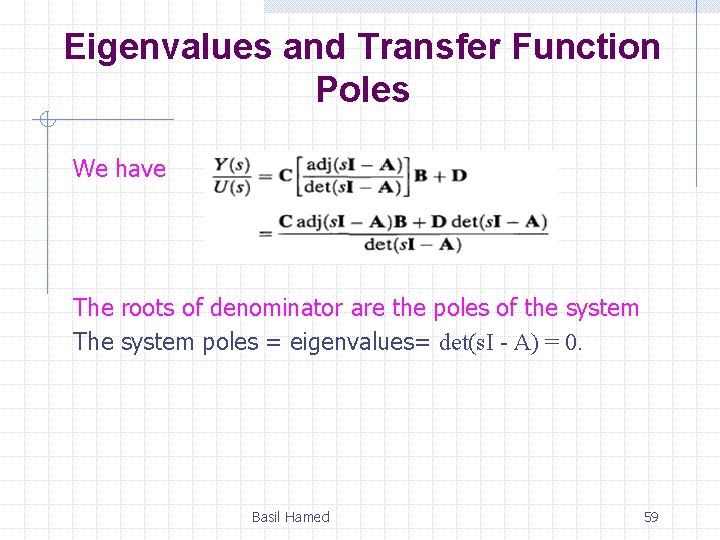
Eigenvalues and Transfer Function Poles We have The roots of denominator are the poles of the system The system poles = eigenvalues= det(s. I - A) = 0. Basil Hamed 59
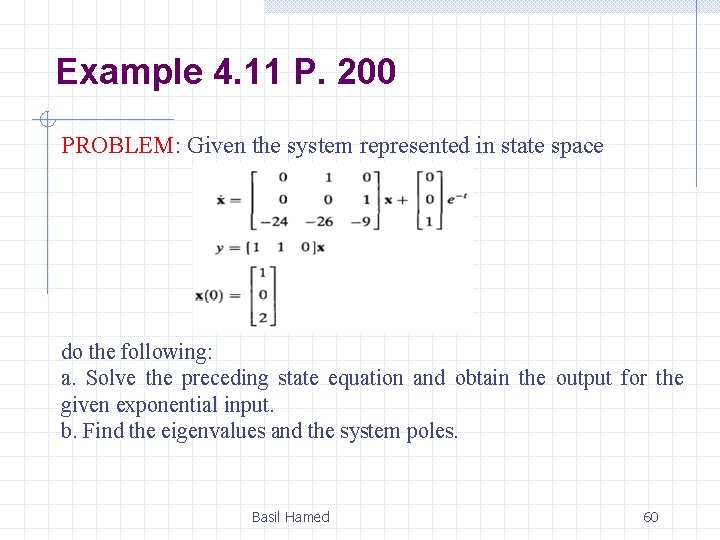
Example 4. 11 P. 200 PROBLEM: Given the system represented in state space do the following: a. Solve the preceding state equation and obtain the output for the given exponential input. b. Find the eigenvalues and the system poles. Basil Hamed 60
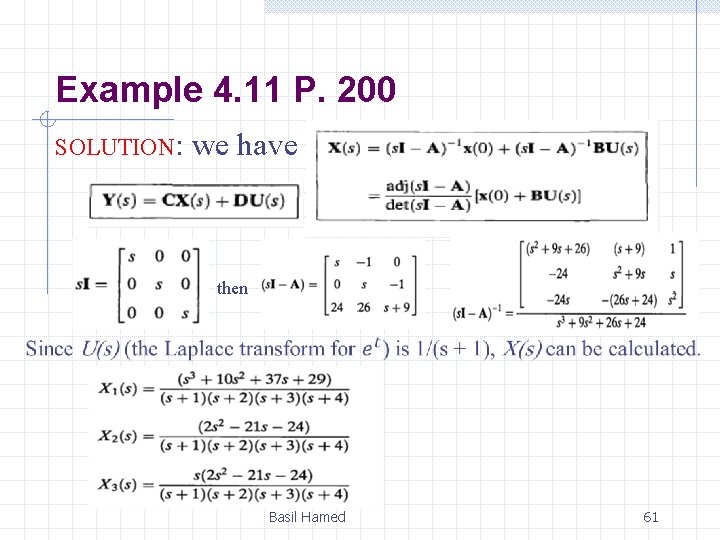
Example 4. 11 P. 200 SOLUTION: we have then Basil Hamed 61
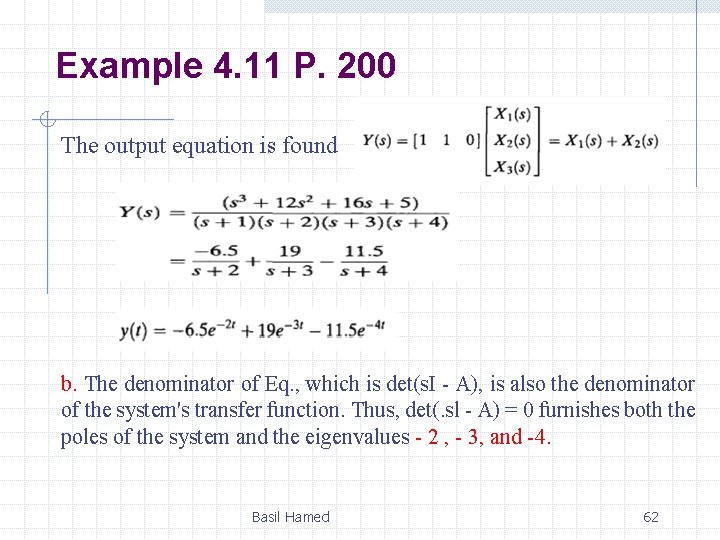
Example 4. 11 P. 200 The output equation is found b. The denominator of Eq. , which is det(s. I - A), is also the denominator of the system's transfer function. Thus, det(. sl - A) = 0 furnishes both the poles of the system and the eigenvalues - 2 , - 3, and -4. Basil Hamed 62
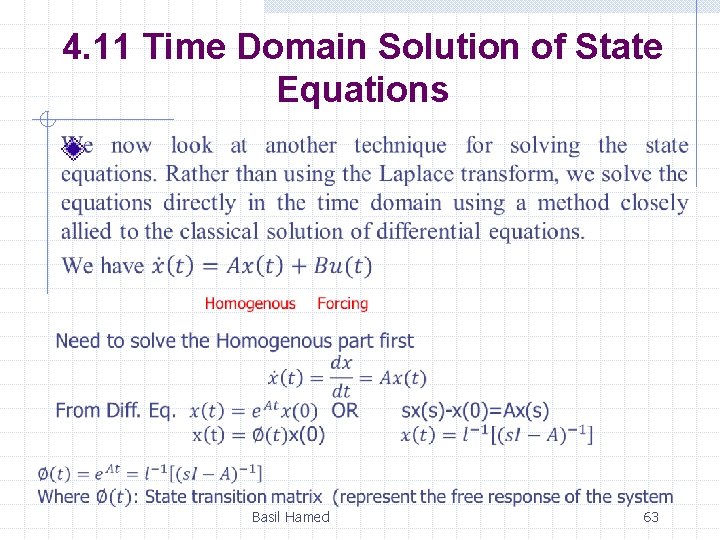
4. 11 Time Domain Solution of State Equations Basil Hamed 63
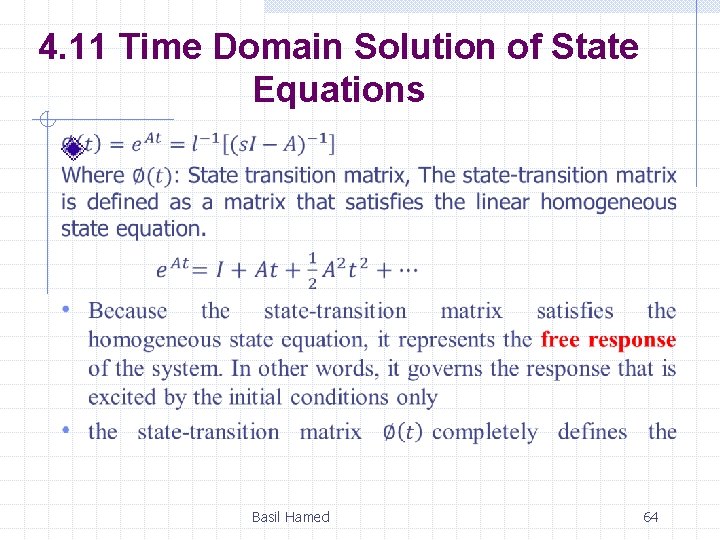
4. 11 Time Domain Solution of State Equations Basil Hamed 64
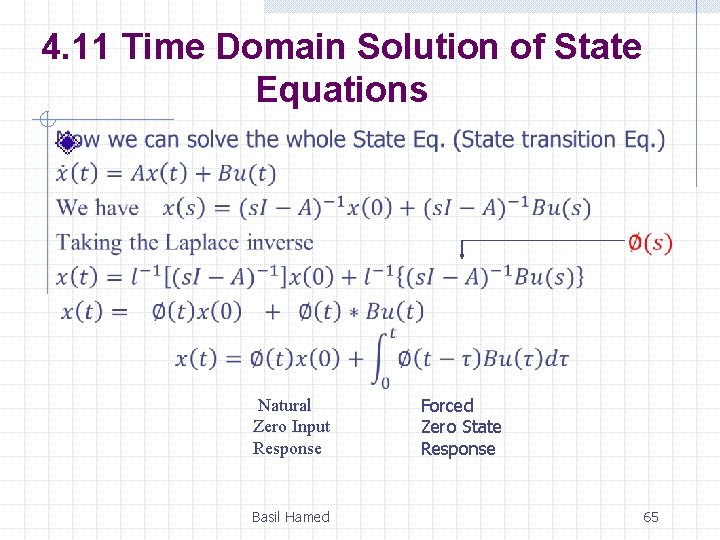
4. 11 Time Domain Solution of State Equations Natural Zero Input Response Basil Hamed Forced Zero State Response 65
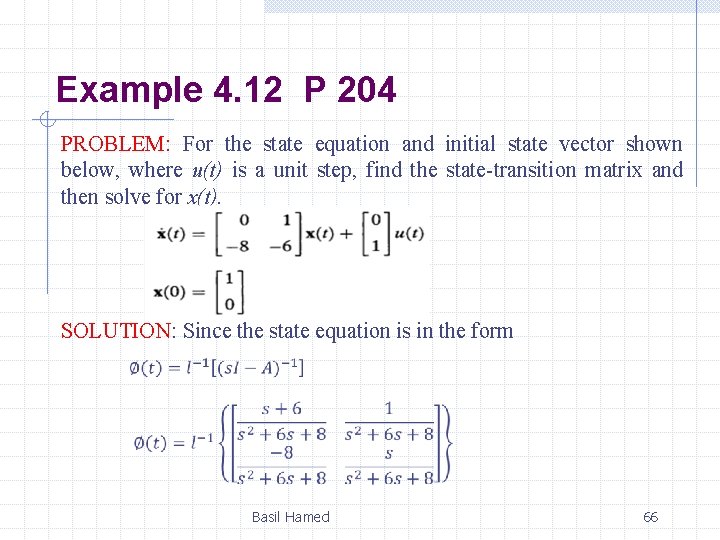
Example 4. 12 P 204 PROBLEM: For the state equation and initial state vector shown below, where u(t) is a unit step, find the state-transition matrix and then solve for x(t). SOLUTION: Since the state equation is in the form Basil Hamed 66
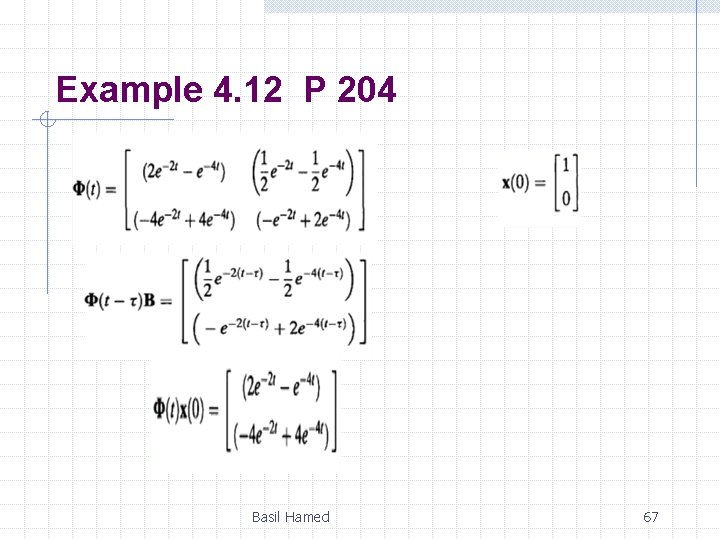
Example 4. 12 P 204 Basil Hamed 67
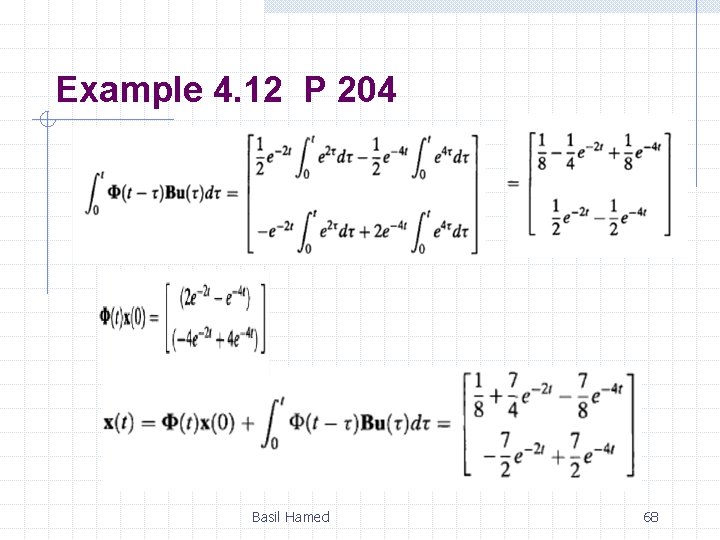
Example 4. 12 P 204 Basil Hamed 68
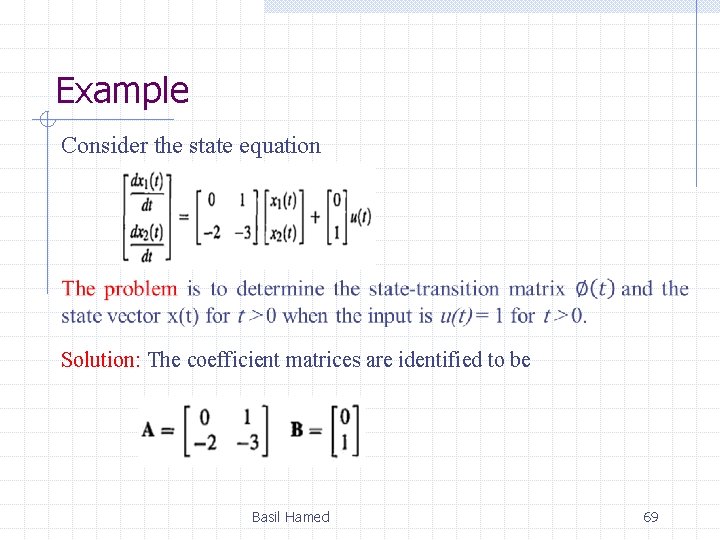
Example Consider the state equation Solution: The coefficient matrices are identified to be Basil Hamed 69
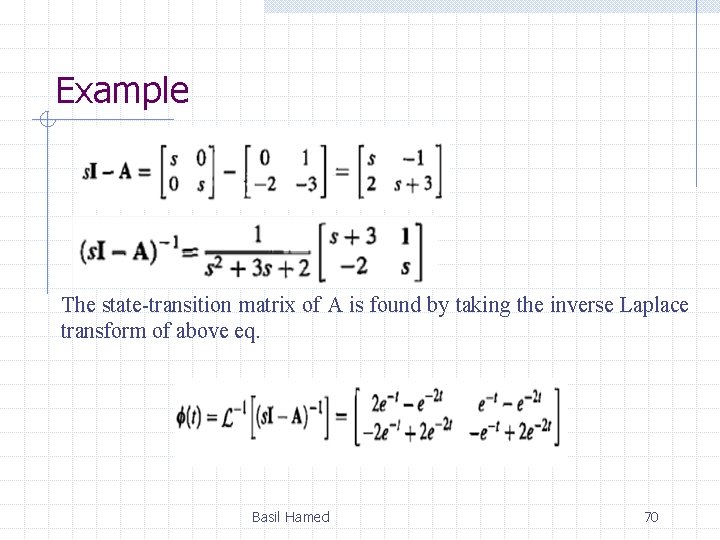
Example The state-transition matrix of A is found by taking the inverse Laplace transform of above eq. Basil Hamed 70
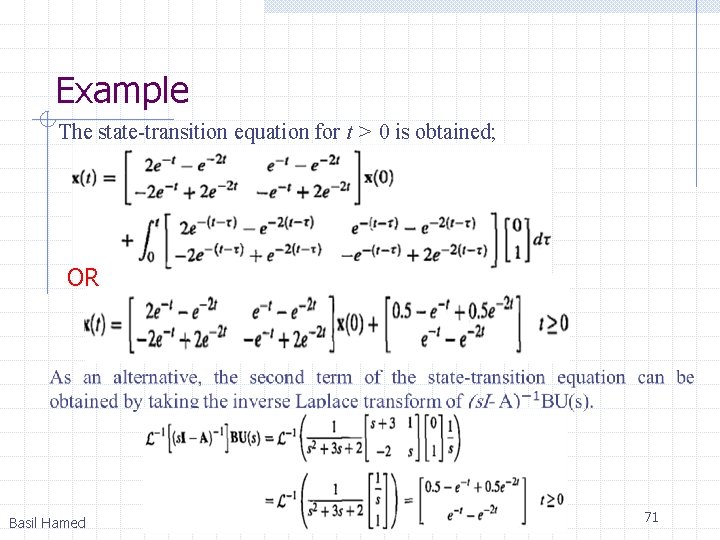
Example The state-transition equation for t > 0 is obtained; OR Basil Hamed 71
- Slides: 71