
Control Systems CS Lecture23 24 Construction of Root





- Slides: 49
Control Systems (CS) Lecture-23 -24 Construction of Root Loci Dr. Imtiaz Hussain Associate Professor Mehran University of Engineering & Technology Jamshoro, Pakistan email: imtiaz. hussain@faculty. muet. edu. pk URL : http: //imtiazhussainkalwar. weebly. com/ 1
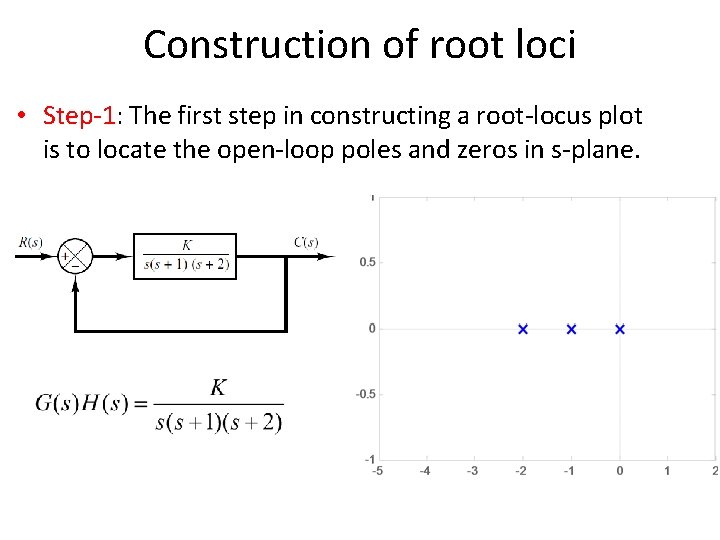
Construction of root loci • Step-1: The first step in constructing a root-locus plot is to locate the open-loop poles and zeros in s-plane.
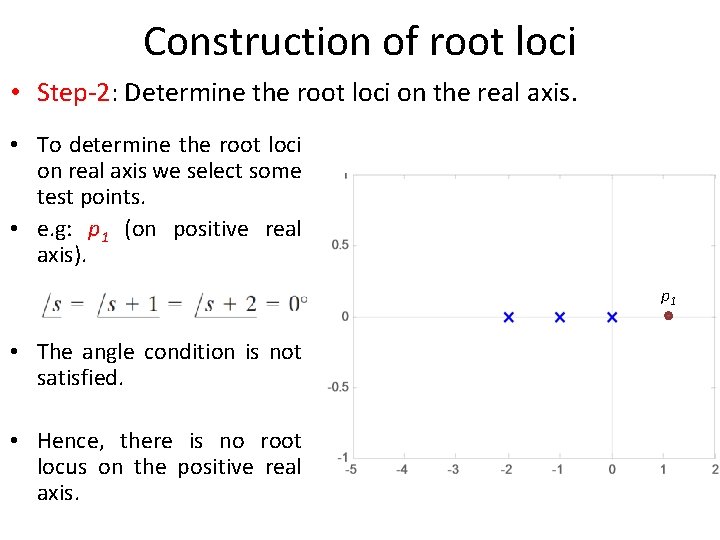
Construction of root loci • Step-2: Determine the root loci on the real axis. • To determine the root loci on real axis we select some test points. • e. g: p 1 (on positive real axis). p 1 • The angle condition is not satisfied. • Hence, there is no root locus on the positive real axis.
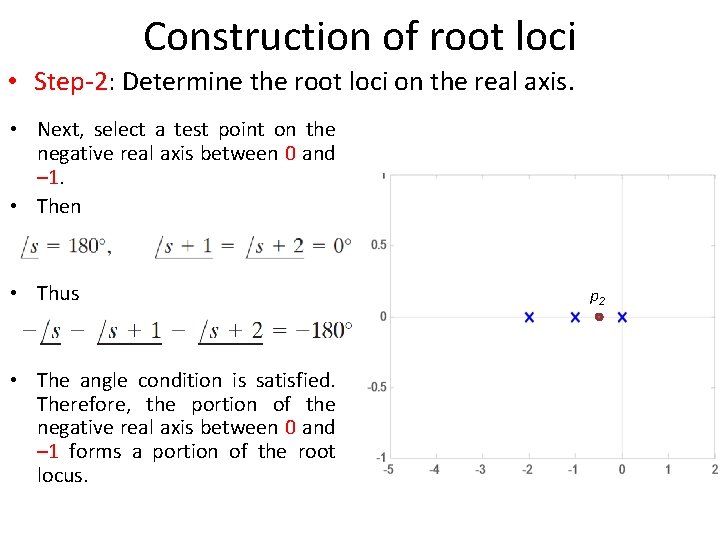
Construction of root loci • Step-2: Determine the root loci on the real axis. • Next, select a test point on the negative real axis between 0 and – 1. • Then • Thus • The angle condition is satisfied. Therefore, the portion of the negative real axis between 0 and – 1 forms a portion of the root locus. p 2
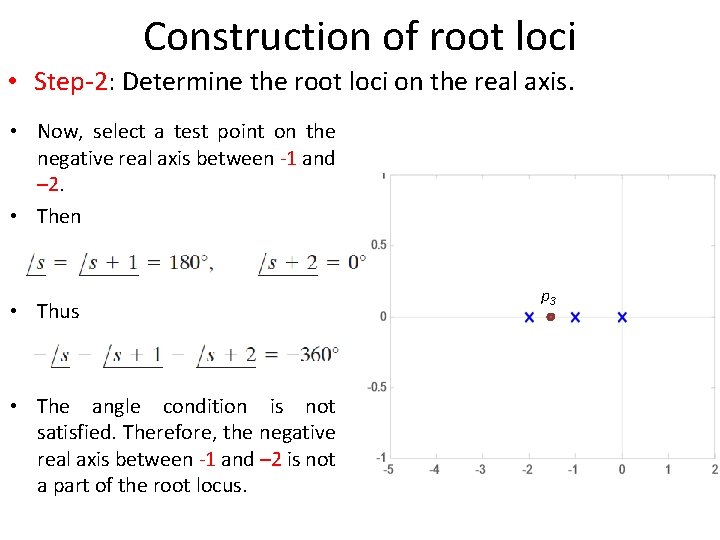
Construction of root loci • Step-2: Determine the root loci on the real axis. • Now, select a test point on the negative real axis between -1 and – 2. • Then • Thus • The angle condition is not satisfied. Therefore, the negative real axis between -1 and – 2 is not a part of the root locus. p 3
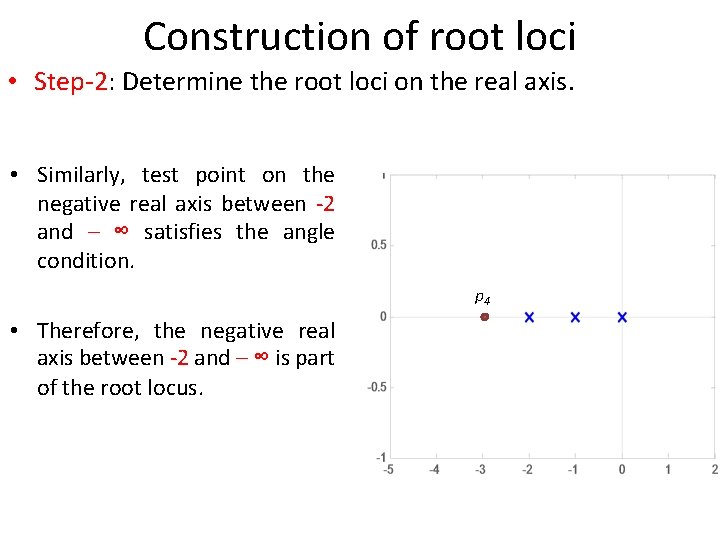
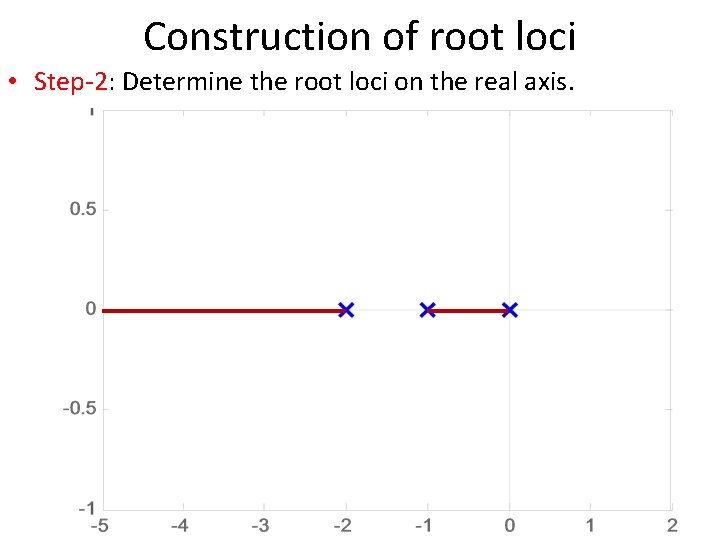
Construction of root loci • Step-2: Determine the root loci on the real axis. • Similarly, test point on the negative real axis between -2 and – ∞ satisfies the angle condition. p 4 • Therefore, the negative real axis between -2 and – ∞ is part of the root locus.
Construction of root loci • Step-2: Determine the root loci on the real axis.
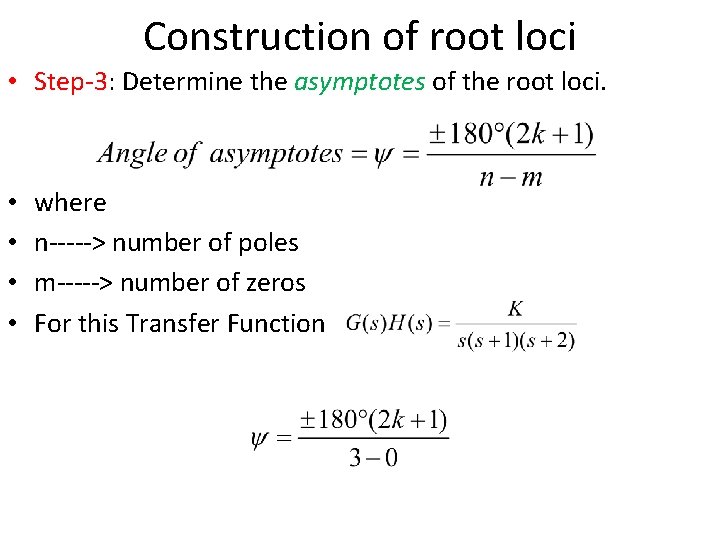
Construction of root loci • Step-3: Determine the asymptotes of the root loci. • • where n-----> number of poles m-----> number of zeros For this Transfer Function
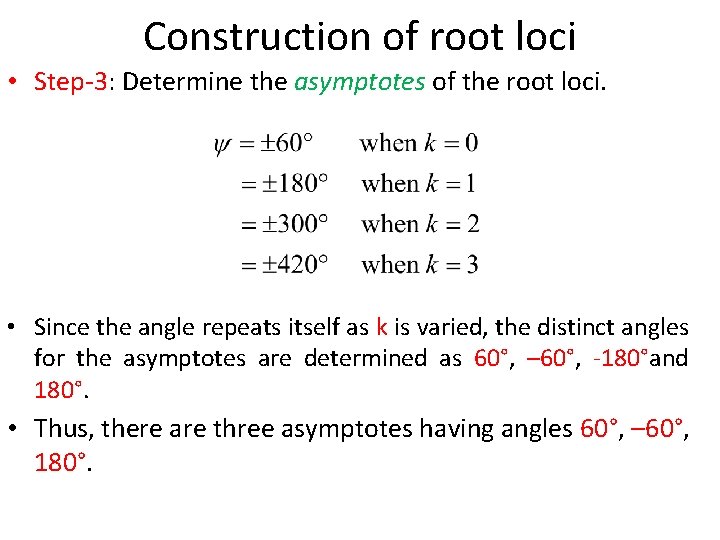
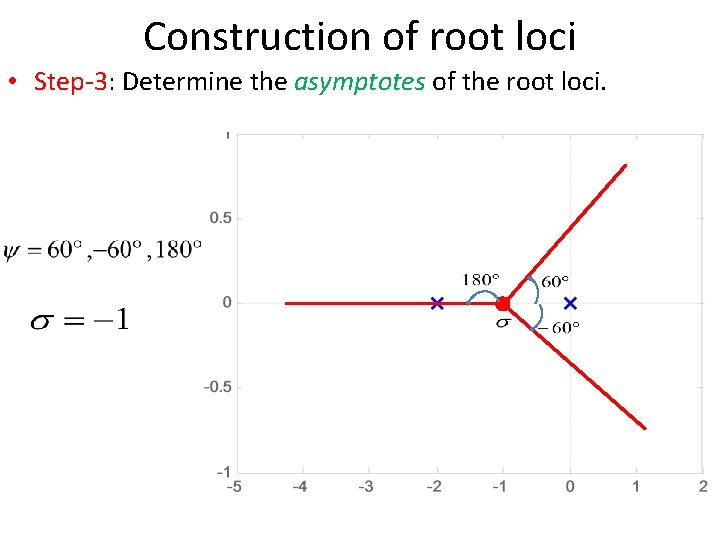
Construction of root loci • Step-3: Determine the asymptotes of the root loci. • Since the angle repeats itself as k is varied, the distinct angles for the asymptotes are determined as 60°, – 60°, -180°and 180°. • Thus, there are three asymptotes having angles 60°, – 60°, 180°.
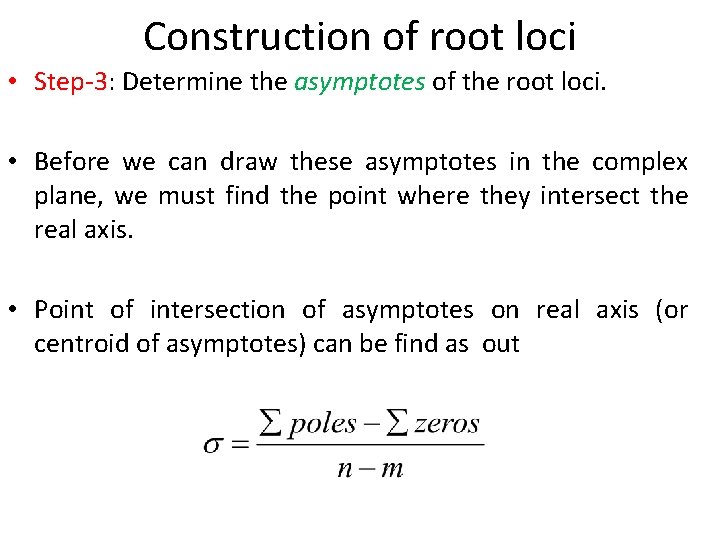
Construction of root loci • Step-3: Determine the asymptotes of the root loci. • Before we can draw these asymptotes in the complex plane, we must find the point where they intersect the real axis. • Point of intersection of asymptotes on real axis (or centroid of asymptotes) can be find as out
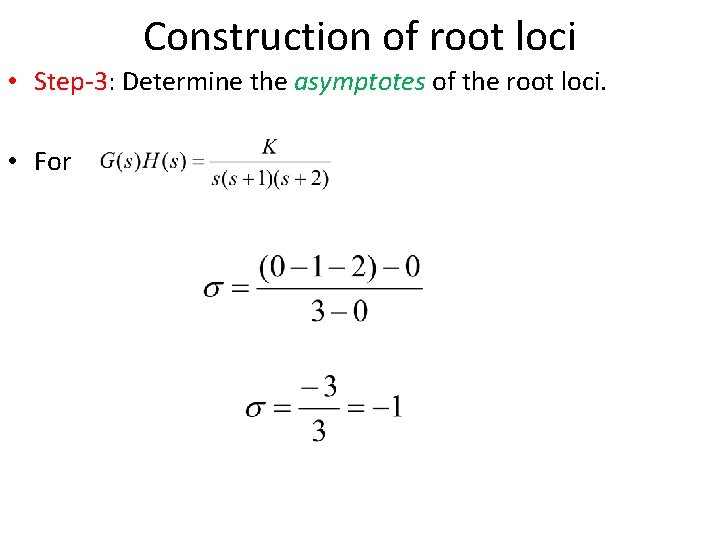
Construction of root loci • Step-3: Determine the asymptotes of the root loci. • For
Construction of root loci • Step-3: Determine the asymptotes of the root loci.
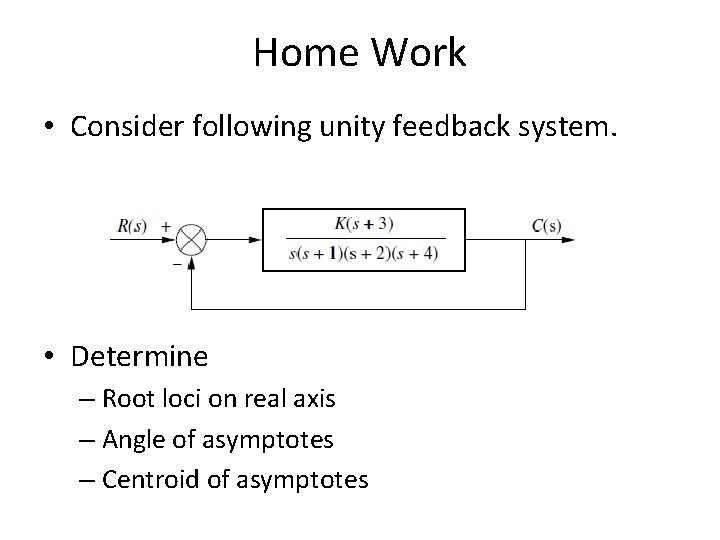
Home Work • Consider following unity feedback system. • Determine – Root loci on real axis – Angle of asymptotes – Centroid of asymptotes
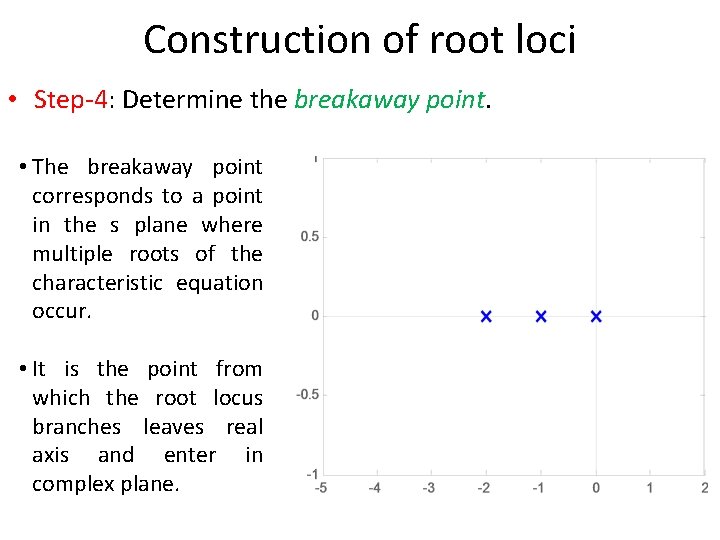
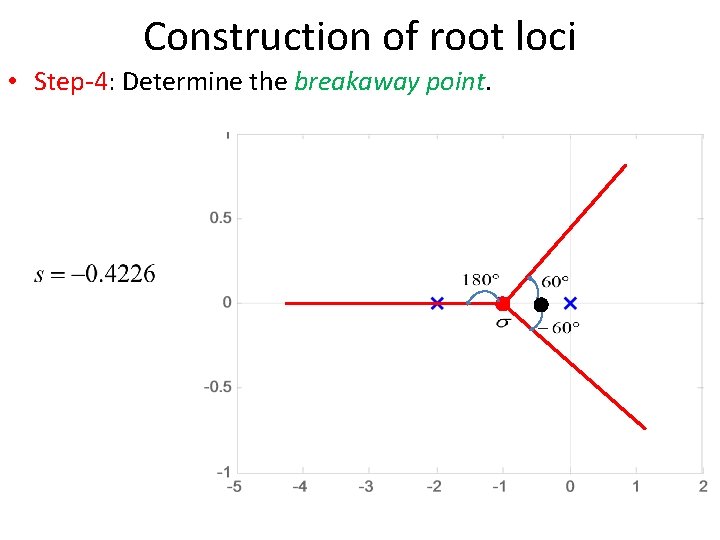
Construction of root loci • Step-4: Determine the breakaway point. • The breakaway point corresponds to a point in the s plane where multiple roots of the characteristic equation occur. • It is the point from which the root locus branches leaves real axis and enter in complex plane.
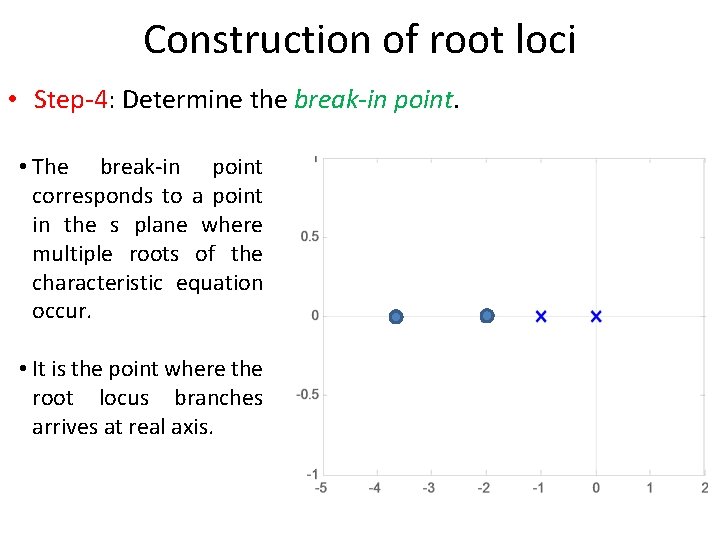
Construction of root loci • Step-4: Determine the break-in point. • The break-in point corresponds to a point in the s plane where multiple roots of the characteristic equation occur. • It is the point where the root locus branches arrives at real axis.
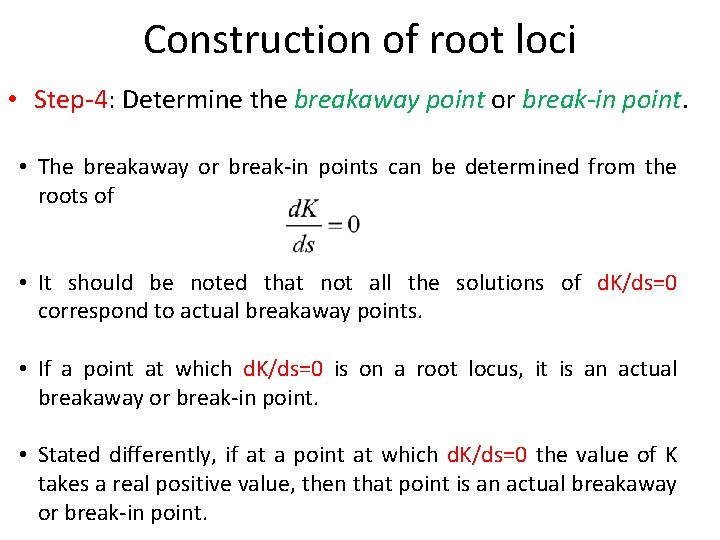
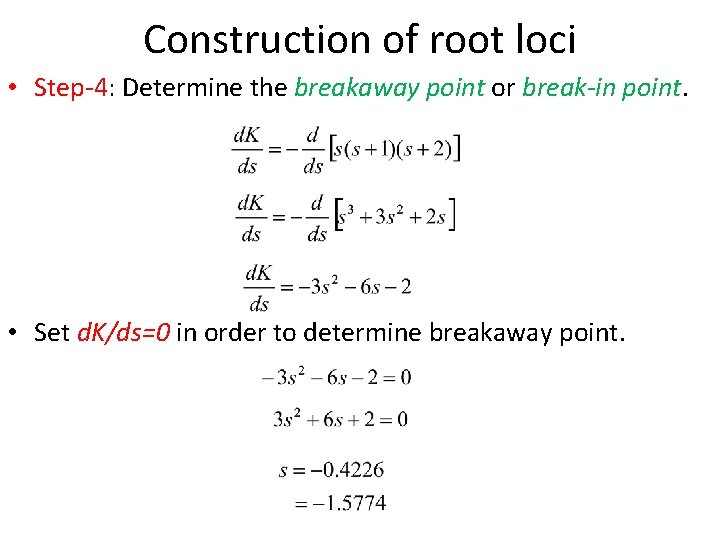
Construction of root loci • Step-4: Determine the breakaway point or break-in point. • The breakaway or break-in points can be determined from the roots of • It should be noted that not all the solutions of d. K/ds=0 correspond to actual breakaway points. • If a point at which d. K/ds=0 is on a root locus, it is an actual breakaway or break-in point. • Stated differently, if at a point at which d. K/ds=0 the value of K takes a real positive value, then that point is an actual breakaway or break-in point.
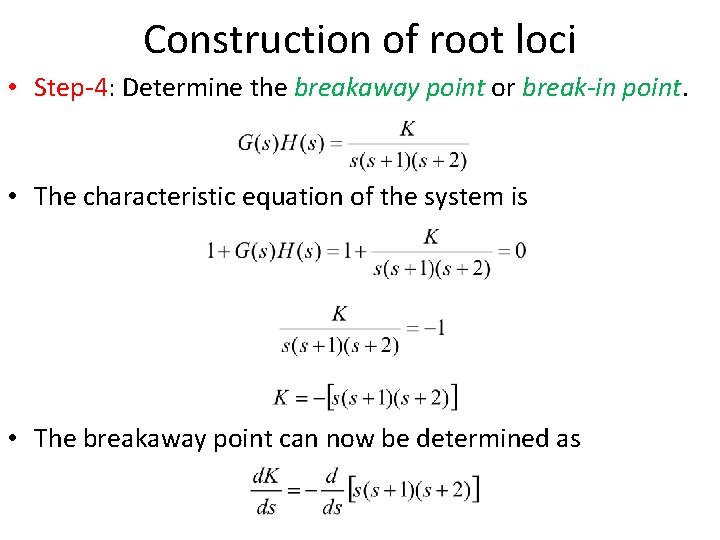
Construction of root loci • Step-4: Determine the breakaway point or break-in point. • The characteristic equation of the system is • The breakaway point can now be determined as
Construction of root loci • Step-4: Determine the breakaway point or break-in point. • Set d. K/ds=0 in order to determine breakaway point.
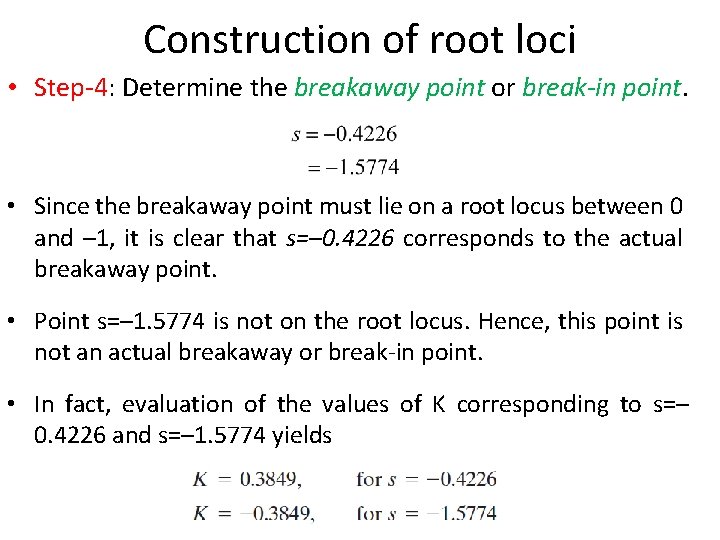
Construction of root loci • Step-4: Determine the breakaway point or break-in point. • Since the breakaway point must lie on a root locus between 0 and – 1, it is clear that s=– 0. 4226 corresponds to the actual breakaway point. • Point s=– 1. 5774 is not on the root locus. Hence, this point is not an actual breakaway or break-in point. • In fact, evaluation of the values of K corresponding to s=– 0. 4226 and s=– 1. 5774 yields
Construction of root loci • Step-4: Determine the breakaway point.
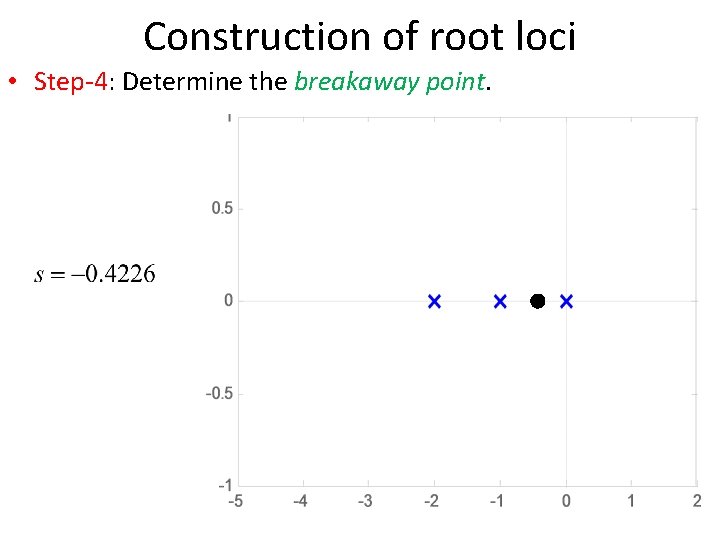
Construction of root loci • Step-4: Determine the breakaway point.
Home Work • Determine the Breakaway and break in points
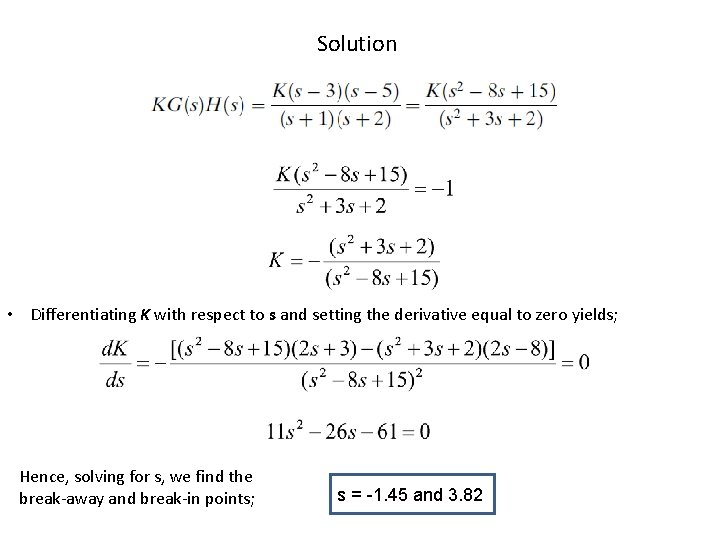
Solution • Differentiating K with respect to s and setting the derivative equal to zero yields; Hence, solving for s, we find the break-away and break-in points; s = -1. 45 and 3. 82
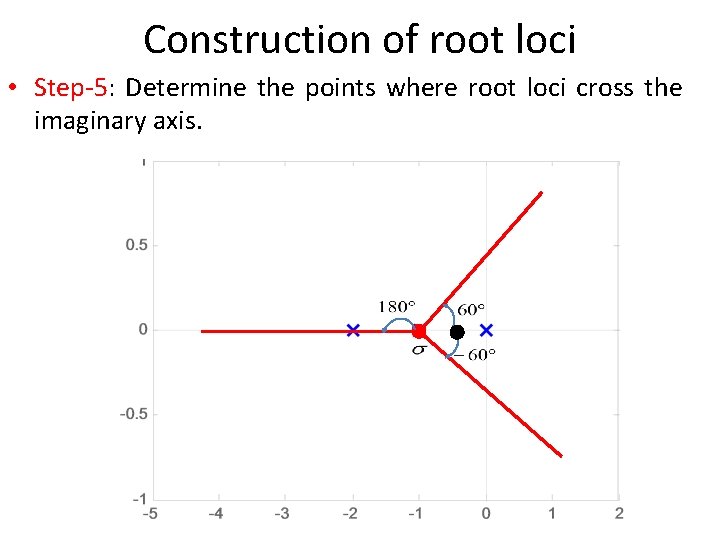
Construction of root loci • Step-5: Determine the points where root loci cross the imaginary axis.
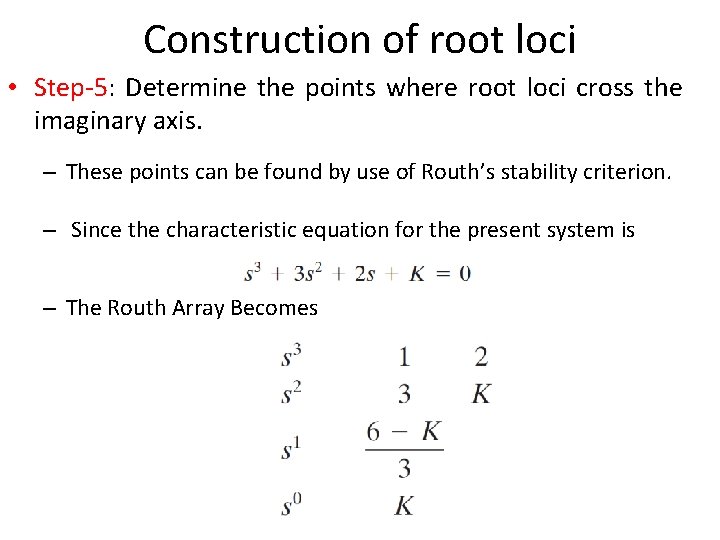
Construction of root loci • Step-5: Determine the points where root loci cross the imaginary axis. – These points can be found by use of Routh’s stability criterion. – Since the characteristic equation for the present system is – The Routh Array Becomes
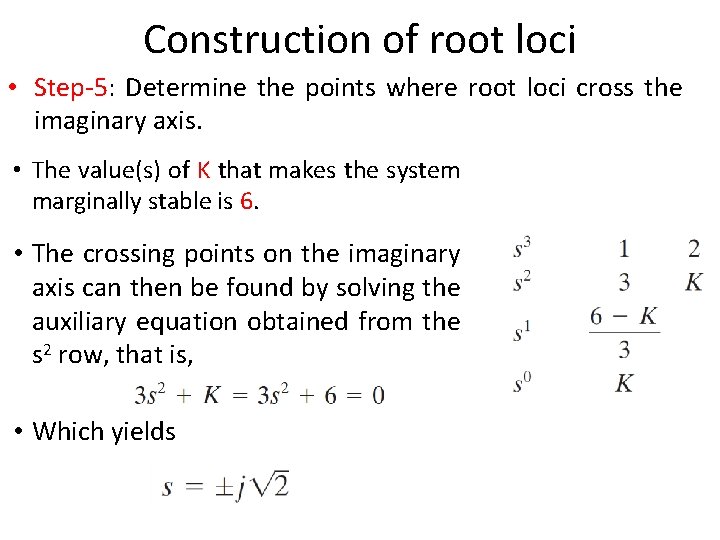
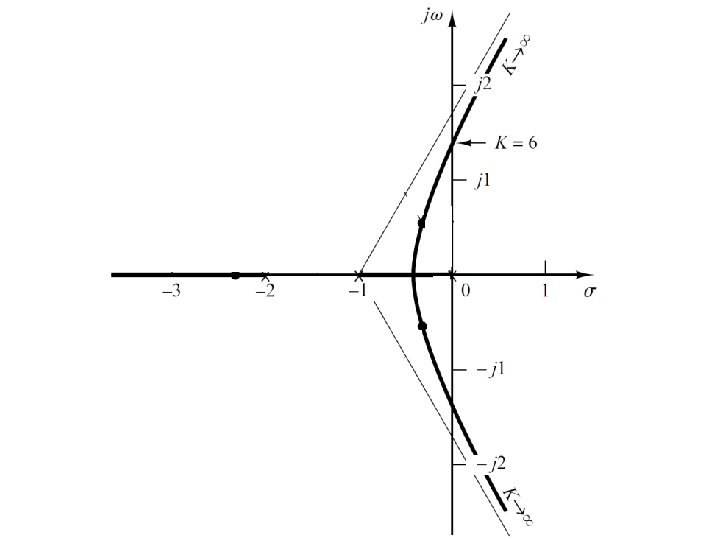
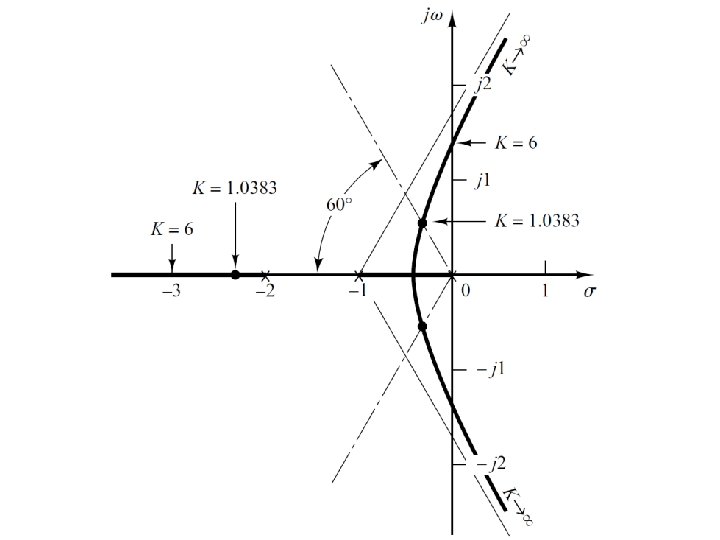
Construction of root loci • Step-5: Determine the points where root loci cross the imaginary axis. • The value(s) of K that makes the system marginally stable is 6. • The crossing points on the imaginary axis can then be found by solving the auxiliary equation obtained from the s 2 row, that is, • Which yields
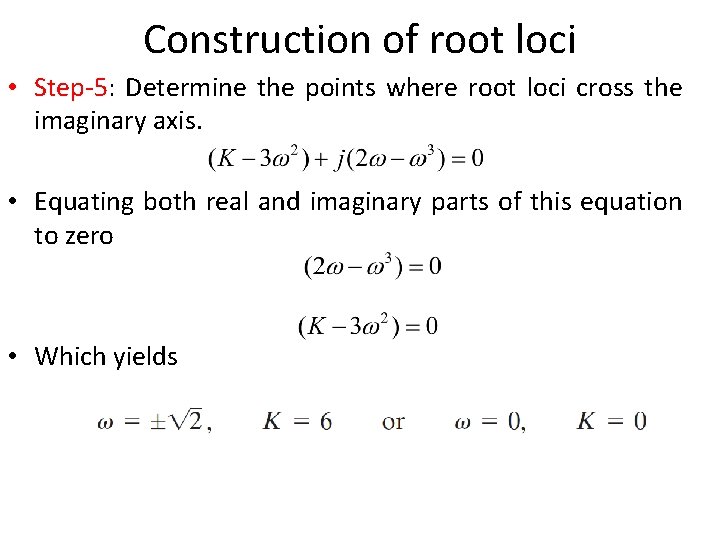
Construction of root loci • Step-5: Determine the points where root loci cross the imaginary axis. • An alternative approach is to let s=jω in the characteristic equation, equate both the real part and the imaginary part to zero, and then solve for ω and K. • For present system the characteristic equation is
Construction of root loci • Step-5: Determine the points where root loci cross the imaginary axis. • Equating both real and imaginary parts of this equation to zero • Which yields
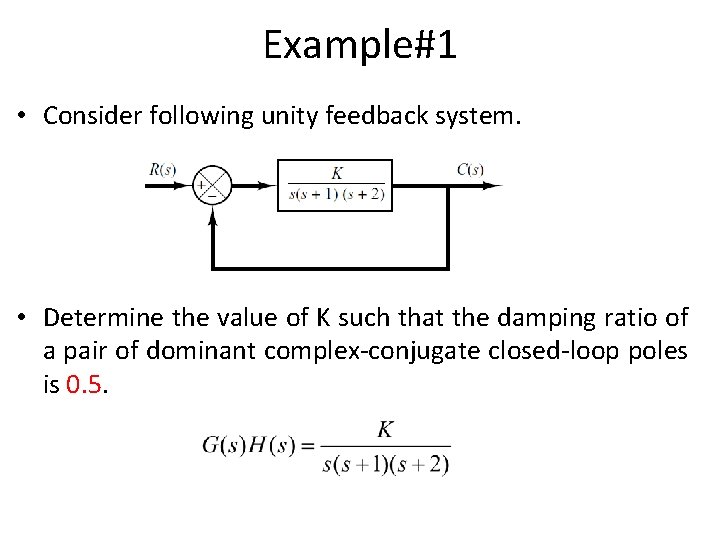
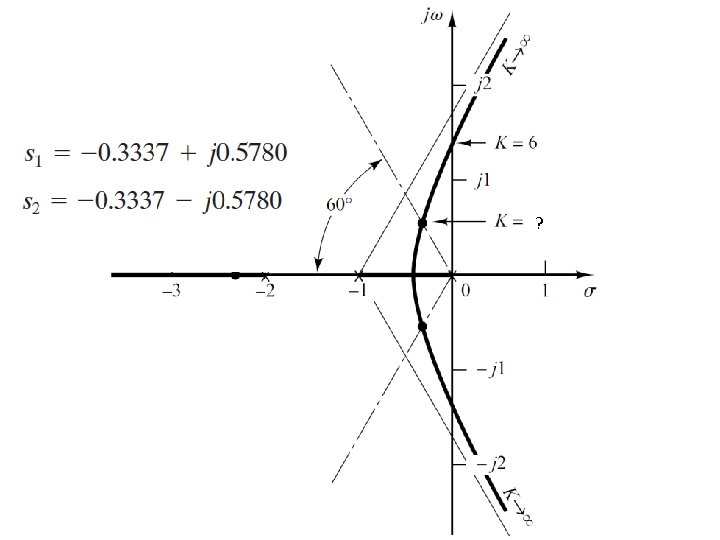
Example#1 • Consider following unity feedback system. • Determine the value of K such that the damping ratio of a pair of dominant complex-conjugate closed-loop poles is 0. 5.
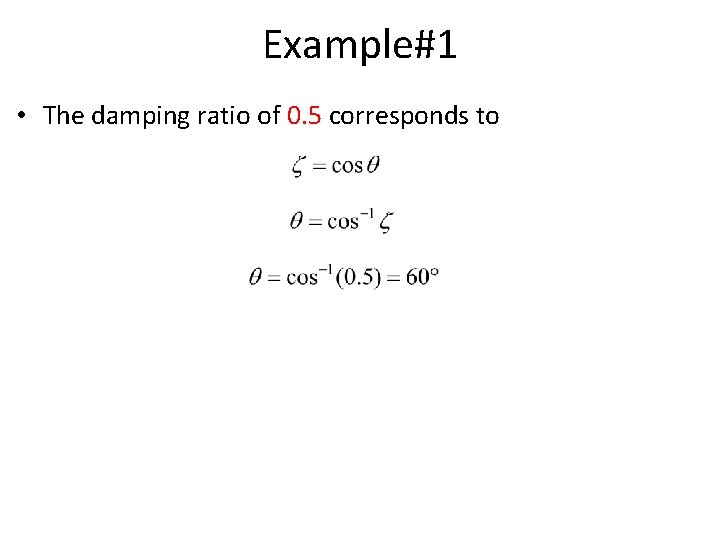
Example#1 • The damping ratio of 0. 5 corresponds to
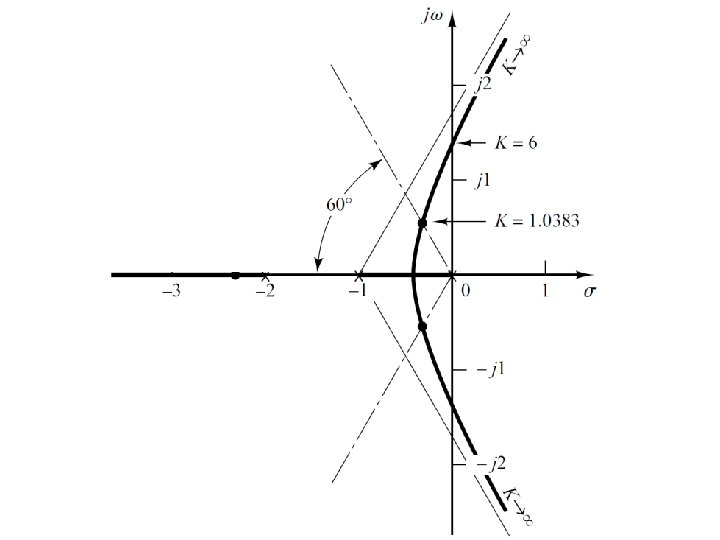
Example#1 • The value of K that yields such poles is found from the magnitude condition
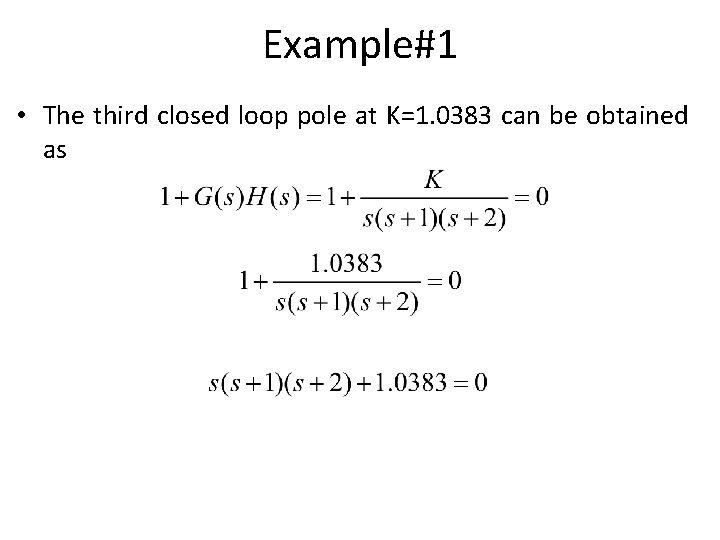
Example#1 • The third closed loop pole at K=1. 0383 can be obtained as
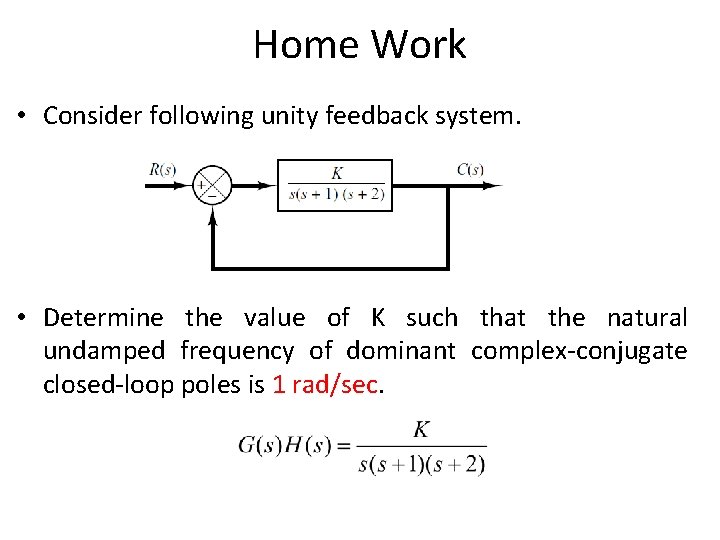
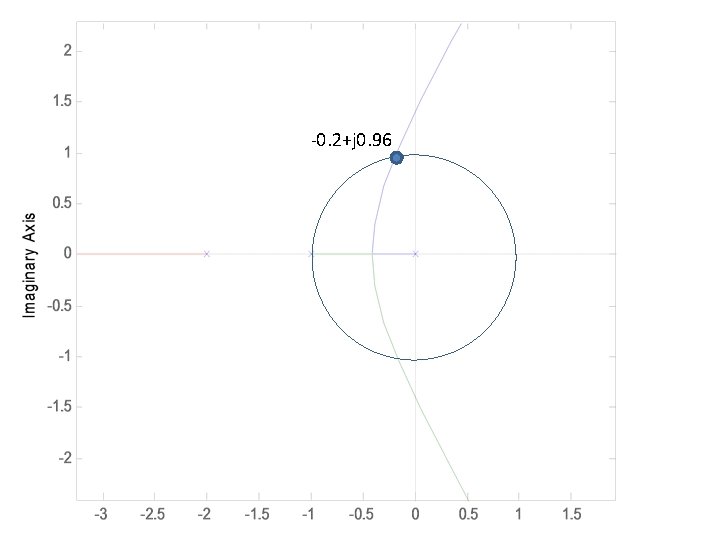
Home Work • Consider following unity feedback system. • Determine the value of K such that the natural undamped frequency of dominant complex-conjugate closed-loop poles is 1 rad/sec.
-0. 2+j 0. 96
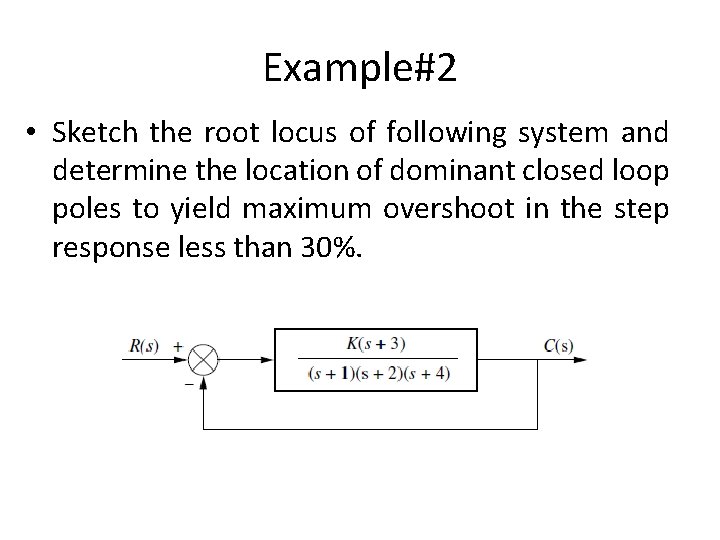
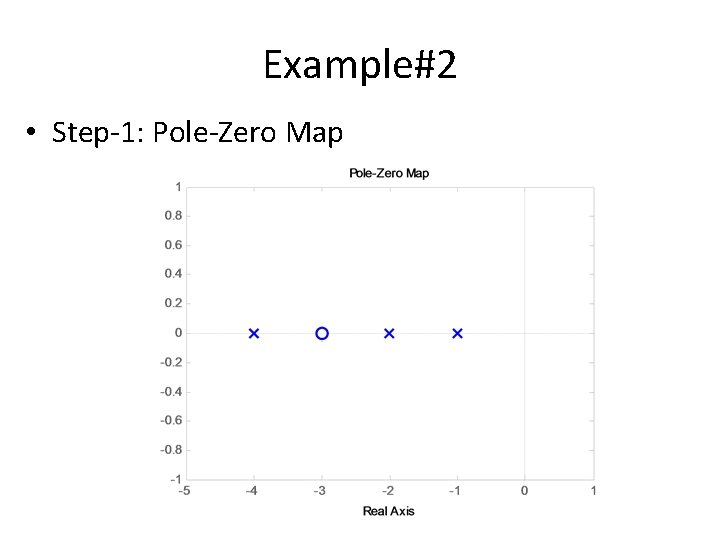
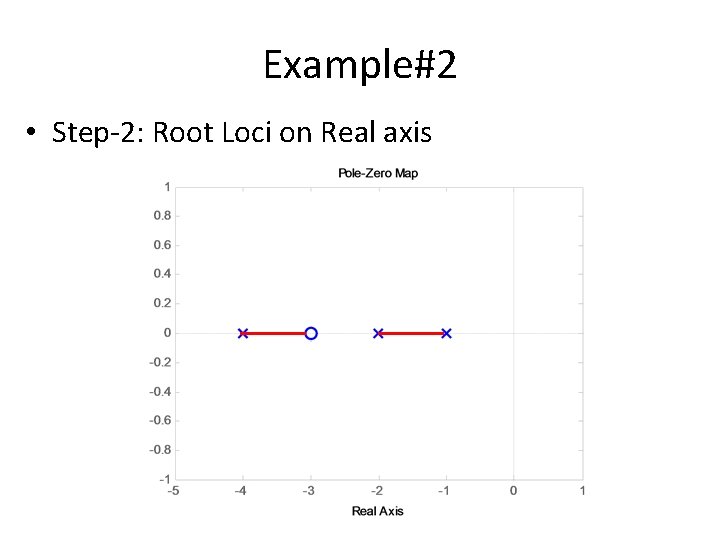
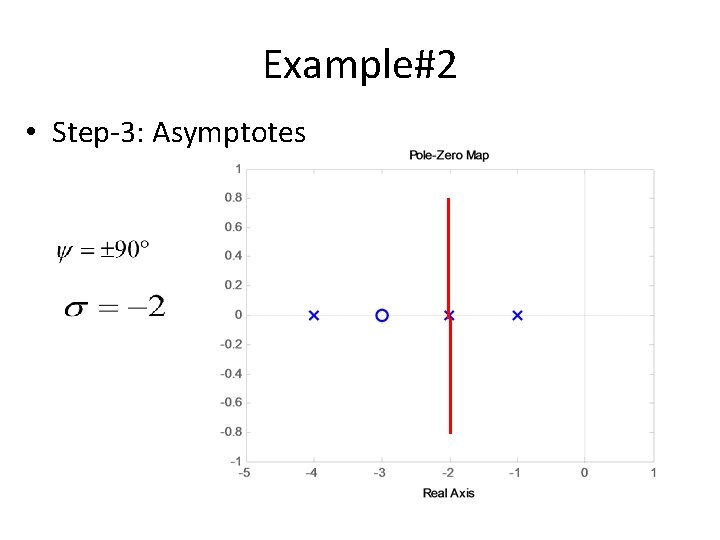
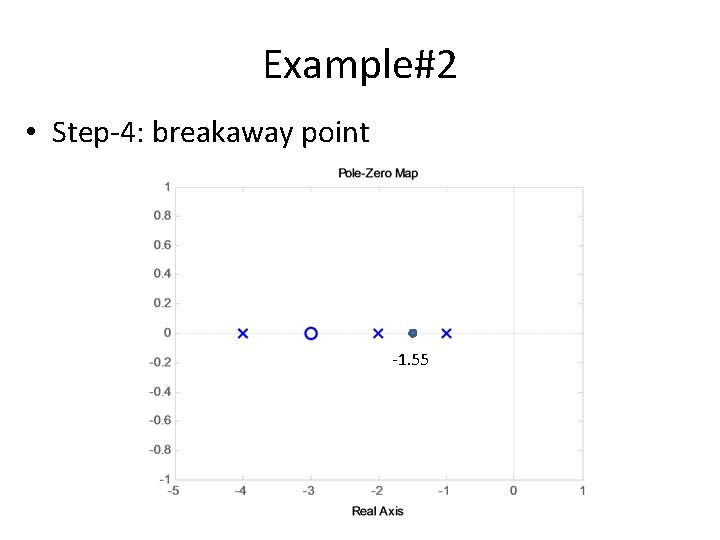
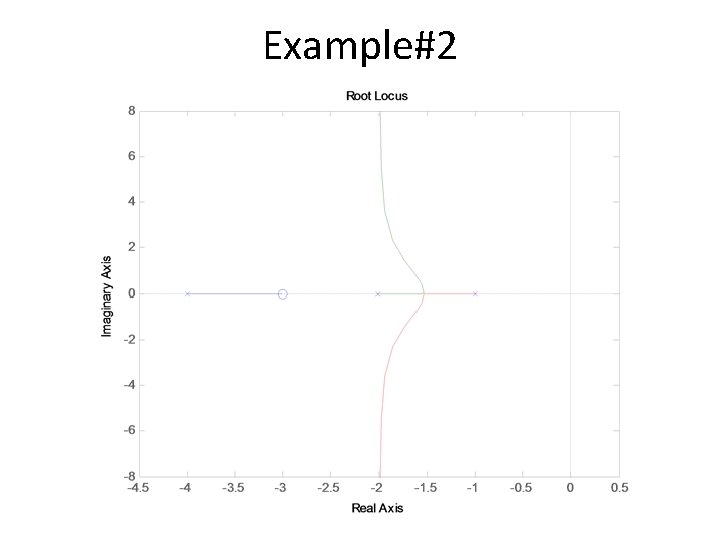
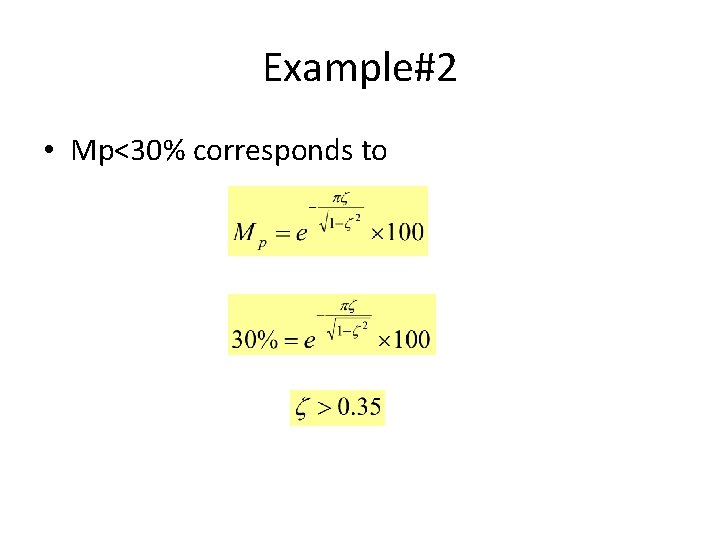
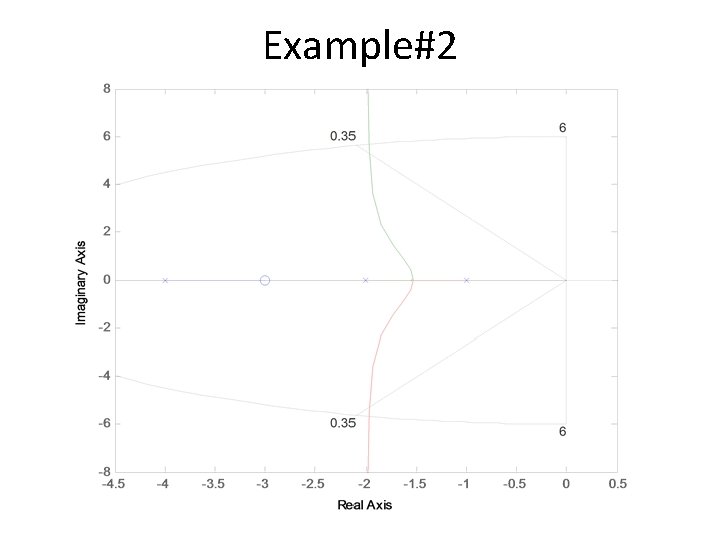
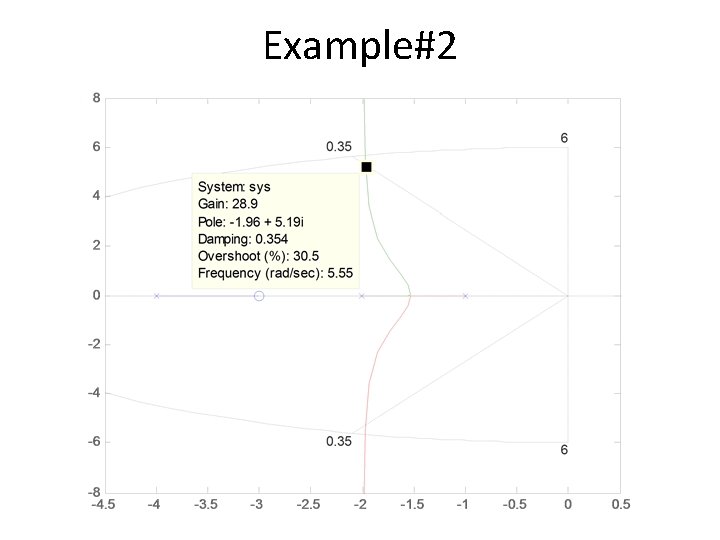
Example#2 • Sketch the root locus of following system and determine the location of dominant closed loop poles to yield maximum overshoot in the step response less than 30%.
Example#2 • Step-1: Pole-Zero Map
Example#2 • Step-2: Root Loci on Real axis
Example#2 • Step-3: Asymptotes
Example#2 • Step-4: breakaway point -1. 55
Example#2
Example#2 • Mp<30% corresponds to
Example#2
Example#2
To download this lecture visit http: //imtiazhussainkalwar. weebly. com/ END OF LECTURES-23 -24