
Control System Toolbox PartII imtiaz hussainfaculty muet edu

Control System Toolbox (Part-II) imtiaz. hussain@faculty. muet. edu. pk 1
Outline • Time Domain Analysis of 1 st Order Systems – Step Response – Impulse Response – Ramp Response – Parabolic Response • Time Domain Analysis of 2 nd Order Systems – Step Response, Impulse Response, Ramp Response and Parabolic Response – Time Domain Specifications
Introduction • The first order system has only one pole. • Where K is the D. C gain and T is the time constant of the system. • Time constant is a measure of how quickly a 1 st order system responds to a unit step input. • D. C Gain of the system is ratio between the input signal and the steady state value of output.
Step Response To obtain the step response of the system num = 10; den = [3 1]; step(num, den) or num = 10; den = [3 1]; sys=tf(num, den) step(sys)
Impulse Response To find the step response of the system num = 10; den = [3 1]; impulse(num, den) 11/3/2020
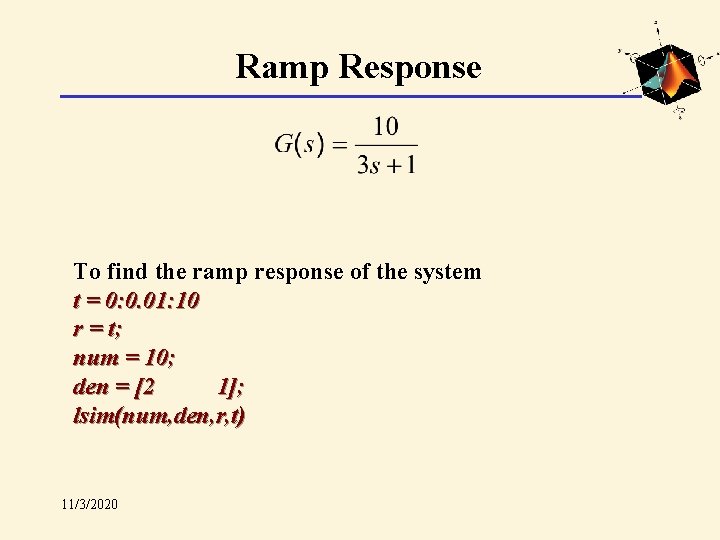
Ramp Response To find the ramp response of the system t = 0: 0. 01: 10 r = t; num = 10; den = [2 1]; lsim(num, den, r, t) 11/3/2020
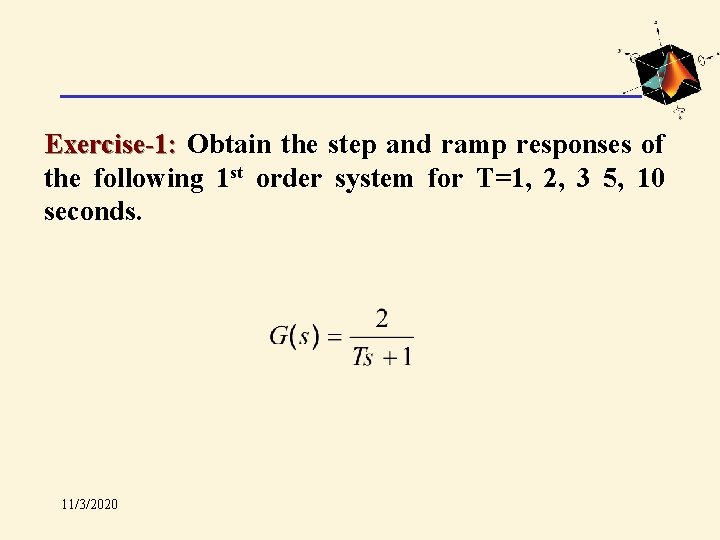
Exercise-1: Obtain the step and ramp responses of the following 1 st order system for T=1, 2, 3 5, 10 seconds. 11/3/2020

Exercise-2: Obtain the step and ramp responses of the following 1 st order system for K=1, 5, 10 and 15. 11/3/2020
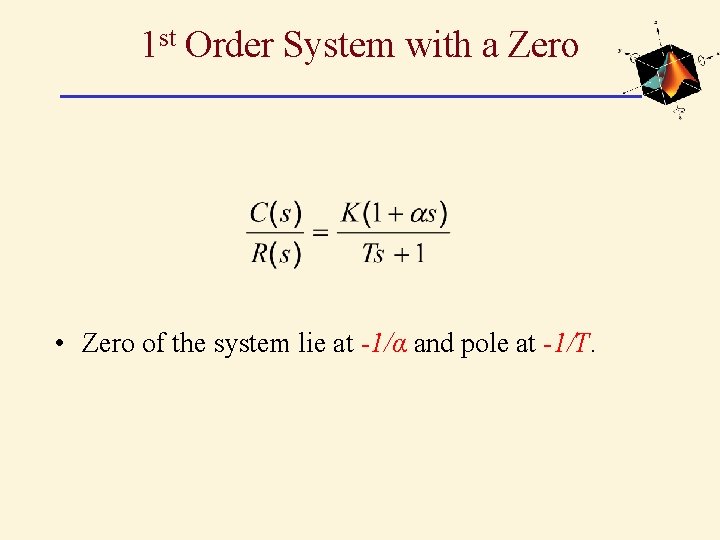
1 st Order System with a Zero • Zero of the system lie at -1/α and pole at -1/T.
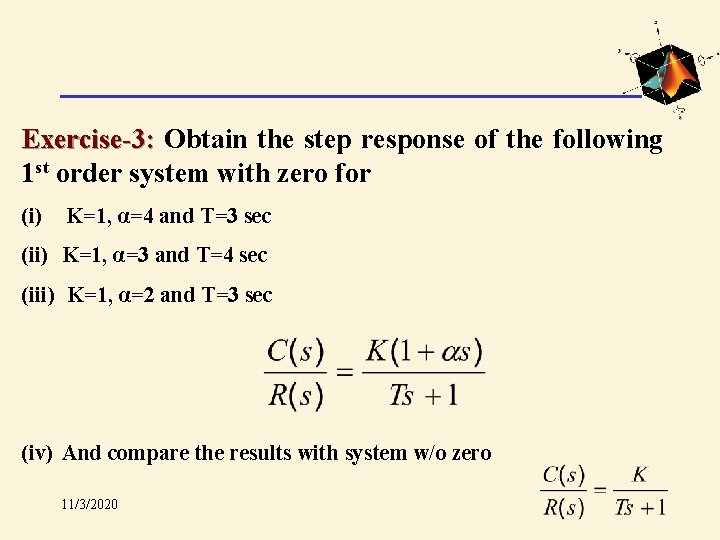
Exercise-3: Obtain the step response of the following 1 st order system with zero for (i) K=1, α=4 and T=3 sec (ii) K=1, α=3 and T=4 sec (iii) K=1, α=2 and T=3 sec (iv) And compare the results with system w/o zero 11/3/2020
TIME RESPONSE OF 2 ND ORDER SYSTEMS
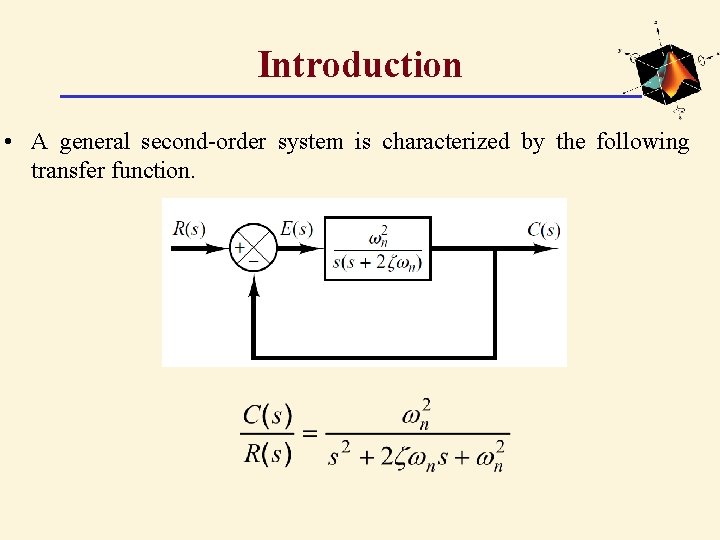
Introduction • A general second-order system is characterized by the following transfer function.
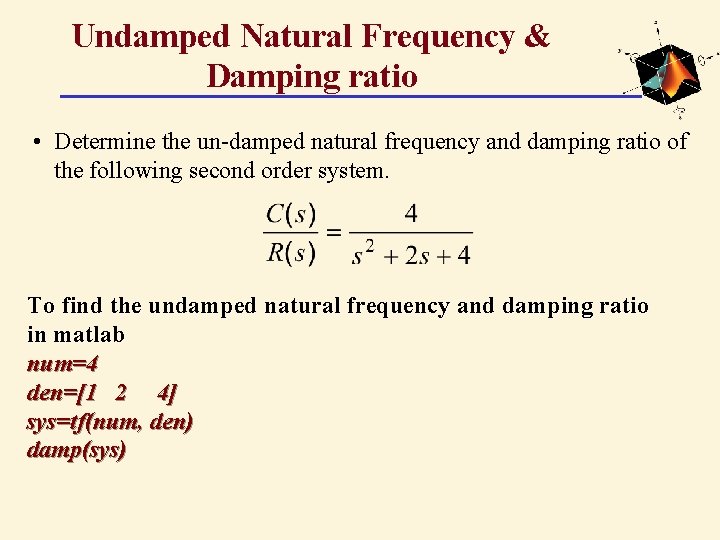
Undamped Natural Frequency & Damping ratio • Determine the un-damped natural frequency and damping ratio of the following second order system. To find the undamped natural frequency and damping ratio in matlab num=4 den=[1 2 4] sys=tf(num, den) damp(sys)
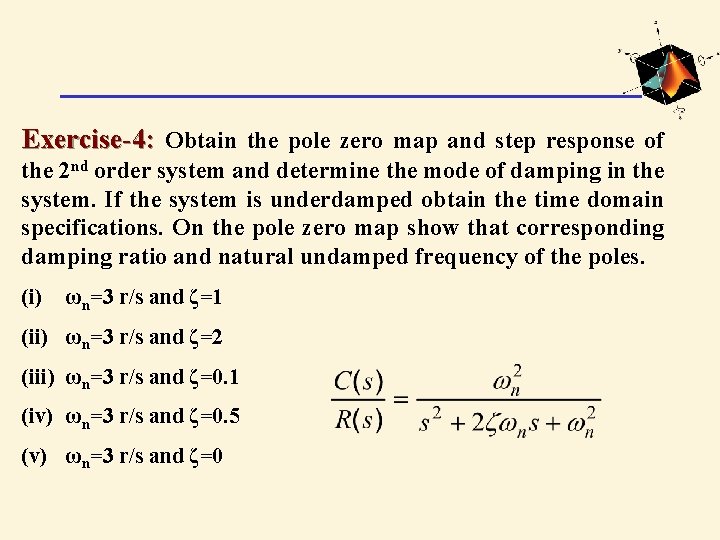
Exercise-4: Obtain the pole zero map and step response of the 2 nd order system and determine the mode of damping in the system. If the system is underdamped obtain the time domain specifications. On the pole zero map show that corresponding damping ratio and natural undamped frequency of the poles. (i) ωn=3 r/s and ζ=1 (ii) ωn=3 r/s and ζ=2 (iii) ωn=3 r/s and ζ=0. 1 (iv) ωn=3 r/s and ζ=0. 5 (v) ωn=3 r/s and ζ=0
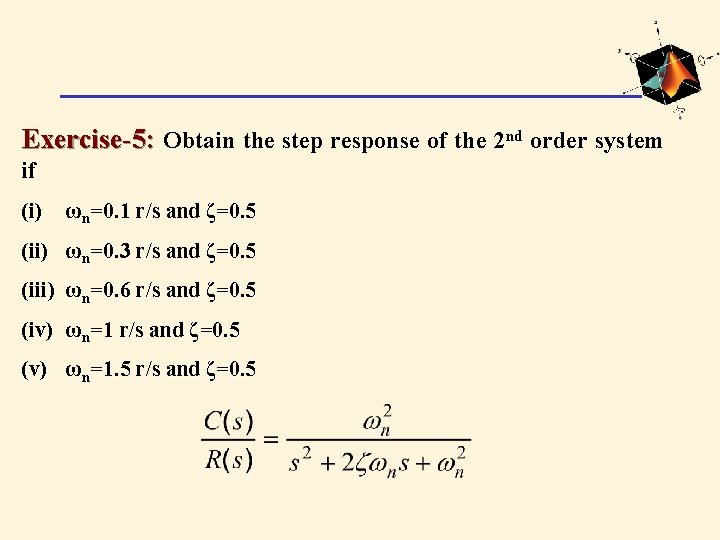
Exercise-5: Obtain the step response of the 2 nd order system if (i) ωn=0. 1 r/s and ζ=0. 5 (ii) ωn=0. 3 r/s and ζ=0. 5 (iii) ωn=0. 6 r/s and ζ=0. 5 (iv) ωn=1 r/s and ζ=0. 5 (v) ωn=1. 5 r/s and ζ=0. 5
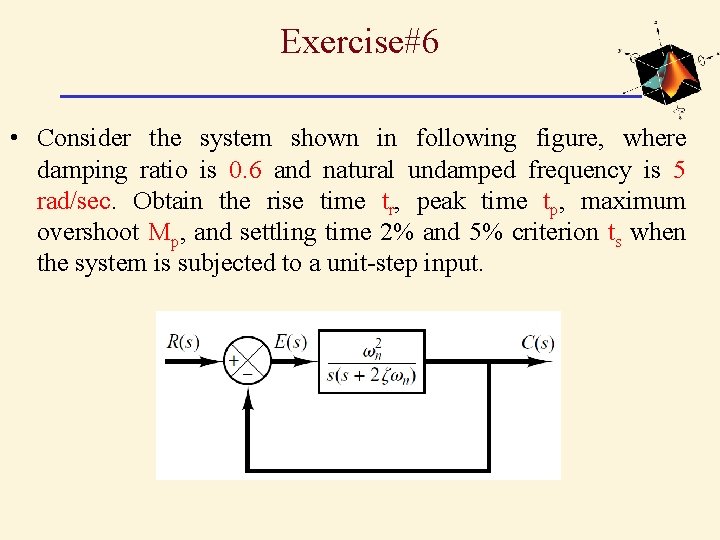
Exercise#6 • Consider the system shown in following figure, where damping ratio is 0. 6 and natural undamped frequency is 5 rad/sec. Obtain the rise time tr, peak time tp, maximum overshoot Mp, and settling time 2% and 5% criterion ts when the system is subjected to a unit-step input.
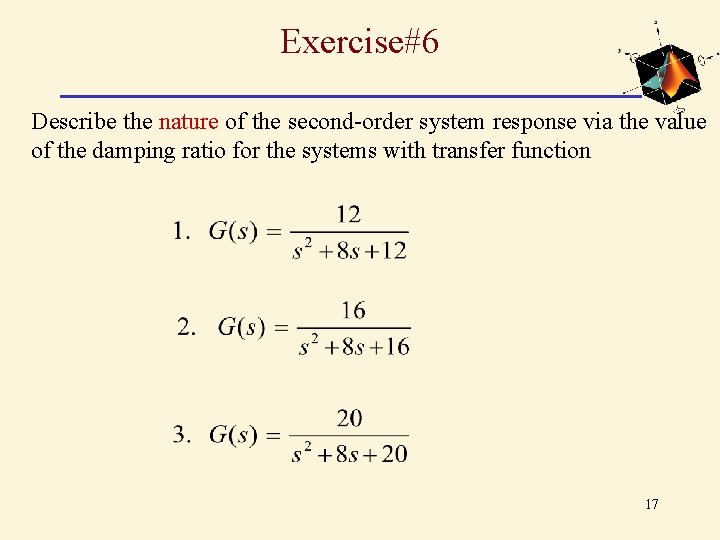
Exercise#6 Describe the nature of the second-order system response via the value of the damping ratio for the systems with transfer function 17

You can Download this tutorial from http: //imtiazhussainkalwar. weebly. com/ END OF TUTORIAL 11/3/2020
- Slides: 18