
Control Structures ifelse semantically the same as CC
- Slides: 12
Control Structures
if-else • semantically the same as C/C++ • syntactically, slightly different. if ($a > 0){ print “$a is positiven”; } elsif ($a == 0){ print “$a equals 0n”; } else { print “$a is negativen”; } • brackets are *required*!
unless • another way of writing if (! …) { } • analogous to English meaning of “unless” • unless (EXPR) BLOCK – “do BLOCK unless EXPR is true” – “do BLOCK if EXPR is false” • can use elsif and else with unless as well
while/until loops • while is similar to C/C++ • while (EXPR) BLOCK – “While EXPR is true, do BLOCK” • until (EXPR) BLOCK – “Until EXPR is true, do BLOCK” – “While EXPR is false, do BLOCK” – another way of saying while (! …) { } • again, brackets are *required*
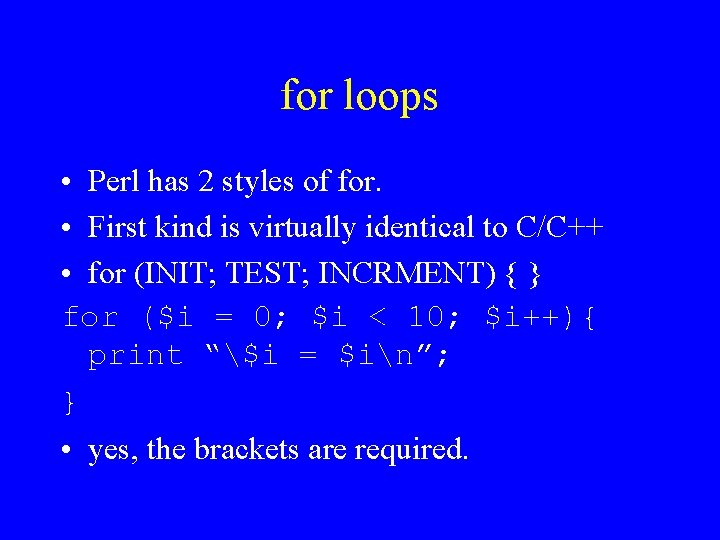
for loops • Perl has 2 styles of for. • First kind is virtually identical to C/C++ • for (INIT; TEST; INCRMENT) { } for ($i = 0; $i < 10; $i++){ print “$i = $in”; } • yes, the brackets are required.
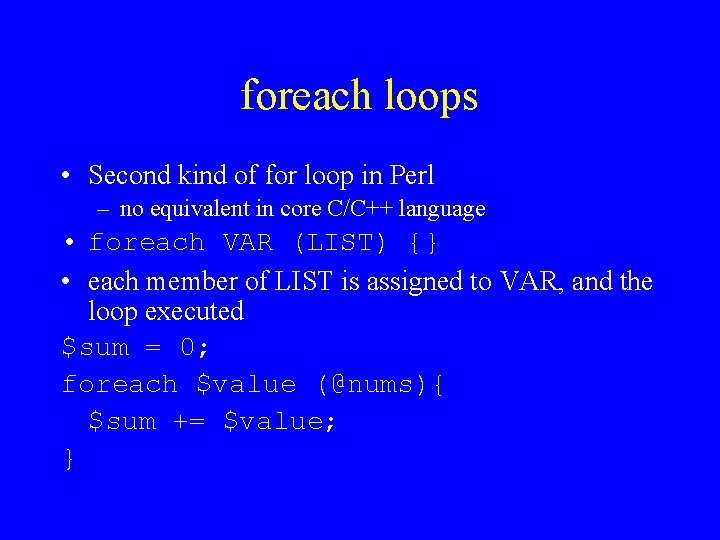
foreach loops • Second kind of for loop in Perl – no equivalent in core C/C++ language • foreach VAR (LIST) {} • each member of LIST is assigned to VAR, and the loop executed $sum = 0; foreach $value (@nums){ $sum += $value; }
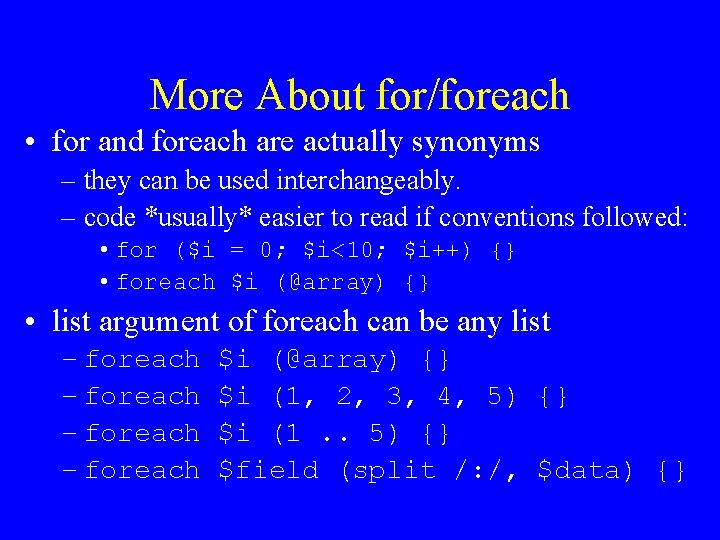
More About for/foreach • for and foreach are actually synonyms – they can be used interchangeably. – code *usually* easier to read if conventions followed: • for ($i = 0; $i<10; $i++) {} • foreach $i (@array) {} • list argument of foreach can be any list – foreach $i (@array) {} $i (1, 2, 3, 4, 5) {} $i (1. . 5) {} $field (split /: /, $data) {}
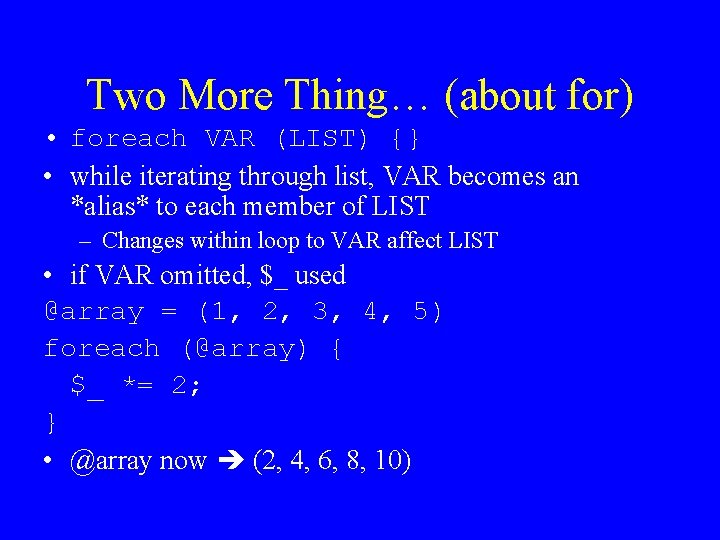
Two More Thing… (about for) • foreach VAR (LIST) {} • while iterating through list, VAR becomes an *alias* to each member of LIST – Changes within loop to VAR affect LIST • if VAR omitted, $_ used @array = (1, 2, 3, 4, 5) foreach (@array) { $_ *= 2; } • @array now (2, 4, 6, 8, 10)
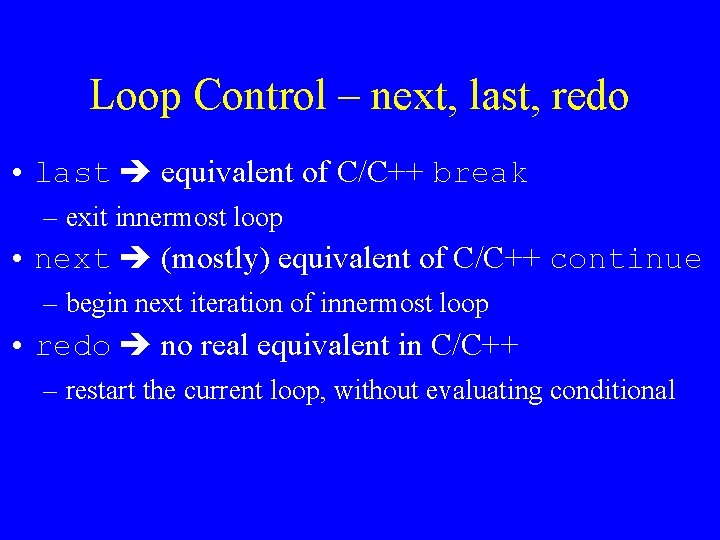
Loop Control – next, last, redo • last equivalent of C/C++ break – exit innermost loop • next (mostly) equivalent of C/C++ continue – begin next iteration of innermost loop • redo no real equivalent in C/C++ – restart the current loop, without evaluating conditional
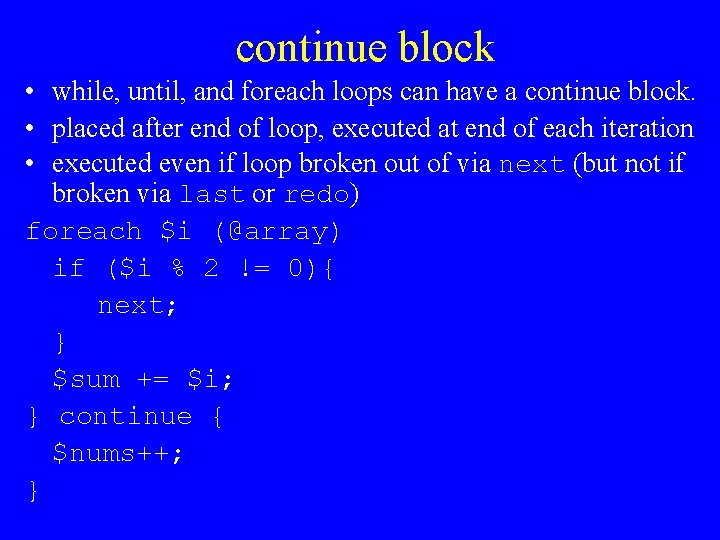
continue block • while, until, and foreach loops can have a continue block. • placed after end of loop, executed at end of each iteration • executed even if loop broken out of via next (but not if broken via last or redo) foreach $i (@array) if ($i % 2 != 0){ next; } $sum += $i; } continue { $nums++; }
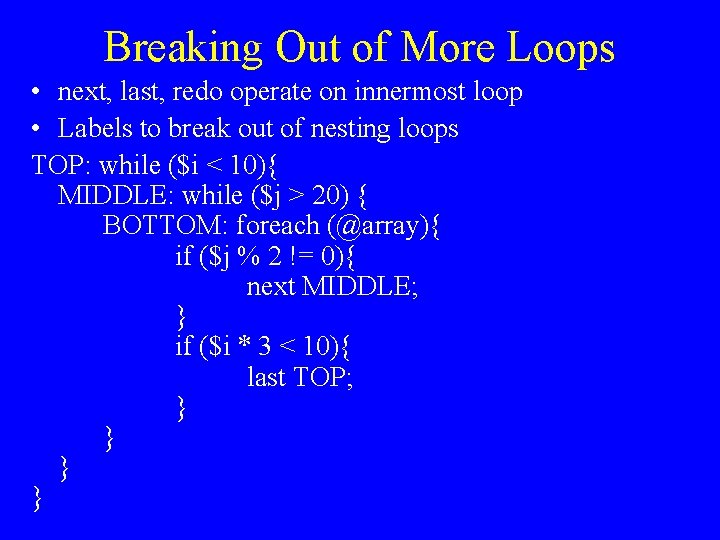
Breaking Out of More Loops • next, last, redo operate on innermost loop • Labels to break out of nesting loops TOP: while ($i < 10){ MIDDLE: while ($j > 20) { BOTTOM: foreach (@array){ if ($j % 2 != 0){ next MIDDLE; } if ($i * 3 < 10){ last TOP; } }
goto • yes, it exists. • No, don’t use it.