
CONTROL STACK AND ACTIVATION RECORDS Control stack or
- Slides: 19
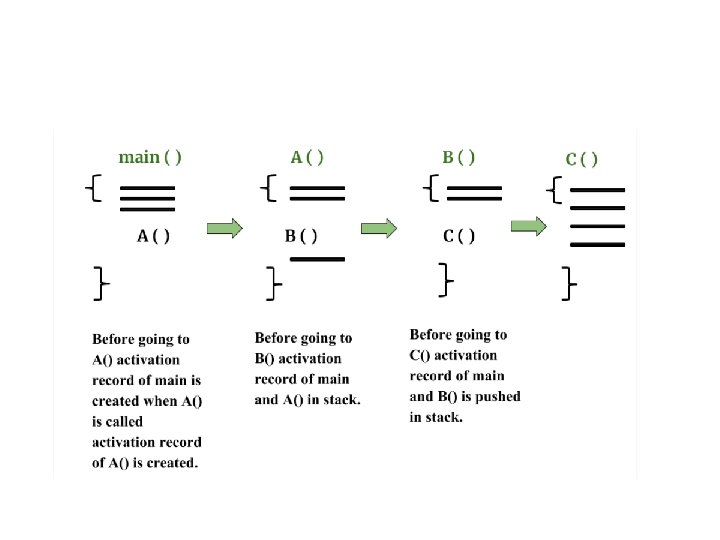
CONTROL STACK AND ACTIVATION RECORDS • Control stack or runtime stack is used to keep track of the live procedure activations i. e the procedures whose execution have not been completed. • A procedure name is pushed on to the stack when it is called (activation begins) and it is popped when it returns (activation ends). Information needed by a single execution of a procedure is managed using an activation record or frame. • When a procedure is called, an activation record is pushed into the stack and as soon as the control returns to the caller function the activation record is popped.
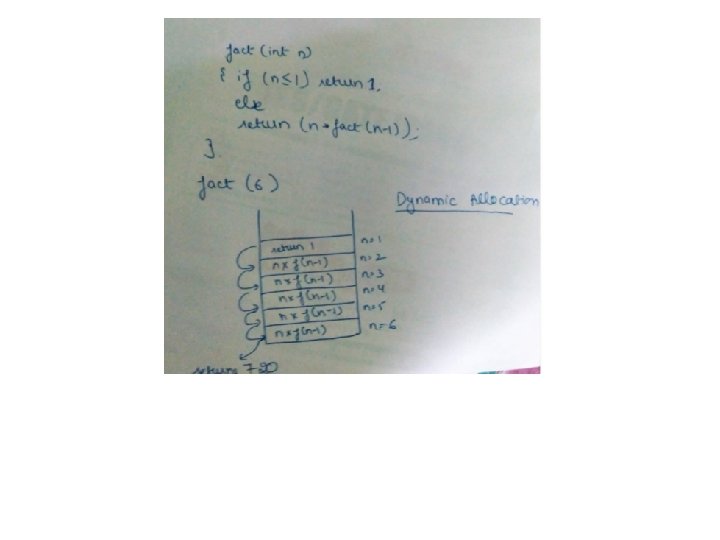
• • STORAGE ALLOCATION TECHNIQUES I. Static Storage Allocation – – – For any program if we create memory at compile time, memory will be created in the static area. For any program if we create memory at compile time only, memory is created only once. It don’t support dynamic data structure i. e memory is created at compile time and deallocated after program completion. The drawback with static storage allocation is recursion is not supported. Another drawback is size of data should be known at compile time • Eg- FORTRAN was designed to permit static storage allocation. • • II. Stack Storage Allocation Storage is organised as a stack and activation records are pushed and popped as activation begin and end respectively. Locals are contained in activation records so they are bound to fresh storage in each activation. Recursion is supported in stack allocation • • • III. Heap Storage Allocation Memory allocation and deallocation can be done at any time and at any place depending on the requirement of the user. Heap allocation is used to dynamically allocate memory to the variables and claim it back when the variables are no more required. Recursion is supported.
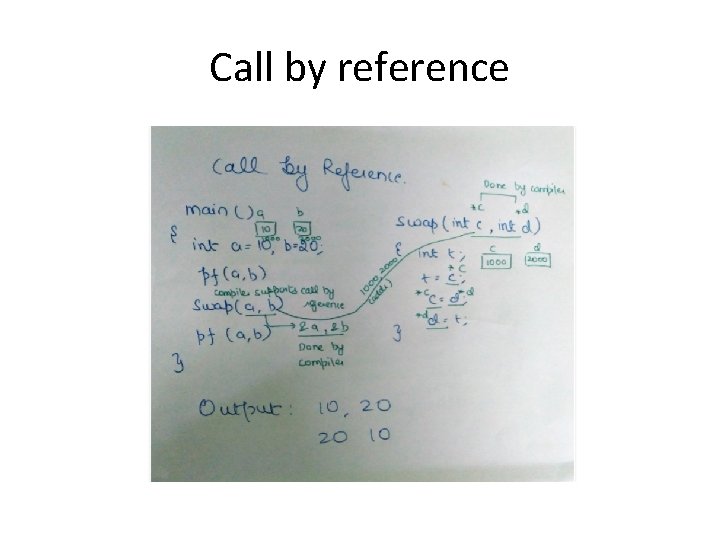
Call by reference
Storage Allocation Strategies • The different storage allocation strategies are : 1. Static allocation - lays out storage for all data objects at compile time • 2. Stack allocation - manages the run-time storage as a stack. • 3. Heap allocation - allocates and deallocates storage as needed at run time from a data area known as heap.
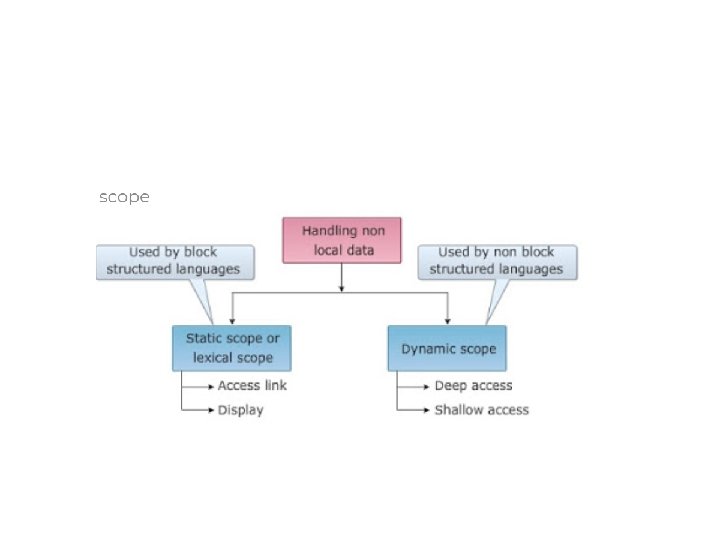
Access to Nonlocal Names • In some cases, when a procedure refer to variables that are not local to it, then such variables are called nonlocal variables • There are two types of scope rules, for the non -local names. They are • Static scope • Dynamic scope
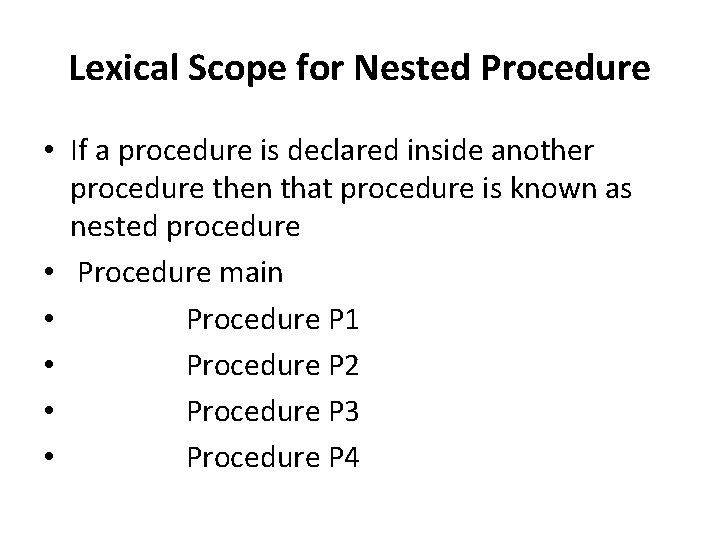
Lexical Scope for Nested Procedure • If a procedure is declared inside another procedure then that procedure is known as nested procedure • Procedure main • Procedure P 1 • Procedure P 2 • Procedure P 3 • Procedure P 4
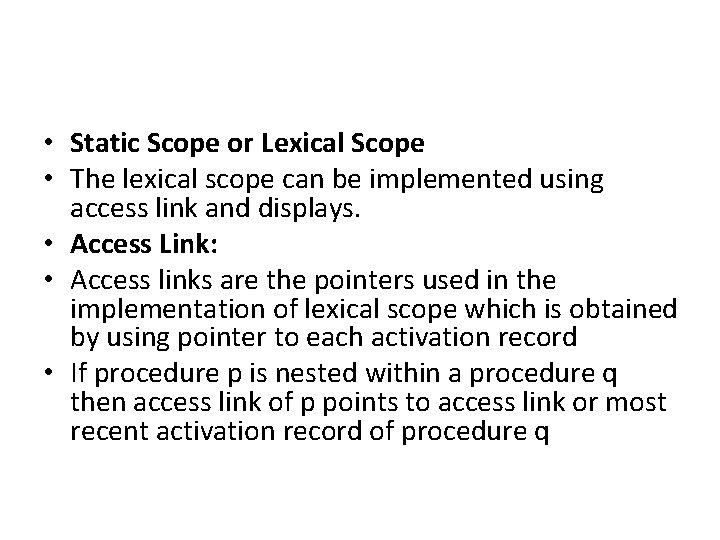
• Static Scope or Lexical Scope • The lexical scope can be implemented using access link and displays. • Access Link: • Access links are the pointers used in the implementation of lexical scope which is obtained by using pointer to each activation record • If procedure p is nested within a procedure q then access link of p points to access link or most recent activation record of procedure q
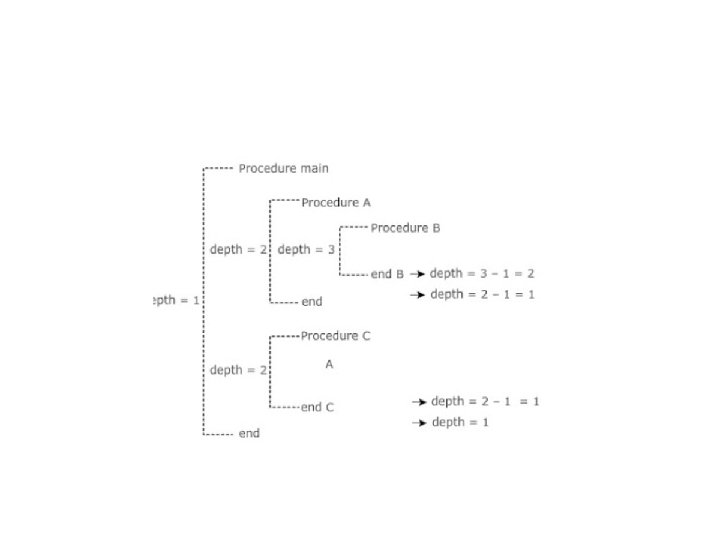
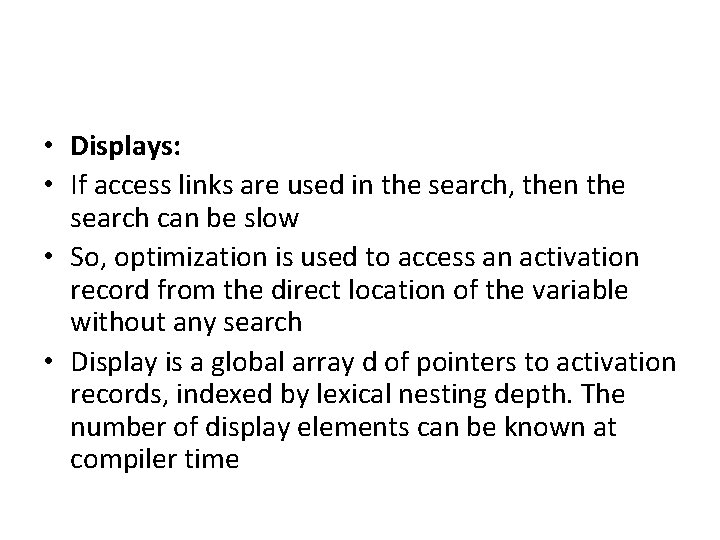
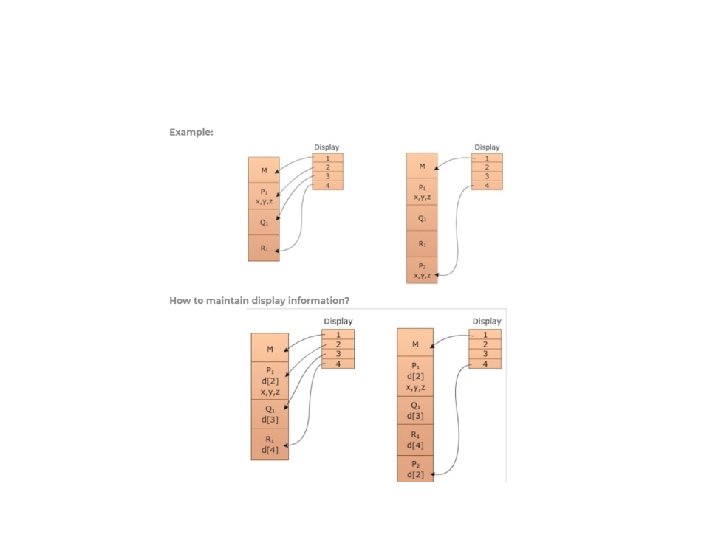
• Displays: • If access links are used in the search, then the search can be slow • So, optimization is used to access an activation record from the direct location of the variable without any search • Display is a global array d of pointers to activation records, indexed by lexical nesting depth. The number of display elements can be known at compiler time
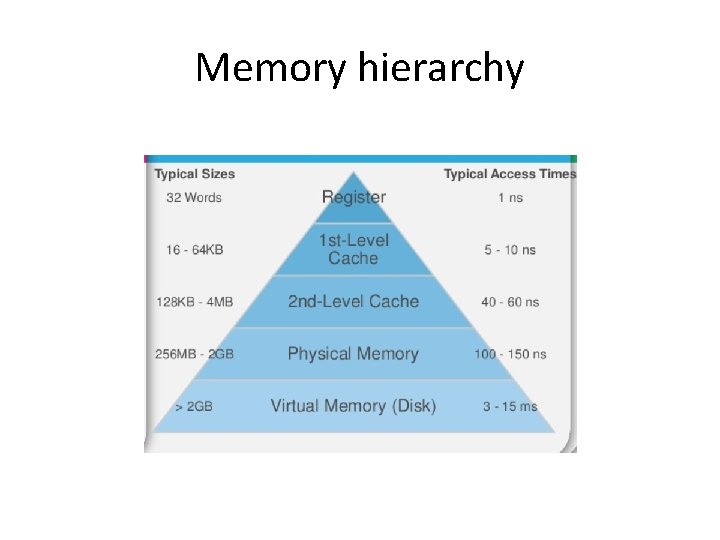
Memory hierarchy