
Control of Waterborne Pathogens in Hospital Water Systems
Control of Waterborne Pathogens in Hospital Water Systems Samir Elmir, PE, Ph. D Environmental Administrator Miami Dade County Health Department Contact info. : 305 -623 -3500 Email: samir_elmir@doh. state. fl. us
Background n Annually, nearly 2 million patients in the USA get an infection in a hospital (HAIs) n Waterborne pathogens are responsible for approx. 100, 000 of those annual HAIs n 90, 000 people will die each year as a result of HAIs n 5, 000 people will die each year from waterborne HAIs
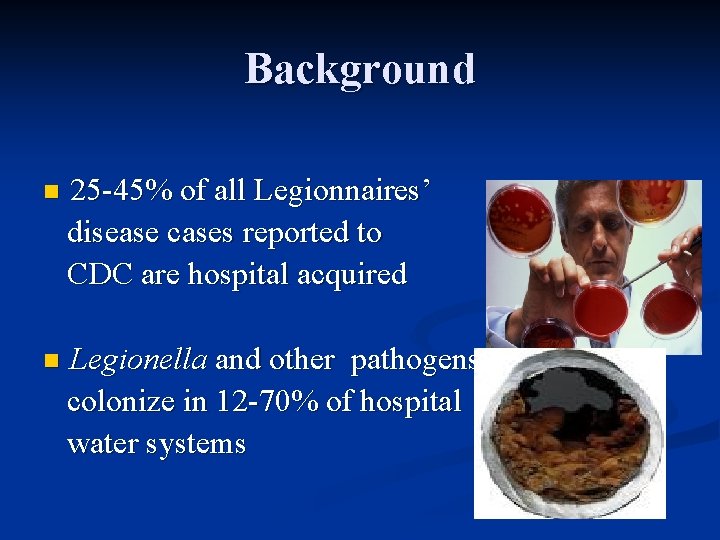
Background n 25 -45% of all Legionnaires’ disease cases reported to CDC are hospital acquired n Legionella and other pathogens colonize in 12 -70% of hospital water systems
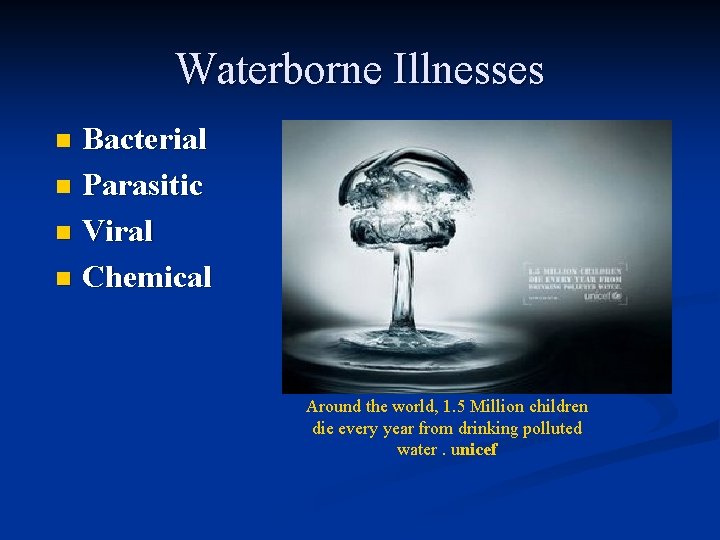
Waterborne Illnesses Bacterial n Parasitic n Viral n Chemical n Around the world, 1. 5 Million children die every year from drinking polluted water. unicef
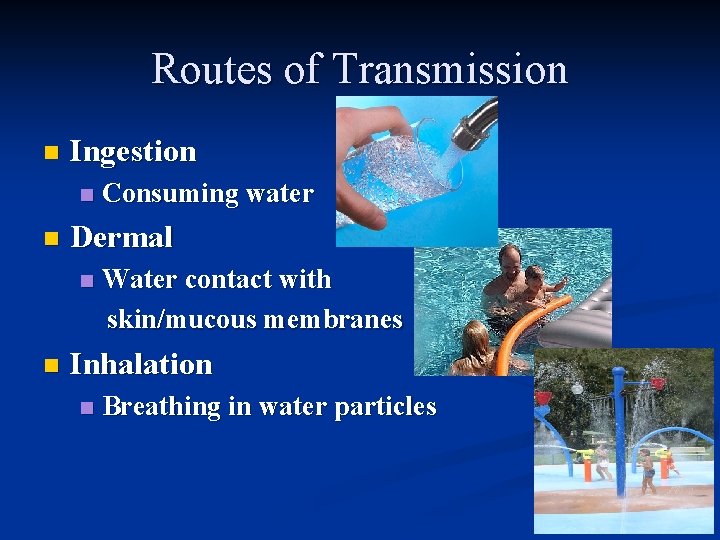
Routes of Transmission n Ingestion n n Dermal n n Consuming water Water contact with skin/mucous membranes Inhalation n Breathing in water particles
Common Waterborne Bacterial Pathogens n Legionella n Pseudomonas n Others
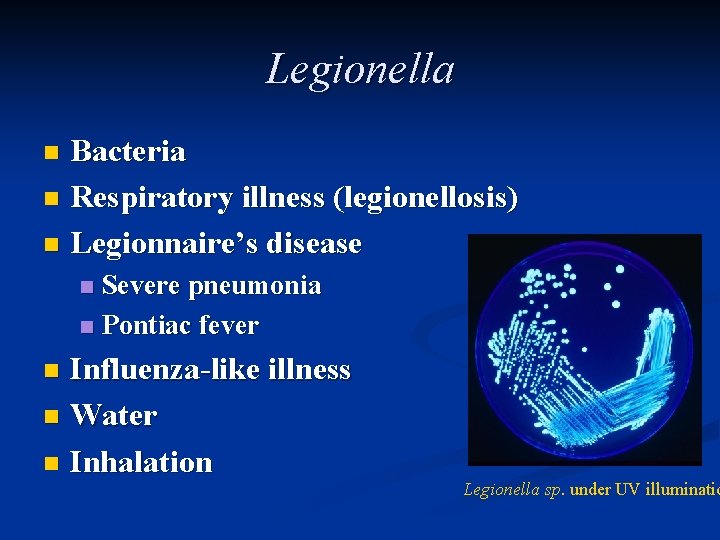
Legionella Bacteria n Respiratory illness (legionellosis) n Legionnaire’s disease n Severe pneumonia n Pontiac fever n Influenza-like illness n Water n Inhalation n Legionella sp. under UV illuminatio
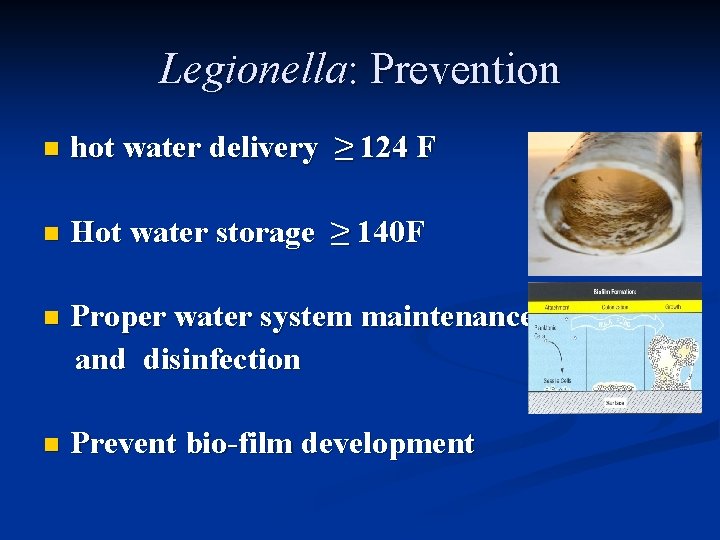
Legionella: Prevention n hot water delivery ≥ 124 F n Hot water storage ≥ 140 F n Proper water system maintenance and disinfection n Prevent bio-film development
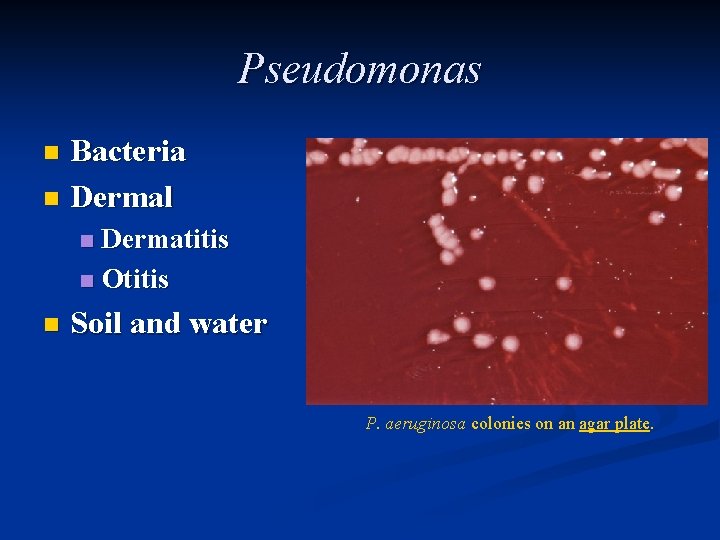
Pseudomonas Bacteria n Dermal n Dermatitis n Otitis n n Soil and water P. aeruginosa colonies on an agar plate.
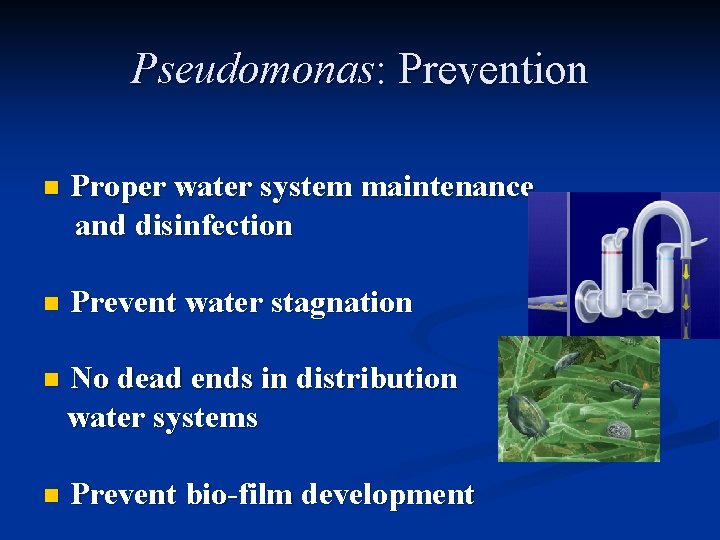
Pseudomonas: Prevention n Proper water system maintenance and disinfection n Prevent water stagnation n No dead ends in distribution water systems n Prevent bio-film development
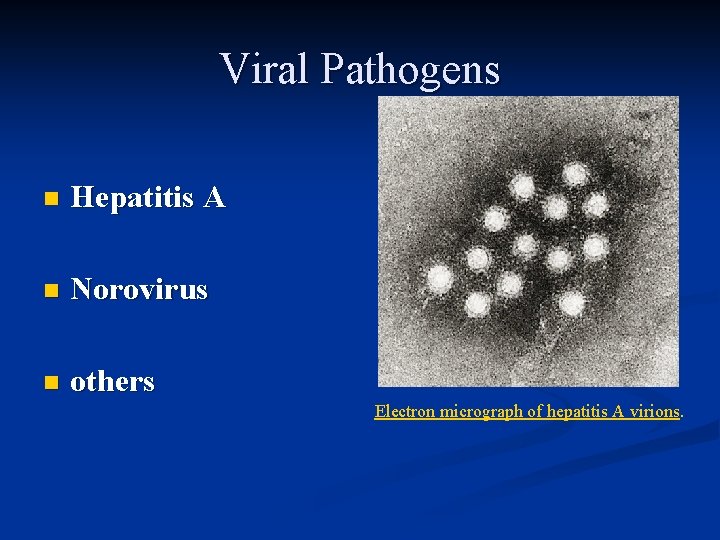
Viral Pathogens n Hepatitis A n Norovirus n others Electron micrograph of hepatitis A virions.
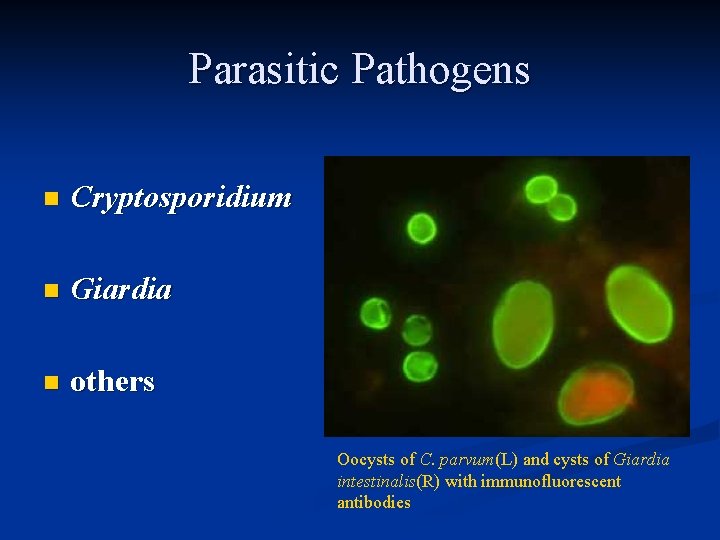
Parasitic Pathogens n Cryptosporidium n Giardia n others Oocysts of C. parvum(L) and cysts of Giardia intestinalis(R) with immunofluorescent antibodies
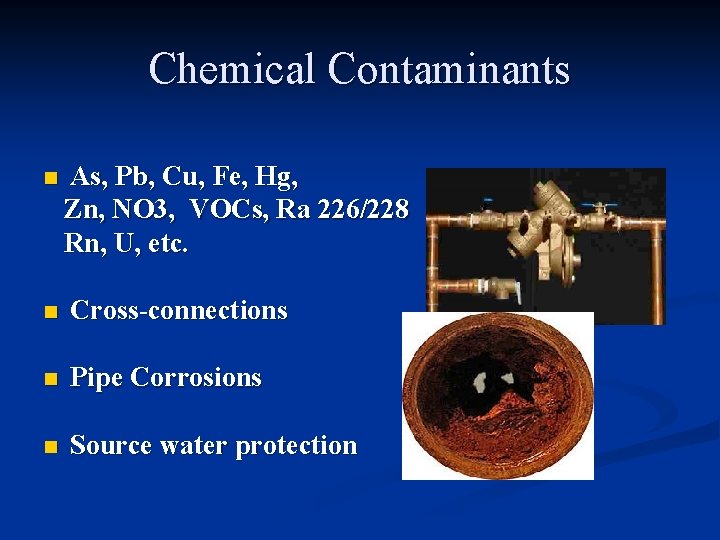
Chemical Contaminants n As, Pb, Cu, Fe, Hg, Zn, NO 3, VOCs, Ra 226/228 Rn, U, etc. n Cross-connections n Pipe Corrosions n Source water protection
Case Review (1) n What: Legionella n Where: Iowa City Hospital, USA n When: 2004 n Who: 2 deaths n Why: Contaminated hospital water system
Case Review (1) Corrective Actions: n Provide patients with bottled water for drinking n Provide filtered water for showering until water system was super-chlorinated and tested
Case Review (2) n What: Legionella n Where: Zaragoza General Hospital, Spain n When: 2004 n Who: 7 deaths- 27 cases n Why: contaminated AC cooling tower
Case Review (2) Corrective actions: n Cooling tower was disinfected n water treatment program was revised
Case Review (3) n What: Pseudomonas aeruginosa n Where: Sainte Justine Hospital, Montreal, Canada n When: 2004 -2005 n Who: 6 deaths of premature babies- 50 babies infected n Why: Dilapidated hospital water system
Case Review (3) Corrective actions: n Prevent immune-compromised patients from exposure to the hospital water system n Complete renovation of the neo-natal ward
Case Review (4) n What: Pseudomonas aeruginosa n Where: ICUs –Toronto General Hospital, Canada n When: 2004 -2006 n Who: 17 deaths, 36 patients contracted infection n Why: Contaminated hand hygiene sink drains
Case Review (4) Corrective action: n Renovate sinks to prevent splashing
Case review (5) n What: Prospective epidemiological study to Evaluate role of faucets as a source for Pseudomonas aeruginosa infecting ICUs patients n Where: ICUs at the University Hospital of Lausanne, Switzerland n When: 2003
Case review (5) Findings: n Water system of the ICUs was the primary source of the organism n 42% of the patients were infected with the same strain of the organism
Regulations and Guidelines n n n n AHCA (Agency for Health Care Administration) CDC (Centers for Disease Control and Prevention) ASHRAE (American Society of Heating Refrigerating and Air-Conditioning Engineers) AIA (American Institute of Architects) State/Local Public Health Departments JCAHO (Joint Commission on Accreditation of Health Care Organizations) Others
Regulations and Guidelines n CDC Guidelines: n Waterborne pathogens vs. potential sources n Hot water temp. ( ≥ 140 - ≥ 124 F ) n Super-chlorination and superheating
Regulations and Guidelines n CDC Guidelines: n Water system construction & repairs increase waterborne pathogens levels in the system n Doesn’t recommend culturing for Legionella in water that have not had Legionellosis related cases
Regulations and Guidelines n ASHRAE Guidelines 12 -2000 n Minimizing the risk of Legionellosis associated with bldgs. water systems n Defines the potable water system n Recommends secondary treatment of hospital potable water system infected with Legionella
Regulations and Guidelines n ASHRAE Guidelines 12 -2000 n Specifies hot water temp. (≥ 140 -124 F) n Recommends monthly flushing of low water use areas n Provides superheating standards: n Bet. 160 to 170 F n Flushing 5 minutes n Adding Cl 2 to reach 2 mg/l
Regulations and Guidelines n AIA Guidelines : Applies only to new construction and renovation projects n Outlines hot water delivery at 120 F n Specifies number and locations of hand washing facilities n Requires Infection Ctrl. Risk Assessment (ICRA) for all construction and renovation projects n
Regulations and Guidelines n Los Angeles County Health Dept. guidelines n n Requires positive level of Cl 2 in hot water system Wisconsin State Plumbing Code n Has specific requirements for the control of legionella in health care facilities
Regulations and Guidelines n JCAHO EC Standards 8. 3 n Adopt by ref. CDC, ASHRAE, AIA, guidelines, state and local plumbing codes as appropriate n Provides no Guidance on the requirements for compliance n Requires hospitals to develop waterborne risk assessment and management program
Regulations and Guidelines n JCAHO EC Standards 8. 3 n Elements of Risk Assessment: n Identification of areas housing patients of greatest risk for infection n History of waterborne HAIs n Engineering –focused assessment of hospital water systems n Pre-Construction Risk Assessment (PCRA)
Conclusions n Lack of awareness regarding the severity of waterborne infection in hospitals n Many guidelines available but not enough regulations n State and local plumbing codes can be more proactive n Waterborne infections in hospitals are preventable
Recommendations n Develop and deploy waterborne risk assessment and management programs n Create on-site water main flushing procedures n Actively participate in the utility’s annual free Cl 2 purge n Implement effective backflow prevention measures
Recommendations n Monitor disinfection residual levels monthly n Conduct monthly standard Heterotrophic Plate Count (HPC) n Consider supplemental disinfection of hospital potable water systems n Provide annual staff training
Resources and References n n n n www. cdc. gov www. fda. gov Waterborne Pathogens (AWWA M 48) American Water Works Association Journal of Water and Health 04 Supplement 2 2006 CDC Guidelines for Environmental Infection Control in Health -Care Facilities, 2003 http: //www. cdc. gov/ncidod/dhqp/gl_environinfection. html USEPA National Drinking Water Regulations EPA 816 -F-09004 May 2009
Resources and References n n n n Joint Commission on Accreditation oh Health Care Organizations (JCAHO) American Society of Heating Refrigerating and Air. Conditionining Engineers (ASHRAE) Guideline 122000 American Institute of Architects (AIA) Canadian Standards Association (CSA) American Society of Mechanical Engineers (ASME) A 112. 19. 2 -2008/CSA B 45. 1 -08 Florida Building Code-Plumbing Section www. eicconsultants. com/products
- Slides: 37