
Control of Scatter Radiation Objectives Begin discussing factors

Control of Scatter Radiation
Objectives Begin discussing factors that influence image detail or visibility of detail n Spatial & Contrast resolution n Radiographic Noise n Scatter Radiation n Ways to reduce scatter & improve image quality n Primary beam restriction & Grids n Technique adjustments when using grids n

What are some factors that increase scatter radiation?
3 factors contribute to an increase in scatter n Increased k. Vp n Increased x-ray field size n Increased patient thickness
2 principal characteristics of any image are Spatial & Contrast Resolution n Spatial resolution Resolution is the ability to image two separate objects and visually distinguish one from the other n Spatial resolution is the ability to image small objects that have high subject contrast (eg. bone-soft tissue interface, calcified lung nodules) n Determined by focal-spot size and other factors that contribute to blur n Diagnostic x-ray has excellent spatial resolution. It is measured in line pairs per mm. n
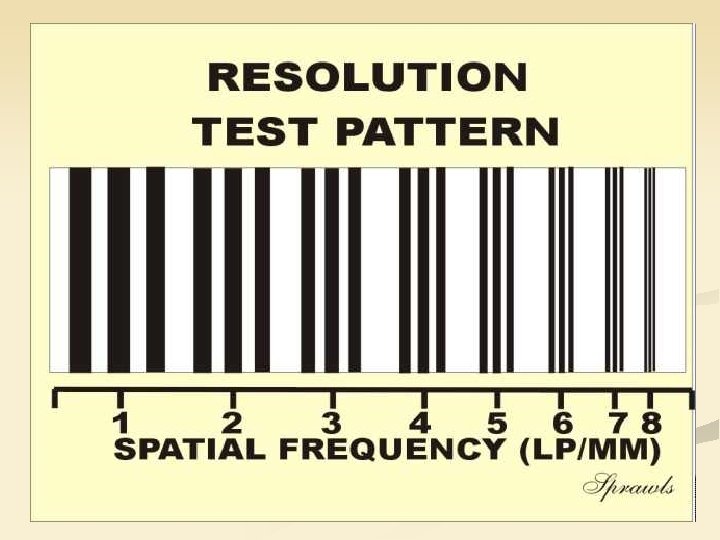
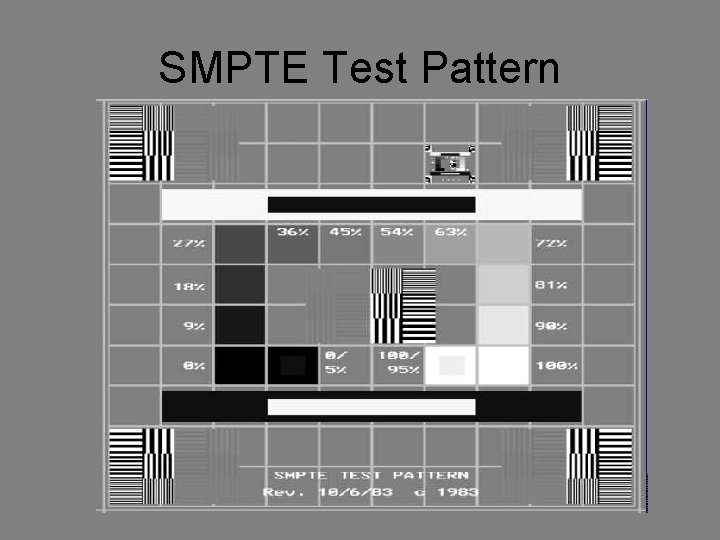
SMPTE Test Pattern
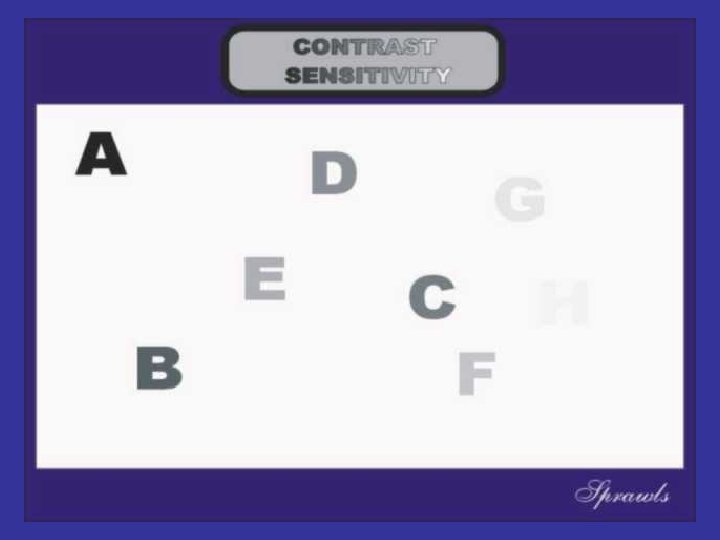
Image-forming x-rays n Two kinds of photons are responsible for the OD and contrast on an image: Photons that pass through without interacting and those that are scattered though Compton. n X-rays that exit the patient are remnant and those that interact with the IR are image-forming.
Ideally, only those x-rays that do not interact with the patient should reach the IR…. n However, scatter radiation is a factor that must be managed n Proper collimation has the PRIMARY effect of reducing patient dose by _____ ? n Proper collimation also improved image contrast by reducing radiographic noise or fog caused by scatter

Fog or Noise
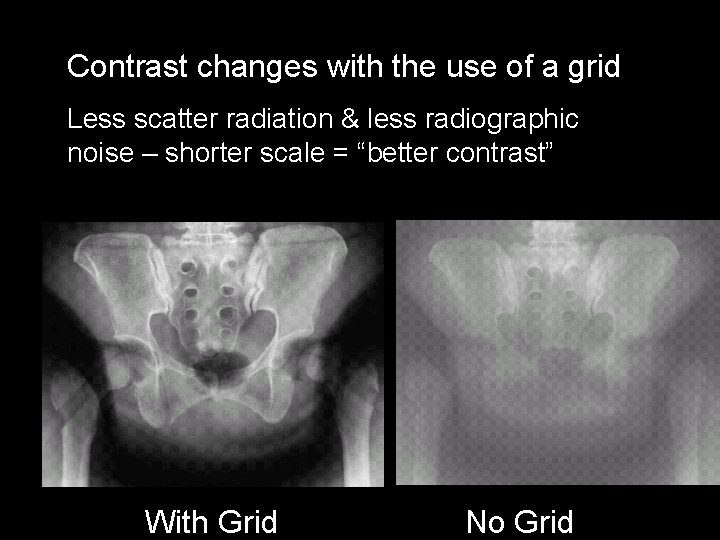
Contrast changes with the use of a grid Less scatter radiation & less radiographic noise – shorter scale = “better contrast” With Grid No Grid
k. Vp n As x-ray energy increases Photoelectric and Compton interactions decrease. Explain? n At 50 k. Vp 79% photoelectric, 21% Compton & less than 1% transmission n At 80 k. Vp 46% photoelectric, 52% Compton & 2% transmission n Pg. 225
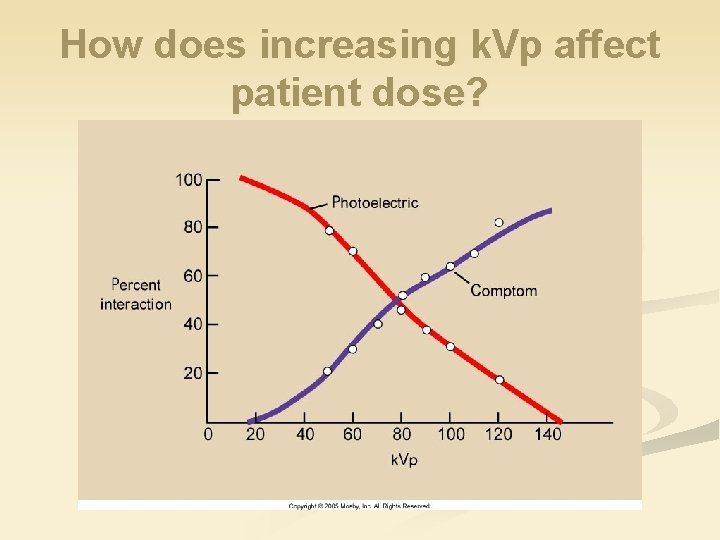
How does increasing k. Vp affect patient dose?
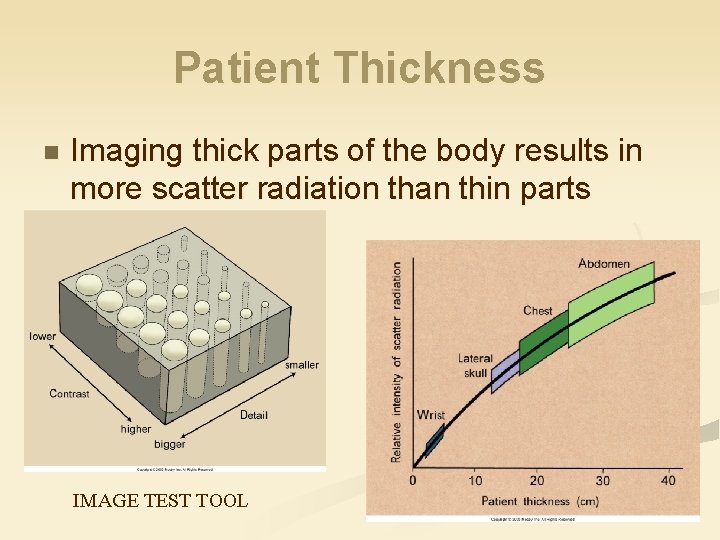
Patient Thickness n Imaging thick parts of the body results in more scatter radiation than thin parts IMAGE TEST TOOL
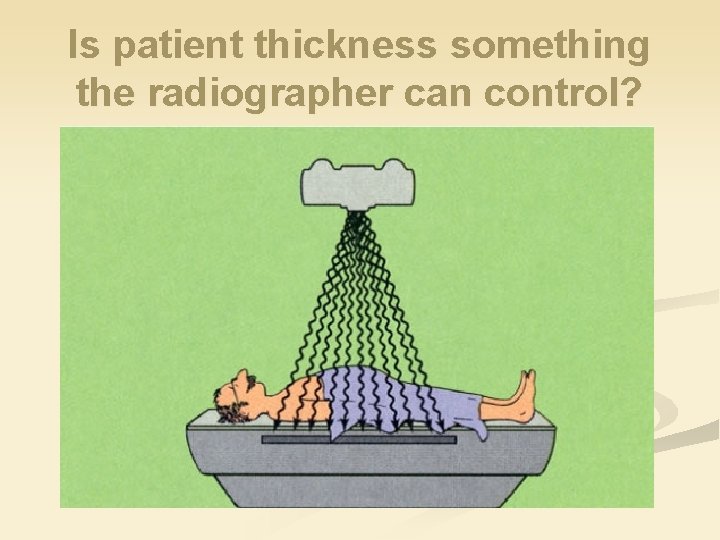
Is patient thickness something the radiographer can control?
Patient thickness n Normally, No n Compression devices improves spatial resolution by reducing patient thickness and bringing the object closer to the IR. Compression also reduces patient dose and contrast resolution
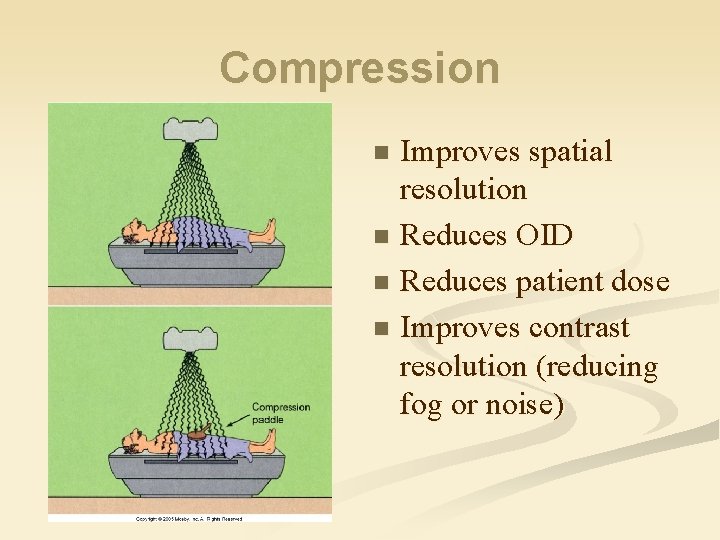
Compression Improves spatial resolution n Reduces OID n Reduces patient dose n Improves contrast resolution (reducing fog or noise) n
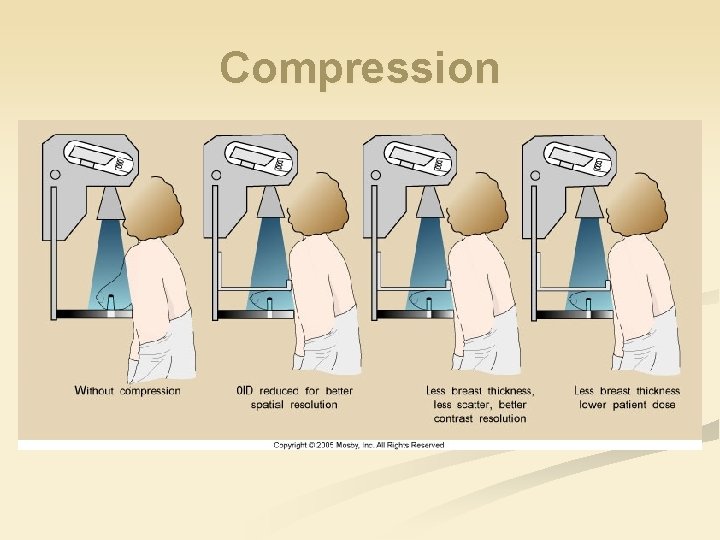
Compression
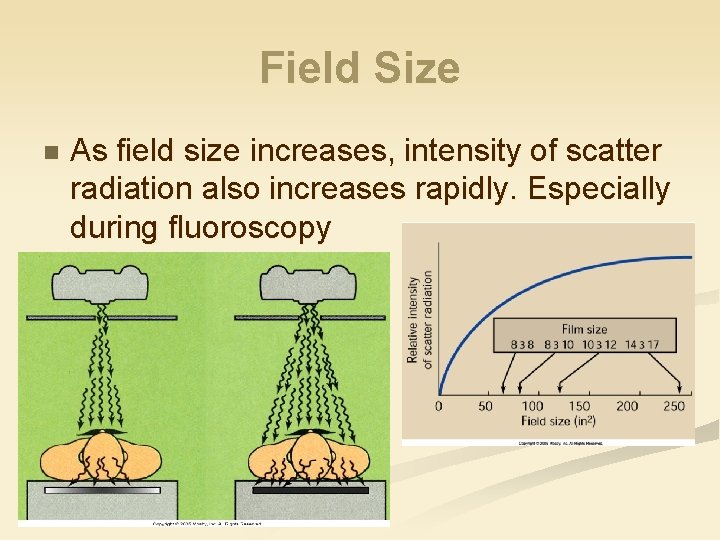
Field Size n As field size increases, intensity of scatter radiation also increases rapidly. Especially during fluoroscopy
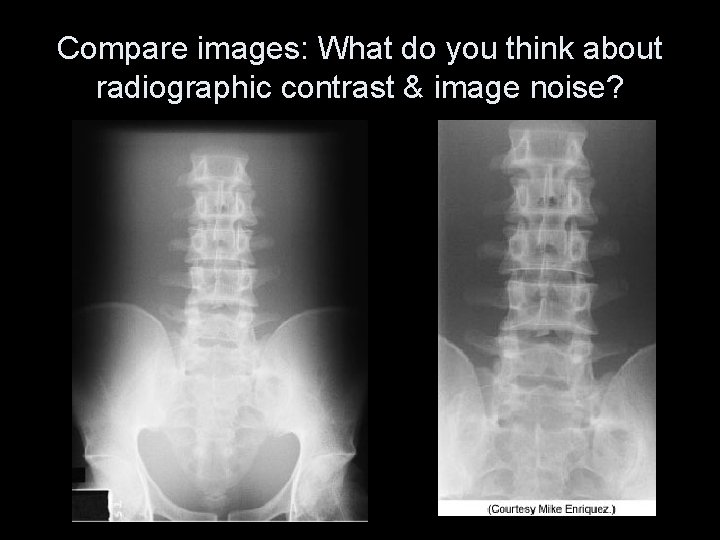
Compare images: What do you think about radiographic contrast & image noise?
Control of Scatter Radiation n Technologists routinely use two types of devices to reduce the amount of scatter radiation reaching the IR n Beam restrictors n Grids
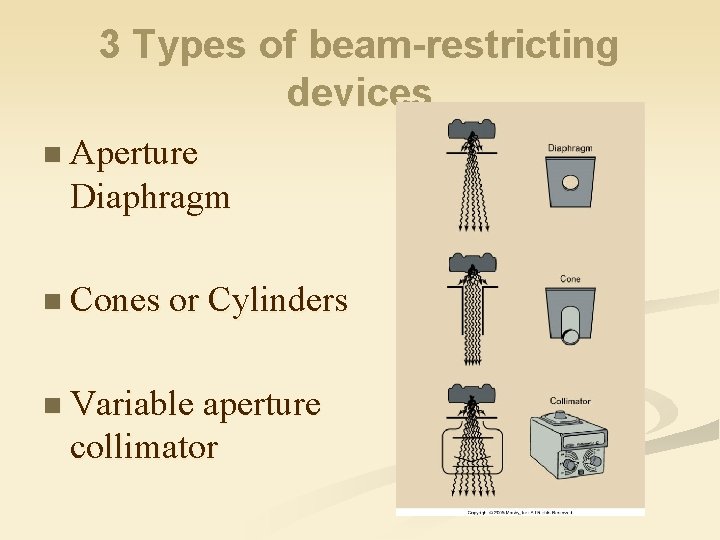
3 Types of beam-restricting devices n Aperture Diaphragm n Cones or Cylinders n Variable aperture collimator
Variable Aperture Collimator n The most common beam-restricting device is the light-localizing variable aperture collimator n The first part of the collimator serves to control off-focus radiation. What is offfocus radiation?
Off - focus Radiation n X-ray tubes are designed so that the projectile e- interacts with the target. However, some of the e- bounce off the target and land on other areas n This caused x-rays to be produced out side the focal spot
Extrafocal Radiation n These rays can also be called off-focus radiation n Extrafocal radiation is undesirable because it extends the size of the focal spot, increases patient skin dose & reduces image contrast
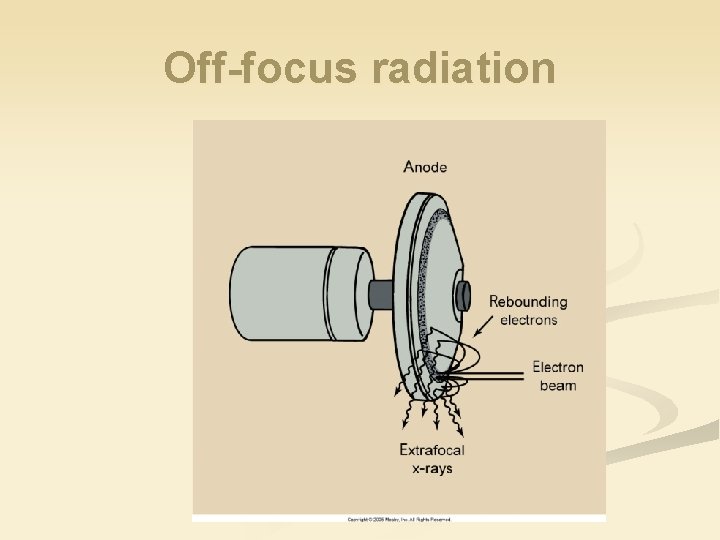
Off-focus radiation
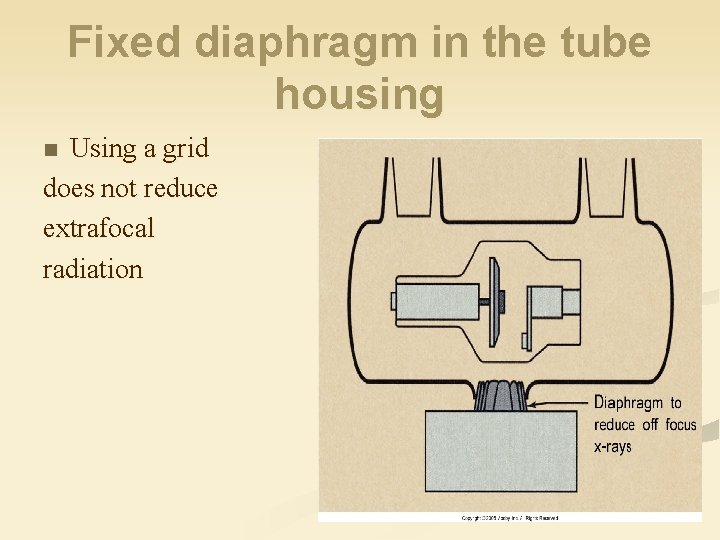
Fixed diaphragm in the tube housing Using a grid does not reduce extrafocal radiation n
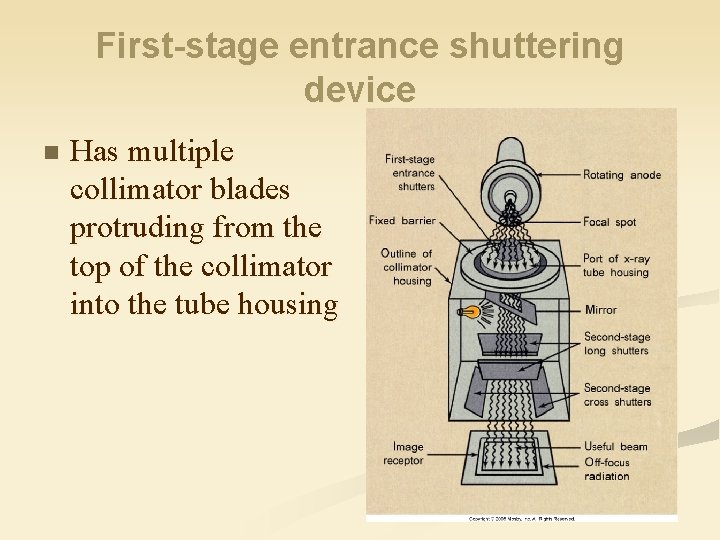
First-stage entrance shuttering device n Has multiple collimator blades protruding from the top of the collimator into the tube housing
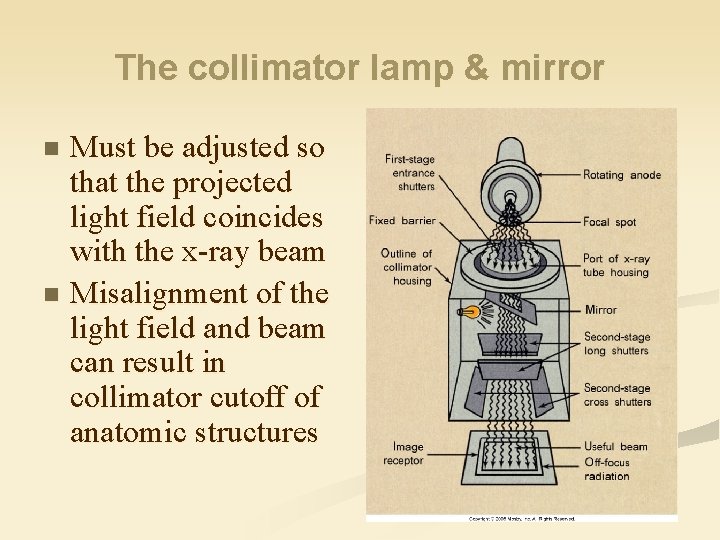
The collimator lamp & mirror Must be adjusted so that the projected light field coincides with the x-ray beam n Misalignment of the light field and beam can result in collimator cutoff of anatomic structures n
Total Filtration review… n Total Filtration = ________ + _______? n n The collimator assembly is usually equivalent to approximately _______ mm Al filtration. n Minimum filtration for tubes that can operate about 70 k. Vp is _______ mm Al or
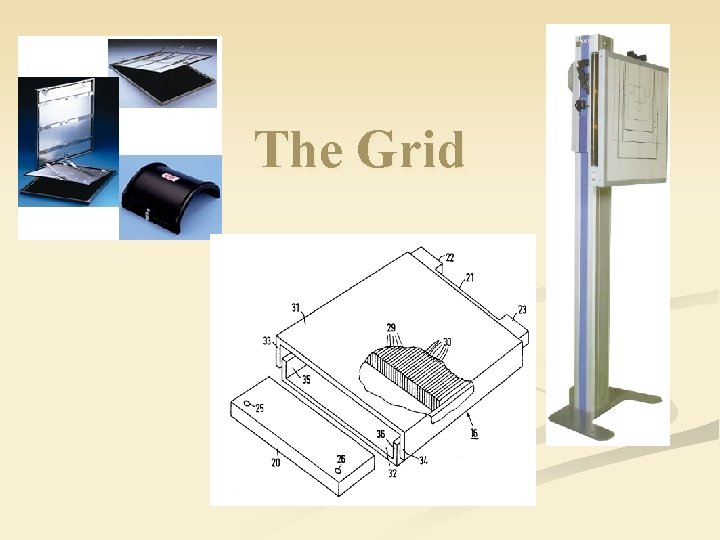
The Grid
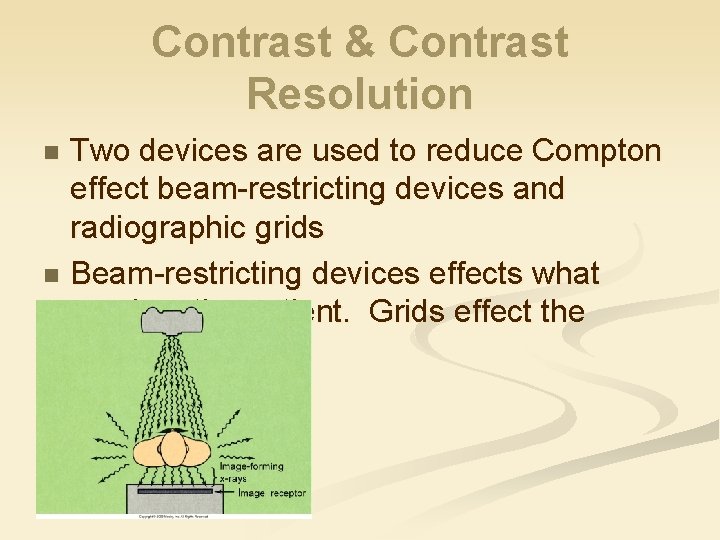
Contrast & Contrast Resolution Two devices are used to reduce Compton effect beam-restricting devices and radiographic grids n Beam-restricting devices effects what reaches the patient. Grids effect the remnant beam n
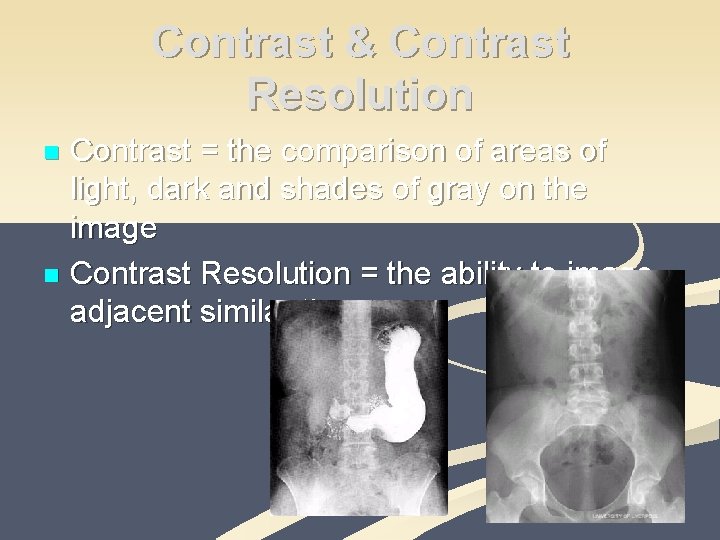
Contrast & Contrast Resolution Contrast = the comparison of areas of light, dark and shades of gray on the image n Contrast Resolution = the ability to image adjacent similar tissues n
Grid Ratio High-ratio grids are more effective in cleaning up scatter radiation than low-ratio grids n The angle of deviation is smaller for highratio grids. (the photon must be traveling in a straighter line to make it through the grid) n However, the higher the ratio the more radiation exposure necessary to get a sufficient number of x-rays through the grid n
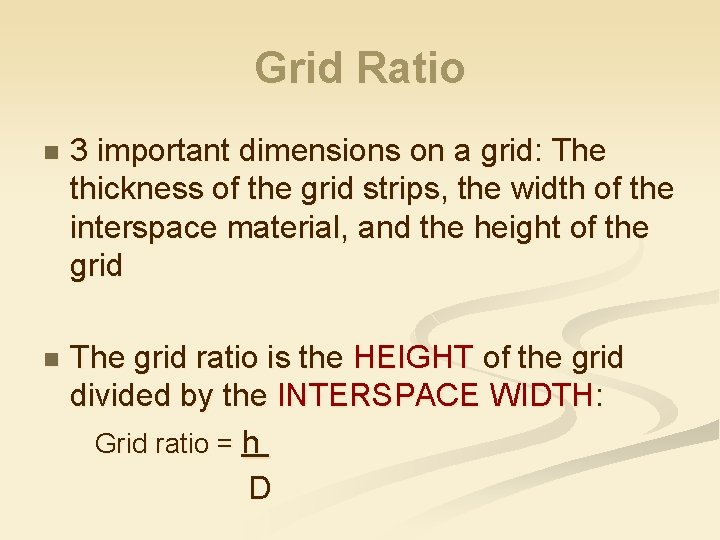
Grid Ratio n 3 important dimensions on a grid: The thickness of the grid strips, the width of the interspace material, and the height of the grid n The grid ratio is the HEIGHT of the grid divided by the INTERSPACE WIDTH: Grid ratio = h D
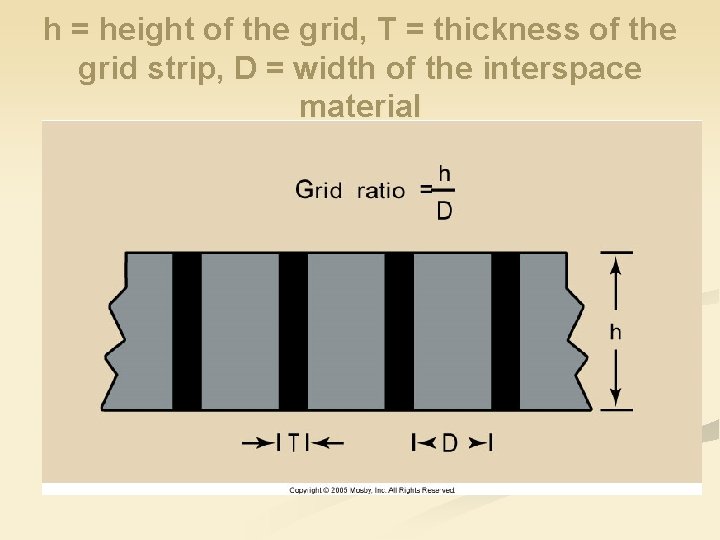
h = height of the grid, T = thickness of the grid strip, D = width of the interspace material
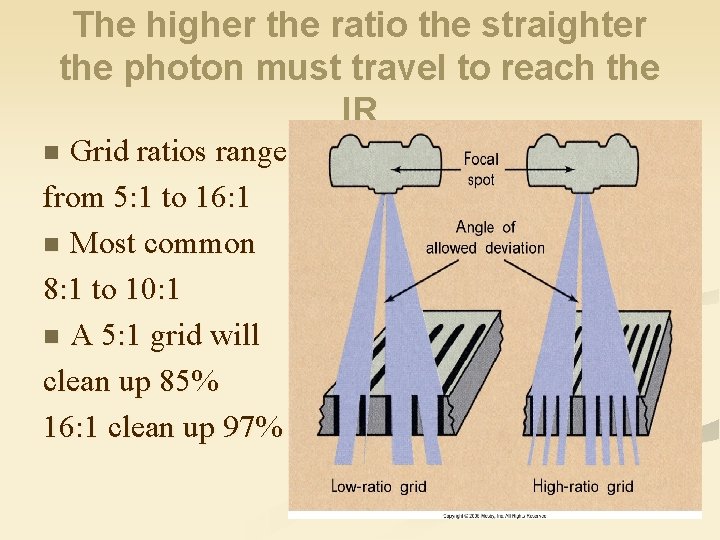
The higher the ratio the straighter the photon must travel to reach the IR Grid ratios range from 5: 1 to 16: 1 n Most common 8: 1 to 10: 1 n A 5: 1 grid will clean up 85% 16: 1 clean up 97% n
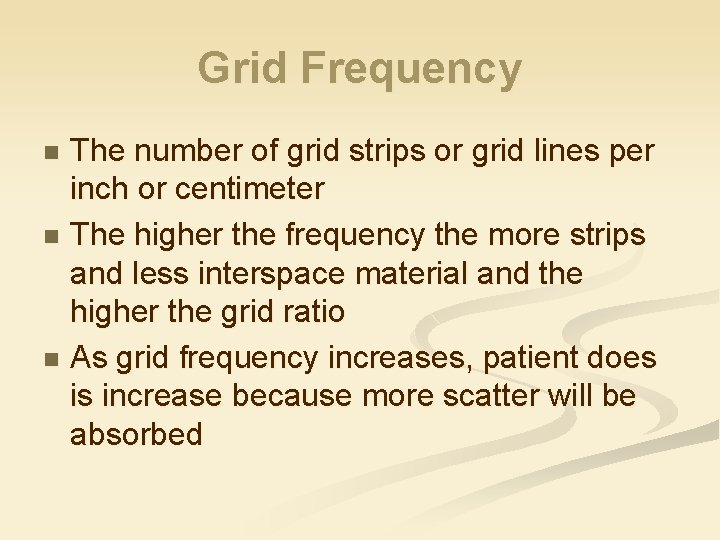
Grid Frequency The number of grid strips or grid lines per inch or centimeter n The higher the frequency the more strips and less interspace material and the higher the grid ratio n As grid frequency increases, patient does is increase because more scatter will be absorbed n
Grid Frequency n Some grids reduce thickness of the strips to reduce the exposure to the patient, this over all reduces the grid clean up n Grids have frequencies in the range of 25 to 45 lines per centimeter (60 to 110 lines per inch)
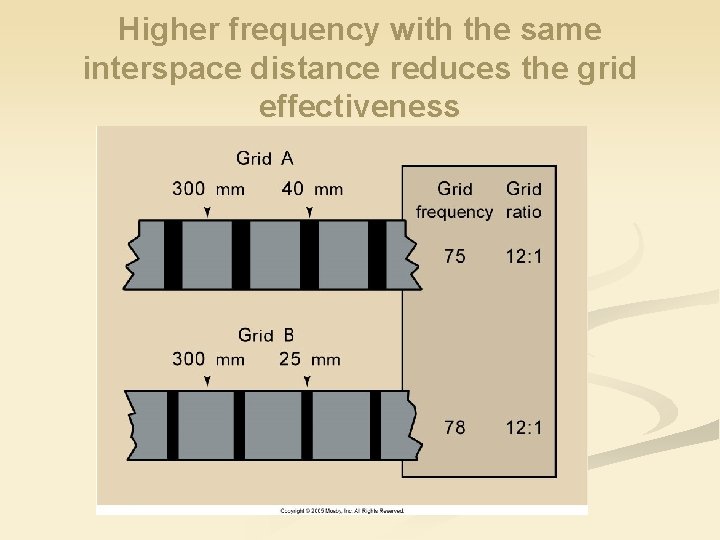
Higher frequency with the same interspace distance reduces the grid effectiveness
Grid Performance The principal function of a grid is to improve image contrast n Contrast Improvement Factor (k) = the ratio of the contrast of a radiograph made with a grid to the contrast of the radiograph made without a grid. A contrast improvement factor of 1 indicates no improvements n The higher the grid ratio & frequency the higher the k n
Bucky Factor n Using grids require more patient dose. Why is this? n When a grid is used technique must be increased to maintain OD n The amount of increase is given by the Bucky factor (B) or grid factor
Bucky Factor or grid factor n The higher the grid ratio or frequency the higher the bucky factor n The Bucky factor increases with increasing k. Vp n Pg 235: We will use the average values for calculations.
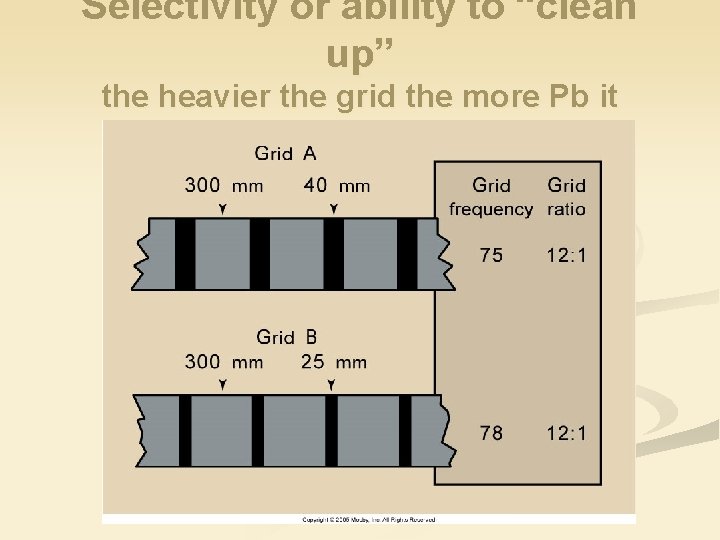
Selectivity or ability to “clean up” the heavier the grid the more Pb it contains
Grid Types Parallel Grid – simplest type of grid n All the lead strips are parallel n Only clean up scatter in one direction (along the axis of the grid) n n Easy to make, however can cause grid cutoff with short SID’s.
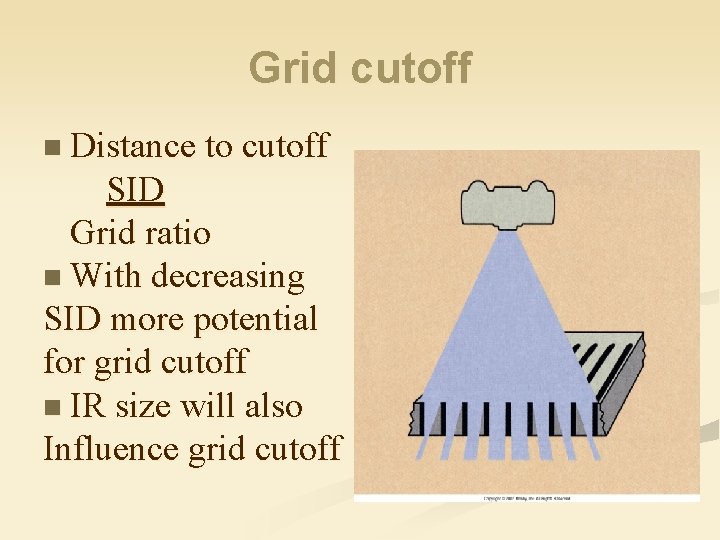
Grid cutoff n Distance to cutoff SID Grid ratio n With decreasing SID more potential for grid cutoff n IR size will also Influence grid cutoff
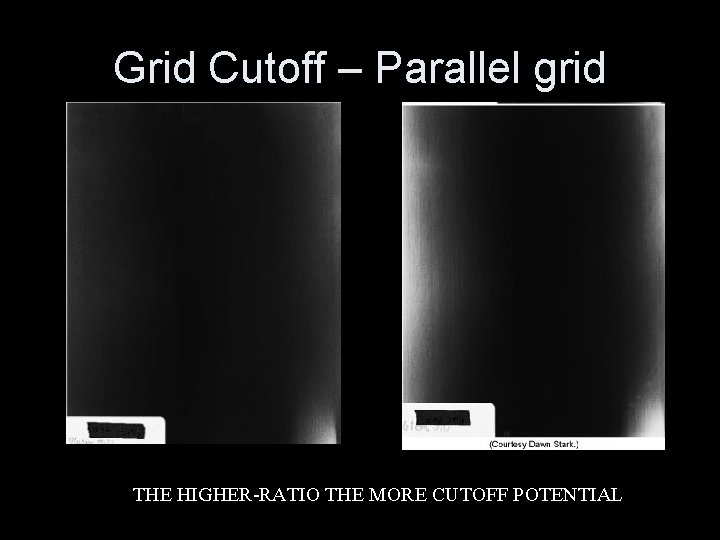
Grid Cutoff – Parallel grid THE HIGHER-RATIO THE MORE CUTOFF POTENTIAL
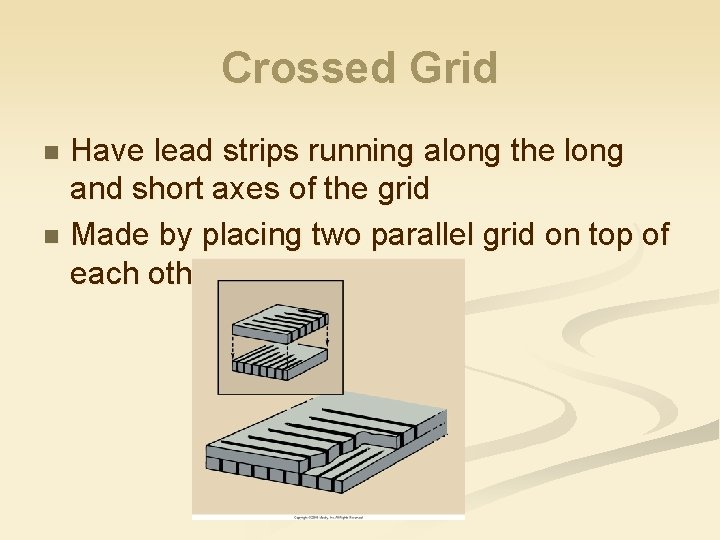
Crossed Grid Have lead strips running along the long and short axes of the grid n Made by placing two parallel grid on top of each other n
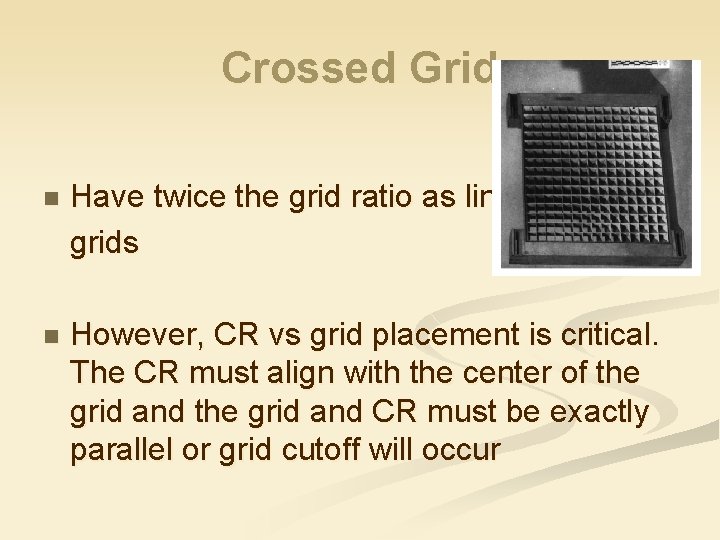
Crossed Grid n Have twice the grid ratio as linear grids n However, CR vs grid placement is critical. The CR must align with the center of the grid and CR must be exactly parallel or grid cutoff will occur
Focused Grid Designed to minimize grid cutoff n Lead strips are aligned with the divergence of the x-ray beam n Each focused grid must be identified with the appropriate SID n Wrong SID = Grid cutoff n
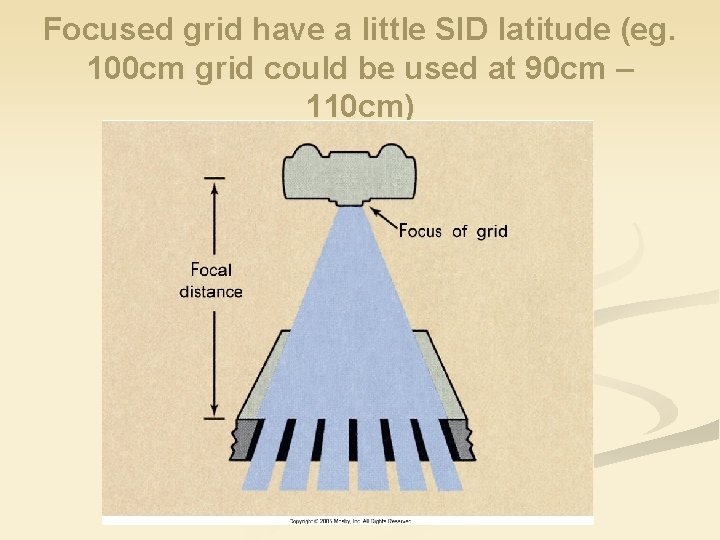
Focused grid have a little SID latitude (eg. 100 cm grid could be used at 90 cm – 110 cm)
Moving Grids n All stationary grids will give you grid lines on your radiograph. Thinner Pb strips will give you less noticeable lines. However, thinner strips have less Pb content not “cleaning up” as well n Grid Lines are made when primary x-rays are absorbed in the grid strips.
Focused grids are usually used as moving grids n The grid is placed in a holding mechanism that begins moving just before the x-ray exposure and continues moving after the exposure ends n 2 types of movement Reciprocating & Oscillating
Grid Motion n Reciprocating = moves several times about 2 cm back and forth during the exposure n Oscillating = moves several times about 2 – 3 cm in a circular pattern n Most grids are moving. Except for portable imaging
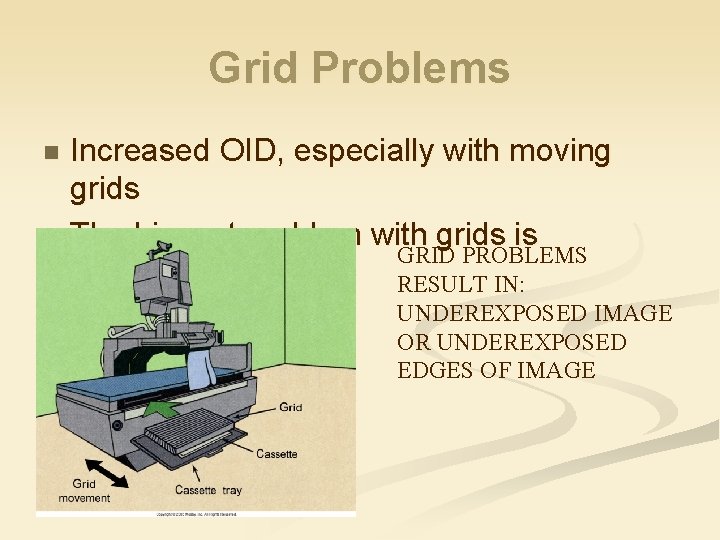
Grid Problems Increased OID, especially with moving grids n The biggest problem with grids is GRID PROBLEMS misalignment RESULT IN: n UNDEREXPOSED IMAGE OR UNDEREXPOSED EDGES OF IMAGE
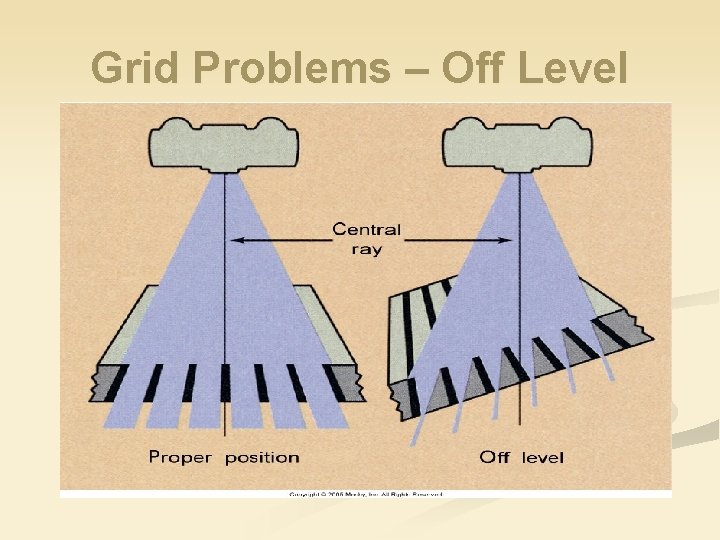
Grid Problems – Off Level
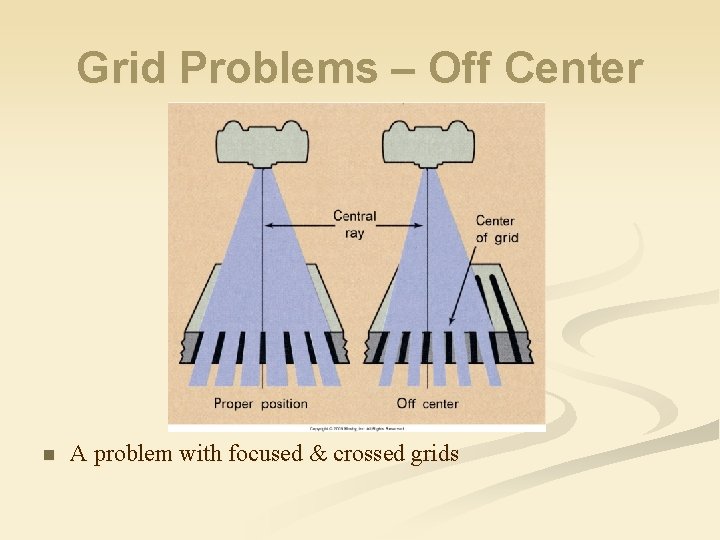
Grid Problems – Off Center n A problem with focused & crossed grids
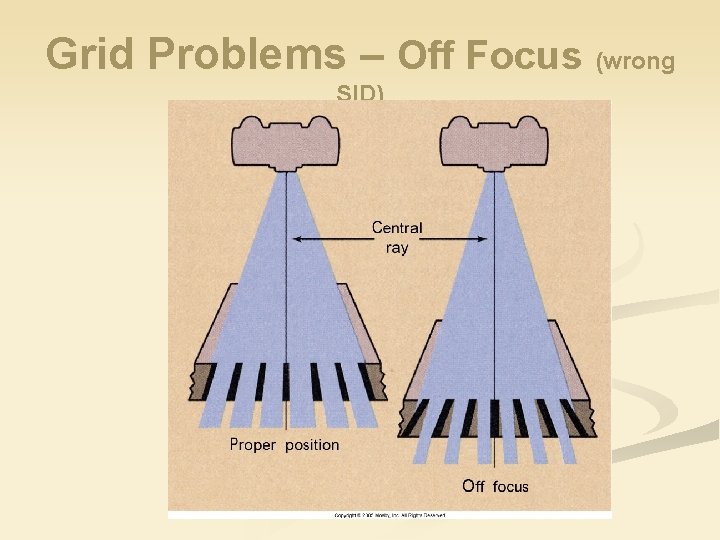
Grid Problems – Off Focus (wrong SID)
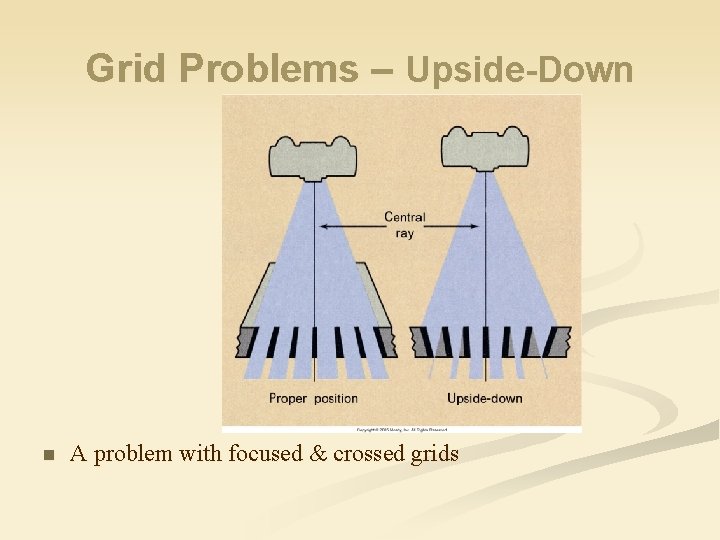
Grid Problems – Upside-Down n A problem with focused & crossed grids
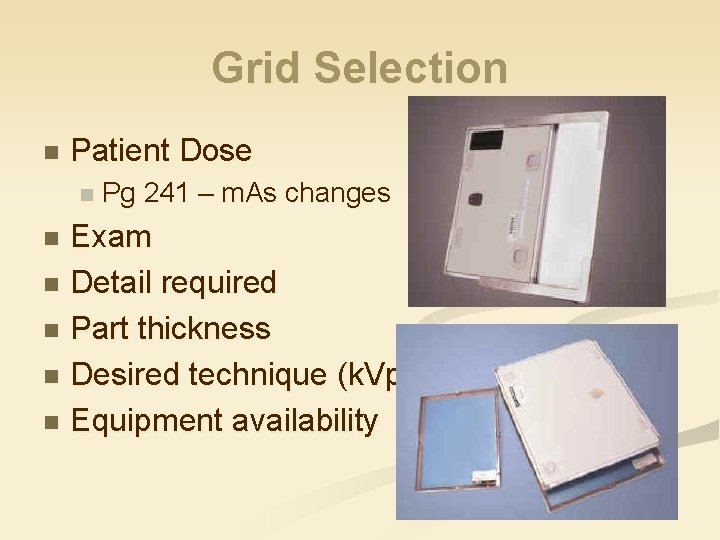
Grid Selection n Patient Dose n Pg 241 – m. As changes Exam n Detail required n Part thickness n Desired technique (k. Vp) n Equipment availability n
Questions…. ?
- Slides: 62