
Control of microbial growth Surgical procedures and even
Control of microbial growth • Surgical procedures and even more invasive medical procedures are performed frequently in hospitals.
• A major risk of all such procedures is the introduction of pathogens into deeper tissues that can lead to life threatening infection. • Failure to properly disinfect or sterilize equipment carries not only risk associated with breach of host barriers but also risk for person-to-person transmission.
• Disinfection and sterilization are essential for ensuring that medical and surgical instruments do not transmit infectious pathogens to patients.
Critical items • Critical items confer a high risk for infection if they are contaminated with any microorganism. Thus, objects that enter sterile tissue or the vascular system must be sterile because any microbial contamination could transmit disease.

Critical items • This category includes surgical instruments, cardiac and urinary catheters, implants, and ultrasound probes used in sterile body cavities. Most of the items in this category should be purchased as sterile or be sterilized with steam if possible.
Semicritical Items • Semicritical items contact mucous membranes or nonintact skin. This category includes respiratory therapy and anesthesia equipment, some endoscopes, laryngoscope blades, esophageal manometry probes, cystoscopes, anorectal manometry catheters, and diaphragm fitting rings.

• These medical devices should be free from all microorganisms; however, small numbers of bacterial spores are permissible, because mucous membranes are often resistant to infections by spores.
Noncritical • Noncritical items are those that come in contact with intact skin but not mucous membranes. Intact skin acts as an effective barrier to most microorganisms; therefore, the sterility of items coming in contact with intact skin is "not critical. "
noncritical • Noncritical items are divided into noncritical patient care items and noncritical environmental surfaces • Examples of noncritical patient-care items are bedpans, blood pressure cuffs, crutches and computers.
Noncritical • Noncritcal environmental surfaces include bed rails, some food utensils, bedside tables, patient furniture and floors. Noncritical environmental surfaces frequently touched by hand (e. g. , bedside tables, bed rails) potentially could contribute to secondary transmission by contaminating hands of health-care workers or by contacting medical equipment that subsequently contacts
Factors affecting sterilization and disinfection • The activity of germicides against microorganisms depends on a number of factors, some of which are intrinsic qualities of the organism, others of which are the chemical and external physical environment. Awareness of these factors should lead to better use of disinfection and sterilization processes and will be briefly reviewed
• • Number and Location of microorganisms Innate Resistance of Microorganisms Concentration and Potency of Disinfectants Physical and Chemical Factors – – – tempt, humidity, p. H, Hardness of water.
• Organic and Inorganic Matter • Duration of Exposure • Biofilms
CLEANING • Cleaning is the removal of foreign material (e. g. , soil, and organic material) from objects and is normally accomplished using water with detergents or enzymatic products. Thorough cleaning is required before high-level disinfection and sterilization because inorganic and organic materials that remain on the surfaces of instruments interfere with the effectiveness of these processes.
• Also, if soiled materials dry or bake onto the instruments, the removal process becomes more difficult and the disinfection or sterilization process less effective or ineffective. Surgical instruments should be presoaked or rinsed to prevent drying of blood and to soften or remove blood from the instruments.
Cleaning • Good cleaning is a form of disinfection. • Examples : hand washing f/b drying reduces the numbers of the organisms. • . . drying of anesthetic tubing and apparatus in drying cabinet.
Disinfection and sterilization
Sterilization • Complete removal of all organisms including the bacterial vegetative forms, bacterial spores, viruses, fungi, fungal spores and protozoa, protozoan cysts.

Disinfection • Removal of some type of pathogenic microorganisms especially the vegetative forms. This does not include the spores. • It is partial reduction of the total number of organisms present, so that it can not initiate infection.
Heat disinfection • Used on inanimate objects(lifeless). • It removes the vegetative forms but the sores remain. • Eg pasteurization, boiling, low tempt steam disinfection.
Pasteurization • It is keeping the object at 63 o. C for 30 min(holder type process). It is used for decontamination of babies’ feeding bottles. • It can be done at 72 o. C for 20 min(flash process) or at 80 o. C for 1 min. • anesthetic apparatus, face masks, bedpans.
Boiling • Heating items to 100 o. C kills pathogenic organisms in less then one min. • Spores of Clostridium tetani spores resist killing for a long time, but Clostridium perfringens spores are killed in 20 min of boiling.
Low tempt steam disinfection • This uses a type of autoclave which generates steam to heat objects at 75 o. C. • In 20 -30 min kills most pathogens. • Sometimes formaldehyde is added if spores are also targeted to be killed. . This is employed for the disinfection of some endoscopes.
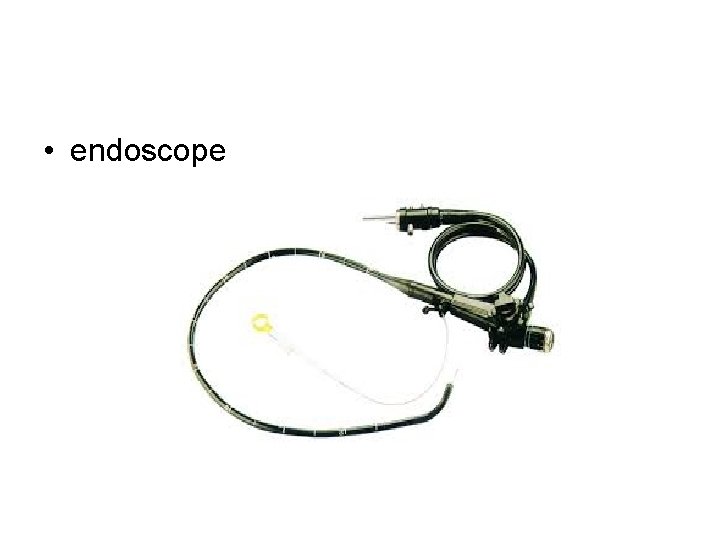
• endoscope
Chemical disinfection • Application of chemicals to reduce the numbers of microbes. • Antiseptics are chemical disinfectants applied to living tissues eg skin. Note that some disinfectants are too harsh to be used on the skin.
• Disinfectants are limited in scope of organisms they act against eg quartenary ammonium compounds (QAC) such as cetrimide, or benzalkonium chloride have good activity against E. coli but poor activity against Pseudomonas aeruginosa.
Factors determining the effectiveness of a chemical disinfection • 1. Select correct chemical for the purpose it is required. Eg it is better to use hypochloride instead of phenols for cleaning Hepatitis contaminated blood from the floor. • 2 use correct concentration of disinfectant.
• 3. leave the chemical on the surface for the reqiured time (time of exposure). eg 2% glutaraldehyde for 3 -5 min may kill Mycobacterium tub. and pseudomonas aeruginosa. • Endoscopes must be left in the disinfectant for 3 h.
• 4. Correct p. H of the disinfectant. Always read the manufaturer’s instruction. Eg one type of glutaraldehyde requires the addition of alkaline activator. • 5. wash away inactivation material first. • Organic materials such as pus, vomit, faeces, body fluids inactivate disinfectants. phenols are less inactivated. Soap inactivates QAC
• 6. temperature and volume of disinfectant. • Hot water is better than cold water for dilution. Add plenty of disinfectant to the material.
• 7. some organisms can grow in dilute disinfectants, especially in antiseptics. • Topical disinfectants must be diluted fresh and use or use alcohol containing disinfectant. eg 1. 5% iodine in spirit or alcoholic chlorhexidine.
• Always clean disinfectant containers adequately and dry them.
Types of disinfectants • • Alcohols Eg isopropyl alcohol and ethyl alcohol. Use Skin antiseptic, before injection or venepuncture.
• Diguanides • Eg chlorhexidine , 4% in detergent is called Hibiscrub…good for the hands of staff. . surgeons. • Use • Pre operative skin preparation.
• Halogens • Eg hypochlorites and chlorines • Good against HIV and HBs. Ag blood spilages.
• Phenolics Phenols –carbolic acid Chloroxylenol Hexachlorophane Uses. . Are good antibacterial disinfectants.
• Quartenary ammonium compounds • Eg cetrimide, Benzalkonium chloride • Uses. Mixed with chlorhexidine, it is a good disinfectant.
Sterilization • • • Complete removal of all types of microbes. Achievable by one of ff: 1. Heat method… dry heat or moist heat. 2. Ionizing radiation 3. Ethylene oxide gas.
• Dry sterilization process (DSP) uses hydrogen peroxide at a concentration of 30 -35% under low pressure conditions. • This process achieves bacterial reduction of 10− 6. . . 10− 8. The complete process cycle time is just 6 seconds, and the surface temperature is increased only 10 -15 °C.
• Originally designed for the sterilization of plastic bottles in the beverage industry, because of the high germ reduction and the slight temperature increase the dry sterilization process is also useful for medical and pharmaceutical applications. • In medical processes it is a disinfection --not sterilization as it is misnomed in food industry(inappropriate).
Peracetic acid • Peracetic acid (0. 2%) is used to sterilize instruments.
Silver • Silver ions and silver compounds show a toxic effect on some bacteria, viruses, algae and fungi. • Its germicidal effects kill many microbial organisms in vitro.
Potential for chemical sterilization of prions • Prions are highly resistant to chemical sterilization. • Treatment with aldehydes (e. g. , formaldehyde) have actually been shown to increase prion resistance. • Hydrogen peroxide (3%) for one hour was shown to be ineffective, providing less than 3 logs (10− 3) reduction in contamination.
• Iodine, formaldehyde, glutaraldehyde and peracetic acid also fail to act on prions. • Only chlorine, phenolic compounds, guanidinium thiocyanate, and sodium hydroxide (Na. OH) reduce prion levels by more than 4 logs. • Chlorine and Na. OH are the most consistent agents for prions.
Hydrogen peroxide • Hydrogen peroxide is another chemical sterilizing agent. It is relatively non-toxic when diluted to low concentrations, such as the familiar 3% retail solutions although hydrogen peroxide is a dangerous oxidizer at high concentrations (> 10% w/w).
• Hydrogen peroxide is strong oxidant and these oxidizing properties allow it to destroy a wide range of pathogens and it is used to sterilize heat or temperature sensitive articles such as endoscopes.
Concentrations required • In medical sterilization hydrogen peroxide is used at higher concentrations, ranging from around 35% up to 90%.
Disadvantage • The biggest advantage of hydrogen peroxide as a sterilant is the short cycle time. • Whereas the cycle time for ethylene oxide (discussed above) may be 10 to 15 hours, the use of very high concentrations of hydrogen peroxide allows much shorter cycle times. • Some hydrogen peroxide modern sterilizers, such as the Sterrad NX have a cycle time as short as 28 minutes.
Filtration methods • Seitz filters. . Filter bacteria from fluids • Millipore filters. . Filter fluids • Glass wool, gauze, etc are used to filter air from ventilators.
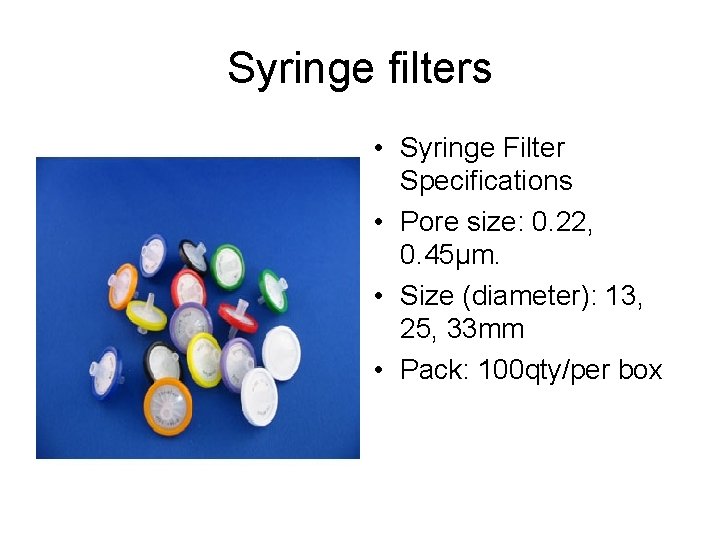
Syringe filters • Syringe Filter Specifications • Pore size: 0. 22, 0. 45µm. • Size (diameter): 13, 25, 33 mm • Pack: 100 qty/per box
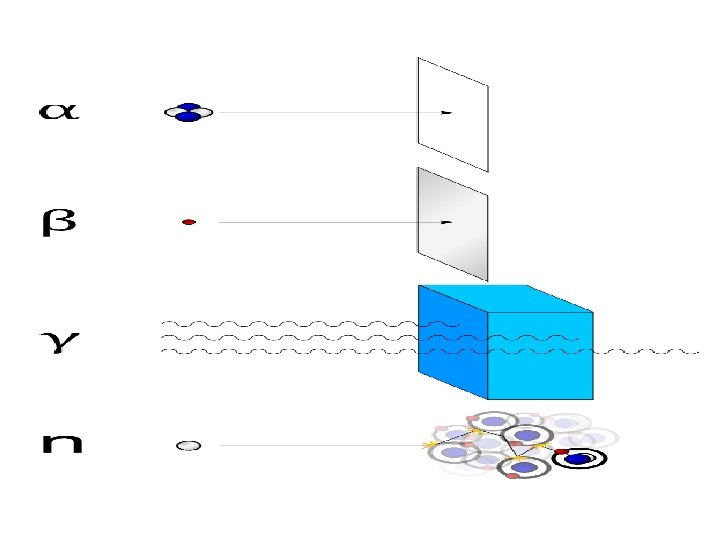
Radiation sterilization • Methods of sterilization exist which uses radiation such as • 1. electron beams, • 2. X-rays, • 3. gamma rays • 4. subatomic particles
• Gamma rays are very penetrating and are commonly used for sterilization of disposable medical equipment, such as syringes, needles, cannulas and IV sets. • Electron beam processing is also commonly used for medical device sterilization.
• X-rays, High-energy X-rays called bremsstrahlung are a form of ionizing energy allowing to irradiate large packages and pallet loads of medical devices.
UV light • Ultraviolet light irradiation (UV, from a germicidal lamp) is useful only for sterilization of surfaces and some transparent objects. • Many objects that are transparent to visible light absorb UV. Glass for example completely absorbs all UV light. • UV irradiation is routinely used to sterilize the interiors of biological safety cabinets between uses, but is ineffective in shaded and dirty areas.
Ethylene Oxide gas • Ethylene oxide is one of the most important raw materials used in the largescale chemical production. • Most ethylene oxide is used for synthesis of ethylene glycols, including diethylene glycol and triethylene glycol.
Many forms • Polyethyleneglycols are used in perfumes, cosmetics, pharmaceuticals, lubricants, paint thinners and plasticizers. • Ethylene glycol ethers are part of brake fluids, detergents, solvents, lacquers and paints. • Other products of ethylene oxide… Ethanolamines are used in the manufacture of soap and detergents and for purification of natural gas
Ethylene oxide • Ethylene oxide (EO or Et. O) gas is commonly used to sterilize objects sensitive to temperatures greater than 60 °C and / or radiation such as plastics, optics and electrics. Ethylene oxide treatment is generally carried out between 30 °C and 60 °C with relative humidity above 30% and a gas concentration between 200 and 800 mg/l, and typically lasts for at least three hours.
EO or Et. O • Ethylene oxide penetrates well, moving through paper, cloth, and some plastic films and is highly effective. • Et. O can kill all known viruses, bacteria and fungi, including bacterial spores and is compatible with most materials of medical devices, even when repeatedly applied.
Disadvantages It is highly flammable, toxic and carcinogenic
Dry heat • Flaming of bacteriological loops • Incinration of infected dressings are examples. • Hot air ovens are used. 160 o. C for 1 h oxidizes the protoplasm of the organism. • Good for glassware, powders like talc, oils. and petroleum jelly.
Moist heat • Steam kills bacteria by coagulating the cytoplasm. It is done in the autoclave. • The autoclave is similar to pressure cooker. • High pressure build up in the autoclave increasing the tempt above 100 o. C. • Usually set at 121 o. C for 15 min.
• Autoclave tapes are used to determine items that have been autoclaved. • To ensure sterility is achieved, spores of Bacillus stearothermophilus is added. It is removed, incubated for growth color change indicates growth or it is plated on blood agar and observed for growth.
Cleaning methods that do not achieve sterilization-summary • This is a brief list of cleaning methods that may be thought to "kill germs" but do not achieve sterilization. • Washing in a dishwasher: Dishwashers often only use hot tap water or heat the water to between 49 and 60 °C, which is not hot enough to kill some bacteria on cooking or eating utensils.
Summary • Bathing can not sterilize skin, even using antibacterial soap. • Disinfectants (for non-living objects). • Antiseptics (for living objects such as skin) These can kill or remove bacteria and viruses, but not all. • Pasteurization of food also kills some bacteria and viruses, but not all.
- Slides: 65