
Control of gene expression Prokaryotes have operons Operon



- Slides: 74
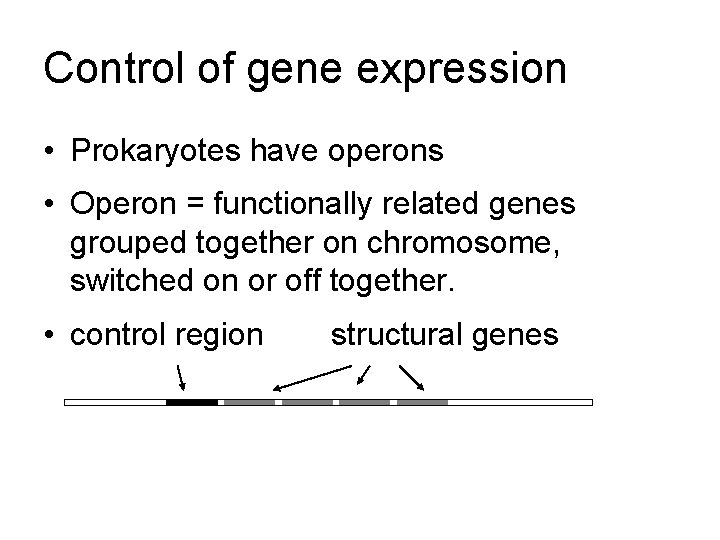
Control of gene expression • Prokaryotes have operons • Operon = functionally related genes grouped together on chromosome, switched on or off together. • control region structural genes
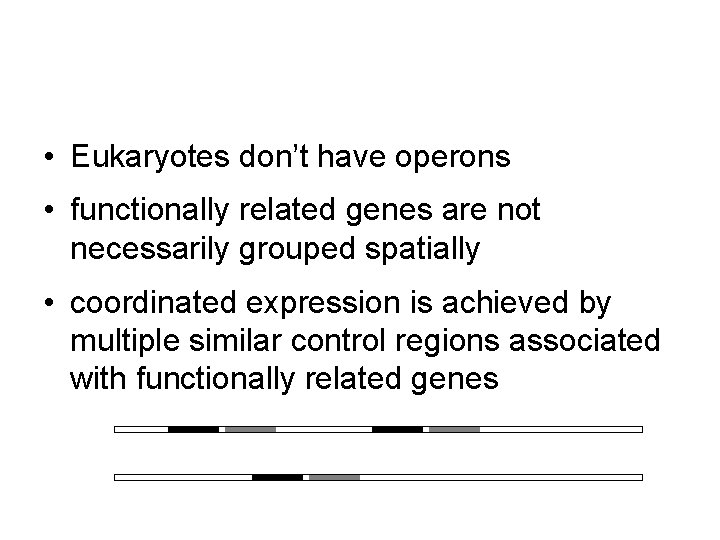
• Eukaryotes don’t have operons • functionally related genes are not necessarily grouped spatially • coordinated expression is achieved by multiple similar control regions associated with functionally related genes
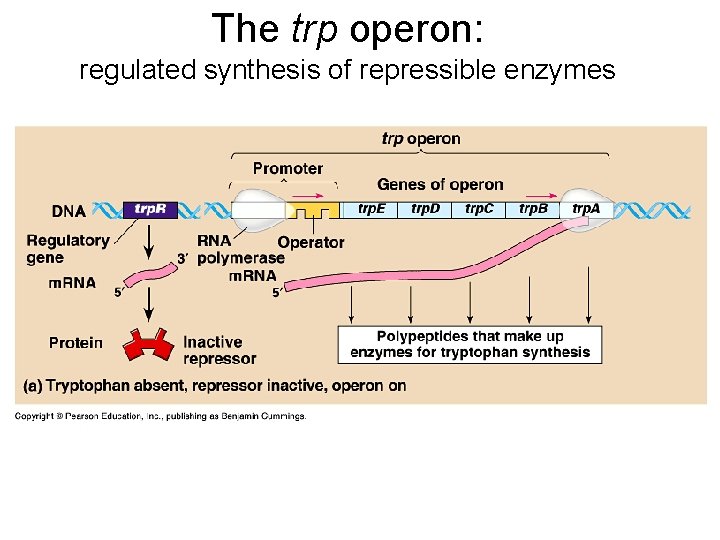
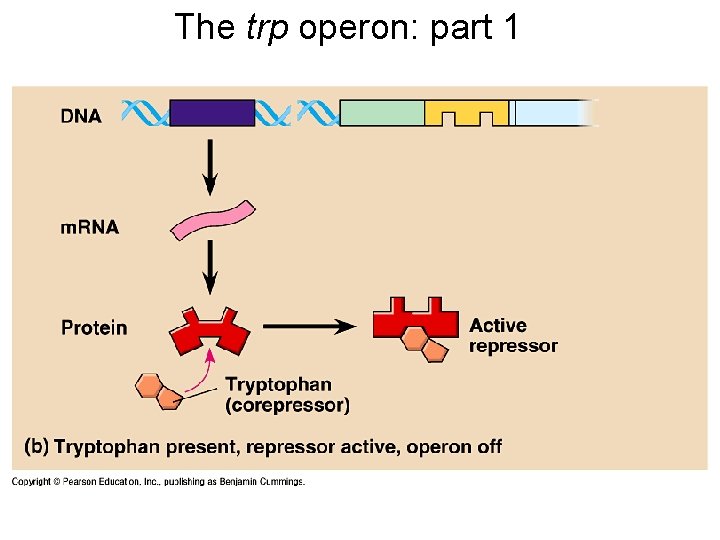
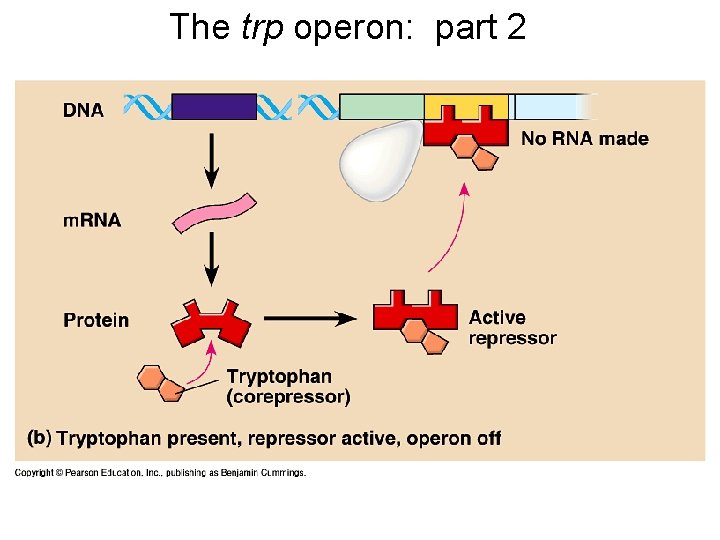
Example: Trp operon • Genes for enzymes that synthesize the amino acid tryptophan • Regulatory gene makes repressor protein • Repressor is activated by binding tryptophan, and blocks transcription by binding operator • Negative feedback- shuts down operon if there is plenty of tryptophan present
The trp operon: regulated synthesis of repressible enzymes
The trp operon: part 1
The trp operon: part 2
Gene expression in multicellular eukaryotes • Variety of cell types • All have same genome • Which genes get expressed & when • Roles: development, cell differentiation, metabolic regulation
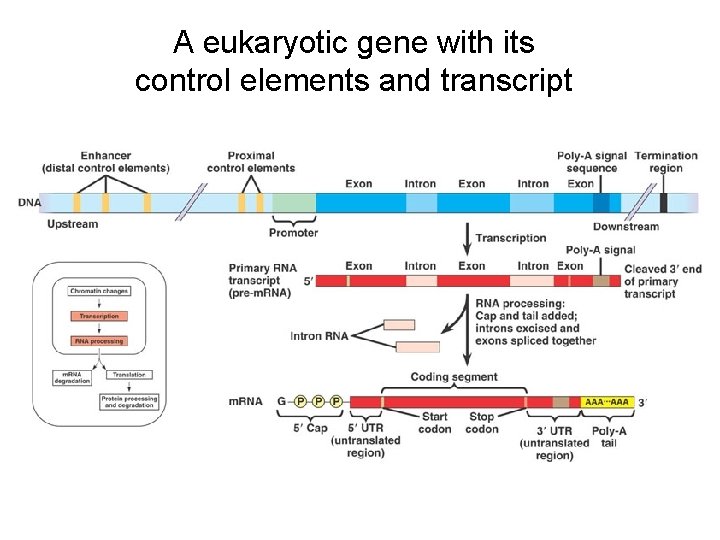
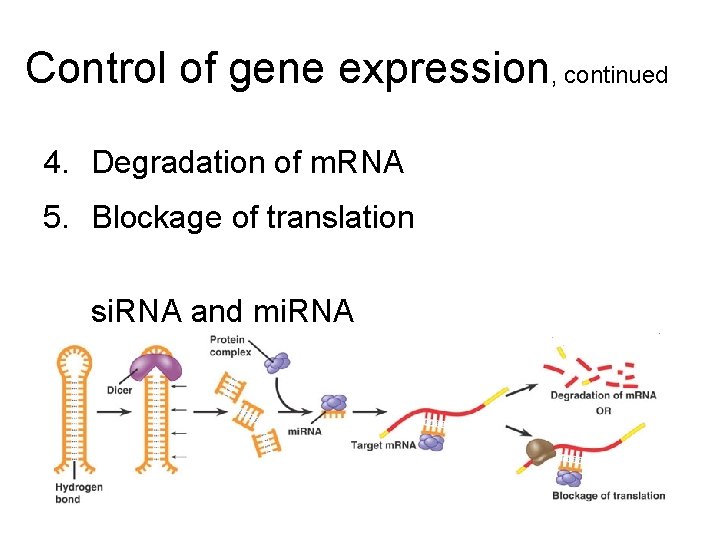
Control of gene expression 1) Chromatin modifications – DNA methylation – Histone acetylation 2) Control of transcription 3) Alternative splicing 4) Degradation of m. RNA 5) Blockage of translation
A eukaryotic gene with its control elements and transcript
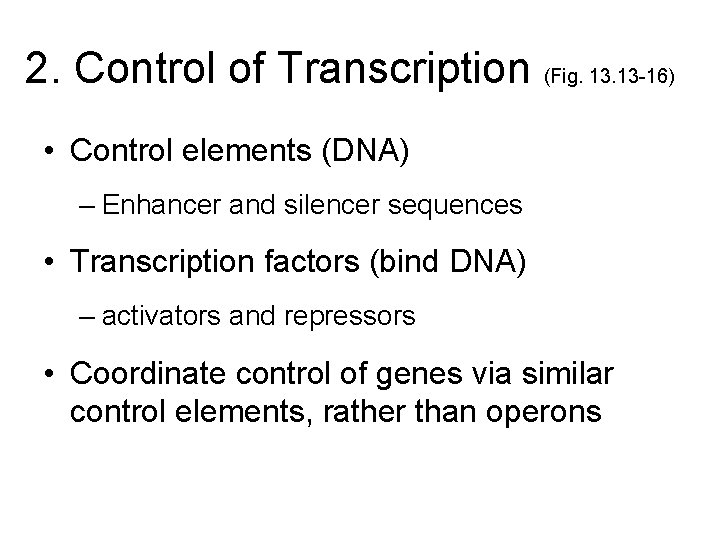
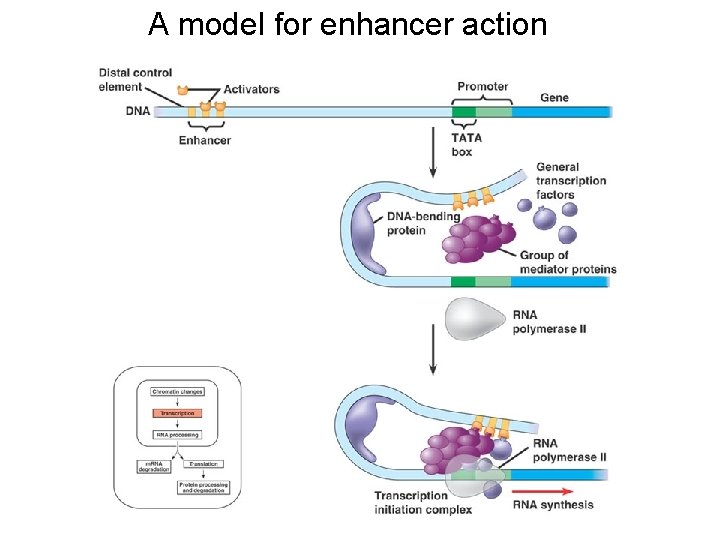
2. Control of Transcription (Fig. 13 -16) • Control elements (DNA) – Enhancer and silencer sequences • Transcription factors (bind DNA) – activators and repressors • Coordinate control of genes via similar control elements, rather than operons
A model for enhancer action
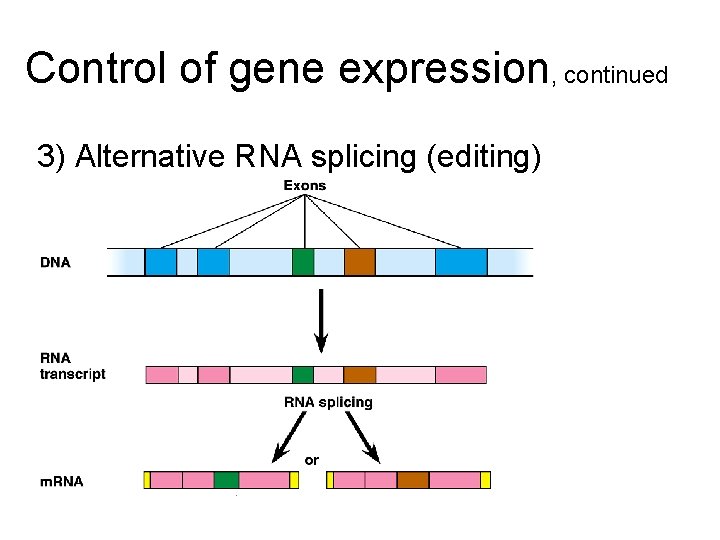
Control of gene expression, continued 3) Alternative RNA splicing (editing)
Control of gene expression, continued 4. Degradation of m. RNA 5. Blockage of translation si. RNA and mi. RNA
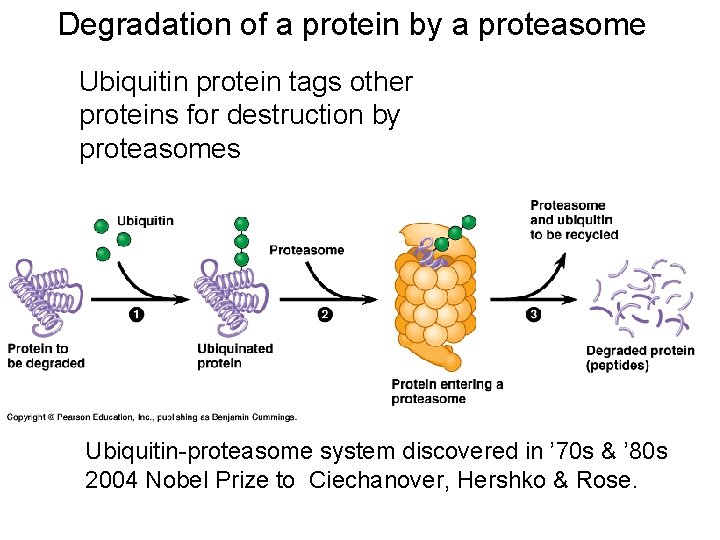
Control of gene expression, continued Post-translation 6) Protein processing, transport 7) Control of enzyme activity by effectors and inhibitors 8) Proteasomes degrade ubiquitin-tagged proteins
Degradation of a protein by a proteasome Ubiquitin protein tags other proteins for destruction by proteasomes Ubiquitin-proteasome system discovered in ’ 70 s & ’ 80 s 2004 Nobel Prize to Ciechanover, Hershko & Rose.
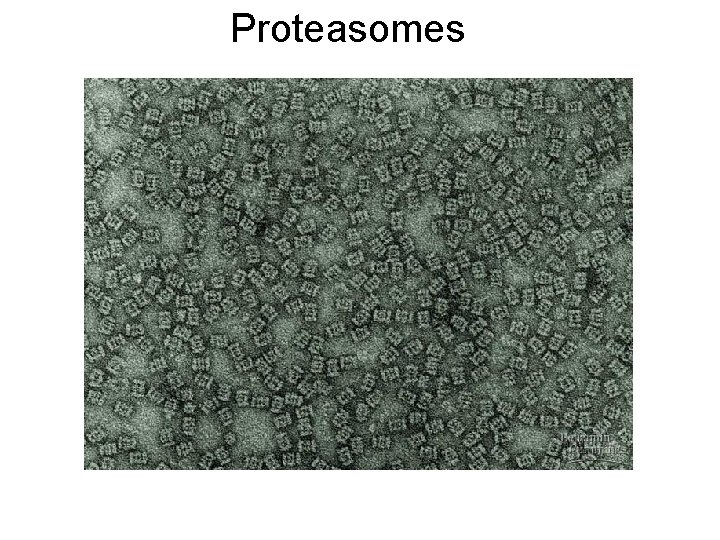
Proteasomes
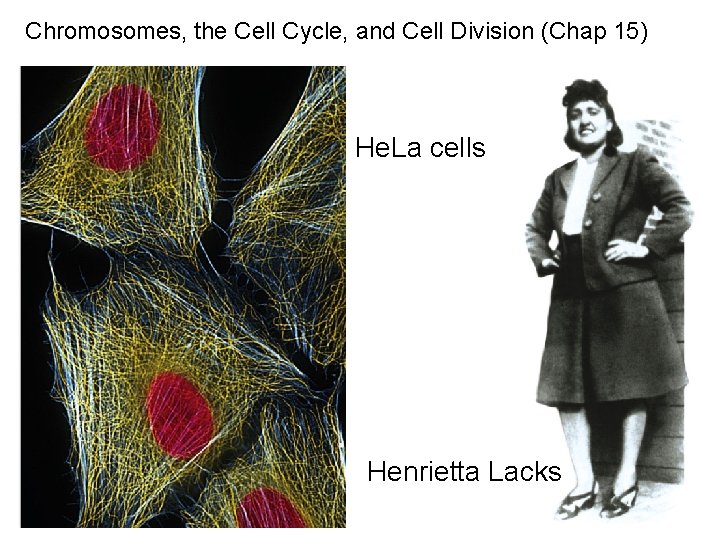
Chromosomes, the Cell Cycle, and Cell Division (Chap 15) He. La cells Henrietta Lacks
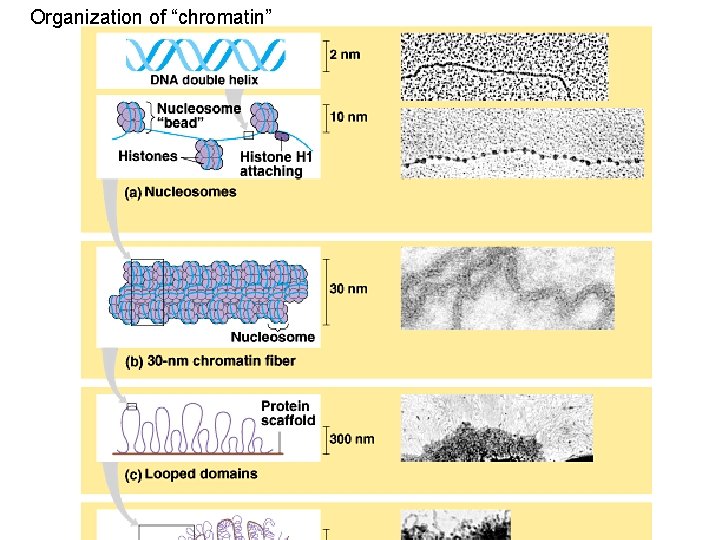
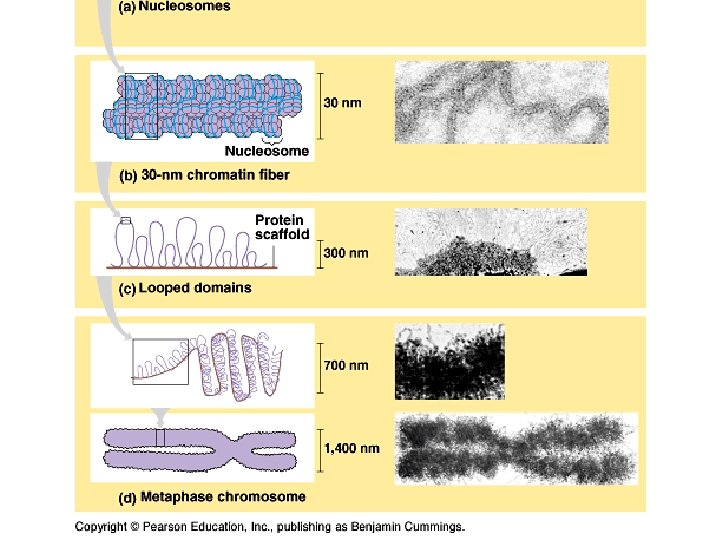
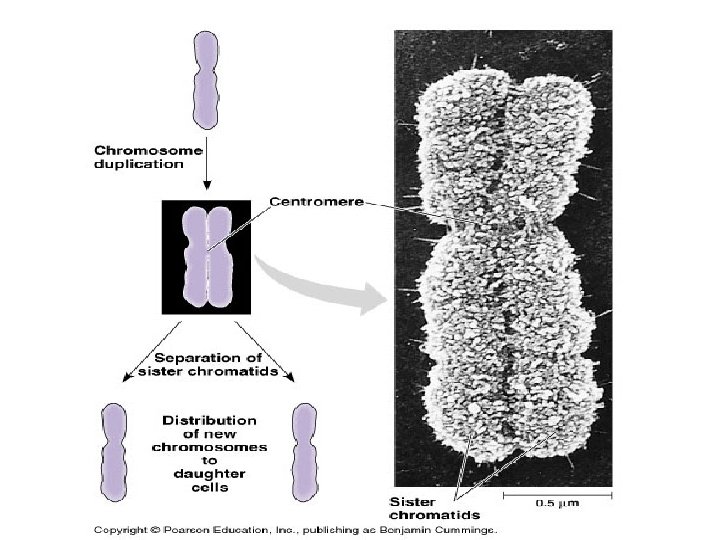
• Chromosome structure – Prokaryote vs eukaryotes – Histones, organization – Ploidy • Cell cycle and reproduction – Mitosis – Asexual reproduction – Meiosis – Sexual reproduction
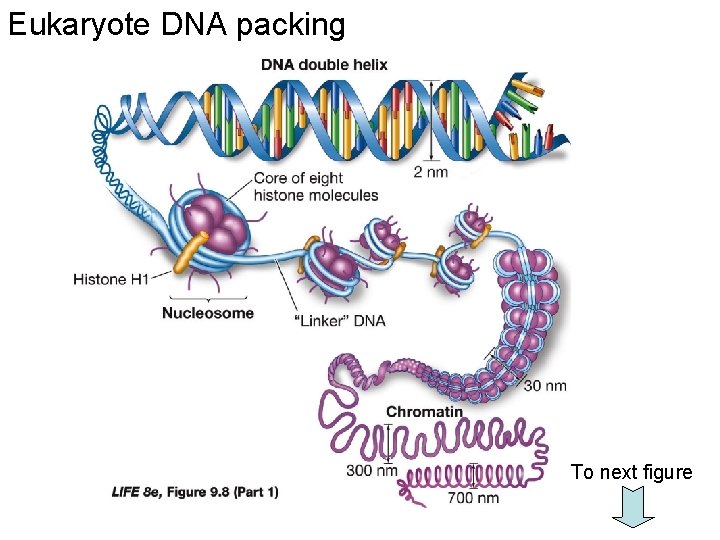
Eukaryote DNA packing To next figure
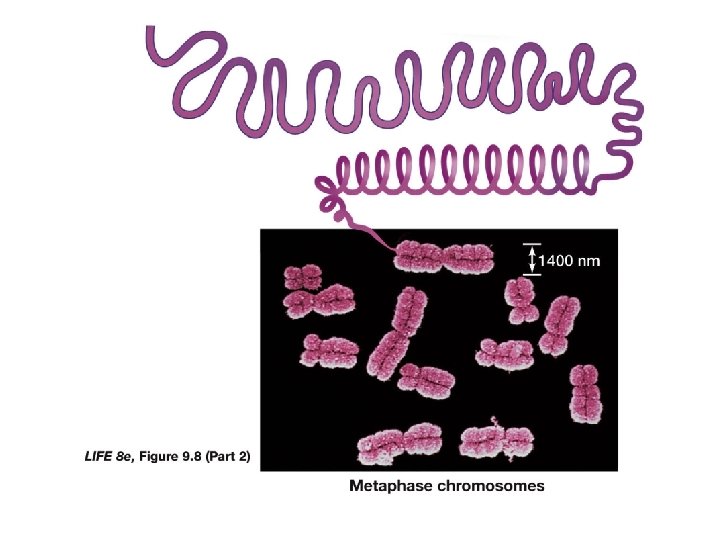
Organization of “chromatin”
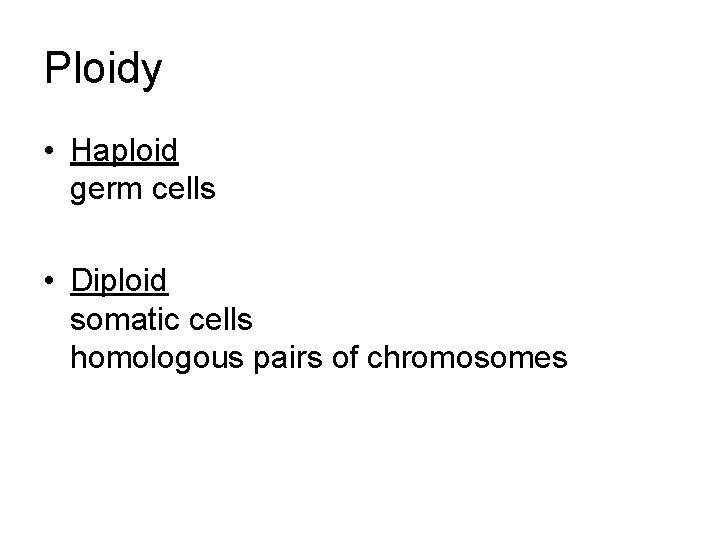
Ploidy • Haploid germ cells • Diploid somatic cells homologous pairs of chromosomes
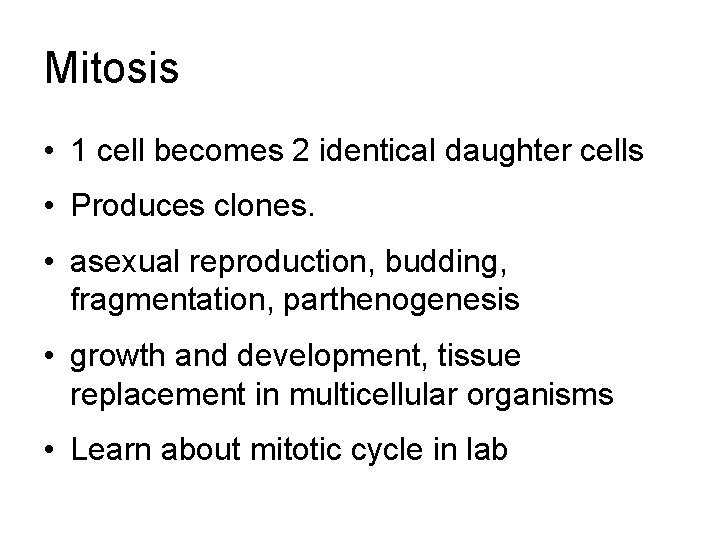
Mitosis • 1 cell becomes 2 identical daughter cells • Produces clones. • asexual reproduction, budding, fragmentation, parthenogenesis • growth and development, tissue replacement in multicellular organisms • Learn about mitotic cycle in lab
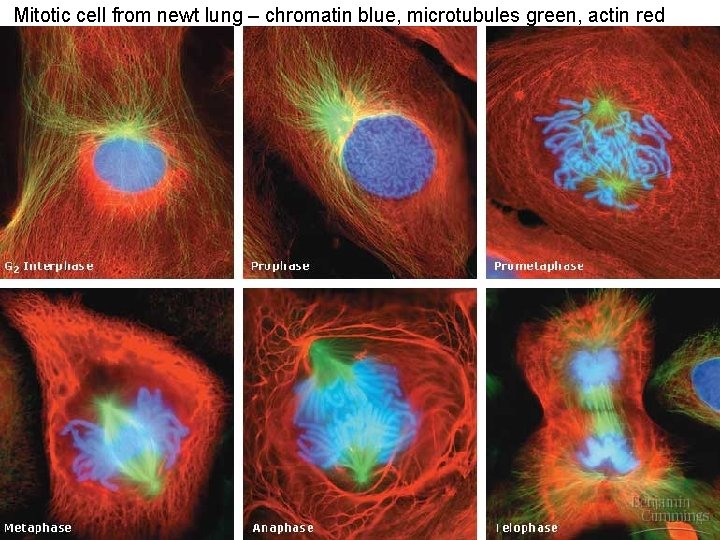
Mitotic cell from newt lung – chromatin blue, microtubules green, actin red
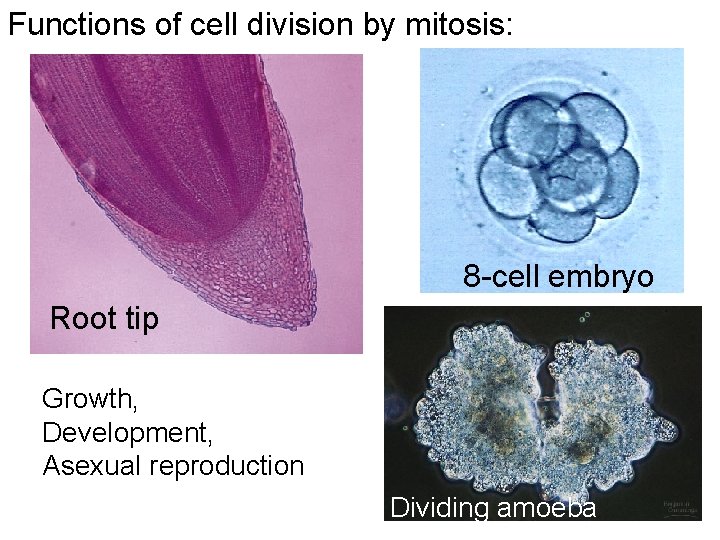
Functions of cell division by mitosis: 8 -cell embryo Root tip Growth, Development, Asexual reproduction Dividing amoeba
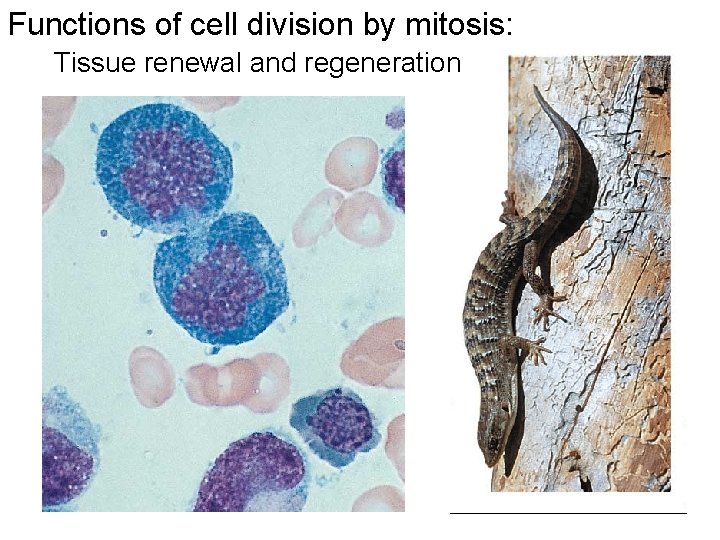
Functions of cell division by mitosis: Tissue renewal and regeneration
Mitosis of a diploid cell (diagrams completed in lecture)
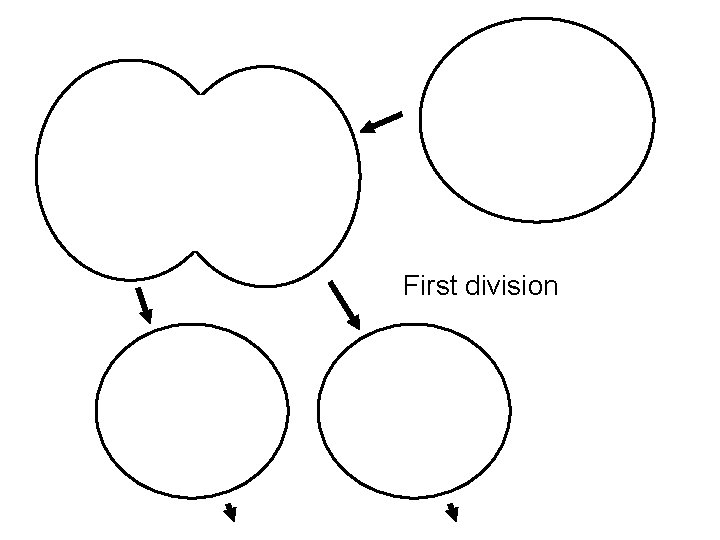
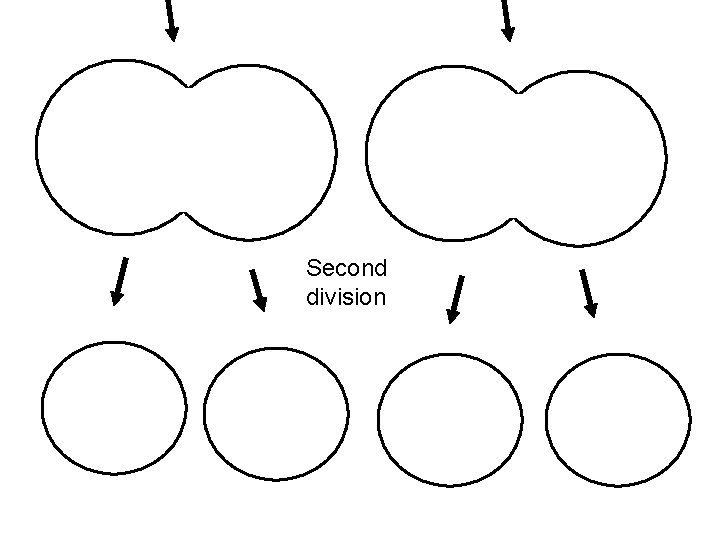
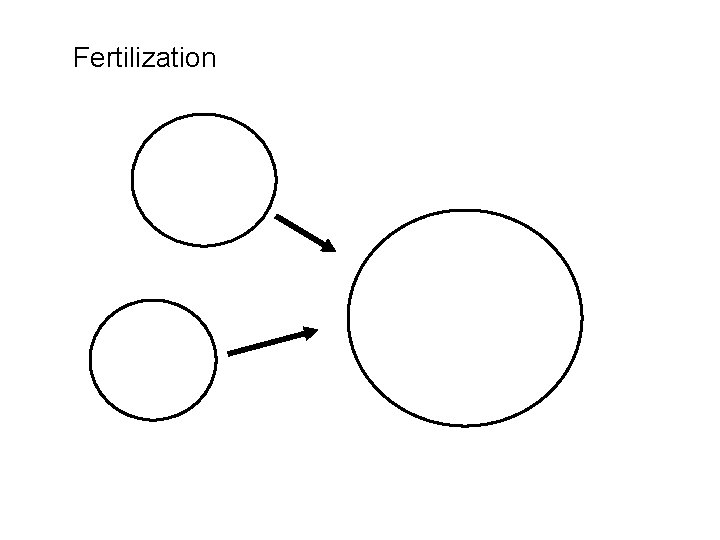
Meiosis • cell division to make gametes for sexual reproduction • One diploid cell produces 4 haploid cells (gametes) Fertilization • A pair of haploid gametes (typically egg and sperm) combine to make a diploid zygote
Meiosis (diagrams completed in lecture)
First division
Second division
Fertilization
Sexual reproduction • Meiosis makes haploid gametes • The gametes are not identical genetically because of: 1) independent assortment of homologues and 2) crossing over • Fertilization: haploid gametes combine to make diploid zygote with homologous pairs of chromosomes
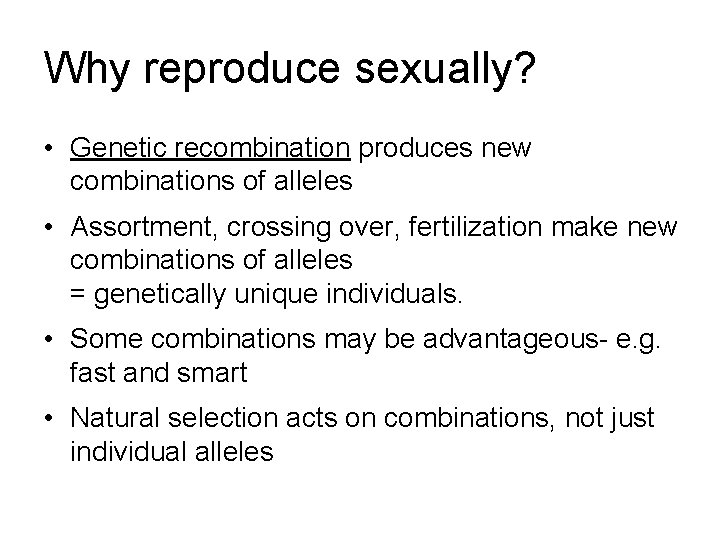
Why reproduce sexually? • Genetic recombination produces new combinations of alleles • Assortment, crossing over, fertilization make new combinations of alleles = genetically unique individuals. • Some combinations may be advantageous- e. g. fast and smart • Natural selection acts on combinations, not just individual alleles
Inheritance (Chap 16) • sexually reproducing organisms inherit homologous pairs of chromosomes: one from each parent • Therefore, offspring inherit a combination of characteristics from parents • patterns of inheritance first accurately described in 1866 by Gregor Mendel
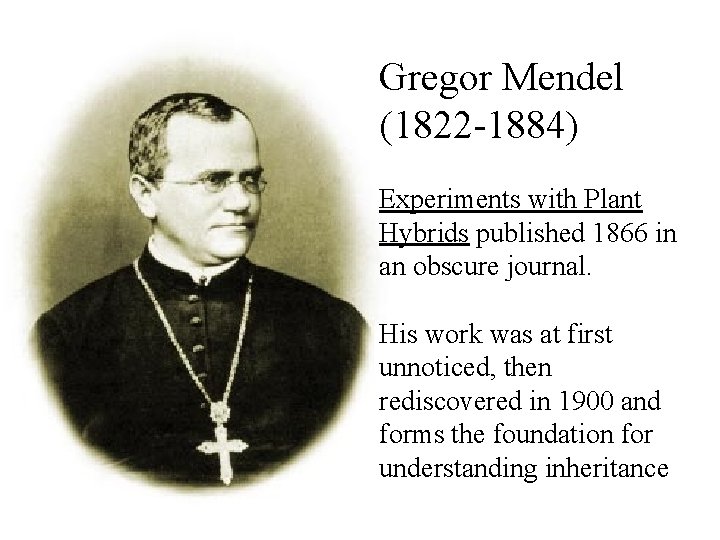
Gregor Mendel (1822 -1884) Experiments with Plant Hybrids published 1866 in an obscure journal. His work was at first unnoticed, then rediscovered in 1900 and forms the foundation for understanding inheritance
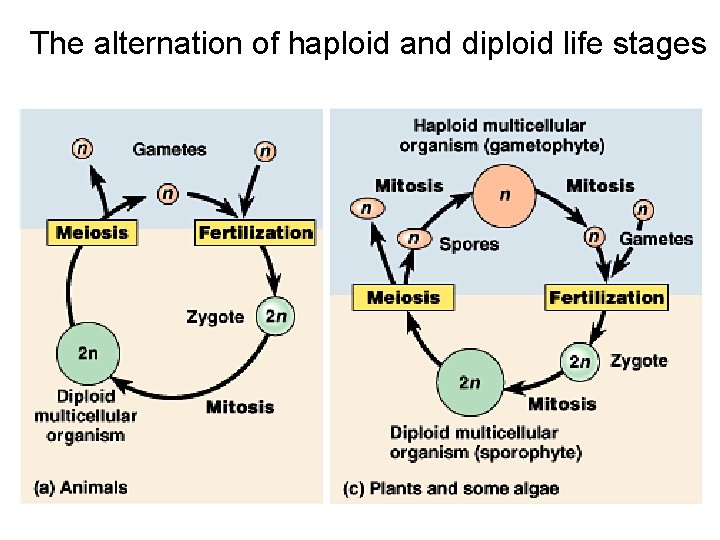
The alternation of haploid and diploid life stages
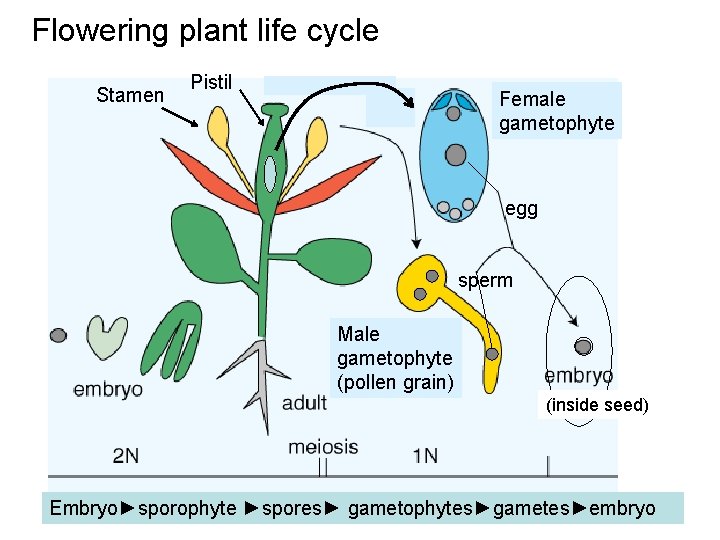
Flowering plant life cycle • Diploid sporophyte through meiosis makes haploid gametophytes (female and male). • The male gametophyte plant is the pollen grain – produces male gamete (sperm) by mitosis • The female gametophyte plant is within the pistil – produces female gamete (egg) by mitosis • You can basically “ignore” this complication in considering inheritance
Flowering plant life cycle Stamen Pistil Female gametophyte egg sperm Male gametophyte (pollen grain) (inside seed) Embryo►sporophyte ►spores► gametophytes►gametes►embryo
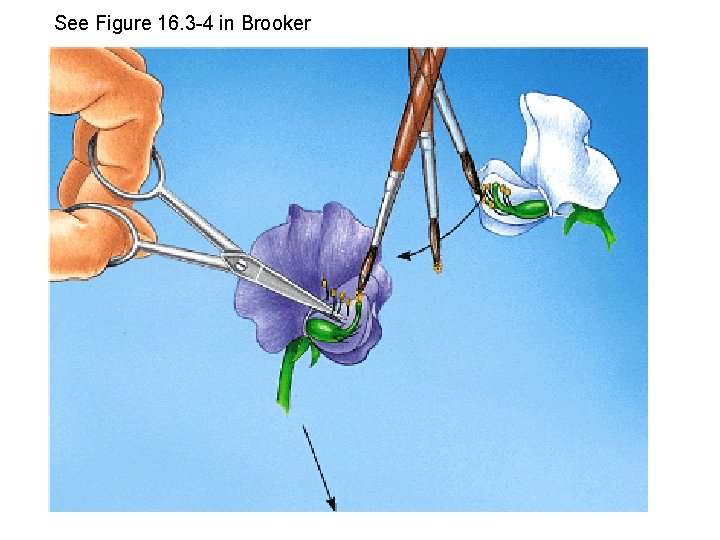
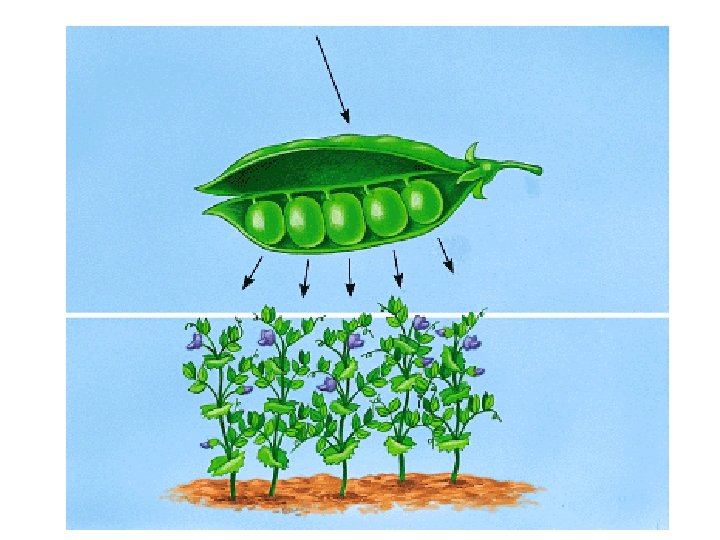
Mendel’s experiments • deduced principles of inheritance without any molecular information • Grew pea plants and recorded characteristics of parents and offspring over many generations • Systematic crosses between parent plants of known lineage • Selfing versus outcrossing
See Figure 16. 3 -4 in Brooker
Example- inheritance of flower color • Two colors- purple, white. • Some individuals always produced self similar offspring if self-fertilized: homozygous ("similar offspring") • Others produced offspring of both colors when selfed: heterozygous ("different offspring")
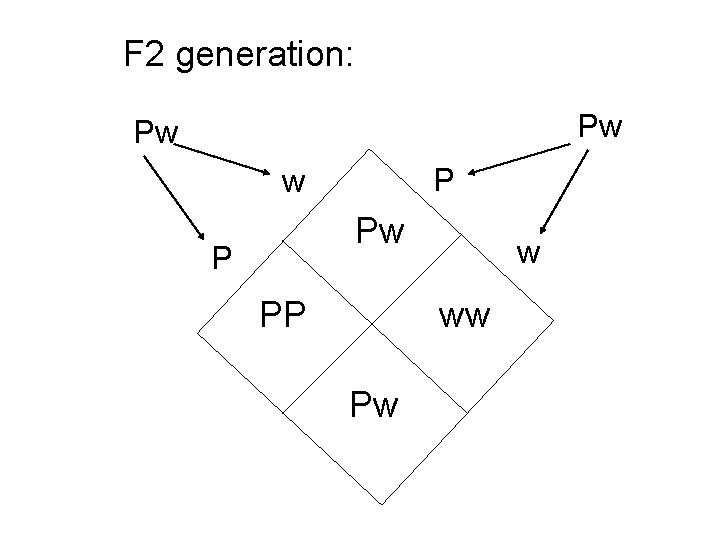
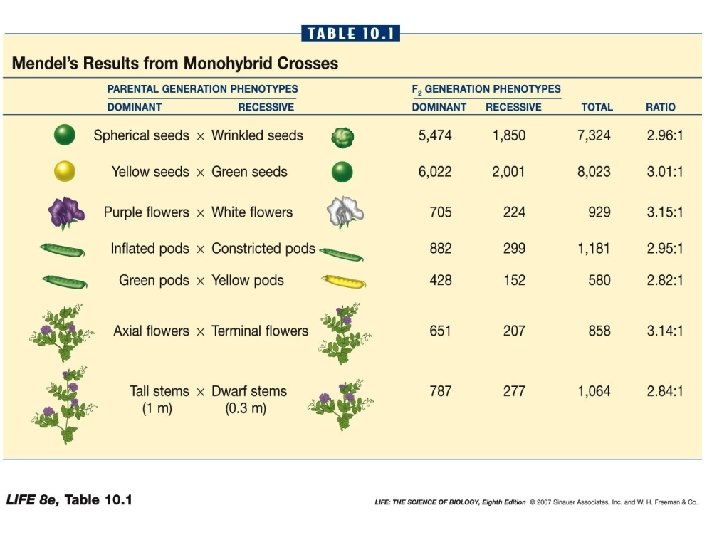
Monohybrid test cross (see Fig 10. 3 p. 211 Sadava) P F 1 F 2 1. Crossed two homozygous parents… x self 2. F 1 all purple. Crossed F 1…. 3. Observed 3: 1 phenotype ratio in F 2
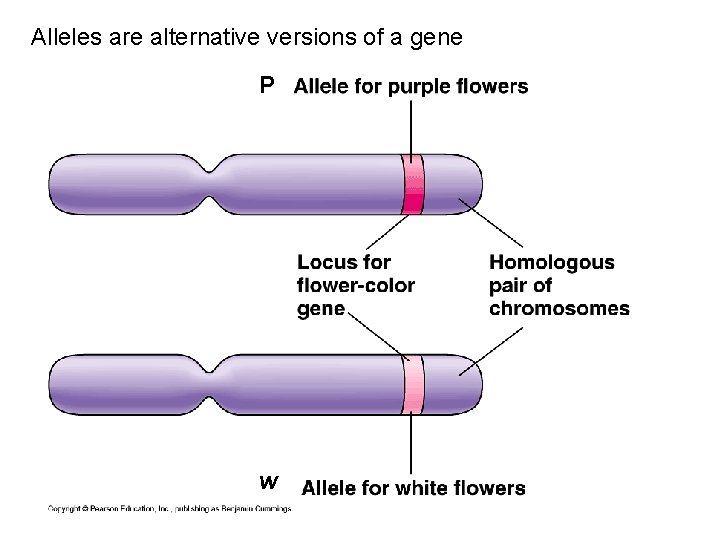
Explanation • There is a gene that affects flower color • The gene exists in two alternative forms (alleles). Call them P and w • Allele P codes for purple protein • Allele w codes for a colorless version of the protein
Alleles are alternative versions of a gene P w
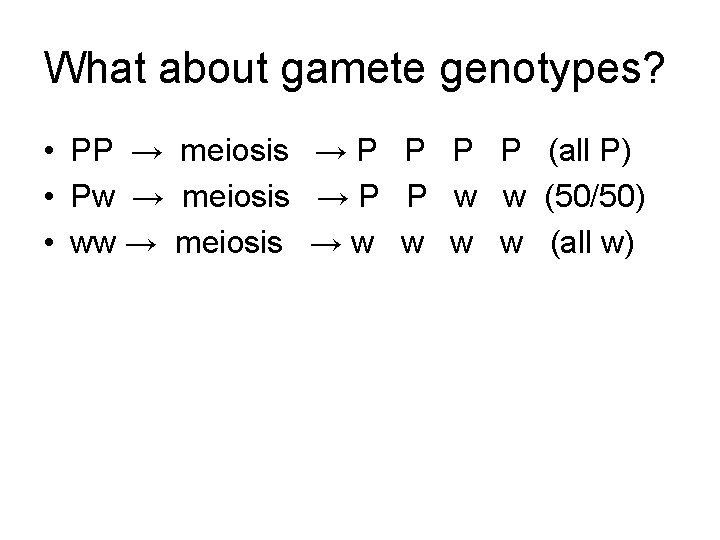
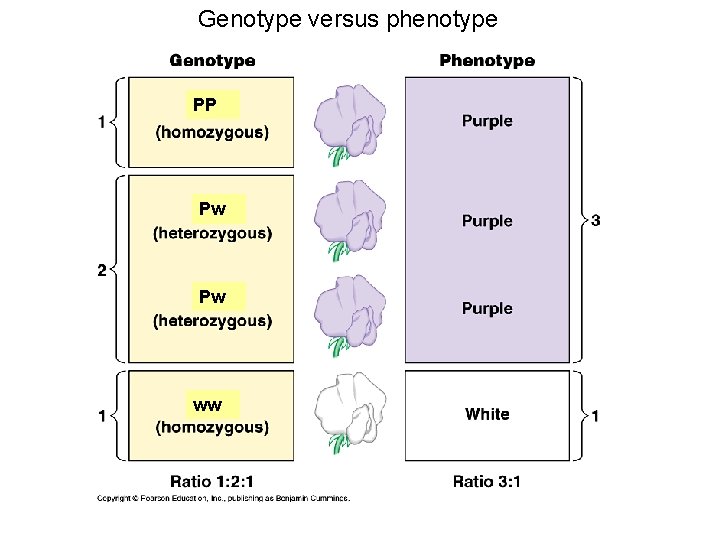
Explanation, continued • Diploid individual inherits two copies of each gene. • Therefore, there are three possible genotypes: PP (homozygous P) Pw (heterozygous) ww (homozygous w)
What about gamete genotypes? • PP → meiosis → P P (all P) • Pw → meiosis → P P w w (50/50) • ww → meiosis → w w (all w)
F 1 generation: all heterozygous ♂ parent ♀ parent ww PP w P Pw Offspring Pw “Punnett square” w Pw
F 2 generation: Pw Pw P PP w ww Pw
Genotype versus phenotype PP Pw Pw ww
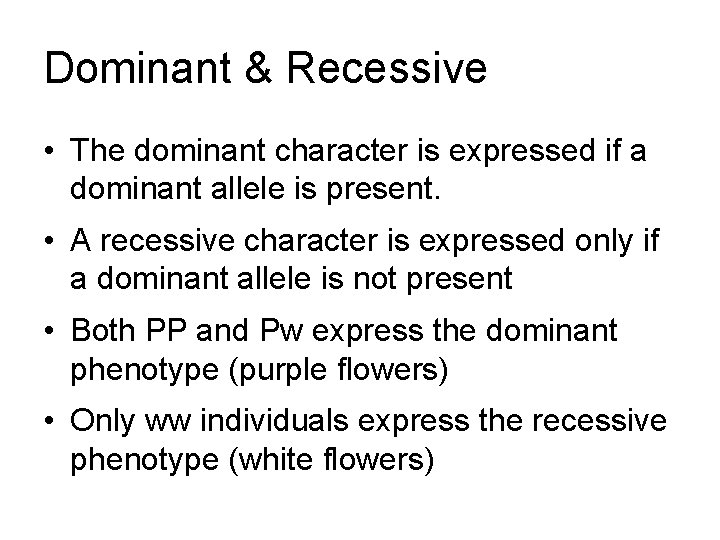
Dominant & Recessive • The dominant character is expressed if a dominant allele is present. • A recessive character is expressed only if a dominant allele is not present • Both PP and Pw express the dominant phenotype (purple flowers) • Only ww individuals express the recessive phenotype (white flowers)
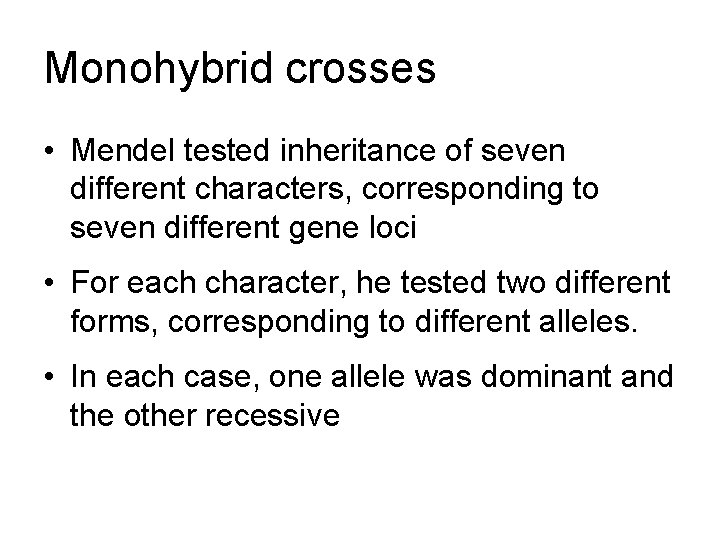
Monohybrid crosses • Mendel tested inheritance of seven different characters, corresponding to seven different gene loci • For each character, he tested two different forms, corresponding to different alleles. • In each case, one allele was dominant and the other recessive
Krogh’s rule • Definition • Why pea plants? • Selfing vs crossing • Large numbers of offspring • Statistical nature of inheritance
Vocabulary review • • Genotype Phenotype Allele Gene locus (plural = loci) Blending & particulate inheritance Homozygous & heterozygous Dominant & recessive
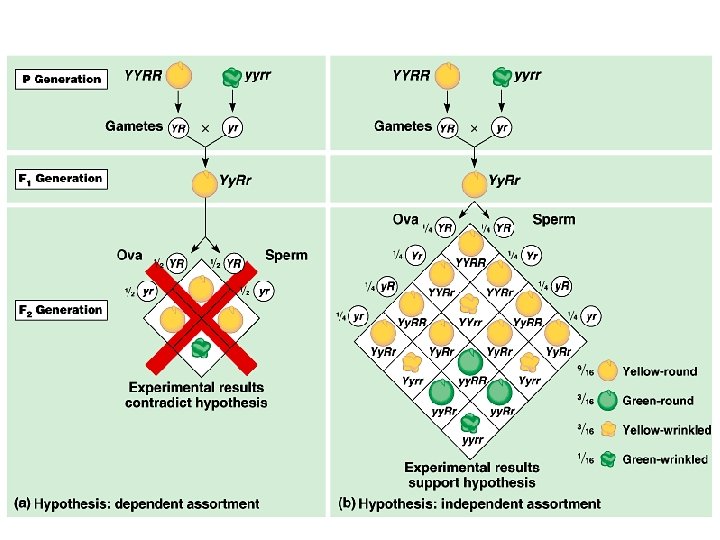
Dihybrid test cross • Mendel analyzed inheritance of pairs of characters • Started with parents homozygous for two characters • For example, seed color and seed shape • Y = yellow y = green • R = round r = wrinkled
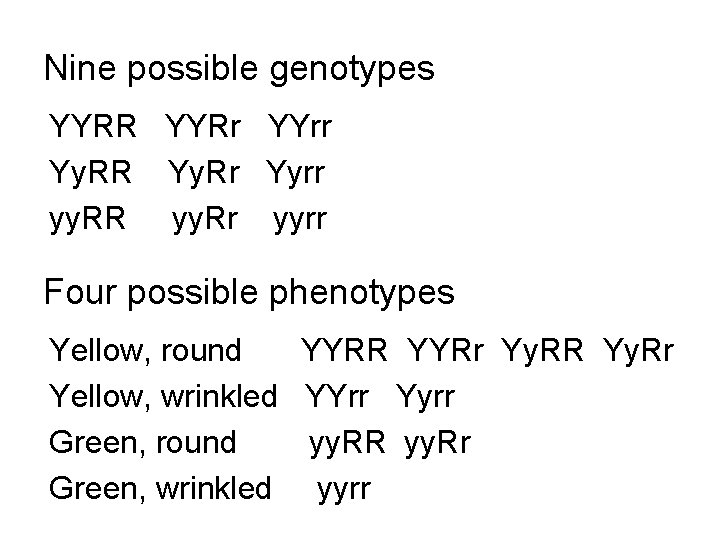
Nine possible genotypes YYRR YYRr YYrr Yy. RR Yy. Rr Yyrr yy. RR yy. Rr yyrr Four possible phenotypes Yellow, round YYRR YYRr Yy. RR Yy. Rr Yellow, wrinkled YYrr Yyrr Green, round yy. RR yy. Rr Green, wrinkled yyrr
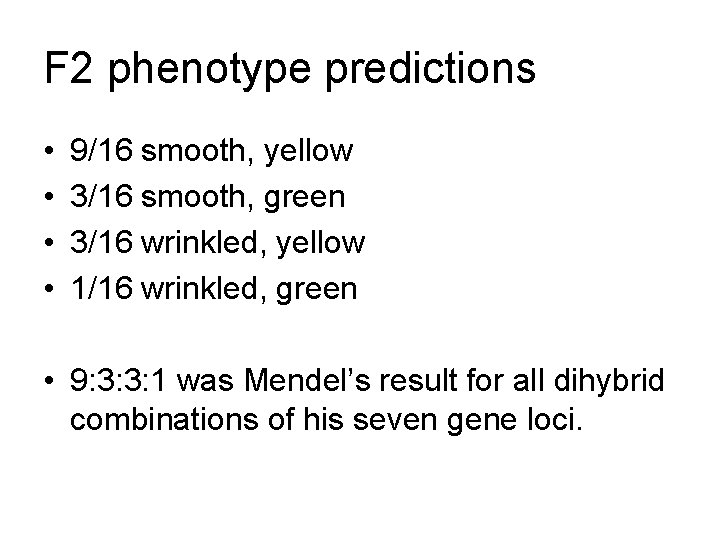
F 2 phenotype predictions • • 9/16 smooth, yellow 3/16 smooth, green 3/16 wrinkled, yellow 1/16 wrinkled, green • 9: 3: 3: 1 was Mendel’s result for all dihybrid combinations of his seven gene loci.
Mendel’s “laws” • Segregation: for each character, an individual inherits two alleles (one from each parent): these separate again during gamete formation. • Independent assortment: the alleles of different genes assort independently of one another (the combinations of alleles are not preserved in the next generation)
Rules of Probability • Multiplication: the probability of two events occurring together is the product of their individual probabilities. • Addition: the probability of an outcome that can occur in several ways is the sum of the probabilities of those events.
Examples- coin tossing • What is the chance of tossing heads? • What is the probability of tossing heads three times in a row? • If you throw heads 3 times in a row, what is the probability of then throwing tails?
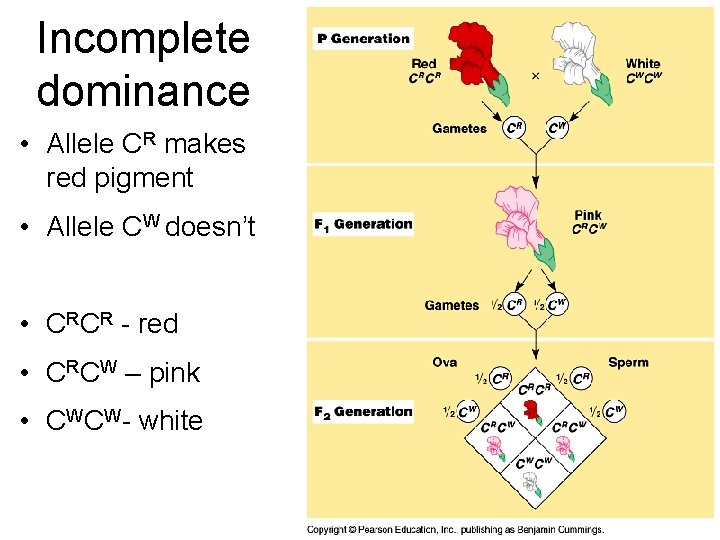
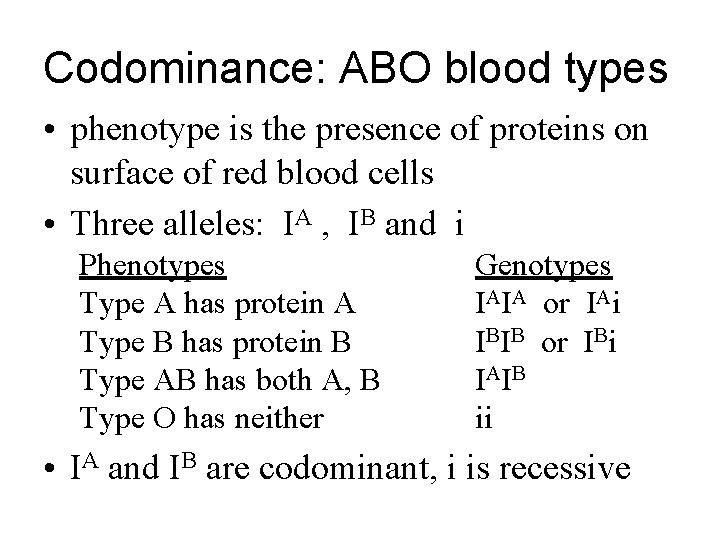
Dominance • Describes effect of allele on phenotype, when paired with a different allele • Complete dominance- phenotype of heterozygotes is the same as that of homozygous dominant individuals. • Incomplete dominance- heterozygotes have intermediate phenotype • Codominance- heterozygote expresses both alleles
Incomplete dominance • Allele CR makes red pigment • Allele CW doesn’t • CRCR - red • CRCW – pink • CWCW- white
Codominance: ABO blood types • phenotype is the presence of proteins on surface of red blood cells • Three alleles: IA , IB and i Phenotypes Type A has protein A Type B has protein B Type AB has both A, B Type O has neither Genotypes IAIA or IAi IBIB or IBi IA IB ii • IA and IB are codominant, i is recessive
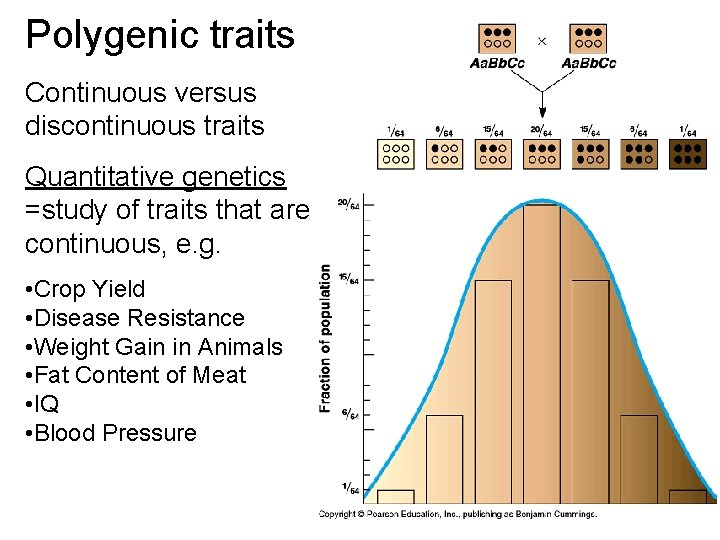
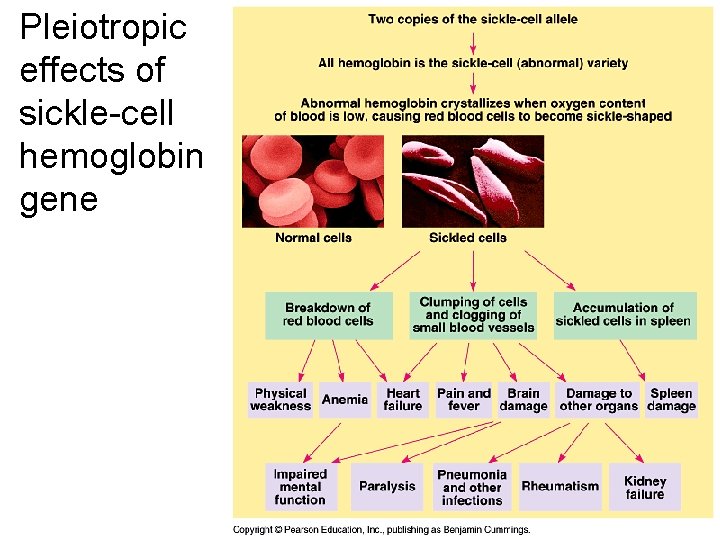
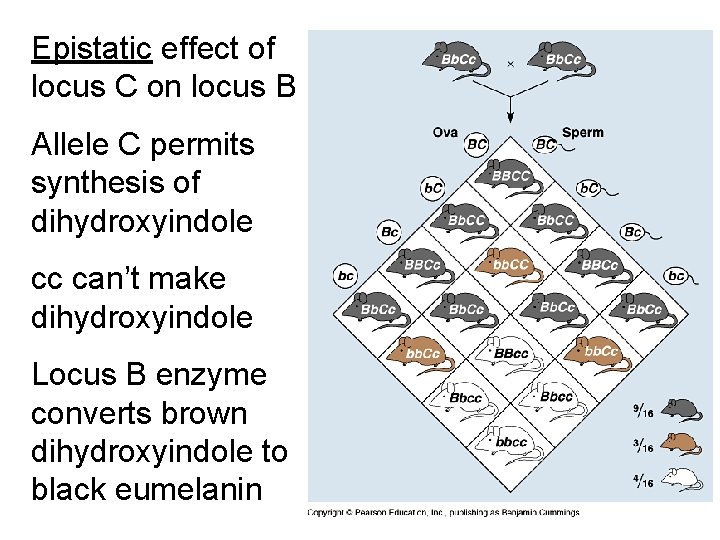
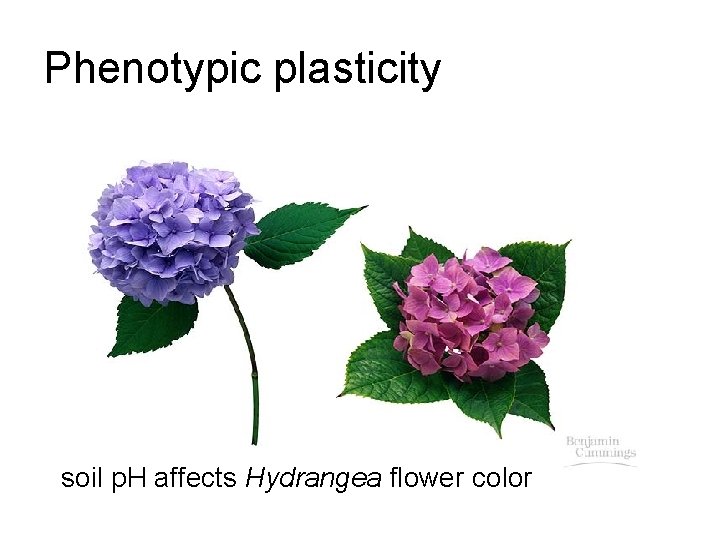
More complications • Polygenic traits- determined by effects of two or more genes • Pleiotropy- gene has multiple effects on phenotype • Epistasis - one gene affects the expression of another • Phenotypic plasticity – environment influences phenotype
Polygenic traits Continuous versus discontinuous traits Quantitative genetics =study of traits that are continuous, e. g. • Crop Yield • Disease Resistance • Weight Gain in Animals • Fat Content of Meat • IQ • Blood Pressure
Pleiotropic effects of sickle-cell hemoglobin gene
Epistatic effect of locus C on locus B Allele C permits synthesis of dihydroxyindole cc can’t make dihydroxyindole Locus B enzyme converts brown dihydroxyindole to black eumelanin
Phenotypic plasticity soil p. H affects Hydrangea flower color