
Control of Cyclotron Vertical Deflector for Proton Therapy
- Slides: 1
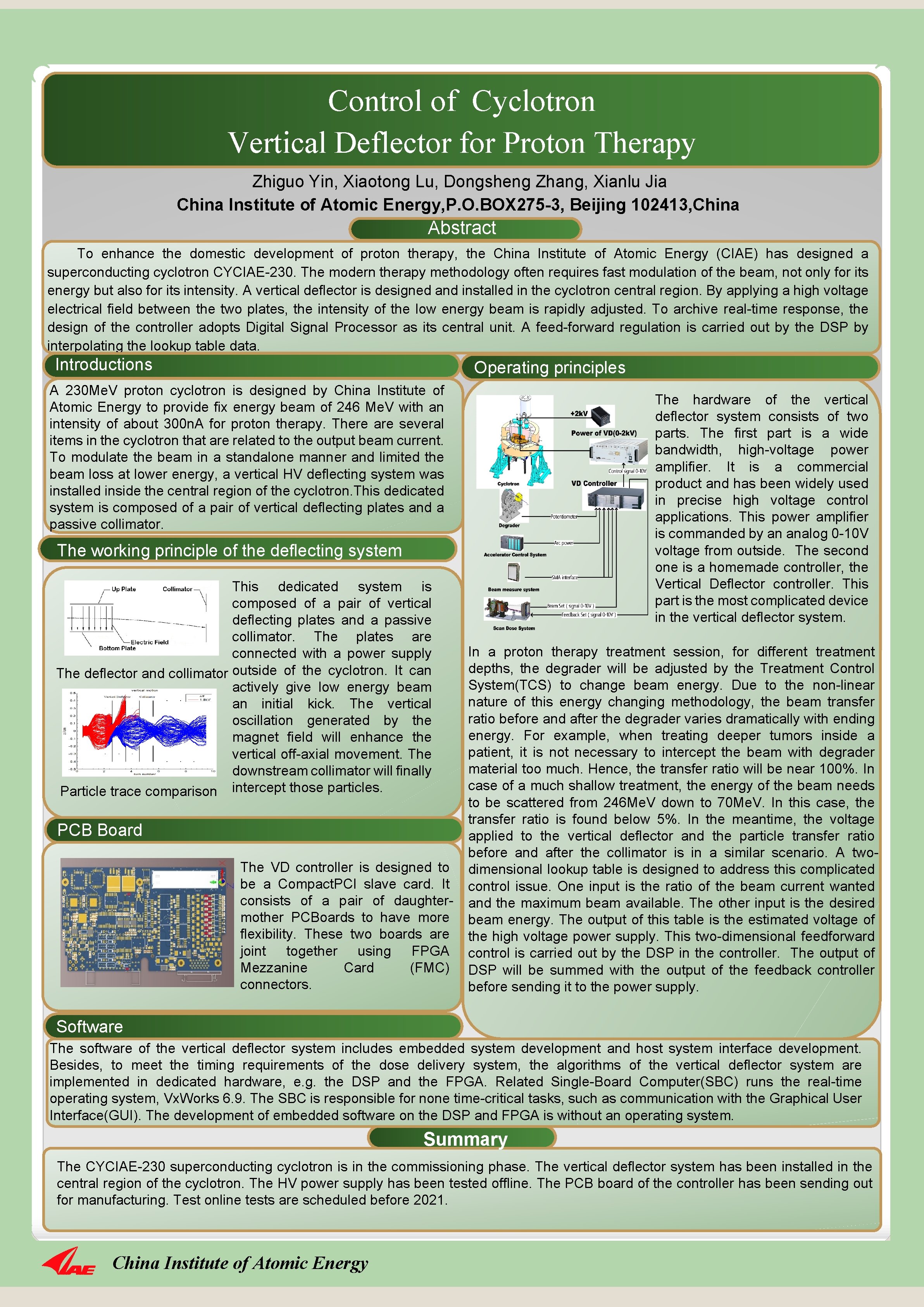
Control of Cyclotron Vertical Deflector for Proton Therapy Zhiguo Yin, Xiaotong Lu, Dongsheng Zhang, Xianlu Jia China Institute of Atomic Energy, P. O. BOX 275 -3, Beijing 102413, China Abstract To enhance the domestic development of proton therapy, the China Institute of Atomic Energy (CIAE) has designed a superconducting cyclotron CYCIAE-230. The modern therapy methodology often requires fast modulation of the beam, not only for its energy but also for its intensity. A vertical deflector is designed and installed in the cyclotron central region. By applying a high voltage electrical field between the two plates, the intensity of the low energy beam is rapidly adjusted. To archive real-time response, the design of the controller adopts Digital Signal Processor as its central unit. A feed-forward regulation is carried out by the DSP by interpolating the lookup table data. Introductions Operating principles A 230 Me. V proton cyclotron is designed by China Institute of Atomic Energy to provide fix energy beam of 246 Me. V with an intensity of about 300 n. A for proton therapy. There are several items in the cyclotron that are related to the output beam current. To modulate the beam in a standalone manner and limited the beam loss at lower energy, a vertical HV deflecting system was installed inside the central region of the cyclotron. This dedicated system is composed of a pair of vertical deflecting plates and a passive collimator. The hardware of the vertical deflector system consists of two parts. The first part is a wide bandwidth, high-voltage power amplifier. It is a commercial product and has been widely used in precise high voltage control applications. This power amplifier is commanded by an analog 0 -10 V voltage from outside. The second one is a homemade controller, the Vertical Deflector controller. This part is the most complicated device in the vertical deflector system. The working principle of the deflecting system This dedicated system is composed of a pair of vertical deflecting plates and a passive collimator. The plates are connected with a power supply The deflector and collimator outside of the cyclotron. It can actively give low energy beam an initial kick. The vertical oscillation generated by the magnet field will enhance the vertical off-axial movement. The downstream collimator will finally Particle trace comparison intercept those particles. PCB Board The VD controller is designed to be a Compact. PCI slave card. It consists of a pair of daughtermother PCBoards to have more flexibility. These two boards are joint together using FPGA Mezzanine Card (FMC) connectors. In a proton therapy treatment session, for different treatment depths, the degrader will be adjusted by the Treatment Control System(TCS) to change beam energy. Due to the non-linear nature of this energy changing methodology, the beam transfer ratio before and after the degrader varies dramatically with ending energy. For example, when treating deeper tumors inside a patient, it is not necessary to intercept the beam with degrader material too much. Hence, the transfer ratio will be near 100%. In case of a much shallow treatment, the energy of the beam needs to be scattered from 246 Me. V down to 70 Me. V. In this case, the transfer ratio is found below 5%. In the meantime, the voltage applied to the vertical deflector and the particle transfer ratio before and after the collimator is in a similar scenario. A twodimensional lookup table is designed to address this complicated control issue. One input is the ratio of the beam current wanted and the maximum beam available. The other input is the desired beam energy. The output of this table is the estimated voltage of the high voltage power supply. This two-dimensional feedforward control is carried out by the DSP in the controller. The output of DSP will be summed with the output of the feedback controller before sending it to the power supply. Software The software of the vertical deflector system includes embedded system development and host system interface development. Besides, to meet the timing requirements of the dose delivery system, the algorithms of the vertical deflector system are implemented in dedicated hardware, e. g. the DSP and the FPGA. Related Single-Board Computer(SBC) runs the real-time operating system, Vx. Works 6. 9. The SBC is responsible for none time-critical tasks, such as communication with the Graphical User Interface(GUI). The development of embedded software on the DSP and FPGA is without an operating system. Summary The CYCIAE-230 superconducting cyclotron is in the commissioning phase. The vertical deflector system has been installed in the central region of the cyclotron. The HV power supply has been tested offline. The PCB board of the controller has been sending out for manufacturing. Test online tests are scheduled before 2021. China Institute of Atomic Energy