
Control Implementation Alternatives Control may be designed using
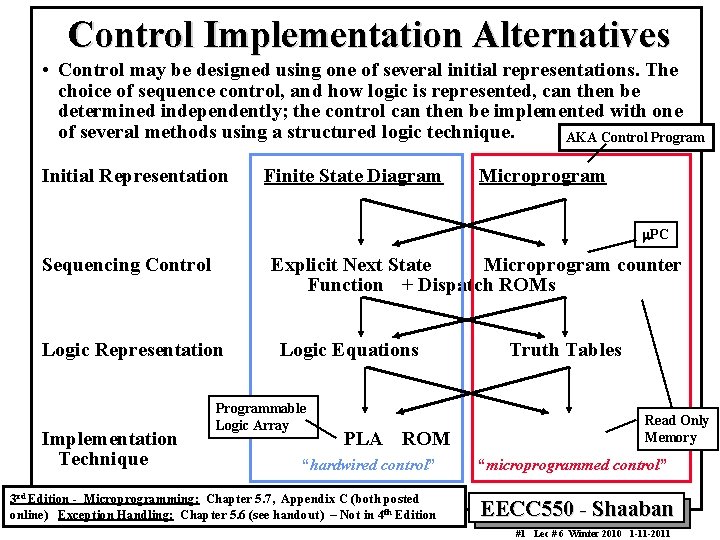
Control Implementation Alternatives • Control may be designed using one of several initial representations. The choice of sequence control, and how logic is represented, can then be determined independently; the control can then be implemented with one of several methods using a structured logic technique. AKA Control Program Initial Representation Finite State Diagram Microprogram m. PC Sequencing Control Explicit Next State Microprogram counter Function + Dispatch ROMs Logic Representation Implementation Technique Logic Equations Programmable Logic Array PLA ROM “hardwired control” 3 rd Edition - Microprogramming: Chapter 5. 7, Appendix C (both posted online) Exception Handling: Chapter 5. 6 (see handout) – Not in 4 th Edition Truth Tables Read Only Memory “microprogrammed control” EECC 550 - Shaaban #1 Lec # 6 Winter 2010 1 -11 -2011
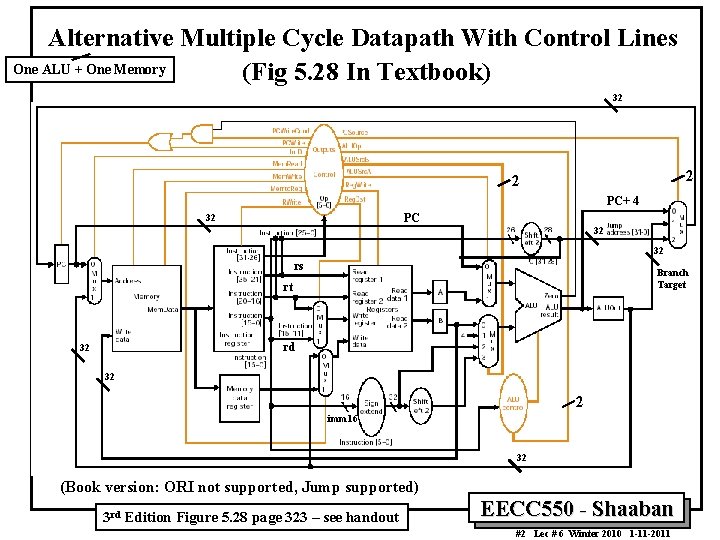
Alternative Multiple Cycle Datapath With Control Lines One ALU + One Memory (Fig 5. 28 In Textbook) 32 2 2 PC+ 4 PC 32 32 32 rs Branch Target rt rd 32 32 2 imm 16 32 (Book version: ORI not supported, Jump supported) 3 rd Edition Figure 5. 28 page 323 – see handout EECC 550 - Shaaban #2 Lec # 6 Winter 2010 1 -11 -2011
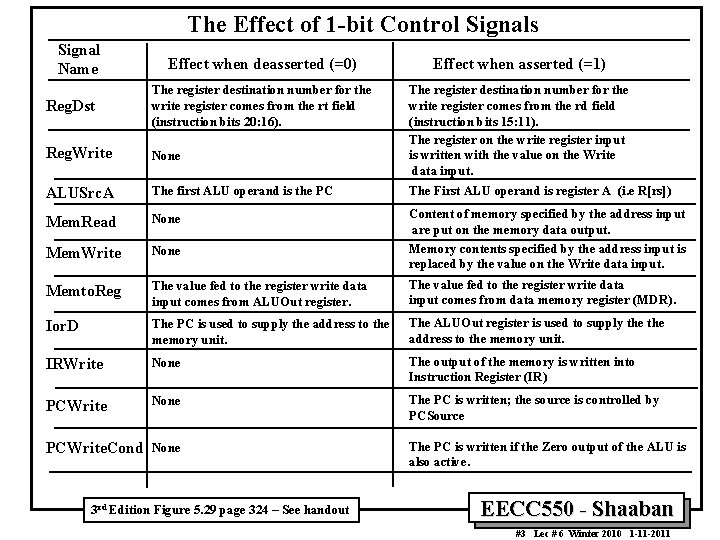
The Effect of 1 -bit Control Signals Signal Name Effect when deasserted (=0) Effect when asserted (=1) Reg. Dst The register destination number for the write register comes from the rt field (instruction bits 20: 16). Reg. Write None The register destination number for the write register comes from the rd field (instruction bits 15: 11). The register on the write register input is written with the value on the Write data input. ALUSrc. A The first ALU operand is the PC The First ALU operand is register A (i. e R[rs]) Mem. Read None Mem. Write None Content of memory specified by the address input are put on the memory data output. Memory contents specified by the address input is replaced by the value on the Write data input. Memto. Reg The value fed to the register write data input comes from ALUOut register. The value fed to the register write data input comes from data memory register (MDR). Ior. D The PC is used to supply the address to the memory unit. The ALUOut register is used to supply the address to the memory unit. IRWrite None The output of the memory is written into Instruction Register (IR) PCWrite None The PC is written; the source is controlled by PCSource PCWrite. Cond None 3 rd Edition Figure 5. 29 page 324 – See handout The PC is written if the Zero output of the ALU is also active. EECC 550 - Shaaban #3 Lec # 6 Winter 2010 1 -11 -2011
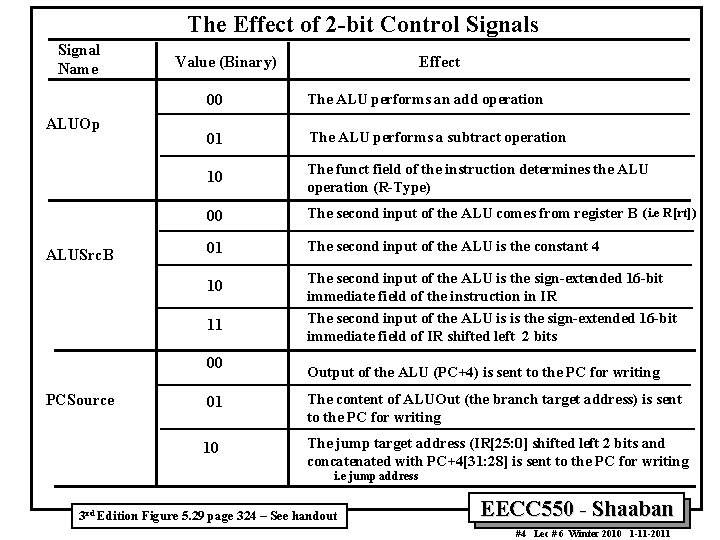
The Effect of 2 -bit Control Signals Signal Name ALUOp ALUSrc. B Value (Binary) 00 The ALU performs an add operation 01 The ALU performs a subtract operation 10 The funct field of the instruction determines the ALU operation (R-Type) 00 The second input of the ALU comes from register B (i. e R[rt]) 01 The second input of the ALU is the constant 4 10 The second input of the ALU is the sign-extended 16 -bit immediate field of the instruction in IR The second input of the ALU is is the sign-extended 16 -bit immediate field of IR shifted left 2 bits 11 00 PCSource Effect Output of the ALU (PC+4) is sent to the PC for writing 01 The content of ALUOut (the branch target address) is sent to the PC for writing 10 The jump target address (IR[25: 0] shifted left 2 bits and concatenated with PC+4[31: 28] is sent to the PC for writing i. e jump address 3 rd Edition Figure 5. 29 page 324 – See handout EECC 550 - Shaaban #4 Lec # 6 Winter 2010 1 -11 -2011
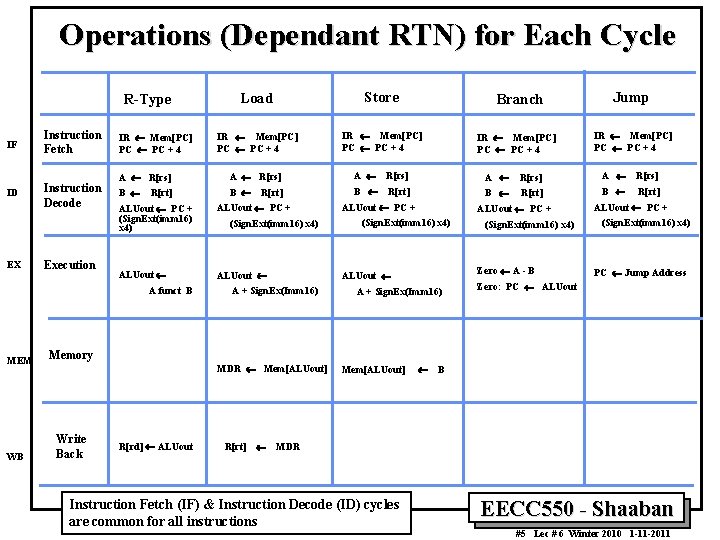
Operations (Dependant RTN) for Each Cycle R-Type IF ID EX Instruction Fetch Instruction Decode Execution IR ¬ Mem[PC] PC ¬ PC + 4 WB Store IR ¬ Mem[PC] PC ¬ PC + 4 Branch IR ¬ Mem[PC] PC ¬ PC + 4 Jump IR ¬ Mem[PC] PC ¬ PC + 4 A ¬ R[rs] A ¬ R[rs] B ¬ B ¬ R[rt] R[rt] ALUout ¬ PC + (Sign. Ext(imm 16) x 4) ALUout ¬ PC + ALUout ¬ A funct B MEM Load (Sign. Ext(imm 16) x 4) ALUout ¬ PC + (Sign. Ext(imm 16) x 4) Zero ¬ A - B ALUout ¬ A + Sign. Ex(Imm 16) (Sign. Ext(imm 16) x 4) A + Sign. Ex(Imm 16) ALUout ¬ PC + (Sign. Ext(imm 16) x 4) PC ¬ Jump Address Zero: PC ¬ ALUout Memory MDR ¬ Mem[ALUout] Write Back R[rd] ¬ ALUout R[rt] ¬ Mem[ALUout] ¬ B MDR Instruction Fetch (IF) & Instruction Decode (ID) cycles are common for all instructions EECC 550 - Shaaban #5 Lec # 6 Winter 2010 1 -11 -2011
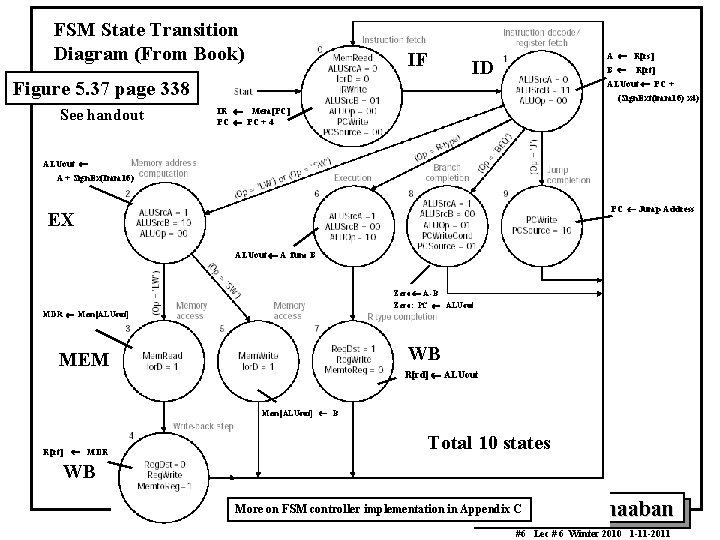
FSM State Transition Diagram (From Book) IF Figure 5. 37 page 338 See handout A ¬ R[rs] ID B ¬ R[rt] ALUout ¬ PC + (Sign. Ext(imm 16) x 4) IR ¬ Mem[PC] PC ¬ PC + 4 ALUout ¬ A + Sign. Ex(Imm 16) PC ¬ Jump Address EX ALUout ¬ A func B Zero ¬ A -B Zero: PC ¬ ALUout MDR ¬ Mem[ALUout] WB MEM R[rd] ¬ ALUout Mem[ALUout] ¬ B R[rt] ¬ MDR Total 10 states WB EECC 550 - Shaaban More on FSM controller implementation in Appendix C #6 Lec # 6 Winter 2010 1 -11 -2011
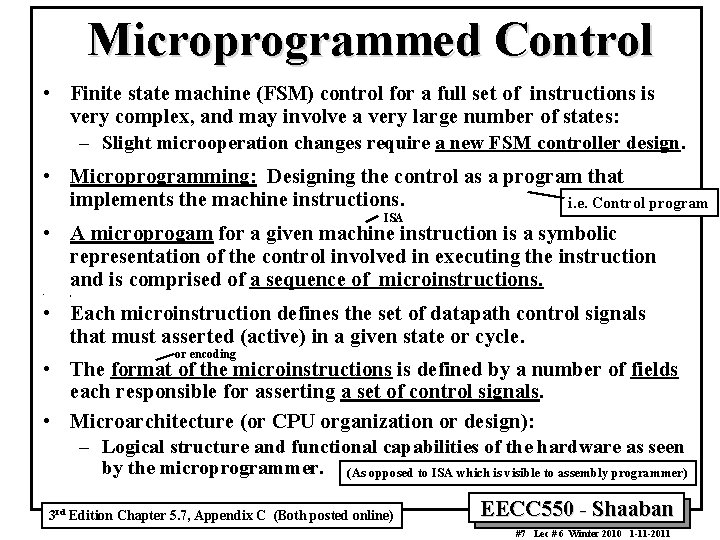
Microprogrammed Control • Finite state machine (FSM) control for a full set of instructions is very complex, and may involve a very large number of states: – Slight microoperation changes require a new FSM controller design. • Microprogramming: Designing the control as a program that implements the machine instructions. i. e. Control program ISA • A microprogam for a given machine instruction is a symbolic representation of the control involved in executing the instruction and is comprised of a sequence of microinstructions. • • Each microinstruction defines the set of datapath control signals that must asserted (active) in a given state or cycle. or encoding • The format of the microinstructions is defined by a number of fields each responsible for asserting a set of control signals. • Microarchitecture (or CPU organization or design): – Logical structure and functional capabilities of the hardware as seen by the microprogrammer. (As opposed to ISA which is visible to assembly programmer) 3 rd Edition Chapter 5. 7, Appendix C (Both posted online) EECC 550 - Shaaban #7 Lec # 6 Winter 2010 1 -11 -2011
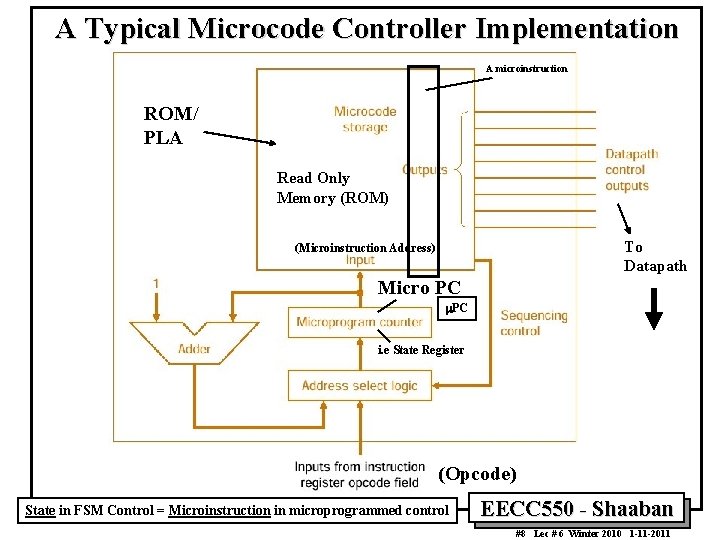
A Typical Microcode Controller Implementation A microinstruction ROM/ PLA Read Only Memory (ROM) To Datapath (Microinstruction Address) Micro PC m. PC i. e State Register (Opcode) State in FSM Control = Microinstruction in microprogrammed control EECC 550 - Shaaban #8 Lec # 6 Winter 2010 1 -11 -2011
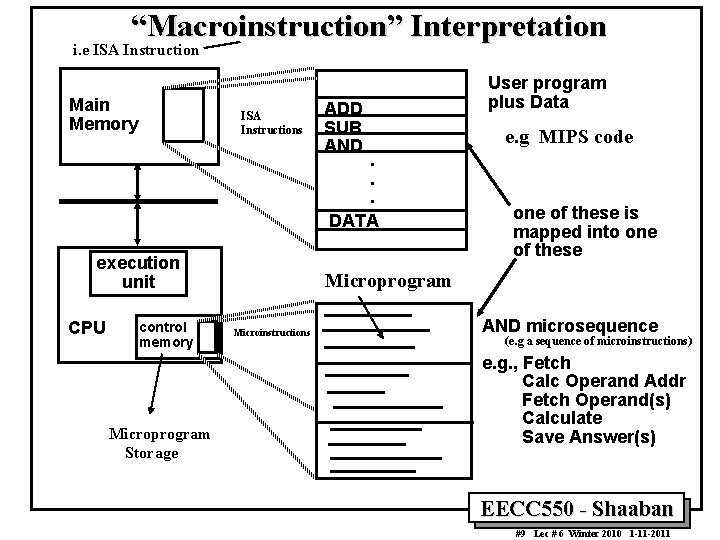
“Macroinstruction” Interpretation i. e ISA Instruction Main Memory ISA Instructions ADD SUB AND . . . DATA execution unit CPU control memory Microprogram Storage User program plus Data e. g MIPS code one of these is mapped into one of these Microprogram Microinstructions AND microsequence (e. g a sequence of microinstructions) e. g. , Fetch Calc Operand Addr Fetch Operand(s) Calculate Save Answer(s) EECC 550 - Shaaban #9 Lec # 6 Winter 2010 1 -11 -2011
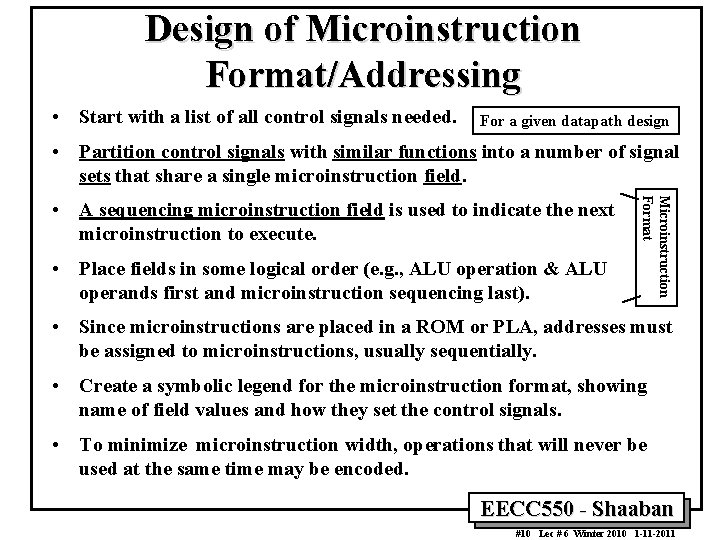
Design of Microinstruction Format/Addressing • Start with a list of all control signals needed. For a given datapath design • Partition control signals with similar functions into a number of signal sets that share a single microinstruction field. • Place fields in some logical order (e. g. , ALU operation & ALU operands first and microinstruction sequencing last). Microinstruction Format • A sequencing microinstruction field is used to indicate the next microinstruction to execute. • Since microinstructions are placed in a ROM or PLA, addresses must be assigned to microinstructions, usually sequentially. • Create a symbolic legend for the microinstruction format, showing name of field values and how they set the control signals. • To minimize microinstruction width, operations that will never be used at the same time may be encoded. EECC 550 - Shaaban #10 Lec # 6 Winter 2010 1 -11 -2011
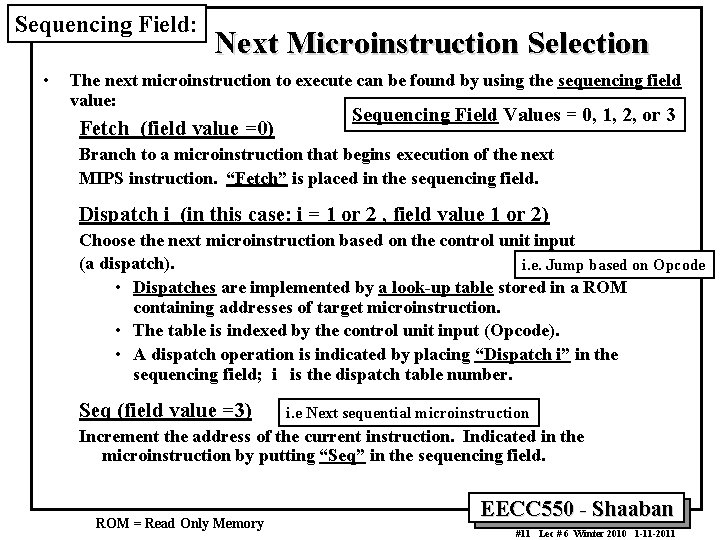
Sequencing Field: • Next Microinstruction Selection The next microinstruction to execute can be found by using the sequencing field value: Fetch (field value =0) Sequencing Field Values = 0, 1, 2, or 3 Branch to a microinstruction that begins execution of the next MIPS instruction. “Fetch” is placed in the sequencing field. Dispatch i (in this case: i = 1 or 2 , field value 1 or 2) Choose the next microinstruction based on the control unit input (a dispatch). i. e. Jump based on Opcode • Dispatches are implemented by a look-up table stored in a ROM containing addresses of target microinstruction. • The table is indexed by the control unit input (Opcode). • A dispatch operation is indicated by placing “Dispatch i” in the sequencing field; i is the dispatch table number. Seq (field value =3) i. e Next sequential microinstruction Increment the address of the current instruction. Indicated in the microinstruction by putting “Seq” in the sequencing field. ROM = Read Only Memory EECC 550 - Shaaban #11 Lec # 6 Winter 2010 1 -11 -2011
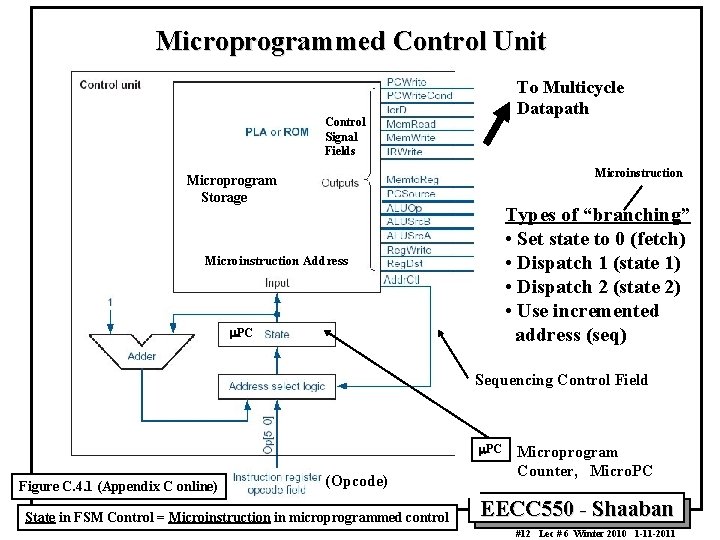
Microprogrammed Control Unit To Multicycle Datapath Control Signal Fields Microinstruction Microprogram Storage Types of “branching” • Set state to 0 (fetch) • Dispatch 1 (state 1) • Dispatch 2 (state 2) • Use incremented address (seq) Microinstruction Address m. PC Sequencing Control Field m. PC Figure C. 4. 1 (Appendix C online) (Opcode) State in FSM Control = Microinstruction in microprogrammed control Microprogram Counter, Micro. PC EECC 550 - Shaaban #12 Lec # 6 Winter 2010 1 -11 -2011
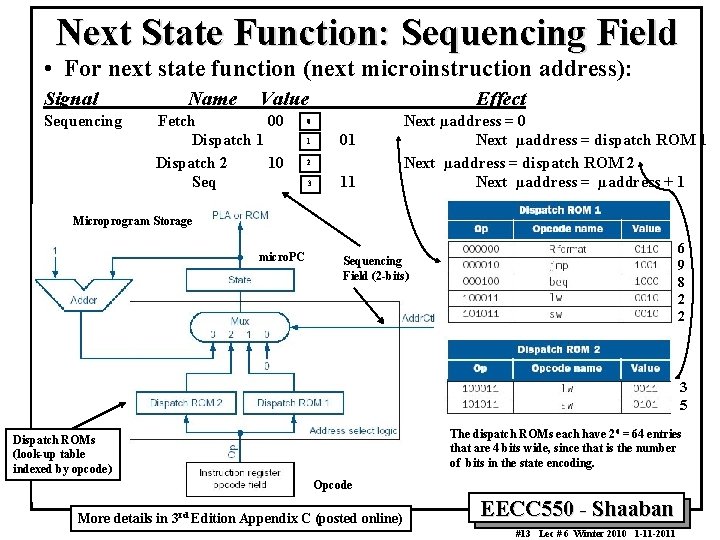
Next State Function: Sequencing Field • For next state function (next microinstruction address): Signal Sequencing Name Value Fetch 00 Dispatch 1 Dispatch 2 10 Seq Effect 0 1 01 2 3 11 Next µaddress = 0 Next µaddress = dispatch ROM 1 Next µaddress = dispatch ROM 2 Next µaddress = µaddress + 1 Microprogram Storage micro. PC 6 9 8 2 2 Sequencing Field (2 -bits) 3 5 The dispatch ROMs each have 26 = 64 entries that are 4 bits wide, since that is the number of bits in the state encoding. Dispatch ROMs (look-up table indexed by opcode) Opcode More details in 3 rd Edition Appendix C (posted online) EECC 550 - Shaaban #13 Lec # 6 Winter 2010 1 -11 -2011
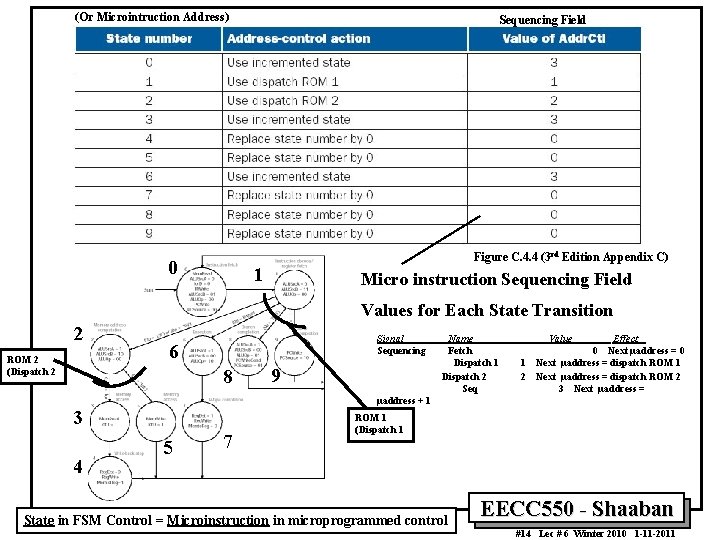
(Or Microintruction Address) 0 Sequencing Field Figure C. 4. 4 (3 rd Edition Appendix C) 1 Micro instruction Sequencing Field Values for Each State Transition 2 ROM 2 (Dispatch 2 Signal Sequencing 6 8 Value 1 2 Effect 0 Next µaddress = dispatch ROM 1 Next µaddress = dispatch ROM 2 3 Next µaddress = µaddress + 1 3 4 9 Name Fetch Dispatch 1 Dispatch 2 Seq 5 7 ROM 1 (Dispatch 1 State in FSM Control = Microinstruction in microprogrammed control EECC 550 - Shaaban #14 Lec # 6 Winter 2010 1 -11 -2011
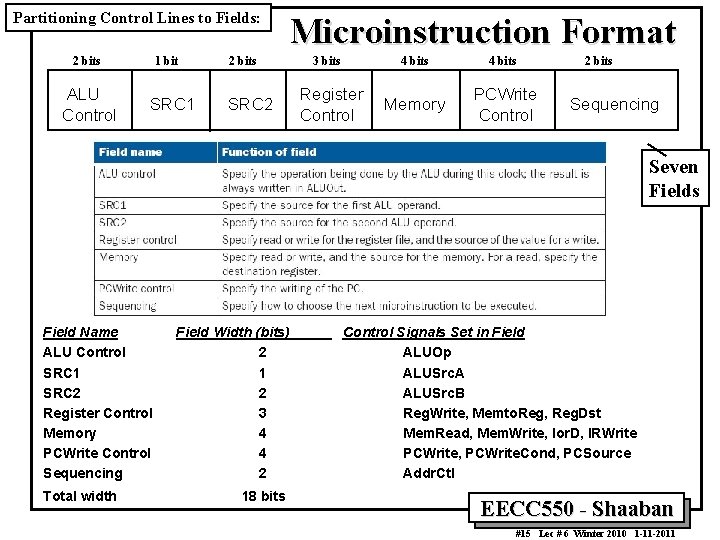
Partitioning Control Lines to Fields: 2 bits ALU Control 1 bit SRC 1 Microinstruction Format 2 bits SRC 2 3 bits Register Control 4 bits Memory PCWrite Control 2 bits Sequencing Seven Fields Field Name ALU Control SRC 1 SRC 2 Register Control Memory PCWrite Control Sequencing Total width Field Width (bits) 2 1 2 3 4 4 2 18 bits Control Signals Set in Field ALUOp ALUSrc. A ALUSrc. B Reg. Write, Memto. Reg, Reg. Dst Mem. Read, Mem. Write, Ior. D, IRWrite PCWrite, PCWrite. Cond, PCSource Addr. Ctl EECC 550 - Shaaban #15 Lec # 6 Winter 2010 1 -11 -2011
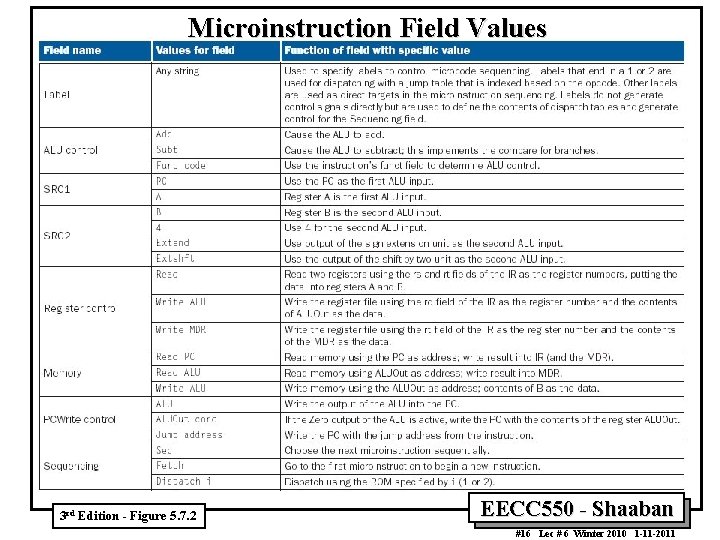
Microinstruction Field Values 3 rd Edition - Figure 5. 7. 2 EECC 550 - Shaaban #16 Lec # 6 Winter 2010 1 -11 -2011
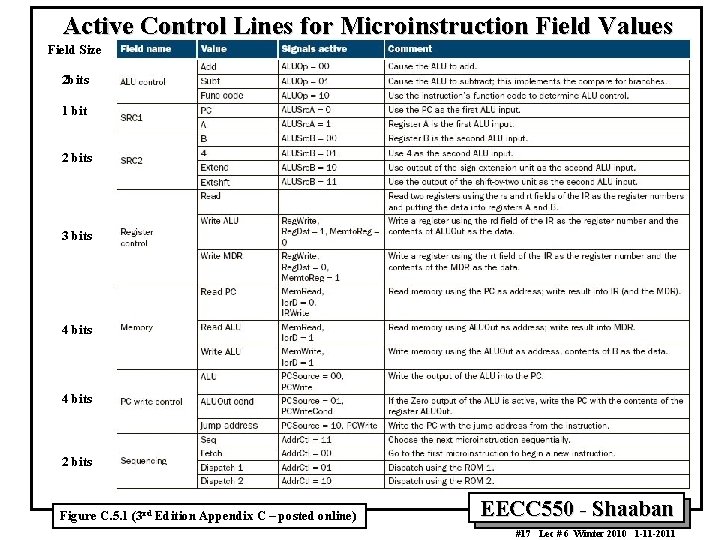
Active Control Lines for Microinstruction Field Values Field Size 2 bits 1 bit 2 bits 3 bits 4 bits 2 bits Figure C. 5. 1 (3 rd Edition Appendix C – posted online) EECC 550 - Shaaban #17 Lec # 6 Winter 2010 1 -11 -2011
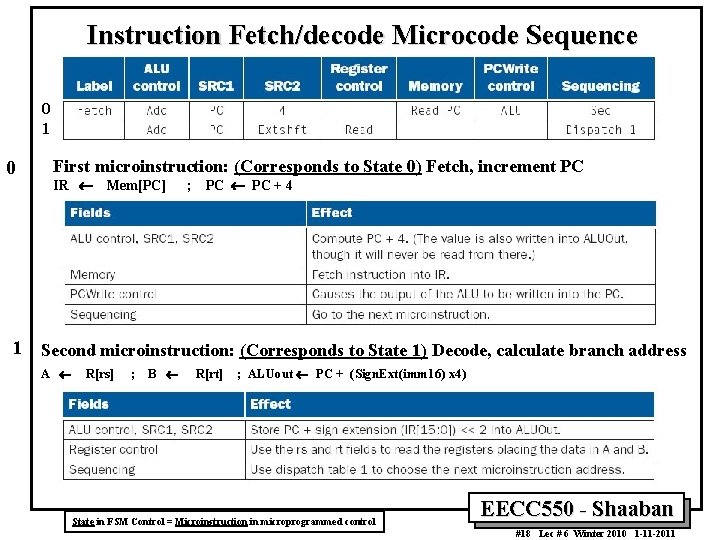
Instruction Fetch/decode Microcode Sequence 0 1 0 First microinstruction: (Corresponds to State 0) Fetch, increment PC IR ¬ Mem[PC] ; PC ¬ PC + 4 1 Second microinstruction: (Corresponds to State 1) Decode, calculate branch address A ¬ R[rs] ; B ¬ R[rt] ; ALUout ¬ PC + (Sign. Ext(imm 16) x 4) State in FSM Control = Microinstruction in microprogrammed control EECC 550 - Shaaban #18 Lec # 6 Winter 2010 1 -11 -2011
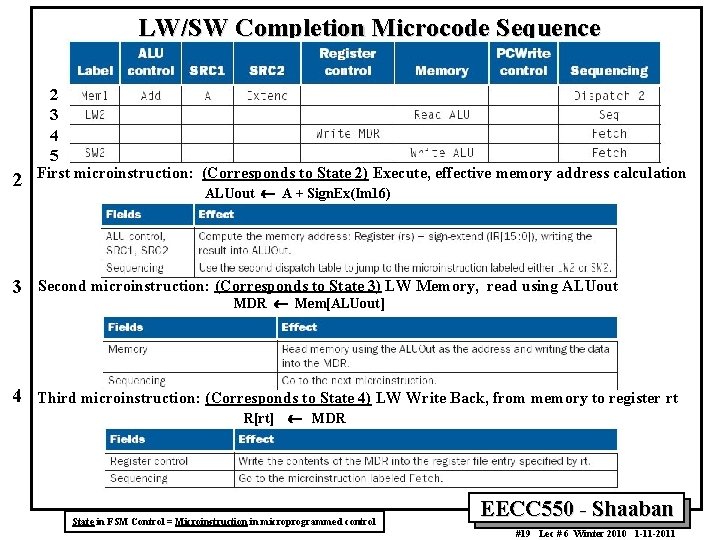
LW/SW Completion Microcode Sequence 2 3 4 5 2 First microinstruction: (Corresponds to State 2) Execute, effective memory address calculation 3 Second microinstruction: (Corresponds to State 3) LW Memory, read using ALUout 4 Third microinstruction: (Corresponds to State 4) LW Write Back, from memory to register rt ALUout ¬ A + Sign. Ex(Im 16) MDR ¬ Mem[ALUout] R[rt] ¬ MDR State in FSM Control = Microinstruction in microprogrammed control EECC 550 - Shaaban #19 Lec # 6 Winter 2010 1 -11 -2011
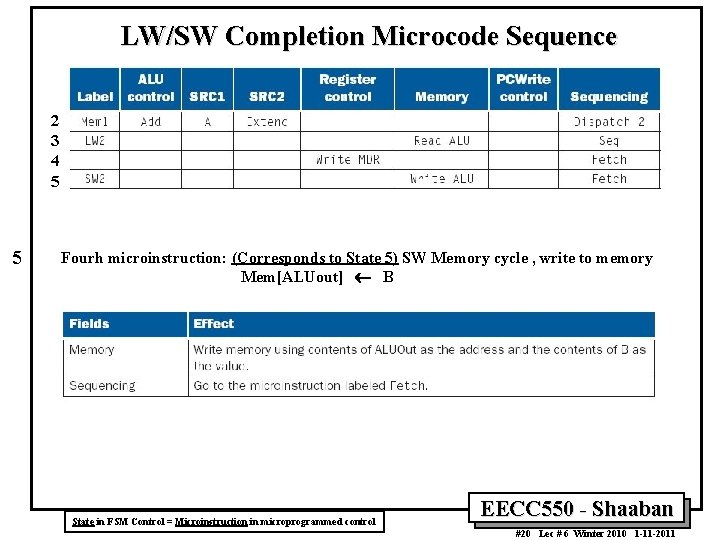
LW/SW Completion Microcode Sequence 2 3 4 5 5 Fourh microinstruction: (Corresponds to State 5) SW Memory cycle , write to memory Mem[ALUout] ¬ B State in FSM Control = Microinstruction in microprogrammed control EECC 550 - Shaaban #20 Lec # 6 Winter 2010 1 -11 -2011
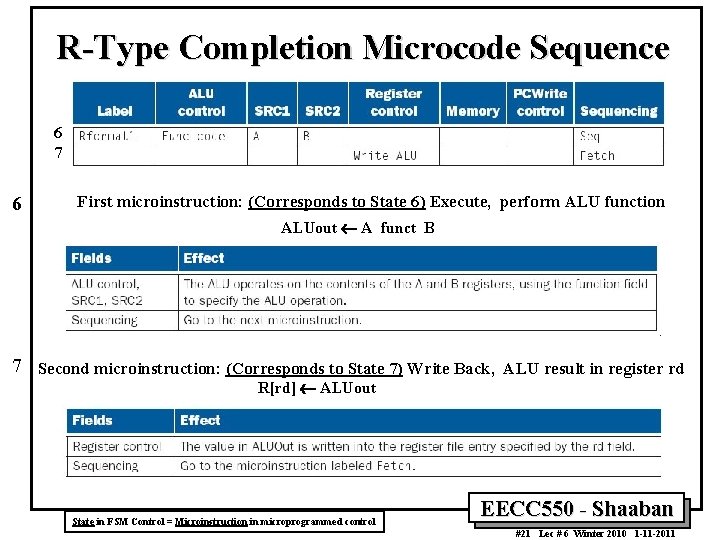
R-Type Completion Microcode Sequence 6 7 6 First microinstruction: (Corresponds to State 6) Execute, perform ALU function ALUout ¬ A funct B 7 Second microinstruction: (Corresponds to State 7) Write Back, ALU result in register rd R[rd] ¬ ALUout State in FSM Control = Microinstruction in microprogrammed control EECC 550 - Shaaban #21 Lec # 6 Winter 2010 1 -11 -2011
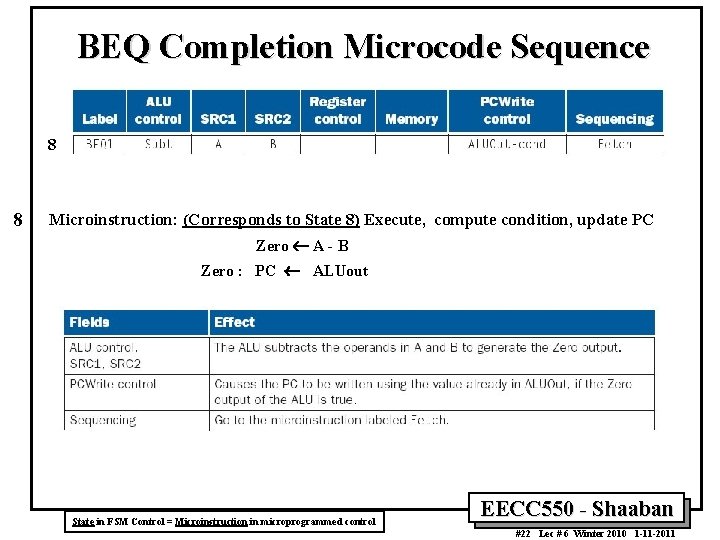
BEQ Completion Microcode Sequence 8 8 Microinstruction: (Corresponds to State 8) Execute, compute condition, update PC Zero ¬ A - B Zero : PC ¬ ALUout State in FSM Control = Microinstruction in microprogrammed control EECC 550 - Shaaban #22 Lec # 6 Winter 2010 1 -11 -2011
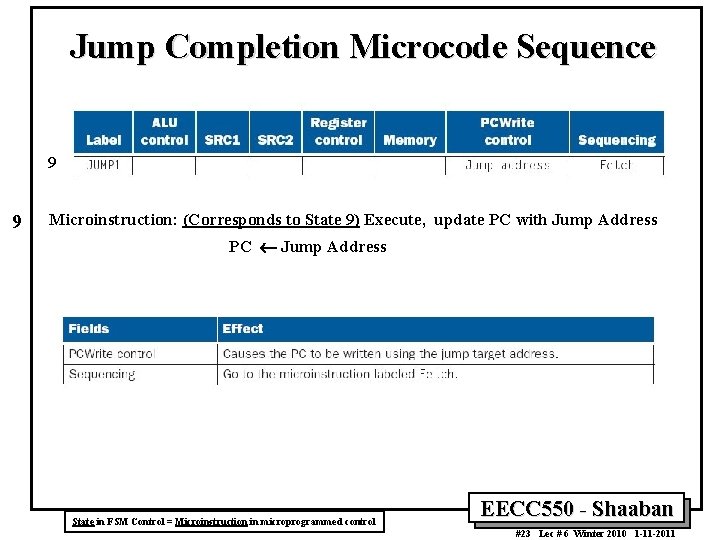
Jump Completion Microcode Sequence 9 9 Microinstruction: (Corresponds to State 9) Execute, update PC with Jump Address PC ¬ Jump Address State in FSM Control = Microinstruction in microprogrammed control EECC 550 - Shaaban #23 Lec # 6 Winter 2010 1 -11 -2011
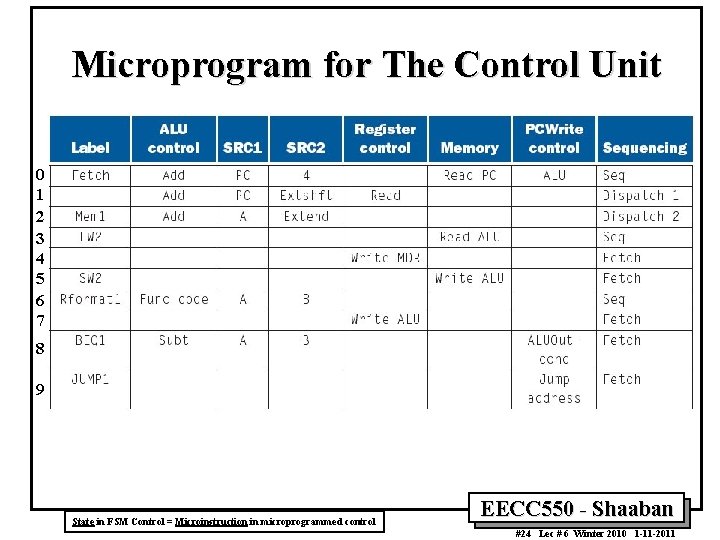
Microprogram for The Control Unit 0 1 2 3 4 5 6 7 8 9 State in FSM Control = Microinstruction in microprogrammed control EECC 550 - Shaaban #24 Lec # 6 Winter 2010 1 -11 -2011
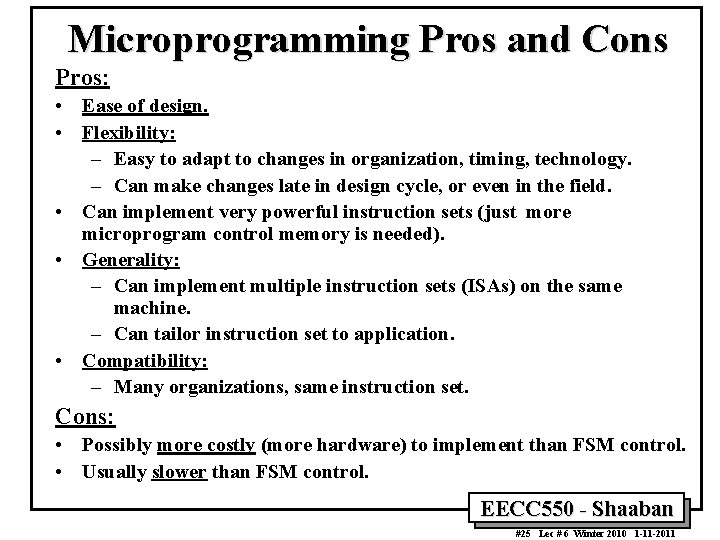
Microprogramming Pros and Cons Pros: • Ease of design. • Flexibility: – Easy to adapt to changes in organization, timing, technology. – Can make changes late in design cycle, or even in the field. • Can implement very powerful instruction sets (just more microprogram control memory is needed). • Generality: – Can implement multiple instruction sets (ISAs) on the same machine. – Can tailor instruction set to application. • Compatibility: – Many organizations, same instruction set. Cons: • Possibly more costly (more hardware) to implement than FSM control. • Usually slower than FSM control. EECC 550 - Shaaban #25 Lec # 6 Winter 2010 1 -11 -2011
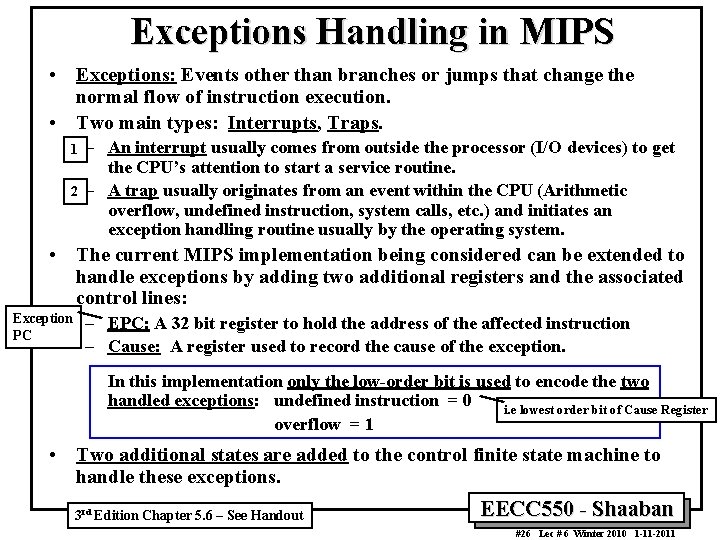
Exceptions Handling in MIPS • Exceptions: Events other than branches or jumps that change the normal flow of instruction execution. • Two main types: Interrupts, Traps. 1 2 – An interrupt usually comes from outside the processor (I/O devices) to get the CPU’s attention to start a service routine. – A trap usually originates from an event within the CPU (Arithmetic overflow, undefined instruction, system calls, etc. ) and initiates an exception handling routine usually by the operating system. • The current MIPS implementation being considered can be extended to handle exceptions by adding two additional registers and the associated control lines: Exception PC – EPC: A 32 bit register to hold the address of the affected instruction – Cause: A register used to record the cause of the exception. In this implementation only the low-order bit is used to encode the two handled exceptions: undefined instruction = 0 i. e lowest order bit of Cause Register overflow = 1 • Two additional states are added to the control finite state machine to handle these exceptions. 3 rd Edition Chapter 5. 6 – See Handout EECC 550 - Shaaban #26 Lec # 6 Winter 2010 1 -11 -2011
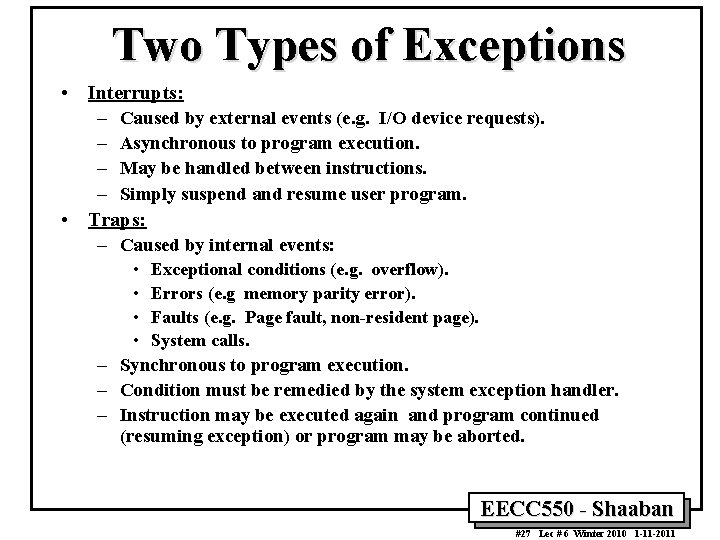
Two Types of Exceptions • Interrupts: – Caused by external events (e. g. I/O device requests). – Asynchronous to program execution. – May be handled between instructions. – Simply suspend and resume user program. • Traps: – Caused by internal events: • Exceptional conditions (e. g. overflow). • Errors (e. g memory parity error). • Faults (e. g. Page fault, non-resident page). • System calls. – Synchronous to program execution. – Condition must be remedied by the system exception handler. – Instruction may be executed again and program continued (resuming exception) or program may be aborted. EECC 550 - Shaaban #27 Lec # 6 Winter 2010 1 -11 -2011
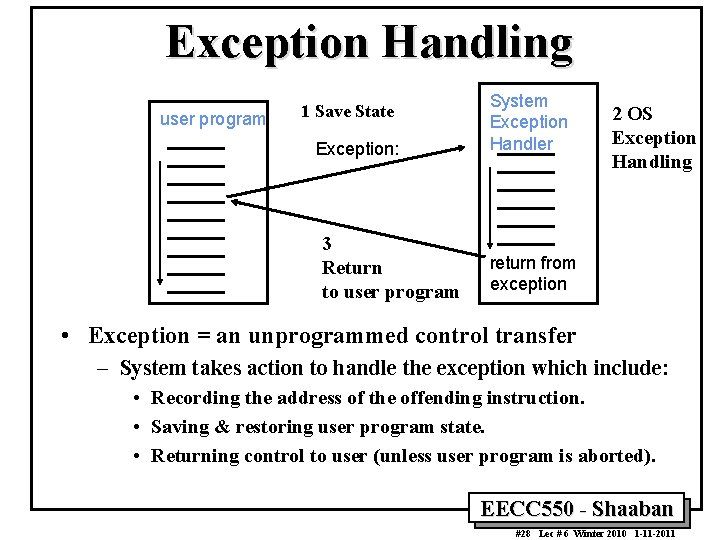
Exception Handling user program 1 Save State Exception: 3 Return to user program System Exception Handler 2 OS Exception Handling return from exception • Exception = an unprogrammed control transfer – System takes action to handle the exception which include: • Recording the address of the offending instruction. • Saving & restoring user program state. • Returning control to user (unless user program is aborted). EECC 550 - Shaaban #28 Lec # 6 Winter 2010 1 -11 -2011
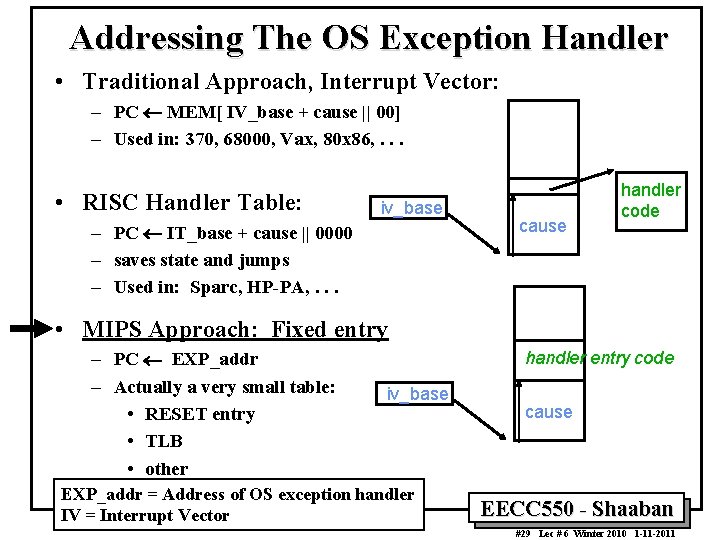
Addressing The OS Exception Handler • Traditional Approach, Interrupt Vector: – PC ¬ MEM[ IV_base + cause || 00] – Used in: 370, 68000, Vax, 80 x 86, . . . • RISC Handler Table: iv_base – PC ¬ IT_base + cause || 0000 – saves state and jumps – Used in: Sparc, HP-PA, . . . cause handler code • MIPS Approach: Fixed entry – PC ¬ EXP_addr – Actually a very small table: • RESET entry • TLB • other handler entry code iv_base EXP_addr = Address of OS exception handler IV = Interrupt Vector cause EECC 550 - Shaaban #29 Lec # 6 Winter 2010 1 -11 -2011
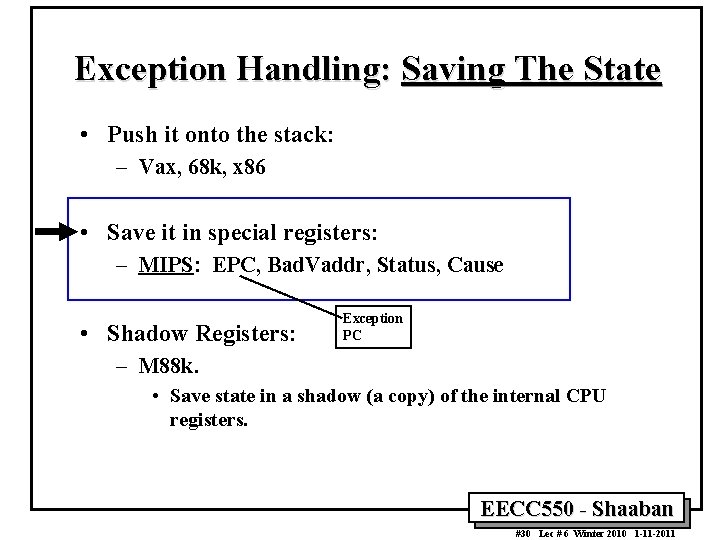
Exception Handling: Saving The State • Push it onto the stack: – Vax, 68 k, x 86 • Save it in special registers: – MIPS: EPC, Bad. Vaddr, Status, Cause • Shadow Registers: Exception PC – M 88 k. • Save state in a shadow (a copy) of the internal CPU registers. EECC 550 - Shaaban #30 Lec # 6 Winter 2010 1 -11 -2011
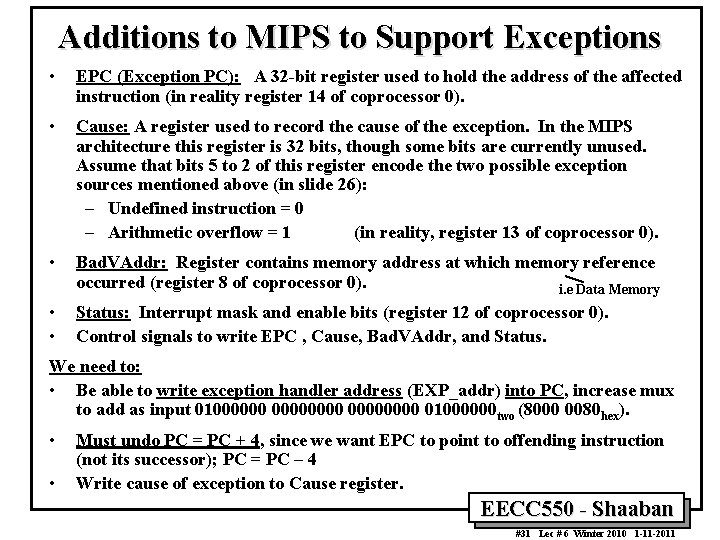
Additions to MIPS to Support Exceptions • EPC (Exception PC): A 32 -bit register used to hold the address of the affected instruction (in reality register 14 of coprocessor 0). • Cause: A register used to record the cause of the exception. In the MIPS architecture this register is 32 bits, though some bits are currently unused. Assume that bits 5 to 2 of this register encode the two possible exception sources mentioned above (in slide 26): – Undefined instruction = 0 – Arithmetic overflow = 1 (in reality, register 13 of coprocessor 0). • Bad. VAddr: Register contains memory address at which memory reference occurred (register 8 of coprocessor 0). i. e Data Memory • • Status: Interrupt mask and enable bits (register 12 of coprocessor 0). Control signals to write EPC , Cause, Bad. VAddr, and Status. We need to: • Be able to write exception handler address (EXP_addr) into PC, increase mux to add as input 0100000000 01000000 two (8000 0080 hex). • • Must undo PC = PC + 4, since we want EPC to point to offending instruction (not its successor); PC = PC – 4 Write cause of exception to Cause register. EECC 550 - Shaaban #31 Lec # 6 Winter 2010 1 -11 -2011
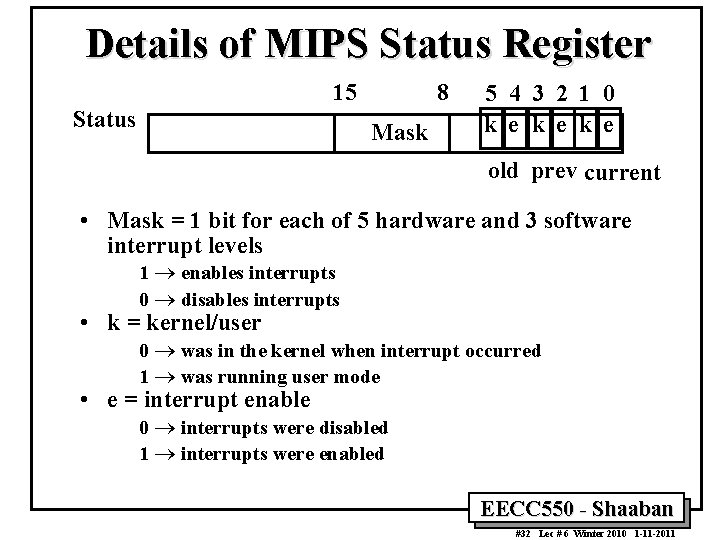
Details of MIPS Status Register 15 Status 8 Mask 5 4 3 2 1 0 k e k e old prev current • Mask = 1 bit for each of 5 hardware and 3 software interrupt levels 1 ® enables interrupts 0 ® disables interrupts • k = kernel/user 0 ® was in the kernel when interrupt occurred 1 ® was running user mode • e = interrupt enable 0 ® interrupts were disabled 1 ® interrupts were enabled EECC 550 - Shaaban #32 Lec # 6 Winter 2010 1 -11 -2011
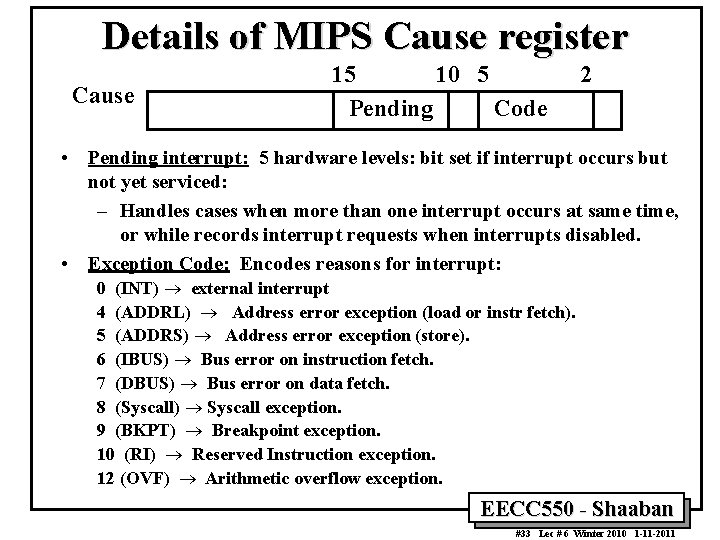
Details of MIPS Cause register Cause 15 10 5 Pending Code 2 • Pending interrupt: 5 hardware levels: bit set if interrupt occurs but not yet serviced: – Handles cases when more than one interrupt occurs at same time, or while records interrupt requests when interrupts disabled. • Exception Code: Encodes reasons for interrupt: 0 (INT) ® external interrupt 4 (ADDRL) ® Address error exception (load or instr fetch). 5 (ADDRS) ® Address error exception (store). 6 (IBUS) ® Bus error on instruction fetch. 7 (DBUS) ® Bus error on data fetch. 8 (Syscall) ® Syscall exception. 9 (BKPT) ® Breakpoint exception. 10 (RI) ® Reserved Instruction exception. 12 (OVF) ® Arithmetic overflow exception. EECC 550 - Shaaban #33 Lec # 6 Winter 2010 1 -11 -2011
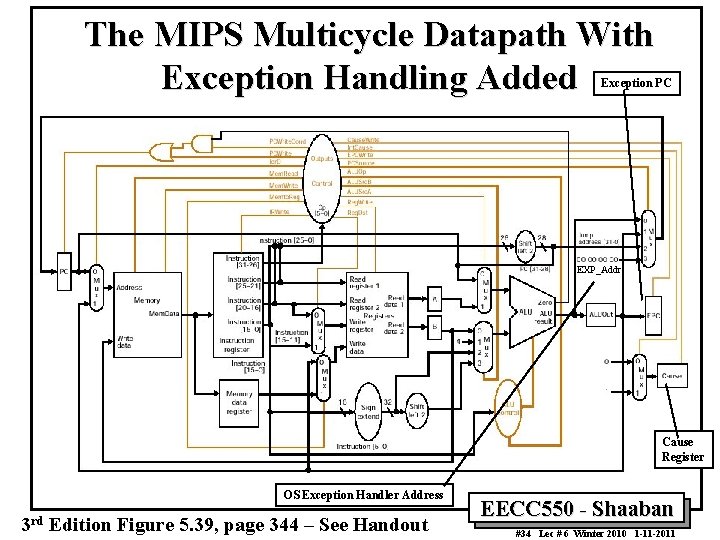
The MIPS Multicycle Datapath With Exception Handling Added Exception PC EXP_Addr Cause Register OS Exception Handler Address 3 rd Edition Figure 5. 39, page 344 – See Handout EECC 550 - Shaaban #34 Lec # 6 Winter 2010 1 -11 -2011
![Normal Finite State Machine (FSM) Specification IR ¬ MEM[PC] PC ¬ PC + 4](http://slidetodoc.com/presentation_image_h2/c6c43cc1930b823afea101269fb54de8/image-35.jpg "Normal Finite State Machine (FSM) Specification IR ¬ MEM[PC] PC ¬ PC + 4")
Normal Finite State Machine (FSM) Specification IR ¬ MEM[PC] PC ¬ PC + 4 “instruction fetch” 0000 ALUout ¬ A fun B 0100 ORi ALUout ¬ A op ZX 0110 Memory Execute R-type ALUout ¬ PC +SX 0001 LW ALUout ¬ A + SX 1000 1001 R[rd] ¬ ALUout R[rt] ¬ M 0101 0111 1010 BEQ SW ALUout ¬ A + SX M ¬ MEM[ALUout] To instruction fetch “decode” 1011 0010 MEM[ALUout] ¬B To instruction fetch 1100 If A = B then PC ¬ ALUout To instruction fetch Write-back A ¬ R[rs] B ¬ R[rt] EECC 550 - Shaaban #35 Lec # 6 Winter 2010 1 -11 -2011
![FSM Control Specification To Handle Exceptions IR ¬ MEM[PC] PC ¬ PC + 4](http://slidetodoc.com/presentation_image_h2/c6c43cc1930b823afea101269fb54de8/image-36.jpg "FSM Control Specification To Handle Exceptions IR ¬ MEM[PC] PC ¬ PC + 4")
FSM Control Specification To Handle Exceptions IR ¬ MEM[PC] PC ¬ PC + 4 “instruction fetch” 0000 undefined instruction overflow ALUout ¬ A fun B 0100 ORi ALUout ¬ A op ZX 0110 LW EPC ¬ PC - 4 PC ¬ exp_addr cause ¬ 0 BEQ SW ALUout ¬ A + SX 1000 M ¬ MEM[ALUout] 1001 R[rd] ¬ ALUout R[rt] ¬ M 0101 0111 1010 To instruction fetch “decode” 0001 Memory Execute R-type ALUout ¬ PC +SX 1011 0010 MEM[ALUout] ¬B To instruction fetch 1100 If A = B then PC ¬ ALUout To instruction fetch Write-back EPC ¬ PC - 4 PC ¬ exp_addr cause ¬ 1 A ¬ R[rs] B ¬ R[rt] EECC 550 - Shaaban #36 Lec # 6 Winter 2010 1 -11 -2011
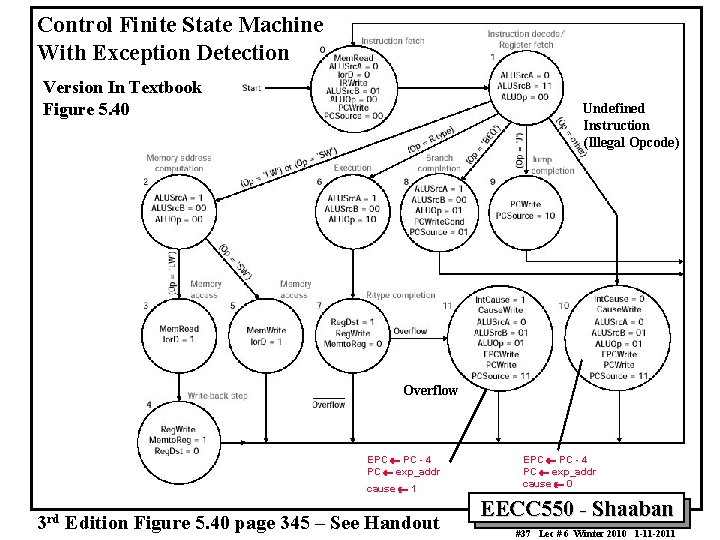
Control Finite State Machine With Exception Detection Version In Textbook Figure 5. 40 Undefined Instruction (Illegal Opcode) Overflow EPC ¬ PC - 4 PC ¬ exp_addr cause ¬ 1 3 rd Edition Figure 5. 40 page 345 – See Handout EPC ¬ PC - 4 PC ¬ exp_addr cause ¬ 0 EECC 550 - Shaaban #37 Lec # 6 Winter 2010 1 -11 -2011
- Slides: 37