
Control Hijacking Defenses Dan Boneh Recap control hijacking
Control Hijacking: Defenses Dan Boneh
Recap: control hijacking attacks Stack smashing: overwrite return address or function pointer Heap spraying: reliably exploit a heap overflow Use after free: attacker writes to freed control structure, which then gets used by victim program Integer overflows Format string vulnerabilities ⋮ Dan Boneh

The mistake: mixing data and control • An ancient design flaw: – enables anyone to inject control signals • 1971: AT&T learns never to mix control and data Dan Boneh
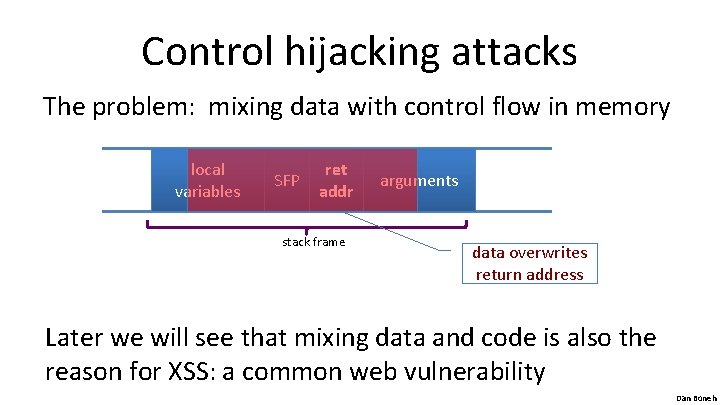
Control hijacking attacks The problem: mixing data with control flow in memory local variables SFP ret addr stack frame arguments data overwrites return address Later we will see that mixing data and code is also the reason for XSS: a common web vulnerability Dan Boneh

Preventing hijacking attacks 1. Fix bugs: – Audit software • Automated tools: Coverity, Prefast/Prefix. – Rewrite software in a type safe languange (Java, ML) • Difficult for existing (legacy) code … 2. Platform defenses: prevent attack code execution Transform: 3. Add runtime code to detect overflows exploits – Halt process when overflow exploit detected – Stack. Guard, CFI, Lib. Safe, … Complete Breach Denial of service Dan Boneh
Control Hijacking Platform Defenses Dan Boneh
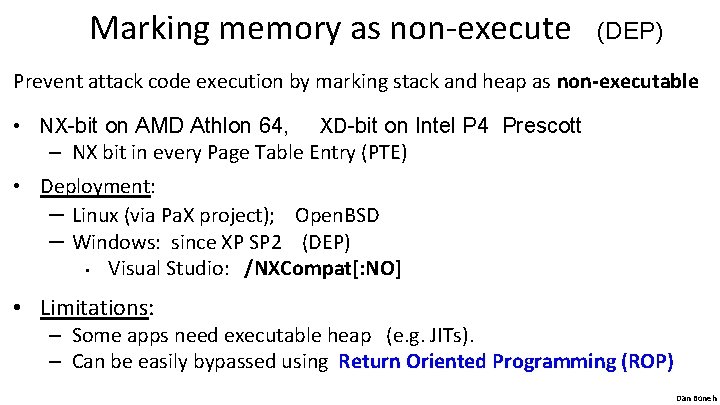
Marking memory as non-execute (DEP) Prevent attack code execution by marking stack and heap as non-executable • NX-bit on AMD Athlon 64, XD-bit on Intel P 4 Prescott – NX bit in every Page Table Entry (PTE) • Deployment: – Linux (via Pa. X project); Open. BSD – Windows: since XP SP 2 (DEP) • Visual Studio: /NXCompat[: NO] • Limitations: – Some apps need executable heap (e. g. JITs). – Can be easily bypassed using Return Oriented Programming (ROP) Dan Boneh

Examples: DEP controls in Windows DEP terminating a program Dan Boneh

Attack: Return Oriented Programming (ROP) Control hijacking without injecting code: stack libc. so args ret-addr sfp exec() printf() local buf “/bin/sh” Dan Boneh
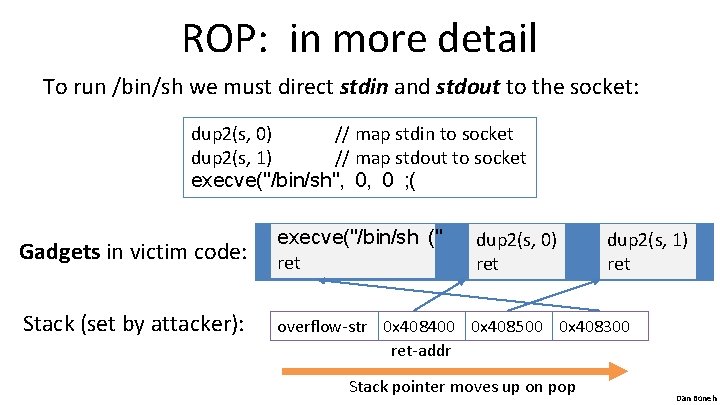
ROP: in more detail To run /bin/sh we must direct stdin and stdout to the socket: dup 2(s, 0) // map stdin to socket dup 2(s, 1) // map stdout to socket execve("/bin/sh", 0, 0 ; ( Gadgets in victim code: Stack (set by attacker): execve("/bin/sh (" ret dup 2(s, 0) ret dup 2(s, 1) ret overflow-str 0 x 408400 0 x 408500 0 x 408300 ret-addr Stack pointer moves up on pop Dan Boneh
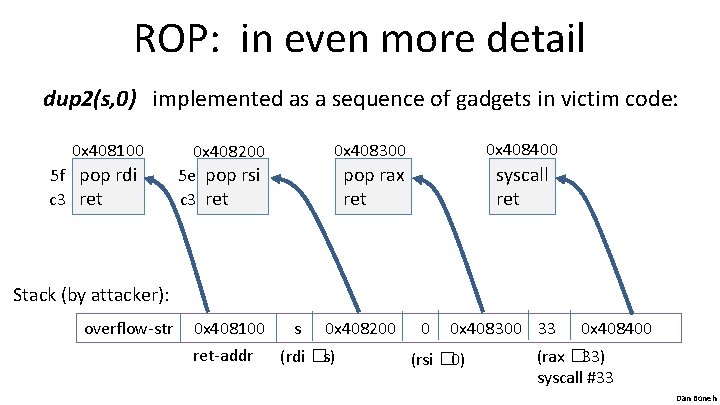
ROP: in even more detail dup 2(s, 0) implemented as a sequence of gadgets in victim code: 0 x 408100 5 f pop rdi c 3 ret 0 x 408200 5 e pop rsi c 3 ret 0 x 408300 0 x 408400 pop rax ret syscall ret Stack (by attacker): overflow-str 0 x 408100 ret-addr s 0 x 408200 (rdi �s) 0 0 x 408300 33 (rsi � 0) 0 x 408400 (rax � 33) syscall #33 Dan Boneh

What to do? ? • ASLR: Randomization (Address Space Layout Randomization) – Map shared libraries to rand location in process memory ⇒ Attacker cannot jump directly to exec function – Deployment: (/Dynamic. Base) • Windows 7: 8 bits of randomness for DLLs – aligned to 64 K page in a 16 MB region ⇒ 256 choices • Windows 8: 24 bits of randomness on 64 -bit processors • Other randomization methods: – Sys-call randomization: randomize sys-call id’s – Instruction Set Randomization (ISR) Dan Boneh
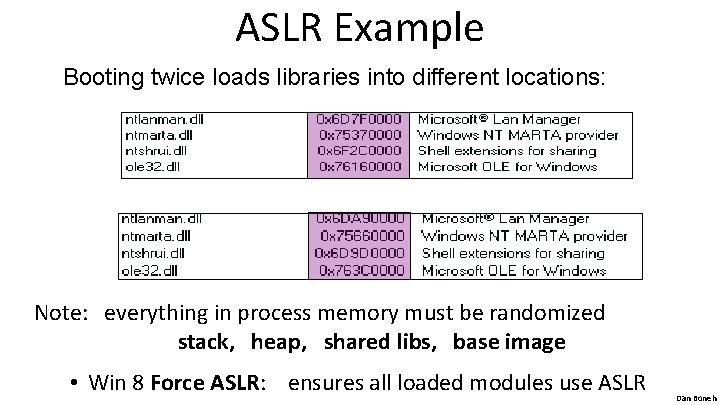
ASLR Example Booting twice loads libraries into different locations: Note: everything in process memory must be randomized stack, heap, shared libs, base image • Win 8 Force ASLR: ensures all loaded modules use ASLR Dan Boneh
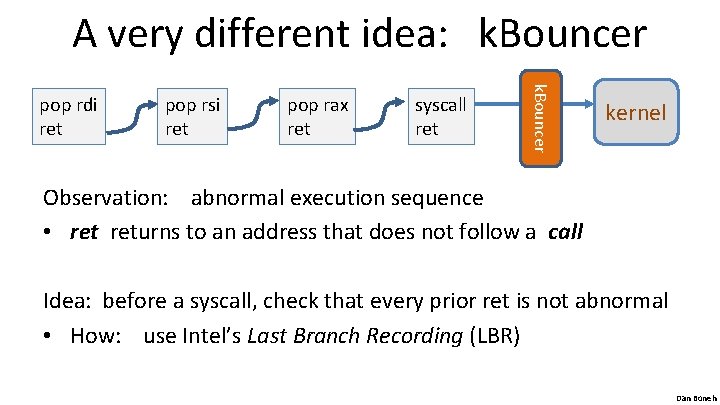
A very different idea: k. Bouncer pop rsi ret pop rax ret syscall ret k. Bouncer pop rdi ret kernel Observation: abnormal execution sequence • returns to an address that does not follow a call Idea: before a syscall, check that every prior ret is not abnormal • How: use Intel’s Last Branch Recording (LBR) Dan Boneh
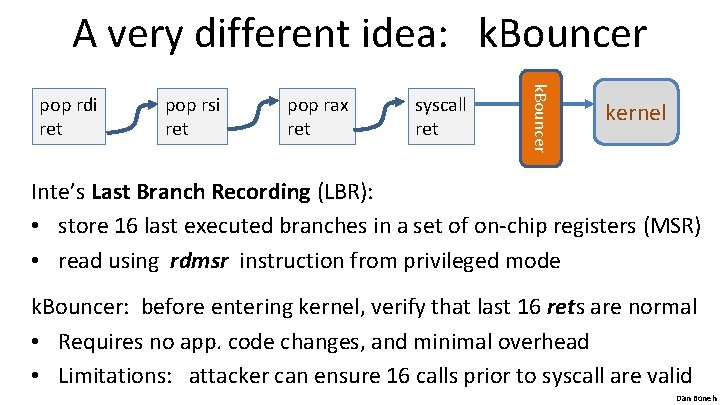
A very different idea: k. Bouncer pop rsi ret pop rax ret syscall ret k. Bouncer pop rdi ret kernel Inte’s Last Branch Recording (LBR): • store 16 last executed branches in a set of on-chip registers (MSR) • read using rdmsr instruction from privileged mode k. Bouncer: before entering kernel, verify that last 16 rets are normal • Requires no app. code changes, and minimal overhead • Limitations: attacker can ensure 16 calls prior to syscall are valid Dan Boneh
Control Hijacking Defenses Hardening the executable Dan Boneh
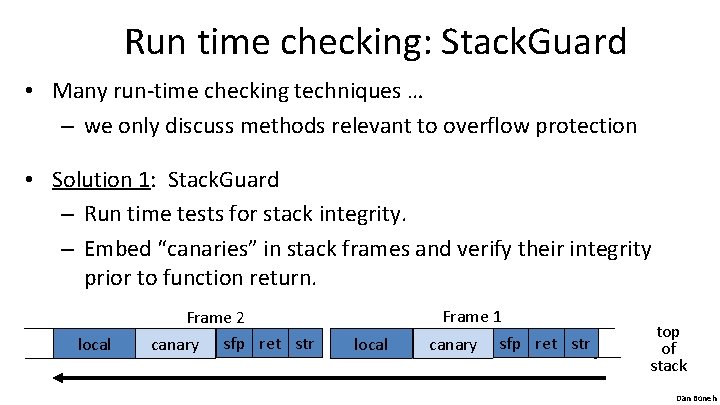
Run time checking: Stack. Guard • Many run-time checking techniques … – we only discuss methods relevant to overflow protection • Solution 1: Stack. Guard – Run time tests for stack integrity. – Embed “canaries” in stack frames and verify their integrity prior to function return. local Frame 2 canary sfp ret str Frame 1 local canary sfp ret str top of stack Dan Boneh
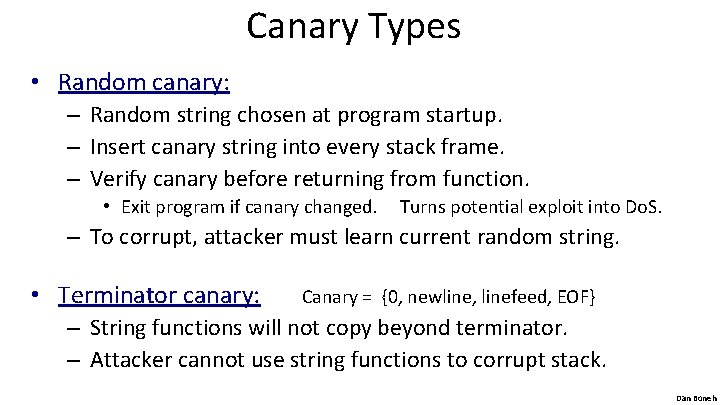
Canary Types • Random canary: – Random string chosen at program startup. – Insert canary string into every stack frame. – Verify canary before returning from function. • Exit program if canary changed. Turns potential exploit into Do. S. – To corrupt, attacker must learn current random string. • Terminator canary: Canary = {0, newline, linefeed, EOF} – String functions will not copy beyond terminator. – Attacker cannot use string functions to corrupt stack. Dan Boneh
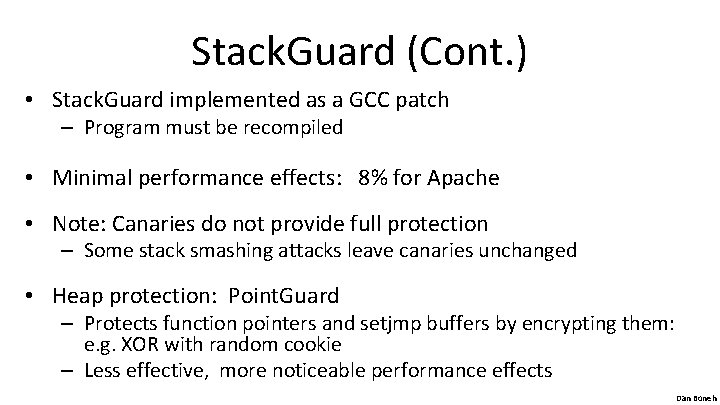
Stack. Guard (Cont. ) • Stack. Guard implemented as a GCC patch – Program must be recompiled • Minimal performance effects: 8% for Apache • Note: Canaries do not provide full protection – Some stack smashing attacks leave canaries unchanged • Heap protection: Point. Guard – Protects function pointers and setjmp buffers by encrypting them: e. g. XOR with random cookie – Less effective, more noticeable performance effects Dan Boneh
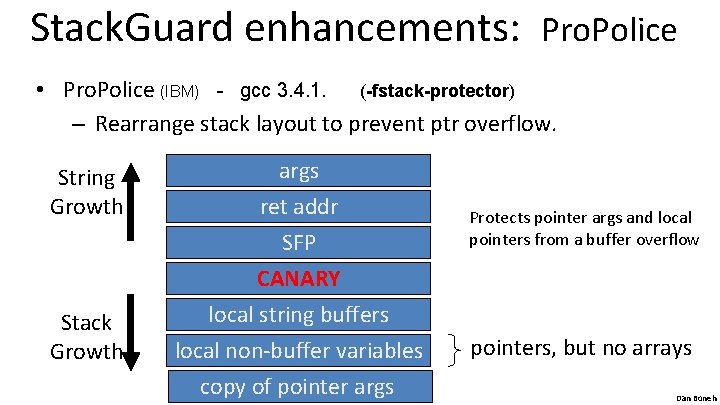
Stack. Guard enhancements: Pro. Police • Pro. Police (IBM) - gcc 3. 4. 1. (-fstack-protector) – Rearrange stack layout to prevent ptr overflow. String Growth Stack Growth args ret addr SFP CANARY local string buffers local non-buffer variables copy of pointer args Protects pointer args and local pointers from a buffer overflow pointers, but no arrays Dan Boneh
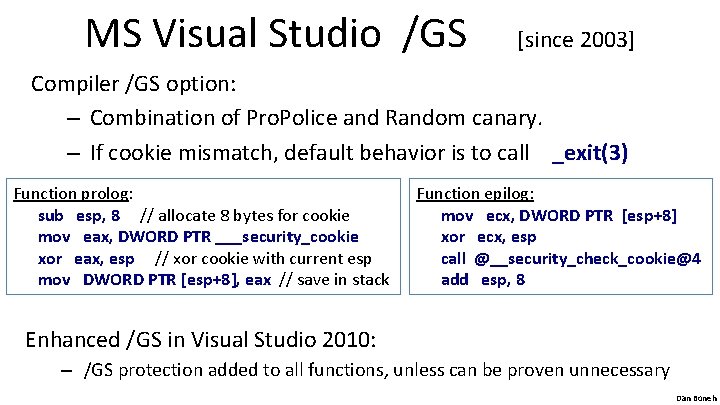
MS Visual Studio /GS [since 2003] Compiler /GS option: – Combination of Pro. Police and Random canary. – If cookie mismatch, default behavior is to call _exit(3) Function prolog: sub esp, 8 // allocate 8 bytes for cookie mov eax, DWORD PTR ___security_cookie xor eax, esp // xor cookie with current esp mov DWORD PTR [esp+8], eax // save in stack Function epilog: mov ecx, DWORD PTR [esp+8] xor ecx, esp call @__security_check_cookie@4 add esp, 8 Enhanced /GS in Visual Studio 2010: – /GS protection added to all functions, unless can be proven unnecessary Dan Boneh
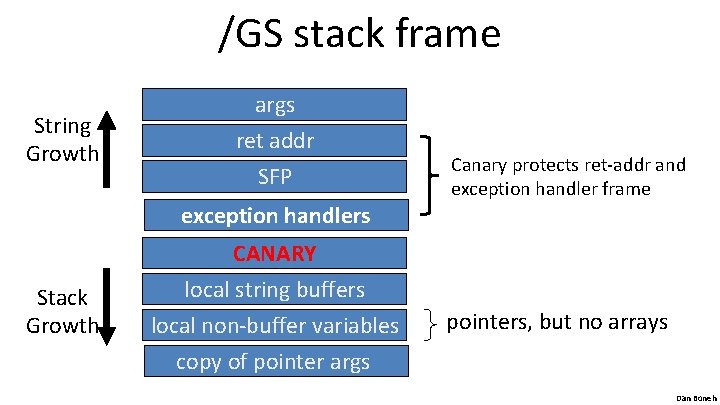
/GS stack frame String Growth args ret addr SFP exception handlers Stack Growth CANARY local string buffers local non-buffer variables copy of pointer args Canary protects ret-addr and exception handler frame pointers, but no arrays Dan Boneh
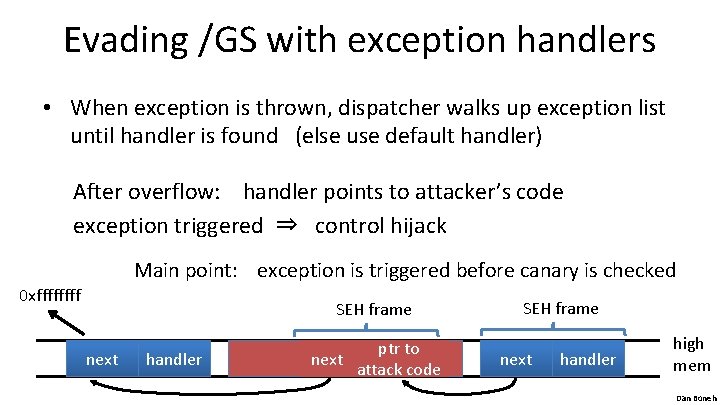
Evading /GS with exception handlers • When exception is thrown, dispatcher walks up exception list until handler is found (else use default handler) After overflow: handler points to attacker’s code exception triggered ⇒ control hijack Main point: exception is triggered before canary is checked 0 xffff SEH frame next handler buf ptr to next handler attack code SEH frame next handler high mem Dan Boneh
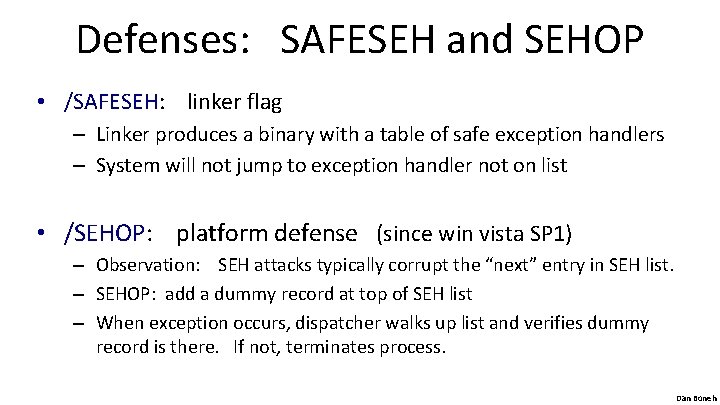
Defenses: SAFESEH and SEHOP • /SAFESEH: linker flag – Linker produces a binary with a table of safe exception handlers – System will not jump to exception handler not on list • /SEHOP: platform defense (since win vista SP 1) – Observation: SEH attacks typically corrupt the “next” entry in SEH list. – SEHOP: add a dummy record at top of SEH list – When exception occurs, dispatcher walks up list and verifies dummy record is there. If not, terminates process. Dan Boneh
Summary: Canaries are not full proof • Canaries are an important defense tool, but do not prevent all control hijacking attacks: – Heap-based attacks still possible – Integer overflow attacks still possible – /GS by itself does not prevent Exception Handling attacks (also need SAFESEH and SEHOP) Dan Boneh
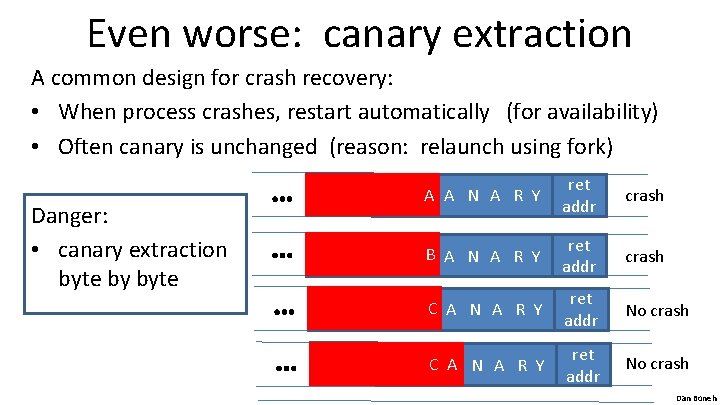
Even worse: canary extraction A common design for crash recovery: • When process crashes, restart automatically (for availability) • Often canary is unchanged (reason: relaunch using fork) Danger: • canary extraction byte by byte ⋯ ⋯ local buffer AC A N A R Y ret addr crash local buffer BC A N A R Y ret addr crash local buffer C A N A R Y ret addr No crash Dan Boneh
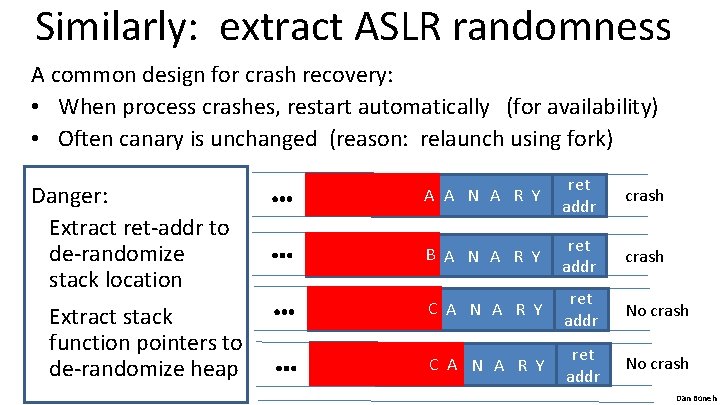
Similarly: extract ASLR randomness A common design for crash recovery: • When process crashes, restart automatically (for availability) • Often canary is unchanged (reason: relaunch using fork) Danger: Extract ret-addr to de-randomize stack location Extract stack function pointers to de-randomize heap ⋯ ⋯ local buffer AC A N A R Y ret addr crash local buffer BC A N A R Y ret addr crash local buffer C A N A R Y ret addr No crash Dan Boneh
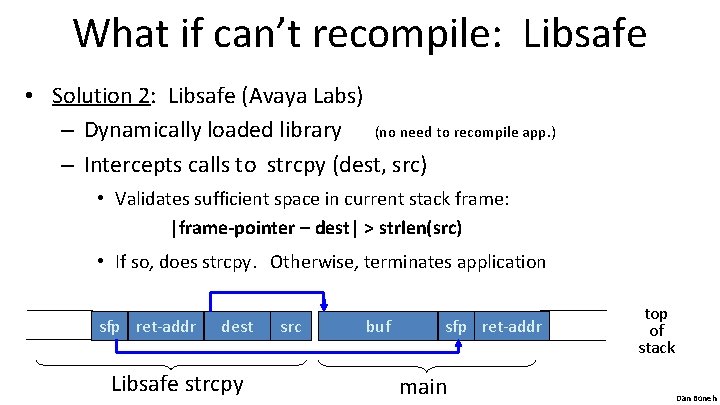
What if can’t recompile: Libsafe • Solution 2: Libsafe (Avaya Labs) – Dynamically loaded library (no need to recompile app. ) – Intercepts calls to strcpy (dest, src) • Validates sufficient space in current stack frame: |frame-pointer – dest| > strlen(src) • If so, does strcpy. Otherwise, terminates application sfp ret-addr dest Libsafe strcpy src buf sfp ret-addr main top of stack Dan Boneh
More methods … Ø Stack. Shield § At function prologue, copy return address RET and SFP to “safe” location (beginning of data segment) § Upon return, check that RET and SFP is equal to copy. § Implemented as assembler file processor (GCC) Ø Control Flow Integrity (CFI) § A combination of static and dynamic checking § Statically determine program control flow § Dynamically enforce control flow integrity Dan Boneh
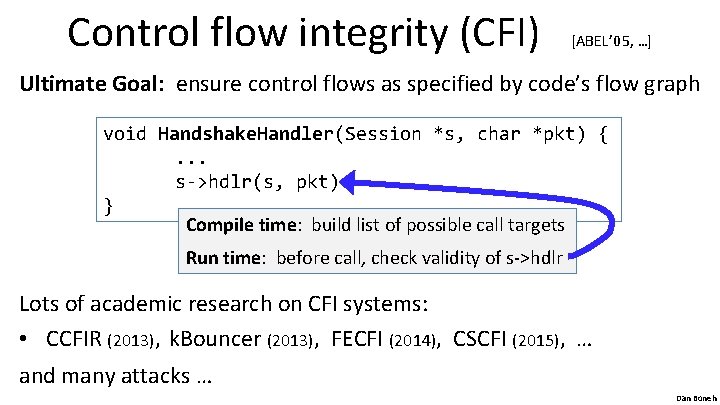
Control flow integrity (CFI) [ABEL’ 05, …] Ultimate Goal: ensure control flows as specified by code’s flow graph void Handshake. Handler(Session *s, char *pkt) {. . . s->hdlr(s, pkt) } Compile time: build list of possible call targets Run time: before call, check validity of s->hdlr Lots of academic research on CFI systems: • CCFIR (2013), k. Bouncer (2013), FECFI (2014), CSCFI (2015), … and many attacks … Dan Boneh
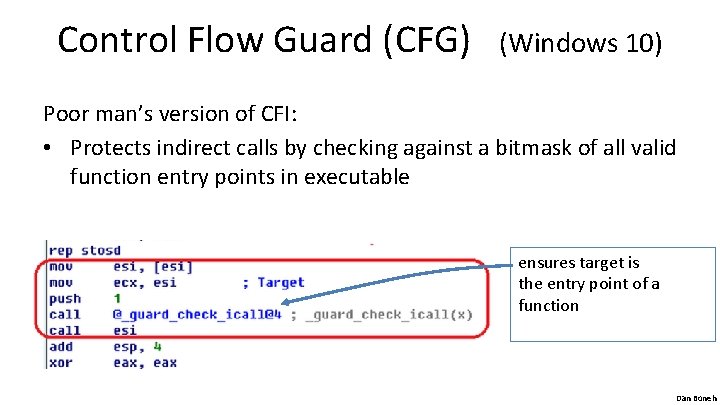
Control Flow Guard (CFG) (Windows 10) Poor man’s version of CFI: • Protects indirect calls by checking against a bitmask of all valid function entry points in executable ensures target is the entry point of a function Dan Boneh
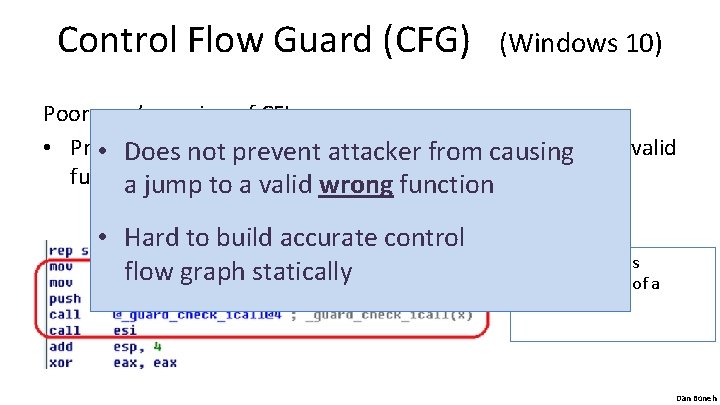
Control Flow Guard (CFG) (Windows 10) Poor man’s version of CFI: • Protects indirect calls by checking against bitmask of all valid • Does not prevent attacker fromacausing function entryto points in executable a jump a valid wrong function • Hard to build accurate control flow graph statically ensures target is the entry point of a function Dan Boneh
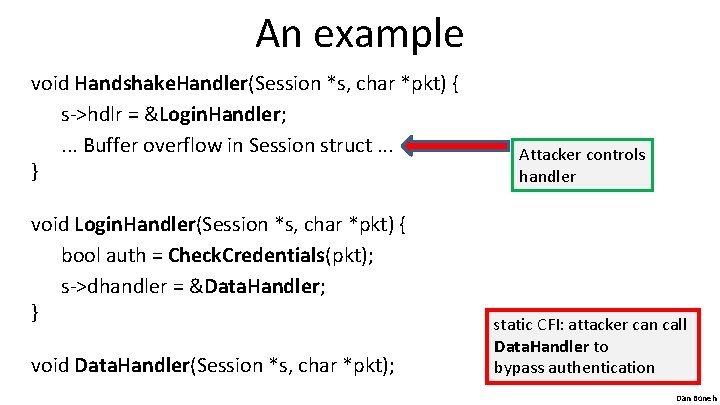
An example void Handshake. Handler(Session *s, char *pkt) { s->hdlr = &Login. Handler; . . . Buffer overflow in Session struct. . . } void Login. Handler(Session *s, char *pkt) { bool auth = Check. Credentials(pkt); s->dhandler = &Data. Handler; } void Data. Handler(Session *s, char *pkt); Attacker controls handler Static CFI: attacker can call Data. Handler to bypass authentication Dan Boneh
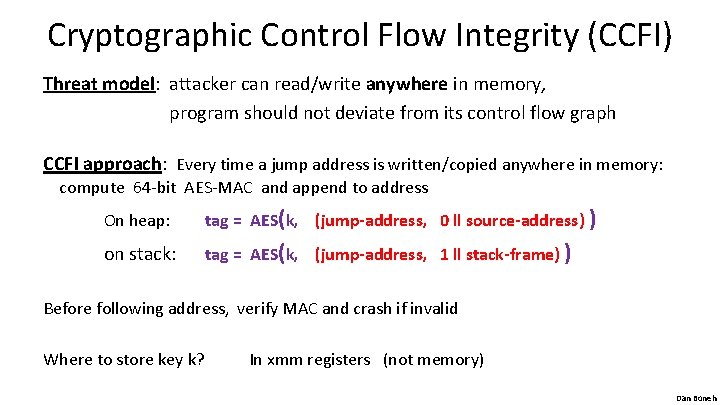
Cryptographic Control Flow Integrity (CCFI) Threat model: attacker can read/write anywhere in memory, program should not deviate from its control flow graph CCFI approach: Every time a jump address is written/copied anywhere in memory: compute 64 -bit AES-MAC and append to address On heap: tag = AES(k, (jump-address, 0 ll source-address) ) on stack: tag = AES(k, (jump-address, 1 ll stack-frame) ) Before following address, verify MAC and crash if invalid Where to store key k? In xmm registers (not memory) Dan Boneh
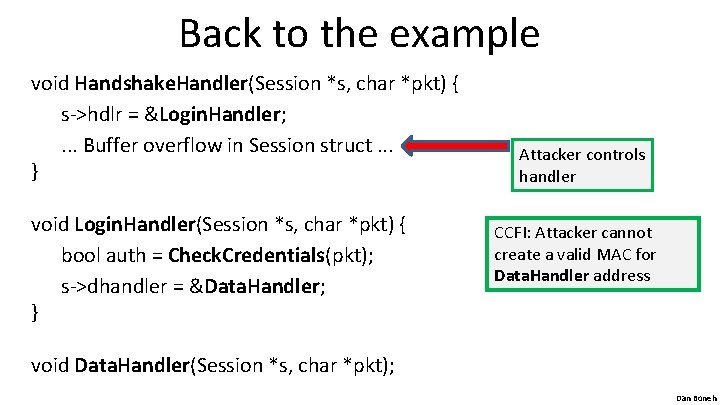
Back to the example void Handshake. Handler(Session *s, char *pkt) { s->hdlr = &Login. Handler; . . . Buffer overflow in Session struct. . . } void Login. Handler(Session *s, char *pkt) { bool auth = Check. Credentials(pkt); s->dhandler = &Data. Handler; } Attacker controls handler CCFI: Attacker cannot create a valid MAC for Data. Handler address void Data. Handler(Session *s, char *pkt); Dan Boneh
THE END Dan Boneh
- Slides: 36