
Control Complexity in Bucklin Fallback and Plurality Voting
Control Complexity in Bucklin, Fallback, and Plurality Voting: An Experimental Approach Jörg Rothe & Lena Schend SEA 2012, Bordeaux – June 2012 Heinrich-Heine-Universität Düsseldorf, Germany
Content • Introduction and Applications • Elections and Voting Systems • Electoral Control • Control Complexity – Theoretical Results • Experimental Setting • Experimental Results • Open Questions and Future Work
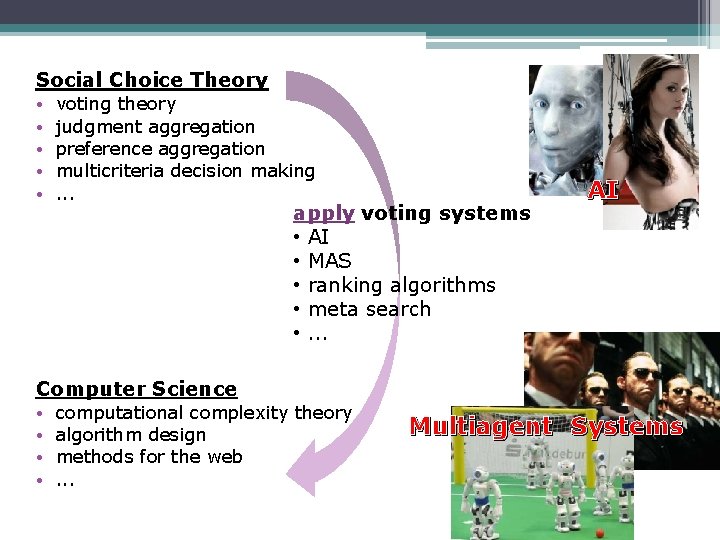
Social Choice Theory • • • voting theory judgment aggregation preference aggregation multicriteria decision making. . . apply voting systems • AI • MAS • ranking algorithms • meta search • . . . AI Computer Science • • computational complexity theory algorithm design methods for the web. . . Multiagent Systems
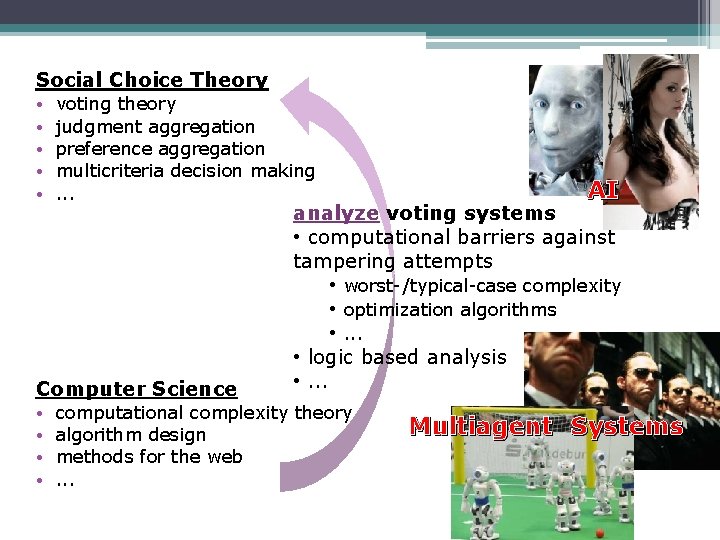
Social Choice Theory • • • voting theory judgment aggregation preference aggregation multicriteria decision making. . . Computer Science • • AI analyze voting systems • computational barriers against tampering attempts • worst-/typical-case complexity • optimization algorithms • . . . • logic based analysis • . . . computational complexity theory algorithm design methods for the web. . . Multiagent Systems
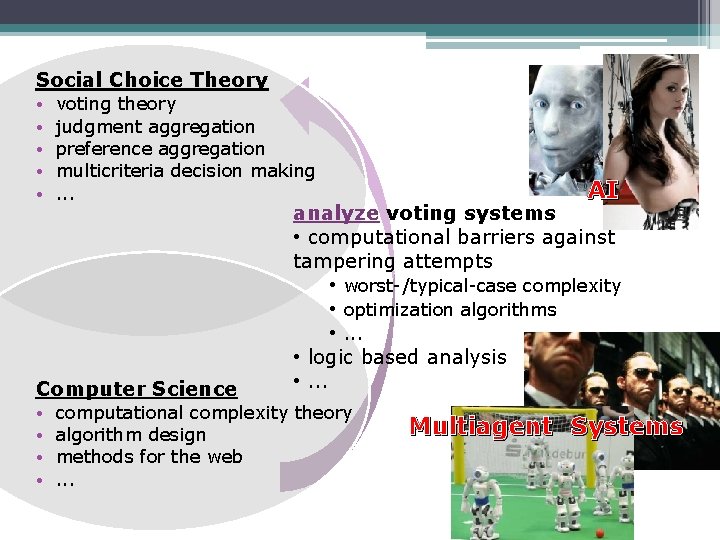
Social Choice Theory • • • voting theory judgment aggregation preference aggregation multicriteria decision making. . . Computer Science • • AI analyze voting systems • computational barriers against tampering attempts • worst-/typical-case complexity • optimization algorithms • . . . • logic based analysis • . . . computational complexity theory algorithm design methods for the web. . . Multiagent Systems
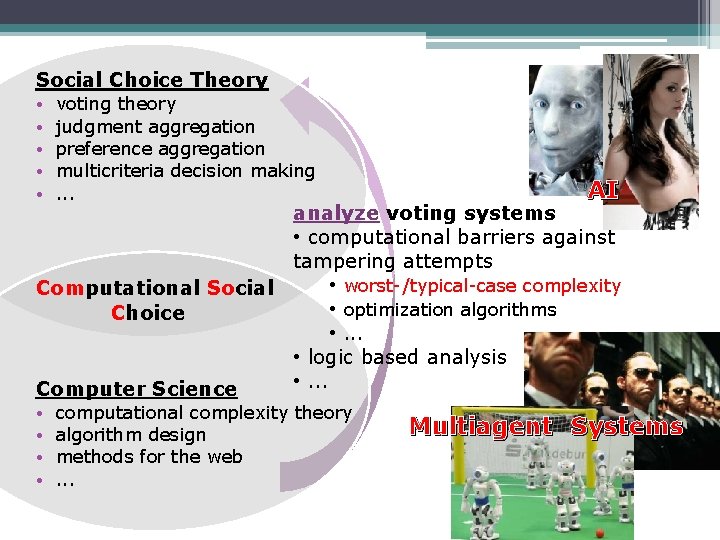
Social Choice Theory • • • voting theory judgment aggregation preference aggregation multicriteria decision making. . . Computational Social Choice Computer Science • • AI analyze voting systems • computational barriers against tampering attempts • worst-/typical-case complexity • optimization algorithms • . . . • logic based analysis • . . . computational complexity theory algorithm design methods for the web. . . Multiagent Systems
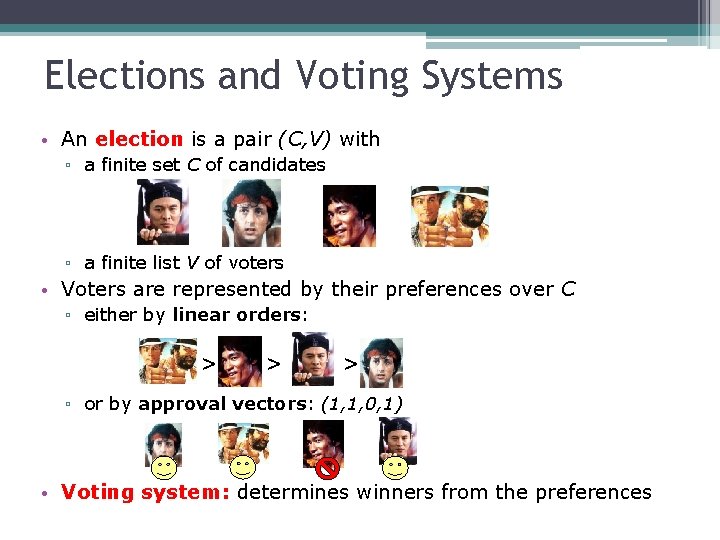
Elections and Voting Systems • An election is a pair (C, V) with ▫ a finite set C of candidates ▫ a finite list V of voters • Voters are represented by their preferences over C ▫ either by linear orders: > > > ▫ or by approval vectors: (1, 1, 0, 1) • Voting system: determines winners from the preferences
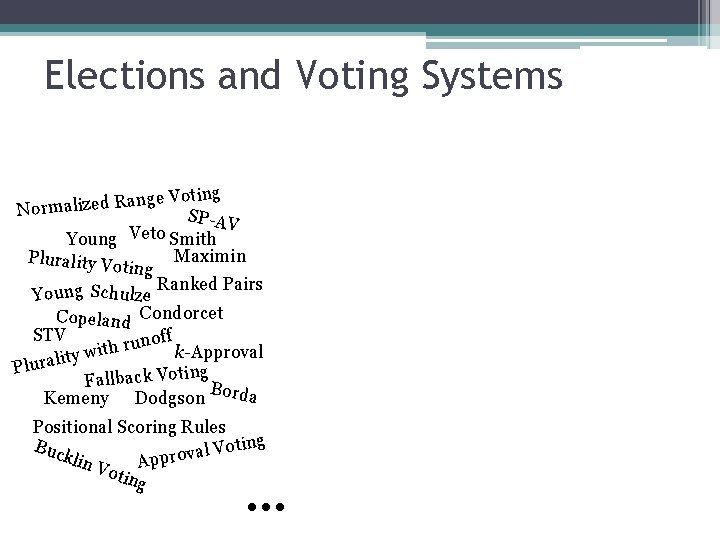
Elections and Voting Systems oting V e g n a R d e z li Norma SP-AV Young Veto Smith Maximin Plurality Vo ting Ranked Pairs Young Schulze Copeland Condorcet STV noff u r h t k-Approval ity wi l a r u l P g Fallback Votin B Kemeny Dodgson orda Positional Scoring Rules ting Buc o V l a v klin ro Vot App ing …
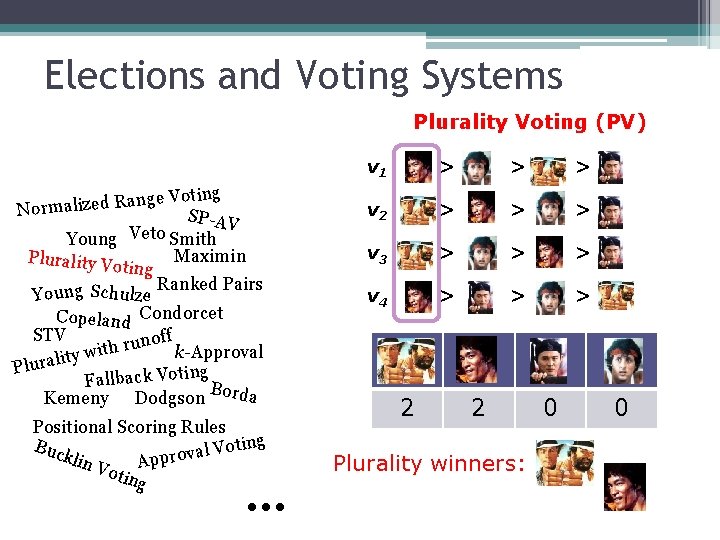
Elections and Voting Systems Plurality Voting (PV) oting V e g n a R d e z li Norma SP-AV Young Veto Smith Maximin Plurality Vo ting Ranked Pairs Young Schulze Copeland Condorcet STV noff u r h t k-Approval ity wi l a r u l P g Fallback Votin B Kemeny Dodgson orda Positional Scoring Rules ting Buc o V l a v klin ro Vot App ing … v 1 > > > v 2 > > > v 3 > > > v 4 > > > 2 2 Plurality winners: 0 0
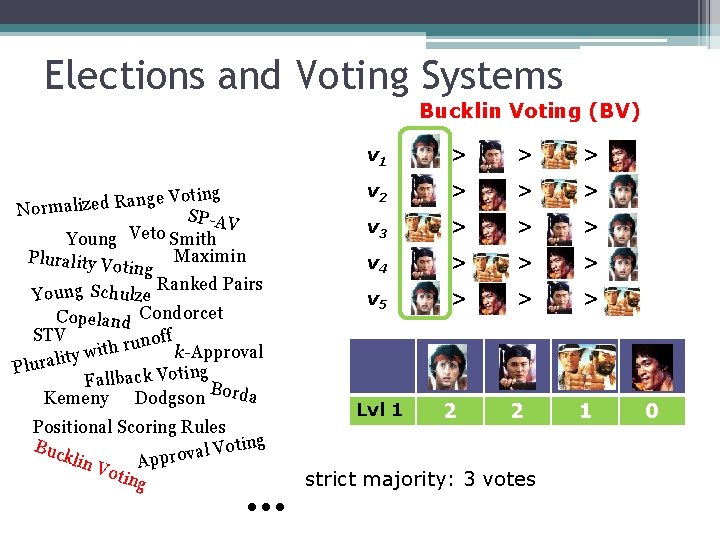
Elections and Voting Systems Bucklin Voting (BV) oting V e g n a R d e z li Norma SP-AV Young Veto Smith Maximin Plurality Vo ting Ranked Pairs Young Schulze Copeland Condorcet STV noff u r h t k-Approval ity wi l a r u l P g Fallback Votin B Kemeny Dodgson orda Positional Scoring Rules ting Buc o V l a v klin ro Vot App ing … v 1 > > > v 2 > > > v 3 > > > v 4 > > > v 5 > > > Lvl 1 2 2 strict majority: 3 votes 1 0
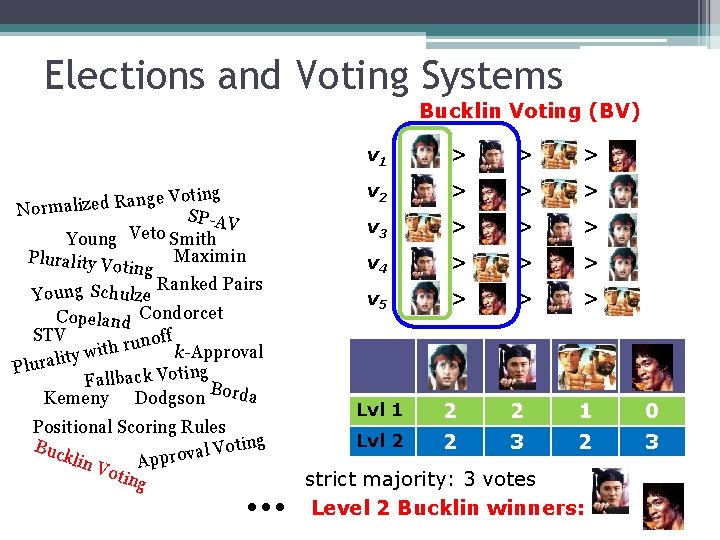
Elections and Voting Systems Bucklin Voting (BV) oting V e g n a R d e z li Norma SP-AV Young Veto Smith Maximin Plurality Vo ting Ranked Pairs Young Schulze Copeland Condorcet STV noff u r h t k-Approval ity wi l a r u l P g Fallback Votin B Kemeny Dodgson orda Positional Scoring Rules ting Buc o V l a v klin ro Vot App ing … v 1 > > > v 2 > > > v 3 > > > v 4 > > > v 5 > > > Lvl 1 2 2 1 0 Lvl 2 2 3 strict majority: 3 votes Level 2 Bucklin winners:
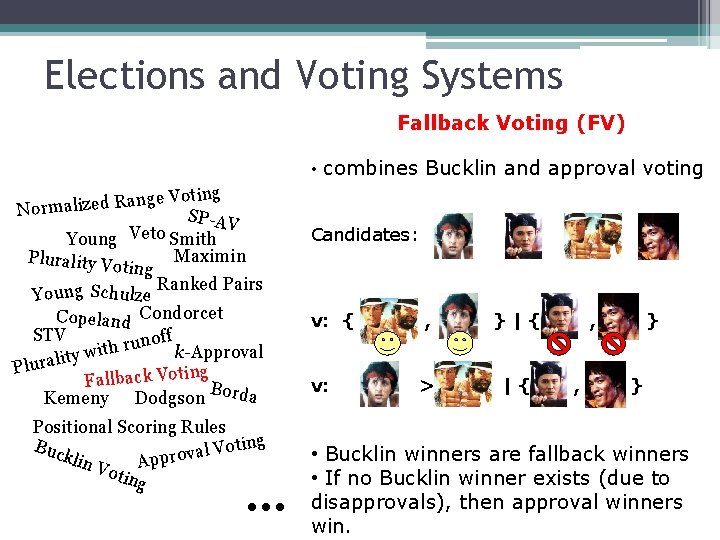
Elections and Voting Systems Fallback Voting (FV) • combines Bucklin and approval voting V e g n a R d e z li Norma SP-AV Young Veto Smith Maximin Plurality Vo ting Ranked Pairs Young Schulze Copeland Condorcet STV noff u r h t k-Approval ity wi l a r u l P g Fallback Votin B Kemeny Dodgson orda Positional Scoring Rules ting Buc o V l a v klin ro Vot App ing … Candidates: v: { v: , }|{ > |{ , , } } • Bucklin winners are fallback winners • If no Bucklin winner exists (due to disapprovals), then approval winners win.
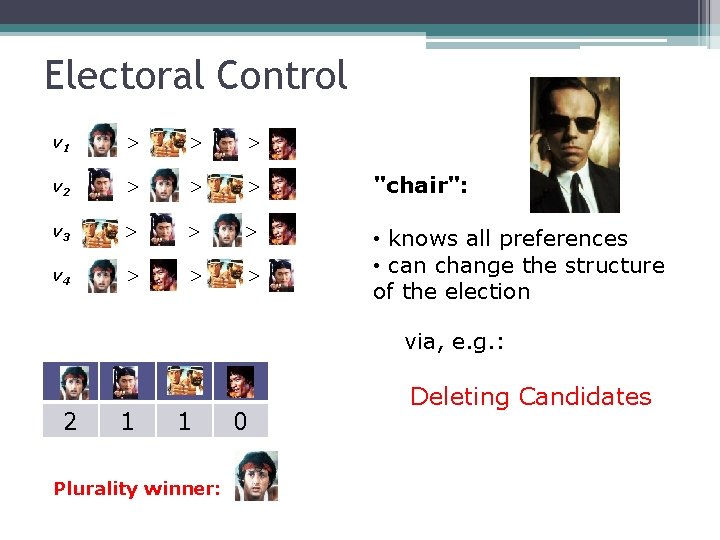
Electoral Control v 1 > > > v 2 > > > "chair": v 3 > > > v 4 > > > • knows all preferences • can change the structure of the election via, e. g. : 2 1 1 Plurality winner: 0 Deleting Candidates
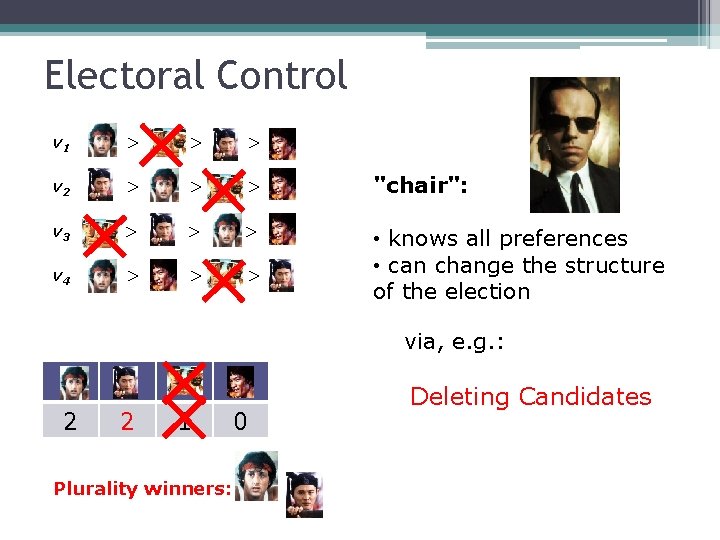
Electoral Control v 1 > > > v 2 > > > "chair": v 3 > > > v 4 > > > • knows all preferences • can change the structure of the election via, e. g. : 2 2 1 Plurality winners: 0 Deleting Candidates
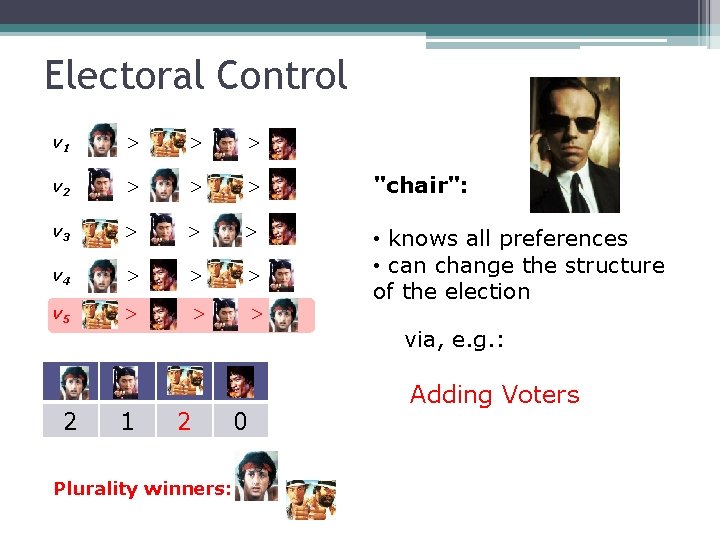
Electoral Control v 1 > > > v 2 > > > "chair": v 3 > > > v 4 > > > v 5 > > > • knows all preferences • can change the structure of the election 2 via, e. g. : 1 2 Plurality winners: 0 Adding Voters
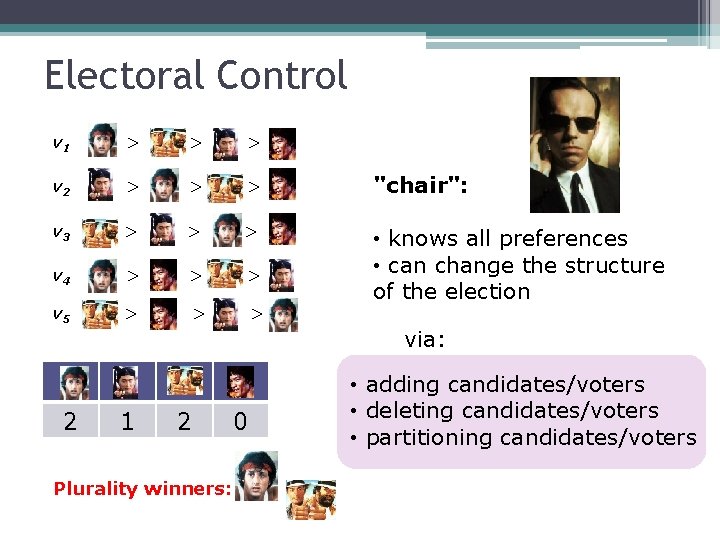
Electoral Control v 1 > > > v 2 > > > "chair": v 3 > > > v 4 > > > v 5 > > > • knows all preferences • can change the structure of the election via: • • 2 1 2 Plurality winners: 0 • adding candidates/voters • deleting candidates/voters • partitioning candidates/voters
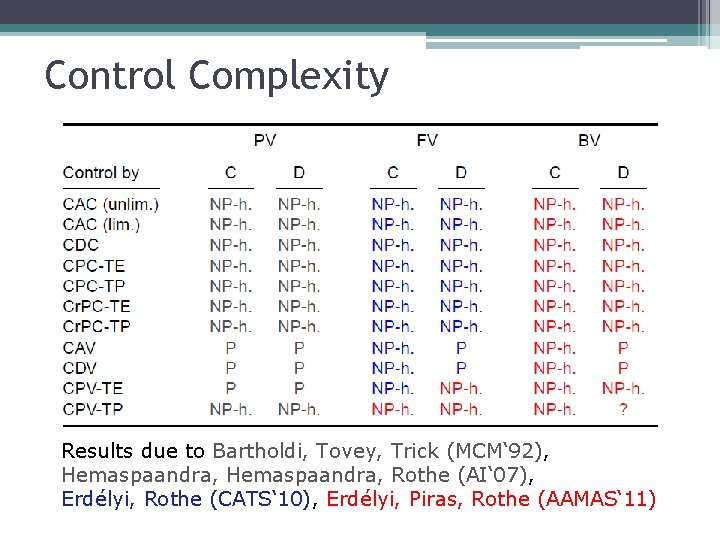
Control Complexity Results due to Bartholdi, Tovey, Trick (MCM‘ 92), Hemaspaandra, Rothe (AI‘ 07), Erdélyi, Rothe (CATS‘ 10), Erdélyi, Piras, Rothe (AAMAS‘ 11)
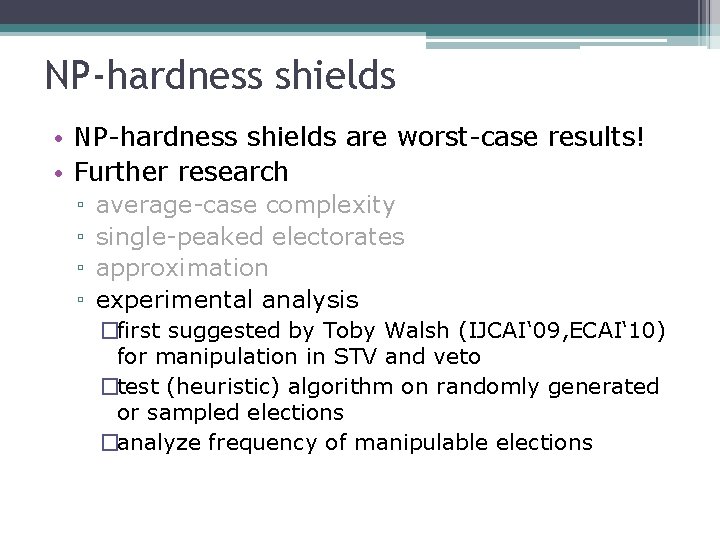
NP-hardness shields • NP-hardness shields are worst-case results! • Further research ▫ ▫ average-case complexity single-peaked electorates approximation experimental analysis �first suggested by Toby Walsh (IJCAI‘ 09, ECAI‘ 10) for manipulation in STV and veto �test (heuristic) algorithm on randomly generated or sampled elections �analyze frequency of manipulable elections
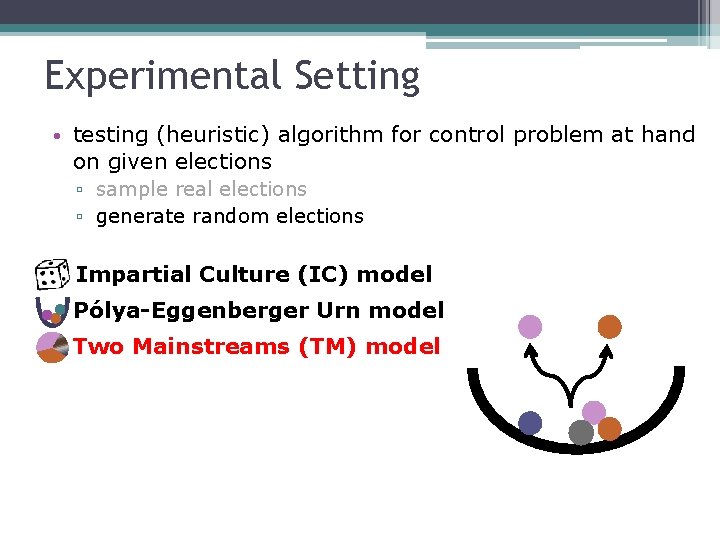
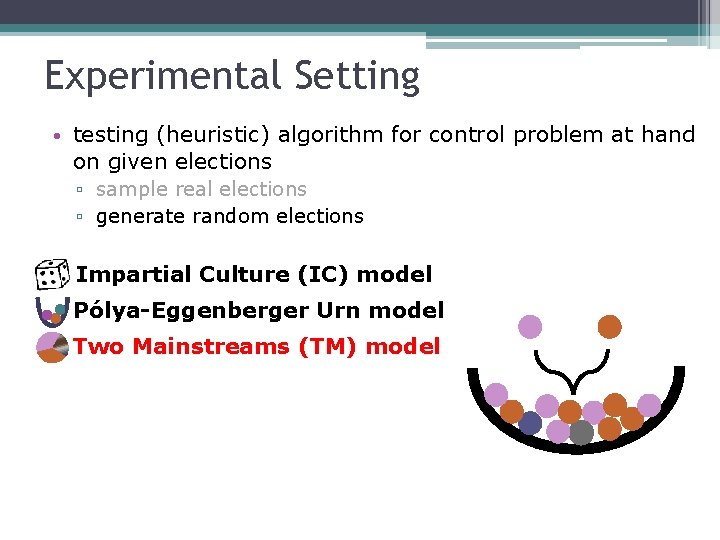
Experimental Setting • testing (heuristic) algorithm for control problem at hand on given elections ▫ sample real elections ▫ generate random elections Impartial Culture (IC) model Pólya-Eggenberger Urn model Two Mainstreams (TM) model
Experimental Setting • testing (heuristic) algorithm for control problem at hand on given elections ▫ sample real elections ▫ generate random elections Impartial Culture (IC) model ▫ voters vote independently ▫ all preferences are equally likely Pólya-Eggenberger Urn model Two Mainstreams (TM) model
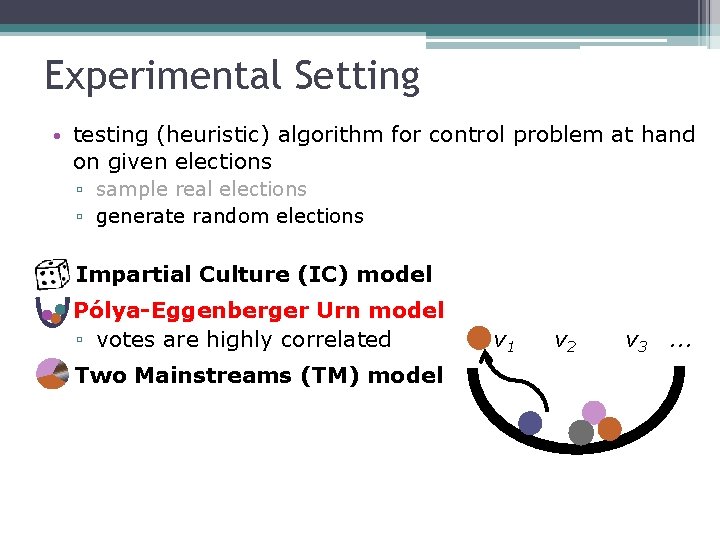
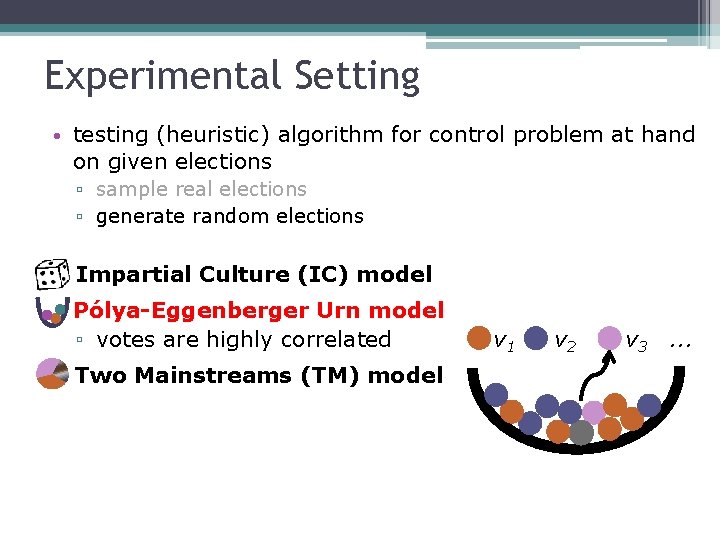
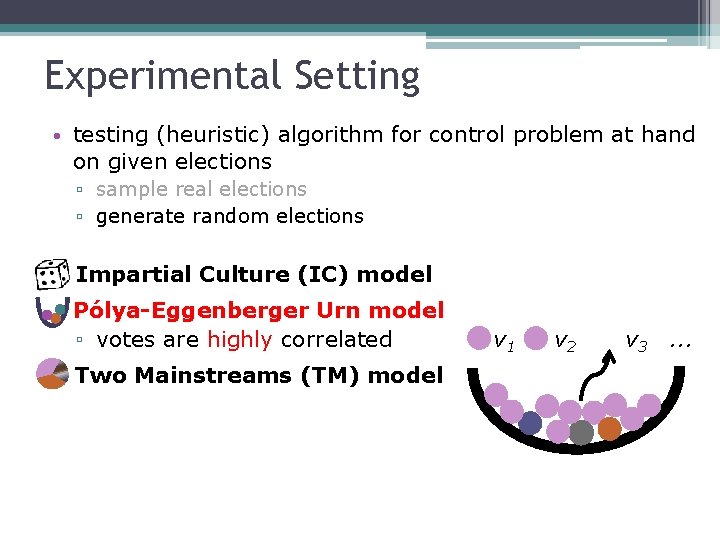
Experimental Setting • testing (heuristic) algorithm for control problem at hand on given elections ▫ sample real elections ▫ generate random elections Impartial Culture (IC) model Pólya-Eggenberger Urn model ▫ votes are highly correlated Two Mainstreams (TM) model v 1 v 2 v 3 . . .
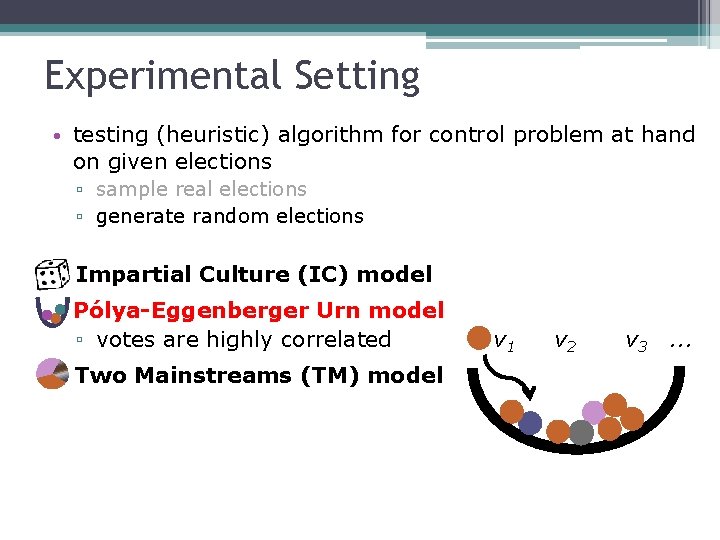
Experimental Setting • testing (heuristic) algorithm for control problem at hand on given elections ▫ sample real elections ▫ generate random elections Impartial Culture (IC) model Pólya-Eggenberger Urn model ▫ votes are highly correlated Two Mainstreams (TM) model v 1 v 2 v 3 . . .
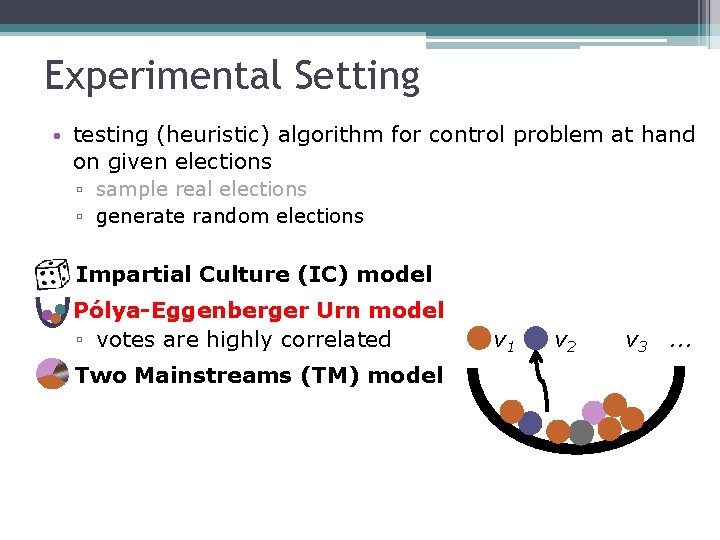
Experimental Setting • testing (heuristic) algorithm for control problem at hand on given elections ▫ sample real elections ▫ generate random elections Impartial Culture (IC) model Pólya-Eggenberger Urn model ▫ votes are highly correlated Two Mainstreams (TM) model v 1 v 2 v 3 . . .
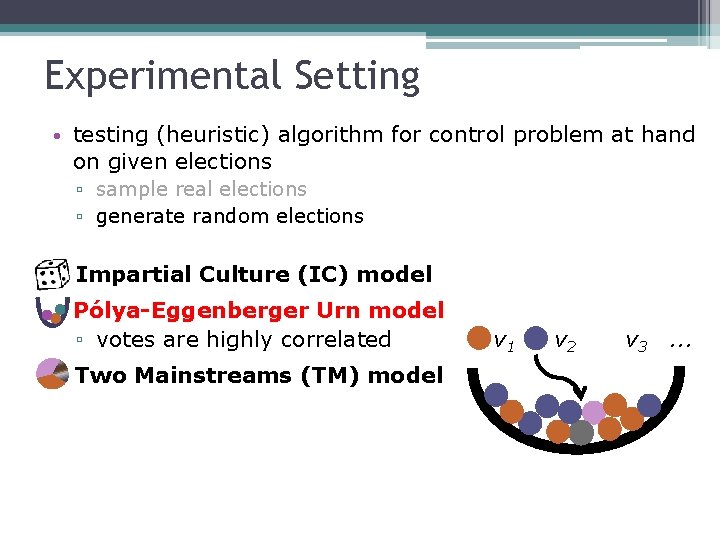
Experimental Setting • testing (heuristic) algorithm for control problem at hand on given elections ▫ sample real elections ▫ generate random elections Impartial Culture (IC) model Pólya-Eggenberger Urn model ▫ votes are highly correlated Two Mainstreams (TM) model v 1 v 2 v 3 . . .
Experimental Setting • testing (heuristic) algorithm for control problem at hand on given elections ▫ sample real elections ▫ generate random elections Impartial Culture (IC) model Pólya-Eggenberger Urn model ▫ votes are highly correlated Two Mainstreams (TM) model v 1 v 2 v 3 . . .
Experimental Setting • testing (heuristic) algorithm for control problem at hand on given elections ▫ sample real elections ▫ generate random elections Impartial Culture (IC) model Pólya-Eggenberger Urn model ▫ votes are highly correlated Two Mainstreams (TM) model v 1 v 2 v 3 . . .
Experimental Setting • testing (heuristic) algorithm for control problem at hand on given elections ▫ sample real elections ▫ generate random elections Impartial Culture (IC) model Pólya-Eggenberger Urn model Two Mainstreams (TM) model
Experimental Setting • testing (heuristic) algorithm for control problem at hand on given elections ▫ sample real elections ▫ generate random elections Impartial Culture (IC) model Pólya-Eggenberger Urn model Two Mainstreams (TM) model
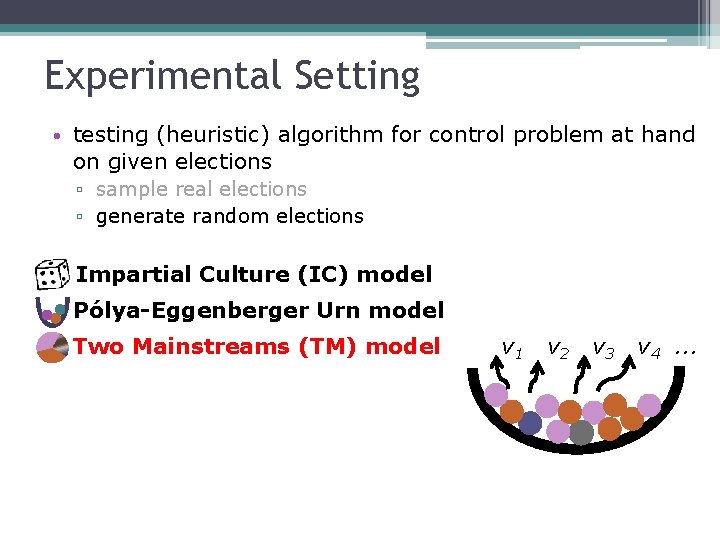
Experimental Setting • testing (heuristic) algorithm for control problem at hand on given elections ▫ sample real elections ▫ generate random elections Impartial Culture (IC) model Pólya-Eggenberger Urn model Two Mainstreams (TM) model v 1 v 2 v 3 v 4. . .
Experimental Setting • algorithms for all control types the 3 voting systems are resistant to • generated elections underlying the TM model IC and • up to 128 voters/candidates • 500 elections for each data point • greedy algorithms checking promising control actions first (timeout implemented)
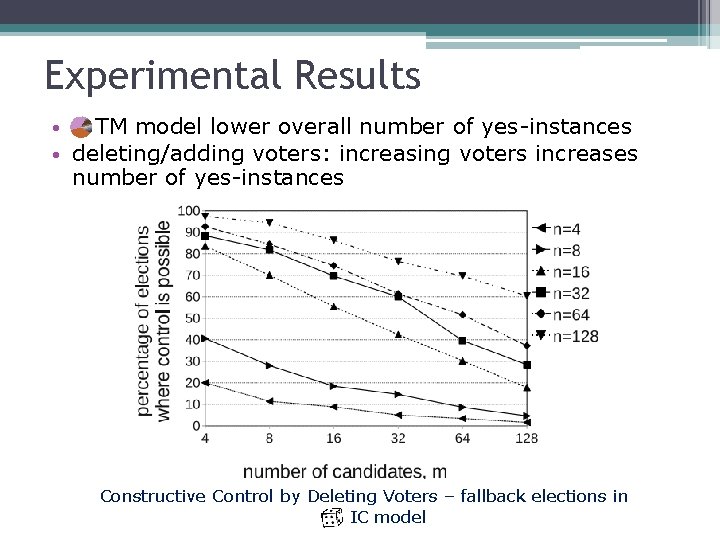
Experimental Results • TM model lower overall number of yes-instances • deleting/adding voters: increasing voters increases number of yes-instances Constructive Control by Deleting Voters – fallback elections in IC model
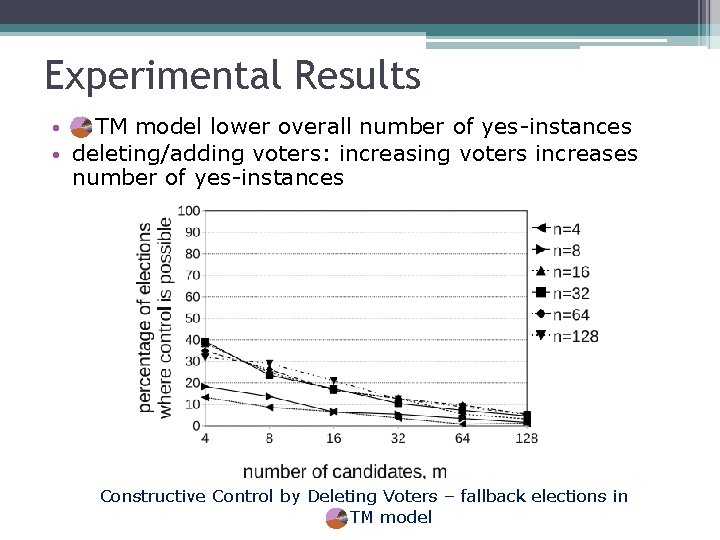
Experimental Results • TM model lower overall number of yes-instances • deleting/adding voters: increasing voters increases number of yes-instances Constructive Control by Deleting Voters – fallback elections in TM model
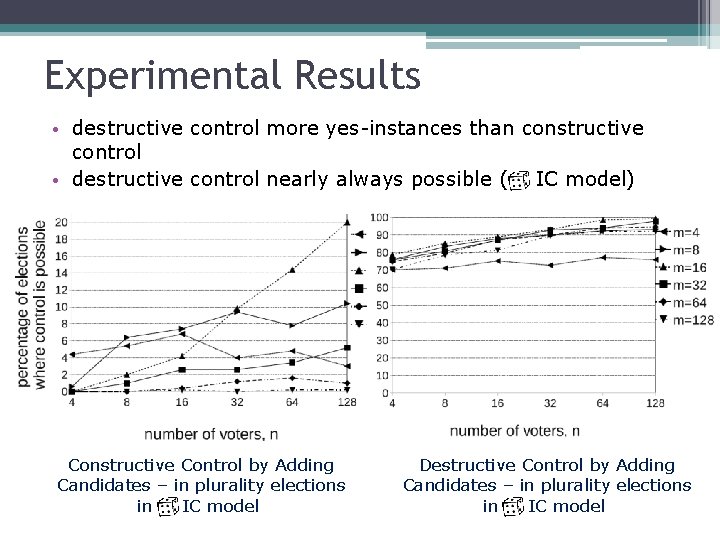
Experimental Results • destructive control more yes-instances than constructive control • destructive control nearly always possible ( IC model) Constructive Control by Adding Candidates – in plurality elections in IC model Destructive Control by Adding Candidates – in plurality elections in IC model
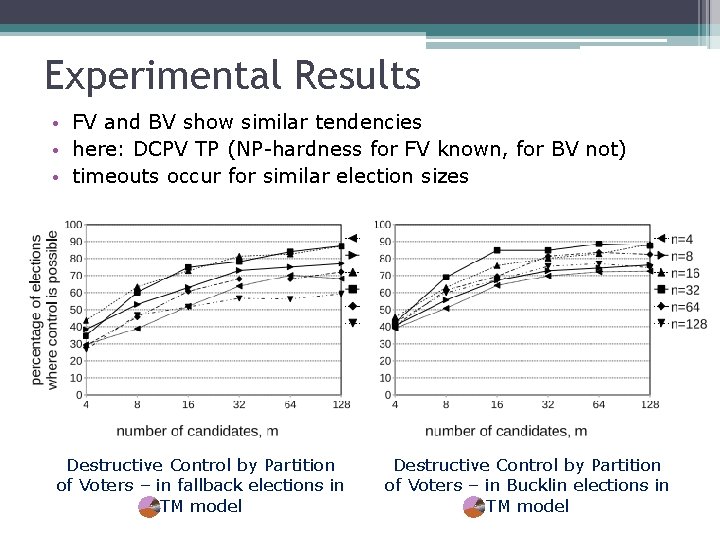
Experimental Results • FV and BV show similar tendencies • here: DCPV TP (NP-hardness for FV known, for BV not) • timeouts occur for similar election sizes Destructive Control by Partition of Voters – in fallback elections in TM model Destructive Control by Partition of Voters – in Bucklin elections in TM model
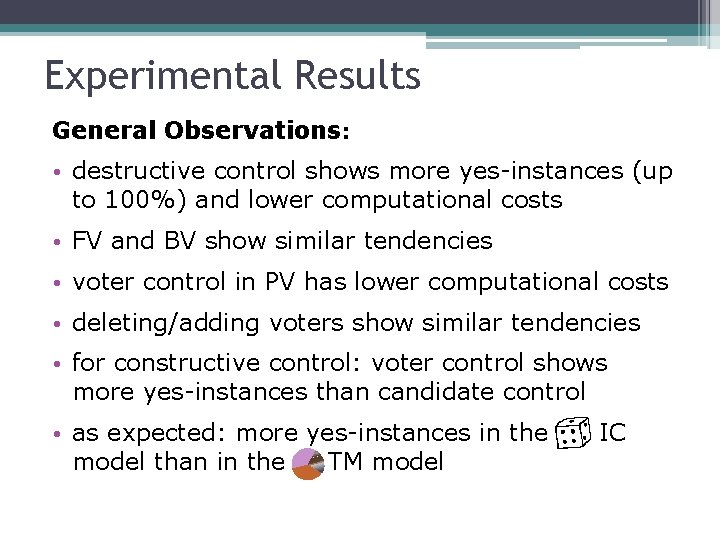
Experimental Results General Observations: • destructive control shows more yes-instances (up to 100%) and lower computational costs • FV and BV show similar tendencies • voter control in PV has lower computational costs • deleting/adding voters show similar tendencies • for constructive control: voter control shows more yes-instances than candidate control • as expected: more yes-instances in the model than in the TM model IC
Open Questions and Future Work • open case for Bucklin voting (DCPV-TP) • improving the algorithms allowing ▫ ▫ ▫ bigger election sizes more candidates/voters to be added/deleted higher number of elections per data point to weaken time limit. . . • other distribution models • other voting systems • . . .
Thank you very much!
- Slides: 37