
Control Abstraction and Parameter Passing Read Scott Chapter
Control Abstraction and Parameter Passing Read: Scott, Chapter 9. 1 -9. 3 (lecture notes cover mostly 9. 3) 1
Lecture Outline n n Control Abstraction Parameter Passing Mechanisms n Call by value Call by reference Call by value-result Call by name n Call by sharing n n n Programming Languages CSCI 4430, A. Milanova 2
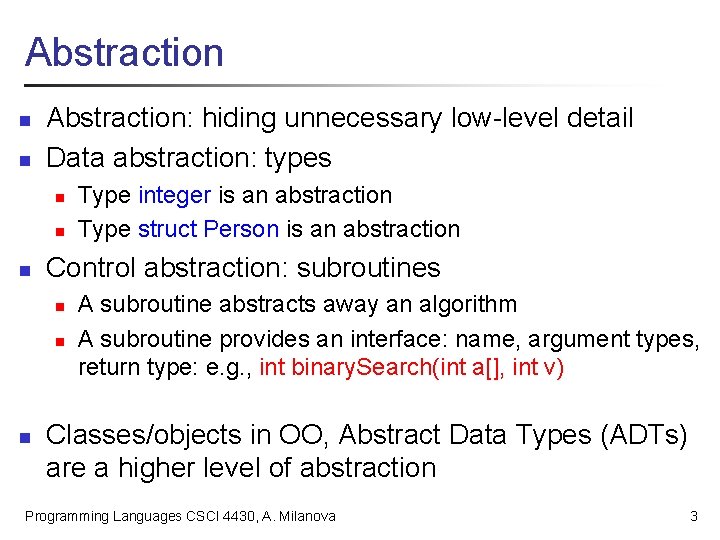
Abstraction n n Abstraction: hiding unnecessary low-level detail Data abstraction: types n n n Control abstraction: subroutines n n n Type integer is an abstraction Type struct Person is an abstraction A subroutine abstracts away an algorithm A subroutine provides an interface: name, argument types, return type: e. g. , int binary. Search(int a[], int v) Classes/objects in OO, Abstract Data Types (ADTs) are a higher level of abstraction Programming Languages CSCI 4430, A. Milanova 3
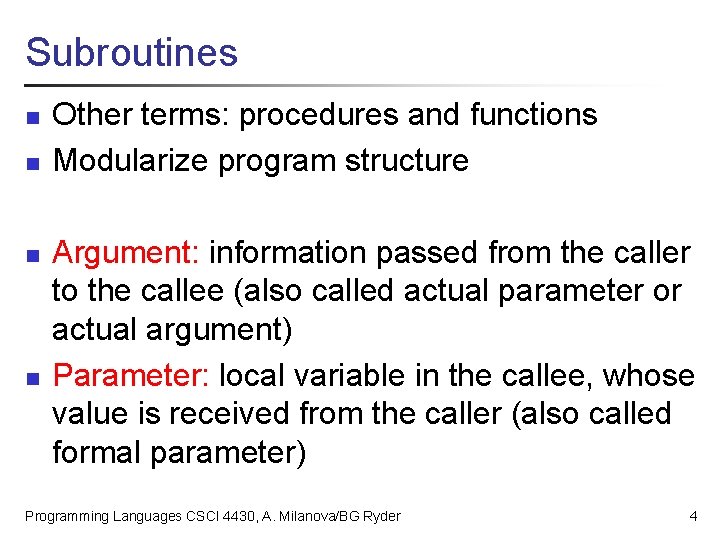
Subroutines n n Other terms: procedures and functions Modularize program structure Argument: information passed from the caller to the callee (also called actual parameter or actual argument) Parameter: local variable in the callee, whose value is received from the caller (also called formal parameter) Programming Languages CSCI 4430, A. Milanova/BG Ryder 4
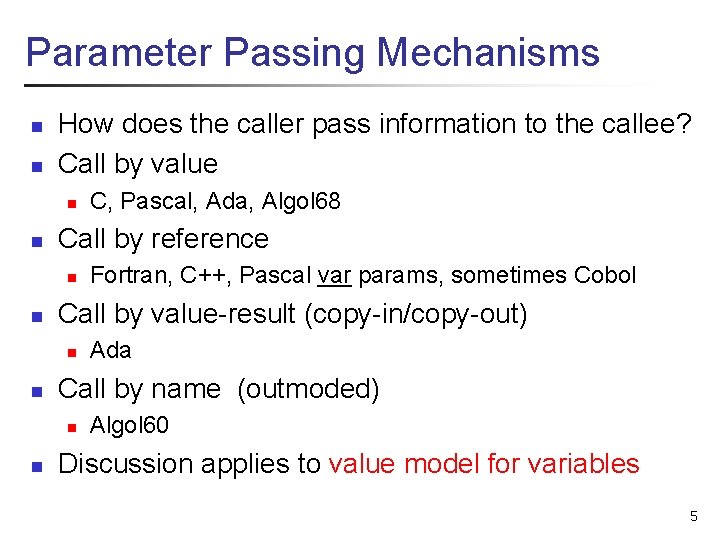
Parameter Passing Mechanisms n n How does the caller pass information to the callee? Call by value n n Call by reference n n Ada Call by name (outmoded) n n Fortran, C++, Pascal var params, sometimes Cobol Call by value-result (copy-in/copy-out) n n C, Pascal, Ada, Algol 68 Algol 60 Discussion applies to value model for variables 5
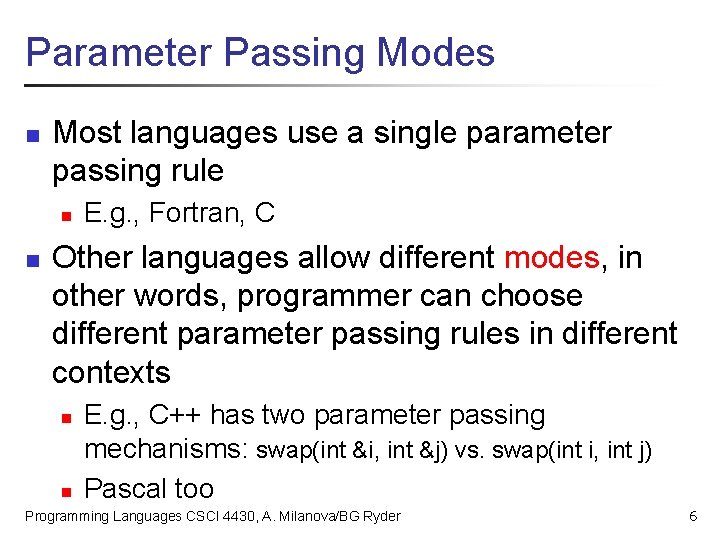
Parameter Passing Modes n Most languages use a single parameter passing rule n n E. g. , Fortran, C Other languages allow different modes, in other words, programmer can choose different parameter passing rules in different contexts n n E. g. , C++ has two parameter passing mechanisms: swap(int &i, int &j) vs. swap(int i, int j) Pascal too Programming Languages CSCI 4430, A. Milanova/BG Ryder 6
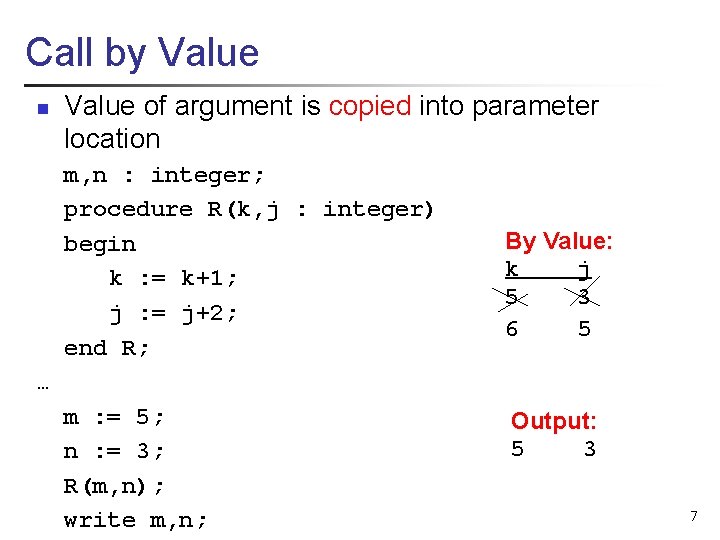
Call by Value n Value of argument is copied into parameter location m, n : integer; procedure R(k, j : integer) begin k : = k+1; j : = j+2; end R; By Value: k j 5 3 6 5 … m : = 5; n : = 3; R(m, n); write m, n; Output: 5 3 7
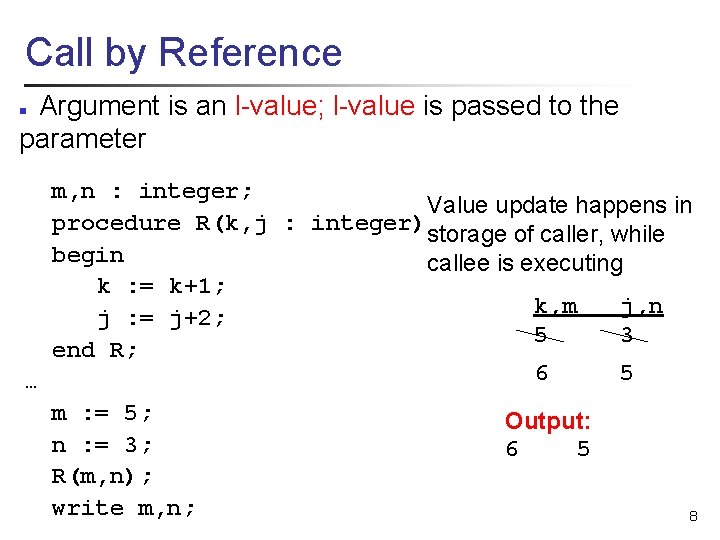
Call by Reference Argument is an l-value; l-value is passed to the parameter n m, n : integer; Value update happens in procedure R(k, j : integer)storage of caller, while begin callee is executing k : = k+1; k, m j, n j : = j+2; 5 3 end R; 6 5 … m : = 5; Output: n : = 3; 6 5 R(m, n); write m, n; 8
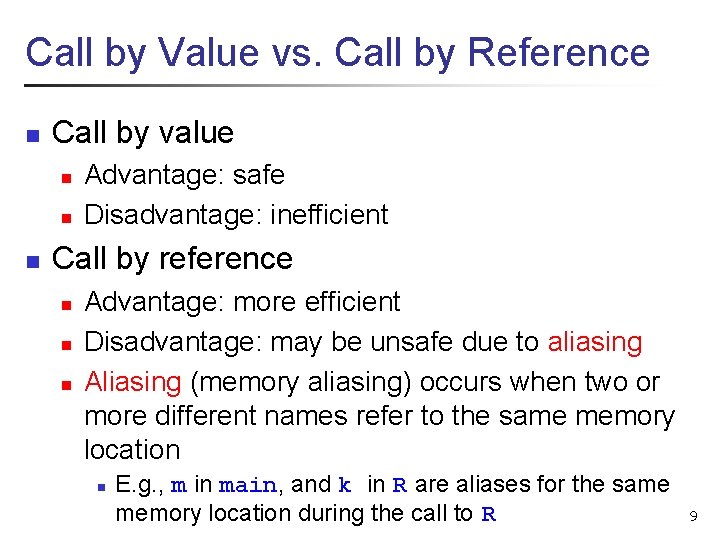
Call by Value vs. Call by Reference n Call by value n n n Advantage: safe Disadvantage: inefficient Call by reference n n n Advantage: more efficient Disadvantage: may be unsafe due to aliasing Aliasing (memory aliasing) occurs when two or more different names refer to the same memory location n E. g. , m in main, and k in R are aliases for the same memory location during the call to R 9
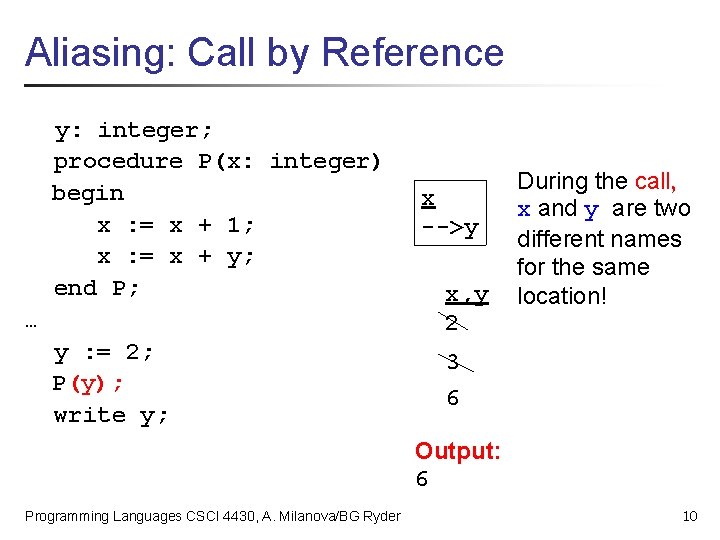
Aliasing: Call by Reference y: integer; procedure P(x: integer) begin x : = x + 1; x : = x + y; end P; … y : = 2; P(y); write y; x -->y x, y 2 During the call, x and y are two different names for the same location! 3 6 Output: 6 Programming Languages CSCI 4430, A. Milanova/BG Ryder 10
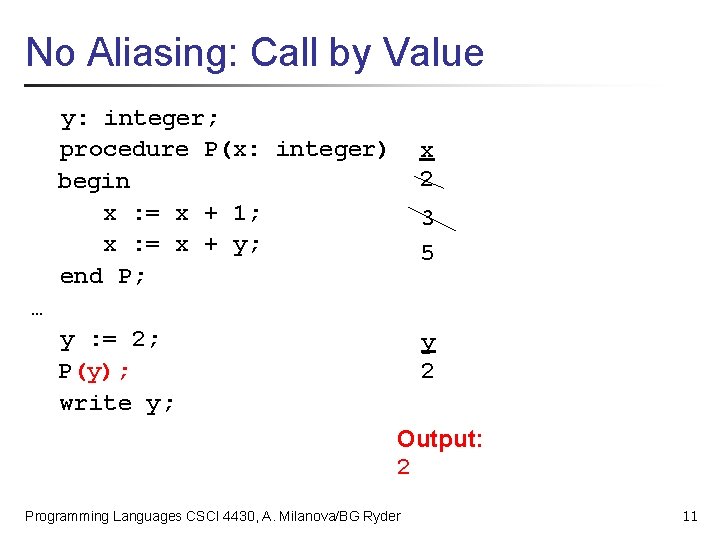
No Aliasing: Call by Value y: integer; procedure P(x: integer) begin x : = x + 1; x : = x + y; end P; x 2 3 5 … y : = 2; P(y); write y; y 2 Output: 2 Programming Languages CSCI 4430, A. Milanova/BG Ryder 11
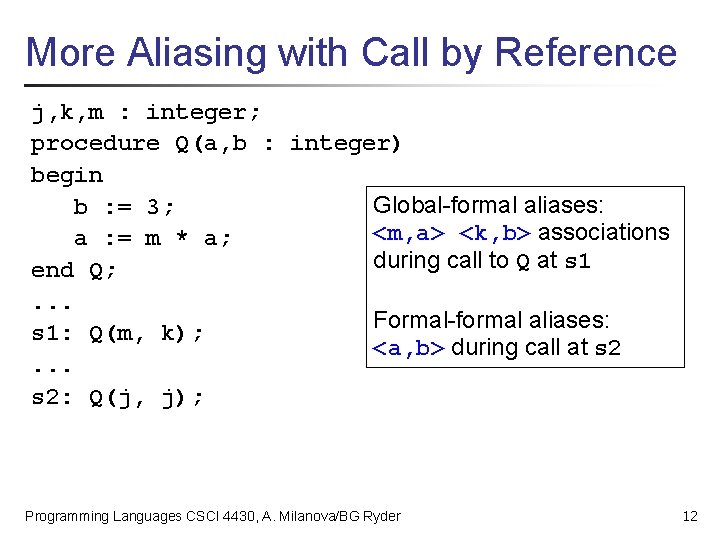
More Aliasing with Call by Reference j, k, m : integer; procedure Q(a, b : integer) begin Global-formal aliases: b : = 3; <m, a> <k, b> associations a : = m * a; during call to Q at s 1 end Q; . . . Formal-formal aliases: s 1: Q(m, k); <a, b> during call at s 2. . . s 2: Q(j, j); Programming Languages CSCI 4430, A. Milanova/BG Ryder 12
Questions n n Aliasing is an important concept in programming Can you think of other examples of aliasing? Why memory aliasing is considered dangerous? Can you think of other ways for creating memory aliasing? Programming Languages CSCI 4430, A. Milanova/BG Ryder 13
Memory Aliasing is Dangerous n n One part of the program can modify a location through one alias, breaking invariants/expectations of other parts that use different aliases to the same location In general, we cannot know whether x->f and y->f are aliases to the same location n We “err” on the safe side Aliasing makes reasoning about code hard Aliasing prevents compiler optimization 14
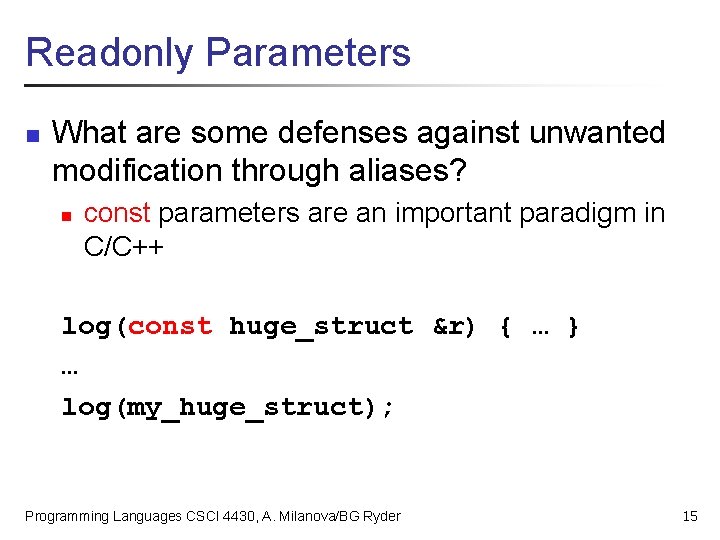
Readonly Parameters n What are some defenses against unwanted modification through aliases? n const parameters are an important paradigm in C/C++ log(const huge_struct &r) { … } … log(my_huge_struct); Programming Languages CSCI 4430, A. Milanova/BG Ryder 15
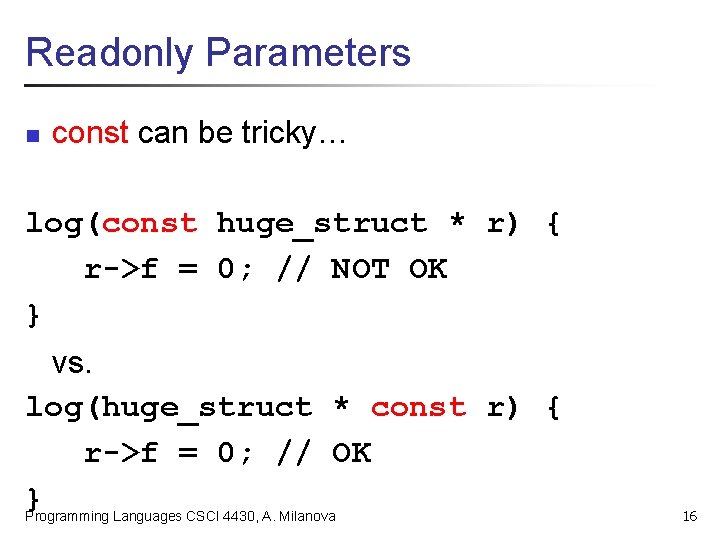
Readonly Parameters n const can be tricky… log(const huge_struct * r) { r->f = 0; // NOT OK } vs. log(huge_struct * const r) { r->f = 0; // OK } Programming Languages CSCI 4430, A. Milanova 16
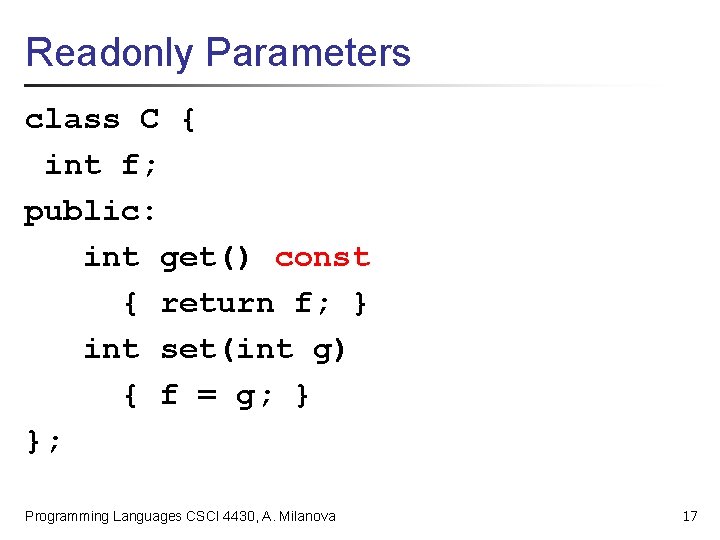
Readonly Parameters class C { int f; public: int get() const { return f; } int set(int g) { f = g; } }; Programming Languages CSCI 4430, A. Milanova 17
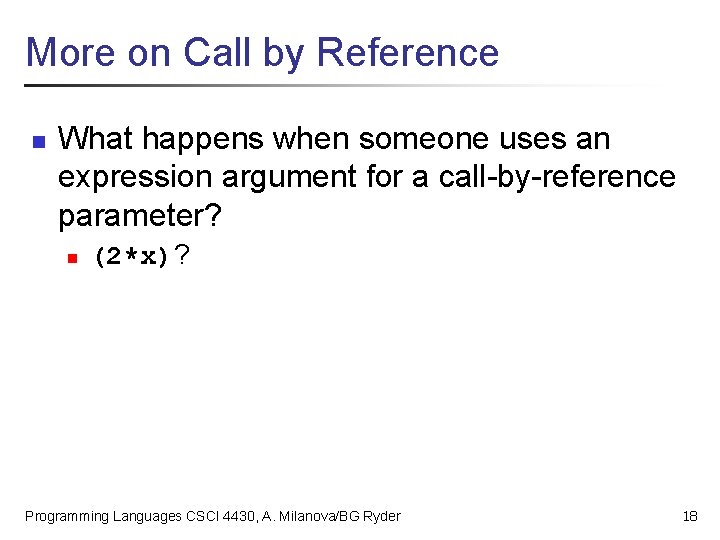
More on Call by Reference n What happens when someone uses an expression argument for a call-by-reference parameter? n (2*x)? Programming Languages CSCI 4430, A. Milanova/BG Ryder 18
Lecture Outline n n Control Abstraction Parameter Passing Mechanisms n Call by value Call by reference Call by value-result Call by name n Call by sharing n n n Programming Languages CSCI 4430, A. Milanova 19
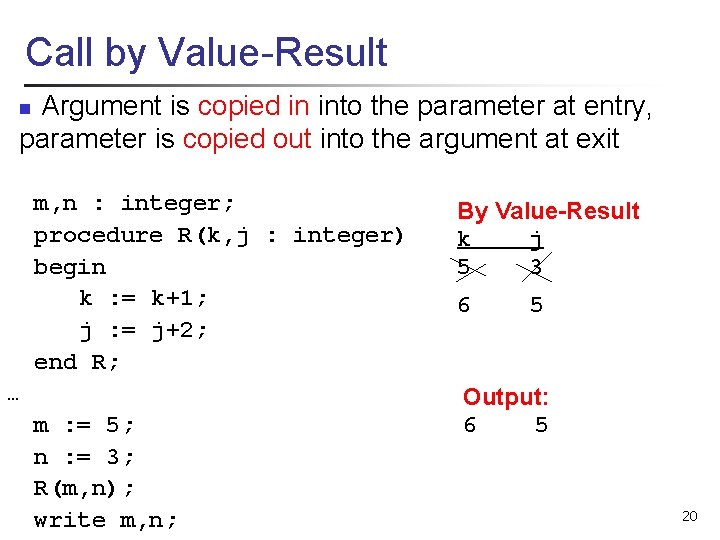
Call by Value-Result Argument is copied in into the parameter at entry, parameter is copied out into the argument at exit n m, n : integer; procedure R(k, j : integer) begin k : = k+1; j : = j+2; end R; … m : = 5; n : = 3; R(m, n); write m, n; By Value-Result k j 5 3 6 5 Output: 6 5 20
![Call by Value-Result c : array [1. . 10] of integer; m, n :](http://slidetodoc.com/presentation_image_h2/d1dcd890b7c10fddd7c39d49c7b86bcb/image-21.jpg "Call by Value-Result c : array [1. . 10] of integer; m, n :")
Call by Value-Result c : array [1. . 10] of integer; m, n : integer; k j procedure R(k, j : integer) 2 2 begin 3 4 k : = k+1; j : = j+2; What element of c end R; has its value changed? c[2]? c[3]? /* set c[i] = i */ m : = 2; R(m, c[m]); write c[1], c[2], …, c[10]; Programming Languages CSCI 4430, A. Milanova/BG Ryder 21
![Call by Value-Result … /* set c[i] = i */ m : = 2;](http://slidetodoc.com/presentation_image_h2/d1dcd890b7c10fddd7c39d49c7b86bcb/image-22.jpg "Call by Value-Result … /* set c[i] = i */ m : = 2;")
Call by Value-Result … /* set c[i] = i */ m : = 2; R(m, c[m]); write c[1], c[2], …, c[10]; k 2 j 2 3 4 What element of c has its value changed? c[2]? c[3]? One possible implementation is to copy arguments from left to right and re-evaluate the l-value at exit. This will produce m=3 and c[3]=4. Programming Languages CSCI 4430, A. Milanova/BG Ryder 22
Exercise n Write a program that produces different result when the parameter passing mechanism is call by value, call by reference, or call by value-result Programming Languages CSCI 4430, A. Milanova/BG Ryder 23
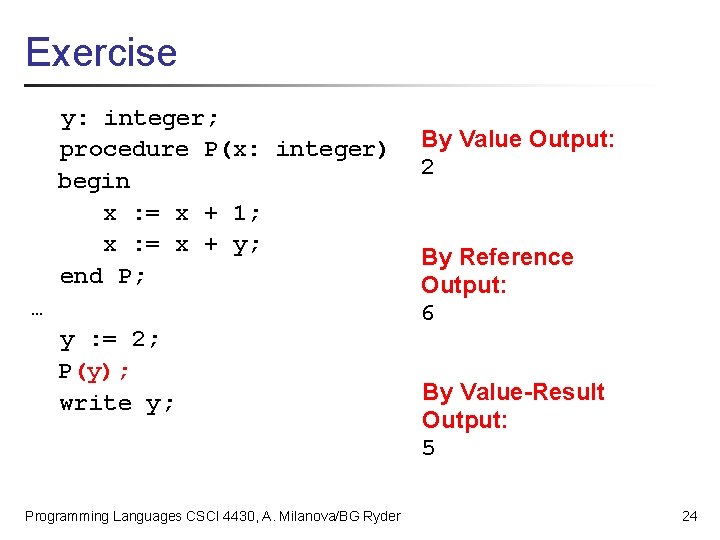
Exercise y: integer; procedure P(x: integer) begin x : = x + 1; x : = x + y; end P; … y : = 2; P(y); write y; Programming Languages CSCI 4430, A. Milanova/BG Ryder By Value Output: 2 By Reference Output: 6 By Value-Result Output: 5 24
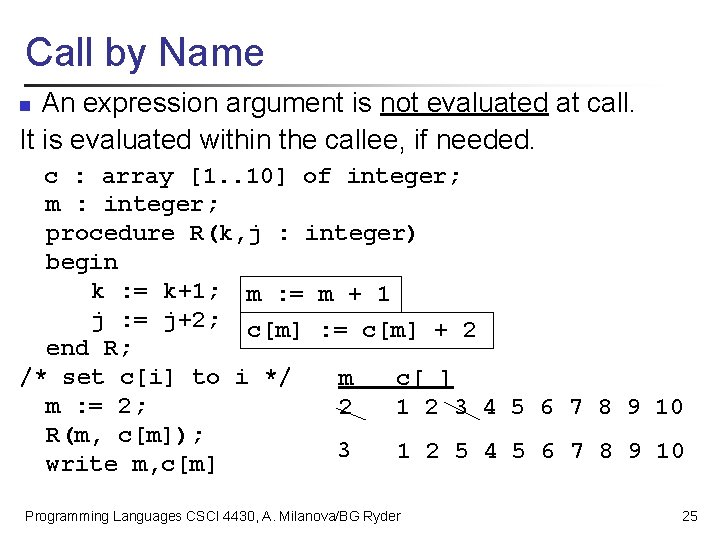
Call by Name An expression argument is not evaluated at call. It is evaluated within the callee, if needed. n c : array [1. . 10] of integer; m : integer; procedure R(k, j : integer) begin k : = k+1; m : = m + 1 j : = j+2; c[m] : = c[m] + 2 end R; /* set c[i] to i */ m c[ ] m : = 2; 2 1 2 3 4 5 6 7 8 9 10 R(m, c[m]); 3 1 2 5 4 5 6 7 8 9 10 write m, c[m] Programming Languages CSCI 4430, A. Milanova/BG Ryder 25
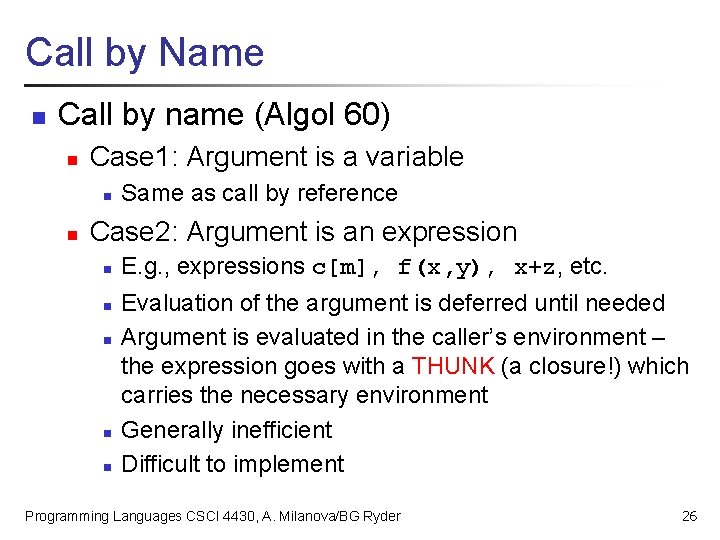
Call by Name n Call by name (Algol 60) n Case 1: Argument is a variable n n Same as call by reference Case 2: Argument is an expression n n E. g. , expressions c[m], f(x, y), x+z, etc. Evaluation of the argument is deferred until needed Argument is evaluated in the caller’s environment – the expression goes with a THUNK (a closure!) which carries the necessary environment Generally inefficient Difficult to implement Programming Languages CSCI 4430, A. Milanova/BG Ryder 26
Call by Name vs. Call by Value n Recall reduction strategies in the -calculus n What reduction strategy corresponds to call by name? n n Normal order reduction What reduction strategy corresponds to call by value? n Applicative order reduction Programming Languages CSCI 4430, A. Milanova/BG Ryder 27
Lecture Outline n n Control Abstraction Parameter Passing Mechanisms n Call by value Call by reference Call by value-result Call by name n Call by sharing n n n Programming Languages CSCI 4430, A. Milanova 28
Reference Model for Variables n n So far, discussion applied to the value model for variables What is the parameter passing mechanism in languages that use the reference model for variables? Neither call by value, nor call by reference make sense for languages with the reference model n Call by sharing: argument reference (address) is copied into parameter. Argument and parameter references refer to the same object Programming Languages CSCI 4430, A. Milanova/BG Ryder 29
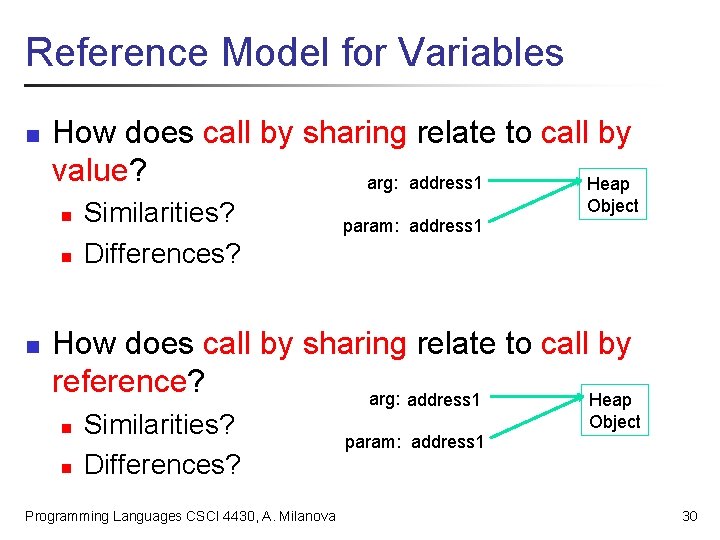
Reference Model for Variables n How does call by sharing relate to call by value? arg: address 1 Heap n n n Similarities? Differences? Object param: address 1 How does call by sharing relate to call by reference? arg: address 1 Heap n n Similarities? Differences? Programming Languages CSCI 4430, A. Milanova Object param: address 1 30
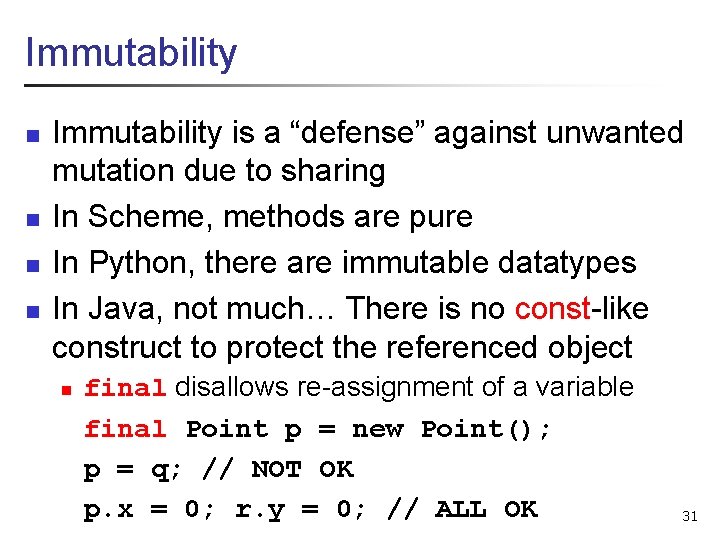
Immutability n n Immutability is a “defense” against unwanted mutation due to sharing In Scheme, methods are pure In Python, there are immutable datatypes In Java, not much… There is no const-like construct to protect the referenced object n final disallows re-assignment of a variable final Point p = new Point(); p = q; // NOT OK p. x = 0; r. y = 0; // ALL OK 31
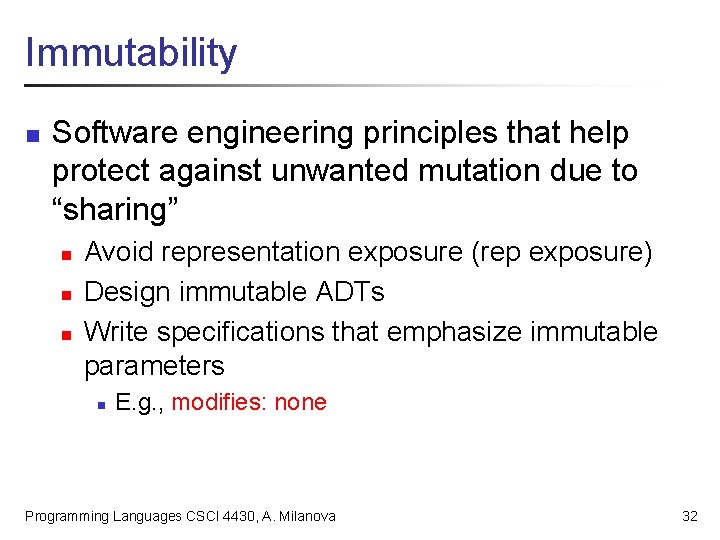
Immutability n Software engineering principles that help protect against unwanted mutation due to “sharing” n n n Avoid representation exposure (rep exposure) Design immutable ADTs Write specifications that emphasize immutable parameters n E. g. , modifies: none Programming Languages CSCI 4430, A. Milanova 32
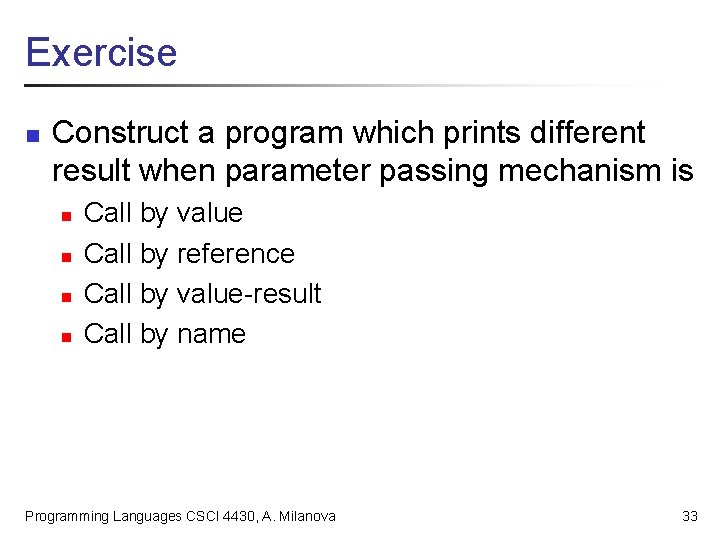
Exercise n Construct a program which prints different result when parameter passing mechanism is n n Call by value Call by reference Call by value-result Call by name Programming Languages CSCI 4430, A. Milanova 33
The End Programming Languages CSCI 4430, A. Milanova 34
- Slides: 34