
CONTRIBUTIONS TO BRITISH HISTORY WINDRUSH COMPREHNSION In June
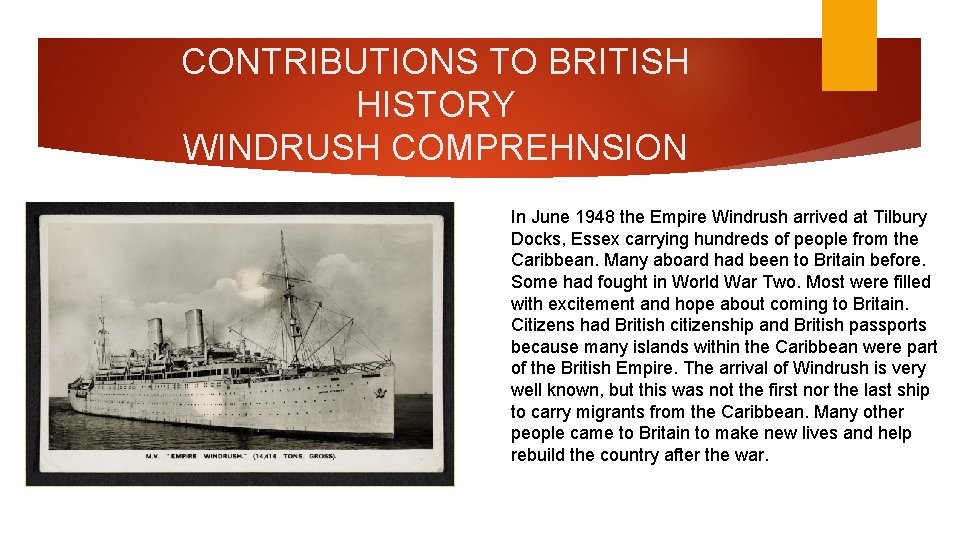
CONTRIBUTIONS TO BRITISH HISTORY WINDRUSH COMPREHNSION In June 1948 the Empire Windrush arrived at Tilbury Docks, Essex carrying hundreds of people from the Caribbean. Many aboard had been to Britain before. Some had fought in World War Two. Most were filled with excitement and hope about coming to Britain. Citizens had British citizenship and British passports because many islands within the Caribbean were part of the British Empire. The arrival of Windrush is very well known, but this was not the first nor the last ship to carry migrants from the Caribbean. Many other people came to Britain to make new lives and help rebuild the country after the war.
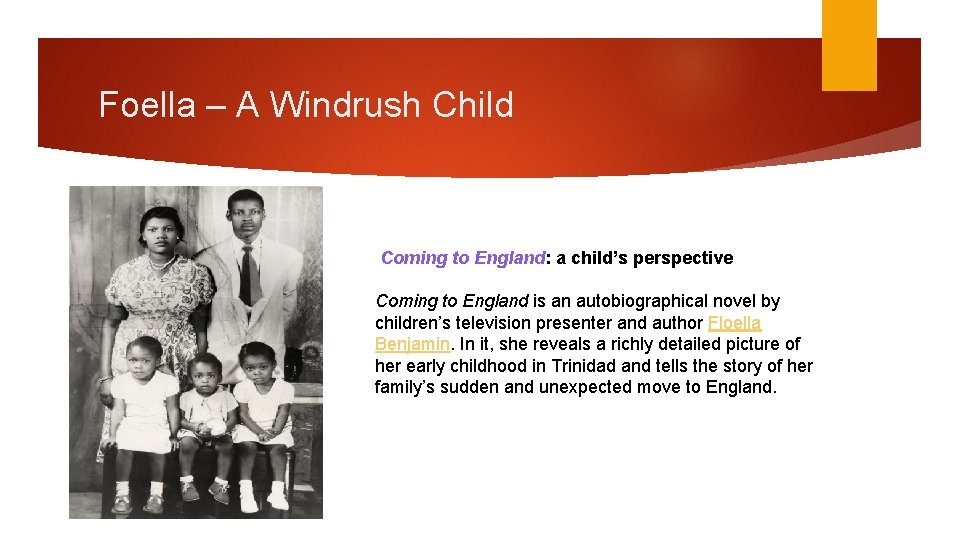
Foella – A Windrush Child Coming to England: a child’s perspective Coming to England is an autobiographical novel by children’s television presenter and author Floella Benjamin. In it, she reveals a richly detailed picture of her early childhood in Trinidad and tells the story of her family’s sudden and unexpected move to England.
Activity 1 - Celebrations This extract describes Floella’s special Sunday lunches at home with her family in Trinidad. Read the description aloud and look out for the details that reveal that, for her, it is a special experience. “For lunch it was either a rich tasty soup which was like a stew made of meat, pulses, vegetables and dumplings, or rice served with beef, chicken or, on Fridays, fish. For dessert we had whatever fresh fruit was in season: mangoes, pineapples, pawpaw or pomsitea, and for supper we had bread and cakes, all baked by Marmie, washed down with cocoa. Saturday was Marmie’s baking day, and she would bake enough for the whole week. Bread or bakes – a sort of bread with no yeast; sweet bread – bread with coconut and sugar; sponge cakes and coconut drops. The smell of freshly baked bread and cakes was wonderful – it always made me hungry. Sandra and I had to do our bit by helping to grease the baking tins and stir the cake mixture. The best part was when we fought over licking the cake bowl. Sunday was a special day in Trinidad. It was the one time of the week when we all got together which gave me a happy feeling of belonging and a sense of occasion. The realisation that the family unit was special began to take place during that time. We ate lavishly in the sitting room: the crisp starched white tablecloth would be spread out over the mahogany table, and the best glasses – frosted coloured ones – and plates were used. Then the table would be laden with dishes of food – it was like a feast. On the menu was brown down chicken, rice, plantains, callaloo, sweet potatoes, cassavas, gungo peas, and macaroni cheese pie. ” (Floella Benjamin, Coming to England, pp. 15– 18) QUESTIONS 1. Give 3 examples of the sensory language that the writer use in this extract? Tip: what can be seen, heard, felt, smelt, tasted? 2. What impact did the writer have on you when sharing this special experience? (How did it leave you feeling? )
Activity 2 - Expectations In this extract, Floella and her siblings have finally boarded a ship bound for England. Their mother, Marmie, has already been there for some time and has now sent for them to join her. Read the extract carefully out loud and think about how Floella is feeling whilst on board the ship. QUESTIONS “Finally the day for our journey across the ocean came. My mother had asked her sister Olive to buy the tickets for all four of us. Auntie Olived in the Port of Spain which was where had to board the ship for England. We spent our final night with her before being packed into her car for the drive through the busy evening traffic to the port. I had been there before to wave goodbye to Dardie when he left the country. But now it was my turn to leave these tropical shores for the first time in my life. I was just about to begin a journey of a lifetime which would take fifteen days across 4, 000 miles of ocean. The excitement at the port gave me a tingle inside. I felt butterflies in my tummy. I could see the big ship far out in the water. It couldn’t come right up to the side of the wharf because the water wasn’t deep enough so everyone had to be transported to the ship in small motor boats. There was so much noise it was deafening, everyone was pushing and shoving, people were shouting, making sure their trunks and suitcases were safe as the boats ferried backwards and forwards. I felt bewildered, lost amongst the other passengers and those who had come to bid them farewell. Many were hugging and crying as they said goodbye. Prayers were being said for a safe passage. Suddenly I started to cry too. I felt scared, but of what I wasn’t sure. Perhaps it was because I now realised what was about to happen. I was leaving my homeland, the land where I had experienced great happiness with my family. Maybe it was because I was frightened of going into the small boat as it bobbed on the dark, oily water – water which crazily reflected the harsh harbour lights like a liquid mirror and separated us from the waiting ship that seemed to be calling me to her. Maybe I was just scared of facing the unknown. I still don’t know. ” 1. How did Foella travel to the UK? (Mode of transport) 2. What devices does the writer use in the second paragraph to describe how she is feeling? 3. What did Foella mean when she said ‘ prayers were being said for a safe passage’?
ACTIVITY 3 – Revelations and New Experiences In this piece, Floella describes the experience of seeing snow for the first time: “There was, however, one kind of weather that made me feel happy, even though it was cold. I so clearly remember the first time I experienced the thrill of it. On a cold morning, as I huddled under my thick blanket, the smell of the paraffin lamp still lingering in the air, I was awakened by a stillness, an eerie quietness. A strong, clear light shone through the curtains, not the usual murky greyness but a magical light. I sensed something was different about this day as I slowly went to the window. I lifted up the curtains and wiped the condensation off the pane. Then I saw it, a pure white blanket that dazzled me. It was a whiteness I had never seen before, and everything was covered in it. I gasped with wonderment, the landscape looked so beautiful, it took my breath away. Surprisingly, I didn’t feel cold; the beauty had warmed me. I had fallen in love with snow. ” QUESTIONS 1. Choose some words and phrases that show Foella paints a picture in the reader’s mind of what she is seeing. 2. How does she create a sense of wonder, of surprise?
COMPREHENSION ANSWERS ACTIVITY 1 ACTIVITY 2 ACTIVITY 3 Suggested answers for sensory language 1. Foella travelled to he UK by ship- The Empire Windrush 1. ‘magical light’ / ‘a pure white blanket that dazzled me’ / ’ a whiteness I had never seen before, and everything was covered in it’/ the landscape looked so beautiful, it took my breath away’. 2. The devices used are metaphors – ‘a tingle inside’ and ‘butterflies in my tummy’. 2. She create a sense of wonder and surprise by her use of vocabulary and in particular use of sight sensory language. For example, words like, dazzle, wonderment, and phrases such as ‘took my breath away’. Rich, tasty, / fresh fruit- taste sensory language ‘Washed down’ – creates an image in the readers mind (sight sensory language) ‘ smell of freshly baked cakes’ – Creates an idea of the smell of baked cakes - Taste and smell are closely related. Most taste and smell words are easy substitutes for bland words like good, nice, or bad ‘We ate lavishly’ / ‘crisp starched white tablecloth’ - Sight -words that related to sight indicate colours, shape or appearance 3. Foella meant that people were saying prayers for those travelling to have a safe journey. The writer also uses short descriptive sentences, listing everything she saw. She created tension by keeping the reader in suspense, not mentioning what she had been describing until the very last word.
Additional Information Sensory Language Words related to sight indicate colours, shape, or appearance. For instance: gloomy, dazzling, bright, foggy, gigantic. Words related to touch describe textures. You can use them to describe feelings and abstract concepts, too: gritty, creepy, slimy, fluff, sticky. Creating suspense In a broad sense, there are two types of suspense: Telling the reader what’s happening. In this type, you generate interest by allowing the reader to know more than the hero. This is called “dramatic irony. ” For example, your hero is waiting for the villain to arrive, but he was already captured and killed by the powerful King in a previous chapter. The reader is now filled with dread and expectation for what they know is coming: the hero’s shock at the news of the villain's death. Withholding information – this is a great way to build tension suspense for the reader. Words related to hearing describe sounds. For instance: crashing, thumping, piercing, tingling, squeaky. Often these words mimic sounds—that’s when they’re called onomatopoeic. Other ways to create suspense Taste and smell are closely related. Most taste and smell words are easy substitutes for bland words like good, nice, or bad. For instance: zesty, tantalizing, sweet, stinky, stale. Use short words, for example, ‘at once’, rather than, ‘immediately’. Motion is sensory, too. By using active words or describing movement, you help your readers experience your words. For instance: vibrating, soaring, mind-boggling, staggering, bumpy. Vary the length of words, sentences and paragraphs to increase the pace and tension: Place several short sentences consecutively. She ducked. He lunged. Include one or two-word sentences. For example: ‘Oh no!’ or ‘Coming closer. Too close. ’ When the action is fast, use partial sentences: He had to get to the others. Had to reach the attic. He staggered, stumbled, scrambled. Five steps more. Use short paragraphs – some may be a single line. Include lots of verbs to convey action and create a fast pace; use several verbs in a single sentence.
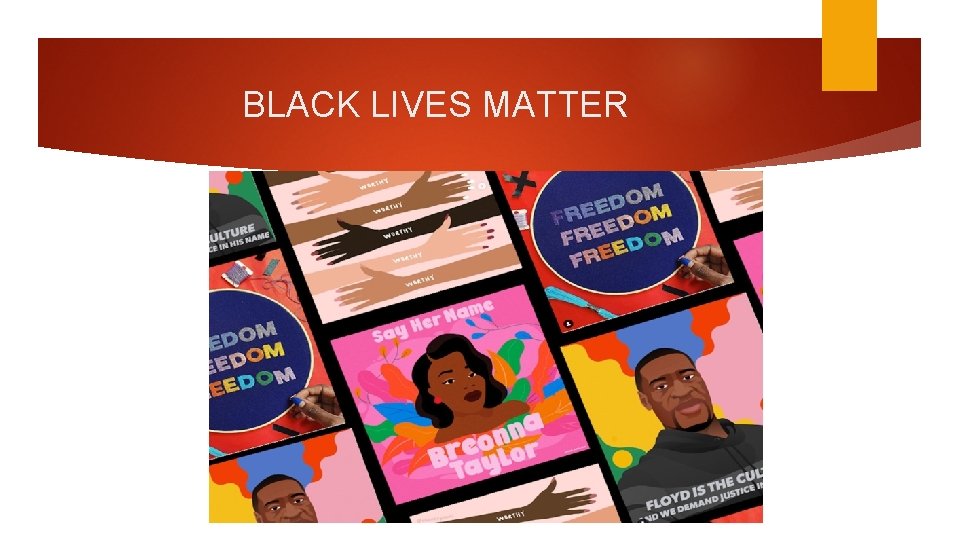
BLACK LIVES MATTER
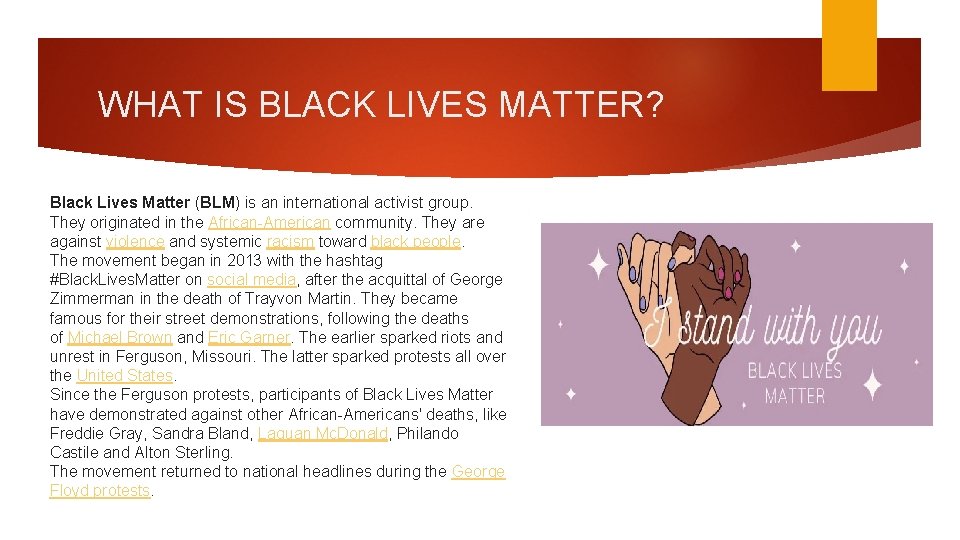
WHAT IS BLACK LIVES MATTER? Black Lives Matter (BLM) is an international activist group. They originated in the African-American community. They are against violence and systemic racism toward black people. The movement began in 2013 with the hashtag #Black. Lives. Matter on social media, after the acquittal of George Zimmerman in the death of Trayvon Martin. They became famous for their street demonstrations, following the deaths of Michael Brown and Eric Garner. The earlier sparked riots and unrest in Ferguson, Missouri. The latter sparked protests all over the United States. Since the Ferguson protests, participants of Black Lives Matter have demonstrated against other African-Americans' deaths, like Freddie Gray, Sandra Bland, Laquan Mc. Donald, Philando Castile and Alton Sterling. The movement returned to national headlines during the George Floyd protests.
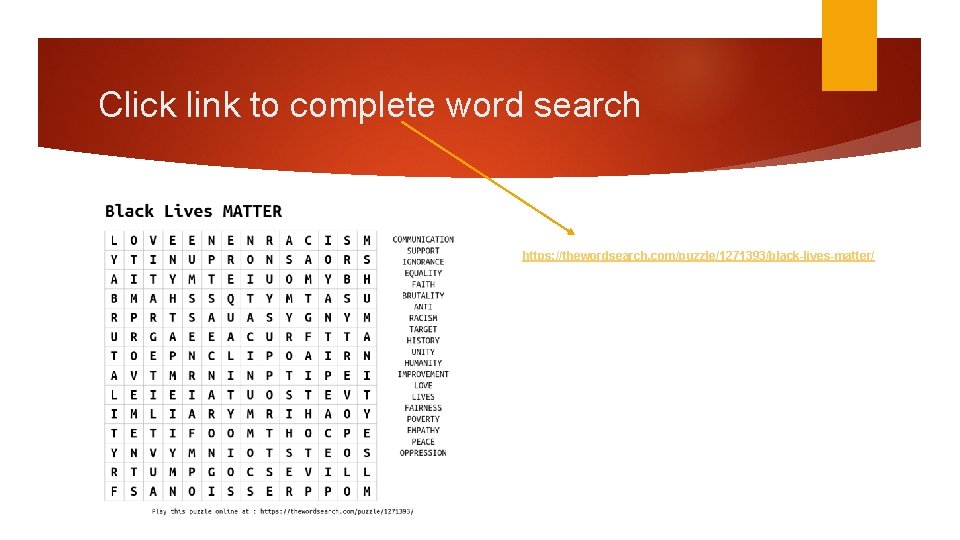
Click link to complete word search https: //thewordsearch. com/puzzle/1271393/black-lives-matter/
- Slides: 10