
Contributions of Condensable Particulate Matter to Atmospheric Organic
Contributions of Condensable Particulate Matter to Atmospheric Organic Aerosol over Japan Yu Morino, *1 Satoru Chatani, 1 Kiyoshi Tanabe, 1 Yuji Fujitani, 1 Tazuko Morikawa, 2 Katsuyuki Takahashi, 3 Kei Sato, 1 and Seiji Sugata 1 (1 National Institute for Environmental Studies, Japan, 2 Japan Automobile Research Institute, Japan, 3 Japan Environmental Sanitation Center, Japan) Environ. Sci. Technol. 2018, 52, 8456− 8466 17 th Annual CMAS Conference Friday Center, UNC-Chapel Hill, October 22 -24, 2018 Acknowledgements: This research was partly supported by the Environment Research and Technology Development Fund (5 -1408, 5 -1506, S-12 -1, and 5 -1801) of the Ministry of the Environment, Japan.

Problems of organic aerosol modeling Simulation of OA in Japan Model representation of OA Molar mass Winter Summer ~ vapor pressure Obs VBS model Two-product model Shiraiwa et al. , 2014; #1: two-product model POA #2: VBS model SOA 1 SOA 2 VOC ←west Primary. OA/SVOC SOA 1 – SOA 4 VOC l Simulation models treat OA in a very simple manner. Obs. sites east→ Morino et al. , AAQR, 2015; 1, Tsushima; 2, Fukuoka; 3, Oki; 4, Matsue; 5, Kyotango; 6, Osaka; 7, Shiga; 8, Tateyama; 9, Toyama; 10, Sado; 11, Niigata; 12, Sapporo; 13, Rishiri; l VBS model better reproduced observed OA than the traditional model, though several problems remained.

Condensable particulate matter • In the gas phase under stack conditions • Condense into PM immediately after discharge from the stack Japanese industrial standards Filterable PM Condensable PM
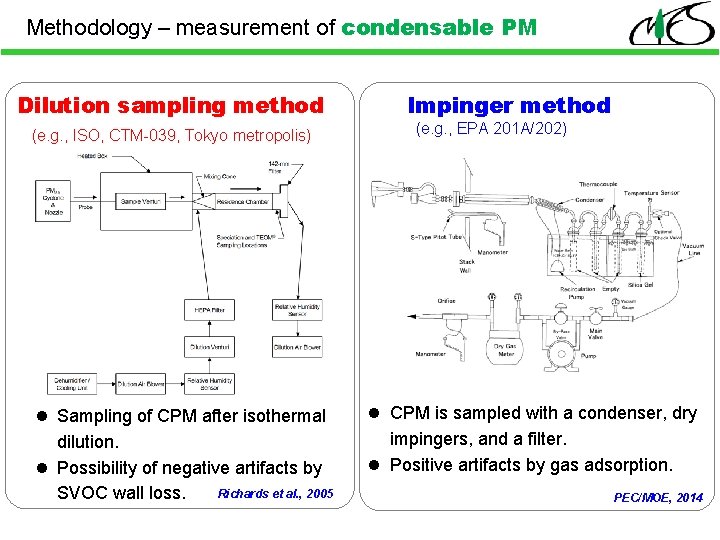
Methodology – measurement of condensable PM Dilution sampling method (e. g. , ISO, CTM-039, Tokyo metropolis) l Sampling of CPM after isothermal dilution. l Possibility of negative artifacts by Richards et al. , 2005 SVOC wall loss. Impinger method (e. g. , EPA 201 A/202) l CPM is sampled with a condenser, dry impingers, and a filter. l Positive artifacts by gas adsorption. PEC/MOE, 2014
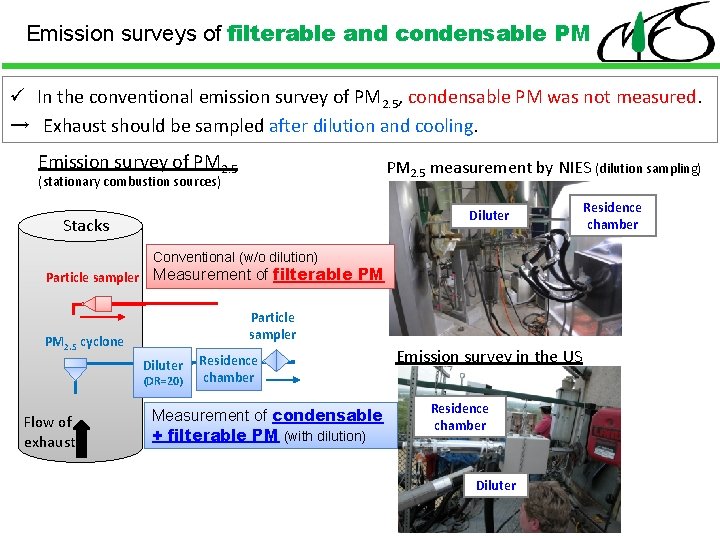
Emission surveys of filterable and condensable PM ü In the conventional emission survey of PM 2. 5, condensable PM was not measured. → Exhaust should be sampled after dilution and cooling. Emission survey of PM 2. 5 measurement by NIES (dilution sampling) (stationary combustion sources) Diluter Stacks Conventional (w/o dilution) Particle sampler Measurement of filterable PM Particle sampler PM 2. 5 cyclone Diluter (DR=20) Flow of exhaust Residence chamber Measurement of condensable + filterable PM (with dilution) Emission survey in the US Residence chamber Diluter Residence chamber
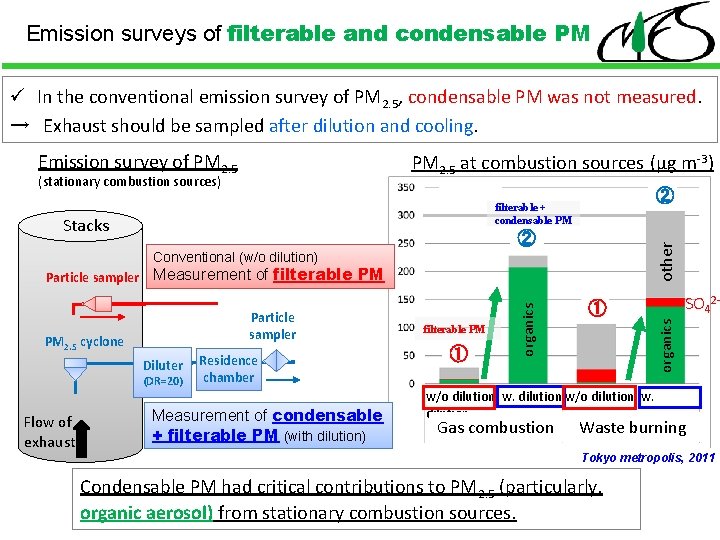
Emission surveys of filterable and condensable PM ü In the conventional emission survey of PM 2. 5, condensable PM was not measured. → Exhaust should be sampled after dilution and cooling. Emission survey of PM 2. 5 at combustion sources (μg m-3) (stationary combustion sources) ② filterable + condensable PM Stacks other ② Conventional (w/o dilution) PM 2. 5 cyclone Diluter (DR=20) Flow of exhaust Residence chamber Measurement of condensable + filterable PM (with dilution) filterable PM ① SO 42 - ① organics Particle sampler Measurement of filterable PM w/o dilution w. dilution Gas combustion Waste burning Tokyo metropolis, 2011 Condensable PM had critical contributions to PM 2. 5 (particularly, organic aerosol) from stationary combustion sources.
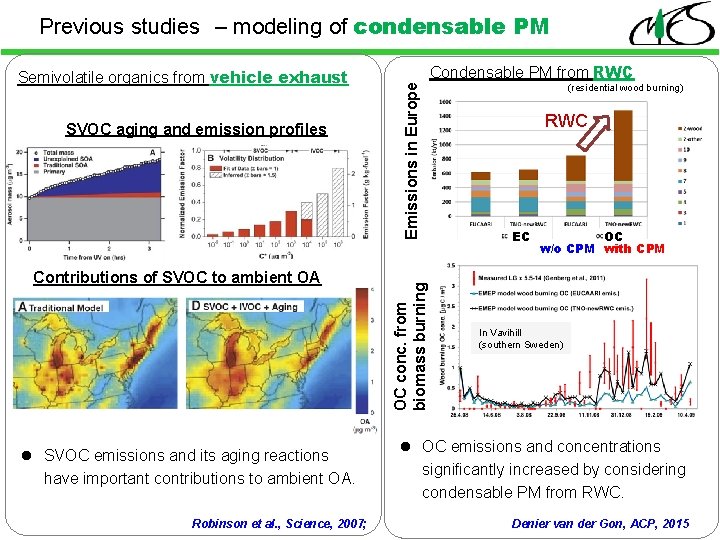
SVOC aging and emission profiles Contributions of SVOC to ambient OA l SVOC emissions and its aging reactions have important contributions to ambient OA. Robinson et al. , Science, 2007; OC conc. from biomass burning Semivolatile organics from vehicle exhaust Emissions in Europe Previous studies – modeling of condensable PM Condensable PM from RWC (residential wood burning) RWC EC OC w/o CPM with CPM In Vavihill (southern Sweden) l OC emissions and concentrations significantly increased by considering condensable PM from RWC. Denier van der Gon, ACP, 2015
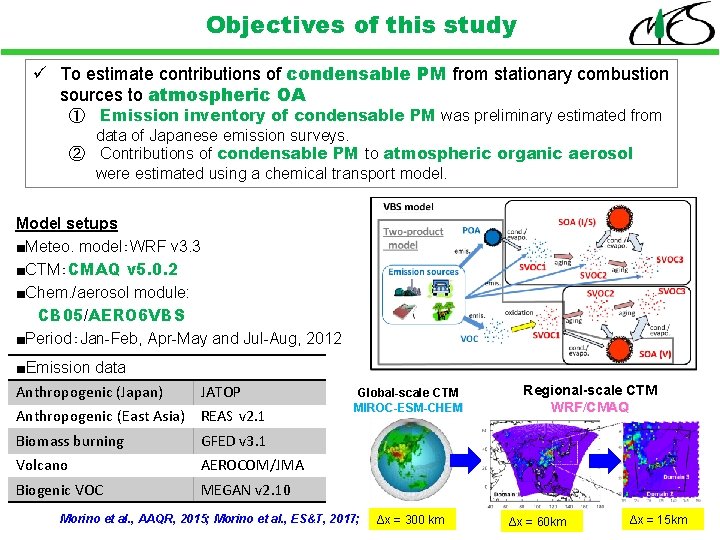
Objectives of this study ü To estimate contributions of condensable PM from stationary combustion sources to atmospheric OA ① Emission inventory of condensable PM was preliminary estimated from data of Japanese emission surveys. ② Contributions of condensable PM to atmospheric organic aerosol were estimated using a chemical transport model. Model setups ■Meteo. model:WRF v 3. 3 ■CTM:CMAQ v 5. 0. 2 ■Chem. /aerosol module: CB 05/AERO 6 VBS ■Period:Jan-Feb, Apr-May and Jul-Aug, 2012 ■Emission data Anthropogenic (Japan) JATOP Anthropogenic (East Asia) REAS v 2. 1 Biomass burning GFED v 3. 1 Volcano AEROCOM/JMA Biogenic VOC MEGAN v 2. 10 Global-scale CTM MIROC-ESM-CHEM Morino et al. , AAQR, 2015; Morino et al. , ES&T, 2017; Δx = 300 km Regional-scale CTM WRF/CMAQ Δx = 60 km Δx = 15 km
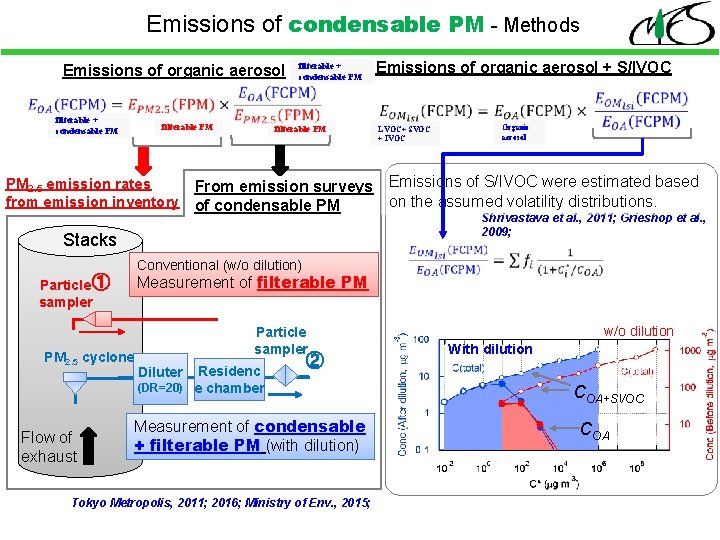
Emissions of condensable PM - Methods Emissions of organic aerosol filterable + condensable PM filterable PM PM 2. 5 emission rates From emission surveys from emission inventory of condensable PM Stacks LVOC+ SVOC + IVOC Organic aerosol Emissions of S/IVOC were estimated based on the assumed volatility distributions. Shrivastava et al. , 2011; Grieshop et al. , 2009; Conventional (w/o dilution) Measurement of filterable PM Particle ① sampler PM 2. 5 cyclone Particle sampler Diluter Residenc ② (DR=20) e chamber Flow of exhaust Emissions of organic aerosol + S/IVOC Measurement of condensable + filterable PM (with dilution) Tokyo Metropolis, 2011; 2016; Ministry of Env. , 2015; w/o dilution With dilution COA+SVOC COA
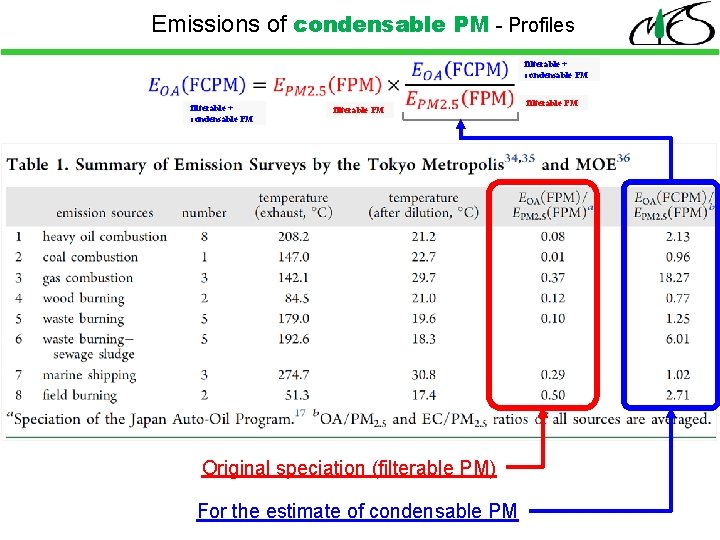
Emissions of condensable PM - Profiles filterable + condensable PM filterable PM Original speciation (filterable PM) For the estimate of condensable PM filterable PM
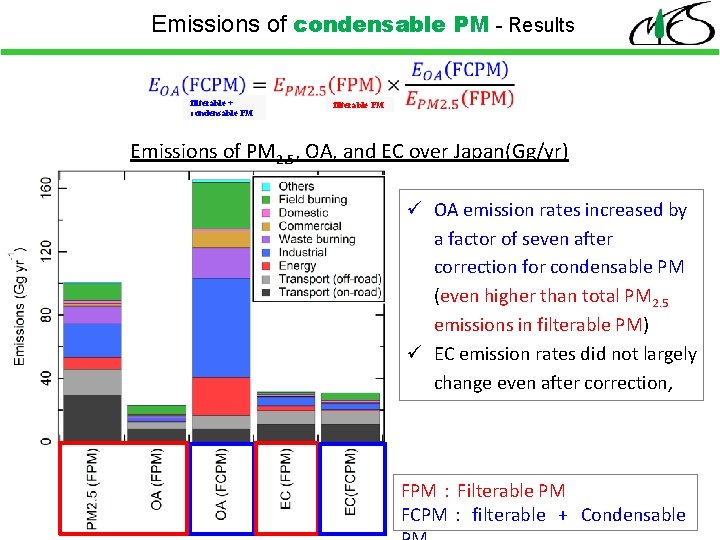
Emissions of condensable PM - Results filterable + condensable PM filterable PM Emissions of PM 2. 5, OA, and EC over Japan(Gg/yr) ü OA emission rates increased by a factor of seven after correction for condensable PM (even higher than total PM 2. 5 emissions in filterable PM) ü EC emission rates did not largely change even after correction, FPM:Filterable PM FCPM: filterable + Condensable
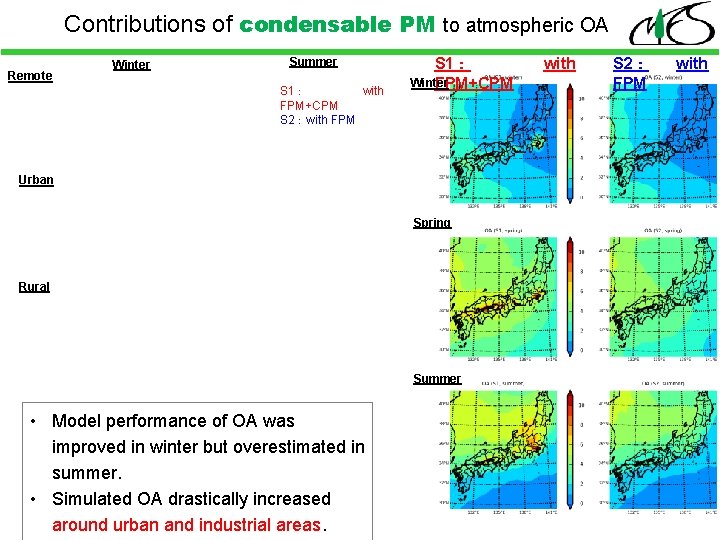
Contributions of condensable PM to atmospheric OA Remote Winter Summer S 1: with FPM+CPM S 2:with FPM S 1: Winter FPM+CPM Urban Spring Rural Summer • Model performance of OA was improved in winter but overestimated in summer. • Simulated OA drastically increased around urban and industrial areas. with S 2: FPM with
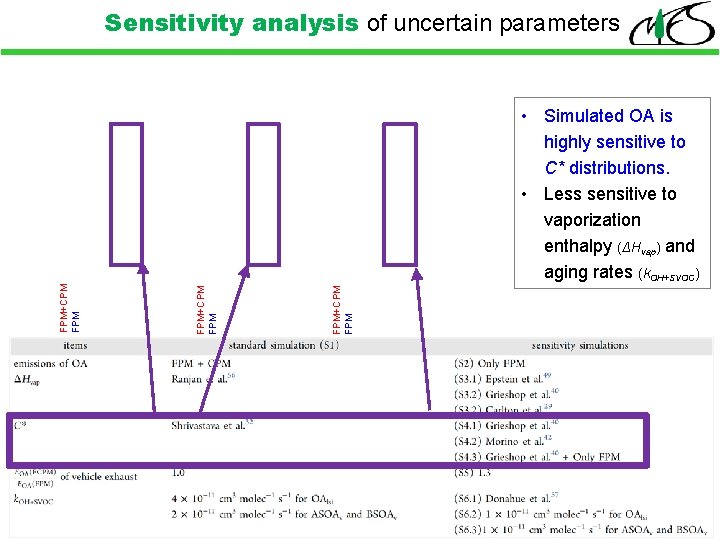
Sensitivity analysis of uncertain parameters FPM+CPM FPM • Simulated OA is highly sensitive to C* distributions. • Less sensitive to vaporization enthalpy (ΔHvap) and aging rates (k. OH+SVOC)
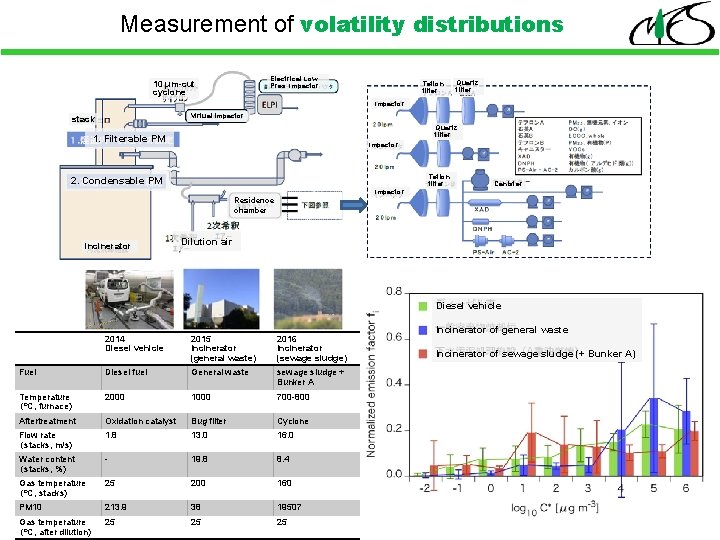
Measurement of volatility distributions Electrical Low Pres. Impactor 10 μm-cut cyclone Teflon filter Quartz filter Impactor Virtual impactor stack Quartz filter 1. Filterable PM Impactor Teflon filter 2. Condensable PM Canister Impactor Residence chamber incinerator Dilution air Diesel vehicle 2014 Diesel vehicle 2015 Incinerator (general waste) 2016 Incinerator (sewage sludge) Fuel Diesel fuel General waste sewage sludge + Bunker A Temperature (ºC, furnace) 2000 1000 700 -800 Aftertreatment Oxidation catalyst Bug filter Cyclone Flow rate (stacks, m/s) 1. 8 13. 0 16. 0 Water content (stacks, %) - 19. 8 8. 4 Gas temperature (ºC, stacks) 25 200 160 PM 10 213. 9 38 19507 Gas temperature (ºC, after dilution) 25 25 25 Incinerator of general waste Incinerator of sewage sludge (+ Bunker A)

Summary Preliminary estimate of condensable PM emissions → By considering condensable PM, OA emissions increased by a factor of seven, and stationary combustion sources in industrial or energy sector became the largest contributors to OA emissions over Japan. Simulation of CMAQ (with VBS) → By considering condensable PM, simulated OA increased by factors of 2. 5– 6. 1 in the Kanto regions. → Model performance of OA was improved in winter, but observed OA was overestimated in summer. Future works → Improvement of emission estimates by collecting emission survey data. → Evaluation of contributions of primary and secondary OA by comparing with organic tracer measurements.
- Slides: 15