
Contrasting Spatial Patterns and Ecological Attributes of Soil
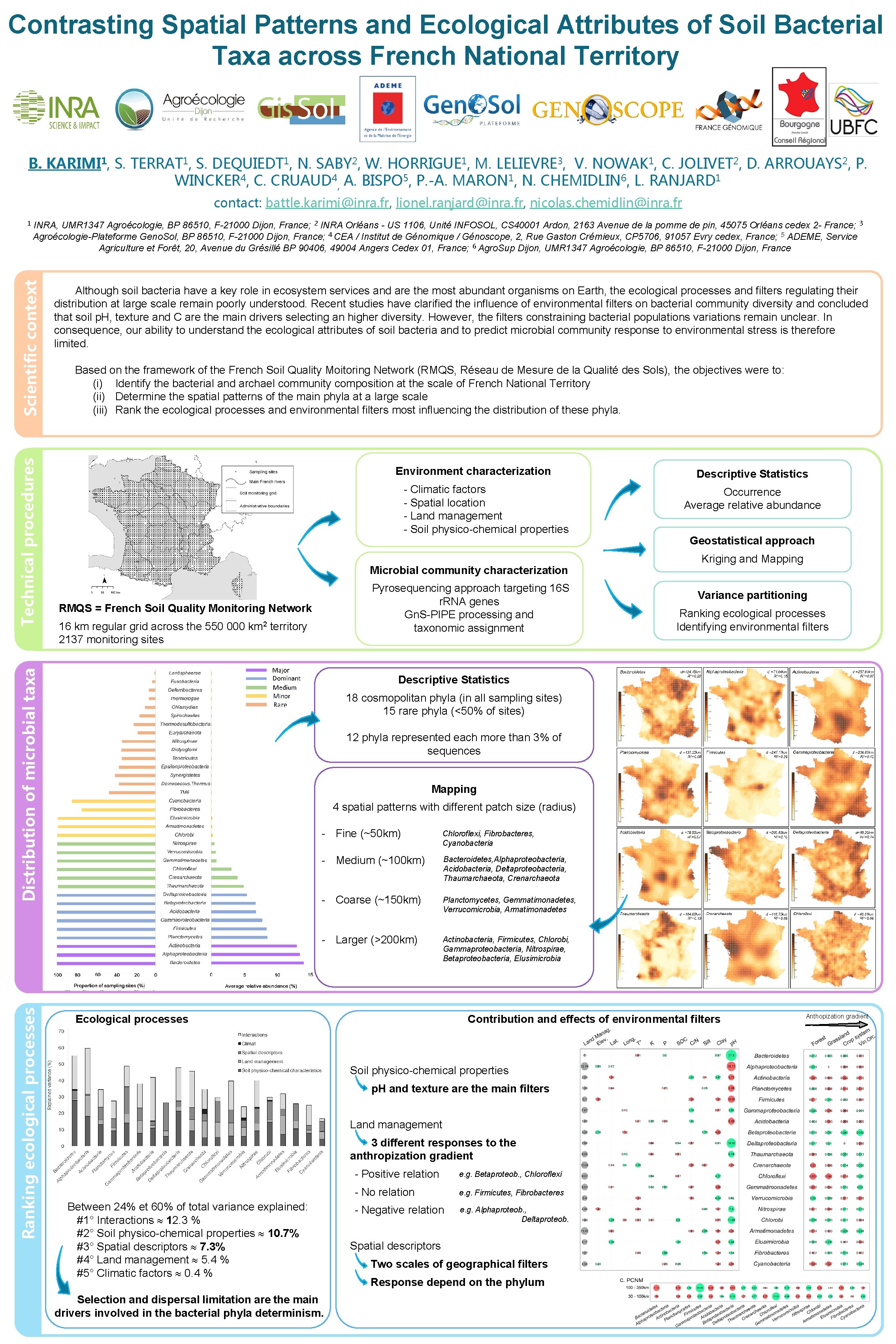
Contrasting Spatial Patterns and Ecological Attributes of Soil Bacterial Taxa across French National Territory B. KARIMI 1, S. TERRAT 1, S. DEQUIEDT 1, N. SABY 2, W. HORRIGUE 1, M. LELIEVRE 3, V. NOWAK 1, C. JOLIVET 2, D. ARROUAYS 2, P. WINCKER 4, C. CRUAUD 4, A. BISPO 5, P. -A. MARON 1, N. CHEMIDLIN 6, L. RANJARD 1 contact: battle. karimi@inra. fr, lionel. ranjard@inra. fr, nicolas. chemidlin@inra. fr INRA, UMR 1347 Agroécologie, BP 86510, F-21000 Dijon, France; 2 INRA Orléans - US 1106, Unité INFOSOL, CS 40001 Ardon, 2163 Avenue de la pomme de pin, 45075 Orléans cedex 2 - France; 3 Agroécologie-Plateforme Geno. Sol, BP 86510, F-21000 Dijon, France; 4 CEA / Institut de Génomique / Génoscope, 2, Rue Gaston Crémieux, CP 5706, 91057 Evry cedex, France; 5 ADEME, Service Agriculture et Forêt, 20, Avenue du Grésillé BP 90406, 49004 Angers Cedex 01, France; 6 Agro. Sup Dijon, UMR 1347 Agroécologie, BP 86510, F-21000 Dijon, France Although soil bacteria have a key role in ecosystem services and are the most abundant organisms on Earth, the ecological processes and filters regulating their distribution at large scale remain poorly understood. Recent studies have clarified the influence of environmental filters on bacterial community diversity and concluded that soil p. H, texture and C are the main drivers selecting an higher diversity. However, the filters constraining bacterial populations variations remain unclear. In consequence, our ability to understand the ecological attributes of soil bacteria and to predict microbial community response to environmental stress is therefore limited. Based on the framework of the French Soil Quality Moitoring Network (RMQS, Réseau de Mesure de la Qualité des Sols), the objectives were to: (i) Identify the bacterial and archael community composition at the scale of French National Territory (ii) Determine the spatial patterns of the main phyla at a large scale (iii) Rank the ecological processes and environmental filters most influencing the distribution of these phyla. Environment characterization - Climatic factors - Spatial location - Land management - Soil physico-chemical properties Microbial community characterization Ranking ecological processes Pyrosequencing approach targeting 16 S r. RNA genes Gn. S-PIPE processing and taxonomic assignment RMQS = French Soil Quality Monitoring Network 16 km regular grid across the 550 000 km 2 territory 2137 monitoring sites Distribution of microbial taxa Technical procedures Scientific context 1 Descriptive Statistics Occurrence Average relative abundance Geostatistical approach Kriging and Mapping Variance partitioning Ranking ecological processes Identifying environmental filters Descriptive Statistics 18 cosmopolitan phyla (in all sampling sites) 15 rare phyla (<50% of sites) 12 phyla represented each more than 3% of sequences Mapping 4 spatial patterns with different patch size (radius) - Fine (~50 km) Chloroflexi, Fibrobacteres, Cyanobacteria - Medium (~100 km) Bacteroidetes, Alphaproteobacteria, Acidobacteria, Deltaproteobacteria, Thaumarchaeota, Crenarchaeota - Coarse (~150 km) Planctomycetes, Gemmatimonadetes, Verrucomicrobia, Armatimonadetes - Larger (>200 km) Actinobacteria, Firmicutes, Chlorobi, Gammaproteobacteria, Nitrospirae, Betaproteobacteria, Elusimicrobia Ecological processes Contribution and effects of environmental filters Soil physico-chemical properties p. H and texture are the main filters Land management 3 different responses to the anthropization gradient Between 24% et 60% of total variance explained: #1° Interactions 12. 3 % #2° Soil physico-chemical properties 10. 7% #3° Spatial descriptors 7. 3% #4° Land management 5. 4 % #5° Climatic factors 0. 4 % Selection and dispersal limitation are the main drivers involved in the bacterial phyla determinism. - Positive relation e. g. Betaproteob. , Chloroflexi - No relation e. g. Firmicutes, Fibrobacteres - Negative relation e. g. Alphaproteob. , Deltaproteob. Spatial descriptors Two scales of geographical filters Response depend on the phylum Anthopization gradient
- Slides: 1