
CONTRACTUAL HEDGES Forward Market Hedge A forward contract
- Slides: 13
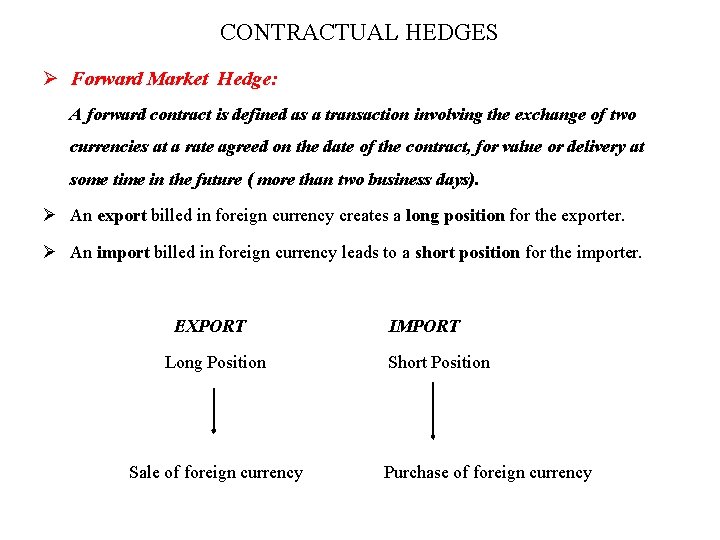
CONTRACTUAL HEDGES Ø Forward Market Hedge: A forward contract is defined as a transaction involving the exchange of two currencies at a rate agreed on the date of the contract, for value or delivery at some time in the future ( more than two business days). Ø An export billed in foreign currency creates a long position for the exporter. Ø An import billed in foreign currency leads to a short position for the importer. EXPORT Long Position Sale of foreign currency IMPORT Short Position Purchase of foreign currency
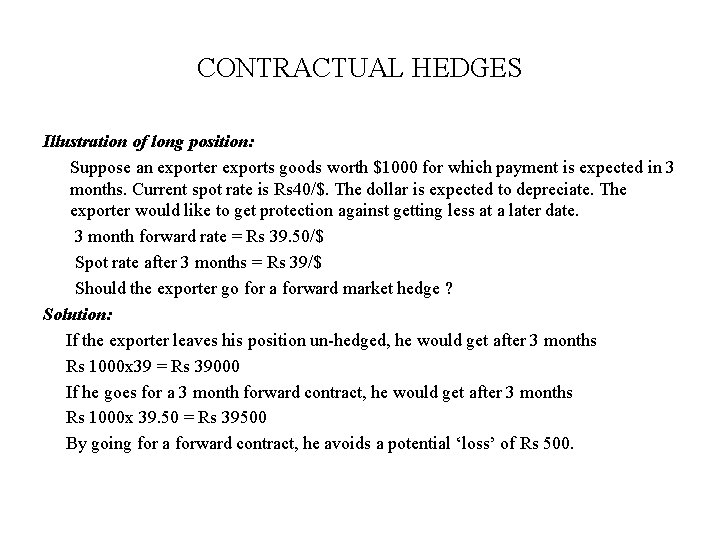
CONTRACTUAL HEDGES Illustration of long position: Suppose an exporter exports goods worth $1000 for which payment is expected in 3 months. Current spot rate is Rs 40/$. The dollar is expected to depreciate. The exporter would like to get protection against getting less at a later date. 3 month forward rate = Rs 39. 50/$ Spot rate after 3 months = Rs 39/$ Should the exporter go for a forward market hedge ? Solution: If the exporter leaves his position un-hedged, he would get after 3 months Rs 1000 x 39 = Rs 39000 If he goes for a 3 month forward contract, he would get after 3 months Rs 1000 x 39. 50 = Rs 39500 By going for a forward contract, he avoids a potential ‘loss’ of Rs 500.
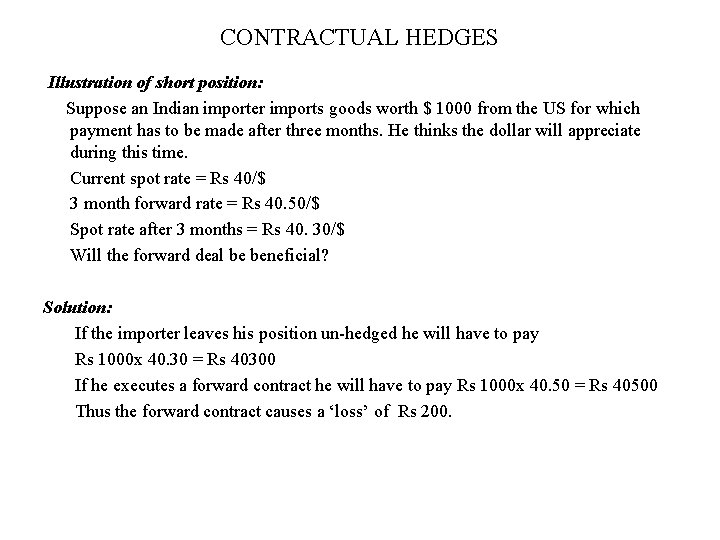
CONTRACTUAL HEDGES Illustration of short position: Suppose an Indian importer imports goods worth $ 1000 from the US for which payment has to be made after three months. He thinks the dollar will appreciate during this time. Current spot rate = Rs 40/$ 3 month forward rate = Rs 40. 50/$ Spot rate after 3 months = Rs 40. 30/$ Will the forward deal be beneficial? Solution: If the importer leaves his position un-hedged he will have to pay Rs 1000 x 40. 30 = Rs 40300 If he executes a forward contract he will have to pay Rs 1000 x 40. 50 = Rs 40500 Thus the forward contract causes a ‘loss’ of Rs 200.
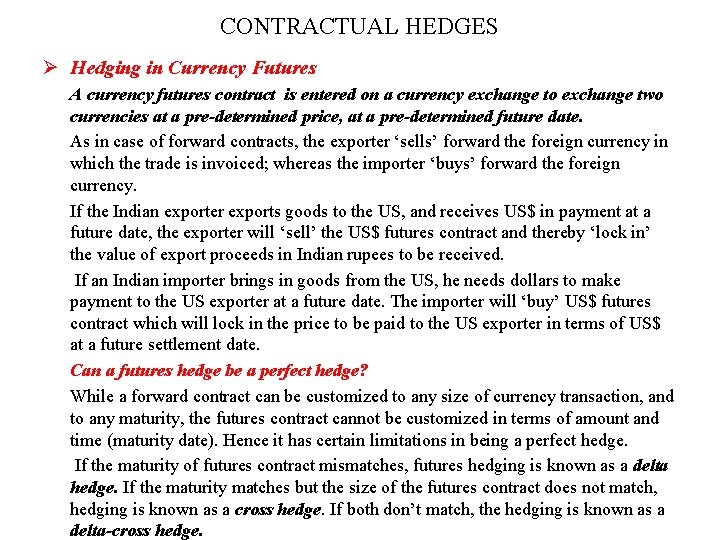
CONTRACTUAL HEDGES Ø Hedging in Currency Futures A currency futures contract is entered on a currency exchange to exchange two currencies at a pre-determined price, at a pre-determined future date. As in case of forward contracts, the exporter ‘sells’ forward the foreign currency in which the trade is invoiced; whereas the importer ‘buys’ forward the foreign currency. If the Indian exporter exports goods to the US, and receives US$ in payment at a future date, the exporter will ‘sell’ the US$ futures contract and thereby ‘lock in’ the value of export proceeds in Indian rupees to be received. If an Indian importer brings in goods from the US, he needs dollars to make payment to the US exporter at a future date. The importer will ‘buy’ US$ futures contract which will lock in the price to be paid to the US exporter in terms of US$ at a future settlement date. Can a futures hedge be a perfect hedge? While a forward contract can be customized to any size of currency transaction, and to any maturity, the futures contract cannot be customized in terms of amount and time (maturity date). Hence it has certain limitations in being a perfect hedge. If the maturity of futures contract mismatches, futures hedging is known as a delta hedge. If the maturity matches but the size of the futures contract does not match, hedging is known as a cross hedge. If both don’t match, the hedging is known as a delta-cross hedge.
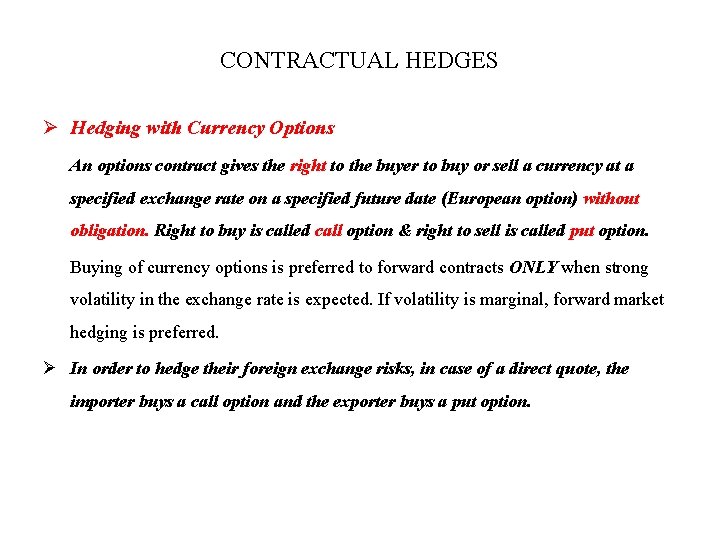
CONTRACTUAL HEDGES Ø Hedging with Currency Options An options contract gives the right to the buyer to buy or sell a currency at a specified exchange rate on a specified future date (European option) without obligation. Right to buy is called call option & right to sell is called put option. Buying of currency options is preferred to forward contracts ONLY when strong volatility in the exchange rate is expected. If volatility is marginal, forward market hedging is preferred. Ø In order to hedge their foreign exchange risks, in case of a direct quote, the importer buys a call option and the exporter buys a put option.
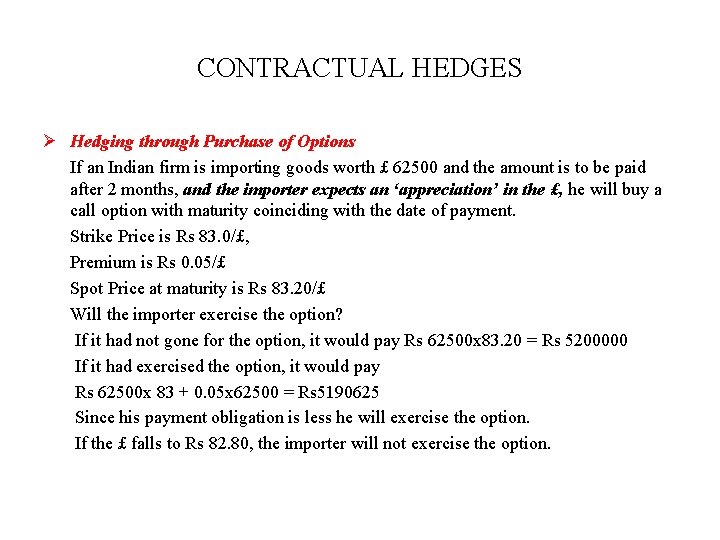
CONTRACTUAL HEDGES Ø Hedging through Purchase of Options If an Indian firm is importing goods worth £ 62500 and the amount is to be paid after 2 months, and the importer expects an ‘appreciation’ in the £, he will buy a call option with maturity coinciding with the date of payment. Strike Price is Rs 83. 0/£, Premium is Rs 0. 05/£ Spot Price at maturity is Rs 83. 20/£ Will the importer exercise the option? If it had not gone for the option, it would pay Rs 62500 x 83. 20 = Rs 5200000 If it had exercised the option, it would pay Rs 62500 x 83 + 0. 05 x 62500 = Rs 5190625 Since his payment obligation is less he will exercise the option. If the £ falls to Rs 82. 80, the importer will not exercise the option.
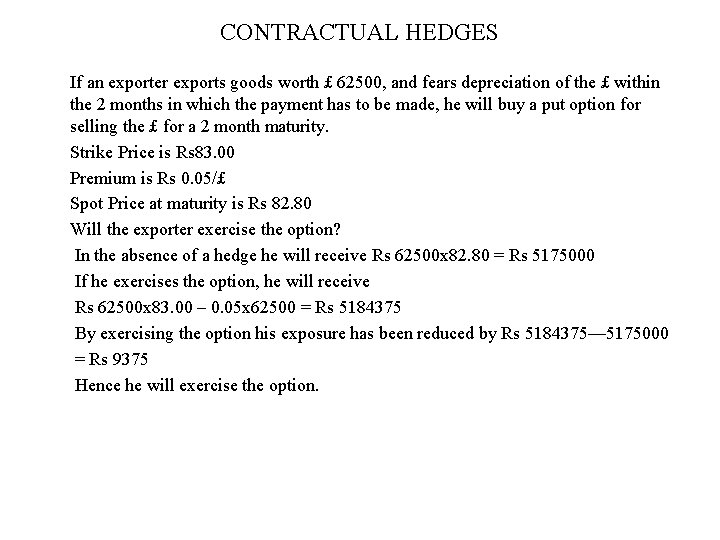
CONTRACTUAL HEDGES If an exporter exports goods worth £ 62500, and fears depreciation of the £ within the 2 months in which the payment has to be made, he will buy a put option for selling the £ for a 2 month maturity. Strike Price is Rs 83. 00 Premium is Rs 0. 05/£ Spot Price at maturity is Rs 82. 80 Will the exporter exercise the option? In the absence of a hedge he will receive Rs 62500 x 82. 80 = Rs 5175000 If he exercises the option, he will receive Rs 62500 x 83. 00 – 0. 05 x 62500 = Rs 5184375 By exercising the option his exposure has been reduced by Rs 5184375— 5175000 = Rs 9375 Hence he will exercise the option.
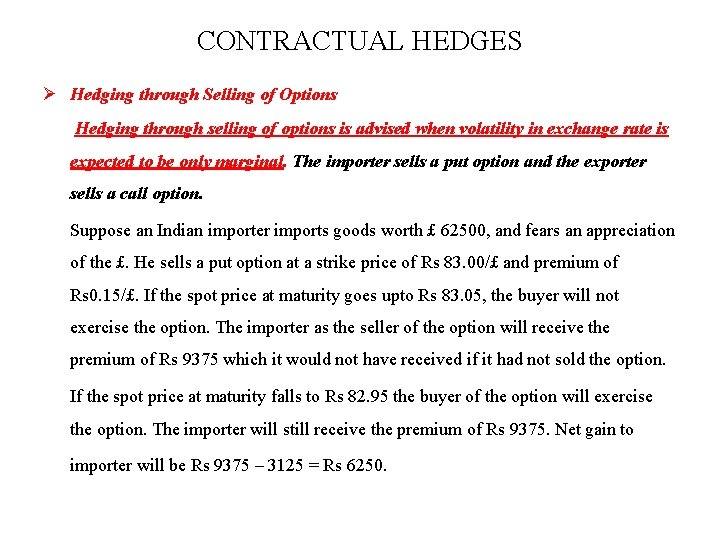
CONTRACTUAL HEDGES Ø Hedging through Selling of Options Hedging through selling of options is advised when volatility in exchange rate is expected to be only marginal. The importer sells a put option and the exporter sells a call option. Suppose an Indian importer imports goods worth £ 62500, and fears an appreciation of the £. He sells a put option at a strike price of Rs 83. 00/£ and premium of Rs 0. 15/£. If the spot price at maturity goes upto Rs 83. 05, the buyer will not exercise the option. The importer as the seller of the option will receive the premium of Rs 9375 which it would not have received if it had not sold the option. If the spot price at maturity falls to Rs 82. 95 the buyer of the option will exercise the option. The importer will still receive the premium of Rs 9375. Net gain to importer will be Rs 9375 – 3125 = Rs 6250.
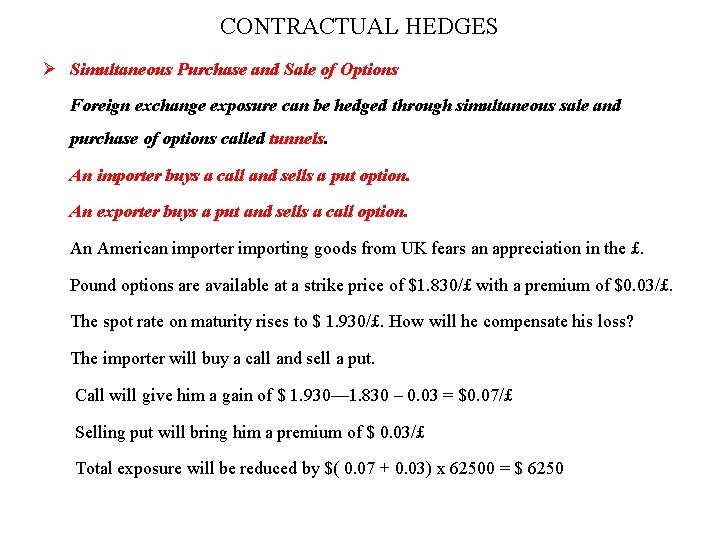
CONTRACTUAL HEDGES Ø Simultaneous Purchase and Sale of Options Foreign exchange exposure can be hedged through simultaneous sale and purchase of options called tunnels. An importer buys a call and sells a put option. An exporter buys a put and sells a call option. An American importer importing goods from UK fears an appreciation in the £. Pound options are available at a strike price of $1. 830/£ with a premium of $0. 03/£. The spot rate on maturity rises to $ 1. 930/£. How will he compensate his loss? The importer will buy a call and sell a put. Call will give him a gain of $ 1. 930— 1. 830 – 0. 03 = $0. 07/£ Selling put will bring him a premium of $ 0. 03/£ Total exposure will be reduced by $( 0. 07 + 0. 03) x 62500 = $ 6250
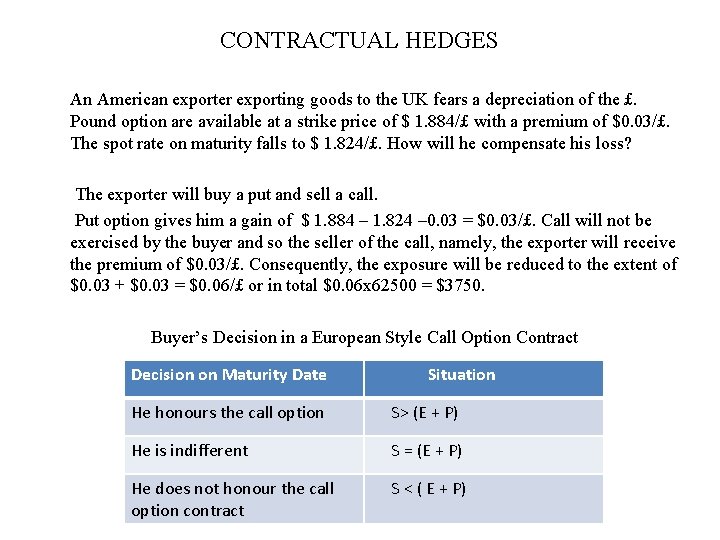
CONTRACTUAL HEDGES An American exporter exporting goods to the UK fears a depreciation of the £. Pound option are available at a strike price of $ 1. 884/£ with a premium of $0. 03/£. The spot rate on maturity falls to $ 1. 824/£. How will he compensate his loss? The exporter will buy a put and sell a call. Put option gives him a gain of $ 1. 884 – 1. 824 – 0. 03 = $0. 03/£. Call will not be exercised by the buyer and so the seller of the call, namely, the exporter will receive the premium of $0. 03/£. Consequently, the exposure will be reduced to the extent of $0. 03 + $0. 03 = $0. 06/£ or in total $0. 06 x 62500 = $3750. Buyer’s Decision in a European Style Call Option Contract Decision on Maturity Date Situation He honours the call option S> (E + P) He is indifferent S = (E + P) He does not honour the call option contract S < ( E + P)
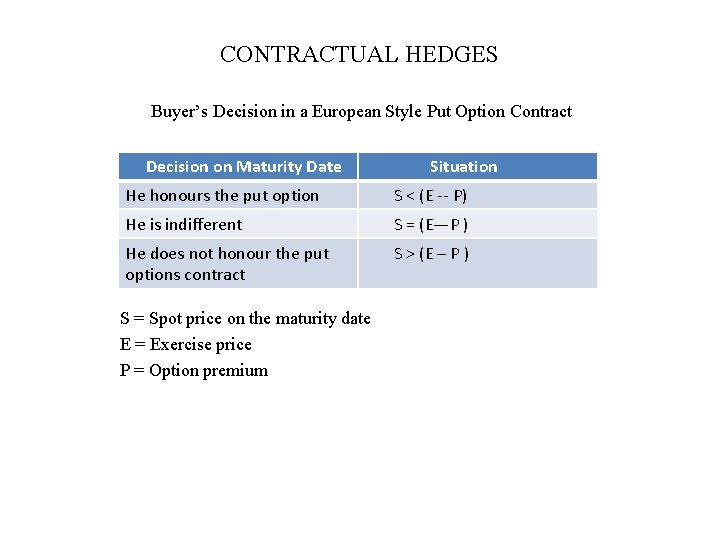
CONTRACTUAL HEDGES Buyer’s Decision in a European Style Put Option Contract Decision on Maturity Date Situation He honours the put option S < (E -- P) He is indifferent S = (E—P ) He does not honour the put options contract S > (E – P ) S = Spot price on the maturity date E = Exercise price P = Option premium
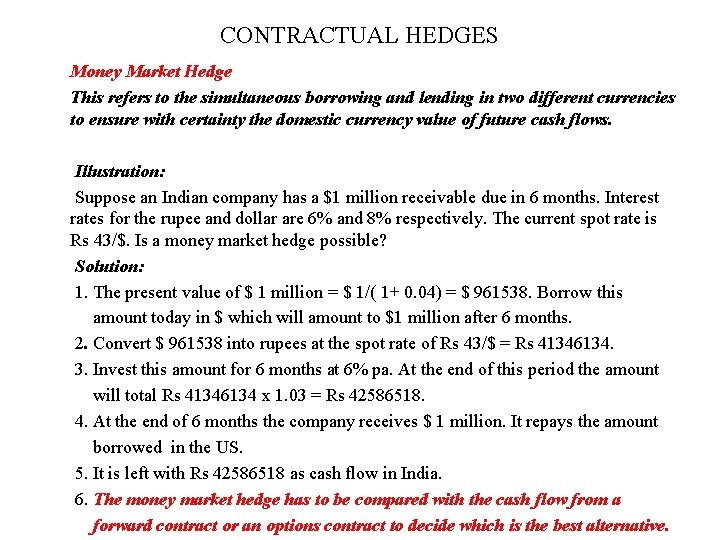
CONTRACTUAL HEDGES Money Market Hedge This refers to the simultaneous borrowing and lending in two different currencies to ensure with certainty the domestic currency value of future cash flows. Illustration: Suppose an Indian company has a $1 million receivable due in 6 months. Interest rates for the rupee and dollar are 6% and 8% respectively. The current spot rate is Rs 43/$. Is a money market hedge possible? Solution: 1. The present value of $ 1 million = $ 1/( 1+ 0. 04) = $ 961538. Borrow this amount today in $ which will amount to $1 million after 6 months. 2. Convert $ 961538 into rupees at the spot rate of Rs 43/$ = Rs 41346134. 3. Invest this amount for 6 months at 6% pa. At the end of this period the amount will total Rs 41346134 x 1. 03 = Rs 42586518. 4. At the end of 6 months the company receives $ 1 million. It repays the amount borrowed in the US. 5. It is left with Rs 42586518 as cash flow in India. 6. The money market hedge has to be compared with the cash flow from a forward contract or an options contract to decide which is the best alternative.
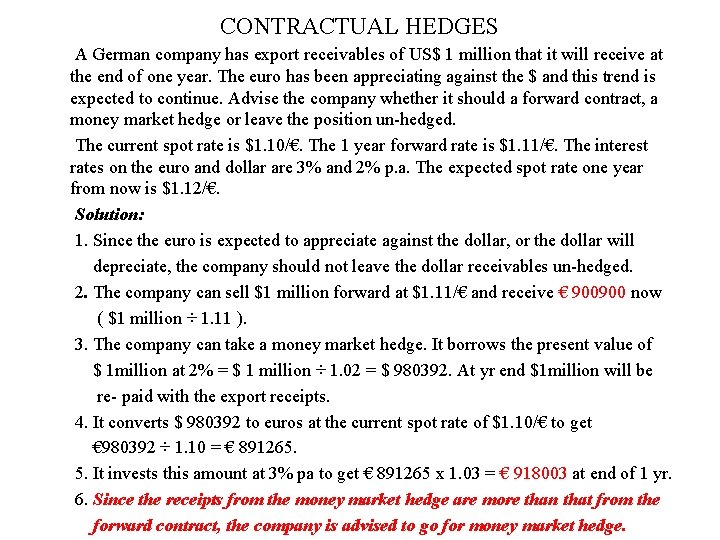
CONTRACTUAL HEDGES A German company has export receivables of US$ 1 million that it will receive at the end of one year. The euro has been appreciating against the $ and this trend is expected to continue. Advise the company whether it should a forward contract, a money market hedge or leave the position un-hedged. The current spot rate is $1. 10/€. The 1 year forward rate is $1. 11/€. The interest rates on the euro and dollar are 3% and 2% p. a. The expected spot rate one year from now is $1. 12/€. Solution: 1. Since the euro is expected to appreciate against the dollar, or the dollar will depreciate, the company should not leave the dollar receivables un-hedged. 2. The company can sell $1 million forward at $1. 11/€ and receive € 900900 now ( $1 million ÷ 1. 11 ). 3. The company can take a money market hedge. It borrows the present value of $ 1 million at 2% = $ 1 million ÷ 1. 02 = $ 980392. At yr end $1 million will be re- paid with the export receipts. 4. It converts $ 980392 to euros at the current spot rate of $1. 10/€ to get € 980392 ÷ 1. 10 = € 891265. 5. It invests this amount at 3% pa to get € 891265 x 1. 03 = € 918003 at end of 1 yr. 6. Since the receipts from the money market hedge are more than that from the forward contract, the company is advised to go for money market hedge.