
CONTRACTOR DEVELOPMENT IN THE DPRT IMPLEMENTATION PLAN BACKGROUND

CONTRACTOR DEVELOPMENT IN THE DPRT IMPLEMENTATION PLAN
BACKGROUND TO THE CDP • • The contractor development programme ( CDP ) of the department is based on the 2007 CDP policy document. In 2007 the department took a strategic decision to build and enhance the capacity of the construction industry. The CDP is a strategic intervention by the department intended to redress the intentional and systematic exclusion of previously disadvantaged individuals. The objectives of CDP: • • Builds capacity by investing in human resources through skills development and training in order to create a sustainable economic climate in the Free State Province. Makes opportunities available for previously disadvantaged persons and also actively encourage their participation in the provincial economy. Alleviate poverty with job creation in local communities. Deliver public infrastructure using labour intensive technology.
BACKGROUND TO THE CDP • • • Four programmes of the Department in the recent past were not concluded in full – the Vuk’Uphile, Makwane, CDP 08 and CDP 10. In Vuk’Uphile and Makwane learner contractors have completed the learnership training but did not exit the programme through the Exit Strategy. The learner contractors of the CDP 08 and CDP 10 have not completed the learnership training and should complete the whole programme. A total number of 186 learner contractors were invited in April 2011 to become compliant regarding all relevant legislation before 30 September 2011 and only 135 succeeded. The CDP 2011 will consist of a Learnership Pool (105) and a Exit Strategy Pool (20). The budget for 2011/12 is R 80 m.

OVERVIEW OF THE CONTRACTOR DEVELOPMENT PROGRAMME • • • The Programme will be fully compliant to all legislation, conditions of contract and the Contractor Development Policy of 2007. It will be an integrated management approach from the HOD down to the supervisor on the ground and will also include other stakeholders outside the Department. Will be a “give and take” process whereby the Department provides capacity building, assistance and opportunities for the learner contractor and the learner contractor diligently applies these skills and knowledge to deliver an acceptable product (work). The Programme aims to nurture and promote the entrepreneurial spirit of the learner contractors and guide them to self-reliance as soon as possible. The Programme structure will be integrated with the current execution structure of the Department.
IMPLEMENTATION STRUCTURES • Management Committee: • Compliance Committee. • Steering Committee. • • Will formulate implementation policy. Source programme budget. Role clarification. Resolve policy matters. Draft compliance policies. Review the compliance of Contractors on an ongoing basis. Deal with cases of non-compliance. • Plan and manage the programme on the short and medium term. • Implement policy matters. • Coordinate actions in the province amongst regions.
MENTORING MODEL • Based on train the trainer. • Utilize the technical knowledge in the department. • Empower the officials while implementing. • The aim is to see the learner as self-reliant as soon as possible.

PROGRAMME STRUCTURE Programme Manager: Director: Road Infrastructure Construction and Maintenance Chief Mentor Social Facilitation Unit Representatives of NDPW and PDPW, CETA and Prov. Treasury CDP Coordinator Engineer: Chief Engineer Region Engineer’s Representative: District Road Superintendent Project Mentor Learner Contractor Training Service Provider and Kroonstad Training Centre

PROGRAMME MANAGER • Spearhead and lead the programme. • Provide direction regarding general planning as well as the achievement of the objectives of the programme. • Facilitates the clearance of implementation obstacles. • Finalise scope of works for different phase contracts.
SOCIAL FACILITATION UNIT • Prepare communities for the implementation of the project or programme. • Establish relevant structures to assist the contractor to communicate with the community. • Put in place systems, mechanisms and procedures for • • • sourcing labour from communities and to appoint PLO’s. Check compliance with regard to job creation in terms of EPWP guidelines. Facilitate and support technical team in the execution of the work. Facilitates and mediate task establishment for the learner contractor.
CDP COORDINATOR l Provide guidance to Engineers. l Monitor implementation progress in Regions. l Ensure that standards and method statements are the same in all Regions. l Cross pollinate workable solutions between Regions. l Ensure implementation of measures prescribed by Management Committee. l Ensure compliance to procedures, processes and requirements. l Manage the training programme. l Monthly reports on each contractor’s work and financial progress. l Coordinate technical, administrative and financial audits on work complete.

MENTORING l Assist and provide guidance on implementing of the programme to Programme Manager, CDP Coordinator and Regional Engineers. l Development of implementation guidelines according to the relevant policies. l Assess implementation processes on an ongoing basis and suggest improvements. l Provide guidance to institute quality control measures for each activity and the approval/disapproval of work on this basis. l Monitor efficiency and effectiveness of the quality control systems employed by Engineers and Learner Contractors. l Provide the extra capacity that Head Office might lack to perform audits. l Transfer project management skills and contract administrative skills to Regional Engineers, Road Superintendents and Road Foremen.
REGIONAL ENGINEERS l l l l l The Regional Engineer is the Engineer in terms of GCC 10 for all the projects in his Region. He will appoint an Engineer’s Representative (ER) in terms of GCC 10 who will be the Road Superintendent of the District in which the project is performed. The Engineer will have all the typical powers as described in GCC 10. Will clarify as well as approve/disapprove work. Monitor the contractor’s programme. Administer and report on construction progress. Manage the contracts and monitor compliance. Verify the contractor’s measurement. Administer site meetings. Administer contract terms and conditions.

LEARNER CONTRACTOR l l l The Contractor will execute the Works. Price the works. Is responsible for the correctness of the setting out of the works (position, levels, dimensions and alignment). The Contractor will provide all the necessary instruments, appliances and labour necessary for setting out the works. Adhere to the standards and conditions of the programme as described in the MOA. Take full responsibility for the site as soon as possible. Employ the local workers. Arrange for training of workers. Procure/operate/administer equipment and material. Complete the projects and therefore the learnership. Arrange and manage the finances of the projects.
TRAINING SERVICE PROVIDERS l l The Training Service Provider (TSP) will provide training for the principals of the learner contractors in the learnerships in Kroonstad and Bloemfontein. The TSP will monitor how the principals apply the skills acquired during the classroom training sessions. The Kroonstad Training Centre (KTC) will provide the normal Road Foremen training to the first line supervisors as well as the technical training to the workers of the learner contractors. The trainers of KTC will do follow up work on the trainees when the projects commences in order to ensure that the skills acquired during training are applied correctly.
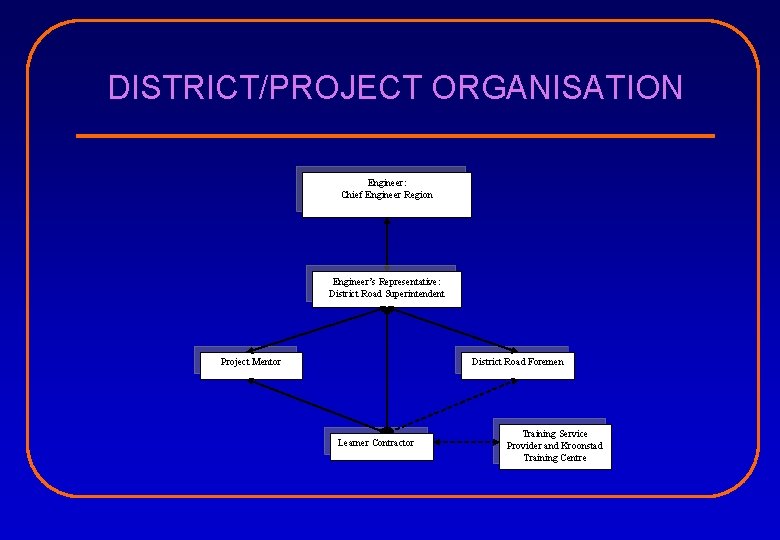
DISTRICT/PROJECT ORGANISATION Engineer: Chief Engineer Region Engineer’s Representative: District Road Superintendent Project Mentor District Road Foremen Learner Contractor Training Service Provider and Kroonstad Training Centre
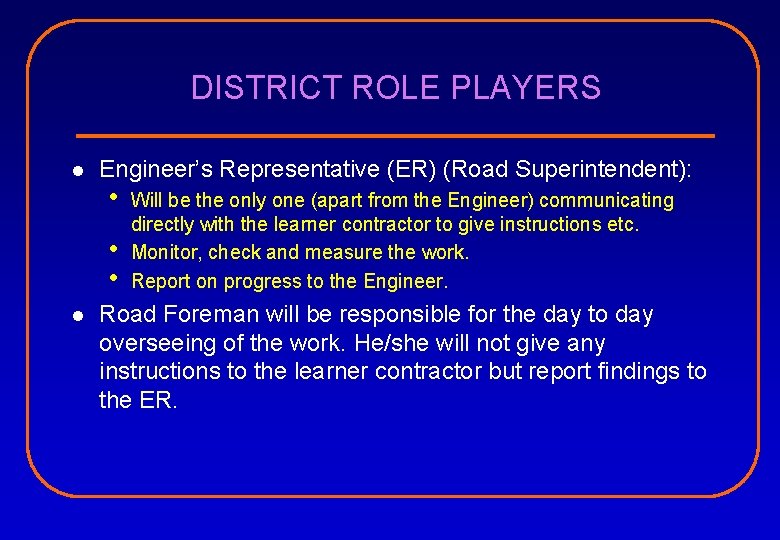
DISTRICT ROLE PLAYERS l Engineer’s Representative (ER) (Road Superintendent): • • • l Will be the only one (apart from the Engineer) communicating directly with the learner contractor to give instructions etc. Monitor, check and measure the work. Report on progress to the Engineer. Road Foreman will be responsible for the day to day overseeing of the work. He/she will not give any instructions to the learner contractor but report findings to the ER.
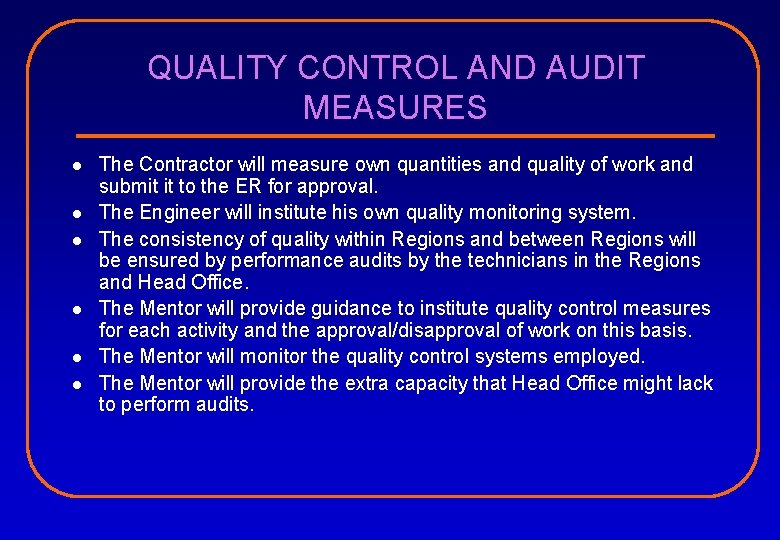
QUALITY CONTROL AND AUDIT MEASURES l l l The Contractor will measure own quantities and quality of work and submit it to the ER for approval. The Engineer will institute his own quality monitoring system. The consistency of quality within Regions and between Regions will be ensured by performance audits by the technicians in the Regions and Head Office. The Mentor will provide guidance to institute quality control measures for each activity and the approval/disapproval of work on this basis. The Mentor will monitor the quality control systems employed. The Mentor will provide the extra capacity that Head Office might lack to perform audits.
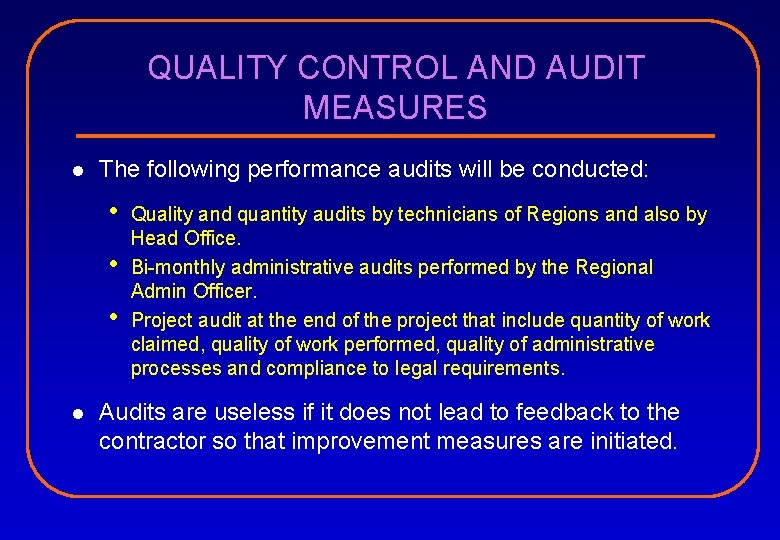
QUALITY CONTROL AND AUDIT MEASURES l The following performance audits will be conducted: • • • l Quality and quantity audits by technicians of Regions and also by Head Office. Bi-monthly administrative audits performed by the Regional Admin Officer. Project audit at the end of the project that include quantity of work claimed, quality of work performed, quality of administrative processes and compliance to legal requirements. Audits are useless if it does not lead to feedback to the contractor so that improvement measures are initiated.

TYPICAL LEARNERSHIP PROGRAMME Year 1 Training Project 1 Training Year 2 Project 2 Training Project 3 Three sessions of classroom training of 2 months or 8 weeks each. Project 1 The first phase project of 4 months. Project 2 The second phase project of 6 months. Project 3 The third phase project of 8 months.
COMMENCEMENT OF CDP 2011 l CDP consist of a learnership as well as a exit strategy for each learner contractor as indicated in the directive of National Treasury of 28 October 2003. l There a number of learner contractors on the programme who have qualified in the CC 02 learnership but there also those without it. l The learner contractors with the CC 02 qualification will enter the Exit Strategy part of the programme. l The Exit Strategy will consist of two pools of learner contractors – an Exit Pool and a Restoration Pool. l The learner Contractors without the CC 02 qualification will do the learnership training programme before they are allowed into the Exit Strategy.
COMMENCEMENT OF CDP 2011 l l l l All the Learner Contractors in the CDP 2011 group who has not completed the CCO 2 learnership will start the learnership with the 8 weeks classroom training. All Learner Contractors will follow the typical learnership programme where three sessions of 8 weeks classroom training is followed by a project. The Learner Contractors who has completed the learnership will have a 4 CEPE CIDB grading and will be put in the Exit Pool of learner contractors along with the Vuk’Uphile and Makwane Learner Contractors. The Learner Contractors that have lost their 4 CEPE CIDB grading due to the suspension of the Exit Strategy will enter the Restoration Pool of the Exit Strategy. The Learner Contractors who came from the Makwane Programme who have not completed 3 projects will also enter the Restoration Pool. As soon as a learner contractor is graded 4 CE by the CIDB he will leave the Restoration Pool and enter the Exit Pool. In the Exit Pool the Learner Contractors will tender in a controlled environment until they secured a project and will then leave the programme.
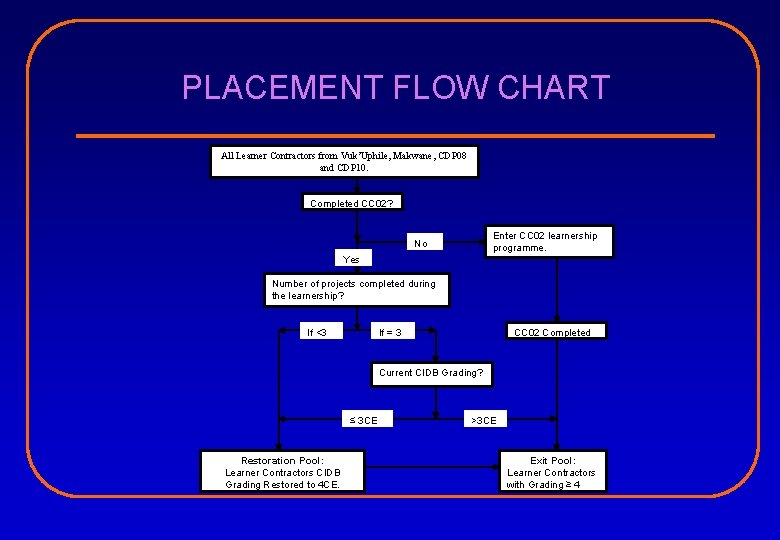
PLACEMENT FLOW CHART All Learner Contractors from Vuk’Uphile, Makwane, CDP 08 and CDP 10. Completed CC 02? Enter CC 02 learnership programme. No Yes Number of projects completed during the learnership? If <3 If = 3 CC 02 Completed Current CIDB Grading? ≤ 3 CE Restoration Pool: Learner Contractors CIDB Grading Restored to 4 CE. >3 CE Exit Pool: Learner Contractors with Grading ≥ 4
THE EXIT STRATEGY OF LEARNER CONTRACTORS l l l The main objective in the Exit Strategy is to empower the Learner Contractors to tender independently as well as to nurture the entrepreneurial spirit of the Learner Contractors will be trained as part of the site clarification meeting in order to prepare them for the work that they will be tendering for. The tenders are released 2 weeks apart. In the controlled bidding environment the normal formal tender processes will be followed (with a closing time and a tender box etc. ) The scope of work and CIDB grading limitation (project budget etc) will guide the determining of a suitable project for a particular group. The release of tenders in the different grading groups and in the two pools will run concurrently.
EXIT STRATEGY: SITE CLARIFICATION l l l Learner contractors receive a full explanation of the conditions of tender and are guided through the requirements in terms of the “returnable documents”. The general conditions of contract, general specifications as well as the project specifications for the specific tender is discussed. The learner contractor will receive method statements (best practice) for the key activities. Photos of the work to be performed are presented. The learner contractor is guided on calculation of tender rates for the particular project. After the project was awarded the unsuccessful bidders will receive feedback on the shortcomings of their own bids.

CONTRACTOR CDP ALLOCATION LEARNER CONTRACTORS PER REGION Number of Learner Contractors Non-Compliant To be Trained Exit Strategy Xhariep 51 5 46 43 3 Mangaung 47 13 34 24 10 Fezile Dabi 21 6 15 13 2 Lejweleputsa 14 5 9 8 1 TM 53 15 38 17 21 Total 186 44 142 105 37 Region

CONTRACTOR CDP ALLOCATION Programme Exit Strategy CC 02 Total Makwane 19 1 20 Vuk' Uphile 16 0 16 CDP 08 2 55 57 CDP 10 0 49 49 Total 37 105 142

CIDB GRADINGS IN EXIT STRATEGY CONTRACTORS CIDB Grading Makwane Vuk' Uphile CDP 08 1 CE 9 7 2 CE 6 3 3 CE 2 4 CE 1 5 CE CDP 10 Total 16 9 2 3 2 6 2 2 6 CE 1 1 2 Total 19 16 0 37 2
TRAINING: IN PHASE 1 l l l In total 105 learners have attended the training sessions and 3589 training days were provided to the group. The pre-selection testing were done and 18 learners tested below 40%. The testing group consisted of the following: • • Male > 35 years: Female > 35 years: Male < 35 years: 49 Female < 35 years: 30 10 16
TRAINING: UNIT STANDARDS COMPLETED IN PHASE 1 l l l l 9964: Apply Health and Safety to a Work Area (13 NYC). 9985: Implement Construction Site Management Procedure (21 NYC). 114921: Apply Labour Intensive Construction Systems and Techniques to do Work Activities (15 NYC). 114916: Apply Labour Intensive Construction Methods to Construct and Maintain Roads and Storm Water Drainage (26 NYC). 114930: Use Labour Intensive Construction Methods to Construct, Repair and Maintain Structures (29 NYC). 114917: Use Labour Intensive Construction Methods to Construct, Repair and Maintain Water and Sanitation Services (28 NYC). 9981 Tender for Construction Projects (38 NYC).

REQUIREMENTS TO START ANY PROJECT IN THE CDP l l l l Valid letter of “Good Standing” for the Compensation Fund. A letter of confirmation from DOL that the particular company as employer complies to all labour legislation. Active CIDB grading. Valid tax clearance certificate. VAT registration. Company income tax registration. Active registration at CIPC.
TIME LINE FOR LEARNERSHIP CONTRACTORS • • • Road shows were concluded on 21 and 22 June 2011. The CUT has registered 105 students on 21 and 22 September 2011. Arrangements for monthly payment of stipends before 30 September 2011. A MOA was signed with the principal of each company in the learnership on registration. Training commenced in Bloemfontein and Kroonstad on 26 September 2011. Compliance of each learner company was finalised on 28 September 2011. The learners were uploaded on CETA website from 25 November 2011 until 4 December 2011. The project budget, scope and location for each learner were identified 31 October 2011. All the tender documents were available from 12 November 2012.
TIME LINE FOR LEARNERSHIP CONTRACTORS • • • Ø Social facilitation commenced on 21 July 2011 based on the scope and location of projects. • 29 briefing sessions were held in 21 towns • 26 preparatory meetings in 16 towns. • 12 stakeholder forum and PSC meetings in 12 towns On 31 January 2012 a total of 101 tenders were priced, negotiated and finalised as offers. HOD has signed 101 contracts to date. Three contracts not yet in offer stage (to be submitted to the HOD) because of compliance difficulties. Will be concluded before 29 February 2012. Appointment letters will be received with site handover that are in process. Appoint ABSA/Nurcha or SEDA for providing operational capital and business support for the learner contractor before 29 February 2012. Milestone: Projects to commence on 21 February 2012.
TIME LINE FOR EXIT STRATEGY FOR LEARNER CONTRACTORS: EXIT POOL • Five tender workshop for the Exit Pool were concluded Ø Ø to date. • Five contractors were appointed and has commenced with the work. Milestone: The work of the first contract will commenced on 12 September 2011. Every fortnight the next tender document will be issued until the Exit Pool is exhausted.
TIME LINE FOR EXIT STRATEGY FOR LEARNER CONTRACTORS: RESTORATION POOL • In total to date 5 tender workshops were held for the Ø Ø Restoration Pool to date. • In total 4 contractors with CIDB grading of 1 CE and 1 contractor of 3 CE were put on site to date. • The tender workshops will commence in March 2012. Milestone: The work of the first contract will commence by 19 September 2011. Every fortnight the next tender document will be issued until the Restoration Pool is exhausted.
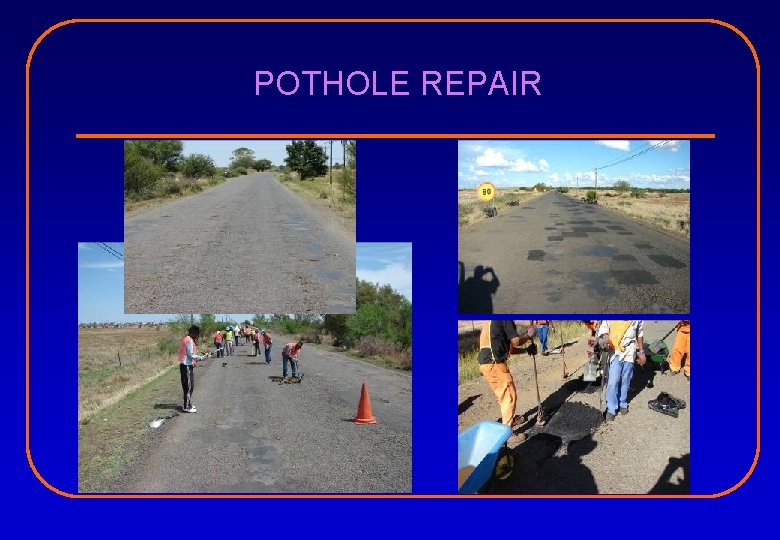
POTHOLE REPAIR
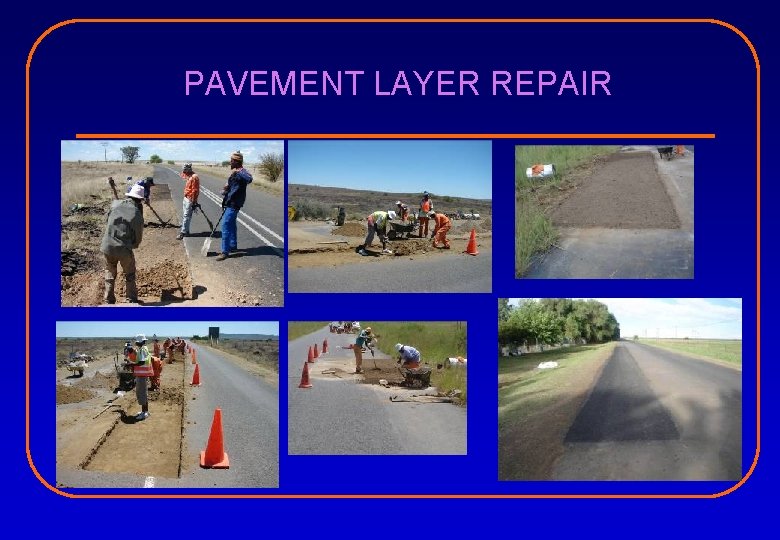
PAVEMENT LAYER REPAIR
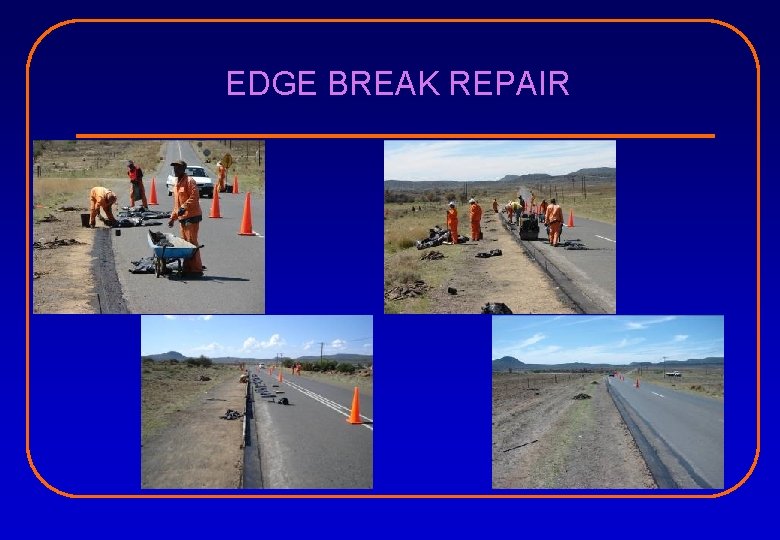
EDGE BREAK REPAIR
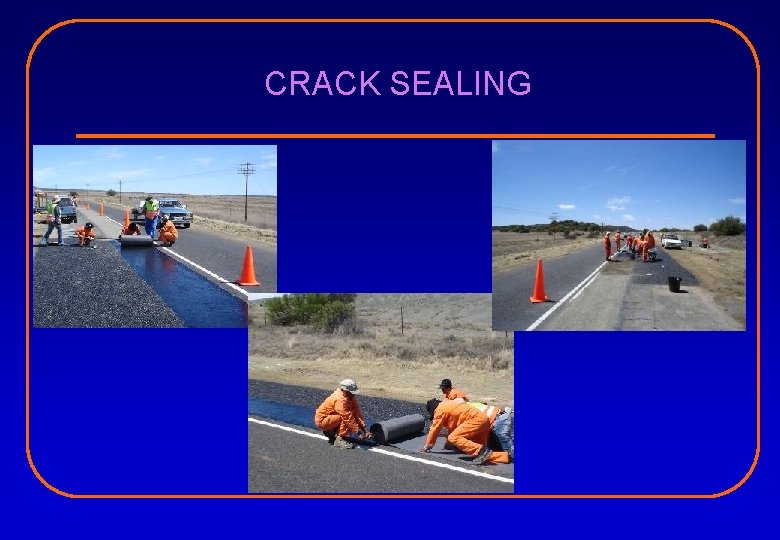
CRACK SEALING
CONCLUSION l l The Officials that will be managing the process will have to be assisted with their monitoring of the work, their mentoring efforts and their project management in terms of GCC 10. The training of learner contractors from the CDP 2008 and CDP 2010 is the most important aspect of the programme which need to be addressed as a matter of urgency. The learner contractors must acquire the skills to program the works, manage a project from a programme and cash flow statement. They still have very limited knowledge of their contractual obligations. The monitoring personnel has done well in phase 1 but should still learn to evaluate a programme and progress, manage variations, extension of time claims and claims. To potential is there it is for us to transfer the skills and experience.
- Slides: 39