
Contraction of Skeletal Muscle 11 2 Learning Objectives
Contraction of Skeletal Muscle 11. 2
Learning Objectives �Explain the sliding filament mechanism �State what evidence supports the sliding filament mechanism �Explain where the energy comes from for muscle contraction Success Criteria �Make notes on evidence for the sliding filament mechanism �Arrange statements for the detail of muscle contraction into the correct order
Starter �Draw the arrangement of actin and myosin in a sarcomere
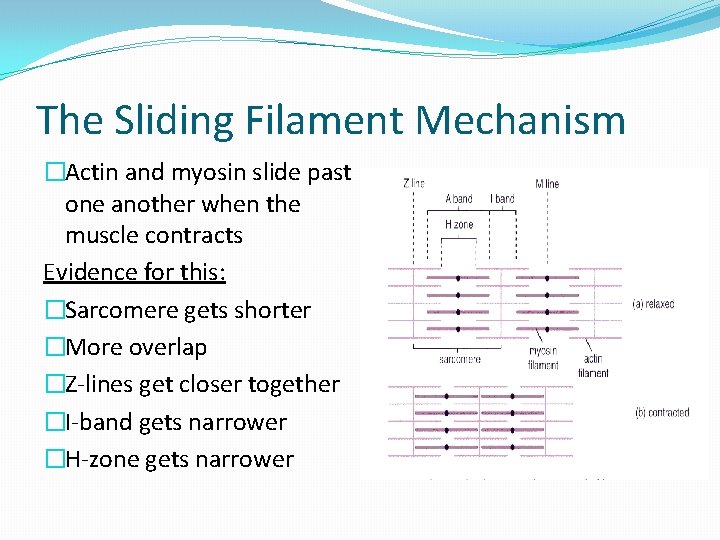
The Sliding Filament Mechanism �Actin and myosin slide past one another when the muscle contracts Evidence for this: �Sarcomere gets shorter �More overlap �Z-lines get closer together �I-band gets narrower �H-zone gets narrower
3 Main Proteins Involved 1. Myosin – 2 globular, bulbous heads and a long tail 2. Actin – a globular protein where the molecules are twisted into a helix 3. Tropomyosin – long, thin threads wrapped around actin
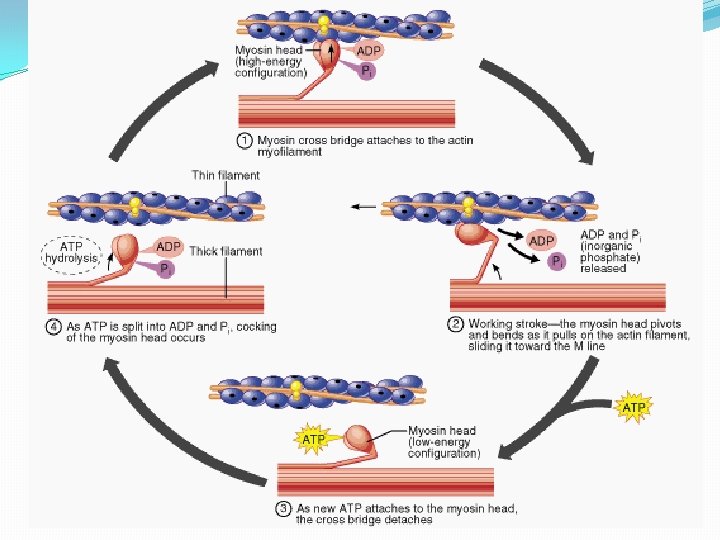
Muscle Contraction – Sliding Filament Mechanism �Heads of myosin form cross-bridges with the actin filaments (attach to binding sites) �Myosin heads flex together and pull the actin along the myosin �They detach �Return to original angle and re-attach (uses ATP) �Repeats 100 times a second
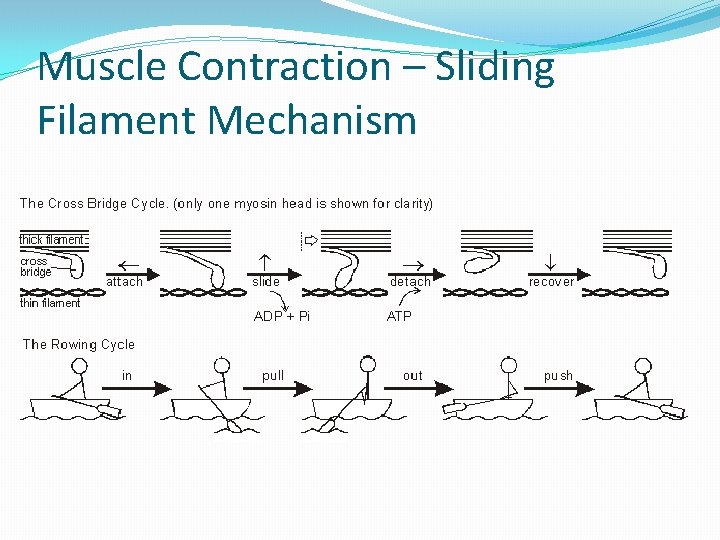
Muscle Contraction – Sliding Filament Mechanism
3 Stages of Muscle Contraction 1. Stimulation �Neuromuscular junctions – acetylcholine diffuses across the cleft and binds to receptors causing depolarisation 2. Contraction �Action potential carried through t-tubules �Ca 2+ ions are released and tropomyosin molecules move away from binding sites �Myosin bind to actin and move it along 3. Relaxation �Ca 2+ ions transported back to the ER and tropomyosin blocks the actin again
Detail on Muscle Contraction �Cut out the key stages and arrange them into the correct order under the 3 headings (Stimulation, Contraction, Relaxation)
Energy Supply �Muscles need a lot of energy when they contract �Supplied by the hydrolysis of ATP �Because of the great demand for energy in certain cases (e. g. Fight or flight responses) then it is required that ATP be generated anaerobically as well �This is achieved by using phosphocreatine �Phosphocreatine is stored in the muscle and helps to regenerate ATP

Plenary �Look through the diagrams on page 190 and check you understand the detail of what is happening
Learning Objectives �Explain the sliding filament mechanism �State what evidence supports the sliding filament mechanism �Explain where the energy comes from for muscle contraction Success Criteria �Make notes on evidence for the sliding filament mechanism �Arrange statements for the detail of muscle contraction into the correct order
- Slides: 13