
Contract Administration Learning Objectives Terminal Objectives Identify Contract
Contract Administration

Learning Objectives Terminal Objectives Identify Contract Administration Actions Required in a Contingency Contracting Scenario Discuss Actions a CCO Should Take When Completing a Contract Claim and/or Dispute Enabling Objectives Identify documents required in a contract file Categorize post award actions to be taken by the CCO Construct a contract modification Determine actions to take when notified of a potential or actual claim Identify actions to reduce the probability of claims Illustrate the Ratification process Compare contract termination options Recognize contract closeout procedures in a contingency environment Learn. Perform. Succeed. 2

Definition and Goals Definition All relationships between Government and contractor that arise from contract performance Includes all dealings between the parties from time of contract award until work completed and accepted, payment made and any/all disputes resolved Learn. Perform. Succeed. Primary Goals The Government obtains the needed work: on time (schedule), location and quantity Obtains the identified level of quality called for by the contract The Parties are in compliance with all requirements of the contract Contractor receives proper compensation (payment) Both parties fulfill all contractual requirements 3
Contract File Contents • All FAR and DFARS administrative recordkeeping and file management continues during contingency, humanitarian assistance and peacekeeping operations unless specifically stated otherwise. • Contract files must be organized and sufficiently annotated to document the actions taken and the supporting rationale for the entire procurement process – including BPAs, GPC and other expenditures Documentation in files shall— • Furnish essential facts (including acquisition environment description) used as a basis for informed decisions at each step in the acquisition process • Document the rationale for actions taken • Provide a complete audit trail to be used to support reviews or future investigations, litigation or congressional inquiries if necessary 4 Learn. Perform. Succeed.
Contract Action Audit System: a simple database reporting system to provide visibility and status of procurement actions is required and should be implemented immediately. The system should include the following data fields: • Date of receipt of requisition • Unit of measure/quantity (PR) - i. e. , job, lot, each, etc. • Commitment Amount • Item Description • Date of award • Contracting Officer’s name • Type of contracting action • Date of receiving report - i. e. , contract, purchase • Date of final payment order, BPA, delivery order, • Date contract was closed out modification • Location of contract file • Contractor name • Remarks • PIIN Log* • *Amount of obligated dollars A well constructed PIIN Log is first step to a sound audit system Learn. Perform. Succeed. 5
Inspection, Acceptance and Payment The process is slightly different. . . For Supplies, Services and Construction Depending on the Contract Type For Commercial or Non Commercial Items The process starts at contract award and does not end until contract closeout Learn. Perform. Succeed. 6
Inspection and Acceptance Inspection • Examining and testing supplies or services (including when appropriate, raw materials, components, and intermediate assemblies) to determine whether they conform to contract requirements Acceptance • Constitutes government acknowledgment supplies or services conform with applicable contract quality and quantity requirements and to other terms and conditions of the contract Learn. Perform. Succeed. 7
Government Right to Inspect • The contractor is expected to deliver supplies and services meeting all contractual requirements • Government has the right to inspect all materials and workmanship at any time, place where work on a contract is being performed – Basis of contract inspection clauses • Inspections may: – Occur at any time prior to acceptance – Be announced or unannounced – Not unduly delay work – Not include directions that would change the contract Learn. Perform. Succeed. 8

Quality Assurance Requirements The government’s role in inspection is communicated by the quality assurance requirements we select for the contract • There are four (4) methods/categories of government contract quality. Inspection assurance (inspection): Higher level Commercial by Standard Items 52. 2124(a) Contractor 52. 246 -1 inspection requirements • Gov’t reserves the right to inspect items tendered • Post acceptance rights • At or below the SAT • Gov’t does not approve inspection system or review records • Gov’t approves contractor inspection system and record access • Provisions/Claus es: 52. 246 -2 through 52. 2469 Most Common in the Contingency Environment Learn. Perform. Succeed. contract quality requirements – 52. 246 -11 • Gov’t involved in inspection throughout contract • ISO, ANSI, ASME, MIL-Q etc. • See 46. 202 -4(b) 9
Construction Contract Challenges Full administration is used on construction contracts. The CCO needs to ensure that all pre-award actions have been accomplished. • Pre-Construction Conference • Bonds • Labor Challenges • Determining Progress • Differing Site Conditions, Materials and Workmanship • Suspension of Work • Liquidated Damages (LDs) determination • Payments Learn. Perform. Succeed. 10
When to Change the Contract Examples of when a Contract Modification should be executed • • Correcting mistakes Adding or removing funding Exercising options Changing any of the terms and conditions (T&Cs) in any part of the contract (including attachments) Changing what you need, where you need it, or when (period of performance) you need it Suspend/Stop work Terminating work (partial or full) Adding additional work (there are limitations) Learn. Perform. Succeed. 11
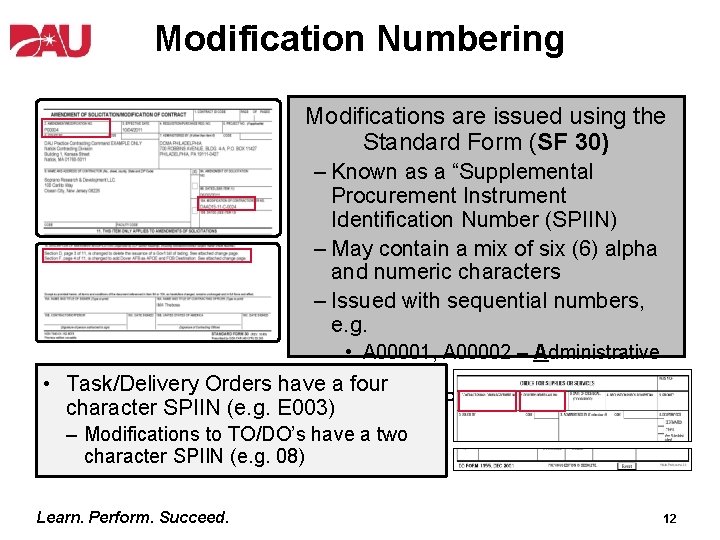
Modification Numbering Modifications are issued using the Standard Form (SF 30) – Known as a “Supplemental Procurement Instrument Identification Number (SPIIN) – May contain a mix of six (6) alpha and numeric characters – Issued with sequential numbers, e. g. • A 00001, A 00002 – Administrative Mods • Task/Delivery Orders have a four character SPIIN (e. g. E 003) • P 00001, P 00002 – Procurement Mods – Modifications to TO/DO’s have a two character SPIIN (e. g. 08) Learn. Perform. Succeed. 12
Types of Contract Modifications Unilater al Modification signed only by the Contracting Officer (KO) • Make Administrative Changes • Issue Change Orders • Make changes authorized by clauses other than Changes Clause – Options, Suspension of Work, etc. , incremental funding are common modifications in this category Bilatera l • Supplemental Issue Termination Notices Modification signed by Agreement; both Contractor and KO • Make negotiated Equitable Adjustments FAR 43. 103 • Definitize letter contracts • Reflect other agreements between the Parties modifying the terms Learn. Perform. Succeed. 13
Change Orders Written modification signed by CCO, directing contractor to make a change without prior agreement • Authorized by the “Changes Clause” • Contractor must continue performance, as changed • Creates “undefinitized” Government liability and Contractor may be entitled to an equitable adjustment • Definitization schedule must be established 52. 212 -4 Contract Terms and Conditions Commercial Items Changes in terms and conditions of this contract may be made only by written agreement of the parties Learn. Perform. Succeed. 14
Changes Clause - Limitations Specifies limits on changes without prior contractor agreement • Supplies • Services – Changes to drawings, design or specification – Method of shipping or packing – Place of delivery FAR Clauses 52. 243 -1 Fixed Price 52. 243 -2 Cost Reimbursement 52. 243 -3 Time & Material 52. 243 -4 Construction Learn. Perform. Succeed. – Description of services to be performed – Time of performance (hours of day or days of week) – Place of performance of services 15
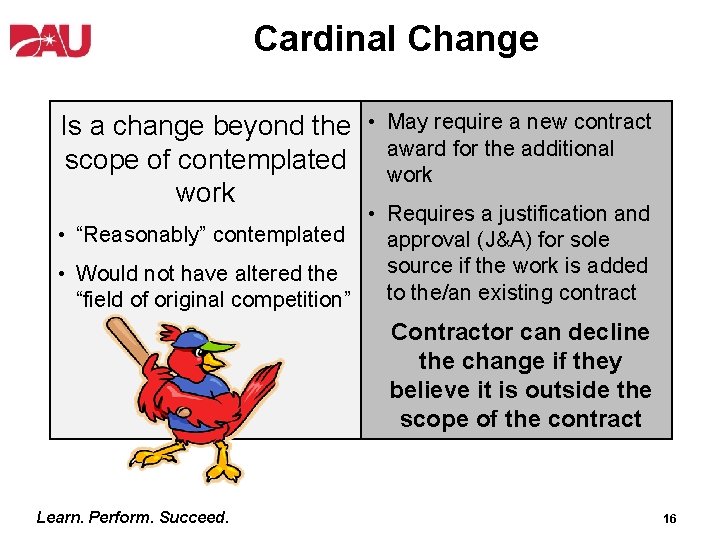
Cardinal Change Is a change beyond the • scope of contemplated work May require a new contract award for the additional work • Requires a justification and • “Reasonably” contemplated approval (J&A) for sole source if the work is added • Would not have altered the to the/an existing contract “field of original competition” Contractor can decline the change if they believe it is outside the scope of the contract Learn. Perform. Succeed. 16
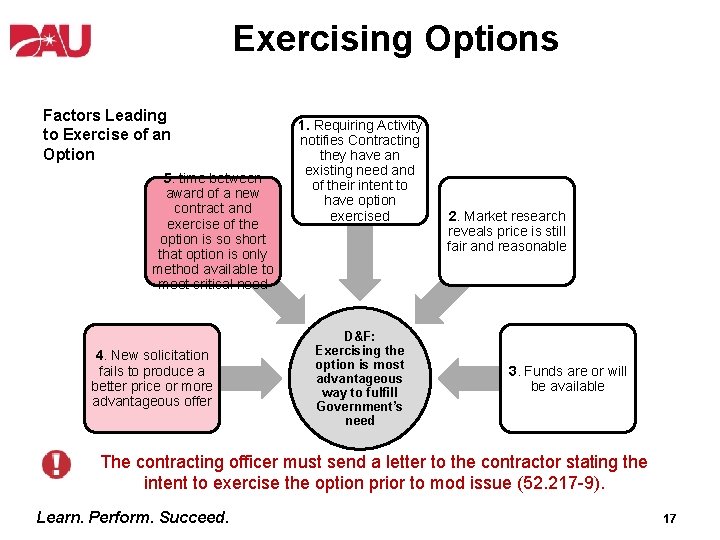
Exercising Options Factors Leading to Exercise of an Option 5. time between award of a new contract and exercise of the option is so short that option is only method available to meet critical need 4. New solicitation fails to produce a better price or more advantageous offer 1. Requiring Activity notifies Contracting they have an existing need and of their intent to have option exercised D&F: Exercising the option is most advantageous way to fulfill Government’s need 2. Market research reveals price is still fair and reasonable 3. Funds are or will be available The contracting officer must send a letter to the contractor stating the intent to exercise the option prior to mod issue (52. 217 -9). Learn. Perform. Succeed. 17
Unauthorized Commitment Ratification Learn. Perform. Succeed. 18
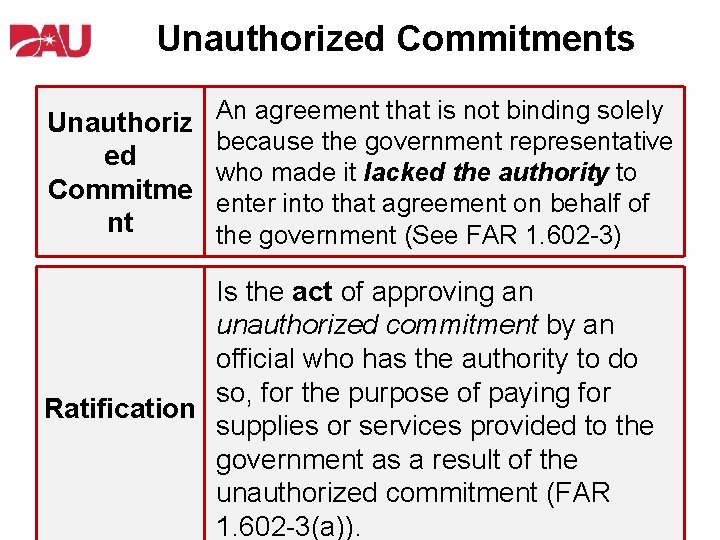
Unauthorized Commitments Unauthoriz ed Commitme nt An agreement that is not binding solely because the government representative who made it lacked the authority to enter into that agreement on behalf of the government (See FAR 1. 602 -3) Is the act of approving an unauthorized commitment by an official who has the authority to do so, for the purpose of paying for Ratification supplies or services provided to the government as a result of the unauthorized commitment (FAR 19 Learn. Perform. Succeed. 1. 602 -3(a)).

Notional Ratification Process • Individual creating unauthorized commitment will submit a statement detailing: • Senior Leader advises KO: – Concurrence that commitment should be ratified – Why normal – Steps taken to prevent procedures were not recurrence followed? – Complete purchase – Did government have a description and bona fide need for funding service/good? – Description of – Did or will the disciplinary action government receive a taken or reasons why benefit? none. Organizations was taken The process isavailable similar across Federal Agencies. will have their –ratification Was money own required at theformats timeand ofrouting the procedures for processing ratifications. You may have to establish those “procedures” at your deployed location. action Learn. Perform. Succeed. 20
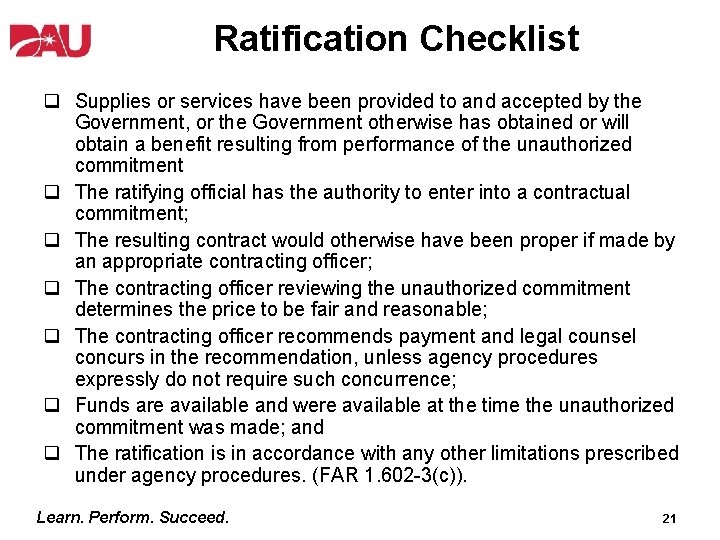
Ratification Checklist q Supplies or services have been provided to and accepted by the Government, or the Government otherwise has obtained or will obtain a benefit resulting from performance of the unauthorized commitment q The ratifying official has the authority to enter into a contractual commitment; q The resulting contract would otherwise have been proper if made by an appropriate contracting officer; q The contracting officer reviewing the unauthorized commitment determines the price to be fair and reasonable; q The contracting officer recommends payment and legal counsel concurs in the recommendation, unless agency procedures expressly do not require such concurrence; q Funds are available and were available at the time the unauthorized commitment was made; and q The ratification is in accordance with any other limitations prescribed under agency procedures. (FAR 1. 602 -3(c)). Learn. Perform. Succeed. 21
Claims, Disputes and Appeals Learn. Perform. Succeed. 22
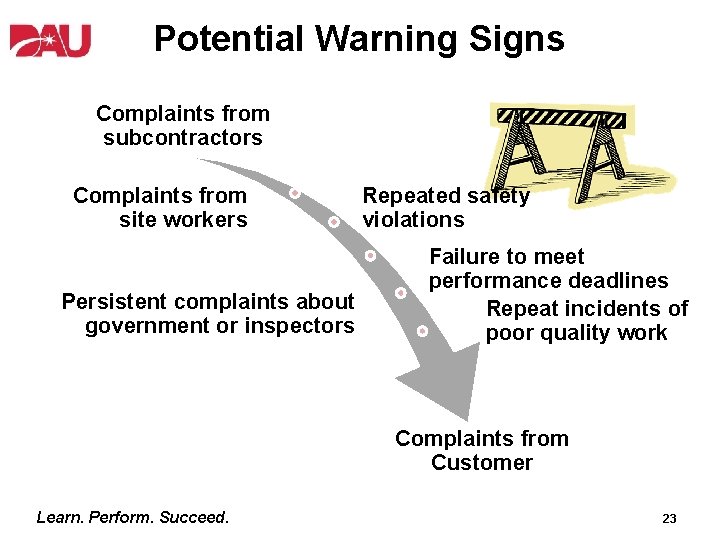
Potential Warning Signs Complaints from subcontractors Complaints from site workers Persistent complaints about government or inspectors Repeated safety violations Failure to meet performance deadlines Repeat incidents of poor quality work Complaints from Customer Learn. Perform. Succeed. 23
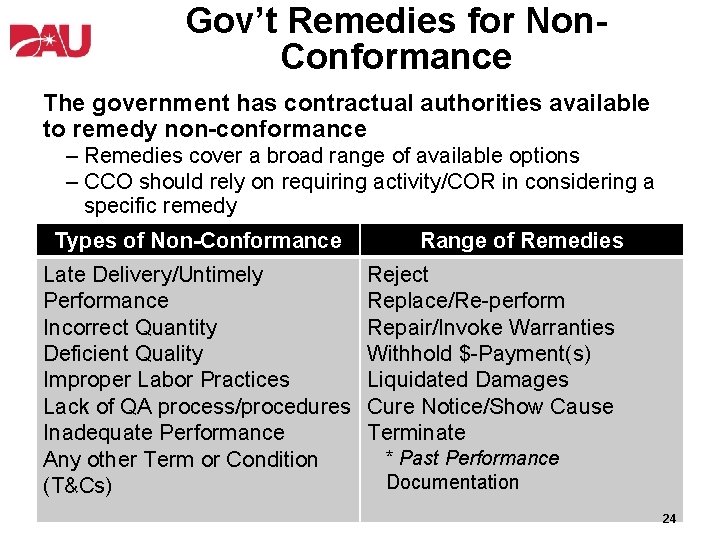
Gov’t Remedies for Non. Conformance The government has contractual authorities available to remedy non-conformance – Remedies cover a broad range of available options – CCO should rely on requiring activity/COR in considering a specific remedy Types of Non-Conformance Late Delivery/Untimely Performance Incorrect Quantity Deficient Quality Improper Labor Practices Lack of QA process/procedures Inadequate Performance Any other Term or Condition (T&Cs) Learn. Perform. Succeed. Range of Remedies Reject Replace/Re-perform Repair/Invoke Warranties Withhold $-Payment(s) Liquidated Damages Cure Notice/Show Cause Terminate * Past Performance Documentation 24
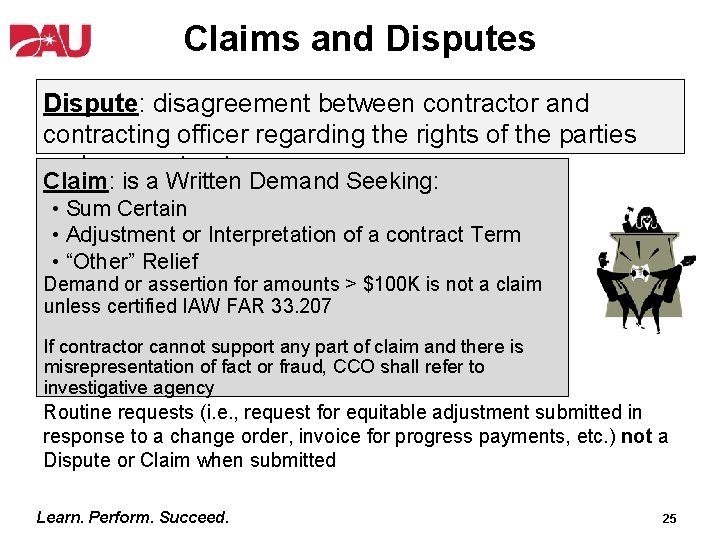
Claims and Disputes Dispute: disagreement between contractor and contracting officer regarding the rights of the parties under a contract Claim: is a Written Demand Seeking: • Sum Certain • Adjustment or Interpretation of a contract Term • “Other” Relief Demand or assertion for amounts > $100 K is not a claim unless certified IAW FAR 33. 207 If contractor cannot support any part of claim and there is misrepresentation of fact or fraud, CCO shall refer to investigative agency Routine requests (i. e. , request for equitable adjustment submitted in response to a change order, invoice for progress payments, etc. ) not a Dispute or Claim when submitted Learn. Perform. Succeed. 25
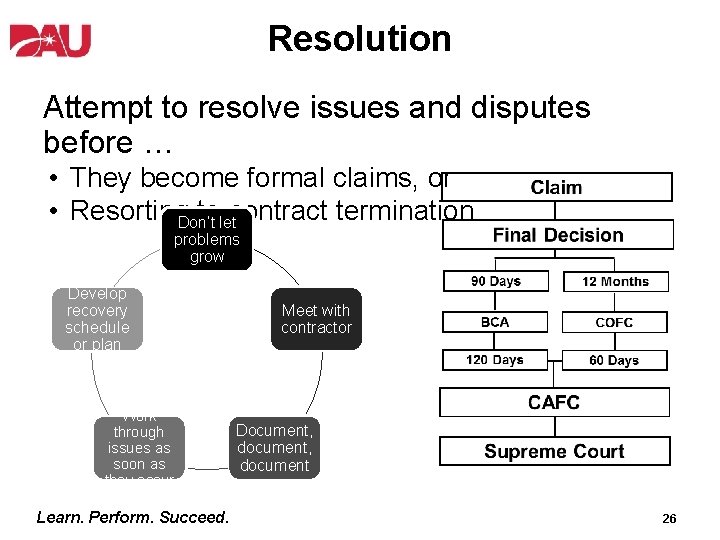
Resolution Attempt to resolve issues and disputes before … • They become formal claims, or • Resorting. Don’t toletcontract termination problems grow Develop recovery schedule or plan Work through issues as soon as they occur Learn. Perform. Succeed. Meet with contractor Document, document 26

CCO Final Decision (FAR 33. 211) If claim can’t be resolved by mutual agreement • Review facts pertinent to claim • Secure legal assistance • Prepare written decision: – Description of the claim or dispute – Reference to the pertinent contract terms – Statement of the factual areas of agreement and disagreement – Statement of the contracting officer’s decision, with supporting rationale – Demand for payment prepared in accordance with 32. 610(b) in all cases where the decision results in a finding that the is indebted to the Learn. contractor Perform. Succeed. CCO shall furnish a copy of the decision to the contractor by certified mail, return receipt requested, or by any other method that provides evidence of receipt • Time limitations – If claim ≤ $100 K, within 60 days of receipt – If claim > $100 K, 60 days after receiving a certified claim, provided that if decision will not be issued within 60 days, CCO provides an estimated timeframe • Failure of the CCO to issue a decision within the required time periods will be deemed a decision by the contracting officer denying the claim and 27 will authorize the contractor to
Disputes – Tips for CCOs • Under the Contract Disputes Act, CCOs receive NO special treatment or waiver of applicable rules simply because a contingency contract action is at issue • CDA requires contractor to continue performance pending a final resolution of any claim (FAR 52. 233 -1 required) • Both parties encouraged to use ADR in lieu of expensive, time-consuming litigation Learn. Perform. Succeed. • • Practical Tips for CCOs, inspectors, and CORs should use digital cameras to document performance problems Account for personnel turnover Maintain accurate, current contract files, electronic files preferred Use legal office (local and/or reach-back) in responding to claims and/or appeals 28
Contract Terminations Learn. Perform. Succeed. 29
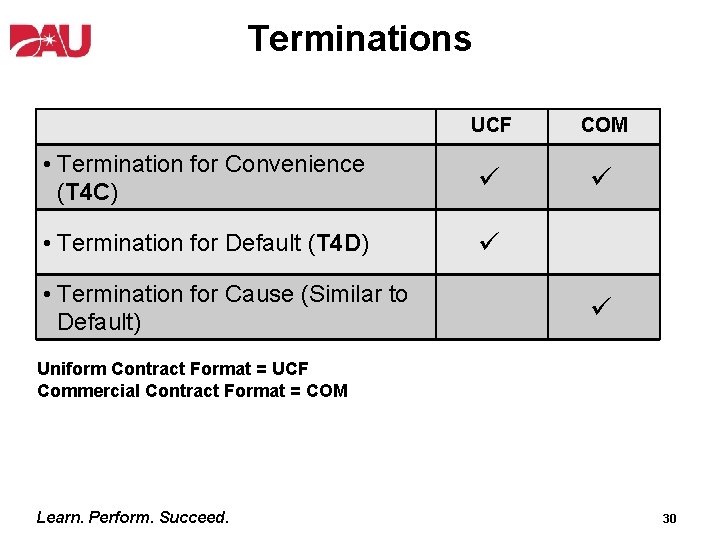
Terminations UCF COM • Termination for Convenience (T 4 C) ü ü • Termination for Default (T 4 D) ü • Termination for Cause (Similar to Default) ü Uniform Contract Format = UCF Commercial Contract Format = COM Learn. Perform. Succeed. 30
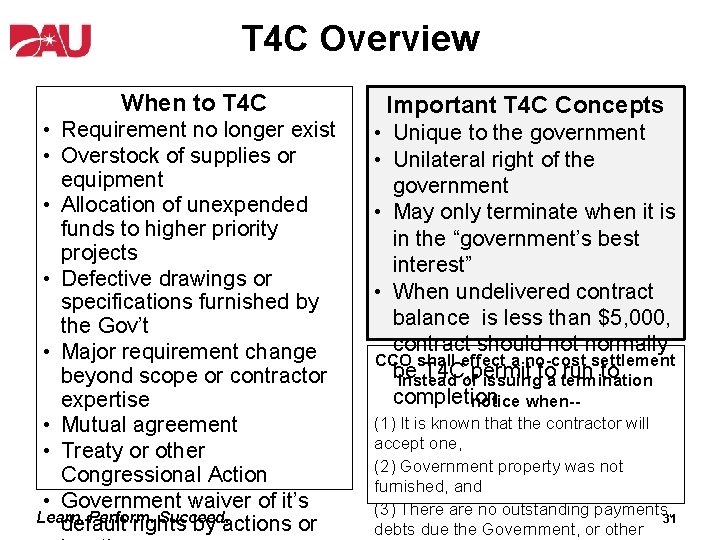
T 4 C Overview When to T 4 C • Requirement no longer exist • Overstock of supplies or equipment • Allocation of unexpended funds to higher priority projects • Defective drawings or specifications furnished by the Gov’t • Major requirement change beyond scope or contractor expertise • Mutual agreement • Treaty or other Congressional Action • Government waiver of it’s Learn. Perform. Succeed. default rights by actions or Important T 4 C Concepts • Unique to the government • Unilateral right of the government • May only terminate when it is in the “government’s best interest” • When undelivered contract balance is less than $5, 000, contract should not normally CCO shall effect a no-cost settlement be T 4 C, permit run to instead of issuingto a termination completion notice when-(1) It is known that the contractor will accept one, (2) Government property was not furnished, and (3) There are no outstanding payments, 31 debts due the Government, or other
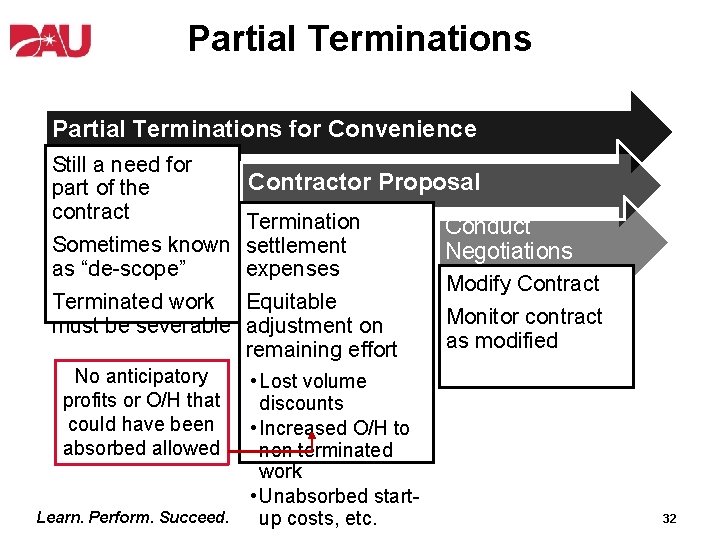
Partial Terminations for Convenience Still a need for part of the contract Sometimes known as “de-scope” Contractor Proposal Termination settlement expenses Terminated work Equitable must be severable adjustment on remaining effort No anticipatory profits or O/H that could have been absorbed allowed Learn. Perform. Succeed. • Lost volume discounts • Increased O/H to non terminated work • Unabsorbed startup costs, etc. Conduct Negotiations Modify Contract Monitor contract as modified 32
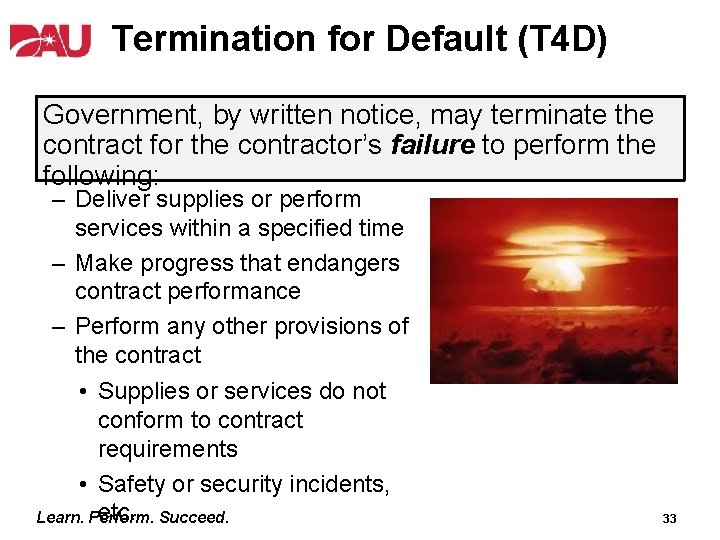
Termination for Default (T 4 D) Government, by written notice, may terminate the contract for the contractor’s failure to perform the following: – Deliver supplies or perform services within a specified time – Make progress that endangers contract performance – Perform any other provisions of the contract • Supplies or services do not conform to contract requirements • Safety or security incidents, etc. Succeed. Learn. Perform. 33
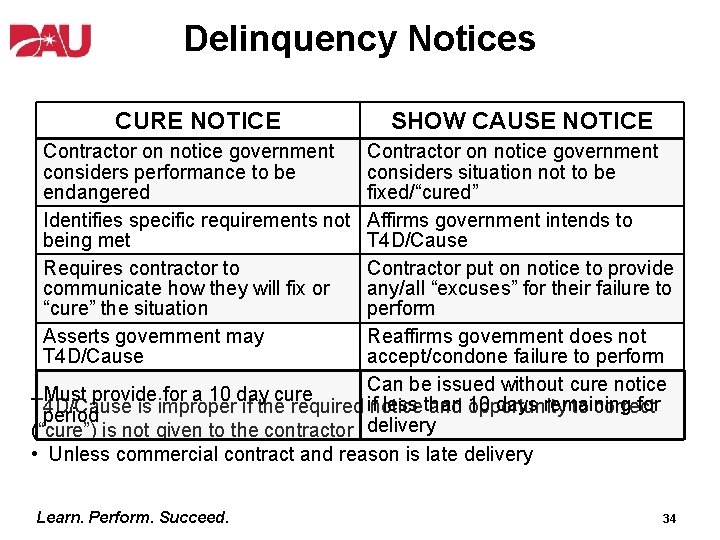
Delinquency Notices CURE NOTICE SHOW CAUSE NOTICE Contractor on notice government considers performance to be endangered Identifies specific requirements not being met Requires contractor to communicate how they will fix or “cure” the situation Asserts government may T 4 D/Cause Contractor on notice government considers situation not to be fixed/“cured” Affirms government intends to T 4 D/Cause Contractor put on notice to provide any/all “excuses” for their failure to perform Reaffirms government does not accept/condone failure to perform Can be issued without cure notice Must provide for a 10 day cure less than 10 days remaining for T 4 D/Cause is improper if the required ifnotice and opportunity to correct period (“cure”) is not given to the contractor delivery • Unless commercial contract and reason is late delivery Learn. Perform. Succeed. 34
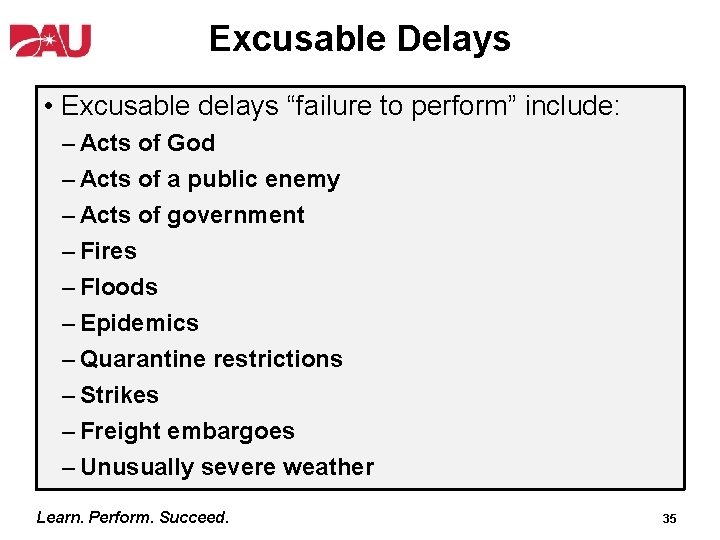
Excusable Delays • Excusable delays “failure to perform” include: – Acts of God – Acts of a public enemy – Acts of government – Fires – Floods – Epidemics – Quarantine restrictions – Strikes – Freight embargoes – Unusually severe weather Learn. Perform. Succeed. 35
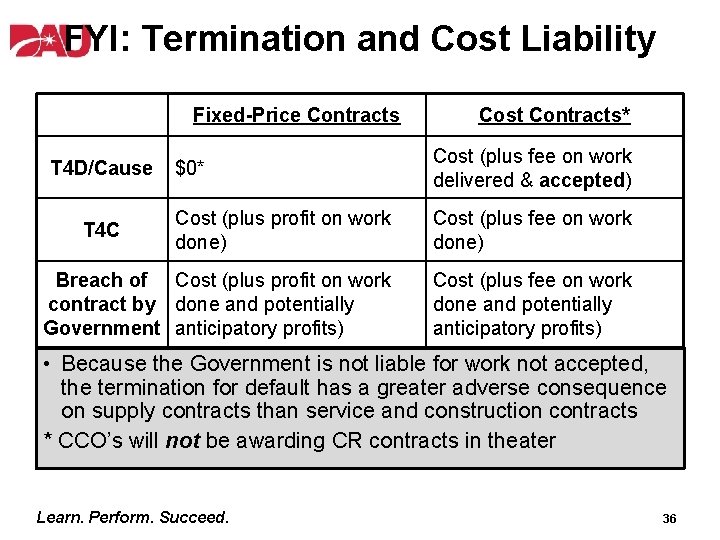
FYI: Termination and Cost Liability Fixed-Price Contracts Cost Contracts* $0* Cost (plus fee on work delivered & accepted) Cost (plus profit on work done) Cost (plus fee on work done) Breach of Cost (plus profit on work contract by done and potentially Government anticipatory profits) Cost (plus fee on work done and potentially anticipatory profits) T 4 D/Cause T 4 C • Because the Government is not liable for work not accepted, the termination for default has a greater adverse consequence on supply contracts than service and construction contracts * CCO’s will not be awarding CR contracts in theater Learn. Perform. Succeed. 36
Contract Closeout Learn. Perform. Succeed. 37
Contract Closeout A contract is not completed until it has been closed; formally closed • Timely contract closeout allows for: – De-obligating excess funds – Identifies the need for additional funds – Allows all affected activities to concentrate on current and future requirements • We must ensure: – All of the customers' requirements have been met – Government property and Classified information dispositioned – Contractors have received all monies due – Past performance has been documented – All contractor AND Government tasks are complete Learn. Perform. Succeed. 38
Government Property Disposition • Government Property May be Disposed of in Numerous Ways and Processes: – It may be scrapped through an approved scrap procedure. – It may be purchased at ACQUISITION COST (CAP Only!!!) – It may be transferred, donated or sold – It may be directed to be destroyed or even abandoned • MUST be Done in Accordance with Applicable Laws and Regulations – Federal Property Administrative Services Act of 1949 – The Federal Management Regulations and the – FAR – Sub. Part 45. 6 • MUST be Demilitarized before disposal, if Learn. Perform. Succeed. 39
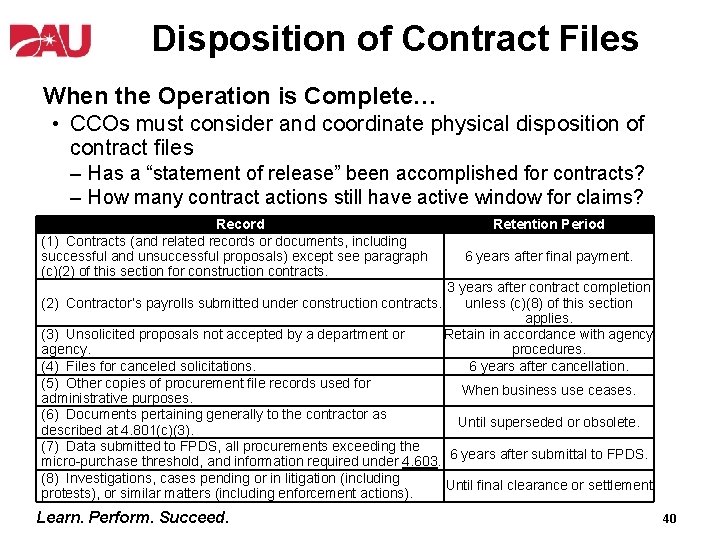
Disposition of Contract Files When the Operation is Complete… • CCOs must consider and coordinate physical disposition of contract files – Has a “statement of release” been accomplished for contracts? – How many contract actions still have active window for claims? • See FAR 4. 805 Record Table 4 -1 (1) Contracts (and related records or documents, including successful and unsuccessful proposals) except see paragraph (c)(2) of this section for construction contracts. (2) Contractor’s payrolls submitted under construction contracts. Retention Period 6 years after final payment. 3 years after contract completion unless (c)(8) of this section applies. Retain in accordance with agency procedures. 6 years after cancellation. (3) Unsolicited proposals not accepted by a department or agency. (4) Files for canceled solicitations. (5) Other copies of procurement file records used for When business use ceases. administrative purposes. (6) Documents pertaining generally to the contractor as Until superseded or obsolete. described at 4. 801(c)(3). (7) Data submitted to FPDS, all procurements exceeding the 6 years after submittal to FPDS. micro-purchase threshold, and information required under 4. 603. (8) Investigations, cases pending or in litigation (including Until final clearance or settlement protests), or similar matters (including enforcement actions). Learn. Perform. Succeed. 40
1. 2. 3. 4. Contract Termination Formal Claim Contract Modification Unauthorized Commitment PRACTICAL EXERCISES Learn. Perform. Succeed. 41
- Slides: 41