
Contraceptive Options for Women and Couples with HIV
- Slides: 23
Contraceptive Options for Women and Couples with HIV Combined Oral Contraceptive Pills (COCs)
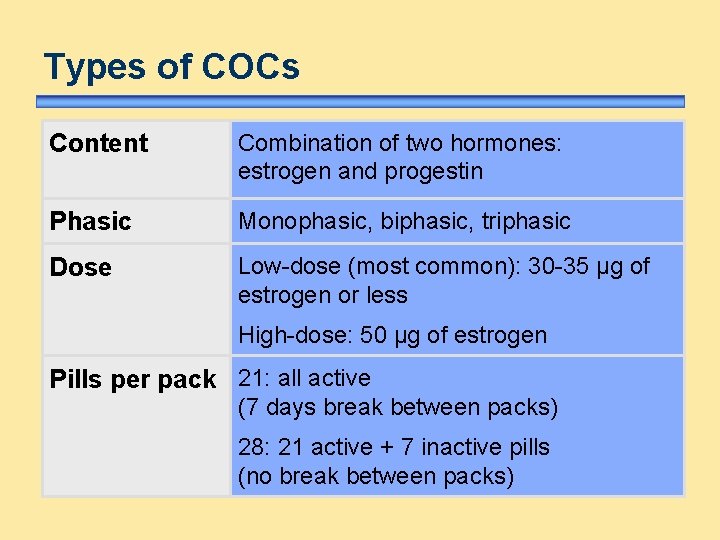
Types of COCs Content Combination of two hormones: estrogen and progestin Phasic Monophasic, biphasic, triphasic Dose Low-dose (most common): 30 -35 µg of estrogen or less High-dose: 50 µg of estrogen Pills per pack 21: all active (7 days break between packs) 28: 21 active + 7 inactive pills (no break between packs)
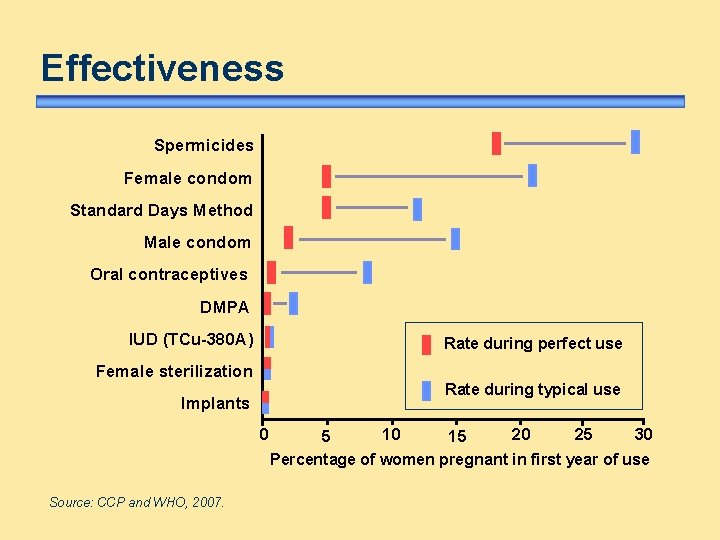
Effectiveness Spermicides Female condom Standard Days Method Male condom Oral contraceptives DMPA IUD (TCu-380 A) Rate during perfect use Female sterilization Rate during typical use Implants 0 5 10 15 20 25 30 Percentage of women pregnant in first year of use Source: CCP and WHO, 2007.
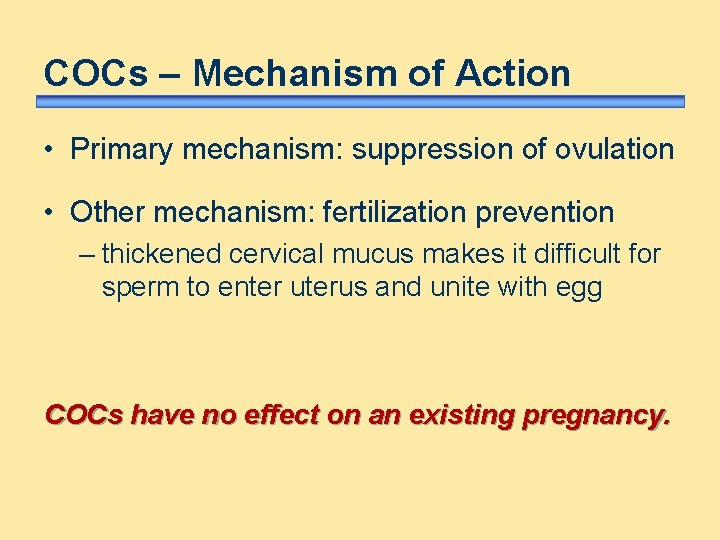
COCs – Mechanism of Action • Primary mechanism: suppression of ovulation • Other mechanism: fertilization prevention – thickened cervical mucus makes it difficult for sperm to enter uterus and unite with egg COCs have no effect on an existing pregnancy.
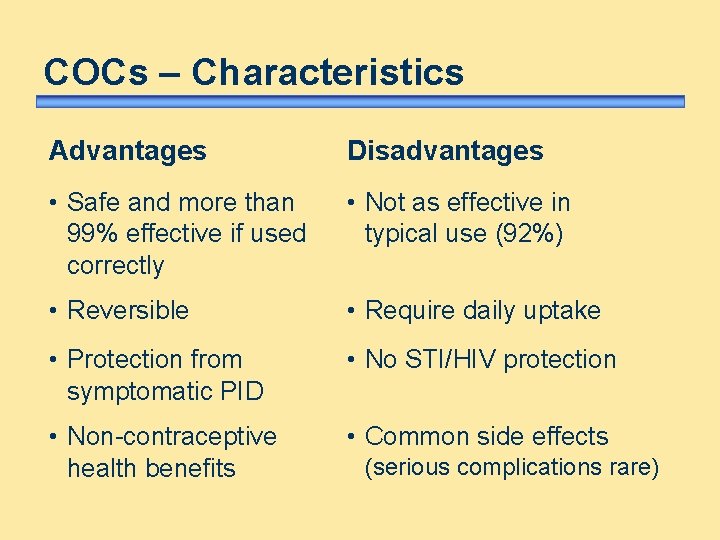
COCs – Characteristics Advantages Disadvantages • Safe and more than 99% effective if used correctly • Not as effective in typical use (92%) • Reversible • Require daily uptake • Protection from symptomatic PID • No STI/HIV protection • Non-contraceptive health benefits • Common side effects (serious complications rare)
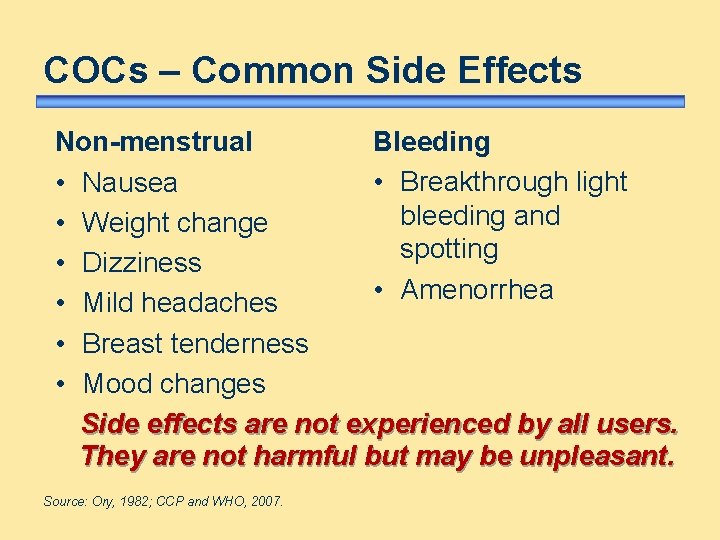
COCs – Common Side Effects Bleeding Non-menstrual • Breakthrough light • Nausea bleeding and • Weight change spotting • Dizziness • Amenorrhea • Mild headaches • Breast tenderness • Mood changes Side effects are not experienced by all users. They are not harmful but may be unpleasant. Source: Ory, 1982; CCP and WHO, 2007.
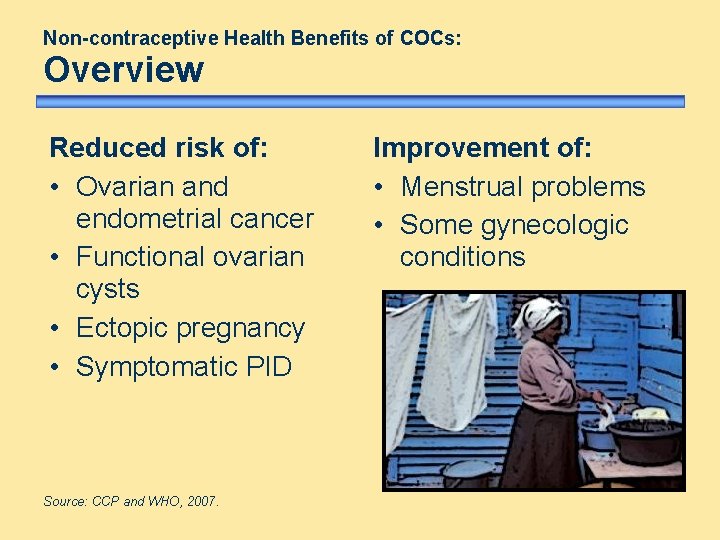
Non-contraceptive Health Benefits of COCs: Overview Reduced risk of: • Ovarian and endometrial cancer • Functional ovarian cysts • Ectopic pregnancy • Symptomatic PID Source: CCP and WHO, 2007. Improvement of: • Menstrual problems • Some gynecologic conditions
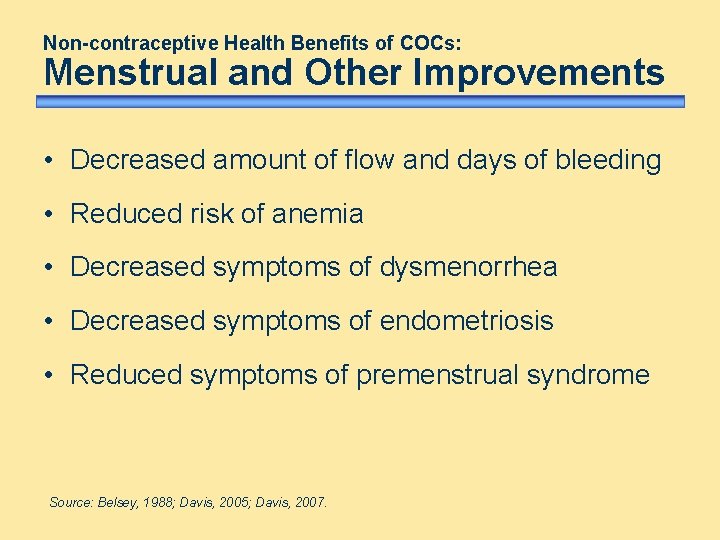
Non-contraceptive Health Benefits of COCs: Menstrual and Other Improvements • Decreased amount of flow and days of bleeding • Reduced risk of anemia • Decreased symptoms of dysmenorrhea • Decreased symptoms of endometriosis • Reduced symptoms of premenstrual syndrome Source: Belsey, 1988; Davis, 2005; Davis, 2007.
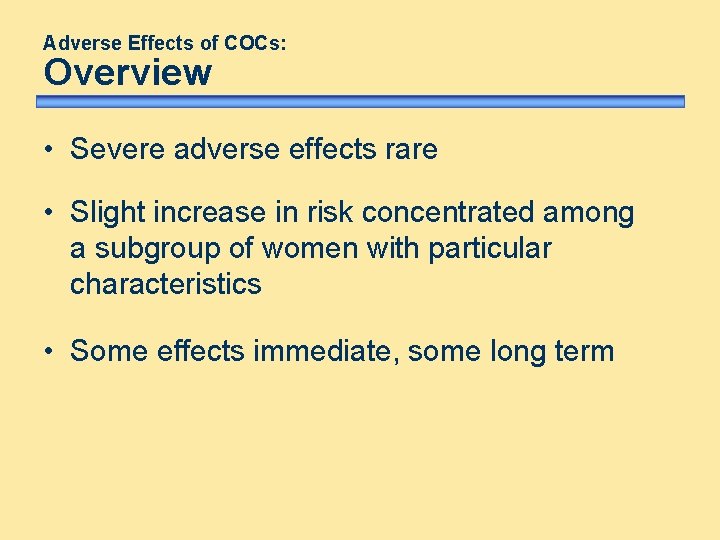
Adverse Effects of COCs: Overview • Severe adverse effects rare • Slight increase in risk concentrated among a subgroup of women with particular characteristics • Some effects immediate, some long term
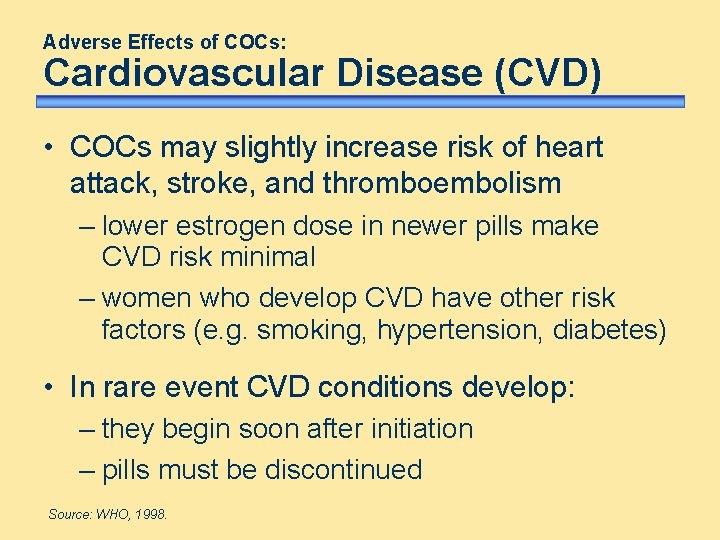
Adverse Effects of COCs: Cardiovascular Disease (CVD) • COCs may slightly increase risk of heart attack, stroke, and thromboembolism – lower estrogen dose in newer pills make CVD risk minimal – women who develop CVD have other risk factors (e. g. smoking, hypertension, diabetes) • In rare event CVD conditions develop: – they begin soon after initiation – pills must be discontinued Source: WHO, 1998.
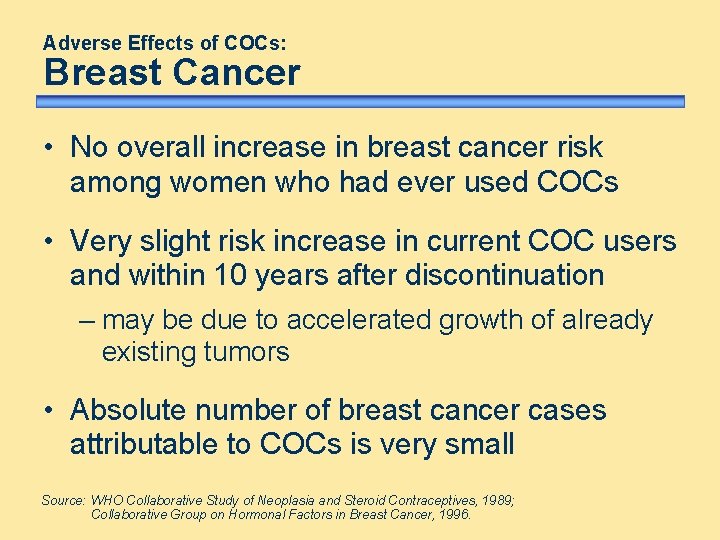
Adverse Effects of COCs: Breast Cancer • No overall increase in breast cancer risk among women who had ever used COCs • Very slight risk increase in current COC users and within 10 years after discontinuation – may be due to accelerated growth of already existing tumors • Absolute number of breast cancer cases attributable to COCs is very small Source: WHO Collaborative Study of Neoplasia and Steroid Contraceptives, 1989; Collaborative Group on Hormonal Factors in Breast Cancer, 1996.
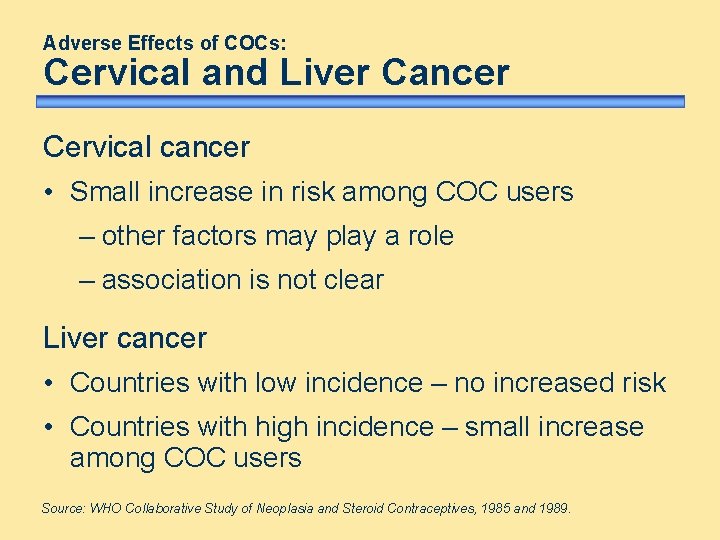
Adverse Effects of COCs: Cervical and Liver Cancer Cervical cancer • Small increase in risk among COC users – other factors may play a role – association is not clear Liver cancer • Countries with low incidence – no increased risk • Countries with high incidence – small increase among COC users Source: WHO Collaborative Study of Neoplasia and Steroid Contraceptives, 1985 and 1989.
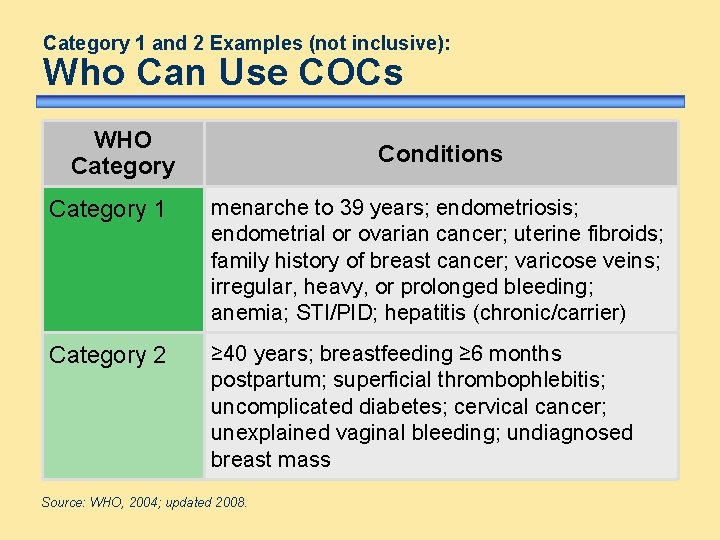
Category 1 and 2 Examples (not inclusive): Who Can Use COCs WHO Category Conditions Category 1 menarche to 39 years; endometriosis; endometrial or ovarian cancer; uterine fibroids; family history of breast cancer; varicose veins; irregular, heavy, or prolonged bleeding; anemia; STI/PID; hepatitis (chronic/carrier) Category 2 ≥ 40 years; breastfeeding ≥ 6 months postpartum; superficial thrombophlebitis; uncomplicated diabetes; cervical cancer; unexplained vaginal bleeding; undiagnosed breast mass Source: WHO, 2004; updated 2008.
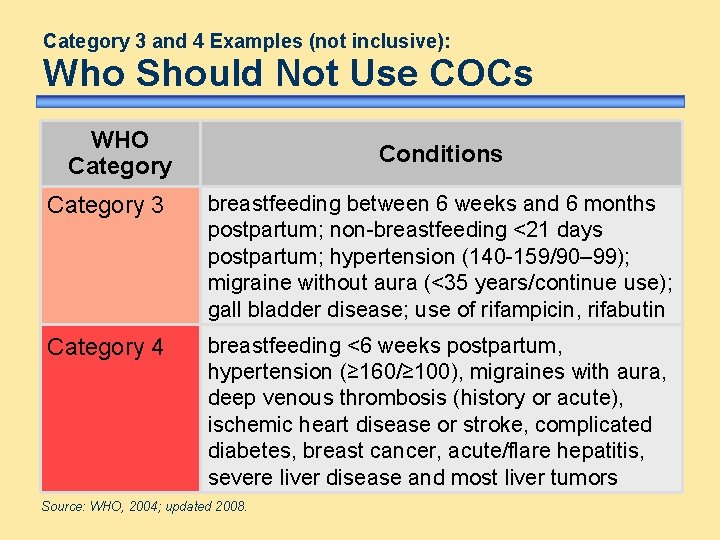
Category 3 and 4 Examples (not inclusive): Who Should Not Use COCs WHO Category Conditions Category 3 breastfeeding between 6 weeks and 6 months postpartum; non-breastfeeding <21 days postpartum; hypertension (140 -159/90– 99); migraine without aura (<35 years/continue use); gall bladder disease; use of rifampicin, rifabutin Category 4 breastfeeding <6 weeks postpartum, hypertension (≥ 160/≥ 100), migraines with aura, deep venous thrombosis (history or acute), ischemic heart disease or stroke, complicated diabetes, breast cancer, acute/flare hepatitis, severe liver disease and most liver tumors Source: WHO, 2004; updated 2008.
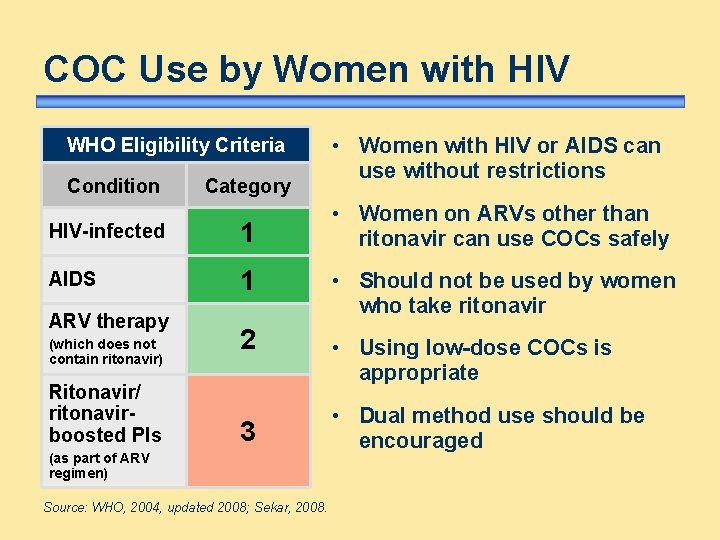
COC Use by Women with HIV WHO Eligibility Criteria Condition Category • Women with HIV or AIDS can use without restrictions • Women on ARVs other than ritonavir can use COCs safely HIV-infected 1 AIDS 1 • Should not be used by women who take ritonavir 2 • Using low-dose COCs is appropriate ARV therapy (which does not contain ritonavir) Ritonavir/ ritonavirboosted PIs 3 (as part of ARV regimen) Source: WHO, 2004, updated 2008; Sekar, 2008. • Dual method use should be encouraged
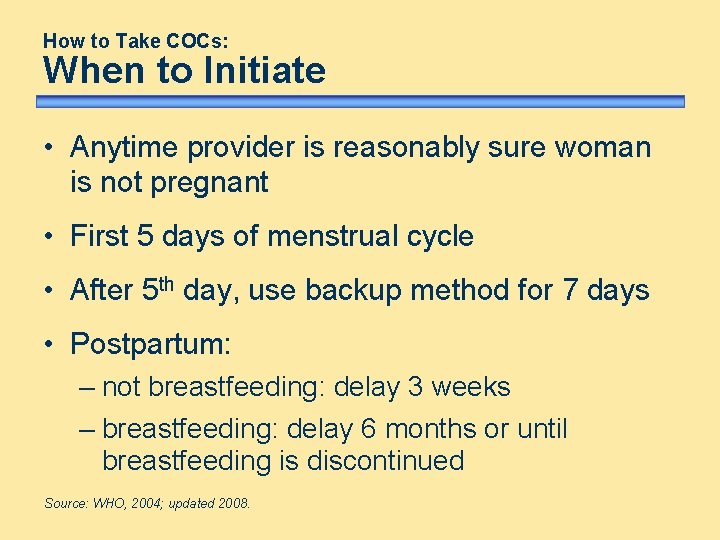
How to Take COCs: When to Initiate • Anytime provider is reasonably sure woman is not pregnant • First 5 days of menstrual cycle • After 5 th day, use backup method for 7 days • Postpartum: – not breastfeeding: delay 3 weeks – breastfeeding: delay 6 months or until breastfeeding is discontinued Source: WHO, 2004; updated 2008.
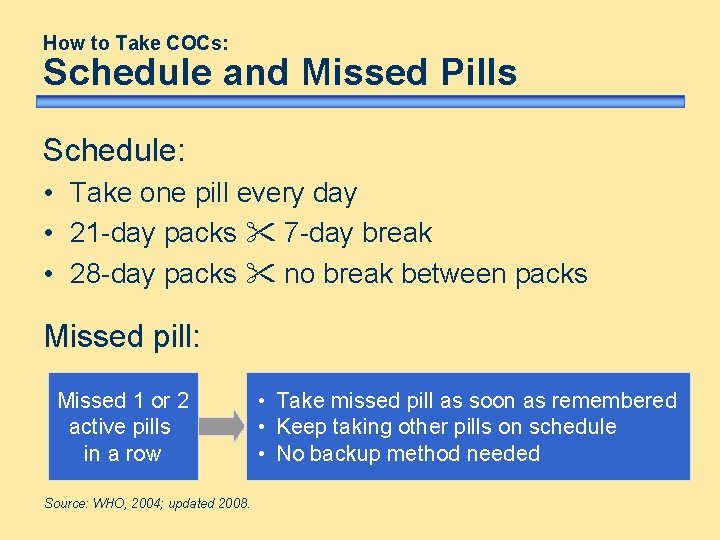
How to Take COCs: Schedule and Missed Pills Schedule: • Take one pill every day • 21 -day packs 7 -day break • 28 -day packs no break between packs Missed pill: Missed 1 or 2 active pills in a row Source: WHO, 2004; updated 2008. • Take missed pill as soon as remembered • Keep taking other pills on schedule • No backup method needed
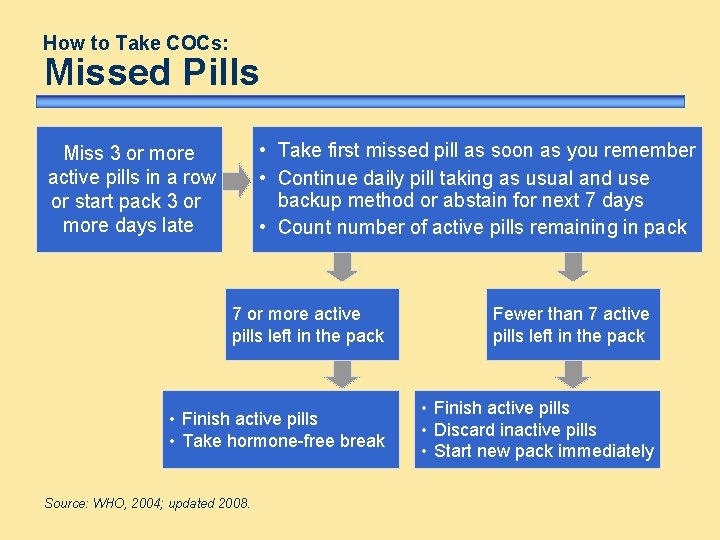
How to Take COCs: Missed Pills • Take first missed pill as soon as you remember • Continue daily pill taking as usual and use backup method or abstain for next 7 days • Count number of active pills remaining in pack Miss 3 or more active pills in a row or start pack 3 or more days late 7 or more active pills left in the pack Fewer than 7 active pills left in the pack • Finish active pills • Take hormone-free break • Finish active pills • Discard inactive pills • Start new pack immediately Source: WHO, 2004; updated 2008.
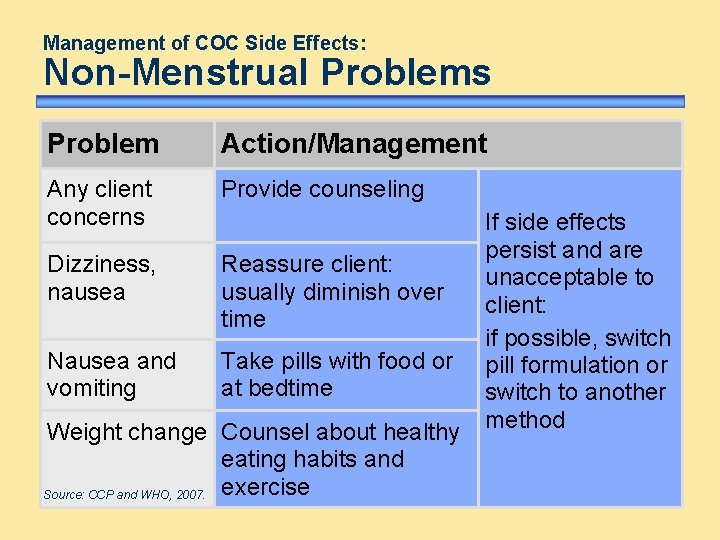
Management of COC Side Effects: Non-Menstrual Problems Problem Action/Management Any client concerns Provide counseling Dizziness, nausea Reassure client: usually diminish over time Nausea and vomiting Take pills with food or at bedtime Weight change Counsel about healthy eating habits and Source: CCP and WHO, 2007. exercise If side effects persist and are unacceptable to client: if possible, switch pill formulation or switch to another method
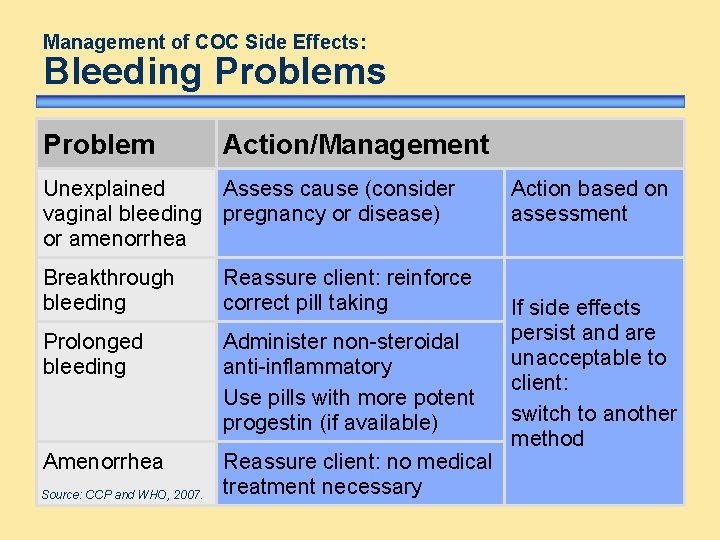
Management of COC Side Effects: Bleeding Problems Problem Action/Management Unexplained Assess cause (consider vaginal bleeding pregnancy or disease) or amenorrhea Breakthrough bleeding Reassure client: reinforce correct pill taking Prolonged bleeding Administer non-steroidal anti-inflammatory Use pills with more potent progestin (if available) Amenorrhea Reassure client: no medical treatment necessary Source: CCP and WHO, 2007. Action based on assessment If side effects persist and are unacceptable to client: switch to another method
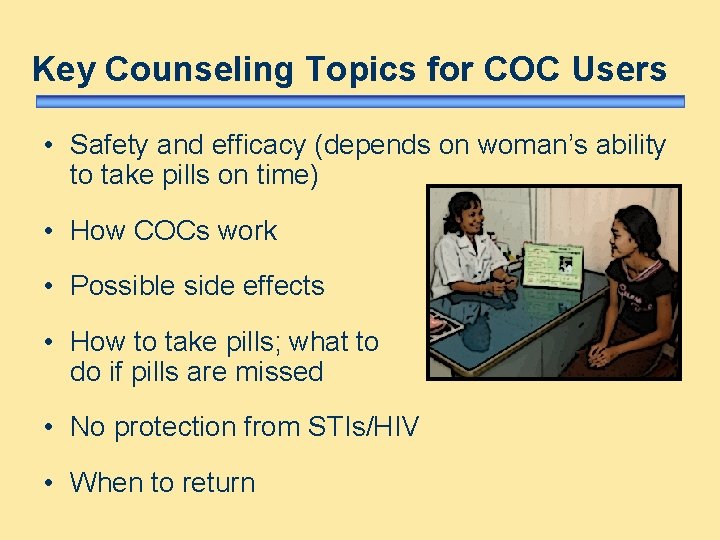
Key Counseling Topics for COC Users • Safety and efficacy (depends on woman’s ability to take pills on time) • How COCs work • Possible side effects • How to take pills; what to do if pills are missed • No protection from STIs/HIV • When to return
When to Return: Warning Signs of COC Complications Return immediately if experiencing ACHES: • Abdominal pain (sharp) • Chest pain (severe) • Headache (severe) • Eye (blurred vision, brief loss of vision) • Sharp leg pain Advise to stop taking pills, use a backup method, and return to the clinic immediately. Source: Pathfinder International, 2006.
When to Return: Follow-up for COCs • No fixed schedule • Return anytime if any questions or concerns and for resupply; give more than one cycle of pills if possible • During follow-up visit: – assess for method satisfaction and any health problems that may restrict COC use – manage and reassure about side effects – reinforce correct pill taking and what to do when pills are missed