
Contraceptive Options for Women and Couples with HIV
- Slides: 23
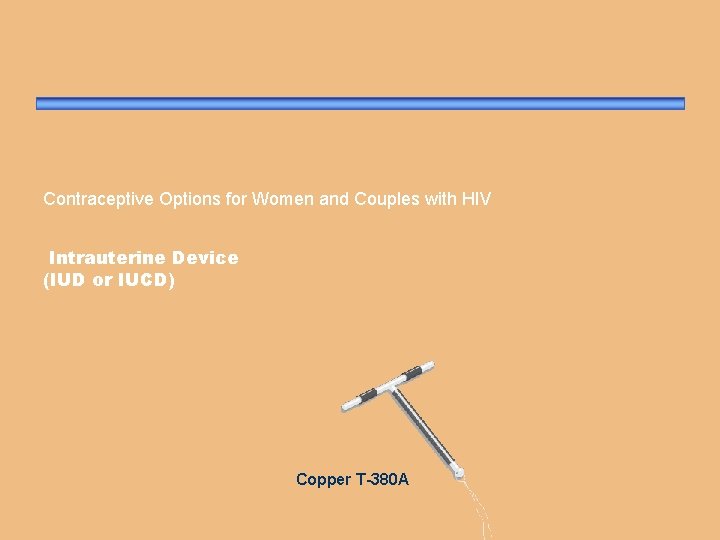
Contraceptive Options for Women and Couples with HIV Intrauterine Device (IUD or IUCD) Copper T-380 A
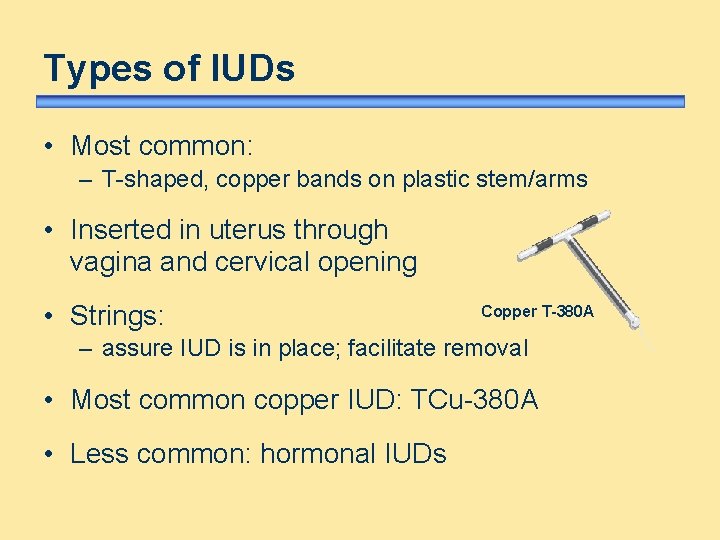
Types of IUDs • Most common: – T-shaped, copper bands on plastic stem/arms • Inserted in uterus through vagina and cervical opening • Strings: Copper T-380 A – assure IUD is in place; facilitate removal • Most common copper IUD: TCu-380 A • Less common: hormonal IUDs
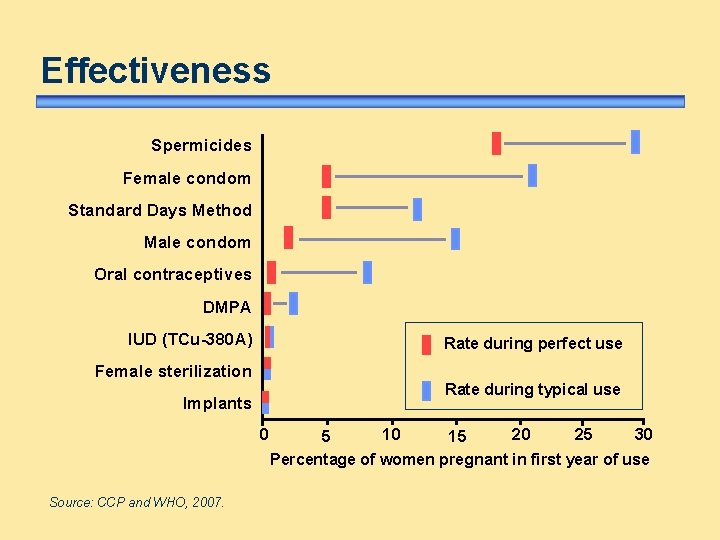
Effectiveness Spermicides Female condom Standard Days Method Male condom Oral contraceptives DMPA IUD (TCu-380 A) Rate during perfect use Female sterilization Rate during typical use Implants 0 5 10 15 20 25 30 Percentage of women pregnant in first year of use Source: CCP and WHO, 2007.
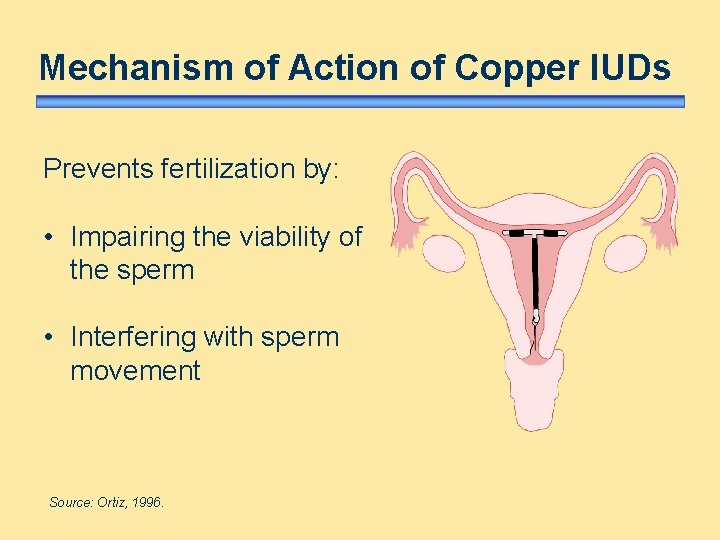
Mechanism of Action of Copper IUDs Prevents fertilization by: • Impairing the viability of the sperm • Interfering with sperm movement Source: Ortiz, 1996.
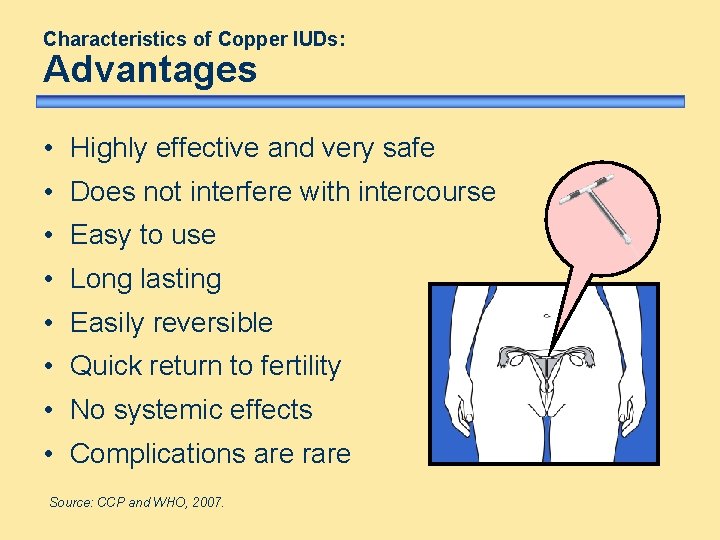
Characteristics of Copper IUDs: Advantages • Highly effective and very safe • Does not interfere with intercourse • Easy to use • Long lasting • Easily reversible • Quick return to fertility • No systemic effects • Complications are rare Source: CCP and WHO, 2007.
Characteristics of Copper IUDs: Disadvantages • Side effects, including cramping and increased or prolonged bleeding • Rare complications include perforation and pelvic inflammatory disease • Method failure can lead to ectopic pregnancy (extremely rare) • Insertion and removal require trained provider • No STI/HIV protection Source: CCP and WHO, 2007.
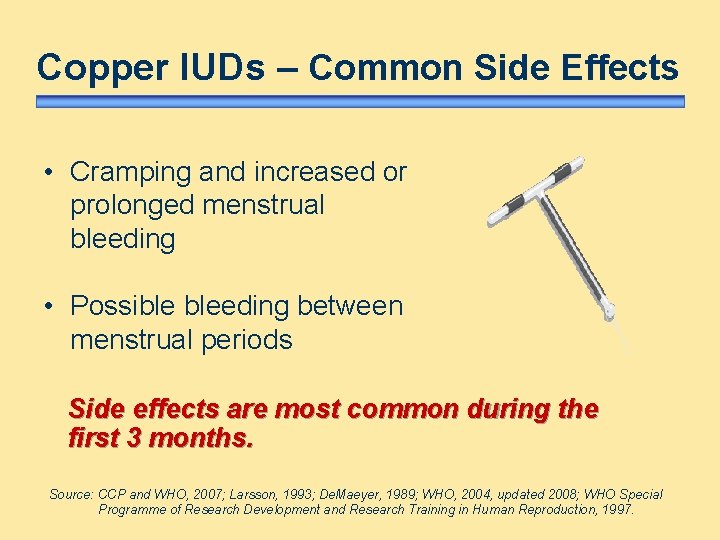
Copper IUDs – Common Side Effects • Cramping and increased or prolonged menstrual bleeding • Possible bleeding between menstrual periods Side effects are most common during the first 3 months. Source: CCP and WHO, 2007; Larsson, 1993; De. Maeyer, 1989; WHO, 2004, updated 2008; WHO Special Programme of Research Development and Research Training in Human Reproduction, 1997.
IUDs – Pelvic Inflammatory Disease (PID) PID is an infection of a woman’s upper genital tract. Risk of PID in IUD users: • Low overall – risk of PID attributable to IUD is 0. 15% to 0. 30% • Higher during first 20 days after insertion • Due mostly to presence of gonorrhea or chlamydia at time of insertion • Similar to risk of PID in women with gonorrhea and chlamydia who are not using IUD Source: Shelton, 2001.
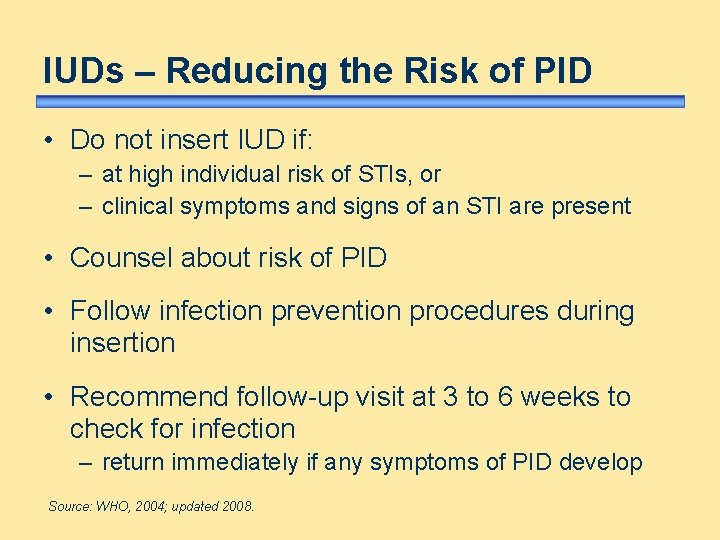
IUDs – Reducing the Risk of PID • Do not insert IUD if: – at high individual risk of STIs, or – clinical symptoms and signs of an STI are present • Counsel about risk of PID • Follow infection prevention procedures during insertion • Recommend follow-up visit at 3 to 6 weeks to check for infection – return immediately if any symptoms of PID develop Source: WHO, 2004; updated 2008.
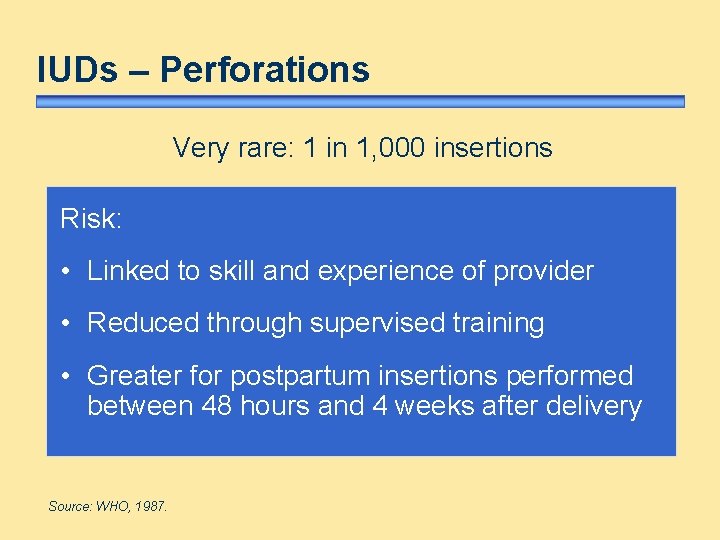
IUDs – Perforations Very rare: 1 in 1, 000 insertions Risk: • Linked to skill and experience of provider • Reduced through supervised training • Greater for postpartum insertions performed between 48 hours and 4 weeks after delivery Source: WHO, 1987.
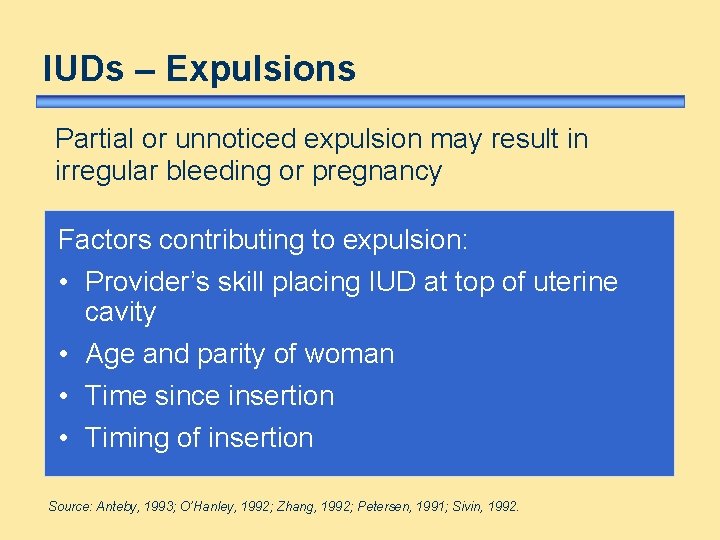
IUDs – Expulsions Partial or unnoticed expulsion may result in irregular bleeding or pregnancy Factors contributing to expulsion: • Provider’s skill placing IUD at top of uterine cavity • Age and parity of woman • Time since insertion • Timing of insertion Source: Anteby, 1993; O’Hanley, 1992; Zhang, 1992; Petersen, 1991; Sivin, 1992.
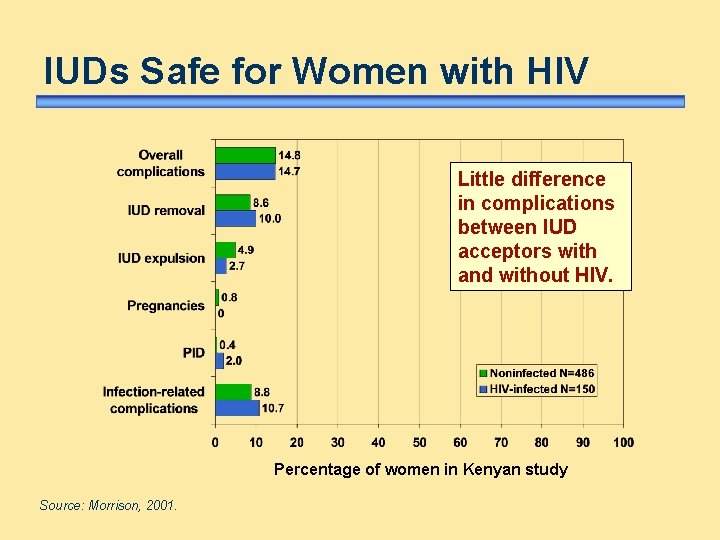
IUDs Safe for Women with HIV Little difference in complications between IUD acceptors with and without HIV. Percentage of women in Kenyan study Source: Morrison, 2001.
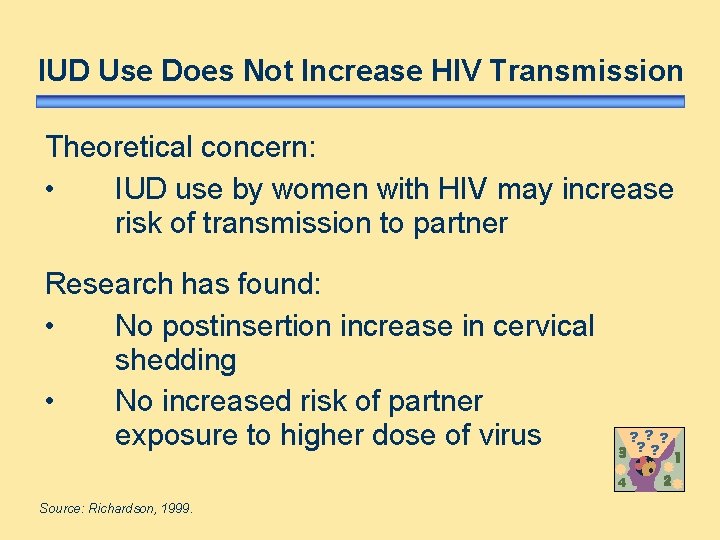
IUD Use Does Not Increase HIV Transmission Theoretical concern: • IUD use by women with HIV may increase risk of transmission to partner Research has found: • No postinsertion increase in cervical shedding • No increased risk of partner exposure to higher dose of virus ? ? ? 4 Source: Richardson, 1999.
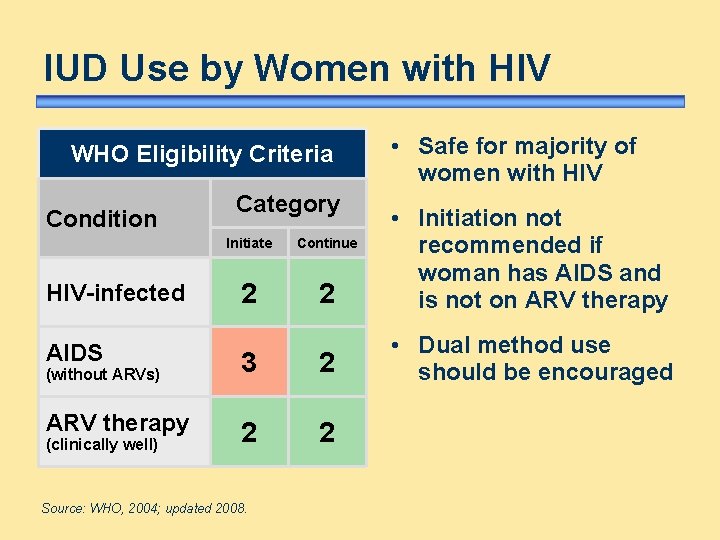
IUD Use by Women with HIV WHO Eligibility Criteria Condition HIV-infected Category Initiate Continue 2 2 • Initiation not recommended if woman has AIDS and is not on ARV therapy • Dual method use should be encouraged AIDS 3 2 ARV therapy 2 2 (without ARVs) (clinically well) • Safe for majority of women with HIV Source: WHO, 2004; updated 2008.
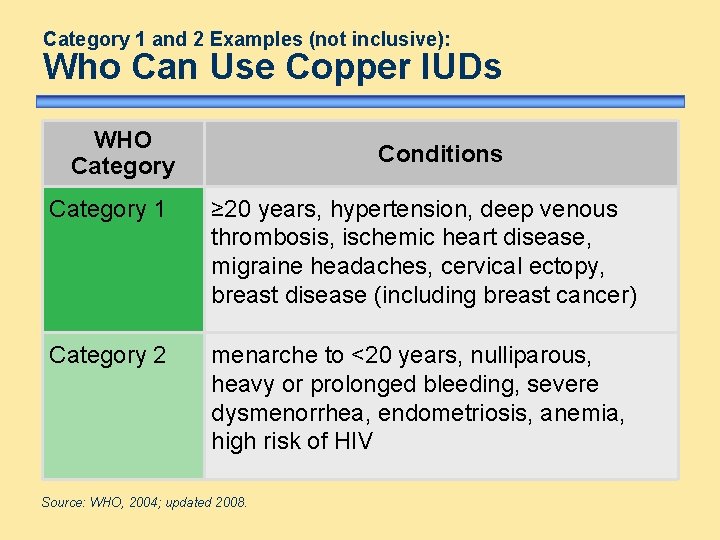
Category 1 and 2 Examples (not inclusive): Who Can Use Copper IUDs WHO Category Conditions Category 1 ≥ 20 years, hypertension, deep venous thrombosis, ischemic heart disease, migraine headaches, cervical ectopy, breast disease (including breast cancer) Category 2 menarche to <20 years, nulliparous, heavy or prolonged bleeding, severe dysmenorrhea, endometriosis, anemia, high risk of HIV Source: WHO, 2004; updated 2008.
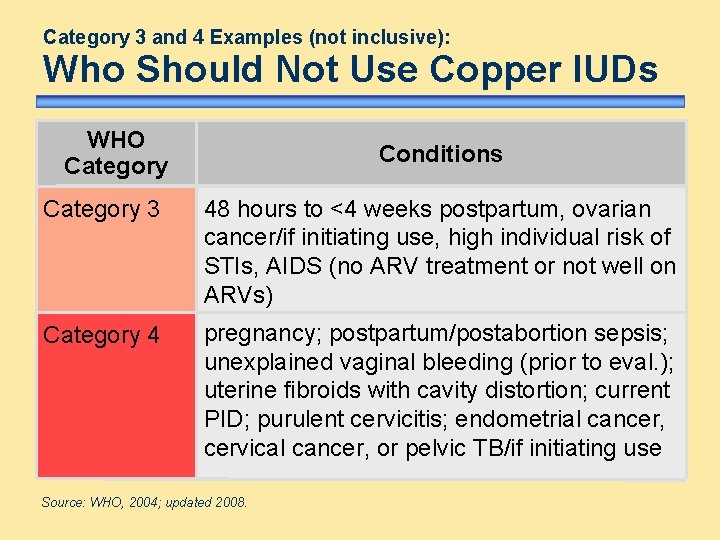
Category 3 and 4 Examples (not inclusive): Who Should Not Use Copper IUDs WHO Category Conditions Category 3 48 hours to <4 weeks postpartum, ovarian cancer/if initiating use, high individual risk of STIs, AIDS (no ARV treatment or not well on ARVs) Category 4 pregnancy; postpartum/postabortion sepsis; unexplained vaginal bleeding (prior to eval. ); uterine fibroids with cavity distortion; current PID; purulent cervicitis; endometrial cancer, cervical cancer, or pelvic TB/if initiating use Source: WHO, 2004; updated 2008.
Timing of IUD Insertion Interval insertion • Anytime during menstrual cycle if woman is not pregnant Postpartum insertion • Immediately after vaginal or cesarean delivery if no infection or bleeding (within 48 hours or delay at least 4 weeks) Postabortion insertion • Immediately if no infection Source: WHO, 2004; updated 2008.
IUD Counseling Topics • Characteristics of IUDs • Effectiveness and how IUDs work • Common side effects • Client’s risk of STIs • Insertion and removal procedures • Instructions for use and follow-up visit (including signs of complications that require immediate return to the clinic)
Counseling about IUD Side Effects: What to Expect During Insertion: • Some pain and cramping First few days: • Light bleeding and mild cramping First few months: • Heavier and/or prolonged menstrual bleeding • Menstrual cramping • Spotting between periods Source: CCP and WHO, 2007.
IUD Use and Follow-up • Teach client how to check for strings: – with clean fingers – after each menses (expulsion most likely in first 6 months) • Schedule follow-up visit at: – 3 to 6 weeks • Counsel to return immediately if any signs of complications Source: CCP and WHO, 2007; WHO, 2004, updated 2008.
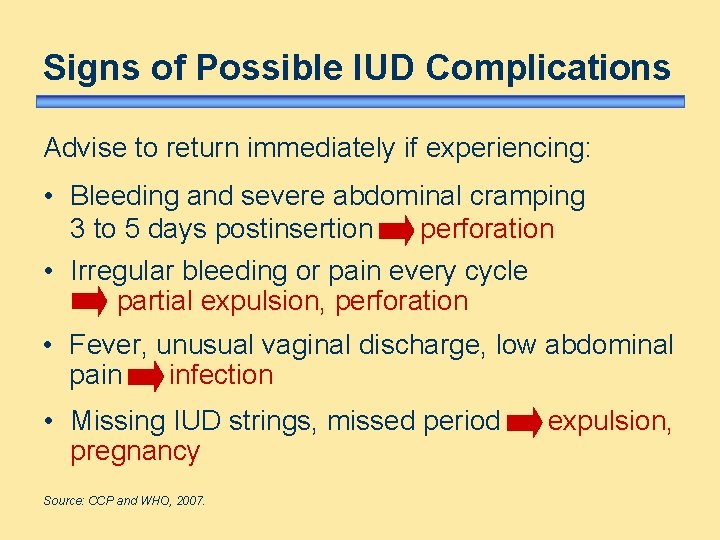
Signs of Possible IUD Complications Advise to return immediately if experiencing: • Bleeding and severe abdominal cramping 3 to 5 days postinsertion perforation • Irregular bleeding or pain every cycle partial expulsion, perforation • Fever, unusual vaginal discharge, low abdominal pain infection • Missing IUD strings, missed period pregnancy Source: CCP and WHO, 2007. expulsion,
Dispelling IUD Myths IUDs: • Are not abortifacients • Do not cause infertility • Do not cause discomfort for the male partner • Do not travel to distant parts of the body • Are not too large for small women Source: CCP and WHO, 2007; Farr, 1994.
IUDs – Summary IUDs are: • Safe, effective, convenient, reversible, long lasting, cost-effective, easy to use, appropriate for the majority of women Providers can ensure safety by: • Informative counseling • Careful screening • Appropriate infection prevention practices • Proper follow-up