
Contraception Resources from the CDC 2016 U S


- Slides: 48
Contraception Resources from the CDC: 2016 U. S. Selected Practice Recommendations for Contraceptive Use Division of Reproductive Health Centers for Disease Control and Prevention National Center for Chronic Disease Prevention and Health Promotion Division of Reproductive Health
Disclaimer q The findings and conclusions in this report are those of the author and do not necessarily represent the official position of the Centers for Disease Control and Prevention
Objectives q Describe the U. S. Selected Practice Recommendations for Contraceptive Use, 2016 (U. S. SPR) q Identify intended use and target audience q Explain how to use the U. S. SPR q Discuss the guidance in specific situations, based on clinical scenarios
U. S. Selected Practice Recommendations for Contraceptive Use, 2016 q Recommendations for contraceptive management questions q Target audience: health care providers q Purpose: to assist health care providers when they counsel patients on contraceptive use and to serve as a source of clinical guidance q Content: Guidance for common contraceptive management topics such as: § § How to be reasonably certain that a woman is not pregnant When to start contraception Medically indicated exams and tests Follow-up and management of problems
Methods for 2016 U. S. SPR q q Adapted from WHO guidelines On-going monitoring of published evidence Expert meeting in August 2014 to discuss scope Expert meeting in August 2015 to review evidence and discuss specific recommendations § CDC staff and outside authors conducted independent systematic reviews to inform recommendations § These systematic reviews have been e-published § CDC determined final recommendations
Why is evidence-based guidance for contraceptive use needed? q q To base family planning practices on the best available evidence To address misconceptions regarding who can safely use contraception To remove unnecessary medical barriers To improve access and quality of care in family planning
Contraceptive Methods in US SPR q q q Intrauterine devices Progestin-only contraceptives Combined hormonal contraceptives Emergency contraception Fertility Awareness-Based Methods Female and Male Sterilization
Major Updates to 2016 U. S. SPR q New recommendation § Using medications to ease IUD insertion q Update of existing recommendation § When to start regular contraception after ulipristal acetate
CLINICAL SCENARIOS
Clinical scenario 1: When to start a contraceptive method q 24 y. o. woman comes to office desiring contraception and wants to start pills § Q: When can she start?
When to start a contraceptive method q Barriers to starting § § § q Filling a prescription Starting during menses Coming back for a second (or more) visit Starting when woman requests contraception (“Quick start”) § May reduce time woman is at risk for pregnancy § May reduce barriers to starting
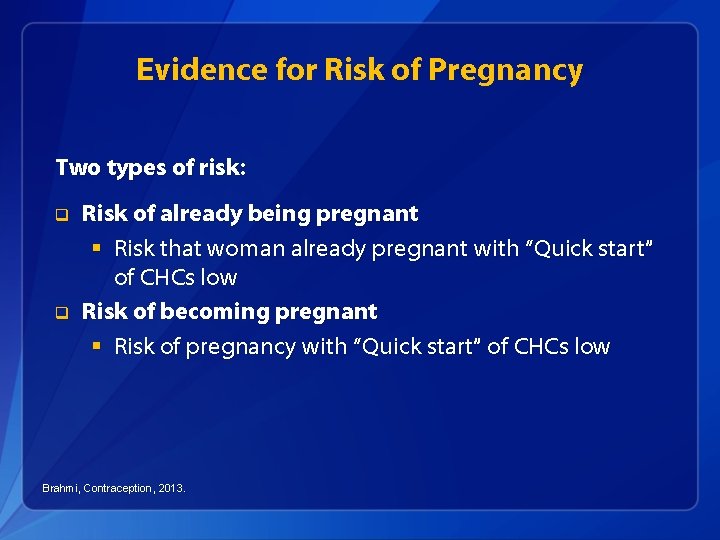
Evidence for Risk of Pregnancy Two types of risk: q q Risk of already being pregnant § Risk that woman already pregnant with “Quick start” of CHCs low Risk of becoming pregnant § Risk of pregnancy with “Quick start” of CHCs low Brahmi, Contraception, 2013.
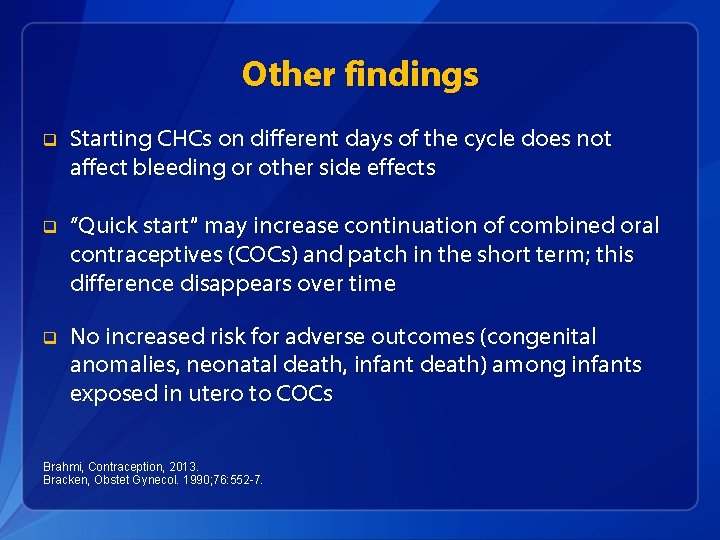
Other findings q Starting CHCs on different days of the cycle does not affect bleeding or other side effects q “Quick start” may increase continuation of combined oral contraceptives (COCs) and patch in the short term; this difference disappears over time q No increased risk for adverse outcomes (congenital anomalies, neonatal death, infant death) among infants exposed in utero to COCs Brahmi, Contraception, 2013. Bracken, Obstet Gynecol. 1990; 76: 552 -7.
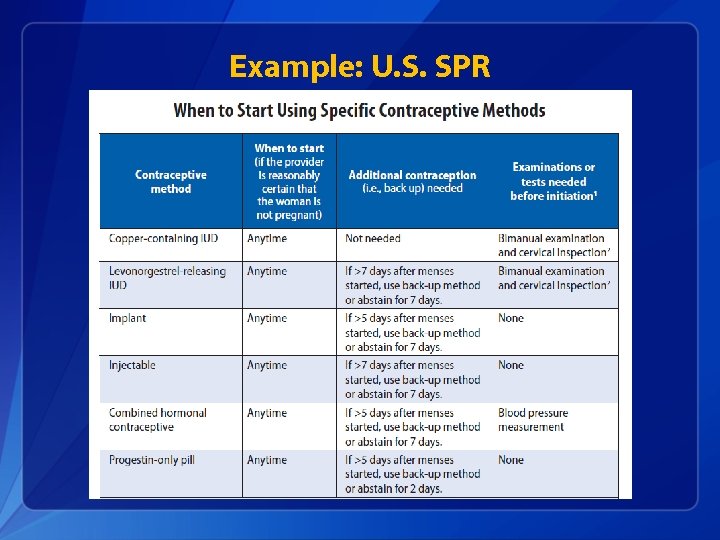
Example: U. S. SPR
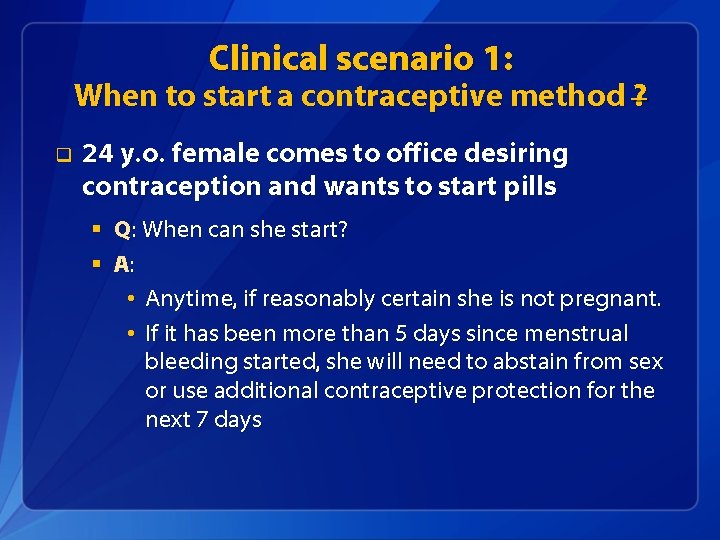
Clinical scenario 1: When to start a contraceptive method ? q 24 y. o. female comes to office desiring contraception and wants to start pills § Q: When can she start? § A: • Anytime, if reasonably certain she is not pregnant. • If it has been more than 5 days since menstrual bleeding started, she will need to abstain from sex or use additional contraceptive protection for the next 7 days
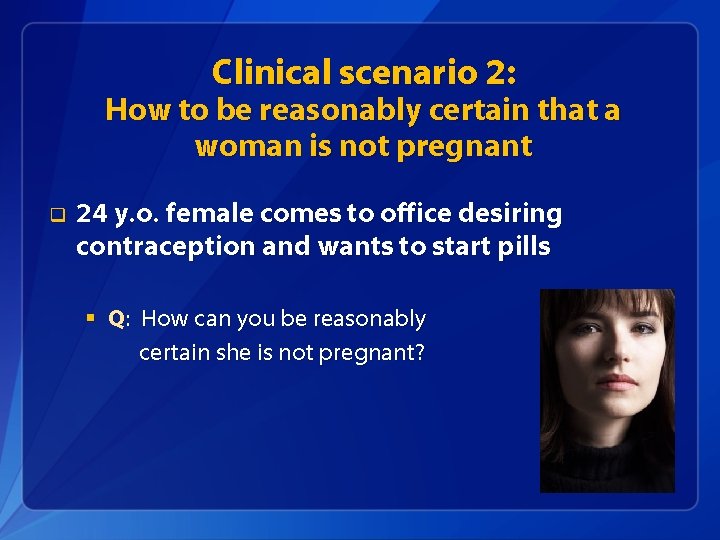
Clinical scenario 2: How to be reasonably certain that a woman is not pregnant q 24 y. o. female comes to office desiring contraception and wants to start pills § Q: How can you be reasonably certain she is not pregnant?
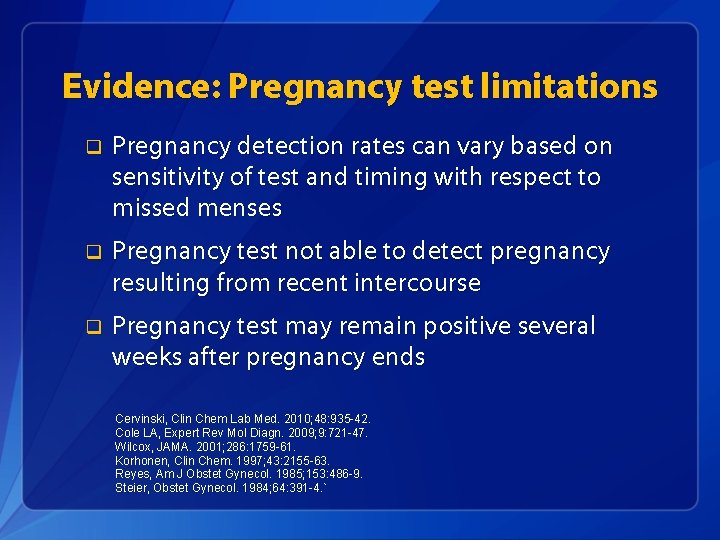
Evidence: Pregnancy test limitations q Pregnancy detection rates can vary based on sensitivity of test and timing with respect to missed menses q Pregnancy test not able to detect pregnancy resulting from recent intercourse q Pregnancy test may remain positive several weeks after pregnancy ends Cervinski, Clin Chem Lab Med. 2010; 48: 935 -42. Cole LA, Expert Rev Mol Diagn. 2009; 9: 721 -47. Wilcox, JAMA. 2001; 286: 1759 -61. Korhonen, Clin Chem. 1997; 43: 2155 -63. Reyes, Am J Obstet Gynecol. 1985; 153: 486 -9. Steier, Obstet Gynecol. 1984; 64: 391 -4. `
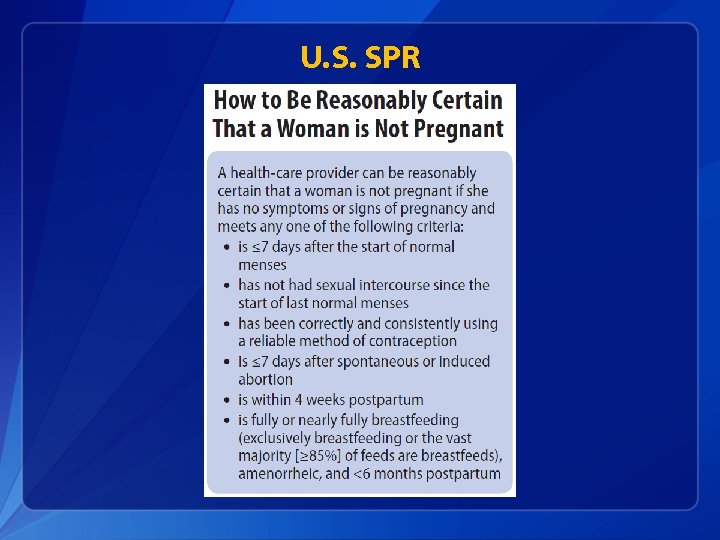
U. S. SPR
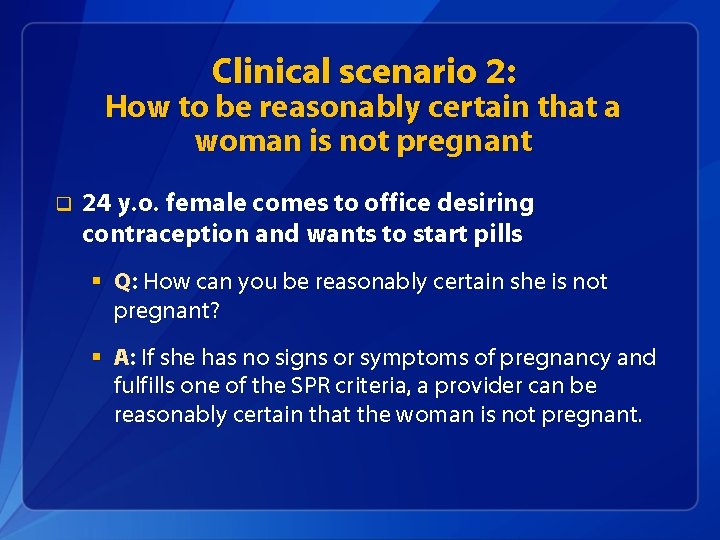
Clinical scenario 2: How to be reasonably certain that a woman is not pregnant q 24 y. o. female comes to office desiring contraception and wants to start pills § Q: How can you be reasonably certain she is not pregnant? § A: If she has no signs or symptoms of pregnancy and fulfills one of the SPR criteria, a provider can be reasonably certain that the woman is not pregnant.
Clinical scenario 3: Exams and tests q 24 y. o. female comes to office desiring contraception and wants to start pills § Q: Do you need to do any exams or tests before she starts?
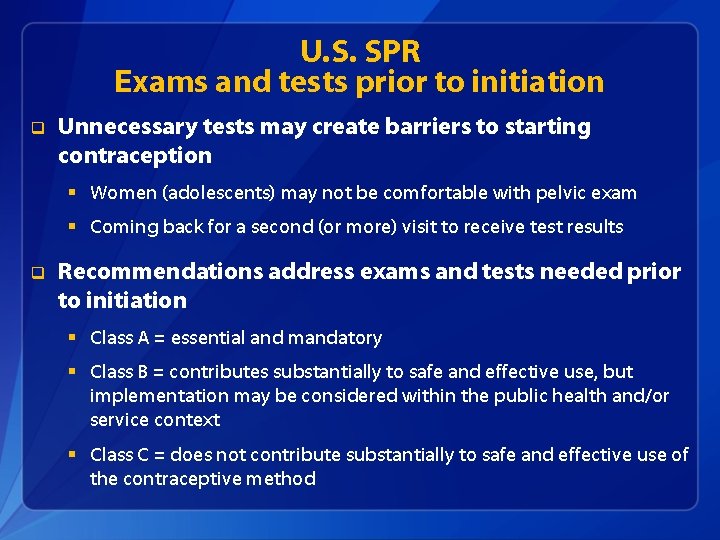
U. S. SPR Exams and tests prior to initiation q Unnecessary tests may create barriers to starting contraception § Women (adolescents) may not be comfortable with pelvic exam § Coming back for a second (or more) visit to receive test results q Recommendations address exams and tests needed prior to initiation § Class A = essential and mandatory § Class B = contributes substantially to safe and effective use, but implementation may be considered within the public health and/or service context § Class C = does not contribute substantially to safe and effective use of the contraceptive method
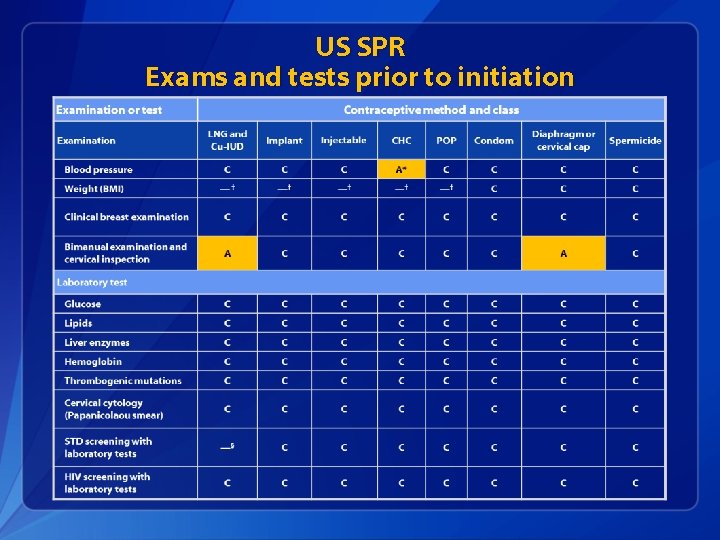
US SPR Exams and tests prior to initiation
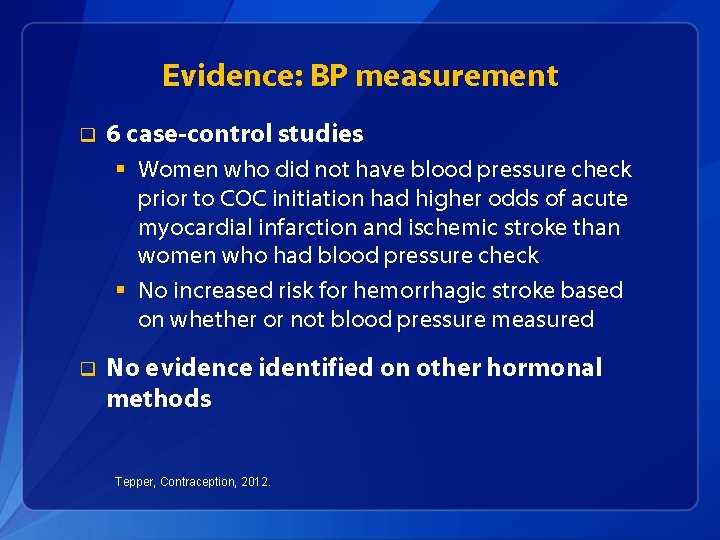
Evidence: BP measurement q 6 case-control studies § Women who did not have blood pressure check prior to COC initiation had higher odds of acute myocardial infarction and ischemic stroke than women who had blood pressure check § No increased risk for hemorrhagic stroke based on whether or not blood pressure measured q No evidence identified on other hormonal methods Tepper, Contraception, 2012.
Pelvic Exam before Initiating CHCs q Is not necessary before starting CHCs q No conditions for which CHCs would be unsafe would be detected by pelvic exam q Evidence: § Two case-control studies § Delayed versus immediate pelvic exam before contraception § No difference in risk factors for cervical neoplasia, incidence of STDs, incidence of abnormal Papanicolaou smears, or incidence of abnormal wet mounts. Tepper Contraception 2013
Clinical scenario 3: Exams and tests q 24 y. o. female comes to office desiring contraception and wants to start pills § Q: Do you need to do any exams or tests before she starts? § A: Blood pressure measurement essential
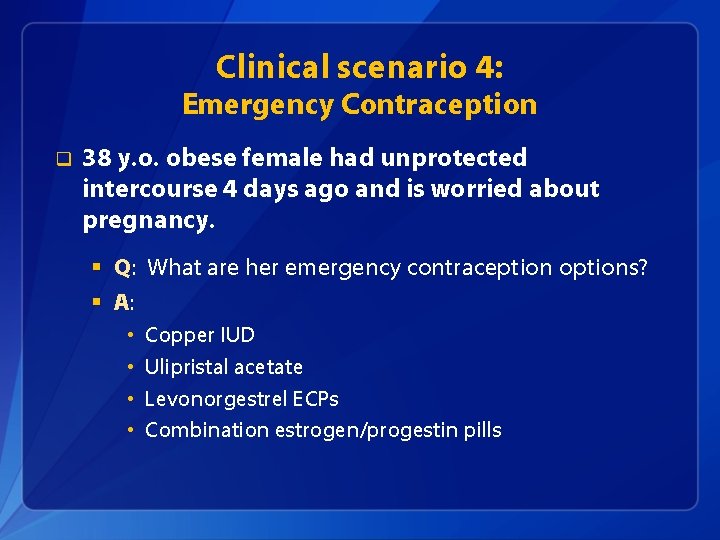
Clinical scenario 4: Emergency Contraception q 38 y. o. obese female had unprotected intercourse 4 days ago and is worried about pregnancy. § Q: What are her emergency contraception options?
Four options for EC available in the US q Intrauterine device § Copper intrauterine device (Cu-IUD) q Emergency contraceptive pills (ECPs) § Ulipristal acetate (UPA) available in a single dose (30 mg) § Levonorgestrel (LNG) in a single or split dose § Estrogen/progestin in 2 doses
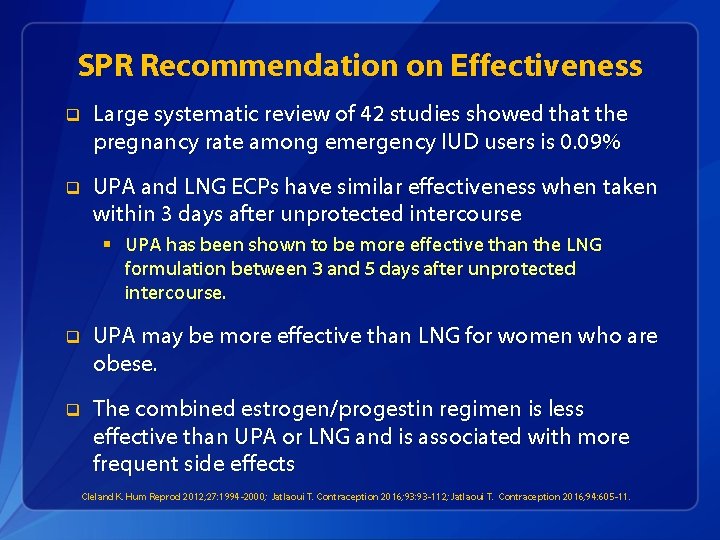
SPR Recommendation on Effectiveness q Large systematic review of 42 studies showed that the pregnancy rate among emergency IUD users is 0. 09% q UPA and LNG ECPs have similar effectiveness when taken within 3 days after unprotected intercourse § UPA has been shown to be more effective than the LNG formulation between 3 and 5 days after unprotected intercourse. q UPA may be more effective than LNG for women who are obese. q The combined estrogen/progestin regimen is less effective than UPA or LNG and is associated with more frequent side effects Cleland K. Hum Reprod 2012; 27: 1994 -2000; Jatlaoui T. Contraception 2016; 93: 93 -112; Jatlaoui T. Contraception 2016; 94: 605 -11.
Clinical scenario 4: Emergency Contraception q 38 y. o. obese female had unprotected intercourse 4 days ago and is worried about pregnancy. § Q: What are her emergency contraception options? § A: • • Copper IUD Ulipristal acetate Levonorgestrel ECPs Combination estrogen/progestin pills
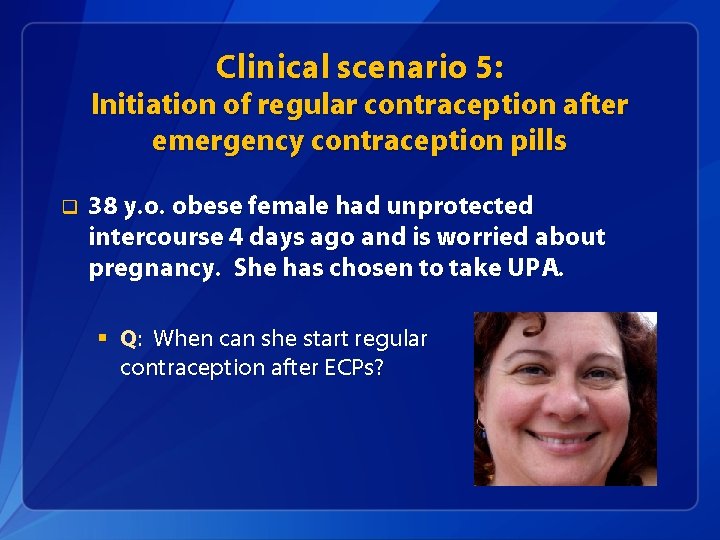
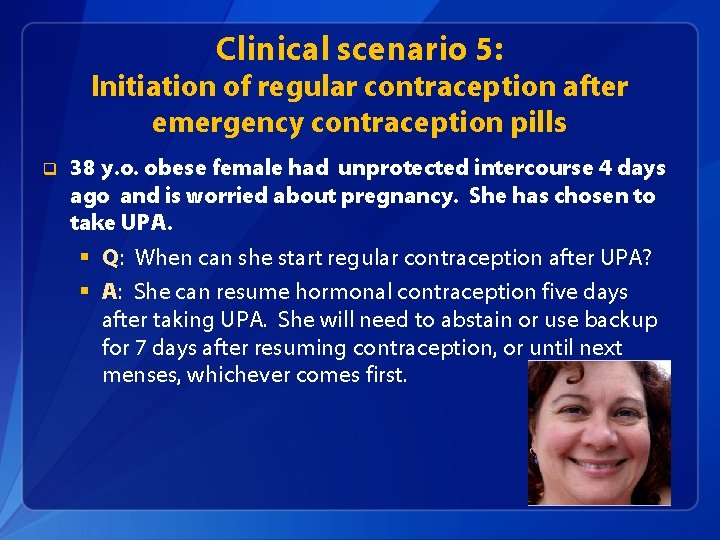
Clinical scenario 5: Initiation of regular contraception after emergency contraception pills q 38 y. o. obese female had unprotected intercourse 4 days ago and is worried about pregnancy. She has chosen to take UPA. § Q: When can she start regular contraception after ECPs? contraception
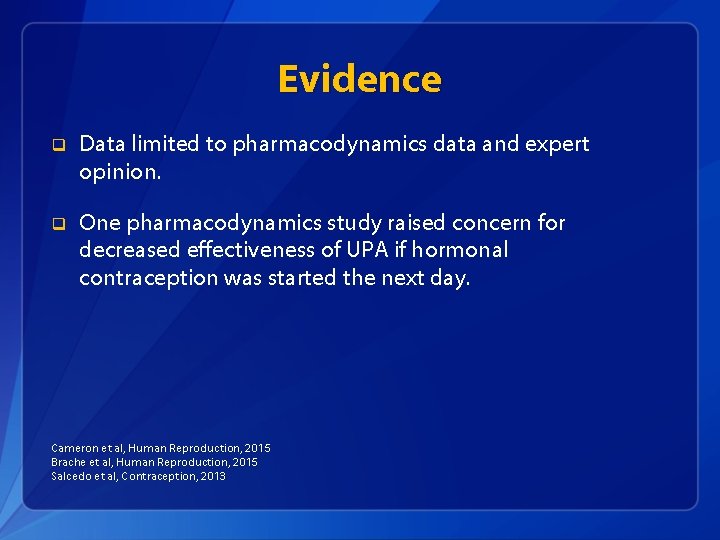
Evidence q Data limited to pharmacodynamics data and expert opinion. q One pharmacodynamics study raised concern for decreased effectiveness of UPA if hormonal contraception was started the next day. Cameron et al, Human Reproduction, 2015 Brache et al, Human Reproduction, 2015 Salcedo et al, Contraception, 2013
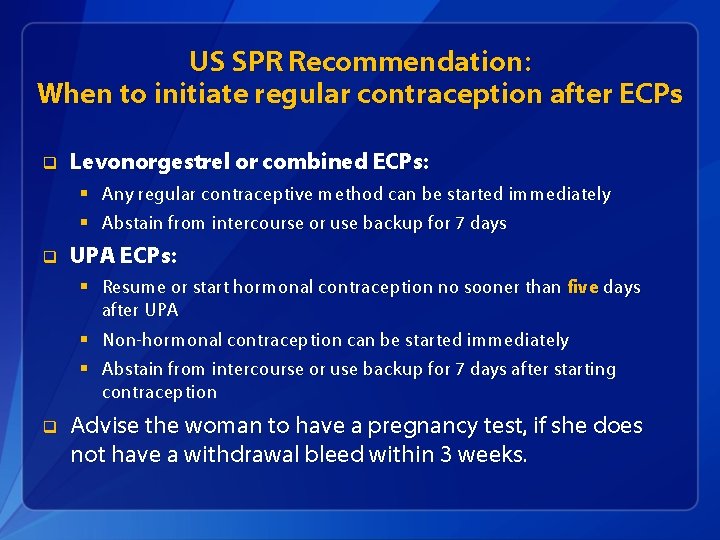
US SPR Recommendation: When to initiate regular contraception after ECPs q Levonorgestrel or combined ECPs: § Any regular contraceptive method can be started immediately § Abstain from intercourse or use backup for 7 days q UPA ECPs: § Resume or start hormonal contraception no sooner than five days after UPA § Non-hormonal contraception can be started immediately § Abstain from intercourse or use backup for 7 days after starting contraception q Advise the woman to have a pregnancy test, if she does not have a withdrawal bleed within 3 weeks.
Clinical scenario 5: Initiation of regular contraception after emergency contraception pills q 38 y. o. obese female had unprotected intercourse 4 days ago and is worried about pregnancy. She has chosen to take UPA. § Q: When can she start regular contraception after UPA? § A: She can resume hormonal contraception five days after taking UPA. She will need to abstain or use backup for 7 days after resuming contraception, or until next menses, whichever comes first.
Clinical scenario 4: Medications to ease IUD insertion q A 19 year old nulliparous woman desires a levonorgestrel IUD. § Q: Should any medications be administered before IUD insertion?
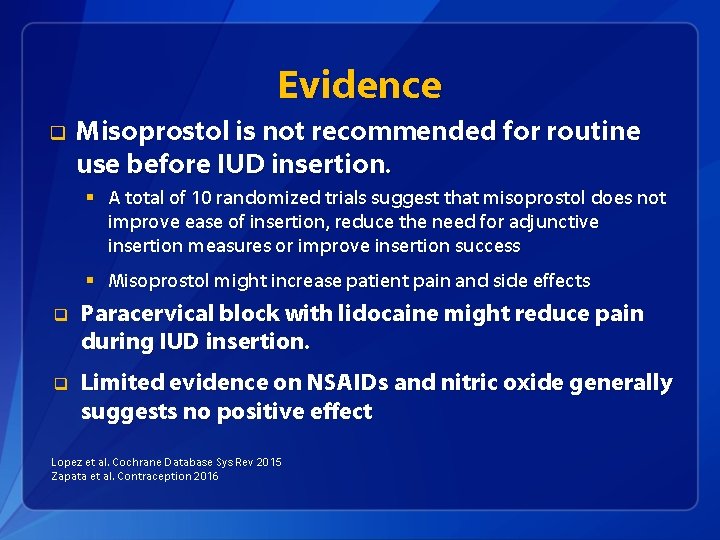
Evidence q Misoprostol is not recommended for routine use before IUD insertion. § A total of 10 randomized trials suggest that misoprostol does not improve ease of insertion, reduce the need for adjunctive insertion measures or improve insertion success § Misoprostol might increase patient pain and side effects q Paracervical block with lidocaine might reduce pain during IUD insertion. q Limited evidence on NSAIDs and nitric oxide generally suggests no positive effect Lopez et al. Cochrane Database Sys Rev 2015 Zapata et al. Contraception 2016
Clinical scenario 4: Medications to ease IUD insertion q A 19 year old nulliparous woman desires a levonorgestrel IUD. § Q: Should any medications be administered before attempting insertion? § A: No adjunctive medications are needed
Take Home Messages, U. S. SPR q U. S. SPR can help providers decrease medical barriers to initiating and using contraception q Most women can start most methods anytime q Few, if any, exams or tests are needed q Routine follow-up generally not required q Regular contraception should be started after emergency contraception q Recommendations for anticipatory counseling for potential bleeding problems and proper management are provided
U. S. Medical Eligibility Criteria for Contraceptive Use, 2016 q Safe use of contraceptive methods by women and men with certain characteristics or medical conditions q Target audience: health care providers q Purpose: to assist health care providers when they counsel patients about contraceptive use and to serve as a source of clinical guidance q Content: more than 1800 recommendations for over 60 conditions
Accessing the MEC and SPR in everyday practice
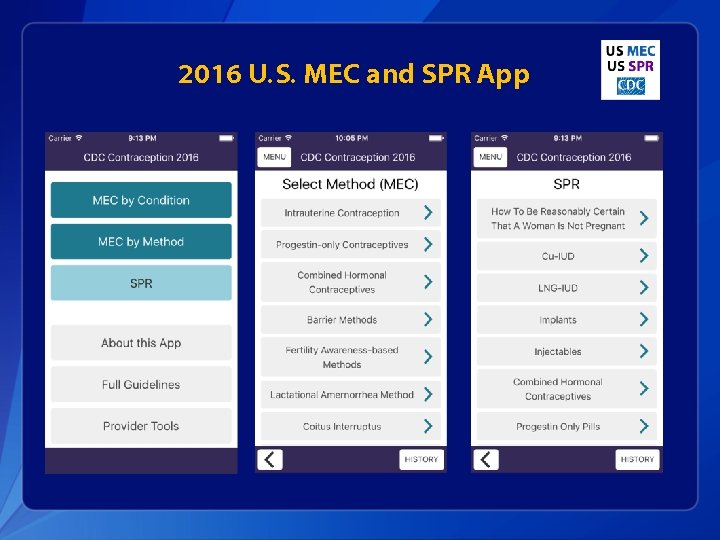
2016 U. S. MEC and SPR App
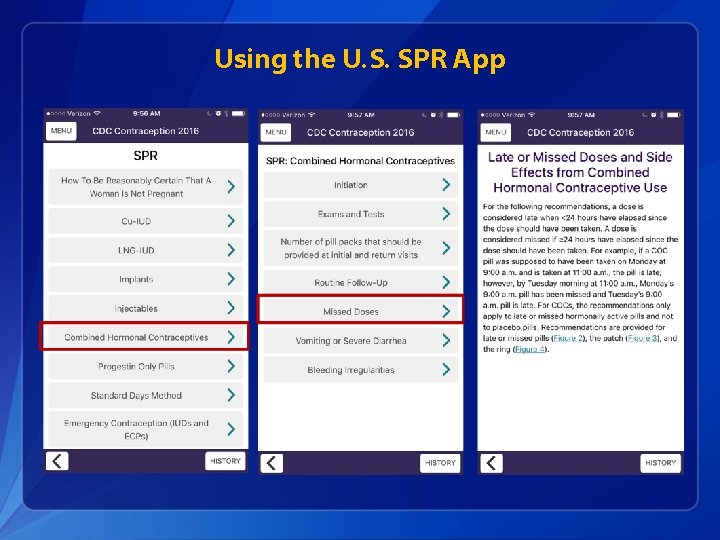
Using the U. S. SPR App
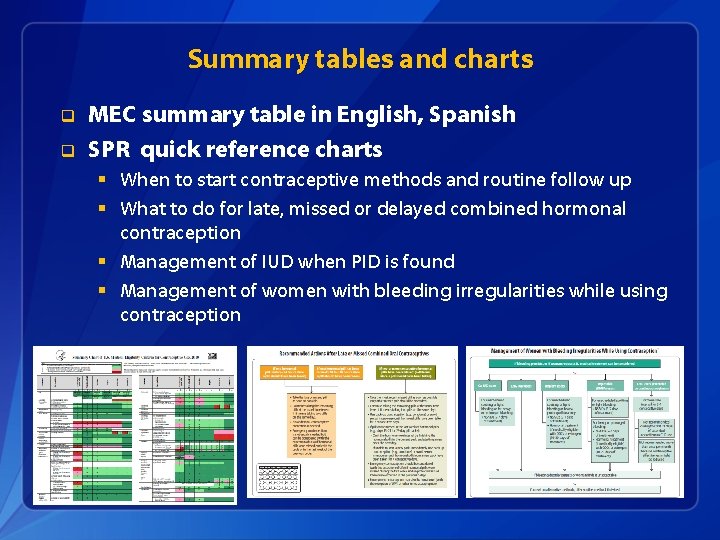
Summary tables and charts q q MEC summary table in English, Spanish SPR quick reference charts § When to start contraceptive methods and routine follow up § What to do for late, missed or delayed combined hormonal contraception § Management of IUD when PID is found § Management of women with bleeding irregularities while using contraception
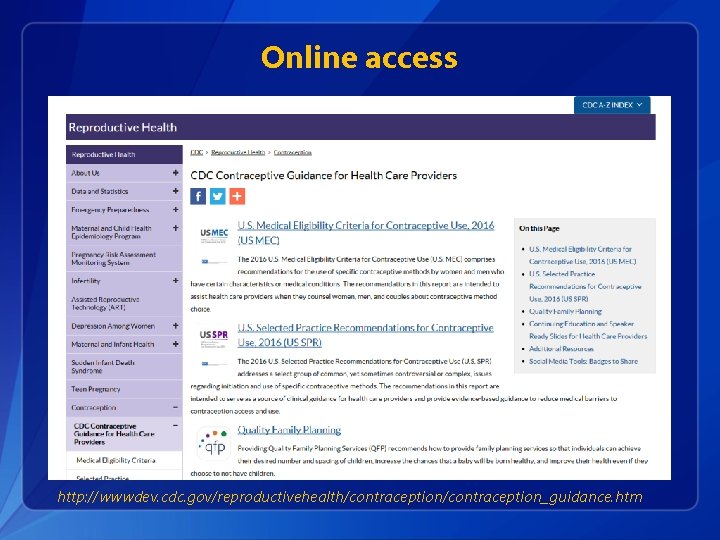
Online access http: //wwwdev. cdc. gov/reproductivehealth/contraception_guidance. htm
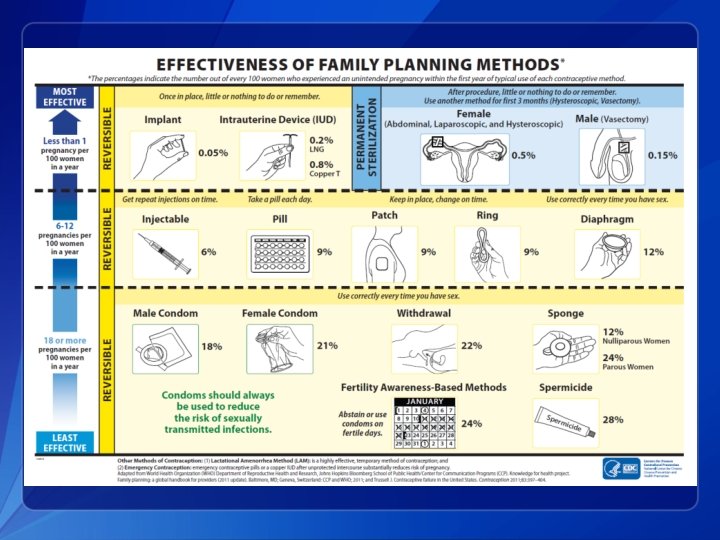
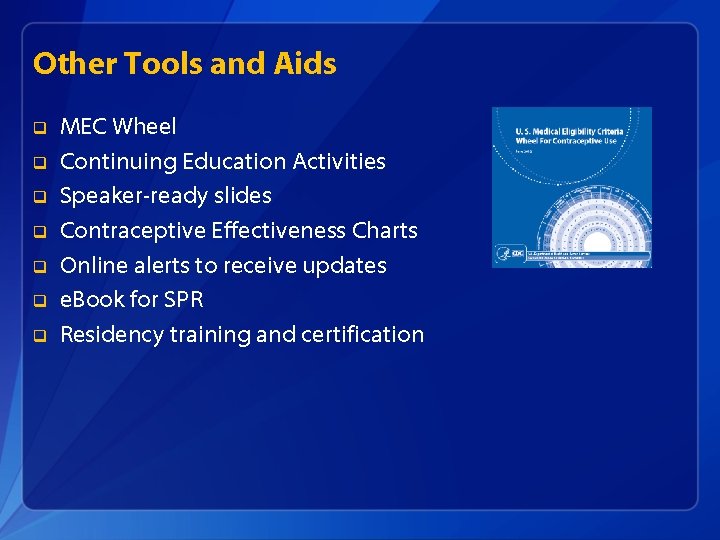
Other Tools and Aids q q q q MEC Wheel Continuing Education Activities Speaker-ready slides Contraceptive Effectiveness Charts Online alerts to receive updates e. Book for SPR Residency training and certification
Resources q CDC evidence-based family planning guidance documents: http: //www. cdc. gov/reproductivehealth/contraception_guidance. htm q Sign up to receive alerts!